
Deuteronomy 11:2

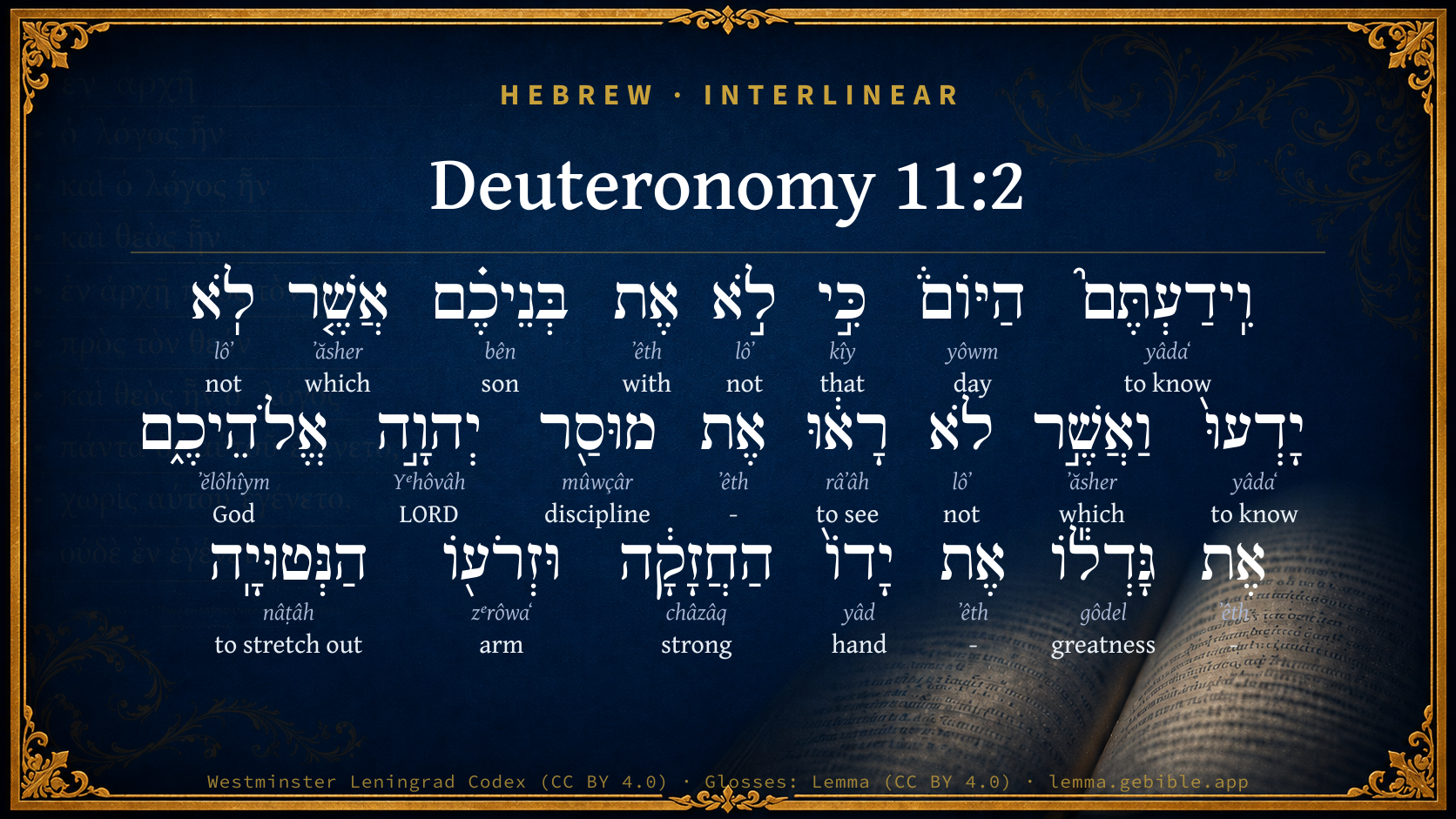
Hebrew (Westminster Leningrad Codex) Deuteronomy 11:2 appears in the Hebrew Old Testament. The text above is from the Westminster Leningrad Codex. Each word links to its Strong’s number, a concise gloss, and parsing drawn from the Open Scriptures Hebrew Bible morphology. Click any word for its full Brown-Driver-Briggs (BDB) entry.
Download image
Cite this verse

Deuteronomy 11:2 (World English Bible). Public Domain. Lemma interlinear Bible study tool, https://lemma.gebible.app/v/deuteronomy/11/2.

Show BibTeX & RIS
BibTeX
RIS
English Translation
Know you this day: for I don't speak with your children who have not known, and who have not seen the chastisement of Yahweh your God, his greatness, his mighty hand, and his outstretched arm,
World English Bible · Public Domain
Highlights
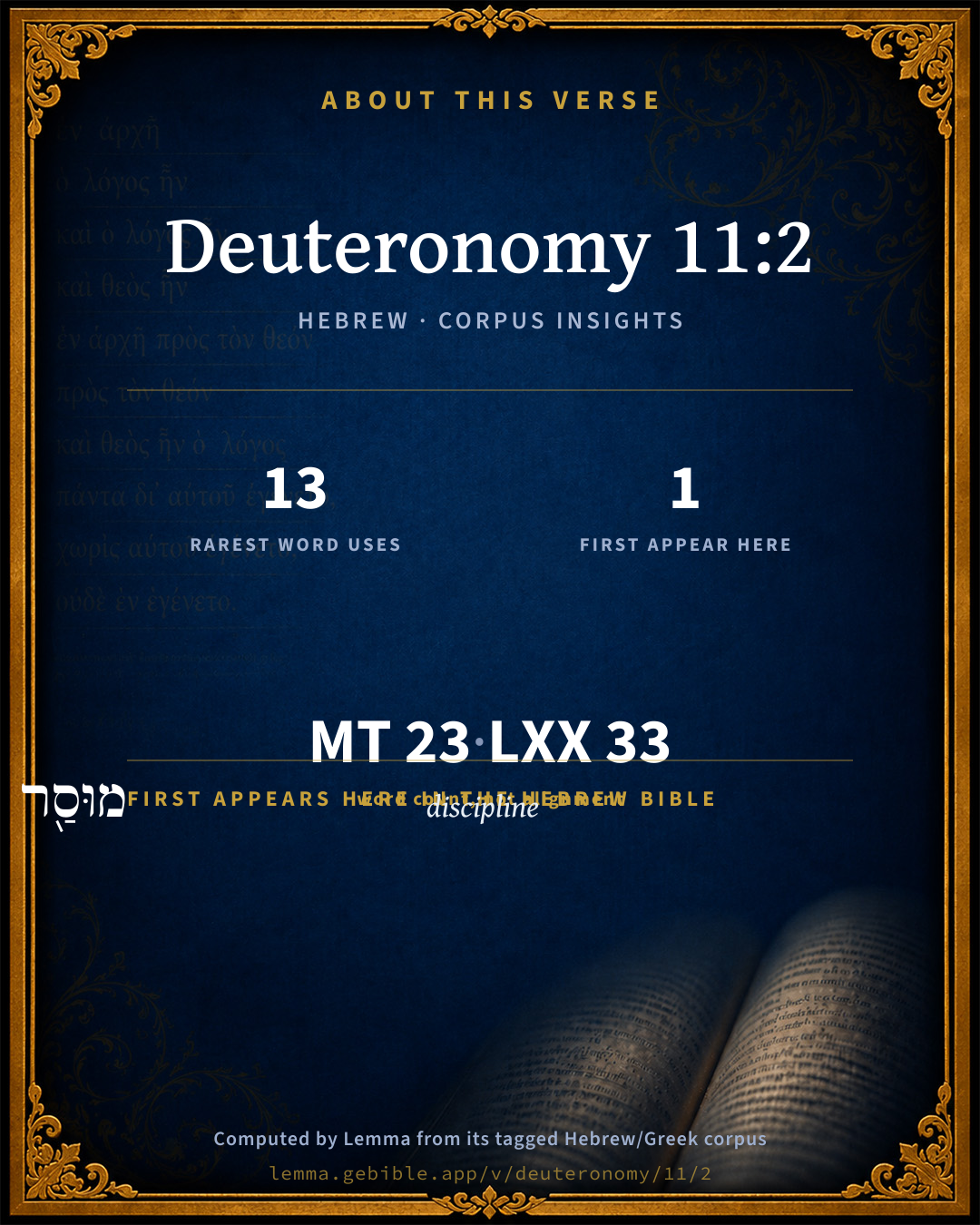
  • 1 first appearance in the Hebrew Bible
Full analysis ↓
Download a study sheet

One document with this verse’s original text, its word-by-word gloss line, the meaning frame, cross-references with their text, attributed commentary, and full source and license credits — printable, and it pastes into notes with its structure intact.

This verse Autodidact and up

Study sheet (.html) Plain text (.txt)

A passage Seminary Student

Up to 50 verses in one chapter. A passage sheet keeps up to 6 commentary sources and 12 cross-references per verse, in the order this page ranks them, and says so on the sheet whenever that leaves anything out. Ask for a single verse and you get the Autodidact verse sheet above.

Everything on this page stays free to read, with no account — the sheet is a download of what is already on screen, not access to it.

Want to remove ads? Support Godless Engineer
Compare translations 3

The same verse in 3 English versions, stacked beneath the original-language interlinear above. Click any original word for its lexicon entry.

Each is an independent rendering of the whole verse — the interlinear is not word-aligned to these translations.

Highlighted words mark where these versions differ — a whole-verse word diff, not a word-by-word alignment.

  • World English Bible Public Domain
    Know you this day: for I don't speak with your children who have not known, and who have not seen the chastisement of Yahweh your God, his greatness, his mighty hand, and his outstretched arm,
  • King James Version Public Domain
    And know ye this day: for I speak not with your children which have not known, and which have not seen the chastisement of the LORD your God, his greatness, his mighty hand, and his stretched out arm,
  • unfoldingWord Literal Text CC BY-SA 4.0
    And know today that not your sons, who have not known and who have not seen the discipline of Yahweh your God—his greatness, his mighty hand, and his outstretched arm,

unfoldingWord Literal Text — © unfoldingWord, licensed CC BY-SA 4.0. Word-aligned USFM3 via Door43 (git.door43.org/unfoldingWord/en_ult).

Versions to compare (up to 4)

3 of 4 selected

Show all 18 translations

Every available English version of this verse, each an independent rendering of the whole verse.

  • World English Bible Public Domain
    Know you this day: for I don't speak with your children who have not known, and who have not seen the chastisement of Yahweh your God, his greatness, his mighty hand, and his outstretched arm,
  • Berean Standard Bible Public Domain
    Know this day that it is not your children who have known and seen the discipline of the LORD your God: His greatness, His mighty hand, and His outstretched arm;
  • Majority Standard Bible Public Domain
    Know this day that it is not your children who have known and seen the discipline of the LORD your God: His greatness, His mighty hand, and His outstretched arm;
  • King James Version Public Domain
    And know ye this day: for I speak not with your children which have not known, and which have not seen the chastisement of the LORD your God, his greatness, his mighty hand, and his stretched out arm,
  • American Standard Version (1901) Public Domain
    And know ye this day: for `I speak' not with your children that have not known, and that have not seen the chastisement of Jehovah your God, his greatness, his mighty hand, and his outstretched arm,
  • Revised Version (1885) Public Domain
    And know ye this day: for I speak not with your children which have not known, and which have not seen the chastisement of the LORD your God, his greatness, his mighty hand, and his stretched out arm,
  • Geneva Bible (1599) Public Domain
    And consider this day (for I speake not to your children, which haue neither knowen nor seene) the chastisement of the Lord your God, his greatnesse, his mighty hande, and his stretched out arme,
  • Douay-Rheims (1899) Public Domain
    Know this day the things that your children know not, who saw not the chastisements of the Lord your God. his great doings and strong hand, and stretched out arm,
  • Young's Literal Translation Public Domain
    and ye have known to-day -- for it is not your sons who have not known, and who have not seen the chastisement of Jehovah your God, His greatness, His strong hand, and His stretched-out arm,
  • Literal Standard Version CC BY-SA 4.0
    and you have known today—for it is not your sons who have not known and who have not seen the discipline of your God YHWH, His greatness, His strong hand, and His outstretched arm;
  • Unlocked Literal Bible CC BY-SA 4.0
    Notice that I am not speaking to your children, who have not known nor have they seen the punishment of Yahweh your God, his greatness, his mighty hand, or his outstretched arm,
  • unfoldingWord Literal Text CC BY-SA 4.0
    And know today that not your sons, who have not known and who have not seen the discipline of Yahweh your God—his greatness, his mighty hand, and his outstretched arm,
  • Darby Bible Public Domain
    And know ye this day...; for [I speak] not with your children who have not known, and who have not seen the chastisement of Jehovah your God, his greatness, his powerful hand, and his stretched-out arm,
  • World Messianic Bible Public Domain
    Know this day—for I don’t speak with your children who have not known, and who have not seen the chastisement of the LORD your God, his greatness, his mighty hand, his outstretched arm,
  • Webster's Bible Public Domain
    And know ye this day: for I speak not with your children who have not known, and who have not seen the chastisement of the LORD your God, his greatness, his mighty hand, and his out-stretched arm,
  • Free Bible Version CC BY-SA 4.0
    You should realize that it's not your children who have experienced the Lord your God's discipline. It was you who saw his greatness, his power and strength;
  • Bible in Basic English Public Domain
    And be certain in your minds this day; for these words are not said to your children, who have had no experience of the training of the Lord your God, and who have not seen his great power or his strong hand and his stretched-out arm,
  • JPS Tanakh (1917) Public Domain
    And know ye this day; for I speak not with your children that have not known, and that have not seen the chastisement of the LORD your God, His greatness, His mighty hand, and His outstretched arm,

Literal Standard Version (2020), Covenant Press — licensed CC BY-SA 4.0. Text via the HelloAO Bible API (eBible.org). Unlocked Literal Bible (unfoldingWord) — licensed CC BY-SA 4.0. Text via the HelloAO Bible API (eBible.org). unfoldingWord Literal Text — © unfoldingWord, licensed CC BY-SA 4.0. Word-aligned USFM3 via Door43 (git.door43.org/unfoldingWord/en_ult). Free Bible Version, Dr. Jonathan Gallagher — licensed CC BY-SA 4.0. Text via the HelloAO Bible API (eBible.org).

Word by word

More ways to search: Search by grammar → Find every occurrence → Compare this word →

Practice this passage: Drill this verse → Learn its vocabulary →

גָּדְל֕וֹ
gôdel
H1433
“greatness · his”
Noun, Common, Masculine, Singular, Construct + Suffix, Personal, 3rd Person, Masculine, Singular
Part of Speech
Noun
Type
Common
Gender
Masculine
Number
Singular
State
Construct
Full BDB Definition

Origin: from H1431

TWOT: 315b

greatness - greatness, magnitude - magnificence - pride, insolence (bad sense)
  1. וִֽידַעְתֶּם֮ yâdaʻ H3045 “and · to know” Conjunction + Verb, Qal, Sequential Perfect, 2nd Person, Masculine, Plural
  2. הַיּוֹם֒ yôwm H3117 “the · day” Particle, Definite Article + Noun, Common, Masculine, Singular, Absolute
  3. כִּ֣י kîy H3588 “that” Conjunction
  4. לֹ֣א lôʼ H3808 “not” Particle, Negative
  5. אֶת ʼêth H854 “with” Preposition
  6. בְּנֵיכֶ֗ם bên H1121 “sons · your” Noun, Common, Masculine, Plural, Construct + Suffix, Personal, 2nd Person, Masculine, Plural
  7. אֲשֶׁ֤ר ʼăsher H834 “which” Particle, Relative
  8. לֹֽא lôʼ H3808 “not” Particle, Negative
  9. יָדְעוּ֙ yâdaʻ H3045 “to know” Verb, Qal, Perfect, 3rd Person, Common, Plural
  10. וַאֲשֶׁ֣ר ʼăsher H834 “and · which” Conjunction + Particle, Relative
  11. לֹא lôʼ H3808 “not” Particle, Negative
  12. רָא֔וּ râʼâh H7200 “to see” Verb, Qal, Perfect, 3rd Person, Common, Plural
  13. אֶת ʼêth H853 “-” Particle, Direct Object
  14. מוּסַ֖ר mûwçâr H4148 “discipline of” Noun, Common, Masculine, Singular, Construct
  15. יְהוָ֣ה Yᵉhôvâh H3068 “LORD” Noun, Proper
  16. אֱלֹהֵיכֶ֑ם ʼĕlôhîym H430 “God(s) · your” Noun, Common, Masculine, Plural, Construct + Suffix, Personal, 2nd Person, Masculine, Plural
  17. אֶת ʼêth H853 “-” Particle, Direct Object
  18. אֶת ʼêth H853 “-” Particle, Direct Object
  19. יָדוֹ֙ yâd H3027 “hand · his” Noun, Common, Both, Singular, Construct + Suffix, Personal, 3rd Person, Masculine, Singular
  20. הַחֲזָקָ֔ה châzâq H2389 “the · strong” Particle, Definite Article + Adjective, Adjective, Feminine, Singular, Absolute
  21. וּזְרֹע֖וֹ zᵉrôwaʻ H2220 “and · arm · his” Conjunction + Noun, Common, Both, Singular, Construct + Suffix, Personal, 3rd Person, Masculine, Singular
  22. הַנְּטוּיָֽה nâṭâh H5186 “the · stretched out” Particle, Definite Article + Verb, Qal, Participle Passive, Feminine, Singular, Absolute

About this verse

These counts appear in no published source. They are computed here, from the morphology-tagged text and Lemma’s own curated glosses. What Lemma adds →

23
words
17
distinct lemmas
Pentateuch
section

Notable vocabulary

The rarest word here is גָּדְל֕וֹ greatness H1433 — appearing just 13 times in the whole Hebrew Bible.

First appearance in Scripture

This word makes its first canonical appearance in the Hebrew Bible here:

  • מוּסַ֖ר discipline H4148

Shared distinctive vocabulary

גָּדְל֕וֹ greatness H1433 occurs in 13 verses of the Hebrew Bible. Also found in:

Grammatical profile

  • 4 verbs
  • 8 nouns
  • 1 adjective
  • 1 preposition
  • 1 conjunction
  • 8 particles

Verb forms

  • וִֽידַעְתֶּם֮ Qal · Sequential Perfect
  • יָדְעוּ֙ Qal · Perfect
  • רָא֔וּ Qal · Perfect
  • הַנְּטוּיָֽה Qal · Participle Passive

Repetition

Words recur within this verse — often emphatic in Hebrew:

  • וִֽידַעְתֶּם֮ to know H3045 ×2
  • לֹ֣א not H3808 ×3
  • אֲשֶׁ֤ר which H834 ×2

Hebrew & Septuagint length

In English translation the verse runs 35 words from the Hebrew and 39 from the Septuagint (LXX English) — closely comparable.

A rough comparison of the two English renderings, which tokenize alike — not a word-level alignment.

Word counts can differ between the Hebrew and the Greek without any difference in meaning — e.g. the Hebrew direct-object marker אֵת has no separate Greek word, and Greek often adds the article ὁ.

In the original languages it is 23 Hebrew tokens and 33 Greek tokens — but the two are counted differently (Hebrew bundles its prefixes and suffixes into one token; the Greek is in lemma form), so that isn’t a like-for-like length.

Cross-references

9

Topical passages linked to Deuteronomy 11:2 in the Treasury of Scripture Knowledge — connected by theme and wording, ordered by reader-vote popularity; previews shown in the World English Bible.

  • Deuteronomy 4:34 Or has God tried to go and take him a nation from the midst of [another] nation, by trials, by signs, and by wonders, and by war, and by a mighty hand, and by an outstretched arm, and by great terrors, according to all that Yahweh your God did for you in Egypt before your eyes?
  • Deuteronomy 5:24 and you said, Behold, Yahweh our God has shown us his glory and his greatness, and we have heard his voice out of the midst of the fire: we have seen this day that God does speak with man, and he lives.
  • Deuteronomy 7:19 the great trials which your eyes saw, and the signs, and the wonders, and the mighty hand, and the outstretched arm, by which Yahweh your God brought you out: so shall Yahweh your God do to all the peoples of whom you are afraid.
  • Deuteronomy 8:2–5 You shall remember all the way which Yahweh your God has led you these forty years in the wilderness, that he might humble you, to prove you, to know what was in your heart, whether you would keep his commandments, or not.
  • Deuteronomy 8:19 It shall be, if you shall forget Yahweh your God, and walk after other gods, and serve them, and worship them, I testify against you this day that you shall surely perish.
  • Deuteronomy 9:26 I prayed to Yahweh, and said, Lord Yahweh, don't destroy your people and your inheritance, that you have redeemed through your greatness, that you have brought forth out of Egypt with a mighty hand.
  • Deuteronomy 29:10 You stand this day all of you before Yahweh your God; your heads, your tribes, your elders, and your officers, even all the men of Israel,
  • Proverbs 22:19 That your trust may be in Yahweh, I teach you today, even you.
  • Acts 26:22 Having therefore obtained the help that is from God, I stand to this day testifying both to small and great, saying nothing but what the prophets and Moses said would happen,

Cross-references courtesy of OpenBible.info (CC BY 4.0).

Hebrew and Greek witnesses Masoretic Hebrew ↔ Greek Septuagint

The same verse in the two great witnesses to the Old Testament, shown verse-for-verse.

These are two independent witnesses, not word-aligned to each other, and the Septuagint is shown in lemma (dictionary) form.

Hebrew Deuteronomy 11:2 Masoretic · Westminster Leningrad Codex

וִֽידַעְתֶּם֮ הַיּוֹם֒ כִּ֣י לֹ֣א אֶת בְּנֵיכֶ֗ם אֲשֶׁ֤ר לֹֽא יָדְעוּ֙ וַאֲשֶׁ֣ר לֹא רָא֔וּ אֶת מוּסַ֖ר יְהוָ֣ה אֱלֹהֵיכֶ֑ם אֶת גָּדְל֕וֹ אֶת יָדוֹ֙ הַחֲזָקָ֔ה וּזְרֹע֖וֹ הַנְּטוּיָֽה

Know you this day: for I don't speak with your children who have not known, and who have not seen the chastisement of Yahweh your God, his greatness, his mighty hand, and his outstretched arm,

World English Bible · Public Domain

Greek LXX Deuteronomy 11:2 Septuagint · lemma form

καί γιγνώσκω σήμερον ὅτι οὐ ὁ παιδίον σύ ὅσος οὐ οἶδα οὐδέ ὁράω ὁ παιδεία κύριος ὁ θεός σύ καί ὁ μεγαλεῖος αὐτός καί ὁ χείρ ὁ κραταιός καί ὁ βραχίων ὁ ὑψηλός

And you⌃ shall know this day; for I speak not to your children, who know not and have not seen the discipline of the Lord your God, and his wonderful works, and his strong hand, and his high arm,

LXX2012 (modern English Septuagint) · Public Domain

On this verse, The Pulpit Commentary discusses the Septuagint’s reading. Read the note in Commentary ↓

Hebrew: Westminster Leningrad Codex (CC BY 4.0). Greek: Septuagint (public domain); English from LXX2012 (modern English Septuagint) (Public Domain). How the Septuagint differs from the Hebrew →

Targum (Aramaic paraphrase)

2

The Targum is the ancient Jewish Aramaic paraphrase of the Hebrew Scriptures — an interpretive translation, not the Hebrew text itself. Onkelos (literal) and Pseudo-Jonathan (expansive) render the Torah, and Jonathan the Prophets. Coverage is partial: where no permissively-licensed English translation exists for a verse, only the Aramaic is shown. This is verse-level text, not a word-by-word alignment to the Hebrew.

  1. Targum Onkelos Torah (Genesis–Deuteronomy)
    וְתִדְעוּן יוֹמָא דֵין אֲרֵי לָא יָת בְּנֵיכוֹן דִי לָא יְדָעוּ וְדִי לָא חֲזוֹ יָת אֻלְפָנָא דַיְיָ אֱלָהֲכוֹן יָת רְבוּתֵהּ יָת יְדֵהּ תַּקִיפָא וּדְרָעֵהּ מְרָמְמָא

    (no public-domain English translation for this verse)

    Targum Onkelos — Aramaic: “Onkelos Genesis” (public domain); “Onkelos Exodus” (public domain); “Onkelos Leviticus” (public domain); “Onkelos Numbers” (public domain); “Onkelos Deuteronomy” (public domain). English: “Sefaria Community Translation” (CC0 1.0 (public-domain dedication)); “J.W. Etheridge. The Targums of Onkelos and Jonathan Ben Uzziel on the Pentateuch. London: Longmans, Green, 1862” (public domain). Text via Sefaria.

  2. Targum Pseudo-Jonathan Torah (Genesis–Deuteronomy)
    וְתִנְדְּעוּן יוֹמָא דֵין אֲרוּם לָא עִם בְּנֵיכוֹן דְּלָא יָדְעוּן וְלָא חָמוּן יַת אוּלְפַן אוֹרַיְיתָא דַיְיָ אֱלָהָכוֹן יַת רְבוּתֵיהּ וְיַת יְדֵיהּ תַקִיפְתָּא וּדְרָעֵיהּ מְרַמַם

    And know you this day, for (I speak) not with your children who have not known or seen the instruction of the law of the Lord your God, nor His greatness, nor His mighty hand, nor His uplifted arm,

    Targum Pseudo-Jonathan — Aramaic: “Targum Jonathan on Genesis” (public domain); “Targum Jonathan on Exodus” (public domain); “Targum Jonathan on Leviticus” (public domain); “Targum Jonathan on Numbers” (public domain); “Targum Jonathan on Deuteronomy” (public domain). English: “The Targum of Jonathan ben Uzziel, trans. J. W. Etheridge, London, 1862” (public domain). Text via Sefaria.

Commentary

Notes on Deuteronomy 11:2 from classic Christian and Jewish commentators (each source and its license shown beneath its notes). The classic Christian expositions comment on the surrounding passage and are grouped to its opening verse, so a note may address several verses; the Jewish commentaries on the Tanakh (Rashi and others) are per-verse, so they appear only where the commentator wrote on this verse.

Lemma curates 59 commentaries, every one of them public domain or Creative Commons licensed, each selected and text-cleaned for this edition rather than reprinted as found. About our sources →

Trapp's Complete Commentary

John Trapp

Deu 11:2 And know ye this day: for [I speak] not with your children which have not known, and which have not seen the chastisement of the LORD your God, his greatness, his mighty hand, and his stretched out arm,

Ver. 2. And which have not seen.]

“ Segnius irritant animos demissa per aures,

Quam quae sunt oculis commissa fidelibua ” - Horat.

He speaks unto them as to eye-witncsses; and those that have such evidence and self-experience are usually more affected than those that have things by hearsay only. "Mine eye affects my heart." {Lam 3:51}

John Trapp, A Commentary or Exposition upon All the Books of the Old and New Testament (1647–1656) — public domain. Text from a community e-Sword module.

Joseph Benson's Commentary

Deu 11:2. Know ye this day — That is, acknowledge and consider it with diligence and thankfulness; for that is the sense of the original word here, and in a multitude of other places. Your children, who have not known — But your eyes have seen, Deu 11:7. The chastisement of the Lord — His judgments executed on the Egyptians in various plagues, the sundry methods of punishment and correction he has used to chastise, amend, and render you obedient to his laws, see Deu 4:36; and Deu 8:5; and Pro 1:2, where the same Hebrew word is used in this sense. His greatness, &c. — His majesty and great power, appearing in his works. He uses a variety of words to make them sensible in how many instances the divine power and goodness had been manifested in effecting their deliverance out of Egyptian bondage, and their subsequent preservation.

Joseph Benson's Commentary on the Old and New Testaments (1811–1818) — public domain. Text from a community e-Sword module.

Keil & Delitzsch

C. F. Keil & F. Delitzsch

To awaken this love they were now to know, i.e., to ponder and lay to heart, the discipline of the Lord their God. The words from "for (I speak) not" to "have not seen" are a parenthetical clause, by which Moses would impress his words most strongly upon the hearts of the older generation, which had witnessed the acts of the Lord. The clause is without any verb or predicate, but this can easily be supplied from the sense. The best suggestion is that of Schultz, viz., ההוּא הדּבר, "for it is not with your children that I have to do," not to them that this admonition applies. Moses refers to the children who had been born in the desert, as distinguished from those who, though not twenty years old when the Israelites came out of Egypt, had nevertheless seen with their own eyes the plagues inflicted upon Egypt, and who were now of mature age, viz., between forty and sixty years old, and formed, as the older and more experienced generation, the stock and kernel of the congregation assembled round him now. To the words, "which have not known and have not seen," it is easy to supply from the context, "what ye have known and seen." The accusatives from "the chastisement" onwards belong to the verb of the principal sentence, "know ye this day." The accusatives which follow show what we are to understand by "the chastisement of the Lord," viz., the mighty acts of the Lord to Egypt and to Israel in the desert. The object of them all was to educate Israel in the fear and love of God. In this sense Moses calls them מוּסר (Eng. Ver. chastisement), παιδεία, i.e., not punishment only, but education by the manifestation of love as well as punishment (like יסּר in Deu 4:36; cf. Pro 1:2, Pro 1:8; Pro 4:1, etc.). "His greatness," etc., as in Deu 3:24 and Deu 4:34. On the signs and acts in Egypt, see at Deu 4:34; Deu 6:22; and on those at the Red Sea, at Ex 14. פּניהם - הצּיף אשׁר, "over whose face He made the waters of the Red Sea to flow;" cf. Exo 14:26. - By the acts of God in the desert (Deu 11:5) we are not to understand the chastenings in Num 11-15 either solely or pre-eminently, but all the manifestations of the omnipotence of God in the guidance of Israel, proofs of love as well as the penal wonders. Of the latter, the miraculous destruction of the company of Korah is specially mentioned in Deu 11:6 (cf. Num 16:31-33). Here Moses only mentions Dathan and Abiram, the followers of Korah, and not Korah himself, probably from regard to his sons, who were not swallowed up by the earth along with their father, but had lived to perpetuate the family of Korah. "Everything existing, which was in their following" (see Exo 11:8), does not mean their possessions, but their servants, and corresponds to "all the men who belonged to Korah" in Num 16:32, whereas the possessions mentioned there are included here in the "tents." היקוּם is only applied to living beings, as in Gen 7:4 and Gen 7:23. - In Deu 11:7 the reason is given for the admonition in Deu 11:2 : the elders were to know (discern) the educational purpose of God in those mighty acts of the Lord, because they had seen them with their own eyes.

Keil & Delitzsch — Biblical Commentary on the Old Testament (1861–1891) — public domain (CC PDM 1.0). Text via the HelloAO Bible API. (Old Testament only.)

Geneva Bible (1599)

Geneva Bible translators

Ye, which have seen God’s graces with your eyes, ought rather to be moved, than your children, which have only heard of them.

Geneva Bible (1599) marginal notes — public domain. Text via Bolls.life.

Jamieson, Fausset & Brown

Robert Jamieson, A. R. Fausset & David Brown

I speak not with your children which have not known . . . But your eyes have seen all the great acts of the Lord which he did--Moses is here giving a brief summary of the marvels and miracles of awful judgment which God had wrought in effecting their release from the tyranny of Pharaoh, as well as those which had taken place in the wilderness. He knew that he might dwell upon these, for he was addressing many who had been witnesses of those appalling incidents. For it will be remembered that the divine threatening that they should die in the wilderness, and its execution, extended only to males from twenty years and upward, who were able to go forth to war. No males under twenty years of age, no females, and none of the tribe of Levi, were objects of the denunciation (see Num 14:28-30; Num 16:49). There might, therefore, have been many thousands of the Israelites at that time of whom Moses could say, "Your eyes have seen all the great acts which He did"; and with regard to those the historic review of Moses was well calculated to stir up their minds to the duty and advantages of obedience.

Jamieson, Fausset & Brown — Commentary Critical and Explanatory on the Whole Bible (1871) — public domain (CC PDM 1.0). Text via the HelloAO Bible API.

Ellicott's Commentary for English Readers

(2) And know ye.—Or, and ye know.

Not with your children which have not known.—It must be remembered that all those who were less than twenty years of age at the date of the Exodus would still be living, and the events of their youth must have left a strong impression on their memories. Every man of forty-five years of age would feel the force of this address.

The chastisement.—Whether of the Egyptians in wrath, or of Israel in love.

His mighty hand. . . .—Or, His hand in its strength, and His arm in its length. The position of the adjectives is emphatic.

A Bible Commentary for English Readers, edited by Charles John Ellicott (1878–1897) — public domain. Text from a community e-Sword module.

The Cambridge Bible for Schools and Colleges

gen. ed. J. J. S. Perowne

2. And know ye] For this deuteronomic form see on Deu_7:9. Know what? The defective construction which follows leaves this obscure. Some suppose that in the course of his involved sentence the writer has forgotten the object of know as well as the verb which should govern your children (accus. case), and they translate, know that it is not with your children I speak, who have not known nor seen the discipline of Jehovah your God; and that the antithesis is reached in Deu_11:7, but that your own eyes, etc. It is, however, difficult to understand why by a solemn formula they should be called to recognise so obvious a distinction between themselves and their children. It seems preferable either to take the formula absolutely and by itself as A.V. and R.V. do, or with most commentators to read the discipline of Jehovah as the object of know and what comes between as a parenthesis. But whichever way the sentence is read the words I speak must be added.

the chastisement] ‘mûsâr denotes neither instruction (see on Deu_4:36) nor chastisement (though this may be included), but moral education or discipline (Gk. παιδεία) attended with greater (Pro_3:11; Job_5:17) or less severity (Pro_1:2; Pro_1:8; Pro_4:1) as the case may be: the sight of Jehovah’s wonders … ought to have exerted upon the Israelites a disciplinary influence, subduing waywardness and pride, promoting humility and reverence, and educating generally their moral and religious nature’ (Driver).

his greatness, his mighty hand, and his stretched out arm] See on Deu_3:24, Deu_5:24, Deu_9:26; and cp. Deu_4:34, greatness.

2–9. A Pl. section recalling God’s discipline of the very generation which is being addressed. The change from Sg. to Pl. has been explained on the logical ground that the speaker is no longer regarding the nation as a single whole, but is addressing the adult generation as individuals distinct from their children (Bertholet). This, of course, is possible. Yet the alternative supposition, that some other source is here used by the compiler, besides being probable from what we have seen in other cases of the change of address, receives some support from the broken construction of the opening sentence as though it were a bad joint. It is significant, too, that the resumption of the Pl. coincides as in Deu_9:8 to Deu_10:11 with a historical retrospect. On the one Sg. clause in the section see on Deu_11:8.

The Cambridge Bible for Schools and Colleges (gen. ed. J. J. S. Perowne; Cambridge University Press, 1878–1918) — public domain. Text from a community e-Sword module.

John Gill's Exposition

And know you this day,.... Take notice of, and diligently attend unto, what is now about to be delivered:

for I speak not unto your children which have not known, and which have not seen, the chastisement of the Lord your God; who have no knowledge and experience of the chastisement of the Lord on themselves, or on their foes or friends; and with whom the argument drawn from it could not come with that force, and make that impression, as it might be thought it would, being used with them who had perfect knowledge of it. The Targums of Onkelos and Jonathan render it doctrine, which, being children, they were not instructed so perfectly in as they were who were adult persons, to whom Moses directs his discourse:

his greatness, his mighty hand, and stretched out arm: the exceeding greatness of his power, displayed in the following instances.

John Gill's Exposition of the Whole Bible (1746–1763) — public domain (CC PDM 1.0). Text via the HelloAO Bible API.

Albert Barnes' Notes on the Bible

And know ... - Render it: And own ye this day (for I have not to do with your children which have not known and which have not seen) the chastisement of the Lord, his greatness, etc.

The “chastisement” consisted in the many mighty acts, both of punishment and mercy, through which God had guided them from Egypt to the borders of the promised land.

Albert Barnes' Notes on the Bible (1834–1885) — public domain. Text from a community e-Sword/MySword module.

Haydock's Catholic Bible Commentary

Know, &c. Reflect on the wonders of God, which you must explain to your children, who were not born, or able to discern them, when they were effected at the Red Sea, and in the punishment of the seditious, ver. 7. Hebrew, "know ye this day, for I do not address myself to your children, who know not, (or have not understanding,) and saw not," &c. (Calmet)

George Leo Haydock (1774–1849), Haydock's Catholic Family Bible and Commentary, 1859 edition — public domain. Excludes Psalms (Douay-Rheims chapter numbering differs from Protestant) and Deuterocanonical books (Catholic canon only).

Matthew Poole's English Annotations

Know ye, i.e. acknowledge and consider it with diligence and thankfulness.

Matthew Poole's English Annotations on the Holy Bible (1683–1685) — public domain. Text from a community e-Sword/MySword module.

Whedon's Commentary on the Bible

Daniel D. Whedon

2. I speak not with your children — Better, And know ye this day: not with your children have I to do. The meaning is this: Not with your children born in the wilderness, who neither knew nor saw what you have seen, am I dealing. I am dealing with you who left Egypt when you were children. You saw the miracles in the time of the people’s deliverance; you saw what was done to your fathers; you saw the signal punishments that were inflicted on the rebellious.

Daniel D. Whedon (gen. ed.), Commentary on the Old and New Testaments (1874–1909) — public domain. Text from a community e-Sword module.

The Pulpit Commentary

Knew ye; take note of, ponder, lay to heart. The words that follow, for seen, are a parenthesis thrown in by the speaker to attract the attention especially of the older generation, who had witnessed the acts of the Lord. The words, the chastisement, etc., are to be connected with know ye, as the object of the knowing, And know ye this day the chastisement, etc. Which have not known, and which have not seen; supp. "what ye have known and seen." Your children; those born during the wandering in the wilderness. Chastisement; not punishment, but discipline, education, training (LXX, paideia), including both correction and instruction. (of the use of the Hebrew word rsWm in Pro_1:2 Pro_5:12; Pro_6:23, etc.) His greatness...stretched out arm (cf. Deu_3:24 Deu_4:34)

Vers. 2-9. The voice of God in passing events to be heeded, interpreted, and obeyed.

As in former paragraphs, we have here much repetition of the same teachings which had been already given. We therefore select for homiletic treatment the one distinctive feature which marks it. The people of God are now on the verge of Canaan, Multitudes of them had been born since the march through the wilderness had begun forty years before. They could not have seen the wonders in Egypt, nor could they know, except by report, of the manifestations of the Divine displeasure at the rebellious spirit manifested by the people during the first years of their course. But there are still some seniors left who had seen all. To these Moses makes his appeal, ere the discourse in which he exhorts to obedience is brought to a close. And he urges them anew, from a consideration of the deep meaning of the events which their own eyes have seen, to learn to be faithful and obedient. We by no means understand Moses as intending to say that the children are not before him to hear his words, but rather that the argument he is now using is specially for the sires rather than the sons. It is in effect this: You, the seniors among the people now, have seen all these things. God has spoken in them directly to yon: therefore, it is incumbent upon you to assign to these events their true meaning, and to give them their rightful power over yon." Whence we get the topic named above for our Homily: The voice of God in passing events to be heeded, understood, and obeyed.

I HERE ARE STIRRING EVENTS WHICH HAD OCCURRED UNDER ISRAEL"S OWN EYES. Three of them are specially named.

1. The plagues brought on Pharaoh and the land of Egypt.

2. The overthrow of the Egyptians in the Red Sea.

3. The overthrow of Korah, Dathan, and Abiram.

(For remarks on these, see Exposition, and Homilies in loc. For much light on the second, see Brugsch"s "Egypt.")

II HERE IS A SPECIFIC MEANING GIVEN TO THESE EVENTS. They are all called "chastisement" (ver. 2). They are not only referred to as works of greatness, deeds of power and of terror, but their moral meaning (which is infinitely mare important) is given in the word "chastisement." It is of very much more consequence to understand the meaning of an event, than to merely have the event stored up in memory as a piece of history. In fact, it may fairly be questioned whether the latter is of any value at all. Of what value is it to a student to know that King John signed Magus Charts, unless he knows the meaning thereof, as related to the rise anti growth of the British Constitution? Even so it is not of the slightest service to know of Red Sea wonders, nor of the plagues in Egypt, unless their place and meaning in history are known. This is the case likewise with events of much greater moment. Not even the wonders of Gethsemane and Calvary are exempted. If regarded only as incidents in history, apart from their spiritual, redemptive meaning, they will serve us nothing. "As the body without the spirit is dead," so facts without their significance are dead also. Hence it is that the attention of Israel is recalled to these olden wonders as chastisements" from the Lord their God.

III THESE EVENTS MAT BE DIVIDED INTO TWO CLASSES; in each class a like principle is illustrated, though in a different form.

1. The first two were the chastisement of Egypt on behalf of God"s oppressed people, showing them the strength of his arm and the value of his covenant love.

2. The third was the chastisement of the chosen people themselves, when they rebelled against the divinely appointed order with reference to the priesthood. In the former cases, God"s jealous love on behalf of his people was proven; in the latter case, God"s jealousy for his own honor, in maintaining his appointed order and ordinances unimpaired. In the former, that jealousy chastised Egypt for Israel"s sake; in the latter, Israel for Jehovah"s sake. Thus Israel would have before them the lesson that, as God in his love would snap the fetters that bound them, so in his purity he would remove the stains that disfigured them; that as they rejoiced in the love of God which was round them as a mighty guard, so they might also cherish a holy fear of that purity which would mark its displeasure at their waywardness and sins.

IV SUCH EVENTS, SO FULL OF MEANING, SHOULD HAVE A CONSTANT EFFECT IN IMPELLING TO OBEDIENCE, AND IN QUICKENING AND SUSTAINING A REVERENT FEAR AND LOVE. God meant much in bringing them to pass, and they should mean much in the use they made of them (vers. 8, 9). If they laid them to heart, and acted out the lessons they were designed to teach, they would continue in the land which God had assigned to them. The reference in the phrase, "that ye may prolong your days in the land," is rather to Israel"s continuance as a nation, than to the long life of the individual. National continuance dependent on national obedience, is the one truth most frequently named in the exhortations of Israel"s lawgiver.

V ALL THIS HAS A PRESENT-DAY APPLICATION TO THE PEOPLE OF GOD NOW. Forms change; but principles never. There are few passages, even in the grand old Book, that open up a wider scope or a sublimer field for the preacher"s efforts than the one before us. The following enumeration of the successive links of thought may be helpful. Our pages give no space for more.

1. At the background of the Christian dispensation there are solid and substantial historical facts on which we can ever fall back.

2. Though the facts, comprised in the birth, cross-bearing, resurrection, and ascension of our Lord Jesus Christ, did not occur in our times, yet the evidence thereof has come down to us in unbroken line, and with unimpaired force.

3. The meaning of these facts is even better known now than it was at the moment of their occurrence; for their significance has been recorded for us in books which have survived fire and flood, and have reached us in all their integrity.

4. There are other sets of facts connected therewith of which we are witnesses, viz. that the gospel of Christ has been the power of God unto salvation to those who believe it, and that believers therein are the guardians of it, holding it in trust for others.

5. Those thus guarding the faith of Christ are the present "commonwealth of Israel;" taking the place in this economy of the Israel of old. They are not indeed visibly one now as in ancient days. But they form a host a hundredfold more numerous, ranged under differing names, yet guarding the ancient faith.

6. Those Churches which are faithful to their acknowledged mission, prolong their days in the land; while those which, either in faith or life, are less loyal and true to their God, die out, and "the candlestick is removed out of its place.

7. This law of Church life is a perpetual declaration of God"s jealousy for his honor. "In proportion to their faithfulness or unfaithfulness," says a modern writer, "particular Churches overcome the world, or are overcome by the world." Thus God shows his care for these supreme facts of our faith, by saying to Churches, "If you guard them, you live; if you guard them not, you die." In the great redemption which is in Christ Jesus, God has broken the fetters which bound man. In his watchful jealousy, he will bring honor to the Church which holds forth and acts out his redemption, and will bring shame to one which represses it, weakens it, or turns the grace of God into lasciviousness. Just as our God cared not for Israel to remain a nation unless they preserved his honor unimpaired, so he cares not for the continued existence of any Church, unless it is "earnestly contending for the faith once delivered to the saints.

8. While, however, the claim and demand of God upon the fidelity of his Israel now is as strong as ever, yea stronger, the mode in which that claim is presented is vastly more tender than in ancient days. In the Epistles to the seven Churches we have a kind of appeal to the Christian Israel, analogous to this of Moses to the Hebrew Israel. But, in lieu of the thunder, trembling, and flame of Sinai, we have the pathos and love of Gethsemane and Calvary. Can we resist such appeals as those which Christ presents? Can we consent to keep back from man the cross, with all its fullness of meaning; or fail to respond to it by intensest love and closest obedience? May our once suffering and now glorified Lord make us faithful, and keep us so till death!

HOMILIES BY J. ORR. Vers. 2-10, 18-22. Obligations arising from personal experience.

(ver. 2) in its wide sense of discipline. The educative process by which God converted, or aimed at converting, the hordes who left Egypt into a nation of brave, free, God-fearing, self-respecting, obedient men and women. This education blended deliverance with judgment on their enemies; loving-kindness in the bestowal of mercies, with severe chastisements in cases of rebellion; attention to their necessities, with frequent exposure to adversity, and consequent trial of their faith and patience. They had been put to school with the Almighty as their Teacher; their lesson-book was the whole extraordinary series of occurrences in Egypt and the desert; the end of the training was to form them to obedience.

I THREE PHASES OF GOD"S INSTRUCTION OF HIS CHURCH.

1. The shattering of worldly power hostile to the Church (vers. 3, 4). Pharaoh, in his pride and obstinacy, is a type of world-power universally, in its opposition to God"s kingdom. (Rom_9:17) But though again and again the waves have thus roared, and the floods have lifted up their voice, (Psa_93:3, Psa_93:4) the Lord on high has shown himself mightier than the noise of many waters, yea, than the mighty waves of the sea. (cf. Ps 83 Isa 37 RAPC 1Ma 4; Act_4:23-34; Rev_19:19; Rev_20:8, Rev_20:9)

1. The preservation and guidance of the Church itself (ver. 5). In securing the perpetuation of a godly remnant in times of greatest apostasy; (1Ki_19:18; Rom_11:5; Rev_3:5; Rev_11:3; Rev_12:17) in providing her with a succession of godly teachers (Mat_28:20; Eph_4:11-14) in supplying her necessities, spiritual (Joh_6:32, Joh_6:33; 1Co_10:4 1Co_12:13; Eph_3:16; Php_4:19) and temporal (Mat_10:9, Mat_10:10; Act_4:34; 1Co_9:14; Php_4:15, 16) in opening up the path of duty (Act_16:10; Rom_15:30, Rom_15:31; 2Co_10:13-17) in conducting her from one stage of attainment to another. (Eph_4:12, Eph_4:13)

2. The overthrow of antichristian rebellion within the Church (ver. 6). The insurrection of Korah and his company may be taken as representative of antichristian movements generally. These are bound to arise, but will infallibly be crushed (2Th_2:3-13; 1Jn_2:18 Re 17)

II OBLIGATIONS ARISING FROM EXPERIENCE OF GOD"S WONDERFUL WORKS. The older portion of that generation had personally witnessed the wonderful works referred to. This gave them a certain advantage, and made disobedience doubly culpable. These works of God had been:

(1) in origin, supernatural;

(2) in kind, of stupendous magnitude; and

(3) had extended over a long period of time.

Those who have lived through any period signalized by remarkable workings of God on behalf of his Church, or whose individual experiences have been remarkable, may learn a lesson. Apply to reformation times, times of religious revival, of deliverance from persecutions, of the forth-putting of God"s power in missions, etc.. (2Ch 31; Ezr_3:10-13 Ezr_6:22; Est_9:27; Psa_40:10 Psa_116:6-9; Act_15:12) Such experiences:

1. Furnish peculiar evidences of God"s grace and power, of the reality of his working in salvation and judgment. These evidences, while not losing their value to later generations, are necessarily of greatest force to those who witness the events.

2. Create impressions of God"s character and attributes not so readily created by report. It is much to hear of the wonderful works of God from credible witnesses, but hearing with the ear cannot equal, in impressiveness and force, seeing with the eye. (Job_42:5)

3. Imply a personal discipline which others have not had the benefit of. The lessons of our experiences may be conveyed to posterity, but the results of them in personal character remain with ourselves. All this lays on those who have had such experiences very special responsibilities. These relate

1. to personal obedience (ver. 8); and

2. to the education of children (vers. 18-21).

How are our children to know of God"s mighty works in former days, or get the benefit of our own experiences; how are they to be convinced, moved, or instructed by these things, save as the result of diligent parental teaching? J.O.

The Pulpit Commentary (1880–1919), ed. H.D.M. Spence-Jones & Joseph S. Exell — public domain. Text from a community e-Sword module.

John Wesley's Explanatory Notes

Know - That is, acknowledge and consider it with diligence and thankfulness.

John Wesley, Explanatory Notes Upon the Whole Bible (1754–1765) — public domain. Text via the GEBible commentary corpus.

unfoldingWord translationNotes

Door43 World Missions Community

who have not known nor have they seen

"who have not experienced"

his mighty hand, or his outstretched arm

Here "mighty hand" and "outstretched arm" are metaphors for Yahweh's power. See how you translated these words in Deuteronomy 4:34. AT: "or his mighty power" (See: Metaphor)

in the midst of Egypt

"in Egypt"

to all his land

Here "land" represents the people. AT: "to all his people" (See: Metonymy)

translationWords

know

punish

Yahweh

God

might

hand

power

miracle

Egypt

Pharaoh

unfoldingWord translationNotes — © Distant Shores Media and the Door43 World Missions Community, licensed CC BY-SA 4.0. Source: git.door43.org/Door43/en_tn.

Rashi

Rabbi Shlomo Yitzchaki (Rashi)

וידעתם היום AND KNOW YE THIS DAY — Set your heart to know and comprehend, and to accept my reproof.

כי לא את בניכם FOR NOT WITH YOUR CHILDREN am I now speaking who might say, “We do not know nor have we seen all this” (all that God did for you, and what He did to Egypt, and for you in the wilderness, and to Dathan and Abiram, as related in vv. 2—6).

Rashi on the Tanakh — English translations: “The Judaica Press complete Tanach with Rashi, translated by A. J. Rosenberg” (CC BY 4.0); “Pentateuch with Rashi's commentary by M. Rosenbaum and A.M. Silbermann, 1929-1934” (public domain); “The Metsudah Tanach series, Lakewood, N.J” (CC BY 4.0); and “The Book of Joshua, Metsudah Publications, 1997” (CC BY 4.0). Text via Sefaria.

Ramban (Nachmanides)

Rabbi Moshe ben Nachman (Ramban / Nachmanides)

HIS GREATNESS, HIS MIGHTY HAND, AND HIS OUTSTRETCHED ARM. Rabbi Abraham ibn Ezra commented: “[His greatness etc.] to bring you out from Egypt; and the signs and wonders, which He did to Pharaoh; and what He did unto you in the wilderness, in the matter of the manna.” But in my opinion it is incorrect, for now he [Moses] speaks only of the chastisement with which G-d admonished those who transgressed His will; [instead, the correct interpretation of the verse is as follows:] His greatness in that He exalted and elevated Himself when saying, Have thou this glory over me; By tomorrow shall this sign be;, Verse 19. And I will distinguish [between My people and thy people];, Verse 19. that thou mayest know that the earth is the Eternal’s., 9:29. And His mighty hand [refers to], And I will put forth My hand, and smite Egypt;, 3:20. the great work which the Eternal did [upon the Egyptians]., 14:31. “Work” — literally: “hand.” And His outstretched arm [means] that He did not give the Egyptians relief and deliverance from the moment His hand was stretched out upon them, and He hath not withdrawn His hand from consuming until He destroyed them. And what He did unto you in the wilderness, [means] that He smote you [Israel] in the affair of the calf, in the fire that burned at Taberah, [in the affair of] the fiery serpents, 21:6. Kibroth-hattaavah, 11:35. the plague at Shittim, 25:9. and the decree in the affair of the spies so that the hand of G-d was upon them until they came to this place. He [Moses] shortened, however, the account of the punishments that He inflicted upon them. And if so, Therefore shall ye keep all the commandment etc. that ye may be strong, for His mighty hand strengthens those who keep His commandments, neither will He uphold the evildoers.

Ramban (Nachmanides) on the Tanakh — English translation: “Commentary on the Torah by Ramban (Nachmanides). Translated and annotated by Charles B. Chavel. New York, Shilo Pub. House, 1971-1976” (CC BY 4.0). Text via Sefaria.

Lesson kit

Teaching starters — assembled from the data on this page, not authored interpretation. Every prompt links to the verse data it draws on. Edit before teaching.

Deuteronomy, in the Pentateuch, opens this verse with 23 words (17 distinct Hebrew lemmas). Its most distinctive word is gôdel (“greatness”). A historical commentator’s framing appears above. Read the whole chapter for the surrounding context.

Discussion questions

  1. The word gôdel carries the sense “greatness.” How does it shape the verse?
  2. This is the first place “discipline” appears in Scripture (first appears here). What does its debut here establish?
  3. How does Numbers 14:19, which shares the word «greatness», read alongside this verse?
  4. What does the repetition of “to know” (2× in this one verse) do in this verse?
  5. The translations on this page render this verse differently — a whole-verse word diff, not a word-by-word alignment. What might account for the different wordings?
  6. «וִֽידַעְתֶּם֮» is a Qal Sequential Perfect verb. How does that grammatical form shape the action described?
  7. Compare how Trapp's Complete Commentary and Joseph Benson's Commentary read this verse. Where do they agree or differ?

Things to notice

Reading settings

Reading text

Shown beneath each verse's original-language words.

Old Testament
Old Testament edition

Read the OT as the Masoretic Hebrew (MT) or the Greek Septuagint (LXX).

English shown for the Greek Septuagint (in the Hebrew ↔ Greek comparison).

Comparing translations? Open the Compare panel on any verse page to stack up to four side by side.