
Ezekiel 20:34

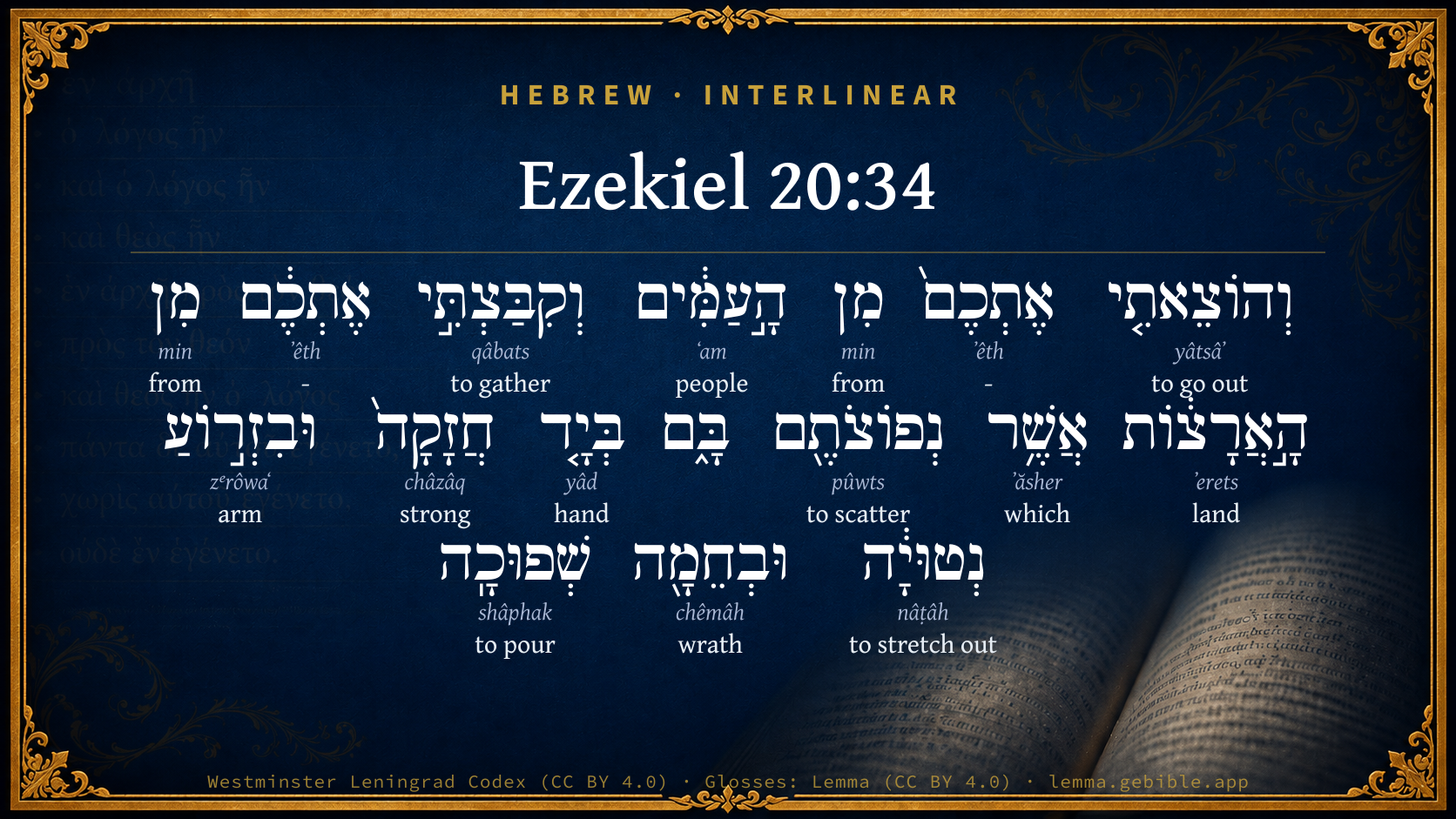
Hebrew (Westminster Leningrad Codex) Ezekiel 20:34 appears in the Hebrew Old Testament. The text above is from the Westminster Leningrad Codex. Each word links to its Strong’s number, a concise gloss, and parsing drawn from the Open Scriptures Hebrew Bible morphology. Click any word for its full Brown-Driver-Briggs (BDB) entry.
Download image
Cite this verse

Ezekiel 20:34 (World English Bible). Public Domain. Lemma interlinear Bible study tool, https://lemma.gebible.app/v/ezekiel/20/34.

Show BibTeX & RIS
BibTeX
RIS
English Translation
and I will bring you out from the peoples, and will gather you out of the countries in which you are scattered, with a mighty hand, and with an outstretched arm, and with wrath poured out;
World English Bible · Public Domain
Download a study sheet

One document with this verse’s original text, its word-by-word gloss line, the meaning frame, cross-references with their text, attributed commentary, and full source and license credits — printable, and it pastes into notes with its structure intact.

This verse Autodidact and up

Study sheet (.html) Plain text (.txt)

A passage Seminary Student

Up to 50 verses in one chapter. A passage sheet keeps up to 6 commentary sources and 12 cross-references per verse, in the order this page ranks them, and says so on the sheet whenever that leaves anything out. Ask for a single verse and you get the Autodidact verse sheet above.

Everything on this page stays free to read, with no account — the sheet is a download of what is already on screen, not access to it.

Want to remove ads? Support Godless Engineer
Compare translations 3

The same verse in 3 English versions, stacked beneath the original-language interlinear above. Click any original word for its lexicon entry.

Each is an independent rendering of the whole verse — the interlinear is not word-aligned to these translations.

Highlighted words mark where these versions differ — a whole-verse word diff, not a word-by-word alignment.

  • World English Bible Public Domain
    and I will bring you out from the peoples, and will gather you out of the countries in which you are scattered, with a mighty hand, and with an outstretched arm, and with wrath poured out;
  • King James Version Public Domain
    And I will bring you out from the people, and will gather you out of the countries wherein ye are scattered, with a mighty hand, and with a stretched out arm, and with fury poured out.
  • unfoldingWord Literal Text CC BY-SA 4.0
    I will bring you out from the other peoples and will gather you out of the countries among whom you have been scattered. I will do this with a mighty hand and with fury poured out.

unfoldingWord Literal Text — © unfoldingWord, licensed CC BY-SA 4.0. Word-aligned USFM3 via Door43 (git.door43.org/unfoldingWord/en_ult).

Versions to compare (up to 4)

3 of 4 selected

Show all 18 translations

Every available English version of this verse, each an independent rendering of the whole verse.

  • World English Bible Public Domain
    and I will bring you out from the peoples, and will gather you out of the countries in which you are scattered, with a mighty hand, and with an outstretched arm, and with wrath poured out;
  • Berean Standard Bible Public Domain
    With a strong hand, an outstretched arm, and outpoured wrath I will bring you out from the peoples and gather you from the lands to which you have been scattered.
  • Majority Standard Bible Public Domain
    With a strong hand, an outstretched arm, and outpoured wrath I will bring you out from the peoples and gather you from the lands to which you have been scattered.
  • King James Version Public Domain
    And I will bring you out from the people, and will gather you out of the countries wherein ye are scattered, with a mighty hand, and with a stretched out arm, and with fury poured out.
  • American Standard Version (1901) Public Domain
    and I will bring you out from the peoples, and will gather you out of the countries wherein ye are scattered, with a mighty hand, and with an outstretched arm, and with wrath poured out;
  • Revised Version (1885) Public Domain
    and I will bring you out from the peoples, and will gather you out of the countries wherein ye are scattered, with a mighty hand, and with a stretched out arm, and with fury poured out.
  • Geneva Bible (1599) Public Domain
    And will bring you from the people, and will gather you out of the countreys, wherein ye are scattered, with a mighty hand, and with a stretched out arme, and in my wrath powred out,
  • Douay-Rheims (1899) Public Domain
    And I will bring you out from the people, and I will gather you out of the countries, in which you are scattered, I will reign over you with a strong hand, and with a stretched out arm, and with fury poured out.
  • Young's Literal Translation Public Domain
    And I have brought you forth from the peoples, And assembled you from the lands In which ye have been scattered, With a strong hand and with a stretched-out arm, And with fury poured out.
  • Literal Standard Version CC BY-SA 4.0
    And I have brought you forth from the peoples, || And assembled you from the lands || In which you have been scattered, || With a strong hand and with an outstretched arm, || And with poured out fury.
  • Unlocked Literal Bible CC BY-SA 4.0
    I will bring you out from the other peoples and will gather you out of the countries among whom you have been scattered. I will do this with a mighty hand and with fury poured out.
  • unfoldingWord Literal Text CC BY-SA 4.0
    I will bring you out from the other peoples and will gather you out of the countries among whom you have been scattered. I will do this with a mighty hand and with fury poured out.
  • Darby Bible Public Domain
    And I will bring you out from the peoples, and will gather you out of the countries wherein ye are scattered, with a mighty hand, and with an outstretched arm, and with fury poured out;
  • World Messianic Bible Public Domain
    I will bring you out from the peoples, and will gather you out of the countries in which you are scattered with a mighty hand, with an outstretched arm, and with wrath poured out.
  • Webster's Bible Public Domain
    And I will bring you out from the people, and will gather you out of the countries in which ye are scattered, with a mighty hand, and with an out-stretched arm, and with fury poured out.
  • Free Bible Version CC BY-SA 4.0
    With all my strength and power, and in my anger, I will lead you out from among the nations and gather you from the countries where you were scattered.
  • Bible in Basic English Public Domain
    And I will take you out from the peoples and get you together out of the countries where you are wandering, with a strong hand and with an outstretched arm and with burning wrath let loose:
  • JPS Tanakh (1917) Public Domain
    and I will bring you out from the peoples, and will gather you out of the countries wherein ye are scattered, with a mighty hand, and with an outstretched arm, and with fury poured out;

Literal Standard Version (2020), Covenant Press — licensed CC BY-SA 4.0. Text via the HelloAO Bible API (eBible.org). Unlocked Literal Bible (unfoldingWord) — licensed CC BY-SA 4.0. Text via the HelloAO Bible API (eBible.org). unfoldingWord Literal Text — © unfoldingWord, licensed CC BY-SA 4.0. Word-aligned USFM3 via Door43 (git.door43.org/unfoldingWord/en_ult). Free Bible Version, Dr. Jonathan Gallagher — licensed CC BY-SA 4.0. Text via the HelloAO Bible API (eBible.org).

Word by word

More ways to search: Search by grammar → Find every occurrence → Compare this word →

Practice this passage: Drill this verse → Learn its vocabulary →

חֲזָקָה֙
châzâq
H2389
“strong”
Adjective, Adjective, Feminine, Singular, Absolute
Part of Speech
Adjective
Type
Adjective
Gender
Feminine
Number
Singular
State
Absolute
Full BDB Definition

Origin: from H2388

TWOT: 636a

strong, stout, mighty - strong - severe, sharp, hot - firm, hard - a strong one (substantive)
  1. וְהוֹצֵאתִ֤י yâtsâʼ H3318 “and · to go out” Conjunction + Verb, Hiphil, Sequential Perfect, 1st Person, Common, Singular
  2. אֶתְכֶם֙ ʼêth H853 “- · you” Particle, Direct Object + Suffix, Personal, 2nd Person, Masculine, Plural
  3. מִן min H4480 “from” Preposition
  4. הָ֣עַמִּ֔ים ʻam H5971 “the · peoples” Particle, Definite Article + Noun, Common, Masculine, Plural, Absolute
  5. וְקִבַּצְתִּ֣י qâbats H6908 “and · to gather” Conjunction + Verb, Piel, Sequential Perfect, 1st Person, Common, Singular
  6. אֶתְכֶ֔ם ʼêth H853 “- · you” Particle, Direct Object + Suffix, Personal, 2nd Person, Masculine, Plural
  7. מִן min H4480 “from” Preposition
  8. הָ֣אֲרָצ֔וֹת ʼerets H776 “the · lands” Particle, Definite Article + Noun, Common, Both, Plural, Absolute
  9. אֲשֶׁ֥ר ʼăsher H834 “which” Particle, Relative
  10. נְפוֹצֹתֶ֖ם pûwts H6327 “to scatter” Verb, Niphal, Perfect, 2nd Person, Masculine, Plural
  11. בְּיָ֤ד yâd H3027 “in/at · hand” Preposition + Noun, Common, Both, Singular, Absolute
  12. וּבִזְר֣וֹעַ zᵉrôwaʻ H2220 “and · in/at · arm” Conjunction + Preposition + Noun, Common, Both, Singular, Absolute
  13. נְטוּיָ֔ה nâṭâh H5186 “stretched out” Verb, Qal, Participle Passive, Feminine, Singular, Absolute
  14. וּבְחֵמָ֖ה chêmâh H2534 “and · in/at · wrath” Conjunction + Preposition + Noun, Common, Feminine, Singular, Absolute
  15. שְׁפוּכָֽה shâphak H8210 “poured” Verb, Qal, Participle Passive, Feminine, Singular, Absolute

About this verse

These counts appear in no published source. They are computed here, from the morphology-tagged text and Lemma’s own curated glosses. What Lemma adds →

17
words
14
distinct lemmas
Prophets
section

Shared distinctive vocabulary

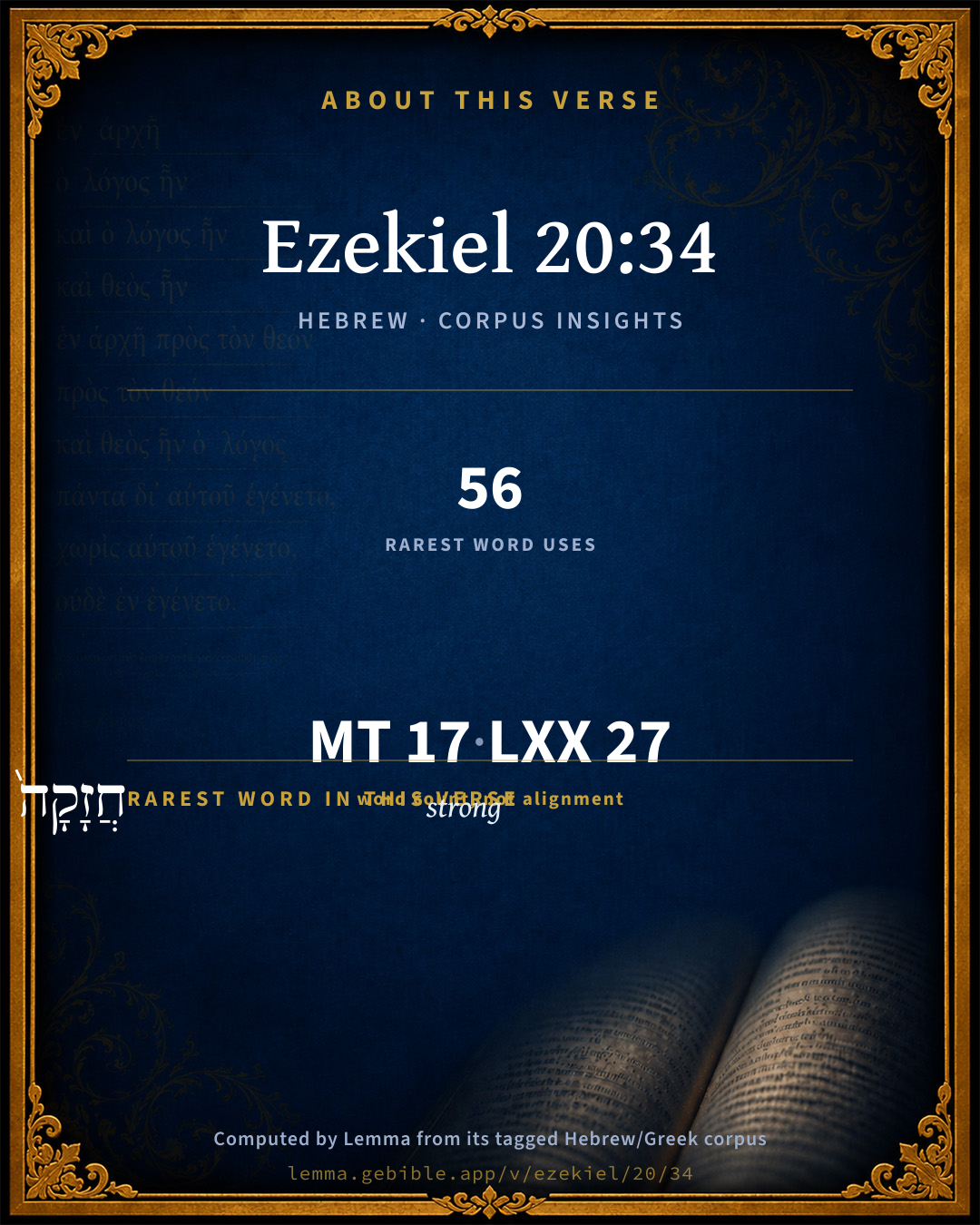
חֲזָקָה֙ strong H2389 occurs in 54 verses of the Hebrew Bible. Also found in:

Grammatical profile

  • 5 verbs
  • 5 nouns
  • 1 adjective
  • 3 prepositions
  • 3 particles

Verb forms

  • וְהוֹצֵאתִ֤י Hiphil · Sequential Perfect
  • וְקִבַּצְתִּ֣י Piel · Sequential Perfect
  • נְפוֹצֹתֶ֖ם Niphal · Perfect
  • נְטוּיָ֔ה Qal · Participle Passive
  • שְׁפוּכָֽה Qal · Participle Passive

Repetition

A word recurs within this verse — often emphatic in Hebrew:

Hebrew & Septuagint length

In English translation the verse runs 36 words from the Hebrew and 33 from the Septuagint (LXX English) — closely comparable.

A rough comparison of the two English renderings, which tokenize alike — not a word-level alignment.

Word counts can differ between the Hebrew and the Greek without any difference in meaning — e.g. the Hebrew direct-object marker אֵת has no separate Greek word, and Greek often adds the article ὁ.

In the original languages it is 17 Hebrew tokens and 27 Greek tokens — but the two are counted differently (Hebrew bundles its prefixes and suffixes into one token; the Greek is in lemma form), so that isn’t a like-for-like length.

Cross-references

6

Topical passages linked to Ezekiel 20:34 in the Treasury of Scripture Knowledge — connected by theme and wording, ordered by reader-vote popularity; previews shown in the World English Bible.

  • Ezekiel 20:38 and I will purge out from among you the rebels, and those who disobey against me; I will bring them forth out of the land where they sojourn, but they shall not enter into the land of Israel: and you shall know that I am Yahweh.
  • Amos 9:9–10 "For, behold, I will command, and I will sift the house of Israel among all the nations, as grain is sifted in a sieve, yet not the least kernel will fall on the earth.
  • Ezekiel 34:16 I will seek that which was lost, and will bring back that which was driven away, and will bind up that which was broken, and will strengthen that which was sick: but the fat and the strong I will destroy; I will feed them in justice.
  • Isaiah 27:9–13 Therefore by this shall the iniquity of Jacob be forgiven, and this is all the fruit of taking away his sin: that he makes all the stones of the altar as chalk stones that are beaten in sunder, [so that] the Asherim and the sun-images shall rise no more.
  • Jeremiah 44:6 Therefore my wrath and my anger was poured forth, and was kindled in the cities of Judah and in the streets of Jerusalem; and they are wasted and desolate, as it is this day.
  • Lamentations 2:4 He has bent his bow like an enemy, he has stood with his right hand as an adversary, Has killed all that were pleasant to the eye: In the tent of the daughter of Zion he has poured out his wrath like fire.

Cross-references courtesy of OpenBible.info (CC BY 4.0).

Hebrew and Greek witnesses Masoretic Hebrew ↔ Greek Septuagint

The same verse in the two great witnesses to the Old Testament, shown verse-for-verse.

These are two independent witnesses, not word-aligned to each other, and the Septuagint is shown in lemma (dictionary) form.

Hebrew Ezekiel 20:34 Masoretic · Westminster Leningrad Codex

וְהוֹצֵאתִ֤י אֶתְכֶם֙ מִן הָ֣עַמִּ֔ים וְקִבַּצְתִּ֣י אֶתְכֶ֔ם מִן הָ֣אֲרָצ֔וֹת אֲשֶׁ֥ר נְפוֹצֹתֶ֖ם בָּ֑ם בְּיָ֤ד חֲזָקָה֙ וּבִזְר֣וֹעַ נְטוּיָ֔ה וּבְחֵמָ֖ה שְׁפוּכָֽה

and I will bring you out from the peoples, and will gather you out of the countries in which you are scattered, with a mighty hand, and with an outstretched arm, and with wrath poured out;

World English Bible · Public Domain

Greek LXX Ezekiel 20:34 Septuagint · lemma form

καί ἐκἄγω σύ ἐκ ὁ λαός καί εἰςδέχομαι σύ ἐκ ὁ χώρα ὅς διασκορπίζω ἐν αὐτός ἐν χείρ κραταιός καί ἐν βραχίων ὑψηλός καί ἐν θυμός χέω

I will bring you out from the nations, and will take you out of the lands wherein you⌃ were dispersed, with a strong hand, and with a high arm, and with outpoured wrath.

LXX2012 (modern English Septuagint) · Public Domain

Hebrew: Westminster Leningrad Codex (CC BY 4.0). Greek: Septuagint (public domain); English from LXX2012 (modern English Septuagint) (Public Domain). How the Septuagint differs from the Hebrew →

Targum (Aramaic paraphrase)

1

The Targum is the ancient Jewish Aramaic paraphrase of the Hebrew Scriptures — an interpretive translation, not the Hebrew text itself. Onkelos (literal) and Pseudo-Jonathan (expansive) render the Torah, and Jonathan the Prophets. Coverage is partial: where no permissively-licensed English translation exists for a verse, only the Aramaic is shown. This is verse-level text, not a word-by-word alignment to the Hebrew.

  1. Targum Jonathan Prophets (Joshua–Malachi)
    וְאַפֵּיק יַתְכוֹן מִבֵּינֵי עַמְמַיָא וְאַכְנֵישׁ יַתְכוֹן מִן מְדִינָתָא דְאִתְבַּדַרְתּוּן בְּהוֹן בְּיַד תַּקִיפָא וּבְדַרְעָא מְרוֹמָם וּבִרְגַז שְׁפִיךְ:

    (no public-domain English translation for this verse)

    Targum Jonathan — Aramaic: “Mikraot Gedolot” (public domain). English: “Sefaria Community Translation” (CC0 1.0 (public-domain dedication)); “London "Chaldee Paraphrase," 1871” (public domain). Text via Sefaria.

Commentary

Notes on Ezekiel 20:34 from classic Christian and Jewish commentators (each source and its license shown beneath its notes). The classic Christian expositions comment on the surrounding passage and are grouped to its opening verse, so a note may address several verses; the Jewish commentaries on the Tanakh (Rashi and others) are per-verse, so they appear only where the commentator wrote on this verse.

Lemma curates 59 commentaries, every one of them public domain or Creative Commons licensed, each selected and text-cleaned for this edition rather than reprinted as found. About our sources →

Trapp's Complete Commentary

John Trapp

Eze 20:34 And I will bring you out from the people, and will gather you out of the countries wherein ye are scattered, with a mighty hand, and with a stretched out arm, and with fury poured out.

Ver. 34. And I will bring you out from the people.] The heathens with whom you have incorporated, hoping so to shun me, and to be out of the reach of my rod; but I shall sure find and ferret you out of all your starting holes; I shall be meet with you. So God was here with the English by the sweating sickness, which hunted and haunted also our countrymen in foreign parts, singling them out from others. It reigned, or rather God reigned by it, some forty years together. {a}

{a} Sennert. De Febrib., lib. iv. cap. 15.

John Trapp, A Commentary or Exposition upon All the Books of the Old and New Testament (1647–1656) — public domain. Text from a community e-Sword module.

Jamieson, Fausset & Brown

Robert Jamieson, A. R. Fausset & David Brown

The Jews in exile might think themselves set free from the "rule" of God (Eze 20:33); therefore, He intimates, He will reassert His right over them by chastening judgments, and these, with an ultimate view, not to destroy, but to restore them.

people--rather, "peoples."

Jamieson, Fausset & Brown — Commentary Critical and Explanatory on the Whole Bible (1871) — public domain (CC PDM 1.0). Text via the HelloAO Bible API.

John Calvin's Commentaries

He confirms the same sentiment, and at the same time marks out the manner of his dominion. For when the Jews were dispersed in captivity, they were like strangers to God’s jurisdiction: they were mingled with the Gentiles, and their condition seemed very like an exemption from God’s power. Now God signifies when he wishes to recover his right, that he had a place at hand, since he will bring them out from the Gentiles, and gather them from the lands through which they were dispersed. We are aware, as we have often said before, that it was a kind of abdication, when God expelled the ten tribes from the land of Canaan and a part also of that of Judea. Since then they were disinherited, they thought themselves free on their part, and they no longer regarded the authority of God, since they ceased to be his peculiar heritage when they were deprived of the promised land. Here God reminds them that although he had emancipated them for the time, yet they were in some sense under his hand, since he would collect them again, and so subdue them, that they should not escape his authority. I will draw you back, says he, and gather you with an outstretched arm and with a strong hand. But what he adds concerning the fury of his wrath does not seem consistent with this. For it was a sign of favor to collect them again, although hard and sorrowful slavery awaited them; yet they might perceive some taste of the divine goodness in gathering them from exile. For we know the bitterness of their captivity; especially under the Chaldaeans, by whom they were subdued. But the phrase wrath may relate as much to the Gentiles as to the Israelites themselves: yet I explain it more willingly of the Israelites, because although God in reality shows that he did not altogether neglect them, yet he asserts his right as a master grievously offended. Just as a person who had lost his slave may afterwards receive him into his house, and yet that house may be like a sepulcher, because he is either thrust into a deep dungeon, or three or four times as much is exacted of him as he can bear. So therefore God pronounces, although he may gather the Israelites again under his hand, yet they shall feel him to be displeased with them, since he nevertheless will require the punishment of their impiety; and this will be better understood from the context.

John Calvin's Commentaries (1540-1563) — public domain. Text from the Calvin Translation Society English edition (1840s-50s) via the Christian Classics Ethereal Library (ccel.org). Calvin's coverage is partial (roughly two-thirds of the Bible); uncommented books and verses are honest gaps, never fabricated. The 19th-century editor's footnotes and remarks are omitted so the notes are faithfully Calvin's own voice.

Ellicott's Commentary for English Readers

(34) Bring you out from the people.—This and the parallel clause, “gather you out of the countries,” cannot refer to the restoration of the people to their land, both because it is an avenging act, “with fury poured out”; and also because its object is said in the next verse to be to bring them into the wilderness. It must therefore refer to the Divine dealings with the people in their dispersion. He will separate them from other people; He will not allow them, as they proposed (Eze_20:32), to “be as the heathen;” but will bring them out and gather them as a distinct race and spiritually separated from them all, to be dealt with as His own peculiar people.

A Bible Commentary for English Readers, edited by Charles John Ellicott (1878–1897) — public domain. Text from a community e-Sword module.

The Cambridge Bible for Schools and Colleges

gen. ed. J. J. S. Perowne

34. the people] peoples. Though Israel was in captivity in the Babylonian empire, this empire embraced many peoples, the world as it was then known (cf. ch. 17) Formerly Israel was entangled among the Egyptians, now it is entangled among all nations; it shall now be gathered out as it was in the former age.

The Cambridge Bible for Schools and Colleges (gen. ed. J. J. S. Perowne; Cambridge University Press, 1878–1918) — public domain. Text from a community e-Sword module.

John Gill's Exposition

I will bring you out from the people, and will gather you out of the countries wherein ye are scattered,.... The Egyptians, Ammonites, and others; where they went for safety and protection, and among whom they intended to settle, and had formed a scheme to cast off the yoke of God and his worship, and be no more a nation or people under his government; but mix themselves with these nations, and become a part of them, and join with them in all matters, civil, commercial, and religious; but here the Lord will not suffer them to continue, but will bring them out from hence:

with a mighty hand, and a stretched out arm, and with fury poured out: as before, Eze 20:33 though some think this is to be understood as a favour to the Israelites, who should be brought out of the countries of the idolatrous Gentiles by mighty power, and with marks of wrath and displeasure upon the nations; designing hereby the good of his people, that they might be reduced to his government, and live happily and comfortably under him, and not be destroyed and lost among the nations.

John Gill's Exposition of the Whole Bible (1746–1763) — public domain (CC PDM 1.0). Text via the HelloAO Bible API.

Matthew Poole's English Annotations

From the people; Sidonians, Ammonites, Moabites, &c., whoever they were to whom the house of the apostate Jews betook themselves; where they thought to lurk, God will bring them thence into Babylonish captivity.

Will gather you; the same thing doubled for greater emphasis.

Are scattered; you dispersed yourselves for your supposed safety and welfare.

With a mighty hand: see Eze 20:33. My power and arm shall execute my just displeasure on you.

Matthew Poole's English Annotations on the Holy Bible (1683–1685) — public domain. Text from a community e-Sword/MySword module.

The Pulpit Commentary

Vers. 34, 35. The prophet"s words seem to look beyond the horizon of any fulfilment as yet seen in history, of which the return of the exiles under Zerubbabel was but the pledge and earnest. He contemplates not a return straight from Babylon to Jerusalem, but a gathering from all the countries in which they had been scattered. (Isa_11:11) When gathered, thewhole nation is to be brought into the wilderness of the peoples, bordered by many nations. This may probably point to the great Syro-Arabian desert lying between Babylon and Palestine. This was to be to them what the wilderness of Sinai had been in the time of the Exodus. There Jehovah would plead with them face to face, in the first instance as an accuser. (For face to face, as expressing the direct revelation of Jehovah, see Deu_5:4 Deu_34:10, and elsewhere.)

The Pulpit Commentary (1880–1919), ed. H.D.M. Spence-Jones & Joseph S. Exell — public domain. Text from a community e-Sword module.

John Wesley's Explanatory Notes

The people - Sidonians, Ammonites, Moabites, or whoever they were, to whom the apostate Jews betook themselves, where they thought to lurk, God will bring them thence into Babylonish captivity.

John Wesley, Explanatory Notes Upon the Whole Bible (1754–1765) — public domain. Text via the GEBible commentary corpus.

Lesson kit

Teaching starters — assembled from the data on this page, not authored interpretation. Every prompt links to the verse data it draws on. Edit before teaching.

Ezekiel, in the Prophets, opens this verse with 17 words (14 distinct Hebrew lemmas). Its most distinctive word is châzâq (“strong”). A historical commentator’s framing appears above. Read the whole chapter for the surrounding context.

Discussion questions

  1. What does “strong” (châzâq) contribute to the verse as a whole?
  2. Exodus 3:19 shares the word «strong» with this verse. How do the two illuminate each other?
  3. “from” occurs 2× in this one verse. What is the effect of the repetition?
  4. The translations on this page render this verse differently — a whole-verse word diff, not a word-by-word alignment. What might account for the different wordings?
  5. The verb «וְהוֹצֵאתִ֤י» is Hiphil Sequential Perfect. How does its form color the action?
  6. Reading how Trapp's Complete Commentary and Jamieson, Fausset & Brown read this verse, where do the two commentators agree and where do they part?

Things to notice

Reading settings

Reading text

Shown beneath each verse's original-language words.

Old Testament
Old Testament edition

Read the OT as the Masoretic Hebrew (MT) or the Greek Septuagint (LXX).

English shown for the Greek Septuagint (in the Hebrew ↔ Greek comparison).

Comparing translations? Open the Compare panel on any verse page to stack up to four side by side.