
Isaiah 42:5

Hebrew (Westminster Leningrad Codex) Isaiah 42:5 appears in the Hebrew Old Testament. The text above is from the Westminster Leningrad Codex. Each word links to its Strong’s number, a concise gloss, and parsing drawn from the Open Scriptures Hebrew Bible morphology. Click any word for its full Brown-Driver-Briggs (BDB) entry.
Download image
Cite this verse

Isaiah 42:5 (World English Bible). Public Domain. Lemma interlinear Bible study tool, https://lemma.gebible.app/v/isaiah/42/5.

Show BibTeX & RIS
BibTeX
RIS
English Translation
Thus says God Yahweh, he who created the heavens, and stretched them forth; he who spread abroad the earth and that which comes out of it; he who gives breath to the people on it, and spirit to those who walk therein:
World English Bible · Public Domain
Download a study sheet

One document with this verse’s original text, its word-by-word gloss line, the meaning frame, cross-references with their text, attributed commentary, and full source and license credits — printable, and it pastes into notes with its structure intact.

This verse Autodidact and up

Study sheet (.html) Plain text (.txt)

A passage Seminary Student

Up to 50 verses in one chapter. A passage sheet keeps up to 6 commentary sources and 12 cross-references per verse, in the order this page ranks them, and says so on the sheet whenever that leaves anything out. Ask for a single verse and you get the Autodidact verse sheet above.

Everything on this page stays free to read, with no account — the sheet is a download of what is already on screen, not access to it.

Want to remove ads? Support Godless Engineer
Compare translations 3

The same verse in 3 English versions, stacked beneath the original-language interlinear above. Click any original word for its lexicon entry.

Each is an independent rendering of the whole verse — the interlinear is not word-aligned to these translations.

Highlighted words mark where these versions differ — a whole-verse word diff, not a word-by-word alignment.

  • World English Bible Public Domain
    Thus says God Yahweh, he who created the heavens, and stretched them forth; he who spread abroad the earth and that which comes out of it; he who gives breath to the people on it, and spirit to those who walk therein:
  • King James Version Public Domain
    Thus saith God the LORD, he that created the heavens, and stretched them out; he that spread forth the earth, and that which cometh out of it; he that giveth breath unto the people upon it, and spirit to them that walk therein:
  • unfoldingWord Literal Text CC BY-SA 4.0
    Thus says God, Yahweh, the one having created the heavens and having stretched them out, the one having beaten out the earth and its offspring, the one giving breath to the people on it and breath to the ones walking on it:

unfoldingWord Literal Text — © unfoldingWord, licensed CC BY-SA 4.0. Word-aligned USFM3 via Door43 (git.door43.org/unfoldingWord/en_ult).

Versions to compare (up to 4)

3 of 4 selected

Show all 18 translations

Every available English version of this verse, each an independent rendering of the whole verse.

  • World English Bible Public Domain
    Thus says God Yahweh, he who created the heavens, and stretched them forth; he who spread abroad the earth and that which comes out of it; he who gives breath to the people on it, and spirit to those who walk therein:
  • Berean Standard Bible Public Domain
    This is what God the LORD says—He who created the heavens and stretched them out, who spread out the earth and its offspring, who gives breath to the people on it and life to those who walk in it:
  • Majority Standard Bible Public Domain
    This is what God the LORD says—He who created the heavens and stretched them out, who spread out the earth and its offspring, who gives breath to the people on it and life to those who walk in it:
  • King James Version Public Domain
    Thus saith God the LORD, he that created the heavens, and stretched them out; he that spread forth the earth, and that which cometh out of it; he that giveth breath unto the people upon it, and spirit to them that walk therein:
  • American Standard Version (1901) Public Domain
    Thus saith God Jehovah, he that created the heavens, and stretched them forth; he that spread abroad the earth and that which cometh out of it; he that giveth breath unto the people upon it, and spirit to them that walk therein:
  • Revised Version (1885) Public Domain
    Thus saith God the LORD, he that created the heavens, and stretched them forth; he that spread abroad the earth and that which cometh out of it; he that giveth breath unto the people upon it, and spirit to them that walk therein:
  • Geneva Bible (1599) Public Domain
    Thus sayeth God the Lord (he that created the heauens and spred them abroad: he that stretched foorth the earth, and the buddes thereof: he that giueth breath vnto the people vpon it, and spirit to them that walke therein)
  • Douay-Rheims (1899) Public Domain
    Thus saith the Lord God that created the heavens, and stretched them out: that established the earth, and the things that spring out of it: that giveth breath to the people upon it, and spirit to them that tread thereon.
  • Young's Literal Translation Public Domain
    Thus said God, Jehovah, preparing The heavens, and stretching them out, Spreading out the earth and its productions, Giving breath to the people on it, And spirit to those walking in it.
  • Literal Standard Version CC BY-SA 4.0
    Thus said God, YHWH, || Creating the heavens, and stretching them out, || Spreading out the earth and its productions, || Giving breath to the people on it, || And spirit to those walking in it.
  • Unlocked Literal Bible CC BY-SA 4.0
    This is what God Yahweh says— the one who created the heavens and stretched them out, the one who made the earth and all that it produces, the one who gives breath to the people on it and life to those who live on it:
  • unfoldingWord Literal Text CC BY-SA 4.0
    Thus says God, Yahweh, the one having created the heavens and having stretched them out, the one having beaten out the earth and its offspring, the one giving breath to the people on it and breath to the ones walking on it:
  • Darby Bible Public Domain
    Thus saith ùGod, Jehovah, he that created the heavens and stretched them out, he that spread forth the earth and its productions, he that giveth breath unto the people upon it, and spirit to them that walk therein:
  • World Messianic Bible Public Domain
    God the LORD, he who created the heavens and stretched them out, he who spread out the earth and that which comes out of it, he who gives breath to its people and spirit to those who walk in it, says:
  • Webster's Bible Public Domain
    Thus saith God the LORD, he that created the heavens, and expanded them; he that spread forth the earth, and that which it produceth; he that giveth breath to the people upon it, and spirit to them that walk therein.
  • Free Bible Version CC BY-SA 4.0
    This is what God the Lord says, the one who created the heavens and stretched them out, who made the earth and everything in it, who gives breath to the people on it, and life to those who live there:
  • Bible in Basic English Public Domain
    God the Lord, even he who made the heavens, measuring them out on high; stretching out the earth, and giving its produce; he who gives breath to the people on it, and life to those who go about on it, says:
  • JPS Tanakh (1917) Public Domain
    Thus saith God the LORD, He that created the heavens, and stretched them forth, He that spread forth the earth and that which cometh out of it, He that giveth breath unto the people upon it, and spirit to them that walk therein:

Literal Standard Version (2020), Covenant Press — licensed CC BY-SA 4.0. Text via the HelloAO Bible API (eBible.org). Unlocked Literal Bible (unfoldingWord) — licensed CC BY-SA 4.0. Text via the HelloAO Bible API (eBible.org). unfoldingWord Literal Text — © unfoldingWord, licensed CC BY-SA 4.0. Word-aligned USFM3 via Door43 (git.door43.org/unfoldingWord/en_ult). Free Bible Version, Dr. Jonathan Gallagher — licensed CC BY-SA 4.0. Text via the HelloAO Bible API (eBible.org).

Word by word

More ways to search: Search by grammar → Find every occurrence → Compare this word →

Practice this passage: Drill this verse → Learn its vocabulary →

רֹקַ֥ע
râqaʻ
H7554
“beating out”
Verb, Qal, Participle Active, Masculine, Singular, Construct
Part of Speech
Verb
Stem
Qal
Form
Participle Active
Gender
Masculine
Number
Singular
State
Construct
Full BDB Definition

Origin: a primitive root

TWOT: 2217

to beat, stamp, beat out, spread out, stretch - (Qal) - to stamp, beat out - one who beats out (participle) - (Piel) to overlay, beat out (for plating) - (Pual) beaten out (participle) - (Hiphil) to make a spreading (of clouds)
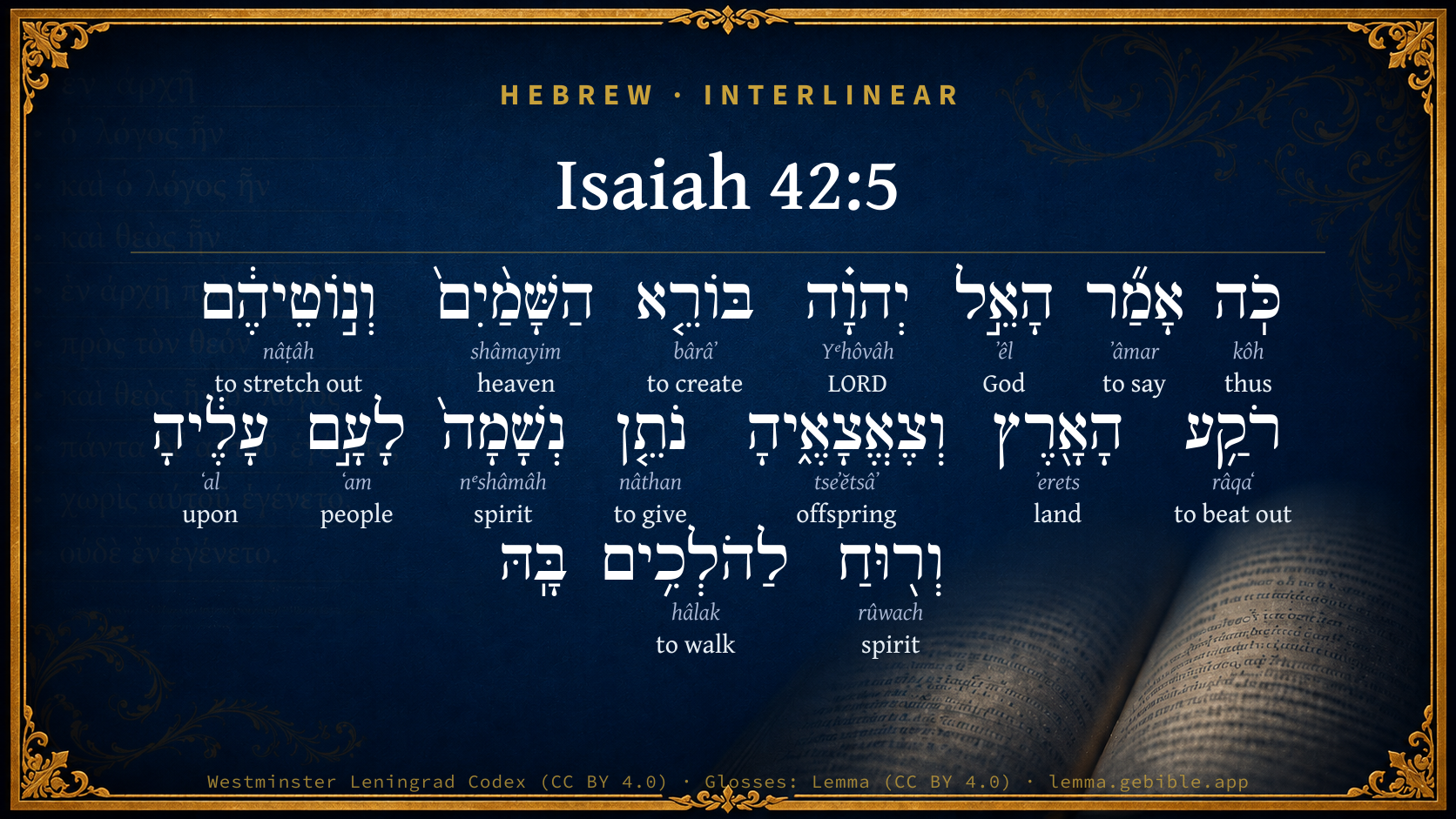
  1. כֹּֽה kôh H3541 “thus” Adverb
  2. אָמַ֞ר ʼâmar H559 “to say” Verb, Qal, Perfect, 3rd Person, Masculine, Singular
  3. הָאֵ֣ל ʼêl H410 “the · God” Particle, Definite Article + Noun, Common, Masculine, Singular, Absolute
  4. יְהוָ֗ה Yᵉhôvâh H3068 “LORD” Noun, Proper
  5. בּוֹרֵ֤א bârâʼ H1254 “creating” Verb, Qal, Participle Active, Masculine, Singular, Construct
  6. הַשָּׁמַ֨יִם֙ shâmayim H8064 “the · heaven(s)” Particle, Definite Article + Noun, Common, Masculine, Plural, Absolute
  7. וְנ֣וֹטֵיהֶ֔ם nâṭâh H5186 “and · stretching out · them” Conjunction + Verb, Qal, Participle Active, Masculine, Singular, Construct + Suffix, Personal, 3rd Person, Masculine, Plural
  8. הָאָ֖רֶץ ʼerets H776 “the · land” Particle, Definite Article + Noun, Common, Both, Singular, Absolute
  9. וְצֶאֱצָאֶ֑יהָ tseʼĕtsâʼ H6631 “and · offspring · her” Conjunction + Noun, Common, Masculine, Plural, Construct + Suffix, Personal, 3rd Person, Feminine, Singular
  10. נֹתֵ֤ן nâthan H5414 “giving” Verb, Qal, Participle Active, Masculine, Singular, Absolute
  11. נְשָׁמָה֙ nᵉshâmâh H5397 “spirit” Noun, Common, Feminine, Singular, Absolute
  12. לָעָ֣ם ʻam H5971 “to/for the · people” Preposition, Determined + Noun, Common, Masculine, Singular, Absolute
  13. עָלֶ֔יהָ ʻal H5921 “upon · her” Preposition + Suffix, Personal, 3rd Person, Feminine, Singular
  14. וְר֖וּחַ rûwach H7307 “and · spirit” Conjunction + Noun, Common, Both, Singular, Absolute
  15. לַהֹלְכִ֥ים hâlak H1980 “to/for the · walking” Preposition, Determined + Verb, Qal, Participle Active, Masculine, Plural, Absolute

About this verse

These counts appear in no published source. They are computed here, from the morphology-tagged text and Lemma’s own curated glosses. What Lemma adds →

17
words
16
distinct lemmas
Prophets
section

Notable vocabulary

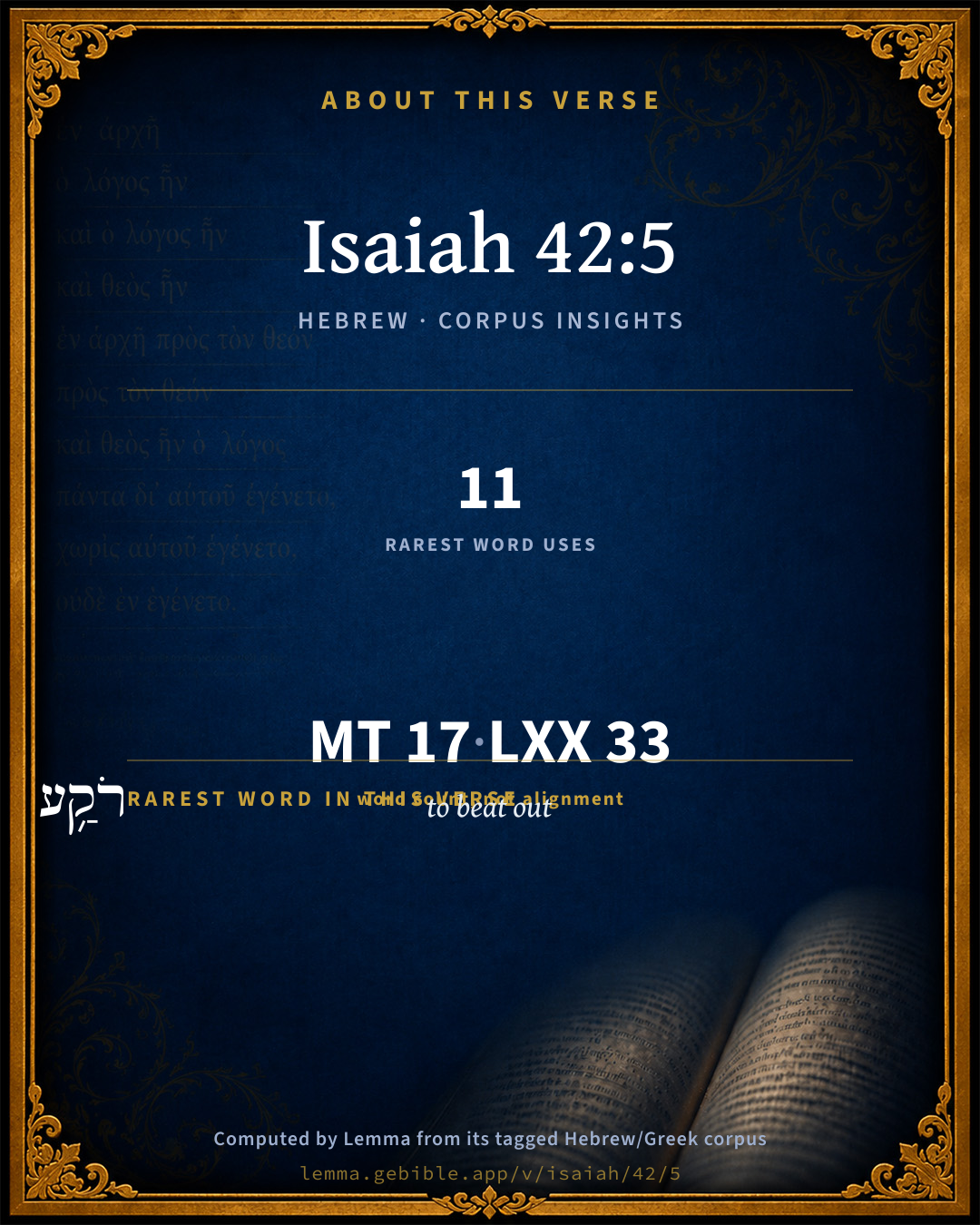
The rarest word here is רֹקַ֥ע to beat out H7554 — appearing just 11 times in the whole Hebrew Bible.

Shared distinctive vocabulary

רֹקַ֥ע to beat out H7554 occurs in 11 verses of the Hebrew Bible. Also found in:

Grammatical profile

  • 6 verbs
  • 8 nouns
  • 2 prepositions
  • 1 adverb

Verb forms

  • אָמַ֞ר Qal · Perfect
  • בּוֹרֵ֤א Qal · Participle Active
  • וְנ֣וֹטֵיהֶ֔ם Qal · Participle Active
  • רֹקַ֥ע Qal · Participle Active
  • נֹתֵ֤ן Qal · Participle Active
  • לַהֹלְכִ֥ים Qal · Participle Active

Hebrew & Septuagint length

In English translation the verse runs 42 words from the Hebrew and 37 from the Septuagint (LXX English) — closely comparable.

A rough comparison of the two English renderings, which tokenize alike — not a word-level alignment.

Word counts can differ between the Hebrew and the Greek without any difference in meaning — e.g. the Hebrew direct-object marker אֵת has no separate Greek word, and Greek often adds the article ὁ.

In the original languages it is 17 Hebrew tokens and 33 Greek tokens — but the two are counted differently (Hebrew bundles its prefixes and suffixes into one token; the Greek is in lemma form), so that isn’t a like-for-like length.

Cross-references

27

Topical passages linked to Isaiah 42:5 in the Treasury of Scripture Knowledge — connected by theme and wording, ordered by reader-vote popularity; previews shown in the World English Bible.

  • Isaiah 40:22 [It is] he who sits above the circle of the earth, and the inhabitants of it are as grasshoppers; who stretches out the heavens as a curtain, and spreads them out as a tent to dwell in;
  • Isaiah 45:12 I have made the earth, and created man on it: I, even my hands, have stretched out the heavens; and all their host have I commanded.
  • Jeremiah 10:12 He has made the earth by his power, he has established the world by his wisdom, and by his understanding has he stretched out the heavens:
  • Zechariah 12:1 An oracle. The word of Yahweh concerning Israel. Yahweh, who stretches out the heavens, and lays the foundation of the earth, and forms the spirit of man within him says:
  • Isaiah 48:13 Yes, my hand has laid the foundation of the earth, and my right hand has spread out the heavens: when I call to them, they stand up together.
  • Psalms 104:2–35 He covers himself with light as with a garment. He stretches out the heavens like a curtain.
  • Isaiah 44:24 Thus says Yahweh, your Redeemer, and he who formed you from the womb: I am Yahweh, who makes all things; who stretches forth the heavens alone; who spreads abroad the earth (who is with me?);
  • Psalms 102:25–26 Of old, you laid the foundation of the earth. The heavens are the work of your hands.
  • Hebrews 1:10–12 And, "You, Lord, in the beginning, laid the foundation of the earth. The heavens are the works of your hands.
  • Jeremiah 32:17 Ah Lord Yahweh! behold, you have made the heavens and the earth by your great power and by your outstretched arm; there is nothing too hard for you,
  • Job 33:4 The Spirit of God has made me, And the breath of the Almighty gives me life.
  • Psalms 33:6 By Yahweh's word the heavens were made; All their host by the breath of his mouth.
  • Isaiah 45:18 For thus says Yahweh who created the heavens, the God who formed the earth and made it, who established it and didn't create it a waste, who formed it to be inhabited: I am Yahweh; and there is no one else.
  • Job 12:10 In whose hand is the life of every living thing, The breath of all mankind?
  • Acts 17:25 neither is he served by men's hands, as though he needed anything, seeing he himself gives to all life and breath, and all things.
  • Psalms 136:6 To him who spread out the earth above the waters; For his loving kindness endures forever:
  • Isaiah 40:12 Who has measured the waters in the hollow of his hand, and meted out the sky with the span, and comprehended the dust of the earth in a measure, and weighed the mountains in scales, and the hills in a balance?
  • Genesis 2:7 Yahweh God formed man from the dust of the ground, and breathed into his nostrils the breath of life; and man became a living soul.
  • Amos 9:6 It is he who builds his chambers in the heavens, and has founded his vault on the earth; he who calls for the waters of the sea, and pours them out on the surface of the earth; Yahweh is his name.
  • Genesis 1:10–12 God called the dry land Earth, and the gathering together of the waters he called Seas. God saw that it was good.
  • Job 27:3 (For the length of my life is still in me, And the spirit of God is in my nostrils);
  • Psalms 24:1–2 The earth is Yahweh's, with its fullness; The world, and those who dwell therein.
  • Hebrews 1:2 has at the end of these days spoken to us by his Son, whom he appointed heir of all things, through whom also he made the worlds.
  • Genesis 1:24–25 God said, "Let the earth bring forth living creatures after their kind, cattle, creeping things, and animals of the earth after their kind," and it was so.
  • Job 34:14 If he set his heart on himself, If he gathered to himself his spirit and his breath;
  • Isaiah 40:28 Have you not known? have you not heard? The everlasting God, Yahweh, the Creator of the ends of the earth, doesn't faint, neither is weary; there is no searching of his understanding.
  • Daniel 5:23 but have lifted up yourself against the Lord of heaven; and they have brought the vessels of his house before you, and you and your lords, your wives and your concubines, have drunk wine from them; and you have praised the gods of silver and gold, of brass, iron, wood, and stone, which don't see, nor hear, nor know; and the God in whose hand your breath is, and whose are all your ways, you have not glorified.

Cross-references courtesy of OpenBible.info (CC BY 4.0).

Hebrew and Greek witnesses Masoretic Hebrew ↔ Greek Septuagint

The same verse in the two great witnesses to the Old Testament, shown verse-for-verse.

These are two independent witnesses, not word-aligned to each other, and the Septuagint is shown in lemma (dictionary) form.

Hebrew Isaiah 42:5 Masoretic · Westminster Leningrad Codex

כֹּֽה אָמַ֞ר הָאֵ֣ל יְהוָ֗ה בּוֹרֵ֤א הַשָּׁמַ֨יִם֙ וְנ֣וֹטֵיהֶ֔ם רֹקַ֥ע הָאָ֖רֶץ וְצֶאֱצָאֶ֑יהָ נֹתֵ֤ן נְשָׁמָה֙ לָעָ֣ם עָלֶ֔יהָ וְר֖וּחַ לַהֹלְכִ֥ים בָּֽהּ

Thus says God Yahweh, he who created the heavens, and stretched them forth; he who spread abroad the earth and that which comes out of it; he who gives breath to the people on it, and spirit to those who walk therein:

World English Bible · Public Domain

Greek LXX Isaiah 42:5 Septuagint · lemma form

οὕτως λέγω κύριος ὁ θεός ὁ ποιέω ὁ οὐρανός καί πήγνυμι αὐτός ὁ στερεόω ὁ γῆ καί ὁ ἐν αὐτός καί δίδωμι πνοή ὁ λαός ὁ ἐπί αὐτός καί πνεῦμα ὁ πατέω αὐτός

Thus says the Lord God, who made the heaven, and established it; who settled the earth, and the things in it, and gives breath to the people on it, and spirit to them that tread on it:

LXX2012 (modern English Septuagint) · Public Domain

Hebrew: Westminster Leningrad Codex (CC BY 4.0). Greek: Septuagint (public domain); English from LXX2012 (modern English Septuagint) (Public Domain). How the Septuagint differs from the Hebrew →

Targum (Aramaic paraphrase)

1

The Targum is the ancient Jewish Aramaic paraphrase of the Hebrew Scriptures — an interpretive translation, not the Hebrew text itself. Onkelos (literal) and Pseudo-Jonathan (expansive) render the Torah, and Jonathan the Prophets. Coverage is partial: where no permissively-licensed English translation exists for a verse, only the Aramaic is shown. This is verse-level text, not a word-by-word alignment to the Hebrew.

  1. Targum Jonathan Prophets (Joshua–Malachi)
    כִּדְנַן אֲמַר יְיָ אֱלָהּ עַלְמָא יְיָ דִי בְרָא שְׁמַיָא וּתְלָנוּן שַׁכְלִיל אַרְעָא וְדַיְרָהָא יָהֵיב נִשְׁמְתָא לְעַמָא דִי עֲלָהּ וְרוּחַ לְדִמְהַלְכִין בָּהּ:

    Thus saith the God of eternity, who hath created the heavens and suspended them, who hath founded the earth, and hath given breath to its inhabitants, even to the people upon it, and spirit to them that walk therein.

    Targum Jonathan — Aramaic: “Mikraot Gedolot” (public domain). English: “Sefaria Community Translation” (CC0 1.0 (public-domain dedication)); “London "Chaldee Paraphrase," 1871” (public domain). Text via Sefaria.

Commentary

Notes on Isaiah 42:5 from classic Christian and Jewish commentators (each source and its license shown beneath its notes). The classic Christian expositions comment on the surrounding passage and are grouped to its opening verse, so a note may address several verses; the Jewish commentaries on the Tanakh (Rashi and others) are per-verse, so they appear only where the commentator wrote on this verse.

Lemma curates 59 commentaries, every one of them public domain or Creative Commons licensed, each selected and text-cleaned for this edition rather than reprinted as found. About our sources →

Matthew Henry's Commentary

Here is I. The covenant God made with and the commission he gave to the Messiah, Isa 42:5-7, which are an exposition of Isa 42:1, Behold my servant, whom I uphold.

1. The royal titles by which the great God here makes himself known, and distinguishes himself from all pretenders, speak very much his glory (Isa 42:5): Thus saith God the Lord. And who are thou, Lord? Why, he is the fountain of all being and therefore the fountain of all power. He is the fountain of being, 1. In the upper world; for he created the heavens and stretched them out (Isa 40:22), and keeps the vast expanse still upon the stretch. 2. In the lower world: for he spread forth the earth, and made it a capacious habitation, and that which comes out of it is produced by his power. 3. In the world of mankind: He gives breath to the people upon it, not only air to breathe in, but the breath of life itself and organs to breathe with; nay, he gives spirit, the powers and faculties of a rational soul, to those that walk therein. Now this is prefixed to God's covenant with the Messiah, and the commission given him, not only to show that he has authority to make such a covenant and give such a commission, and had power sufficient to bear him out, but that the design of the work of redemption was to maintain the honour of the Creator, and to restore man to the allegiance he owes to God as his Maker.

2. The assurances which he gives to the Messiah of his presence with him in all he did pursuant to his undertaking speak much encouragement to him, Isa 42:6. (1.) God owns that the Messiah did not take the honour of being Mediator to himself, but was called of God, that he was no intruder, no usurper, but was fairly brought to it (Heb 5:4): I have called thee in righteousness. God not only did him no wrong in calling him to this hard service, he having voluntarily offered himself to it, but did himself right in providing for his own honour and performing the word which he had spoken. (2.) He promises to stand by him and strengthen him in it, to hold his hand, not only to his work, but in it, to hold his hand, that it might not shake, that it might not fail, and so to keep him. When an angel was sent from heaven to strengthen him in his agonies, and the Father himself was with him, then this promise was fulfilled. Note, Those whom God calls he will own and help, and will hold their hands.

3. The great intentions of this commission speak abundance of comfort to the children of men. He was given for a covenant of the people, for a mediator, or guarantee, of the covenant of grace, which is all summed up in him. God, in giving us Christ, has with him freely given us all the blessings of the new covenant. Two glorious blessings Christ, in his gospel, brings with him to the Gentile world - light and liberty. (1.) He is given for a light to the Gentiles, not only to reveal to them what they were concerned to know, and which otherwise they could not have known, but to open the blind eyes, that they might know it. By his Spirit in the word he presents the object; by his Spirit in the heart he prepared the organ. When the gospel came light came, a great light, to those that sat in darkness, Mat 4:16; Joh 3:19. And St. Paul was sent to the Gentiles to open their eyes, Act 26:18. Christ is the light of the world. (2.) He is sent to proclaim liberty to the captives, as Cyrus did, to bring out the prisoners; not only to open the prison-doors, and give them leave to go out, which was all that Cyrus could do, but to bring them out, to induce and enable them to make use of their liberty, which none did but those whose spirits God stirred up. This Christ does by his grace.

II. The ratification and confirmation of this grant. That we may be assured of the validity of it consider, 1. The authority of him that makes the promise (Isa 42:8): I am the Lord, Jehovah, that is my name, and that was the name by which he made himself known when he began to perform the promise made to the patriarchs; whereas, before, he manifested himself by the name of God Almighty, Exo 6:3. If he is the Lord that gives being and birth to all things, he will give being and birth to this promise. If his name be Jehovah, which speaks him God alone, we may be sure his name is jealous, and he will not give his glory to another, whoever it is that stands in competition with him, especially not to graven images. He will send the Messiah to open men's eyes, that so he may turn them from the service of dumb idols to serve the living God, because, though he has long winked at the times of ignorance, he will now maintain his prerogative, and will not give his glory to graven images. He will perform his word because he will not lose the honour of being true to it, nor be ever charged with falsehood by the worshippers of false gods. He will deliver his people from under the power of idolaters because it looks as if he had given his praise to graven images when he gives up his own worshippers to be worshippers of images. 2. The accomplishment of the promises he had formerly made concerning his church, which are proofs of the truth of his word and the kindness he bears to his people (Isa 42:9): "Behold, the former things have come to pass; hitherto the Lord has helped his church, has supported her under former burdens, relieved her in former staits; and this in performance of the promises made to the fathers. There has not failed one word, Kg1 8:56. And now new things do I declare. Now I will make new promises, which shall as certainly be fulfilled in their season as old ones were; now I will bestow new favours, such as have not been conferred formerly. Old Testament blessings you have had abundantly; now I declare New Testament blessings, not a fruitful country and dominion over your neighbours, but spiritual blessings in heavenly things. Before they spring forth in the preaching of the gospel I tell you of them, under the type and figure of the former things." Note, The receipt of former mercies may encourage us to hope for further mercies; for God is constant in his care for his people, and his compassions are still new.

III. The song of joy and praise which should be sung hereupon to the glory of God (Isa 42:10): Sing unto the Lord a new song, a New Testament song. The giving of Christ for a light to the Gentiles (Isa 42:6) was a new thing, and very surprising. The apostle speaks of it as a mystery which, in other ages, was not made known, as it is now revealed, that the Gentiles should be fellow-heirs, Eph 3:5, Eph 3:6. Now, this being the new thing which God declares, the newness of the song which is to be sung on this occasion is this, that whereas, before, the songs of the Lord were very much confined to the temple at Jerusalem (David's psalms were in the language of the Jews only, and sung by them in their own country only; for, when they were in a strange land, they hung their harps on the willow-trees and could not sing the Lord's song, as we find, Psa 137:2-4), now the songs of holy joy and praise shall be sung all the world over. The Gentile nations shall share equally with the Jews in New Testament blessings, and therefore shall join in New Testament praises and acts of worship. There shall be churches set up in Gentile nations and they shall sing a new song. The conversion of the Gentiles is often foretold under this notion, as appears, Rom 15:9-11. It is here promised that the praises of God's grace shall be sung with joy and thankfulness, 1. By those that live in the end of the earth, in countries that lie most remote from Jerusalem. From the uttermost parts of the earth have we heard songs, Isa 24:16. This was fulfilled when Christianity was planted in our land. 2. By mariners and merchants, and those that go down to the sea, that do business in great waters, and suck the riches of the sea, and so make themselves masters of the fulness thereof and all that is therein, with which they shall praise God, and justly, for it is his, Psa 24:1; Psa 95:5. The Jews traded little at sea; if therefore God's praises be sung by those that go down to the sea, it must be by Gentiles. Sea-faring men are called upon to praise God, Psa 107:23. 3. By the islands and the inhabitants thereof, Isa 42:10, and again, Isa 42:12. Let them declare his praise in the islands, the isles of the Gentiles, probably referring to the islands of Greece. 4. By the wilderness and the cities thereof, and the villages of Kedar. These lay east from Jerusalem, as the islands lay west, so that the gospel songs should be sung from the rising of the sun to the going down of the same. The whole Gentile world had been like an island, cut off from communication with God's church, and like a wilderness, uncultivated and bringing forth no fruit to God; but now the islands and the wilderness shall praise God. 5. By the inhabitants of the rock, and those that dwell on the tops of the mountains, not only the Gentiles, but the poorest and meanest and most despicable, those that dwell in cottages, as well as those that inhabit cities and villages. The rude and most barbarous, as the mountaineers commonly are, shall be civilized by the gospel. Or by the inhabitants of the rock may be meant the inhabitants of that part of Arabia which is called Petraea - the rocky. Perhaps the neighbouring countries shared in the joy of the Israelites when they returned out of Babylon and some of them came and joined with them in their praises; but we find not that it was to any such degree as might fully answer this illustrious prophecy, and must conclude that it reaches further, and was fulfilled in that which many other prophecies of the joy of the nations are said in the New Testament to be fulfilled in, the conversion of the Gentiles to the faith of Christ. When they are brought into the church they are brought to give glory to the Lord; then they are to him for a name and a praise, and they make it their business to praise him. He is glorified in them and by them.

Matthew Henry's Commentary on the Whole Bible (1708–1710) — public domain (CC PDM 1.0). Text via the HelloAO Bible API.

Jamieson, Fausset & Brown

Robert Jamieson, A. R. Fausset & David Brown

Previously God had spoken of Messiah; now (Isa 42:5-7) He speaks to Him. To show to all that He is able to sustain the Messiah in His appointed work, and that all might accept Messiah as commissioned by such a mighty God, He commences by announcing Himself as the Almighty Creator and Preserver of all things.

spread . . . earth-- (Psa 136:6).

Jamieson, Fausset & Brown — Commentary Critical and Explanatory on the Whole Bible (1871) — public domain (CC PDM 1.0). Text via the HelloAO Bible API.

Trapp's Complete Commentary

John Trapp

Isa 42:5 Thus saith God the LORD, he that created the heavens, and stretched them out; he that spread forth the earth, and that which cometh out of it; he that giveth breath unto the people upon it, and spirit to them that walk therein:

Ver. 5. Thus saith God the Lord, he that created the heavens, and stretched them out.] Heb., And they that stretched them out; noting the Trinity in unity. {as Deu 6:4} Some pagans concluded the world must needs have had a beginning, otherwise we could not know whether the egg or the bird, the seed or the plant, the day or the night, the light or the darkness, were first.

John Trapp, A Commentary or Exposition upon All the Books of the Old and New Testament (1647–1656) — public domain. Text from a community e-Sword module.

The Biblical Illustrator

Joseph S. Exell

Isa_42:5-6

Thus saith God the Lord, He that created the heavens

The oneness of God in revelation and in nature

The first of the two verses is a description of God; the second is a declaration of His purposes.

What is the declaration which is introduced so impressively? It is often an idiom of prophetic speech, and especially of the style of Isaiah, when a declaration is to be made respecting the work of redemption, to give it the form of a direct address to the Messiah, and to declare to Him the thing which God was about to perform. Such is the idiom now before us. I, that is, the God of nature who had just been described,--I, the Lord, have called Thee in righteousness--that is, I who created the heavens, have summoned Thee as the Redeemer of men, in execution of My righteous purpose. I will hold Thine hand, and will keep Thee--that is, I, the Former of the earth, will be faithful unto Thee. I will give Thee for a covenant of the people, and for a light of the Gentiles--that is, I, the Author of the souls of men, will give Thee as a pledge of My love, and the nations shall be redeemed. The sentiment is that the God of nature is the God also of redemption. From the fact that the Author of nature and the God of revelation are one, we may infer--

I. THAT RELIGIOUS INVESTIGATION SHOULD BE CHARACTERISED BY THE SPIRIT OF DOCILE INQUIRY. If there be one thing which more than another vitiates the methods by which men form their religious opinions, it is the want of the humility of inquirers after truth; and yet, if there be one thing more firmly settled than another in the methods of science, it is that the docility of inquiry after truth is the only spirit becoming to scientific discovery. How often are we compelled to note the distinction, that in religion men feel at liberty to create their opinions; while in natural science, and in all that domain of truth which lies outside of the realm of conscience, they feel bound to seek for their opinions. In the one case we assume that we know, in the other we consent to be taught.

II. THE PRESUMPTION THAT IN A REVEALED THEOLOGY WILL BE FOUND A DEFINITE AND POSITIVE SYSTEM OF TRUTH. Side by side with Christian dogmatism there grows up a Christianised scepticism, within the range of scriptural thought. We must presume, especially, that when we open this revelation of God in language, we shall come upon certain verities which shall be patent, on the face of the record, to unperverted inquiry. We do not so much find them here, as that they find us. They are verities which unbiassed readers in all ages will read here, and will believe; verities which infidelity will always read here; and verities which it is as unphilo-sophical for a believer in the inspiration of the Bible to deny, as it is for any sane mind to refuse credence to the elementary facts of geology, or of anatomy. Moreover, we must presume that these Scriptures contain a theology, not only of robust material, and of graphic outline, but of such firmness of construction that it can be positively preached. It must be free from self-contradictions, as other sciences are, so that an athletic faith can use it. And we must look for a theology which, when it is thus preached, shall prove itself to be a power in the earth.

III. THE CERTAINTY THAT THE PACTS OF THESE TWO DEPARTMENTS OF GODS WORKING WILL NEVER CONTRADICT EACH OTHER.

IV. THAT WE SHOULD EXPECT TO FIND THE REVEALED GOVERNMENT OF GOD TO BE A SYSTEM CHARACTERISED BY SACREDNESS AND UNIFORMITY OF LAW. In the natural world we find no such thing as caprice. Why, then, should we not expect to find in a revelation respecting the moral world, a similar omnipresence and omnipotence of law? It would be instructive to pursue this analogy between law in the natural world and law in Gods moral government to certain other results. We might see--

1. How accordant with nature it is that the laws of religion cannot be violated with impunity.

2. How natural it is that fatal consequences in respect of religion should follow from apparently trifling disobedience of Gods commands.

3. The foundation which is laid in the nature of things for that law of Gods government by which sin often reaches over from the time when it is committed, and strikes its penalty in a remote experience of the sinner.

4. We might infer the credibility and the probability that the sins of one brief life on earth should pass on, beyond the grave, to reap their reward in eternity.

5. The naturalness of the faith that, if God has devised any remedial scheme to meet the emergency of sin, it must be one that shall honour delicately and rigidly the sacredness of law.

V. THAT WE HAVE REASON TO EXPECT THIS OCCURRENCE OF MYSTERIES IN A REVEALED THEOLOGY. The mysteries of theology always meet us before we have travelled far on any track of religious inquiry. But this is no anomaly peculiar to religious thought. Science in the world of matter is thwarted in all its investigations, sooner or later, by insolvable mysteries.

VI. A CONFIRMATION OF OUR FAITH IN THE CERTAINTY OF THIS WORLDS CONVERSION TO CHRISTIANITY. We are too often unmindful that the creation of this world and the redemption of this world are, in a truthful sense, parallel acts of omnipotence. It is as certain that the one will occur as that the other has occurred; for the revelation of that which God will do in the one case is as worthy of trust as the history of that which He has done in the other. This luxuriance of metaphor which the kingdom of nature yields up to the portraiture of the kingdom of grace, springs from no fortuitous resemblances. Our God is one God; and therefore it is that a mind inspired to foresee the success of omnipotence in redemption, carries over into this moral kingdom its conceptions of the working of omnipotence in nature. The mountains, rivers, seas, flocks of Kedar, sun, moon, in which God has wrought, become, not only the emblems, but the pledges of the mighty works which He will do for mans recovery. (A. Phelps, D. D.)

The analogy between Gods working in revelation and in nature

The analogy between these two departments of Gods working discloses some striking resemblances of method in the details of His work.

1. A resemblance between the Divine methods of working in nature and in grace is seen in the law common to both kingdoms, that great results ensue from feeble beginnings.

2. It is also a law of the two kingdoms of Gods working, that results are often for a long time suppressed from human view. Kepler said, when he published his system of astronomy, that the world had waited six thousand years for some one to read the heavens aright. The coal mines of Pennsylvania and the quarries of Quincy were forming before the garden of Eden existed. Who can tell us why the western continent lay for fifty-four centuries unknown to the dominant races of men? Our God is one God.

3. It is furthermore a law in the two kingdoms of Gods working, that results often come to human view suddenly and by seeming accident. The kingdom of God cometh not with observation. But have we not told our children of the falling apple, which was so instructive to the mind of Newton; and of the invention of the mariners compass by an unknown genius; and of the gold mines of California, which a labourer accidentally discovered in building a sawmill? Our God is one God.

4. It is a law of the two kingdoms of Gods working, that His work proceeds with great apparent waste. This work of the worlds conversion is a costly labour. But Gods plans have this evidence of their greatness, that they go on with that which to us appears like waste. The earth every year produces food sufficient for three times its burden of inhabitants. The sun wastes two-thirds of its beams on trackless waters and deserts. The stars are not put out, like your street lamps, when the traveller has no further need of them. Poets have sung of flowers that waste their sweetness. God works on a generous scale. Even of suffering He is not sparing in the laws of His providence. How much of apparently useless suffering is endured under the laws of disease! What a waste of life do we see everywhere in the death of the young! In this seeming prodigality of the Divine procedure, we see evidence that God has plans too deep for us to fathom. And these plans run under the two systems of nature and of grace alike. (H. Macmillan, D. D.)

The Biblical Illustrator, edited by Joseph S. Exell (c. 1880s–1900s) — public domain. Text from a community e-Sword module.

Joseph Benson's Commentary

Isa 42:5-7. Thus saith God the Lord, &c. — This large description of God’s infinite power is here seasonably added, to give assurance of the certain accomplishment of these great and wonderful promises, which otherwise would seem incredible. I the Lord have called thee in righteousness — To declare my righteousness, as is said Rom 3:26 : or, my faithfulness, manifested in fulfilling my promises, long since made, and often renewed; and will hold thy hand — Will give thee counsel and strength for thy great and mighty work. And will keep thee — That thou shalt not fail in, nor, by thine enemies, be hindered from, the accomplishment of thy work; and give thee for a covenant of the people — To be the Angel of the covenant, Mal 3:1; or, the Mediator, in and by whom my covenant of grace is made and confirmed with mankind, even with all people who will accept of it. For a light of the Gentiles — To enlighten them with true and saving knowledge, and to direct them in the right way to true happiness, out of which they had miserably wandered. To open the blind eyes — The eyes of men’s minds, blinded with long ignorance, deep prejudice, and inveterate error, and by the god of this world, 2Co 4:4. And to bring out the prisoners, &c. — Namely, sinners who are taken captive by the devil at his will, (2Ti 2:26,) and enslaved by their own lusts, and who can only be made free by Christ, Joh 8:32; Joh 8:36 : compare Isa 61:1, and Luk 4:17-21.

Joseph Benson's Commentary on the Old and New Testaments (1811–1818) — public domain. Text from a community e-Sword module.

The Preacher's Complete Homiletical Commentary

Joseph S. Exell (gen. ed.)

THE ONENESS OF GOD IN REVELATION AND IN NATURE

Isa_42:5-6. Thus saith God the Lord, &c.

Isa_42:5 is a description of God; Isa_42:6, a declaration of His purposes. The sentiment is that the God of nature is the God also of redemption.

Assuming the truth of the identity of the Author of nature with the God of revelation, consider certain lessons which follow as corollaries from it:—

I. That religious investigation should be characterised by the spirit of docile inquiry. Want of humility vitiates the methods by which men form their religious opinions. In science, it is settled that docility of inquiry is the one spirit which can lead to scientific discovery; in religion many feel at liberty to create their opinions. Especially is the faith which men think they derive from revelation often formed arrogantly. We bring to it a burden of habits of mind, of purposes of life, of usages in society, of the demands of science, the necessities of philosophy, and of authorities in theology. Pursuing our researches thus, we do not discover our facts; we make them (H. E. I. 558, 559). What is the reception which the civilised world now gives to the old astronomy of the Ptolemies, which mapped out the heavens like a Chinese atlas? The truth which we infer as indisputable from the fact of the oneness of the God of nature with the God of revelation is that the disclosures of God in the one should be received in the same spirit as the disclosures of God in the other.

II. That in revealed theology will be found a definite and positive system of truth. Side by side with Christian dogmatism there grows up a Christianised scepticism within the range of Scriptural thought. On the one hand, it is claimed that a revelation shall teach this; and on the other, that this revelation, properly speaking, can teach nothing. We begin with inquiry, we end with inquiry. It is refreshing to turn to the confidence with which, in the natural sciences, men express their convictions. How courageous is the etymology of the very word “science!” It is power, because it is knowledge. It even believes that it knows things which are not demonstrable. But our God is one God. We must look for a theology which is a system, not of inquiries, but of answers. We must presume, especially, that in the Book of God we shall come upon certain verities which shall be patent to unperverted inquiry. We do not so much find them as they find us. They come home to the heart of a child as readily as to that of a sage, just as the facts of nature do. Moreover, we must presume that these Scriptures contain a theology that can be positively preached. It must be free from self-contradictions, as other sciences are, so that an athletic faith can use it. It must be such as can show its strength in its methods of working; such as can penetrate and agitate and instrumentally regenerate souls.

III. That the facts of these two departments of God’s working will never contradict each other. The trial which Christianity has undergone from its imagined conflict with the discoveries of science has now a history. The history of science confirms the faith which we should cherish, that there is a oneness of God in revelation and in nature. Science itself has established it as an axiom that there are no insulated departments of inquiry. When men think they discover in nature something antagonistic to revelation, we may safely reply, as did the three men at the mouth of the furnace, “We are not careful to answer thee,” &c. (Dan_3:16-17).

IV. That we should expect to find the revealed government of God to be a system characterised by sacredness and uniformity of law. In the natural world we find no such thing as caprice. Disease, even, has laws which are as beautiful in their operation as the laws of health. Law in nature,—Decree in religion. The two revolve around each other like twin stars; both are developments of one truth—that God acts by plan, and not by caprice (Mat_10:29-30).

V. That from the unity of God in nature and in revelation we have reason to expect the occurrence of mysteries in a revealed theology. Science, in the world of matter, is thwarted in all its investigations, sooner or later, by insoluble mysteries; and just so, and no otherwise, is it with certain problems in religion. Nor is it any more marvellous that revealed theology does not solve such problems in the one realm of thought, than that natural science does not in the other. Is the connection of the race with Adam one of the hard sayings of a revealed theology? But is it more easy of solution that the vices of a father become a poison in the veins of his children and children’s children?

VI. That from the oneness of God in nature and revelation we may infer a confirmation of our faith in the certainty of this world’s conversion to Christianity. The creation of this world and its redemption are, in a truthful sense, parallel acts of omnipotence. It is as certain that the one will occur as that the other has occurred. The necessity of law in nature,—the certainty of law in redemption. The heart is in the hand of the Lord as the rivers of water; He turneth it whithersoever He will. Who has not observed the profusion with which the natural world is made emblematic, in the prophetic Scriptures, of the final triumphs of the Gospel? (chap. Isa_55:10-11; Isa_60:21; Psa_72:16; Isa_35:2; Isa_2:2; Isa_66:12; Isa_11:9; Psa_72:7; Psa_72:17; Isa_60:6-7; Isa_11:6-8). The mountains, &c., become not only the emblems, but the pledges of the mighty works which He will do for man’s recovery.—Austin Phelps, D.D.: Exegete and Homiletic Monthly, vol. i. pp. 281–292.

CALLED IN RIGHTEOUSNESS

Isa_42:5-8. Thus saith God the Lord, &c.

Some of the most wonderful words ever uttered. It is God speaking to His own Son. It is as if we were secretly admitted into the counsel of God.

I. God provided the Saviour. “I have called Thee in righteousness”—I have asked Thee to do this work of righteousness; to work out this salvation, which shall show me to be a righteous God. God did, as it were, look round all the creatures to see whom He would call to this great work. But He chose His Son. None other could be a sufficient Saviour.

II. God upheld the Saviour. “I will hold,” &c. The figure seems taken from a father and his little child. When God called His Son to the work it could not but be a fearful work in His eyes. God here comforts His Son under the view. Learn—

(1.) How dreadful the sufferings of Christ were.

(2.) The greatness of your sins.

(3.) God’s great hand in Christ’s work.

III. God gave Christ for a covenant. Gave Him away to be a covenant Saviour to the people and a light to lighten the Gentiles. The Son was infinitely dear to the Father. Sinners were infinitely vile in the sight of the Father. Yet, “I will give Thee!” Learn—

(1.) The intense love of God for sinners.

(2.) That God must have the glory of their redemption.

IV. God gave Christ for a light.

1. By nature men have blind eyes.

2. Are bound in prison.

3. Sit in a dark prison-house. A change comes through the gift of God.

CONCLUSION.—Has Christ been made to rise upon your soul? Plead with God to fulfil His word.—R. M. M‘Cheyne: additional Remains, pp. 61, &c.

THE COVENANT OF GRACE ESTABLISHED IN CHRIST

Isa_42:6. I will give Thee for a covenant of the people.

These words are repeated by the prophet (Isa_49:8). There are three things which have affinity one to another, and yet differ one from another—a purpose, a promise, a covenant. A purpose differs from a promise and a covenant, in that it lays no obligation upon a man. A promise lays an obligation upon him who makes it. There is in every covenant a mutual promise and stipulation between the parties covenanting, whereby they are equally bound each to other in certain articles and agreements consented to by both. Consider, then—

I. WHAT COVENANT IS HERE MEANT.

There are covenants between men and men. Abimelech and Abraham made a covenant (Gen_21:32); Jacob and Laban (Gen_31:44). Such are called civil covenants. There are also religious covenants, of which two have become famous. One of these was made in the state of man’s innocency (Gen_2:16-17). In this, God promised to Adam, for himself and his posterity, life and happiness, upon the condition of perfect and perpetual obedience. This is called the covenant of works. The other was made after the Fall (Gen_3:15); it was renewed with Abraham (Gen_12:3), and with Isaac (Gen_26:4), and with Jacob (Gen_28:14). In this covenant eternal life is promised to man upon the condition of faith in Christ. The apostle calls it “the law of faith” (Rom_3:27). It is of this the text speaks. Christ, the Mediator of the New Covenant, had nothing to do in the first. It was fœdus amicitiæ. God and Adam were perfect friends when it was made. That of which Christ is Mediator was made to bring man to life and salvation, after his sinful violation of the first covenant.

II. WHO THIS PEOPLE IS TO WHOM CHRIST IS GIVEN AS A COVENANT.

By “the people” we are to understand the people of Israel. These are principally mentioned for three reasons. 1—Because Christ, according to His human nature, descended from them (Rom_1:3; Isa_11:1).

2. Because this covenant of grace was first made with them (Rom_9:4).

3. Because when Christ should come in the flesh, this covenant was first to be pressed upon them (Mat_10:5-6; Mat_15:24). Still, the promise of Christ to Abraham extends to the elect of all nations (Gen_12:3).

III. IN WHAT RESPECTS CHRIST IS CALLED A COVENANT OF THE PEOPLE.

1. He is the Head of the covenant. Adam was the head of the covenant of works; Christ, the second Adam, is the Head of the covenant of grace. He is caput electionis; and He is caput fœderis, in whom all the elect are fœderati, entered into covenant with God. Fallen man was unmeet to enter into covenant immediately with the holy God. All the promises of God are in Christ (2Co_1:20).

2. He is the Purchaser and Procurer of the covenant. We read of the “blood of the testament” (Heb_9:20; Isa_53:10).

3. He is the Sum and Substance of the covenant. Take Christ out of it, and it will be but an empty thing; He is its Alpha and its Omega, its very pith and kernel.

4. He is the Messenger of the covenant (Mal_3:1). He published it of old by the prophets (1Pe_1:11), and alterwards in His own person (Eph_2:17); when He was ascended, by the apostles (Mar_16:15); and still by the ministry instituted by Him to continue to the end of the world (2Co_5:18-19).

5. He is the Surety of the covenant (Heb_7:22). He undertakes on God’s part that all that He hath promised shall be made good to the believer.

(1.) By His Word (Joh_5:24).

(2.) By the shedding of His blood. His blood was poured out to ratify the covenant.

(3.) By the ordinances of Baptism and the Lord’s Supper. One end of these is to confirm the covenant; they are both outward seals of the covenant.

(4.) By His Spirit. The Spirit is a sealing as well as a sanctifying Spirit (1Co_2:12). And Christ is a Surety on our part. He undertakes that we shall close with the covenant, and that we shall walk according to it (Eph_4:11-13; 2Co_4:13; Rom_1:4).

CONCLUSION.—

1. The whole business of our salvation centres in Christ Jesus. Who can express the strong, rich comfort which springs out of this to all that have an interest in Christ?

2. Let the unbeliever be warned that the covenant of peace is built on Christ. He that hath not Christ hath not the covenant; out of Christ, out of the covenant (Eph_2:12).—Ralph Robinson: Sermons, pp. 462–479.

He who is promised as the chief matter, the mediator, surety, scope of the covenant, is by a metonymy called “the covenant.” “I will give Thee for a covenant;” that is, I covenant to give Thee to the people. Jesus is granted in the covenant to bring us to God. To which blessed and glorious purposes He is exhibited—

I. AS THE LIGHT OF LIFE (Luk_2:32; Joh_1:4; Joh_8:12). There is a light that serves to kill and destroy, to bring death and condemnation to light: the light of the law, that killing letter concerning which the apostle says (Rom_7:9-10). But Christ brings life and immortality to light (2Co_4:6; Joh_14:8-9; Joh_17:3).

II. AS THE LORD OUR RIGHTEOUSNESS. This is His name (Jer_23:6). To this end He is given to us—

1. As our propitiatory sacrifice (1Jn_2:2; Rom_3:25).

2. As a merciful and faithful High Priest (Heb_2:17; Heb_9:24; Exo_28:12; Exo_28:29; Heb_12:24; 1Jn_2:1-2; Rom_8:33-34). Not only a righteous, but a merciful High Priest, that is provided with a sacrifice, and hath a heart to offer (Heb_5:2). No dignity to which He is exalted can make Him forget His friends (2Ti_2:13).

III. AS OUR LORD AND KING (Zec_9:9; Isa_9:6). God hath more care of His saints than to leave the government of them on their shoulder. He is a King to gather them, to govern them, to defend and save them (Mat_1:21). Let the children of Zion be joyful in their King.

IV. AS OUR HEAD AND HUSBAND (Eph_1:22-23; 1Co_11:3). Believers are joined to the Lord (1Co_6:17; Col_2:19). They are married to Christ (2Co_11:2). From this union follows:—

1. A communication of influences (Col_2:3; Col_1:19). This fulness of Christ is ours, and for us (Joh_1:16; Col_3:3).

2. A complication of interests. Christ and His saints are mutually concerned. They have nothing but through Him; their whole tenure is in the Head; and whatsoever is His is theirs—His God His Father, His merits, &c.—R. Alleine: God’s Covenant Grant, pp. 24–36.

The word “covenant” stands in the centre of this passage (Isa_42:5-8), and we may well conclude, on a consideration of the whole context, that the idea of covenant is central also in meaning. In (Isa_42:5) we are reminded of God’s creative, providential, and sustaining energy, as manifested in the material universe and in the region of human souls. From this elementary truth we are led on to the deep secret which God is ever unfolding in His revelations of mercy and saving love. The whole passage teaches us—

I. THAT JEHOVAH, WHO IS THE KING OF THE UNIVERSE, IS ALSO THE KING OF GRACE. Isa_42:5 sublimely expresses His supremacy over nature and man, and is suggestive—

1. Of what He teaches us in astronomy (“He that created the heavens and stretched them out”).

2. Of what He teaches us in geology, botany, and related sciences (“He that spread forth the earth, and that which cometh out of it”).

3. Of what He teaches us in the history of nations (“He that giveth breath,” &c.; comp. Act_17:25). So also is He supreme in the empire of souls—in the work of redeeming as well as of creating. His glory in this respect cannot be shared by another (Isa_42:8). He is the Originator of all saving methods, and the Source of all spiritual fulness.

II. THAT HIS PURPOSES IN THE DOMAIN OF GRACE ARE EQUALLY REAL AND SURE AS THOSE IN THE SPHERE OF NATURE. He disdains not to make a covenant with the people. His gracious intentions are not capricious, haphazard, accidental, or in any way partaking of the nature of after-thought. They are of the nature of a covenant—a divine purpose, treasured up and unfolded in the course of the ages. Modern science loves to trace the invariability of natural laws. Christian theism, also, accepts the teaching as proof of the divine veracity. In nature and in grace we learn of a covenant-keeping God. Indeed, the one is but an illustration of the other. (See Jer_31:36; Jer_33:25-26; Isa_55:10-11.)

III. THAT THE DIVINE COVENANT IS SPECIALLY ATTESTED. God would have us know, beyond all mistake, that He is covenanting with us.

1. The earlier forms of pledge were given in the special selection of the Jewish nation to bear testimony for Him.

2. The crowning pledge of His covenant is afforded us in the gift of Christ. Only in Him do the words of Isa_42:6-7 find their true fulfilment.

IV. THAT THE DIVINE COVENANT HAS RESPECT TO ALL NATIONS AND PEOPLES. For the blind and self-righteous Jew of ancient times, or the hard and unsympathetic dogmatist of modern times, to regard the covenant as expressive of an exclusive compact by which a vast portion of mankind was to be shut out from God’s pitying favour, is to mistake its significance. This is to turn a sublime truth into a keynote of caprice and unworthy favouritism. It is a “covenant of the people, a light of the Gentiles” (Isa_42:6), that is here indicated. So the earliest form of the promise was comprehensive, and looked onward to an all-inclusive plan (see Gen_12:3). We see in Jehovah’s covenant, then, a basis of redemption for all men, an offer of saving help to every sinner of every race.—William Manning.

THE GREAT NAME

Isa_42:8. I am the Lord: that is my name.

The names and titles of the Almighty, which convey ideas of overwhelming greatness and glory mingled with awful mysteriousness, are most worthy of our best attention.

I. THE NAME BY WHICH GOD HAS GRACIOUSLY REVEALED HIMSELF.

Our translators have only retained the word JEHOVAH four times out of 6855 instances in which it occurs in the original Hebrew. Seldom, if ever, used by the Jews after the Babylonish captivity; on account of their great reverence for the Divine Being, they substituted Adonai—Lord; and their example was followed by our translators, who, out of respect to this feeling, have almost invariably rendered it Lord, always, however, directing it to be printed in capitals, to denote that the original word is JEHOVAH, and to distinguish it from every other name.

Its derivation and meaning. The incommunicable name. Psa_83:18 accords with this declaration. In two instances we have God’s own interpretation of this great name (Exo_3:14; Exo_34:6-7, more fully interpreted). In the former instance He announced Himself to Moses in the glory of His self-existent and eternal majesty, as “I AM;” in the latter, in the glory of His grace and goodness—the most ample and particular description of the Divine character, as given by Himself, in the sacred records.

It also denotes God’s special relation of love and care to His people. The covenant name. He is the God of all flesh, but He is the JEHOVAH of His people (Psa_68:4). If we would rejoice before the Lord, we must contemplate Him in the special relation of love and care. Our comfort very much depends upon the views we cherish of our God. The splendour of His attributes cannot of itself awaken joy. Trusting in Him, through Christ, as our JEHOVAH—an unchangeable Lord of purpose and promise—gives comfort, and we can view His glorious perfections with holy, chastened joy, that softens down to adoring love. For, Heb_6:17-18. Our hearts can only find satisfaction in union with a Being such as God has revealed Himself to be.

II. THIS GREAT NAME IN UNION WITH SOME OF ITS OLD TESTAMENT COMBINATIONS.

1. JEHOVAH TSIDKENU (Jer_23:6). Jesus is not only the righteous Lord, but the Lord our righteousness. This short sentence, only two words in the Hebrew, comprises the whole Gospel. As sinners need a righteousness in which to stand before the Holy One, Christ’s Gospel is the grand provision for the restoration of righteousness in fallen and sinful men (2Co_5:21; Rom_3:25-26); personal righteousness, obtained only by faith (Rom_4:5; Rom_5:1; Rom_10:3-4).

2. JEHOVAH-SHALOM—Jehovah is peace (Jdg_6:24). The Lord speaks peace unto His people. He who is our righteousness is also our peace (Eph_2:14; Rom_5:1). Our legacy (Joh_14:27).

3. JEHOVAH-NISSI—Jehovah is my banner (Exo_17:15). Material warfare an emblem of the spiritual.

(1.) The Church of God is a Church militant; ever at war with the kingdom of darkness. The world must be conquered for Christ. The banner of King Jesus is not placed in our hands for us to be calmly indifferent, but to inspire us with an absorbing ambition for its increase of glory. Victory is sure.

(2.) Our Christian life is a battle. Not only troubles to meet and pass through, but active enemies to resist and overcome. There is no furlough and no discharge. Yet we need not fear.

4. JEHOVAH-JIREH—The Lord will provide (Gen_22:14). Let this memorial of the past be our watchword for the future. The Lord will provide for us in wisdom according to our necessities (Php_4:19). He has done so, and He will (Rom_8:32).

5. JEHOVAH-SHAMMAH—The Lord is there (Eze_48:35). Doubtless Ezekiel has another city and another promised land in view—the Gospel church and the Heavenly Jerusalem. The Church is called “the city of the living God.” The Lord is there—our joy and rejoicing—nor will He ever forsake His people. Of the Church triumphant JEHOVAH-SHAMMAH is the chief glory and happiness. “God Himself shall be with them, and dwell among them.”

“This is their supreme delight,

And makes a heaven, of heaven.”

CONCLUSION.—This Infinite Jehovah is anxious to become your Covenant Friend, and Guide, and Portion.—Alfred Tucker.

THE RIGHTS OF GOD MAINTAINED

Isa_42:8. I am the Lord; that is my name, &c.

God is jealous of His honour (Exo_20:2-5). The injunctions against idolatry have been repeatedly violated by all the nations of the earth: in ancient times by the Egyptians, Assyrians, Babylonians, and even the Israelites; in somewhat later times by the Persians, Greeks, Romans; and every modern nation known to us is either now idolatrous or has been rescued from idolatry through the influence of Christianity. To the corrupted mind of man idolatry has peculiar charms: it gratifies his desire for outward signs; it meets his craving after the material and the visible.

The text is of vital interest to ourselves, inasmuch as every impenitent sinner and every unfaithful follower of Christ dishonours God and is chargeable with a kind of idolatry. Mark—

I. THE IMPORT OF GOD’S NAME. “I am Jehovah, that is my name.”

1. It means the Being that exists. Of every other being, animate and inanimate, it can be affirmed that there was a time when it did not exist; but of Jehovah no such affirmation can be made (Psa_90:2; Isa_40:14).

2. It implies that He is the fountain of all being. A false philosophy affirms the existence of other beings independent of God, and maintains especially the eternity of matter. But such views are irrational and absurd (Jer_10:12; Isa_40:26). Nor may it be affirmed that these passages imply no more than that God worked on pre-existent matter (Heb_11:3; H. E. I. 353–359).

3. The word signifies that God is also the preserver of being. He made all things for Himself—not to be abandoned to themselves and fate; but to be watched over and sustained, that the end of their creation might be fully answered (H. E. I. 362–365).

4. The name Jehovah indicates that God is the God of Providence. It is admitted that God operates by law; but it is as certainly His power that upholds the worlds as it would be were there no law of gravitation. The laws of nature, so called, are but the modes in which God works. Miracles show that those laws are under His control (Psa_148:8; H. E. I. 3530–3538).

5. The sublimest feature in His Providence is that which was exhibited in the redemption of mankind. The name Jehovah leads us to this point. God is the Saviour of the world, since for a sinful world there could have been no preservation without redemption. In Christ the character of God as the merciful I AM is clearly manifested (Joh_1:14).

II. THE GLORY WHICH BELONGS TO HIM. “My glory will I not give to another,” &c. The term glory is sometimes used in Scripture in reference to the visible symbol of Jehovah’s presence—the Shekinah; at other times it denotes the manifestation of His power and wisdom in creation; and at other times again it is employed in a more general sense to set forth the attributes and perfections of His character. But in the text the word is equivalent to honour, worship, adoration. What, then, is the glory which belongs exclusively to God?

1. The glory of the creation of all things (Rev_4:11).

2. The glory of the world’s redemption. The work to be achieved was not simply the redemption of mankind, but their redemption in a way consistent with the law of God. But achieved it was, and achieved by God Himself; no angelic being aided in the enterprise, and “of the people there was none with Him.”

3. The glory of the application of redemption to the case of each individual believer in Christ Jesus (Eph_2:8; Tit_3:5-6). Where is boasting then? It is excluded.

4. The glory of the advancement of mankind in knowledge, holiness, and peace. The human race is certainly improving; and it is to Christianity we are indebted chiefly for our civil privileges, and for all our social and domestic comforts. To whom is the glory of our national greatness due? To Him by whom kings reign, to whom the wise owe their wisdom, and from whom every good and every perfect gift descends. Christianity, moreover, is the means which God employs for the world’s regeneration; for though other instrumentalities may be brought into operation, they are but subordinate.

III. HIS DETERMINATION TO MAINTAIN HIS RIGHTS. “I will not give my glory to another,” &c. This declaration may be viewed as corrective—

1. Of the sin of idolatry. He has not given His glory to the gods of the heathen, nor will He permit their devotees to give it them. But there are forms of idolatry practised by the Christian professor. What is the worship of the Virgin Mary, of saints and martyrs, of relics and of pictures, but idolatry? And what is the inordinate love of the creature but idolatry? What is covetousness but idolatry? What is the grasping after wealth which prevails but idolatry? (1Jn_2:15).

2. Of the sin of pride. The proud man takes God’s glory to Himself. Perhaps one reason why Christians are less useful than they might be is that they fail to give God the glory due unto His name, and would fain reserve a measure of praise for themselves (1Sa_2:30).

3. Of the sin of unbelief. This is allied to pride. It scorns to be indebted for eternal life to grace; it will not submit to the righteousness of God. It robs God of His claims to our confidence and love; but God will not give His glory to another, and never will the terms of mercy be other than they are (Mar_16:16).—Thornley Smith: Sermons by Wesleyan Ministers (1852), pp. 172–187.

The Preacher's Complete Homiletical Commentary (gen. ed. Joseph S. Exell; Funk & Wagnalls, c. 1892) — public domain (pre-1929). A full-Bible homiletical/sermon-outline anthology covering 65 of 66 books (2 John is absent from the source module). Text from a community e-Sword module.

Ellicott's Commentary for English Readers

(5) He that created.—The accumulation of Divine attributes, as enhancing the solemnity of a revelation, has an earlier parallel in Amo_5:8; a later one in Zec_12:1.

A Bible Commentary for English Readers, edited by Charles John Ellicott (1878–1897) — public domain. Text from a community e-Sword module.

The Cambridge Bible for Schools and Colleges

gen. ed. J. J. S. Perowne

5–9. Jehovah’s promise to Israel, based on the preceding description.

God] in the Heb. hâ-’çl, the God,—the God who alone is truly God, who has created and sustains all things.

spread forth] or “made firm.” The word means to beat out into a thin surface, and probably (as in the noun “firmament”) combines the ideas of density and extension (cf. ch. Isa_44:24; Psa_136:6). By a strong zeugma this verb is made to govern a second object, that which cometh out of it, which here probably denotes “vegetation” (see on ch. Isa_34:1).

breath and spirit are here nearly identical, the divine principle of life breathed into man at his creation; Gen_2:7.

The Cambridge Bible for Schools and Colleges (gen. ed. J. J. S. Perowne; Cambridge University Press, 1878–1918) — public domain. Text from a community e-Sword module.

John Gill's Exposition

Thus saith God the Lord,.... The God of the world, as the Targum. This, with what follows, is a preface to the call of Christ, to the great work of redemption; setting forth the greatness of God as a Creator, that calls him to it, and thereby encouraging him as man and Mediator in it, as well as the faith of his people to regard him as their Saviour and Redeemer, and believe that this work he was called unto should be performed by him; for what is it that God, the Creator of all things, cannot do?

he that created the heavens, and stretched them out: he first made them out of nothing, and stretched out the firmament of them as a curtain and canopy over the earth, and them as a tent for himself to dwell in, Isa 40:22,

he that spread forth the earth; into the length and breadth it has, for man and beast to dwell on it:

and that which cometh out of it; grass, herbs, and trees, which he has spread all over it:

he that giveth breath unto the people upon it; as he did to man at first, he breathed into him the breath of life, and as he gives to all since, Gen 2:7,

and spirit to them that walk therein; not only breath in common with the beasts of the field, and other creatures, but a rational spirit, or a reasonable soul, an intellective faculty, a capacity of understanding things, as brutes have not. Jarchi interprets this of the Holy Spirit, which God gives to them that walk before him.

John Gill's Exposition of the Whole Bible (1746–1763) — public domain (CC PDM 1.0). Text via the HelloAO Bible API.

Albert Barnes' Notes on the Bible

Thus saith God the Lord - This verse commences a new form of discourse. It is still Yahweh who speaks; but in the previous verses he had spoken of the Messiah in the third person; here he is introduced as speaking to him directly. He introduces the discourse by showing that he is the Creator and Lord of all things. The object of his dwelling on this seems to have been, to show that he had power to sustain the Messiah in the work to which he had called him; and to secure for him respect as having been commissioned by him who had formed the heavens and the earth, and who ruled over all. He shows that he had power to accomplish all that he had promised: and he seeks thus to elevate and confirm the hopes of the people with the assurance of their deliverance and salvation.

And stretched them out - The heavens are often represented as stretched out as a veil (Gen 1:6, Hebrew) or as an expanse that can be rolled up (see the note at Isa 34:4), or as a tent for the appropriate dwelling-place of God (see the note at Isa 40:22). His great power and glory are indicated by the fact that he has stretched out what to us appears a vast expanse over our heads. On the grammatical construction of the word which occurs here in the Hebrew, see Rosenmuller in loc.

He that spread forth the earth - He stretched it out as a plain - retaining the idea which was so common among the ancients that the earth was a vast plain, reaching from one end of the heavens to the other. The words, however, which are used here are not inconsistent with the idea that the earth is a sphere, since it may still be represented as stretched out, or expanded to a vast extent. The main idea in the passage is not to teach the form in which the earth is made, but to show that it has been made by God.

And that which cometh out of it - The productions of the earth - the trees, shrubs, grain, etc. As the verb to stretch out cannot be applied to these, some verb must be understood; as he produced, or caused to grow.

He that giveth breath and spirit to them - This refers, doubtless, to beasts as well as to people; and the idea is, that God is the source of life to all the creatures that live and move on the earth. The argument in the passage is, that as God is the creator and upholder of all; as he has given life to all, and has the universe entirely under his control, he has a right to appoint whom he will to be the medium of his favors to people, and to demand that suitable respect shall be shown to the Messiah whom he has designated for this work.

Albert Barnes' Notes on the Bible (1834–1885) — public domain. Text from a community e-Sword/MySword module.

Matthew Poole's English Annotations

This large description of God’s infinite power is here seasonably added, to give them assurance of the certain accomplishment of these great and wonderful promises, which otherwise would seem incredible.

Matthew Poole's English Annotations on the Holy Bible (1683–1685) — public domain. Text from a community e-Sword/MySword module.

Whedon's Commentary on the Bible

Daniel D. Whedon

5-9. The words of Jehovah here are not, as in Isa_42:1-4, so much about as to his “servant.”

God the Lord — האל יהוה, Hael Jehovah. This phrase is peculiar. It means the Mighty One, the Lord. The great Creator, the Mighty One, proclaims himself also the mighty Redeemer. But why announced just here? (1) To keep still in view the infinite contrast between the only true God and the miserable nothingness of idolatry. (2) To give solidity to the hopes and faith which Israel, and the concentrative idea of Messiah springing out of the true Israel, should have in the work now before Messiah to accomplish. And (3) to show, as the predicates expressing creation, etc., are all participles in the present tense, that God, in creating worlds, does not wind up the machinery, set it a going, and then retire, but that his omnipotent presence is as needful to preserve as his power had been to create. Heb_1:3. The language here is simple, phenomenal, and descriptive.

Daniel D. Whedon (gen. ed.), Commentary on the Old and New Testaments (1874–1909) — public domain. Text from a community e-Sword module.

The Pulpit Commentary

Thus saith God the Lord; literally, thus saith the (One) God, Jehovah. The entire utterance, vers. 1-4, is the utterance of God; but, as that fact is gathered by inference, not asserted, the prophet suddenly stops, and makes a new beginning. It must be made perfectly clear that the announcement of the "Servant of the Lord" and his mission are from the Almighty; and so we have the solemn announcement of the present verse. He that created the heavens, etc. (comp. Isa_40:12, Isa_40:22) The earth, and that which cometh out of it; i.e. all that the earth produces gold, and silver, and precious stones, and corn, and wine, and luscious fruits, and lovely flowers all that sustains life, and all that makes life delightful nay more, life itself the breath and the spirit that make men living beings.

Vers. 5-9. Mission of Jehovah"s Servant.

"A new revelation defines the mission of the Servant with greater precision. The plan of the mission requires an exhibition of the Divine wisdom and power on as large a scale as in creation and preservation" (cf. Zec_12:1) (Cheyne).

I THE RELATION OF GOD To THE WORLD. He is the God the only God. (cf. Psa_85:9) He can admit no rival; he stands in a unique relation to the world is alone to be worshipped. He is the Creator: his work is the heaven and the earth, and the people. The breath of life is by him breathed into his creatures. The universe is entirely subject to him, and he has the right to appoint whom he will to be the minister and channel of his favours to men. To the appointed Messiah, then, due reverence is to be paid.

II HIS COVENANT WITH ISRAEL AND MANKIND. There is a covenant with the chosen people, and through them all nations are to own him as God. Generally the righteousness of God stands for the goodness of God, manifested to his world in the whole scheme and agency of salvation. "I have done this as a righteous and just God, and in accomplishment of my righteous purposes. I am the just moral Governor of the universe, and have designated thee to this work, in the accomplishment of those purposes.

III THE MEDIATOR OF THE COVENANT. God holds his hand in his. What strength, then; what grace and Divine communication must there not be with the Mediator, who will be guided and guarded, will be visibly in the enjoyment of the Divine favour! And so the Mediator himself is called a Covenant the personal realization of God"s thought and purpose to the people the embodiment of that spiritual relation announced in vers. 30, 31, etc. Another of his names is Light. Being Intelligence in himself, the Wisdom of God, he will diffuse it among the nations: bringing men out of their spiritual blindness and the prison-house and confinement of spiritual distress. (Psa_107:10 Job_36:8) "Such is the freedom the gospel imparts; nor can there be a more striking description of its happy effects on the minds and hearts of darkened and wretched men". (1Pe_2:9)

IV THE SOLEMN ASSURANCE. Jehovah now turns to the people, and assures them that he is the only true God, and jealously claims a sole and undivided homage. He is "the Eternal." The name includes "the unique reality, and power to confer reality, of the Divine Being." His glory he will not give to another; for were such a God"s prediction to fail, he would sink to a lower level than the imaginary deities, who have, at any rate, not deluded their worshippers. But the earlier predictions have been fulfilled those against the Babylonians or Assyrians; and the new things, later and more splendid the deliverances of the Jews will in like manner be fulfilled. The plant is contained in the seed; the event in the mind; the fulfilment in the Word of Jehovah. J. (Isa_9:8 Isa_55:10, 11 Amo_3:7)

Vers. 5-8. God and man: refusal, retribution, restoration.

I THE DIVINE COMMAND. God demands the glory which is his due (ver. 8). His claim is based on:

1. What he is in himself. "I am the Lord (Jehovah); that is my Name." As the Eternal One, who only hath immortality, the Underived and Everlasting One, who in the very fullest, deepest, and highest sense is God over all, he rightly demands our reverence, our homage, our worship.

2. What he has done for our race. He has "created the heavens," etc. (ver. 5). He is the Divine Author of our own human spirits, the Divine Originator of all material things, the Divine Giver of all surrounding comforts. As the Father of our souls and as the Source of all our good of every kind, God righteously demands our thought, our gratitude, our love, our service.

II OUR GUILTY REFUSAL. Of whatever crimes, or vices, or follies we are guiltless, there is one sin which we must all acknowledge we have not rendered unto our God "the glory due unto his Name." "The God in whose hand our breath is, and whose are all our ways, we have not glorified" as we might have done and should have done. In this matter all, even the best, have "come short". (Rom_3:23) The great multitudes of mankind have been sadly and guiltily negligent, and we have had to pay

III THE PENALTY OF OUR GUILT. This penalty is very severe; it is manifold; it comprises:

1. Forfeiture of the Divine favour.

2. Fear of final condemnation and banishment from the Father"s presence.

3. The various ills and evils, including sickness, and sorrow, and death, which befall us here.

4. Spiritual deterioriation. This is, perhaps, the saddest and most serious part of our penalty. He that sins against God "wrongs his own soul;" he dyes that which inflicts on himself most grievous wounds; his own soul suffers harm, the extent and the pitifulness of which no mind can measure, no words express. The text (ver. 7) points to two of these spiritual evils.

(1) Mental blindness. The commission of any sin has a far worse result than that of enfeebling bodily health or injuring the circumstances of a man. It clouds his mind; it dulls his spiritual apprehension; he gradually loses his power of distinguishing between what is right and wrong, pure and impure, reverent and profane, kind and unkind, true and false. Ultimately his vision is confused, and mental obliquity takes the place of clear perception. "His eye is evil, and his whole body is full of darkness;" he "calls good evil, and evil good;" he has "blind eyes" (ver. 7).

(2) Bondage of the soul. Sin leads down to servitude to a bondage of which all bodily slaveries and imprisonments are only types and shadows. For, to be held in the bars of a spiritual captivity, of an unholy lust. of a depraved habit, of an irresistible tendency of mind, to struggle more and more feebly and ineffectually against this, and at last for the soul to surrender itself a hopeless captive, this is a degradation beyond and beneath which it is impossible for man to pass. But we have the promise of

IV DIVINE RESTORATION. "I have called thee... to open the blind eyes, to bring out the prisoners," etc. (vers. 6, 7). Jesus Christ came "to preach deliverance to the captives". (Luk_4:18) This he does by

(1) his enlightening truth;

(2) his renewing and redeeming Spirit. C.

The Pulpit Commentary (1880–1919), ed. H.D.M. Spence-Jones & Joseph S. Exell — public domain. Text from a community e-Sword module.

John Wesley's Explanatory Notes

He - This description of God's infinite power, is seasonably added, to give them assurance of the certain accomplishment of his promises.

John Wesley, Explanatory Notes Upon the Whole Bible (1754–1765) — public domain. Text via the GEBible commentary corpus.

Keil & Delitzsch

C. F. Keil & F. Delitzsch

The words of Jehovah are now addressed to His servant himself. He has not only an exalted vocation, answering to the infinite exaltation of Him from whom he has received his call; but by virtue of the infinite might of the caller, he may be well assured that he will never be wanting in power to execute his calling. "Thus saith God, Jehovah, who created the heavens, and stretched them out; who spread the earth, and its productions; who gave the spirit of life to the people upon it, and the breath of life to them that walk upon it: I, Jehovah, I have called thee in righteousness, and grasped thy hand; and I keep thee, and make thee the covenant of the people, the light of the Gentiles, to open blind eyes, to bring out prisoners out of the prison, them that sit in darkness out of the prison-house." The perfect 'âmar is to be explained on the ground that the words of God, as compared with the prophecy which announces them, are always the earlier of the two. האל (the absolutely Mighty) is an anticipatory apposition to Jehovah (Ges. 113**). The attributive participles we have resolved into perfects, because the three first at least declare facts of creation, which have occurred once for all. נוטיהם is not to be regarded as a plural, after Isa 54:5 and Job 35:10; but as בּורא precedes it, we may take it as a singular with an original quiescent Yod, after Isa 5:12; Isa 22:11; Isa 26:12. On רקע (construct of רקע), see Isa 40:19. The ו of וצאצאיה (a word found both in Job and Isaiah, used here in its most direct sense, to signify the vegetable world) must be taken in accordance with the sense, as the Vav of appurtenance; since רקע may be affirmed of the globe itself, but not of the vegetable productions upon it (cf., Gen 4:20; Jdg 6:5; Ch2 2:3). Neshâmâh and rūăch are epithets applied to the divine principle of life in all created corporeal beings, or, what is the same thing, in all beings with living souls. At the same time, neshâmâh is an epithet restricted to the self-conscious spirit of man, which gives him his personality (Psychol. p. 76, etc.); whereas rūăch is applied not only to the human spirit, but to the spirit of the beast as well. Accordingly, עם signifies the human race, as in Isa 40:7. What is it, then, that Jehovah, the Author of all being and all life, the Creator of the heaven and the earth, says to His servant here? "I Jehovah have called thee 'in righteousness'" (betsedeq: cf., Isa 45:13, where Jehovah also says of Cyrus, "I have raised him up in righteousness"). צדק, derived from צדק, to be rigid, straight, denotes the observance of a fixed rule. The righteousness of God is the stringency with which He acts, in accordance with the will of His holiness. This will of holiness is, so far as the human race is concerned, and apart from the counsels of salvation, a will of wrath; but from the standpoint of these counsels it is a will of love, which is only changed into a will of wrath towards those who despise the grace thus offered to them. Accordingly, tsedeq denotes the action of God in accordance with His purposes of love and the plan of salvation. It signifies just the same as what we should call in New Testament phraseology the holy love of God, which, because it is a holy love, has wrath against its despisers as its obverse side, but which acts towards men not according to the law of works, but according to the law of grace. The word has this evangelical sense here, where Jehovah says of the Mediator of His counsels of love, that He has called Him in strict adherence to the will of His love, which will show mercy as right, but at the same time will manifest a right of double severity towards those who scornfully repel the offered mercy. That He had been called in righteousness, is attested to the servant of Jehovah by the fact that Jehovah has taken Him by the hand (ואחזד contracted after the manner of a future of sequence), and guards Him, and appoints Him גּוים לאור עם לברית. These words are a decisive proof that the idea of the expression "servant of Jehovah" has been elevated in Isa 42:1., as compared with Isa 41:8, from the national base to the personal apex. Adherence to the national sense necessarily compels a resort to artifices which carry their own condemnation, such as that עם ברית signifies the "covenant nation,"as Hitzig supposes, or "the mediating nation," as Ewald maintains, whereas either of these would require ברית עם; or "national covenant" (Knobel), in support of which we are referred, though quite inconclusively, to Dan 11:28, where קדשׁ בּרית does not mean the covenant of the patriots among themselves, but the covenant religion, with its distinctive sign, circumcision; or even that עם is collective, and equivalent to עמים (Rosenmller), whereas עם and גוים, when standing side by side, as they do here, can only mean Israel and the Gentiles; and so far as the passage before us is concerned, this is put beyond all doubt by Isa 49:8 (cf., Isa 42:6).

An unprejudiced commentator must admit that the "servant of Jehovah" is pointed out here, as He in whom and through whom Jehovah concludes a new covenant with His people, in the place of the old covenant that was broken - namely, the covenant promised in Isa 54:10; Isa 61:8; Jer 31:31-34; Eze 16:60. The mediator of this covenant with Israel cannot be Israel itself, not even the true Israel, as distinguished from the mass (where do we read anything of this kind?); on the contrary, the remnant left after the sweeping away of the mass is the object of this covenant.

(Note: This is equally applicable to V. F. Oehler (Der Knecht Jehova's im Deuterojesaia, 2 Theile, 1865), who takes the "servant of Jehovah" as far as Isa 52:14 in a national sense, and supposes "the transition from the 'servant' as a collective noun, to the 'servant' as an individual," to be effected there; whereas two younger theologians, E. Schmutz (Le Serviteur de Jhova, 1858) and Ferd. Philippi (Die bibl. Lehre vom Knechte Gottes, 1864), admit that the individualizing commences as early as Isa 42:1.)

Nor can the expression refer to the prophets as a body, or, in fact, have any collective meaning at all: the form of the word, which is so strongly personal, is in itself opposed to this. It cannot, in fact, denote any other than that Prophet who is more than a prophet, namely, Malachi's "Messenger of the covenant" (Isa 3:1). Amongst those who suppose that the "servant of Jehovah" is either Israel, regarded in the light of its prophetic calling, or the prophets as a body, Umbreit at any rate is obliged to admit that this collective body is looked at here in the ideal unity of one single Messianic personality; and he adds, that "in the holy countenance of this prophet, which shines forth as the idea of future realization, we discern exactly the loved features of Him to whom all prophecy points, and who saw Himself therein." This is very beautiful; but why this roundabout course? Let us bear in mind, that the servant of Jehovah appears here not only as one who is the medium of a covenant to the nation, and of light to the Gentiles, but as being himself the people's covenant and heathen's light, inasmuch as in his own person he is the band of a new fellowship between Israel and Jehovah, and becomes in his own person the light which illumines the dark heathen world. This is surely more than could be affirmed of any prophet, even of Isaiah or Jeremiah. Hence the "servant of Jehovah" must be that one Person who was the goal and culminating point to which, from the very first, the history of Israel was ever pressing on; that One who throws into the shade not only all that prophets did before, but all that had been ever done by Israel's priests of kings; that One who arose out of Israel, for Israel and the whole human race, and who stood in the same relation not only to the wider circle of the whole nation, but also to the inner circle of the best and noblest within it, as the heart to the body which it animates, or the head to the body over which it rules. All that Cyrus did, was simply to throw the idolatrous nations into a state of alarm, and set the exiles free. But the Servant of Jehovah opens blind eyes; and therefore the deliverance which He brings is not only redemption from bodily captivity, but from spiritual bondage also. He leads His people (cf., Isa 49:8-9), and the Gentiles also, out of night into light; He is the Redeemer of all that need redemption and desire salvation.

Keil & Delitzsch — Biblical Commentary on the Old Testament (1861–1891) — public domain (CC PDM 1.0). Text via the HelloAO Bible API. (Old Testament only.)

J. A. Alexander on Isaiah

Joseph Addison Alexander

“Thus saith the Mighty (God), Jehovah, creating the heavens and stretching them out, spreading’ the earth and its issues, giving breath to the people on it, and spirit to those walking in it.” The substitution of the preterite for the participle in the English Version (He that created the heavens and stretched them out) is not only a gratuitous departure from the form of the original, but hides from the English reader the allusion to the creative power of God as constantly exercised in the continued existence of his works. The same-figure is exhibited more fully in Isa 40:22, and the places there referred to. This clause is not a scientific but a poetical description. To the eye, the heavens have the appearance of a canopy or curtain, and the verdant surface of the earth that of a carpet. No single English word is so appropriate as ‘issues’ to express both the meaning and the derivation of the corresponding one in Hebrew, which denotes the things that come out of the earth, its produce, growth, or vegetation; with particular allusion here to grass. Here, as in Isa 40:7, the word people is evidently used in application to the whole human race, a fact of some importance in the exposition of what follows. The enumeration of Jehovah’s attributes in this verse is intended to accredit the assurances contained in the context.

Joseph Addison Alexander, The Prophecies of Isaiah (1846–1847; New York: Scribner, 1870–1878) — public domain. Text from a community e-Sword module.

unfoldingWord translationNotes

Door43 World Missions Community

the one who created the heavens and stretched them out, the one who made the earth

The prophet speaks of Yahweh creating the heavens and the earth as if the heavens and earth were fabric which Yahweh stretched out. (See: Metaphor)

gives breath to the people on it and life to those who live on it

These phrases mean basically the same thing and emphasize that Yahweh gives life to every person. The word "breath" is a metonym for life. AT: "gives life to the people who live on the earth" (See: Parallelism and Metonymy)

have called you

Here "you" is singular and refers to Yahweh's servant. (See: Forms of You)

I will ... set you as a covenant for the people

Here the word "covenant" is a metonym for the one who establishes or mediates a covenant. AT: "I will ... make you be the mediator of a covenant with the people" (See: Metonymy)

a light for the Gentiles

Yahweh speaks of making his servant the one who delivers the nations from bondage as if he were making him a light that shines in dark places for the Gentiles. (See: Metaphor)

translationWords

God

Yahweh

create

heaven

earth

life

breath

people group

righteous

hand

covenant

light

Gentile

unfoldingWord translationNotes — © Distant Shores Media and the Door43 World Missions Community, licensed CC BY-SA 4.0. Source: git.door43.org/Door43/en_tn.

Rashi

Rabbi Shlomo Yitzchaki (Rashi)

God the Lord The Master of justice and the Master of clemency.

the Creator of the heavens First like a sort of ball of warp thread, and afterward He stretched it out as it is stated in Tractate Hagigah (12a).

and what springs forth from it And He creates what springs forth from it.

Who gave a soul A soul of life.

to the people upon it To all of them equally.

and a spirit of sanctity.

to those who walk thereon To those who walk before Him.

Rashi on the Tanakh — English translations: “The Judaica Press complete Tanach with Rashi, translated by A. J. Rosenberg” (CC BY 4.0); “Pentateuch with Rashi's commentary by M. Rosenbaum and A.M. Silbermann, 1929-1934” (public domain); “The Metsudah Tanach series, Lakewood, N.J” (CC BY 4.0); and “The Book of Joshua, Metsudah Publications, 1997” (CC BY 4.0). Text via Sefaria.

Ibn Ezra

Rabbi Abraham ibn Ezra

בורא שמים He that shaped the heavens. There is a line, by which they are bordered.

And stretched them out over the earth; comp. רקיע expanse (Gen. 1:6).

רוקע He that spread forth. ק has Pathah because of the ע which follows; comp. הנוטע he who planted (Psa. 94:9).

And that which cometh out of it. The plants which grow upon the surface of the earth.

לעם עליה נותן נשמה He that giveth a soul unto the people upon it, that is, to man.

ורוח להלכים בה And breath to them that walk therein, that is, to the animals.

Upon it is used in the first instance, because man walks upright.

Ibn Ezra on the Tanakh — English translations: “Sefaria Community Translation” (CC0 1.0 (public-domain dedication)); “Yalkut, Sifsei Chachomim Chumash, Metsudah Publications, 2009” (CC BY 4.0); and “Commentary of Ibn Ezra on Isaiah - trans. by M. Friedlander, 1873” (public domain). Text via Sefaria.

Lesson kit

Teaching starters — assembled from the data on this page, not authored interpretation. Every prompt links to the verse data it draws on. Edit before teaching.

Isaiah, in the Prophets, opens this verse with 17 words (16 distinct Hebrew lemmas). Its most distinctive word is râqaʻ (“to beat out”). A historical commentator’s framing appears above. Read the whole chapter for the surrounding context.

Discussion questions

  1. What does “to beat out” (râqaʻ) contribute to the verse as a whole?
  2. Exodus 39:3 shares the word «to beat out» with this verse. How do the two illuminate each other?
  3. These translations render this verse differently. What is at stake in choosing one wording over another?
  4. The verb «אָמַ֞ר» is Qal Perfect. How does its form color the action?
  5. Reading how Matthew Henry's Commentary and Jamieson, Fausset & Brown read this verse, where do the two commentators agree and where do they part?

Things to notice

Reading settings

Reading text

Shown beneath each verse's original-language words.

Old Testament
Old Testament edition

Read the OT as the Masoretic Hebrew (MT) or the Greek Septuagint (LXX).

English shown for the Greek Septuagint (in the Hebrew ↔ Greek comparison).

Comparing translations? Open the Compare panel on any verse page to stack up to four side by side.