
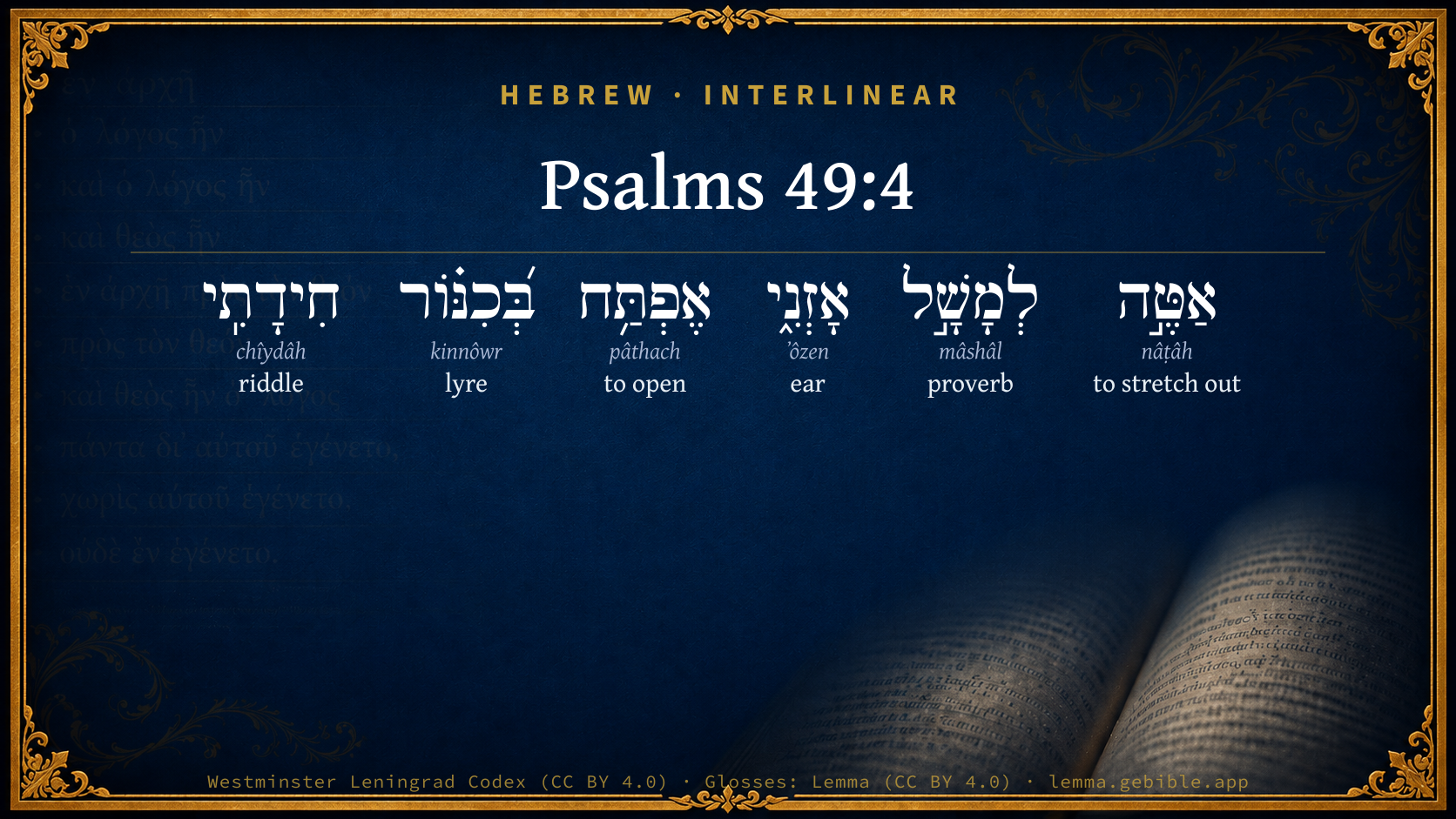
Psalms 49:4

Hebrew (Westminster Leningrad Codex) Psalms 49:4 appears in the Hebrew Old Testament. The text above is from the Westminster Leningrad Codex. Each word links to its Strong’s number, a concise gloss, and parsing drawn from the Open Scriptures Hebrew Bible morphology. Click any word for its full Brown-Driver-Briggs (BDB) entry.
Download image
Cite this verse

Psalms 49:4 (World English Bible). Public Domain. Lemma interlinear Bible study tool, https://lemma.gebible.app/v/psalms/49/4.

Show BibTeX & RIS
BibTeX
RIS
English Translation
I will incline my ear to a proverb. I will open my riddle on the harp.
World English Bible · Public Domain
Download a study sheet

One document with this verse’s original text, its word-by-word gloss line, the meaning frame, cross-references with their text, attributed commentary, and full source and license credits — printable, and it pastes into notes with its structure intact.

This verse Autodidact and up

Study sheet (.html) Plain text (.txt)

A passage Seminary Student

Up to 50 verses in one chapter. A passage sheet keeps up to 6 commentary sources and 12 cross-references per verse, in the order this page ranks them, and says so on the sheet whenever that leaves anything out. Ask for a single verse and you get the Autodidact verse sheet above.

Everything on this page stays free to read, with no account — the sheet is a download of what is already on screen, not access to it.

Want to remove ads? Support Godless Engineer
Compare translations 3

The same verse in 3 English versions, stacked beneath the original-language interlinear above. Click any original word for its lexicon entry.

Each is an independent rendering of the whole verse — the interlinear is not word-aligned to these translations.

Highlighted words mark where these versions differ — a whole-verse word diff, not a word-by-word alignment.

  • World English Bible Public Domain
    I will incline my ear to a proverb. I will open my riddle on the harp.
  • King James Version Public Domain
    I will incline mine ear to a parable: I will open my dark saying upon the harp.
  • unfoldingWord Literal Text CC BY-SA 4.0
    I will incline my ear to a proverb; I will open my enigma with a harp.

unfoldingWord Literal Text — © unfoldingWord, licensed CC BY-SA 4.0. Word-aligned USFM3 via Door43 (git.door43.org/unfoldingWord/en_ult).

Versions to compare (up to 4)

3 of 4 selected

Show all 18 translations

Every available English version of this verse, each an independent rendering of the whole verse.

  • World English Bible Public Domain
    I will incline my ear to a proverb. I will open my riddle on the harp.
  • Berean Standard Bible Public Domain
    I will incline my ear to a proverb; I will express my riddle with the harp:
  • Majority Standard Bible Public Domain
    I will incline my ear to a proverb; I will express my riddle with the harp:
  • King James Version Public Domain
    I will incline mine ear to a parable: I will open my dark saying upon the harp.
  • American Standard Version (1901) Public Domain
    I will incline mine ear to a parable: I will open my dark saying upon the harp.
  • Revised Version (1885) Public Domain
    I will incline mine ear to a parable: I will open my dark saying upon the harp.
  • Geneva Bible (1599) Public Domain
    I will incline mine eare to a parable, and vtter my graue matter vpon the harpe.
  • Douay-Rheims (1899) Public Domain
    My mouth shall speak wisdom: and the meditation of my heart understanding.
  • Young's Literal Translation Public Domain
    I incline to a simile mine ear, I open with a harp my riddle:
  • Literal Standard Version CC BY-SA 4.0
    I incline my ear to an allegory, || I open my riddle with a harp:
  • Unlocked Literal Bible CC BY-SA 4.0
    I will incline my ear to a parable; I will begin my parable with the harp.
  • unfoldingWord Literal Text CC BY-SA 4.0
    I will incline my ear to a proverb; I will open my enigma with a harp.
  • Darby Bible Public Domain
    I will incline mine ear to a parable, I will open my riddle upon the harp.
  • World Messianic Bible Public Domain
    I will incline my ear to a proverb. I will solve my riddle on the harp.
  • Webster's Bible Public Domain
    \\49:3\\My mouth shall speak of wisdom; and the meditation of my heart shall be of understanding.
  • Free Bible Version CC BY-SA 4.0
    I pay attention to wise sayings; I answer hard questions to a tune on the harp.
  • Bible in Basic English Public Domain
    I will put my teaching into a story; I will make my dark sayings clear with music.
  • JPS Tanakh (1917) Public Domain
    (49-5) I will incline mine ear to a parable; I will open my dark saying upon the harp.

Literal Standard Version (2020), Covenant Press — licensed CC BY-SA 4.0. Text via the HelloAO Bible API (eBible.org). Unlocked Literal Bible (unfoldingWord) — licensed CC BY-SA 4.0. Text via the HelloAO Bible API (eBible.org). unfoldingWord Literal Text — © unfoldingWord, licensed CC BY-SA 4.0. Word-aligned USFM3 via Door43 (git.door43.org/unfoldingWord/en_ult). Free Bible Version, Dr. Jonathan Gallagher — licensed CC BY-SA 4.0. Text via the HelloAO Bible API (eBible.org).

Word by word

More ways to search: Search by grammar → Find every occurrence → Compare this word →

Practice this passage: Drill this verse → Learn its vocabulary →

About this verse

These counts appear in no published source. They are computed here, from the morphology-tagged text and Lemma’s own curated glosses. What Lemma adds →

6
words
6
distinct lemmas
Wisdom
section

Notable vocabulary

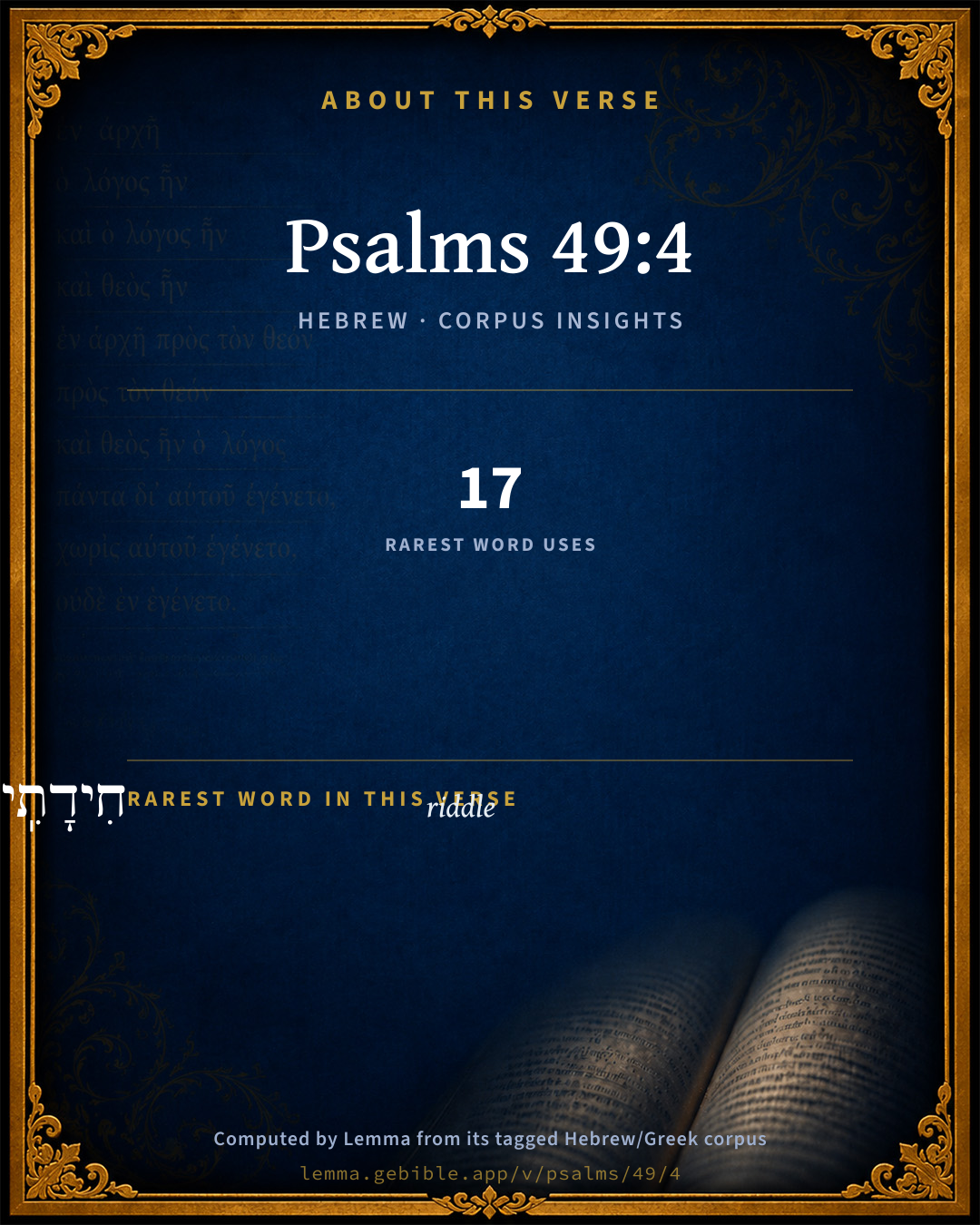
The rarest word here is חִידָתִֽי riddle H2420 — appearing just 17 times in the whole Hebrew Bible.

Shared distinctive vocabulary

חִידָתִֽי riddle H2420 occurs in 17 verses of the Hebrew Bible. Also found in:

Grammatical profile

  • 2 verbs
  • 4 nouns

Verb forms

  • אַטֶּ֣ה Hiphil · Imperfect
  • אֶפְתַּ֥ח Qal · Imperfect

Hebrew & Septuagint length

In English translation the verse runs 16 words from the Hebrew and 16 from the Septuagint (LXX English) — the same length.

A rough comparison of the two English renderings, which tokenize alike — not a word-level alignment.

Word counts can differ between the Hebrew and the Greek without any difference in meaning — e.g. the Hebrew direct-object marker אֵת has no separate Greek word, and Greek often adds the article ὁ.

Cross-references

10

Topical passages linked to Psalms 49:4 in the Treasury of Scripture Knowledge — connected by theme and wording, ordered by reader-vote popularity; previews shown in the World English Bible.

  • Psalms 78:2 I will open my mouth in a parable. I will utter dark sayings of old,
  • Matthew 13:35 that it might be fulfilled which was spoken through the prophet, saying, "I will open my mouth in parables; I will utter things hidden from the foundation of the world."
  • Numbers 12:8 with him will I speak mouth to mouth, even manifestly, and not in dark speeches; and the form of Yahweh shall he see: why then were you not afraid to speak against my servant, against Moses?
  • Numbers 23:7 He took up his parable, and said, From Aram has Balak brought me, The king of Moab from the mountains of the East: Come, curse me Jacob, Come, defy Israel.
  • Matthew 13:11–15 He answered them, "To you it is given to know the mysteries of the Kingdom of Heaven, but it is not given to them.
  • Luke 12:3 Therefore whatever you have said in the darkness will be heard in the light. What you have spoken in the ear in the inner chambers will be proclaimed on the housetops.
  • 2 Corinthians 3:12 Having therefore such a hope, we use great boldness of speech,
  • Proverbs 1:6 To understand a proverb, and parables, The words and riddles of the wise.
  • Ezekiel 20:49 Then said I, Ah Lord Yahweh! they say of me, Isn't he a speaker of parables?
  • Daniel 8:23 In the latter time of their kingdom, when the transgressors are come to the full, a king of fierce face, and understanding dark sentences, shall stand up.

Cross-references courtesy of OpenBible.info (CC BY 4.0).

Hebrew and Greek witnesses Masoretic Hebrew ↔ Greek Septuagint

The same verse in the two great witnesses to the Old Testament, shown verse-for-verse.

You’re reading Greek Psalm 48 (Hebrew Psalm 49). The Septuagint counts the superscription, so verse numbers can differ from the Hebrew — chapter-level alignment, not verse-by-verse. Numbering follows Rahlfs.

These are two independent witnesses, not word-aligned to each other, and the Septuagint is shown in lemma (dictionary) form.

Hebrew Psalms 49:4 Masoretic · Westminster Leningrad Codex

אַטֶּ֣ה לְמָשָׁ֣ל אָזְנִ֑י אֶפְתַּ֥ח בְּ֝כִנּ֗וֹר חִידָתִֽי

I will incline my ear to a proverb. I will open my riddle on the harp.

World English Bible · Public Domain

Greek LXX Greek Psalm 48:4 Septuagint · lemma form

ὁ στόμα ἐγώ λαλέω σοφία καί ὁ μελέτη ὁ καρδία ἐγώ σύνεσις

I will incline my ear to a parable: I will open my riddle on the harp.

LXX2012 (modern English Septuagint) · Public Domain

On this verse, Ellicott's Commentary for English Readers discusses the Septuagint’s reading. Read the note in Commentary ↓

Hebrew: Westminster Leningrad Codex (CC BY 4.0). Greek: Septuagint (public domain); English from LXX2012 (modern English Septuagint) (Public Domain). How the Septuagint differs from the Hebrew →

Commentary

Notes on Psalms 49:4 from classic Christian and Jewish commentators (each source and its license shown beneath its notes). The classic Christian expositions comment on the surrounding passage and are grouped to its opening verse, so a note may address several verses; the Jewish commentaries on the Tanakh (Rashi and others) are per-verse, so they appear only where the commentator wrote on this verse.

Lemma curates 59 commentaries, every one of them public domain or Creative Commons licensed, each selected and text-cleaned for this edition rather than reprinted as found. About our sources →

Trapp's Complete Commentary

John Trapp

Psa 49:4 I will incline mine ear to a parable: I will open my dark saying upon the harp.

Ver. 4. I will incline mine ear to a parable] q.d. I desire you to do no more than I will do myself. I believed, therefore have I spoken; I have wrought my doctrine upon mine own affections first, and shall dig it out of mine own bosom for your benefit. It is a parable I must tell you, or a master sentence, yea, it is a mystery, a riddle, as the other word here signifieth.

I will open my dark sayings] The doctrine of life eternal, and the judgment to come, here more clearly delivered than anywhere else almost in the Old Testament, is a mystery.

John Trapp, A Commentary or Exposition upon All the Books of the Old and New Testament (1647–1656) — public domain. Text from a community e-Sword module.

The Biblical Illustrator

Joseph S. Exell

Psa_49:4

I will open my dark saying upon the harp.

Dark sayings

Some minds are darker than a dark saying. Doubt is cloudland; and cloudland presupposes the existence of some degree of light. In complete darkness no cloud is perceived. The time at which a man begins to doubt is the critical point of life. Doubt in a young and inexperienced mind may develop into a demon of free thought. Much depends upon the way in which doubt is treated by the doubter himself, and by his advisers. Doubt is not a thing to be injudiciously dealt with. Take care how you open a dark saying. The dark saying is any question difficult to answer or hard to solve. Notice that David does not say, I will close up my dark saying--I will fold the serpent up in my bosom, and let it sting me. He says, I will open my dark saying. Often enough a mans peace of mind depends upon the way in which he opens his dark saying. Too often he has to open it himself, without sympathy or help from any one. It may save us some disappointment if we settle it as a general rule that a providential thing does not mean a pleasant thing. Tim ultimate end of Providence is the sanctification of the human heart, and it is not probable that God will sanctify us by letting us have our own way. We frequently apply the term Providence loosely. When we reap worldly advantage we say, It is quite providential. When trouble comes we omit the word. The opposite of this is true as a rule. Prosperity will never wean us from this world, but adversity may. When dark sayings trouble us, let us pray to the Father of lights that He may guide us into all truth. We are vexed and mystified by second causes, because we forget that He is the Great First Cause of all. His providence to us is like a piece of tapestry reversed. We see that a hand has been at work, but the threads are massed in confusion. In the day of account we shall see the other side. David further says upon the harp. Musical instruments are called instruments of God. It is to the Psalms, not to the Proverbs, that the heavy heart turns for consolation. Even when the harp hangs upon the willows, the spirit of song awakes in sympathy with the loved and lost. It was to the Psalms that the suffering Saviour turned in the hour and power of darkness. The introduction of the Gospel into Europe was marked by the strength of song. At midnight Paul and Silas prayed and sang praises to God. Who shall say what resolutions, what ardent longings after purity, and peace, and truth, have been breathed into the souls of men by sacred song? In days when liberty of thought was choked by tyranny, when bigotry warped the understanding and suppressed the truth, what was there left to the people but the emotion of a song? The clark saying was opened upon the harp, and stray seeds of sanctity were germinated by the atmosphere of music, though sometimes it was but the music of some distant chime. By the power of song we are transported into a sphere where selfishness and worldliness have no part; a world where nothing defileth or maketh a lie. Man is the only creature who abuses the gift of sound. From him only comes the jarring note. He can only sing the new song in the world to come. (Henry J. Swallow.)

Dark sayings on a harp

My text points to two principles; first, there is the bowing before, and hearkening to, the mystery of things--the universal, parabolic utterances; and, second, the turning the mystery and the parable into a cheerful song--the dark saying becoming, like the birds song in the covert of the night, a clear stream, without sorrow and without care. Find the cheerful aspect of solemn things. See how sorrow is rounded by cheerfulness; hearken, and you will be able to give a cheerful response to the most solemn views of life. The greatest mystery of all art, perhaps, is music; the soul that leaps from the mere material chords and pipes, and, whilst it emanates from, plays upon the spirit of man. There is a mystery and a meaning in music we can never either expound or explore; and it is felt that those natures, which are the greatest burden and mystery to themselves, find most the solace of song in the combinations of all great sounds; we have known this, it is not always that in joyfulness of heart we sing. The girl oppressed by some great trial and loss, as she bends over her needle, or goes about her house-work, will sing, and, while she sings, finds unconsciously that her song has been her medicine, and has given to her relief. And something like this is a very general experience. Hence we have poetry for all cultured people, and hymns for holy people; and do we not know what it is to become happy while we sing? Good it is sometimes to utter the dark saying to the harp rather than to others; it composes, allays, and tranquillizes the mind while we utter it. Therefore, says David, I will open my dark saying upon the harp. David was a master of the harp, and we see, plainly enough, that to him life was full of dark sayings, uttered with more or less of clearness, coming upon him with more or less of gloom. His dark sayings are abundant. We have often thought together of that wonderful summary of holy genius, the Book of Psalms. He would seem to have given everything to his harp; everywhere, as in the words of the text before us, he was inclining his ear to a parable. To him, it would seem, nature was a great harp, framed, touched and moved by the finger of God, and every object became jubilant, and even prophetic.

I. All scripture itself is a dark saying on a harp. However you regard it, you must be amazed by its mysterious unity, not less by its mysterious murmurs--murmurs as of a distant, infinite sea, or as in a forest we listen to the tones as of strange bells among the far-off boughs. There is a Divine reticence in the Bible; there is aa awful secretiveness. Oh! it is all parable; it is all dark saying! Vainly do I ever think I have exhausted any single word or meaning; it is inspiration and revelation throughout. It is a dark saying, for it is inspiration; it is uttered, for it is a revelation.

II. Man himself is a dark saying on a harp. He is himself a universe of being in which life, and nature and grace seek to combine in music. Consider thy nature: how strange that we should be made thus, strange the opposition between sin and conscience, even in the best of men; strange the contradiction between what man effects and what man is. Has not his history through all time been a dark saying? What is this creature we call man? Is he angel, or is he beast, or is he fiend? for there are things he has done which warrant all these translations, read simply from the sensual eye. And what a mistake the life of man seems! And sometimes, how his failures and his inner conflicts seem to boast of him as of a being built out of the pieces of the wreck of the fall.

III. And providence is a dark saying on a harp. The mysteries of Providence were as startling to David as they are to us, and the very psalm whence I take this text recites and records them; it did not seem to be a world of highways to the psalmist; and this is one of the great causes of grief and of the dark sayings--the world and its sorrows. It is the cry, the incessant cry, Why hast thou made all men in vain? The world is full of dark sayings; it is hieroglyphic all, you feel the incongruity and the contradiction, but you have never felt it so clearly as the Bible has stated it, and especially the psalmists; they perpetually--Asaph, David and others--saw and uttered their sense of the solemn discords of this life. There is a picture I have often turned to look at in the chapel in one of the old palaces of France, and I have sometimes looked, as the dear dreamer said, till the water has found its way to my eyes; it is suspended over the altar--it is the cloud of eternity, and the Ancient of Days is there, and the Lamb is there, and round the circle the harpers harping with their harps--every one robed in white, and every brow bound with the crown--kings and priests unto God and to the Lamb for ever; every eye fixed on the Lamb, as it had been slain, and every crowned form bearing a harp, and striking it to Him that hath loved. To them were given harps. Why, what does it mean? Oh, it tells how the lost life will regain and be restored to its unity. This is that harp, all the chords of the being one, and for ever one. Then, indeed, may we say, I will praise thee on the harp, O God, my God. (E. Paxton Hood.)

Mysteries set to music

I. The mystery of nature. John Stuart Mills arraignment of created things is too well known to be repeated. A more recent writer is Mr. Laing, who says in his Modern Science and Modern Thought, Is it true that love is creations finest law, when we find this enormous and apparently prodigal waste of life going on; these cruel internecine battles between individuals and species in the struggle for existence; this cynical indifference of nature to suffering? There are approximately 3,600 millions of deaths of human beings in every century, of whom at least 20 per cent., or 720 millions, die before they have attained to clear self-consciousness and conscience. What becomes of them? Why were they born? Axe they natures failures and cast as rubbish to the void? To such questions there is no answer. Perhaps it is wrong to say there is no answer, for considerations exist in plenty which tone down the harsher aspects of natures work. But when this is admitted there remains much that is enigmatical. Now, the effect of this mystery upon some minds is to drive them into pessimism; it is a mystery whose discord is for ever jarring on their ears. Not so with the man who walks by faith. He says, I believe in God, and instantly there is harmony. Nature has mysteries still, but they are set to music.

II. The mystery of suffering. Huxley says, If there is one thing plainer than another, it is that neither the pleasure nor the pains of life, in the merely animal world, are distributed according to desert, for it is admittedly impossible for the lower order of sentient beings to deserve either the one or the other. If there is a generalization from the facts of human life which has the assent of thoughtful men in every age and country it is that the violator of ethical rules constantly escapes the punishment he deserves; that the wicked flourishes like a green bay tree while the righteous begs his bread; that the sins of their fathers are visited upon the children; that in the realm of nature ignorance is punished just as severely as wilful wrong; and that thousands upon thousands of innocent beings suffer for the crime or unintentional trespass of one. (Evolution and Ethics, p. 12.)

The professors statements are not cast in such a form as to be above challenge, but they may be taken as indicative of the attitude of many towards the problem of suffering. Broken law will explain much of the worlds woe, perhaps more than we are apt to imagine; and the educative influence of suffering is not far to seek. Thou hast enlarged me when I was in distress. But after all there remains much that is mysterious; very often moral sequences seem to fail entirely, and the good man dies in his struggles to do right, whilst the prosperous sinner lives to satirize every sound principle of commercial morality. Hence we have the cynic in our midst, and the pessimist is always within shouting distance. But the man who discerns spiritual things after a spiritual manner can feel something more than hard and unexplainable facts in the problem of suffering. God is behind it, he says, and therefore all is well. The mystery has lost its bitterness; it is still a dark saying, but it is a dark saying upon the harp.

III. The mystery of death. Mr. Goldwin Smith looking at death and destruction in all grades of creation says, Our satellite, so far as we can see, is either a miscarriage or a wreck, and if omnipotence and benevolence are to meet it must apparently be at a point at present beyond our ken. Mr. Smith answers himself when he says, so far as we can see. Without God and immortality, the despair of the present generation is the most natural product of mental inquiry; the picture of blighted prospects and incompleted lives stricken down by the hand of death is enough to appal the stoutest heart. But in Christ all mysteries are set to music. It was the superior music of Orpheus which saved him from shipwreck on the sirens shore, and since hope springs eternal in the human breast, Christianity, as a gospel of glad tidings, will always play other tunes than the note of wailing and despair; in the future, as in the past, her better music will be the worlds salvation. (T. S. Knowlson.)

Mysteries set to music

In seeking to get instruction from the text, we may regard it broadly as inculcating the principle, that the dark problems of the world may be so understood, that instead of leading us to despair they become a source of light and hope and joy.

I. The problem of the divine existence. This is the first of all problems--the earliest, the most necessary, the most irresistible. Primeval man long ago had to face it as we have to face it to-day. For the savage dwelling in the rude cave, or in the log-hut, reared on piles driven into the ground in the centre of a lonely lake, this was the principal theme of speculation, even as it is still the question which by its vastness wearies the strongest thought, and baffles the keenest insight. The first of all questions is, at the same time, the darkest. Interrogate Nature, and what is it that it tells you? It tells of a first cause, powerful, mighty and omnipotent. It points to a force that is infinite, a wisdom that is transcendent, and a will that is all-dominant. But it speaks of more than this. It speaks of a law that is invariable, relentless and cruel. It has its tale of pain, and suffering, and sorrow, and death. If it glories in the sunshine and the rain, it recounts with grief the story of the plague and the earthquake, and the unceasing strife of man, and beast, and earth, and sea, and sky. Over all there is the one necessity, for all there is the same struggle.

II. The problem of the world. How did the world come into being? Is it the result of chance, of fate, of a blind force working how and as it may? No millions of years, no unimaginable stretches of time, can bring the existent out of the non-existent, the intelligent out of the non-intelligent, the cosmos out of the chaos. How, then, can we open this dark saying of the worlds history on the harp? How can we set it to harmony and rhythm and music? There is one way only that I know. Behind the world there is a Divine Person; in the movements and the laws of the world there is a Divine will. All comes from God; all is under His care and governance.

III. The problem of mans life. Taken as he is, and apart from his relation to God, mans life is inexplicable. It is a contradiction, without meaning or purpose. There is in it the high and the low, the pure and the impure, the spiritual and the material. It is divided in interest; it is driven this way and that; and oftentimes it becomes the sport of a power and a fate that are too much for it. But, in the light of the Divine love, and the mediation of Jesus, this enigma of the human life becomes plain.

IV. The progress of humanity. Nation follows nation, kingdoms and dynasties rise and fall, and there seems to be no real progress. Civilizations are more or less relative. We in these last times, notwithstanding our marvellous modern science and discovery, are, in some respects, behind the ancient Egyptians and Greeks, and Romans, or even the Celts and the Scandinavians. Is there any progress then at all as the result of the conflict of the ages? Is life in the main stationary, or does it like a mighty wheel go round and round for ever? The key to this question can alone be found in Christianity. It has already infused new life into the nations, it has re.created their moral standards, and it has given them a pre-eminence which the old Pagan peoples never knew. It has done all this because it has set before men not only an infinite hope, but because it has supplied them with the motive and the power to realize it. It has given them a new ideal, it has also provided them with a new dynamic, or force, by which they can attain the ideal. We need have no fear for the future. Humanity, instead of having become effete and lived its day, is only setting out on the line of infinite progress that stretches before it. Much it has done in the past, much it has achieved in these modern times; but infinitely more will it yet achieve before its course is run. Physically, intellectually, morally, the race has still before it a boundless destiny. (R. Munro, B. D.)

The harp of the godly

I. Why are the words of godly life in scripture called dark sayings?

1. Because they are so far to seek. From the Creator, not the creature; from eternity, not from time.

2. Because they are so little known. The world disregards them.

3. Because they meet with so much repugnance. All the impulses of our depraved nature are averse and hostile to the wisdom that sanetifieth. Oh, how difficult to understand what opposes our hearts propensities!

II. Why are the details of providence in scripture called dark savings?

1. Because the specific designs of Providence are concealed. A man knows not whether in any enterprise, though he has scrutinized his motive and implored Divine direction, he is to fail or succeed. Through his failures may come his truest successes.

2. Because the aim of Providence is overlooked (Eph_3:1-21.; Joh_2:1-25.). We fix our eyes on outward things, and call prosperity and adversity after them. That is a bright Providence wherein these abound, and a dark one whereby these are smitten. Now God looks at our souls;--their liberty from earthly fetters; their confidence in Divine support; their formation and sustenance of holy purpose; their culture and maturity of moral character.

3. Because the dispensations of Providence inflict pain and distress. What a dark passage leads to conversion!

III. Why may a Christian open these upon the harp?

1. Because God has put a harp into your hands. It would be ungrateful not to use this. Do you ask what this is? I reply, The Gospel in all its plenitude of mercy, remedy, promise, prospect.

2. Because your dark sayings are thus opened, i.e. they become clear and plain. Devotion illuminates the mind. While you are musing the fire kindles and burns.

3. Because every true prayer is a prophecy. The evils it deprecates will assuredly pass away. (W. Wheeler.)

The Biblical Illustrator, edited by Joseph S. Exell (c. 1880s–1900s) — public domain. Text from a community e-Sword module.

J. A. Alexander on Psalms

Joseph Addison Alexander

5. (Psa 49:4). I will incline to a parable my ear, and open with a harp my riddle. I will hear what God says, and impart it to others. To incline (or bend) the ear is to lean forward as a sign or gesture of attention. See above, on Psa 17:6; Psa 31:3 (2), 40:2 (1). Parable, literally likeness or comparison; then any figurative, tropical expression. See above, on Psa 44:15 (14). The parallel word here means an enigma, something hard to understand. To open it is not to begin it, but either to utter it or to explain it, probably the latter. What he hears from God he will open or expound to man. With the harp indicates the form in which his exposition is to be presented, namely, that of a lyrical composition, intended to be sung with an instrumental accompaniment. See above, on Psa 33:2; Psa 47:4.

Joseph Addison Alexander, The Psalms Translated and Explained (1850) — public domain. Text from a community e-Sword module.

Tyndale Open Study Notes

Tyndale Open Resources

49:4 The teacher used both proverbs and riddles for instruction in wisdom (see Prov 1:5-6).

Tyndale Open Study Notes — © Tyndale Open Resources, licensed CC BY-SA 4.0. Text via the HelloAO Bible API.

Jamieson, Fausset & Brown

Robert Jamieson, A. R. Fausset & David Brown

incline--to hear attentively (Psa 17:6; Psa 31:2).

parable--In Hebrew and Greek "parable" and "proverb" are translations of the same word. It denotes a comparison, or form of speech, which under one image includes many, and is expressive of a general truth capable of various illustrations. Hence it may be used for the illustration itself. For the former sense, "proverb" (that is, one word for several) is the usual English term, and for the latter, in which comparison is prominent, "parable" (that is, one thing laid by another). The distinction is not always observed, since here, and in Psa 78:2; "proverb" would better express the style of the composition (compare also Pro 26:7, Pro 26:9; Hab 2:6; Joh 16:25, Joh 16:29). Such forms of speech are often very figurative and also obscure (compare Mat 13:12-15). Hence the use of the parallel word--

dark saying--or, "riddle" (compare Eze 17:2).

open--is to explain.

upon the harp--the accompaniment for a lyric.

Jamieson, Fausset & Brown — Commentary Critical and Explanatory on the Whole Bible (1871) — public domain (CC PDM 1.0). Text via the HelloAO Bible API.

Adam Clarke's Commentary

Verse 4. I will incline mine ear to a parable] This was the general method of conveying instruction among the Asiatics. They used much figure and metaphor to induce the reader to study deeply in order to find out the meaning. This had its use; it obliged men to think and reflect deeply; and thus in some measure taught them the use, government, and management of their minds.

My dark saying upon the harp.] Music was sometimes used to soothe the animal spirits, and thus prepare the mind for the prophetic influx.

Adam Clarke's Commentary on the Bible (1810–1826) — public domain. Text from a community e-Sword/MySword module.

John Calvin's Commentaries

4. I will incline my ear to a parable The Hebrew word משל, mashal, which I have translated parable, properly denotes a similitude; but it is often applied to any deep or weighty sayings, because these are generally embellished with figures and metaphors. The noun which follows, חידת, chidoth and which I have rendered an enigma, or riddle, is to be understood in nearly the same sense. In Ezekiel 17:2, we have both the nouns with their corresponding verbs joined together, חור חידה ומשל משל, chud chedah umshol mashal, the literal translation being, “Enigmatize an enigma, and parabolize a parable.” I am aware that the reference in this place is to an allegorical discourse, but I have already adverted to the reason why, in Hebrew, the name of enigmas or similitudes is given to any remarkable or important sayings. The Psalmist, when he adds that he will open his dark saying, shows that nothing was farther from his intention than to wrap the subject of his discourse in perplexing and intricate obscurity. The truths of revelation are so high as to exceed our comprehension; but, at the same time, the Holy Spirit has accommodated them so far to our capacity, as to render all Scripture profitable for instruction. None can plead ignorance: for the deepest and most difficult doctrines are made plain to the most simple and unlettered of mankind. I see little force in the idea suggested by several interpreters, of the Psalmist having employed his harp, that he might render a subject in itself harsh and disagreeable more engaging by the charms of music. He would merely follow the usual practice of accompanying the psalm with the harp.

John Calvin's Commentaries (1540-1563) — public domain. Text from the Calvin Translation Society English edition (1840s-50s) via the Christian Classics Ethereal Library (ccel.org). Calvin's coverage is partial (roughly two-thirds of the Bible); uncommented books and verses are honest gaps, never fabricated. The 19th-century editor's footnotes and remarks are omitted so the notes are faithfully Calvin's own voice.

Ellicott's Commentary for English Readers

(4) I will incline mine ear.—The psalmist first listens, that he may himself catch the inspiration which is to reach others through his song. It was an obvious metaphor in a nation to whom God’s voice was audible, as it was to Wordsworth, for whom nature had an audible voice:

“The stars of midnight shall be dear

To her; and she shall lend her ear

In many a secret place,

Where rivulets dance their wayward round,

And beauty, born of murmuring sound,

Shall pass into her face.”

Parable.—Heb. mâshal, root idea, similitude. It is the term used of Balaam’s prophecies, and of the eloquent speeches of Job. Hence here proverb-song (Ewald), since the psalmist intends his composition for musical accompaniment.

Dark saying.—Either from a root meaning to tie, and so “a knotty point;” or to sharpen, and so a sharp, incisive saying. The LXX. and Vulgate have “problem,” “proposition.”

To open the riddle is not to solve it, but to propound it, as we say to “open a discourse.” (Comp. St. Paul’s phrase, “opening and alleging.”) The full phrase is probably found in Pro_31:26, “She openeth her mouth with wisdom.’”

A Bible Commentary for English Readers, edited by Charles John Ellicott (1878–1897) — public domain. Text from a community e-Sword module.

The Cambridge Bible for Schools and Colleges

gen. ed. J. J. S. Perowne

4. The poet receives by revelation what he desires to teach. He will bend his ear to listen to the voice of God before he ventures himself to speak to men. Mâshâl, rendered parable, means (1) primarily a comparison, (2) a proverb, as frequently involving a comparison, (3) a parable, as the extension of a proverb, (4) a poem, either contemptuous (Isa_14:4) or didactic, as here. Chîdâh, denotes (1) an enigma or riddle (Jdg_14:12 f.; 1Ki_10:1), (2) a parable or simile (Eze_17:2), (3) any profound or obscure utterance, a problem, dark saying. Both words occur together in Psa_78:2; Pro_1:6; Eze_17:2. The prosperity of the godless was one of the great ‘enigmas of life’ to the pious Israelite, demanding a solution which could only be partially given before the fuller revelation of Christ “brought life and immortality to light.” What he has learned on this perplexing question he will open upon the harp, set it forth in a poem accompanied by music.

The Cambridge Bible for Schools and Colleges (gen. ed. J. J. S. Perowne; Cambridge University Press, 1878–1918) — public domain. Text from a community e-Sword module.

John Gill's Exposition

I will incline mine ear to a parable,.... In which way of speaking the doctrines of the Gospel were delivered out by Christ, Mat 13:3. Wherefore the prophet, representing his apostles and disciples, signifies that he would listen thereunto, that he might attain to the knowledge thereof, and communicate it to others;

I will open my dark saying upon the harp; the enigmas, riddles, and mysteries of the Gospel, being understood by the ministers of it, are opened and explained in a very pleasant and delightful manner; they are made clear and evident, and are as a lovely song upon a harp; see Eze 33:32.

John Gill's Exposition of the Whole Bible (1746–1763) — public domain (CC PDM 1.0). Text via the HelloAO Bible API.

Albert Barnes' Notes on the Bible

I will incline mine ear to a parable - The phrase “I will incline mine ear” means that he would listen or attend to - as we incline our ear toward those whom we are anxious to hear, or in the direction from which a sound seems to come. Compare Psa 5:1; Psa 17:1; Psa 39:12; Isa 1:2. On the word rendered “parable” here משׁל mâshâl - see the notes at Isa 14:4. Compare Job 13:12, note; Job 27:1, note. The word properly means similitude; then, a sentence, sententious saying, apophthegm; then, a proverb; then, a song or poem. There is usually found in the word some idea of “comparison,” and hence, usually something that is to be illustrated “by” a comparison or a story. The reference here would seem to be to some dark or obscure subject which needed to be illustrated; which it was not easy to understand; which had given the writer, as well as others, perplexity and difficulty. He proposed now, with a view to understand and explain it, to place his ear, as it were, “close to the matter,” that he might clearly comprehend it. The matter was difficult, but he felt assured he could explain it - as when one unfolds the meaning of an enigma. The “problem” - the “parable” - the difficult point - related to the right use, or the proper value, of wealth, or the estimate in which it should be held by those who possessed it, and by those who did not. It was very evident to the author of the psalm that the views of people were not right on the subject; he therefore proposed to examine the matter carefully, and to state the exact truth.

I will open - I will explain; I will communicate the result of my careful inquiries.

My dark saying - The word used here - חידה chı̂ydâh - is rendered “dark speeches” in Num 12:8; “riddle,” in Jdg 14:12-19; Eze 17:2; “hard questions” in 1Ki 10:1; 2Ch 9:1; “dark saying” (as here) in Psa 78:2; Pro 1:6; “dark sentences,” in Dan 8:23; and “proverb” in Hab 2:6. It does not elsewhere occur. It means properly “something entangled, intricate;” then, a trick or stratagem; then art intricate speech, a riddle; then, a sententious saying, a maxim; then a parable, a poem, a song, a proverb. The idea here is, that the point was intricate or obscure; it was not well understood, and he purposed “to lay it open,” and to make it plain.

Upon the harp - On the meaning of the word used here, see the notes at Isa 5:12. The idea here is, that he would accompany the explanation with music, or would so express it that it might be accompanied with music; that is, he would give it a poetic form - a form such that the sentiment might be used in public worship, and might be impressed upon the mind by all the force and power which music would impart. Sentiments of purity and truth, and sentiments of pollution and falsehood also, are always most deeply imbedded in the minds of people, and are made most enduring and effective, when they are connected with music. Thus the sentiments of patriotism are perpetuated and impressed in song; and thus sentiments of sensuality and pollution owe much of their permanence and power to the fact that they are expressed in corrupt verse, and that they are perpetuated in exquisite poetry, and are accompanied with song. Scenes of revelry, as well as acts of devotion, are kept up by song. Religion proposes to take advantage of this principle in our nature by connecting the sentiments of piety with the sweetness of verse, and by impressing and perpetuating those sentiments through associating them with all that is tender, pure, and inspiriting in music. Hence, music, both vocal and that which is produced by instruments, has always been found to be an invaluable auxiliary in securing the proper impression of truth on the minds of people, as well as in giving utterance to the sentiments of piety in devotion.

Albert Barnes' Notes on the Bible (1834–1885) — public domain. Text from a community e-Sword/MySword module.

Matthew Poole's English Annotations

I will incline mine ear: this is another argument to persuade them to hearken to him: I will hearken what God by his Spirit speaks to me, and that and nothing else will I now speak to you; and therefore it is well worth your hearing. I also shall join with you in attending to it, that whilst I teach you, I myself may learn the same lesson. For as ministers now teach themselves whilst they teach others, so the holy prophets did ofttimes search into and study to find out the meaning of their own prophecies, as appears plainly from 1Pe 1:10,11. The phrase is thought to be taken from the musicians, who lay their ear close to the instrument when they tune it, and by their ear try how the voice and instrument agree.

To a parable; which properly is a figurative and allegorical speech, but is oft more largely taken for any excellent, and important, and withal dark or difficult, doctrine or sentence: see Num 23:7; 24:3,15; Psa 78:2, compared with Mat 13:35.

I will open, i.e. I will not smother it in my own breast, but publish it to the world.

My dark saying; so he justly calls the following discourse, because the thing in question is and ever hath been thought difficult and hard to be understood.

Matthew Poole's English Annotations on the Holy Bible (1683–1685) — public domain. Text from a community e-Sword/MySword module.

The Treasury of David

Charles H. Spurgeon

Ver. 4. I will incline mine ear to a parable. He who would have others hear, begins by hearing himself. As the minstrel leans his ear to his harp, so must the preacher give his whole soul to his ministry. The truth came to the psalmist as a parable, and he endeavoured to unriddle it for popular use; he would not leave the truth in obscurity, but he listened to its voice till he so well understood it as to be able to interpret and translate it into the common language of the multitude. Still of necessity it would remain a problem, and a dark saying to the unenlightened many, but this would not be the songster's fault, for, saith he, I will open my dark saying upon the harp. The writer was no mystic, delighting in deep and cloudy things, yet he was not afraid of the most profound topics; he tried to open the treasures of darkness, and to uplift pearls from the deep. To win attention he cast his proverbial philosophy into the form of song, and tuned his harp to the solemn tone of his subject. Let us gather round the minstrel of the King of kings, and hear the Psalm which first was led by the chief musician, as the chorus of the sons of Korah lifted up their voices in the temple.

Ver. 4. I will incline mine ear to a parable, i.e, I will diligently attend, that I may not sing anything ungracefully; a metaphor taken from musicians who bring their ear close to the harp, that they may ascertain the harmony of the sound. Victorinus Bythner.

None.

Psalms 49:5*

Charles H. Spurgeon's The Treasury of David (1869–1885) — public domain. Psalms only. Text from a community e-Sword/MySword module.

Whedon's Commentary on the Bible

Daniel D. Whedon

4. A parable—A poem where similitude is used, and things profound and spiritual are made more clear by comparison with things objective and sensible.

Dark saying—That which lies beyond the realm of sense, particularly revelations or oracles from God. Same as “parables,” just named.

Upon the harp—That is, poetically. In this form the bards of a people, in the earlier ages, often preserved important matter; (see an instance in Num_21:27;) but especially prophets and inspired men commonly delivered their messages in the diction, if not in the rhythm, of poetry.

Daniel D. Whedon (gen. ed.), Commentary on the Old and New Testaments (1874–1909) — public domain. Text from a community e-Sword module.

The Pulpit Commentary

I will incline mine ear to a parable. The psalmist is "like a minstrel who has to play a piece of music put into his hands. The strain is none of his own devising; and as he proceeds, each note awakes in him a mysterious echo, which he would fain catch and retain in memory" (Kay). A parable" in the Old Testament means any enigmatical or dark saying, into which much metaphor or imagery is introduced, so that it is only fwnan sunetoisi . I will open my dark saying upon the harp; i.e. with a harp accompaniment. Music was a help to inspired persons in the delivery of messages which they were commissioned to deliver. (see 1Sa_10:5 2Ki_3:15)

The Pulpit Commentary (1880–1919), ed. H.D.M. Spence-Jones & Joseph S. Exell — public domain. Text from a community e-Sword module.

John Wesley's Explanatory Notes

I will - I will hearken what God by his Spirit speaks to me, and that will I now speak to you. A parable - Which properly is an allegorical speech, but is often taken for an important, and withal, dark doctrine or sentence. Open - I will not smother it in my own breast, but publish it to the world. Dark - So he calls the following discourse, because the thing in question ever hath been thought hard to be understood.

John Wesley, Explanatory Notes Upon the Whole Bible (1754–1765) — public domain. Text via the GEBible commentary corpus.

Rashi

Rabbi Shlomo Yitzchaki (Rashi)

and the thoughts of my heart are understanding The thoughts of my heart are understanding.

Rashi on the Tanakh — English translations: “The Judaica Press complete Tanach with Rashi, translated by A. J. Rosenberg” (CC BY 4.0); “Pentateuch with Rashi's commentary by M. Rosenbaum and A.M. Silbermann, 1929-1934” (public domain); “The Metsudah Tanach series, Lakewood, N.J” (CC BY 4.0); and “The Book of Joshua, Metsudah Publications, 1997” (CC BY 4.0). Text via Sefaria.

Ibn Ezra

Rabbi Abraham ibn Ezra

"My mouth" - to teach all the wisdom hidden from them, which those wise of heart explain by riddles.

And "thoughts and insights" - that my heart thought.

Ibn Ezra on the Tanakh — English translations: “Sefaria Community Translation” (CC0 1.0 (public-domain dedication)); “Yalkut, Sifsei Chachomim Chumash, Metsudah Publications, 2009” (CC BY 4.0); and “Commentary of Ibn Ezra on Isaiah - trans. by M. Friedlander, 1873” (public domain). Text via Sefaria.

Lesson kit

Teaching starters — assembled from the data on this page, not authored interpretation. Every prompt links to the verse data it draws on. Edit before teaching.

Psalms, in the Wisdom, opens this verse with 6 words (6 distinct Hebrew lemmas). Its most distinctive word is chîydâh (“riddle”). A historical commentator’s framing appears above. Read the whole chapter for the surrounding context.

Discussion questions

  1. How does “riddle” (chîydâh) shape what this verse is saying?
  2. How does Numbers 12:8, which shares the word «riddle», read alongside this verse?
  3. The translations on this page render this verse differently — a whole-verse word diff, not a word-by-word alignment. What might account for the different wordings?
  4. «אַטֶּ֣ה» is a Hiphil Imperfect verb. How does that grammatical form shape the action described?
  5. Compare how Trapp's Complete Commentary and The Biblical Illustrator read this verse. Where do they agree or differ?

Things to notice

Reading settings

Reading text

Shown beneath each verse's original-language words.

Old Testament
Old Testament edition

Read the OT as the Masoretic Hebrew (MT) or the Greek Septuagint (LXX).

English shown for the Greek Septuagint (in the Hebrew ↔ Greek comparison).

Comparing translations? Open the Compare panel on any verse page to stack up to four side by side.