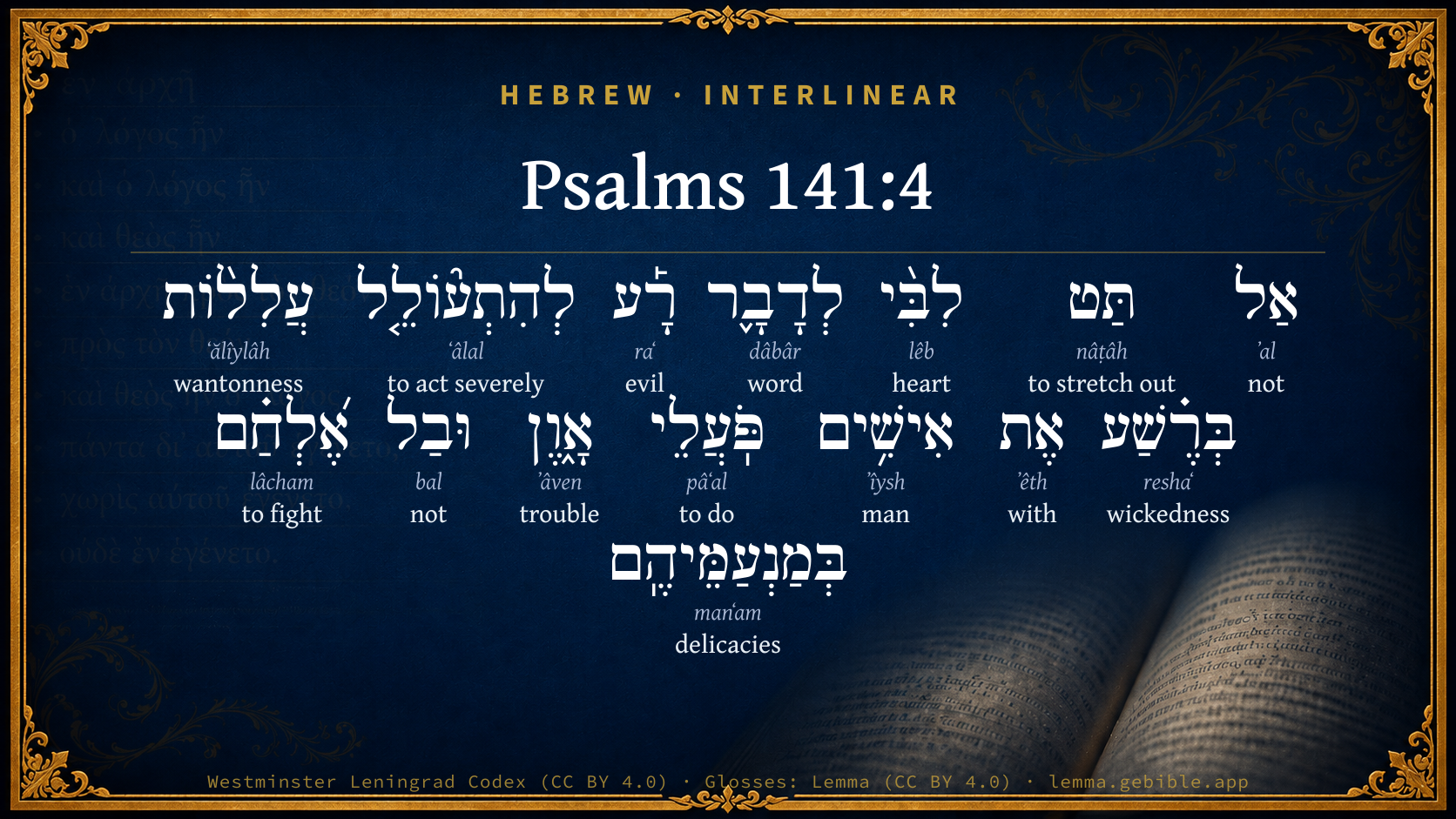
Psalms 141:4

Hebrew (Westminster Leningrad Codex) Psalms 141:4 appears in the Hebrew Old Testament. The text above is from the Westminster Leningrad Codex. Each word links to its Strong’s number, a concise gloss, and parsing drawn from the Open Scriptures Hebrew Bible morphology. Click any word for its full Brown-Driver-Briggs (BDB) entry.
Download image
Cite this verse

Psalms 141:4 (World English Bible). Public Domain. Lemma interlinear Bible study tool, https://lemma.gebible.app/v/psalms/141/4.

Show BibTeX & RIS
BibTeX
RIS
English Translation
Don't incline my heart to any evil thing, To practice deeds of wickedness with men who work iniquity. Don't let me eat of their delicacies.
World English Bible · Public Domain
Highlights
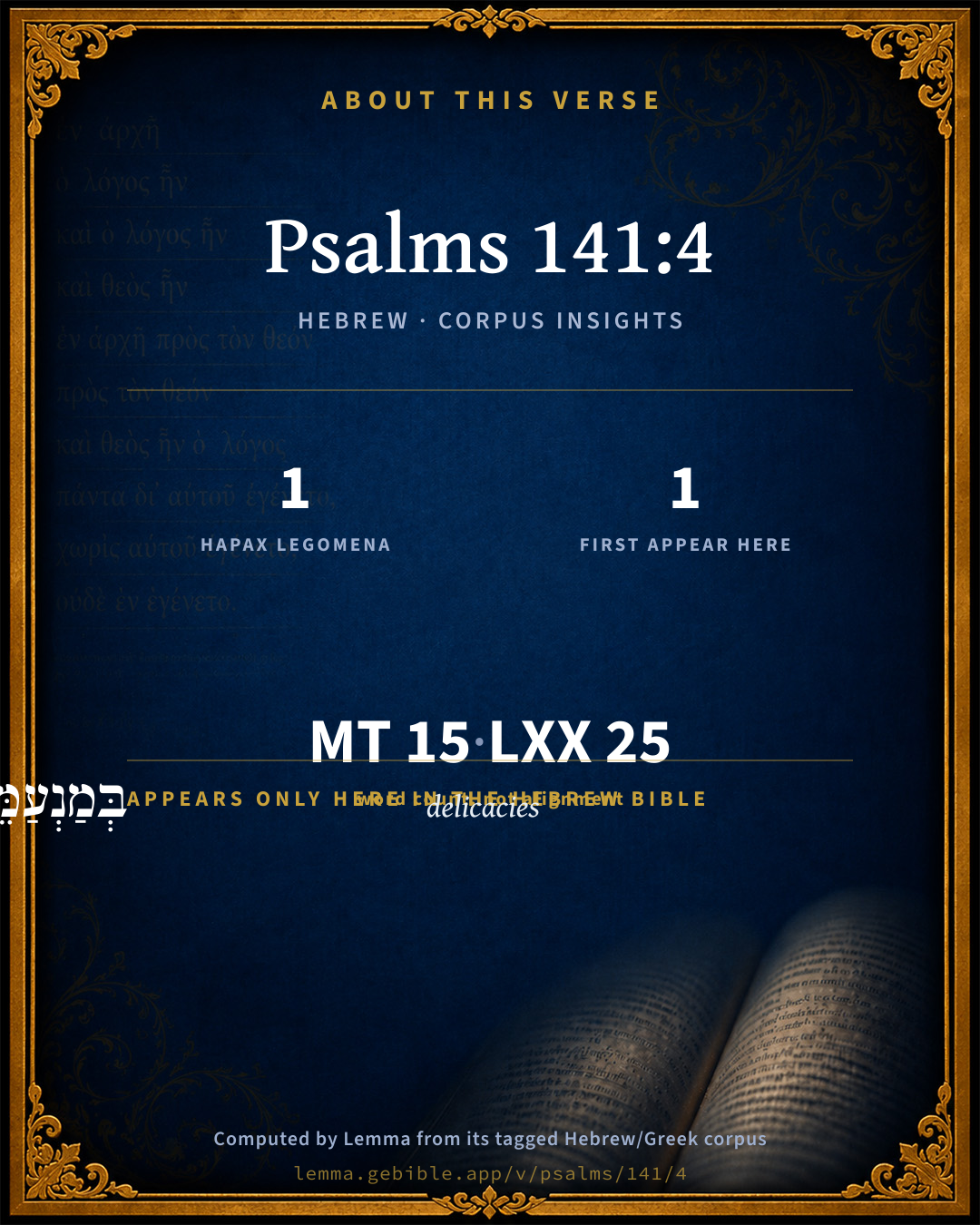
  • 1 hapax legomenon — only here in the Hebrew Bible
  • 1 first appearance in the Hebrew Bible
Full analysis ↓
Download a study sheet

One document with this verse’s original text, its word-by-word gloss line, the meaning frame, cross-references with their text, attributed commentary, and full source and license credits — printable, and it pastes into notes with its structure intact.

This verse Autodidact and up

Study sheet (.html) Plain text (.txt)

A passage Seminary Student

Up to 50 verses in one chapter. A passage sheet keeps up to 6 commentary sources and 12 cross-references per verse, in the order this page ranks them, and says so on the sheet whenever that leaves anything out. Ask for a single verse and you get the Autodidact verse sheet above.

Everything on this page stays free to read, with no account — the sheet is a download of what is already on screen, not access to it.

Want to remove ads? Support Godless Engineer
Compare translations 3

The same verse in 3 English versions, stacked beneath the original-language interlinear above. Click any original word for its lexicon entry.

Each is an independent rendering of the whole verse — the interlinear is not word-aligned to these translations.

Highlighted words mark where these versions differ — a whole-verse word diff, not a word-by-word alignment.

  • World English Bible Public Domain
    Don't incline my heart to any evil thing, To practice deeds of wickedness with men who work iniquity. Don't let me eat of their delicacies.
  • King James Version Public Domain
    Incline not my heart to any evil thing, to practise wicked works with men that work iniquity: and let me not eat of their dainties.
  • unfoldingWord Literal Text CC BY-SA 4.0
    Do not turn my heart toward an evil thing to wantonly act in activities in wickedness with men, doers of evil. And may I not dine on their delicacies.

unfoldingWord Literal Text — © unfoldingWord, licensed CC BY-SA 4.0. Word-aligned USFM3 via Door43 (git.door43.org/unfoldingWord/en_ult).

Versions to compare (up to 4)

3 of 4 selected

Show all 18 translations

Every available English version of this verse, each an independent rendering of the whole verse.

  • World English Bible Public Domain
    Don't incline my heart to any evil thing, To practice deeds of wickedness with men who work iniquity. Don't let me eat of their delicacies.
  • Berean Standard Bible Public Domain
    Do not let my heart be drawn to any evil thing or take part in works of wickedness with men who do iniquity; let me not feast on their delicacies.
  • Majority Standard Bible Public Domain
    Do not let my heart be drawn to any evil thing or take part in works of wickedness with men who do iniquity; let me not feast on their delicacies.
  • King James Version Public Domain
    Incline not my heart to any evil thing, to practise wicked works with men that work iniquity: and let me not eat of their dainties.
  • American Standard Version (1901) Public Domain
    Incline not my heart to any evil thing, To practise deeds of wickedness With men that work iniquity: And let me not eat of their dainties.
  • Revised Version (1885) Public Domain
    Incline not my heart to any evil thing, to be occupied in deeds of wickedness with men that work iniquity: and let me not eat of their dainties.
  • Geneva Bible (1599) Public Domain
    Incline not mine heart to euill, that I should commit wicked workes with men that worke iniquitie: and let me not eate of their delicates.
  • Douay-Rheims (1899) Public Domain
    They have sharpened their tongues like a serpent: the venom of saps is under their lips.
  • Young's Literal Translation Public Domain
    Incline not my heart to an evil thing, To do habitually actions in wickedness, With men working iniquity, Yea, I eat not of their pleasant things.
  • Literal Standard Version CC BY-SA 4.0
    Do not incline my heart to an evil thing, || To habitually do actions in wickedness, || Working iniquity with men, || Indeed, I do not eat of their pleasant things.
  • Unlocked Literal Bible CC BY-SA 4.0
    Do not let my heart desire any evil thing or participate in sinful activities with men who behave wickedly. May I not eat any of their delicacies.
  • unfoldingWord Literal Text CC BY-SA 4.0
    Do not turn my heart toward an evil thing to wantonly act in activities in wickedness with men, doers of evil. And may I not dine on their delicacies.
  • Darby Bible Public Domain
    Incline not my heart to any evil thing, to practise deeds of wickedness with men that are workers of iniquity; and let me not eat of their dainties.
  • World Messianic Bible Public Domain
    Don’t incline my heart to any evil thing, to practice deeds of wickedness with men who work iniquity. Don’t let me eat of their delicacies.
  • Webster's Bible Public Domain
    Incline not my heart to any evil thing, to practice wicked works with men that work iniquity: and let me not eat of their dainties.
  • Free Bible Version CC BY-SA 4.0
    Don't let me think about evil things or take part in doing anything wrong with wicked people. I won't join in eating fancy food at their feasts.
  • Bible in Basic English Public Domain
    Keep my heart from desiring any evil thing, or from taking part in the sins of the evil-doers with men who do wrong: and let me have no part in their good things.
  • JPS Tanakh (1917) Public Domain
    Incline not my heart to any evil thing, to be occupied in deeds of wickedness with men that work iniquity; and let me not eat of their dainties.

Literal Standard Version (2020), Covenant Press — licensed CC BY-SA 4.0. Text via the HelloAO Bible API (eBible.org). Unlocked Literal Bible (unfoldingWord) — licensed CC BY-SA 4.0. Text via the HelloAO Bible API (eBible.org). unfoldingWord Literal Text — © unfoldingWord, licensed CC BY-SA 4.0. Word-aligned USFM3 via Door43 (git.door43.org/unfoldingWord/en_ult). Free Bible Version, Dr. Jonathan Gallagher — licensed CC BY-SA 4.0. Text via the HelloAO Bible API (eBible.org).

Word by word

More ways to search: Search by grammar → Find every occurrence → Compare this word →

Practice this passage: Drill this verse → Learn its vocabulary →

בְּמַנְעַמֵּיהֶֽם
manʻam
H4516
“in/at · delicacies · their”
Preposition + Noun, Common, Masculine, Plural, Construct + Suffix, Personal, 3rd Person, Masculine, Plural
Part of Speech
Preposition + Noun
Type
Common
Gender
Masculine
Number
Plural
State
Construct
Full BDB Definition

Origin: from H5276

TWOT: 1384d

delicacies, dainties
  1. אַל ʼal H408 “not” Particle, Negative
  2. תַּט nâṭâh H5186 “to stretch out” Verb, Hiphil, Jussive, 2nd Person, Masculine, Singular
  3. לִבִּ֨י lêb H3820 “heart · my” Noun, Common, Masculine, Singular, Construct + Suffix, Personal, 1st Person, Common, Singular
  4. לְדָבָ֪ר dâbâr H1697 “to/for · word” Preposition + Noun, Common, Masculine, Singular, Absolute
  5. רָ֡ע raʻ H7451 “evil” Adjective, Adjective, Masculine, Singular, Absolute
  6. לְהִתְע֘וֹלֵ֤ל ʻâlal H5953 “to act severely” Preposition + Verb, Hithpolel, Infinitive Construct
  7. עֲלִל֨וֹת ʻălîylâh H5949 “deeds” Noun, Common, Feminine, Plural, Absolute
  8. בְּרֶ֗שַׁע reshaʻ H7562 “in/at · wickedness” Preposition + Noun, Common, Masculine, Singular, Absolute
  9. אֶת ʼêth H854 “with” Preposition
  10. אִישִׁ֥ים ʼîysh H376 “men” Noun, Common, Masculine, Plural, Absolute
  11. פֹּֽעֲלֵי pâʻal H6466 “doing” Verb, Qal, Participle Active, Masculine, Plural, Construct
  12. אָ֑וֶן ʼâven H205 “trouble” Noun, Common, Masculine, Singular, Absolute
  13. וּבַל bal H1077 “and · not” Conjunction + Particle, Negative
  14. אֶ֝לְחַ֗ם lâcham H3898 “to fight” Verb, Qal, Imperfect, 1st Person, Common, Singular

About this verse

These counts appear in no published source. They are computed here, from the morphology-tagged text and Lemma’s own curated glosses. What Lemma adds →

15
words
15
distinct lemmas
Wisdom
section

Notable vocabulary

1 hapax legomenon — a word that appears only here in the entire Hebrew Bible:

  • בְּמַנְעַמֵּיהֶֽם delicacies H4516

First appearance in Scripture

This word makes its first canonical appearance in the Hebrew Bible here:

  • בְּמַנְעַמֵּיהֶֽם delicacies H4516

Shared distinctive vocabulary

לְהִתְע֘וֹלֵ֤ל to act severely H5953 occurs in 18 verses of the Hebrew Bible. Also found in:

Grammatical profile

  • 4 verbs
  • 7 nouns
  • 1 adjective
  • 1 preposition
  • 2 particles

Verb forms

  • תַּט Hiphil · Jussive
  • לְהִתְע֘וֹלֵ֤ל Hithpolel · Infinitive Construct
  • פֹּֽעֲלֵי Qal · Participle Active
  • אֶ֝לְחַ֗ם Qal · Imperfect

Hebrew & Septuagint length

In English translation the verse runs 25 words from the Hebrew and 25 from the Septuagint (LXX English) — the same length.

A rough comparison of the two English renderings, which tokenize alike — not a word-level alignment.

Word counts can differ between the Hebrew and the Greek without any difference in meaning — e.g. the Hebrew direct-object marker אֵת has no separate Greek word, and Greek often adds the article ὁ.

In the original languages it is 15 Hebrew tokens and 25 Greek tokens — but the two are counted differently (Hebrew bundles its prefixes and suffixes into one token; the Greek is in lemma form), so that isn’t a like-for-like length.

Cross-references

17

Topical passages linked to Psalms 141:4 in the Treasury of Scripture Knowledge — connected by theme and wording, ordered by reader-vote popularity; previews shown in the World English Bible.

  • Matthew 6:13 Bring us not into temptation, but deliver us from the evil one. For yours is the Kingdom, the power, and the glory forever. Amen.'
  • Psalms 119:36 Turn my heart toward your statutes, Not toward selfish gain.
  • Isaiah 63:17 O Yahweh, why do you make us to err from your ways, and harden our heart from your fear? Return for your servants' sake, the tribes of your inheritance.
  • 1 Corinthians 15:33 Don't be deceived! "Evil companionships corrupt good morals."
  • 2 Corinthians 6:17 Therefore, "'Come out from among them, And be separate,' says the Lord, 'Touch no unclean thing. I will receive you.
  • 1 Kings 8:58 that he may incline our hearts to him, to walk in all his ways, and to keep his commandments, and his statutes, and his ordinances, which he commanded our fathers.
  • 1 Corinthians 10:31 Whether therefore you eat, or drink, or whatever you do, do all to the glory of God.
  • James 1:13 Let no man say when he is tempted, "I am tempted by God," for God can't be tempted by evil, and he himself tempts no one.
  • Deuteronomy 29:4 but Yahweh has not given you a heart to know, and eyes to see, and ears to hear, to this day.
  • Revelation 18:4 I heard another voice from heaven, saying, "Come out of her, my people, that you have no participation in her sins, and that you don't receive of her plagues,
  • Daniel 1:5–8 The king appointed for them a daily portion of the king's dainties, and of the wine which he drank, and that they should be nourished three years; that at the end of it they should stand before the king.
  • 1 Kings 22:22 Yahweh said to him, 'How?' He said, 'I will go forth, and will be a lying spirit in the mouth of all his prophets.' He said, 'You shall entice him, and shall prevail also: go forth, and do so.'
  • Proverbs 23:1–3 When you sit to eat with a ruler, Consider diligently what is before you;
  • Numbers 25:2 for they called the people to the sacrifices of their gods; and the people ate, and bowed down to their gods.
  • Deuteronomy 2:30 But Sihon king of Heshbon would not let us pass by him; for Yahweh your God hardened his spirit, and made his heart obstinate, that he might deliver him into your hand, as at this day.
  • Proverbs 23:6–8 Don't eat the food of him who has a stingy eye, And don't crave his delicacies:
  • 1 Corinthians 10:27–28 But if one of those who don't believe invites you to a meal, and you are inclined to go, eat whatever is set before you, asking no questions for the sake of conscience.

Cross-references courtesy of OpenBible.info (CC BY 4.0).

Hebrew and Greek witnesses Masoretic Hebrew ↔ Greek Septuagint

The same verse in the two great witnesses to the Old Testament, shown verse-for-verse.

You’re reading Greek Psalm 140 (Hebrew Psalm 141). The Septuagint counts the superscription, so verse numbers can differ from the Hebrew — chapter-level alignment, not verse-by-verse. Numbering follows Rahlfs.

These are two independent witnesses, not word-aligned to each other, and the Septuagint is shown in lemma (dictionary) form.

Hebrew Psalms 141:4 Masoretic · Westminster Leningrad Codex

אַל תַּט לִבִּ֨י לְדָבָ֪ר רָ֡ע לְהִתְע֘וֹלֵ֤ל עֲלִל֨וֹת בְּרֶ֗שַׁע אֶת אִישִׁ֥ים פֹּֽעֲלֵי אָ֑וֶן וּבַל אֶ֝לְחַ֗ם בְּמַנְעַמֵּיהֶֽם

Don't incline my heart to any evil thing, To practice deeds of wickedness with men who work iniquity. Don't let me eat of their delicacies.

World English Bible · Public Domain

Greek LXX Greek Psalm 140:4 Septuagint · lemma form

μή ἐκκλίνω ὁ καρδία ἐγώ εἰς λόγος πονηρία ὁ προφασίζω πρόφασις ἐν ἁμαρτία σύν ἄνθρωπος ἐργάζομαι ἀνομία καί οὐ μή συνδυάζω μετά ὁ ἐκλεκτός αὐτός

Incline not my heart to evil things, to employ pretexts for sins, with those who work iniquity. Let me not unite with their choice ones.

LXX2012 (modern English Septuagint) · Public Domain

On this verse, Ellicott's Commentary for English Readers discusses the Septuagint’s reading. Read the note in Commentary ↓

Hebrew: Westminster Leningrad Codex (CC BY 4.0). Greek: Septuagint (public domain); English from LXX2012 (modern English Septuagint) (Public Domain). How the Septuagint differs from the Hebrew →

Commentary

Notes on Psalms 141:4 from classic Christian and Jewish commentators (each source and its license shown beneath its notes). The classic Christian expositions comment on the surrounding passage and are grouped to its opening verse, so a note may address several verses; the Jewish commentaries on the Tanakh (Rashi and others) are per-verse, so they appear only where the commentator wrote on this verse.

Lemma curates 59 commentaries, every one of them public domain or Creative Commons licensed, each selected and text-cleaned for this edition rather than reprinted as found. About our sources →

Trapp's Complete Commentary

John Trapp

Psa 141:4 Incline not my heart to [any] evil thing, to practise wicked works with men that work iniquity: and let me not eat of their dainties.

Ver. 4. Incline not my heart] Out of the abundance of the heart the mouth speaketh. For the better ordering of his words, therefore, he prayeth, not to be delivered up to Satan, and to his own heart’s lust (as he was, 1Ch 21:1, with 2Sa 24:1), for God tempteth no man, but the devil and his own concupiscence, Jas 1:13-14, but to be bent the better way by God’s overpowering, efficacious grace, and to be stablished with his free spirit.

To practise wicked works] The Vulgate rendereth it, ad excusandas excusationes in peccatis, to frame excuse for mine offences; but that, when I have over reacted, I may confess and forsake, and so find mercy. Gnalai significat operari cum occasione, praetextu, causa.

And let me not eat of their dainties] Their murdering morsels of iniquity; or their flatteries and baits, whereby Saul’s courtiers sought to ensnare him. The Chaldee expoundeth it of their songs at banquets.

John Trapp, A Commentary or Exposition upon All the Books of the Old and New Testament (1647–1656) — public domain. Text from a community e-Sword module.

J. A. Alexander on Psalms

Joseph Addison Alexander

4. (Psa 141:4) Incline not my heart to an evil word, to practise practices in wickedness with men (who are) workers of iniquity, and let me not eat of their dainties. An evil word may be strictly understood, as referring still to sins of the tongue, or be taken in the idiomatic sense of an evil matter, which last is preferred by most interpreters. The assonance in practise practices is copied from the Hebrew, where the cognate verb and noun are combined in the same manner. Practices in wickedness, or wicked practices. The last words seem to be a prayer, that he might not be tempted, by the luxurious prosperity of wicked men, to follow their example. See above, on Psa 73:3-7; Psa 73:12.

Joseph Addison Alexander, The Psalms Translated and Explained (1850) — public domain. Text from a community e-Sword module.

Geneva Bible (1599)

Geneva Bible translators

Let not their prosperity allure me to be wicked as they are.

Geneva Bible (1599) marginal notes — public domain. Text via Bolls.life.

Adam Clarke's Commentary

Verse 4. Let me eat not of their dainties.] This may refer either to eating things forbidden by the law; or to the partaking in banquets or feasts in honour of idols.

Adam Clarke's Commentary on the Bible (1810–1826) — public domain. Text from a community e-Sword/MySword module.

Ellicott's Commentary for English Readers

(4) To practise wicked works . . .—The Vulg., ad excusandas excusationes, following the LXX., not only preserves the expressive assonance of the original, but probably conveys its meaning better than the somewhat tame English version. Evidently the danger to be guarded against was not so much a sinful act as a sinful utterance, and the expression “to make pretexts or excuses” may possibly refer to the casuistries by which some of the laxer Jews excused their participation in heathen rites or licentious banquets. Symmachus has, “to devise wicked devices.”

Dainties.—The word is peculiar to this passage, but derived from a root meaning “pleasant.” The LXX. and Vulg. refer it to persons instead of things. But the use of the same root in Psa_141:6, “for they are sweet,” where the reference is to “words,” suggests a meaning here different both from the English and the ancient versions. “I will not taste of their sweets” may mean “I will not listen to their allurements: what finds favour with them shall not tempt me.” On the other hand, if we retain the English allusion to the dainties of a feast (so Symmachus), the word in Psa_141:6 will be used metaphorically in contrast. The words of condemnation he utters, though bitter to these feasters, are in reality sweet with the sweetness of truth.

A Bible Commentary for English Readers, edited by Charles John Ellicott (1878–1897) — public domain. Text from a community e-Sword module.

The Cambridge Bible for Schools and Colleges

gen. ed. J. J. S. Perowne

4. Incline not my heart &c.] Leave me not by the withdrawal of Thy grace, to turn aside from the path of right. Cp. Psa_119:10; Psa_119:133.

to practise &c.] To occupy myself in wicked practices with men who are workers of iniquity. The word for men implies that they are men of rank and position who set this bad example. Cp. Psa_4:2, note.

let me not eat of their dainties] Let me not share their life of sensual luxury, the means for which are procured by violence and injustice. Cp. Pro_4:17, “For they eat the bread of wickedness, and drink the wine of violence”: Psa_24:1-2. There does not seem to be any allusion to participation in idolatrous sacrifices.

The Cambridge Bible for Schools and Colleges (gen. ed. J. J. S. Perowne; Cambridge University Press, 1878–1918) — public domain. Text from a community e-Sword module.

John Gill's Exposition

Incline not my heart to any evil thing,.... Or "evil word" (z), as the Targum; since out of the abundance of that the mouth speaketh, Mat 12:34; or to any sinful thing, to the commission of any evil action: not that God ever inclines men's hearts to sin by any physical influence, it being what is repugnant to his nature and will, and what he hates and abhors; for though he hardens the hearts of wicked men, and gives them up to the lusts of them; yet he does not move, incline, or tempt any man to sin, Jam 1:13; but he may be said to do this when he suffers them to follow their own sinful inclinations, and leaves them to be inclined by the power and prevalency of their own corruptions, and by the temptations of Satan, which is here deprecated; see Psa 119:36. So as

to practise wicked works with men that work iniquity; to join with those that make a trade of sinning; the course of whose life is evil, in their unfruitful works of darkness; and do as they do, even commit crimes the most flagitious and enormous: he seems to have respect to great persons, whose examples are very forcible and ensnaring; and therefore it requires an exertion of the powerful and efficacious grace of God, to preserve such from the influence of them, whose business is much with them;

and let me not eat of their dainties; since their table was a snare to themselves, it might be so to him; and be a means of betraying him unawares into the commission of some sins, which would be dishonourable and grieving to him: the psalmist desires not to partake with them at their table; but chose rather a meatier table and coarser fare, where he might be more free from temptation; see Pro 23:1. Or this may be understood of the dainties and sweet morsels of sin; which are like stolen waters, and bread eaten in secret, to a carnal heart: though the pleasures of it are but imaginary, and last but for a season, and therefore are avoided by a gracious man; by whom even afflictions with the people of God are preferred unto them, Heb 11:25. The Targum interprets it of the song of the house of their feasts; which is ensnaring.

(z) "ad verbum malum", Montanus.

John Gill's Exposition of the Whole Bible (1746–1763) — public domain (CC PDM 1.0). Text via the HelloAO Bible API.

Albert Barnes' Notes on the Bible

Incline not my heart to any evil thing - Hebrew, to a word that is evil; that is, wrong. The connection seems to demand that the term should be thus explained. The expression “Incline not” is not designed to mean that God exerts any “positive” influence in leading the heart to that which is wrong; but it may mean “Do not place me in circumstances where I may be tempted; do not leave me to myself; do not allow any improper influence to come over me by which I shall be led astray.” The expression is similar to that in the Lord’s Prayer: “Lead us not into temptation.” The psalmist’s allusion here has been explained in the introduction to the psalm.

To practice wicked works with people that work iniquity - To be united or associated with people who do wrong; to do the things which wicked and unprincipled people do. Let me not be permitted to do anything that will be regarded as identifying me with them. Let me not, in the circumstances in which I am placed, be left to act so that the fair interpretation of my conduct shall be that I am one of their number, or act on the same principles on which they act. Literally, “To practice practices in wickedness with people.”

And let me not eat of their dainties - Let me not be tempted by any prospect of participating in their mode of living - in the luxuries and comforts which they enjoy - to do a wicked or wrong thing. Let not a prospect or desire of this overcome my better judgment, or the dictates of my conscience, or my settled principles of what is right. People often do this. Good people are often tempted to do it. The prospect or the hope of being enabled to enjoy what the rich enjoy, to live in luxury and ease, to be “clothed in short linen and fare sumptuously every day,” to move in circles of splendor and fashion, often leads them to a course of action which their consciences condemn; to practices inconsistent with a life of godliness; to sinful indulgences which utterly ruin their character. Satan has few temptations for man more attractive and powerful than the “dainties” which wealth can give; and there are few of his devices more effectual in ruining people than those which are derived from these allurements. The word here rendered dainties properly refers to things which are pleasant, lovely, attractive; which give delight or pleasure. It may embrace “all” that the world has to offer as suited to give pleasure or enjoyment. It refers here to what those in more elevated life have to offer; what they themselves live for.

Albert Barnes' Notes on the Bible (1834–1885) — public domain. Text from a community e-Sword/MySword module.

Matthew Poole's English Annotations

Incline not; suffer it not to be inclined or led aside, either by my own errors or lusts, or by the temptations of the world or of the devil. Thus God is frequently said to harden men’s hearts, not positively, for he can do no evil, nor tempt any man to it, Jam 1:3; but privatively, by denying softening grace.

My heart; keep me not only from wicked speeches, Psa 141:3, but from all evil motions of my heart, which otherwise will draw me to many evil speeches and actions.

To practice wicked works with men that work iniquity; either,

1. To join with them in their sinful courses; or,

2. To do wickedly, as they do.

Let me not eat of their dainties; let me never enjoy or desire worldly comforts upon such terms as they do, to wit, with God’s wrath and curse, as instruments of wickedness, and of my own eternal destruction. My afflictions are more desirable than such prosperity. Let none of their sweet morsels, the pleasures or advantages which they gain by their wickedness, tempt me to approve of or imitate their ways.

Matthew Poole's English Annotations on the Holy Bible (1683–1685) — public domain. Text from a community e-Sword/MySword module.

The Treasury of David

Charles H. Spurgeon

Ver. 4. Incline not my heart to any evil thing, etc. The present pleasure and commodity of sin is in high estimation with the sinner, and much sweeter to him than what he may lawfully enjoy; the pleasures of sin are his delicates. No man can keep himself from being taken with the allurements of a sinful course, except the Lord preserve him: Let me not eat of their dainties. The holiest men in Scripture have been most sensible of the impotency of their own free will, and of their inability to resist temptations, or to bring the principles of grace into action; most diffident of themselves, most dependent upon God, most careful to make use of means, and conscientious in following of ordinances, as their prayers do testify: "Incline not my heart to any evil thing", etc. David Dickson.

Ver. 4. Incline not my heart. Heb. Let not be inclined my heart. John Jebb.

Ver. 4. My heart. That man is like Esau which had an inheritance, which had a heart but now he hath not possession of his own; therefore, give God thy heart, that he may keep it; and not a piece of thy heart, not a room in thy heart, but thy heart. The heart divided, dieth. God is not like the mother which would have the child divided, but like the natural mother, which said, rather than it should be divided, let her take all. Let the devil have all, if he which gave it be not worthy of it. God hath no cope-mate, therefore he will have no parting of stakes, but all or none; and therefore he which asks here thy heart, in the sixth of Deuteronomy and the fifth verse, asketh "all thy heart, all thy soul, and all thy strength"; thrice he requireth all, lest we should keep a thought behind. Yet it is thy heart, that is, a vain heart, a barren heart, a sinful heart, until thou give it unto God, and then it is the spouse of Christ, the temple of the Holy Ghost, and the image of God, so changed, and formed, and refined, that God calls it a new heart.

There is such strife for the heart as there was for Moses's body. "Give it me", saith the Lord; "give it me", saith the tempter; "give it me", saith the pope; "give it me", saith riches; "give it me", saith pleasure; as though thou must needs give it to some one. Now here is the choice, whether thou wilt give it to God or the devil; God's heart or the devil's heart; whose wilt thou be? Henry Smith.

Ver. 4. Let me not eat of their dainties. Sin is not only meat, but sweet meat, not only bread, but pleasant bread to an evil heart. Daniel for some weeks ate no pleasant bread; he ate bread to keep life and soul together, but he forbare feasting or good cheer. Sin is a feast to a carnal man, it is his good cheer, yea, it is "dainties" to him. David, speaking of wicked men, says, Incline not my heart to any evil thing, to practise wicked works with men that work iniquity: and let me not eat of their dainties. These "dainties" may be expounded either for the prosperity that comes in by wicked practices (some by wicked ways get not only their ordinary food but "dainties"); or those "dainties" are sin itself: they feasted themselves in doing evil: "Lord, let me not eat of their dainties." If that be their food I had rather starve than eat with them. Joseph Caryl.

Ver. 4. Their dainties. The enemies of David were sensual and luxurious; and they would have gladly admitted him to share in their banquets, if his character had resembled their own. He entreats to be preserved from inducement so to do. William Walford.

Ver. 4. Total abstinence from evil desires, practices, and delights.

Ver. 4. A prayer,

1. For the repression of every evil tendency in the heart: "Incline not my heart", etc.

2. For the prevention of any association with the wicked in their sinful works: "To practise", etc.

3. For a holy contempt of the temporal pleasure or profit placed in our way through the sin of others: "Let me not eat", etc. Note, many who will not engage in a wicked act do not object to participate in its gains. J. F.

Ver. 4. Deprecation of,

1. Devil's desires.

2. Devil's deeds.

3. Devil's dainties. W. B. H.

Psalms 141:5*

Charles H. Spurgeon's The Treasury of David (1869–1885) — public domain. Psalms only. Text from a community e-Sword/MySword module.

Whedon's Commentary on the Bible

Daniel D. Whedon

4. Incline not my heart—As in Psa_141:3 he would have the “door” of his “lips” guarded, so now he would have his “heart” rightly inclined. The prayer is against being abandoned to the pressure and tendency of external circumstances. If left to himself he would fall into sin.

Practise wicked works—Literally, To practise practices in wickedness. The habit of evil doing, into which he was in danger of insensibly gliding by the contagion of surrounding example, he here deprecates.

Not eat of their dainties— Neither at their idol feasts nor as a guest at their social entertainments; thus tacitly condemning their practices.

Daniel D. Whedon (gen. ed.), Commentary on the Old and New Testaments (1874–1909) — public domain. Text from a community e-Sword module.

The Pulpit Commentary

Incline not my heart to any evil thing; i.e. let not my heart be inclined to any form of evil. To practice wicked works (rather, wicked practices) with men that work iniquity; and let me not eat of their dainties. Let me not be drawn in to their life of sinful luxury.

God"s preventions.

This prayer, "Incline not my heart to any evil thing," should be compared with the clause in the Lord"s Prayer, "Lead us not into temptation." In neither case can God be thought of as the direct cause of evil or temptation; but in both cases he may be thought of as the indirect occasion. God does place men in circumstances in connection with which temptation may come to them; and the circumstances may even induce an evil inclination to yield to the temptation. It belonged to the intense Hebrew conception of God, and of God"s relations with men, that the distinction between God as cause and God as occasion was hopelessly confused. "Incline not my heart" can only mean, "Do not put me into such circumstances as must incline my heart to evil." Here is

I A DEEP SENSE OF THE CONNECTION BETWEEN CIRCUMSTANCES AND FEELINGS. "Oh that nothing may arise in thy providence which would excite our desires in a wrong direction!" We are creatures of circumstance. Inward moods answer responsively to outward conditions.

1. There are circumstances which excite evil feeling in us always.

2. There are circumstances which excite evil in us when we are in particular states of body or of mind. These, being the more subtle mischief, send us the more earnestly seeking the Divine defending and help.

II A DEEP SENSE OF THE CONTROL WHICH GOD CAN HAVE OF OUR FEELING THROUGH THE MASTERY OF OUR CIRCUMSTANCES. "Our times are in his hand," and through our times he can effectually control us. It is often left as an impression on religious minds that something called "natural law" is ruling in the sphere of things; and that God"s operations are confined to the sphere of hearts. That impression needs to be removed. God does work in hearts in a spiritual way, but it is also true that he is ever active in the sphere of events and circumstances, in order to use them for his higher work in feeling and in souls. So the good man asks God to be in the circumstances in order that he may have control in the feelings. R.T.

The Pulpit Commentary (1880–1919), ed. H.D.M. Spence-Jones & Joseph S. Exell — public domain. Text from a community e-Sword module.

John Wesley's Explanatory Notes

Incline not - Suffer it not to be inclined. Heart - Keep me not only from wicked speeches, but from all evil motions of my heart. Dainties - The pleasures or advantages which they gain by their wickedness.

John Wesley, Explanatory Notes Upon the Whole Bible (1754–1765) — public domain. Text via the GEBible commentary corpus.

Rashi

Rabbi Shlomo Yitzchaki (Rashi)

Do not incline my heart May my heart not be inclined toward evil.

and may I not partake of their feasts And I shall not sit at their feasts.

Rashi on the Tanakh — English translations: “The Judaica Press complete Tanach with Rashi, translated by A. J. Rosenberg” (CC BY 4.0); “Pentateuch with Rashi's commentary by M. Rosenbaum and A.M. Silbermann, 1929-1934” (public domain); “The Metsudah Tanach series, Lakewood, N.J” (CC BY 4.0); and “The Book of Joshua, Metsudah Publications, 1997” (CC BY 4.0). Text via Sefaria.

Lesson kit

Teaching starters — assembled from the data on this page, not authored interpretation. Every prompt links to the verse data it draws on. Edit before teaching.

Psalms, in the Wisdom, opens this verse with 15 words (15 distinct Hebrew lemmas). Its most distinctive word is manʻam (“delicacies”). A historical commentator’s framing appears above. Read the whole chapter for the surrounding context.

Discussion questions

  1. The word manʻam carries the sense “delicacies.” How does it shape the verse?
  2. This verse holds 1 word here found nowhere else in the Hebrew Bible. What might the rare word draw attention to?
  3. The word “delicacies” first appears here in Scripture. What is being introduced at this debut?
  4. Exodus 10:2 shares the word «to act severely» with this verse. How do the two illuminate each other?
  5. These translations render this verse differently; the difference is in the English rendering, not the original. What questions does that raise?
  6. The verb «תַּט» is Hiphil Jussive. How does its form color the action?
  7. Reading how Trapp's Complete Commentary and J. A. Alexander on Psalms read this verse, where do the two commentators agree and where do they part?

Things to notice

Reading settings

Reading text

Shown beneath each verse's original-language words.

Old Testament
Old Testament edition

Read the OT as the Masoretic Hebrew (MT) or the Greek Septuagint (LXX).

English shown for the Greek Septuagint (in the Hebrew ↔ Greek comparison).

Comparing translations? Open the Compare panel on any verse page to stack up to four side by side.