
2 Kings 19:16

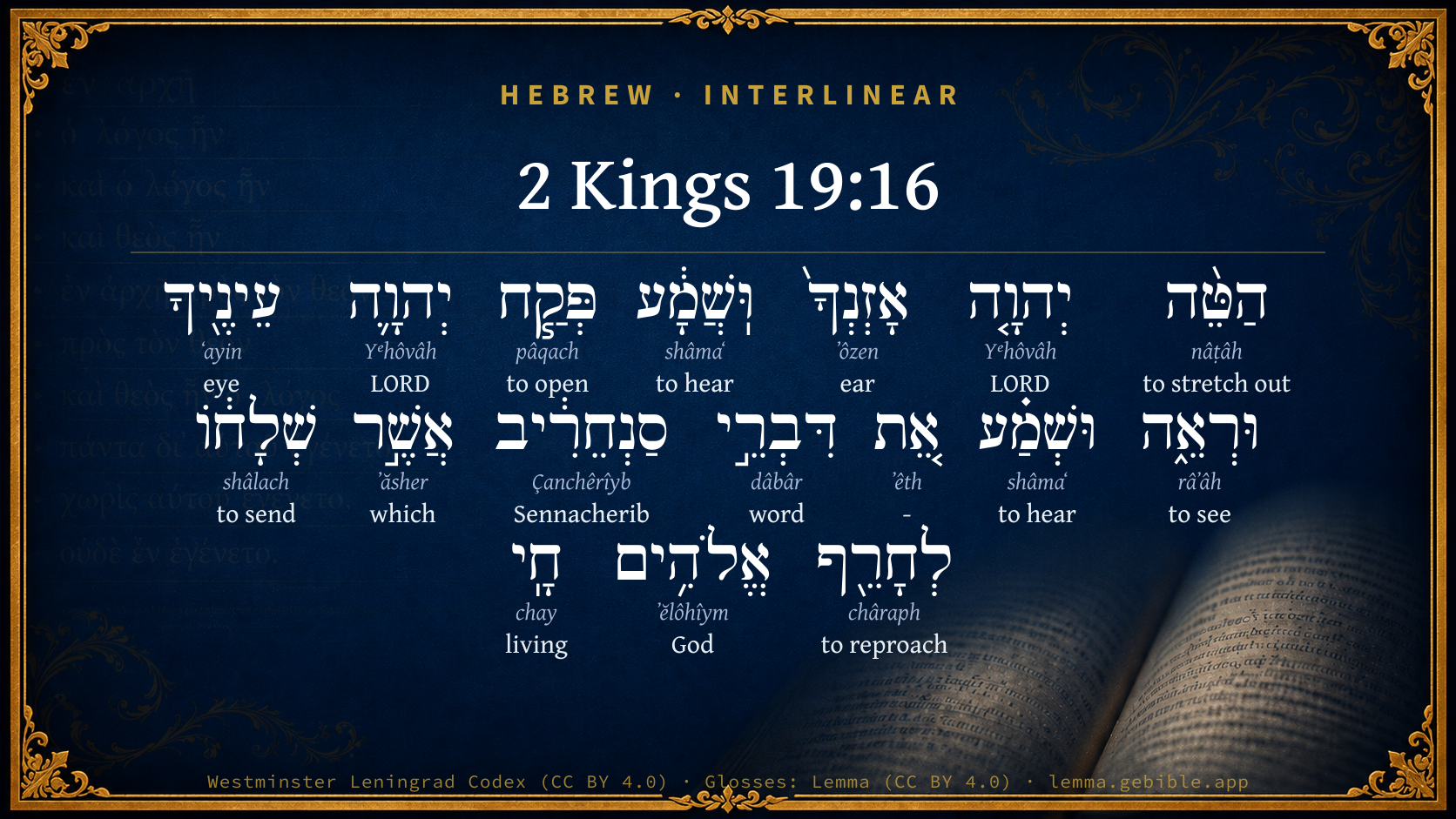
Hebrew (Westminster Leningrad Codex) 2 Kings 19:16 appears in the Hebrew Old Testament. The text above is from the Westminster Leningrad Codex. Each word links to its Strong’s number, a concise gloss, and parsing drawn from the Open Scriptures Hebrew Bible morphology. Click any word for its full Brown-Driver-Briggs (BDB) entry.
Download image
Cite this verse

2 Kings 19:16 (World English Bible). Public Domain. Lemma interlinear Bible study tool, https://lemma.gebible.app/v/2-kings/19/16.

Show BibTeX & RIS
BibTeX
RIS
English Translation
Incline your ear, Yahweh, and hear; open your eyes, Yahweh, and see; and hear the words of Sennacherib, with which he has sent him to defy the living God.
World English Bible · Public Domain
Download a study sheet

One document with this verse’s original text, its word-by-word gloss line, the meaning frame, cross-references with their text, attributed commentary, and full source and license credits — printable, and it pastes into notes with its structure intact.

This verse Autodidact and up

Study sheet (.html) Plain text (.txt)

A passage Seminary Student

Up to 50 verses in one chapter. A passage sheet keeps up to 6 commentary sources and 12 cross-references per verse, in the order this page ranks them, and says so on the sheet whenever that leaves anything out. Ask for a single verse and you get the Autodidact verse sheet above.

Everything on this page stays free to read, with no account — the sheet is a download of what is already on screen, not access to it.

Want to remove ads? Support Godless Engineer
Compare translations 3

The same verse in 3 English versions, stacked beneath the original-language interlinear above. Click any original word for its lexicon entry.

Each is an independent rendering of the whole verse — the interlinear is not word-aligned to these translations.

Highlighted words mark where these versions differ — a whole-verse word diff, not a word-by-word alignment.

  • World English Bible Public Domain
    Incline your ear, Yahweh, and hear; open your eyes, Yahweh, and see; and hear the words of Sennacherib, with which he has sent him to defy the living God.
  • King James Version Public Domain
    LORD, bow down thine ear, and hear: open, LORD, thine eyes, and see: and hear the words of Sennacherib, which hath sent him to reproach the living God.
  • unfoldingWord Literal Text CC BY-SA 4.0
    Incline your ear, Yahweh, and hear. Open your eyes, Yahweh, and see. And hear the words of Sennacherib which he has sent it to taunt the living God.

unfoldingWord Literal Text — © unfoldingWord, licensed CC BY-SA 4.0. Word-aligned USFM3 via Door43 (git.door43.org/unfoldingWord/en_ult).

Versions to compare (up to 4)

3 of 4 selected

Show all 18 translations

Every available English version of this verse, each an independent rendering of the whole verse.

  • World English Bible Public Domain
    Incline your ear, Yahweh, and hear; open your eyes, Yahweh, and see; and hear the words of Sennacherib, with which he has sent him to defy the living God.
  • Berean Standard Bible Public Domain
    Incline Your ear, O LORD, and hear; open Your eyes, O LORD, and see. Listen to the words that Sennacherib has sent to defy the living God.
  • Majority Standard Bible Public Domain
    Incline Your ear, O LORD, and hear; open Your eyes, O LORD, and see. Listen to the words that Sennacherib has sent to defy the living God.
  • King James Version Public Domain
    LORD, bow down thine ear, and hear: open, LORD, thine eyes, and see: and hear the words of Sennacherib, which hath sent him to reproach the living God.
  • American Standard Version (1901) Public Domain
    Incline thine ear, O Jehovah, and hear; open thine eyes, O Jehovah, and see; and hear the words of Sennacherib, wherewith he hath sent him to defy the living God.
  • Revised Version (1885) Public Domain
    Incline thine ear, O LORD, and hear; open thine eyes, O LORD, and see: and hear the words of Sennacherib, wherewith he hath sent him to reproach the living God.
  • Geneva Bible (1599) Public Domain
    Lord, bow downe thine eare, and heare: Lord open thine eyes and behold, and heare the wordes of Saneherib, who hath sent to blaspheme the liuing God.
  • Douay-Rheims (1899) Public Domain
    Incline thy ear, and hear: open, O Lord, thy eyes, and see: and hear all the words of Sennacherib, who hath sent to upbraid unto us the living God.
  • Young's Literal Translation Public Domain
    Incline, O Jehovah, Thine ear, and hear; open, O Jehovah, Thine eyes, and see; and hear Thou the words of Sennacherib with which he hath sent him to reproach the living God.
  • Literal Standard Version CC BY-SA 4.0
    Incline, O YHWH, Your ear, and hear; open, O YHWH, Your eyes, and see; and hear the words of Sennacherib with which he has sent him to reproach the living God.
  • Unlocked Literal Bible CC BY-SA 4.0
    Turn your ear, Yahweh, and listen. Open your eyes, Yahweh, and see, and hear the words of Sennacherib, which he has sent to mock the living God.
  • unfoldingWord Literal Text CC BY-SA 4.0
    Incline your ear, Yahweh, and hear. Open your eyes, Yahweh, and see. And hear the words of Sennacherib which he has sent it to taunt the living God.
  • Darby Bible Public Domain
    Incline thine ear, Jehovah, and hear; open, Jehovah, thine eyes, and see; and hear the words of Sennacherib, who hath sent him to reproach the living God.
  • World Messianic Bible Public Domain
    Incline your ear, LORD, and hear. Open your eyes, LORD, and see. Hear the words of Sennacherib, which he has sent to defy the living God.
  • Webster's Bible Public Domain
    LORD, bow down thy ear, and hear: open, LORD, thy eyes, and see: and hear the words of Sennacherib, who hath sent him to reproach the living God.
  • Free Bible Version CC BY-SA 4.0
    Please listen with your ears, Lord, and hear; open your eyes, Lord, and see. Listen to the message that Sennacherib has sent to insult the living God.
  • Bible in Basic English Public Domain
    Let your ear be turned to us, O Lord, and let your eyes be open, O Lord, and see; take note of all the words of Sennacherib who has sent men to say evil against the living God.
  • JPS Tanakh (1917) Public Domain
    Incline Thine ear, O LORD, and hear; open Thine eyes, O LORD, and see; and hear the words of Sennacherib, wherewith he hath sent him to taunt the living God.

Literal Standard Version (2020), Covenant Press — licensed CC BY-SA 4.0. Text via the HelloAO Bible API (eBible.org). Unlocked Literal Bible (unfoldingWord) — licensed CC BY-SA 4.0. Text via the HelloAO Bible API (eBible.org). unfoldingWord Literal Text — © unfoldingWord, licensed CC BY-SA 4.0. Word-aligned USFM3 via Door43 (git.door43.org/unfoldingWord/en_ult). Free Bible Version, Dr. Jonathan Gallagher — licensed CC BY-SA 4.0. Text via the HelloAO Bible API (eBible.org).

Word by word

More ways to search: Search by grammar → Find every occurrence → Compare this word →

Practice this passage: Drill this verse → Learn its vocabulary →

סַנְחֵרִ֔יב
Çanchêrîyb
H5576
“Sennacherib”
Noun, Proper
Part of Speech
Noun
Type
Proper
Full BDB Definition

Origin: of foreign origin

TWOT: None

Sennacherib = "Sin multiplied brothers" (Sin = the moon) - son of Sargon, father of Esarhaddon, and king of Assyria from 705-681 BC; attacked Judah during the reign of king Hezekiah and Judah was delivered when in response to the prayer of Hezekiah an angel smote 185,000 Assyrian soldiers
  1. הַטֵּ֨ה nâṭâh H5186 “stretch out” Verb, Hiphil, Imperative, 2nd Person, Masculine, Singular
  2. יְהוָ֤ה Yᵉhôvâh H3068 “LORD” Noun, Proper
  3. אָזְנְךָ֙ ʼôzen H241 “ear · your” Noun, Common, Feminine, Singular, Construct + Suffix, Personal, 2nd Person, Masculine, Singular
  4. וּֽשֲׁמָ֔ע shâmaʻ H8085 “and · hear” Conjunction + Verb, Qal, Imperative, 2nd Person, Masculine, Singular
  5. פְּקַ֧ח pâqach H6491 “open” Verb, Qal, Imperative, 2nd Person, Masculine, Singular
  6. יְהוָ֛ה Yᵉhôvâh H3068 “LORD” Noun, Proper
  7. עֵינֶ֖יךָ ʻayin H5869 “eyes · your” Noun, Common, Both, Dual, Construct + Suffix, Personal, 2nd Person, Masculine, Singular
  8. וּרְאֵ֑ה râʼâh H7200 “and · see” Conjunction + Verb, Qal, Imperative, 2nd Person, Masculine, Singular
  9. וּשְׁמַ֗ע shâmaʻ H8085 “and · hear” Conjunction + Verb, Qal, Imperative, 2nd Person, Masculine, Singular
  10. אֵ֚ת ʼêth H853 “-” Particle, Direct Object
  11. דִּבְרֵ֣י dâbâr H1697 “words of” Noun, Common, Masculine, Plural, Construct
  12. אֲשֶׁ֣ר ʼăsher H834 “which” Particle, Relative
  13. שְׁלָח֔וֹ shâlach H7971 “to send · him” Verb, Qal, Perfect, 3rd Person, Masculine, Singular + Suffix, Personal, 3rd Person, Masculine, Singular
  14. לְחָרֵ֖ף châraph H2778 “to reproach” Preposition + Verb, Piel, Infinitive Construct
  15. אֱלֹהִ֥ים ʼĕlôhîym H430 “God(s)” Noun, Common, Masculine, Plural, Absolute
  16. חָֽי chay H2416 “living” Adjective, Adjective, Masculine, Singular, Absolute

About this verse

These counts appear in no published source. They are computed here, from the morphology-tagged text and Lemma’s own curated glosses. What Lemma adds →

17
words
15
distinct lemmas
Historical
section

Notable vocabulary

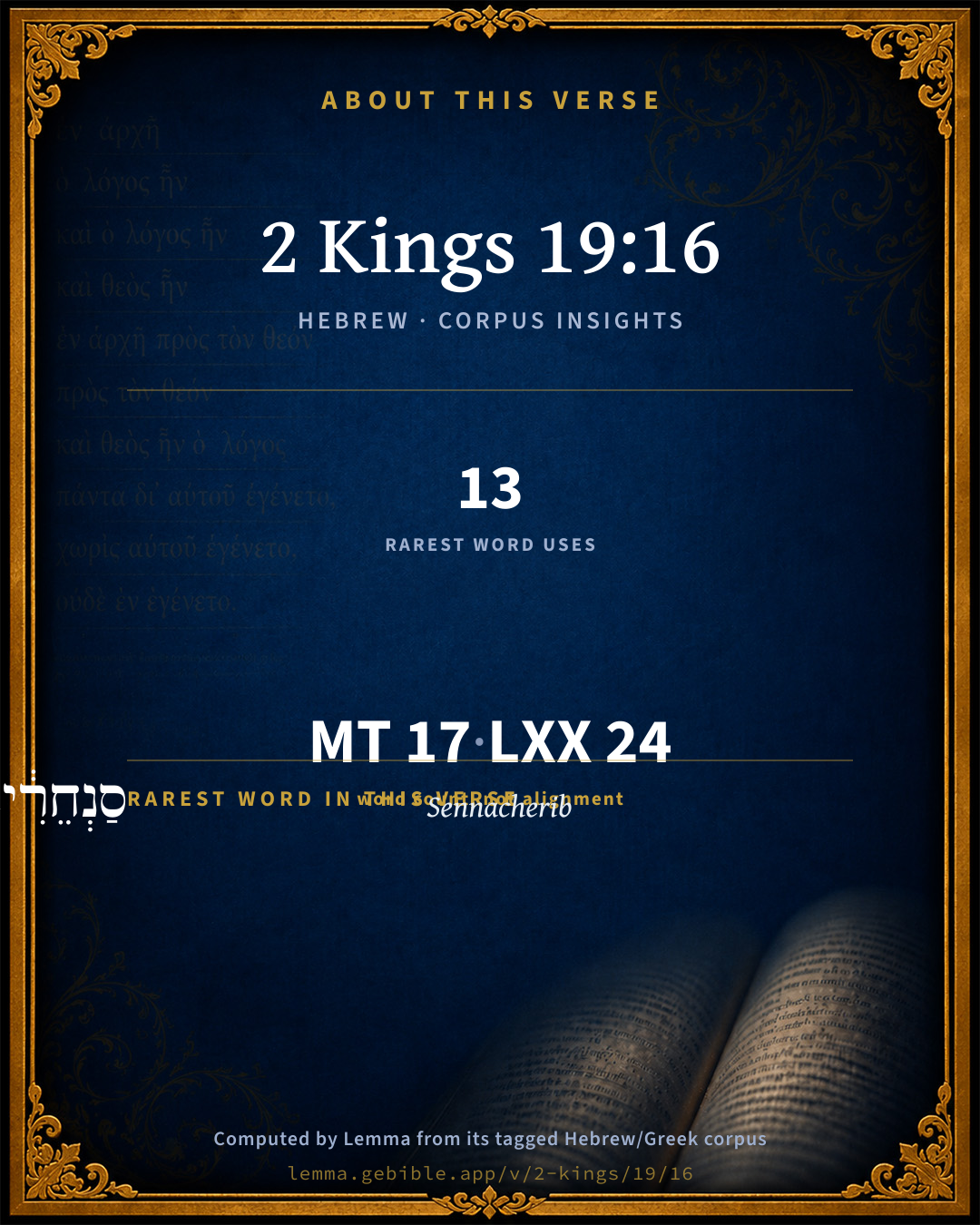
The rarest word here is סַנְחֵרִ֔יב Sennacherib H5576 — appearing just 13 times in the whole Hebrew Bible.

Shared distinctive vocabulary

סַנְחֵרִ֔יב Sennacherib H5576 occurs in 13 verses of the Hebrew Bible. Also found in:

Grammatical profile

  • 7 verbs
  • 7 nouns
  • 1 adjective
  • 2 particles

Verb forms

  • הַטֵּ֨ה Hiphil · Imperative
  • וּֽשֲׁמָ֔ע Qal · Imperative
  • פְּקַ֧ח Qal · Imperative
  • וּרְאֵ֑ה Qal · Imperative
  • וּשְׁמַ֗ע Qal · Imperative
  • שְׁלָח֔וֹ Qal · Perfect
  • לְחָרֵ֖ף Piel · Infinitive Construct

Repetition

Words recur within this verse — often emphatic in Hebrew:

  • יְהוָ֤ה LORD H3068 ×2
  • וּֽשֲׁמָ֔ע to hear H8085 ×2

Hebrew & Septuagint length

In English translation the verse runs 29 words from the Hebrew and 28 from the Septuagint (LXX English) — closely comparable.

A rough comparison of the two English renderings, which tokenize alike — not a word-level alignment.

Word counts can differ between the Hebrew and the Greek without any difference in meaning — e.g. the Hebrew direct-object marker אֵת has no separate Greek word, and Greek often adds the article ὁ.

In the original languages it is 17 Hebrew tokens and 24 Greek tokens — but the two are counted differently (Hebrew bundles its prefixes and suffixes into one token; the Greek is in lemma form), so that isn’t a like-for-like length.

Cross-references

9

Topical passages linked to 2 Kings 19:16 in the Treasury of Scripture Knowledge — connected by theme and wording, ordered by reader-vote popularity; previews shown in the World English Bible.

  • 2 Kings 19:4 It may be Yahweh your God will hear all the words of Rabshakeh, whom the king of Assyria his master has sent to defy the living God, and will rebuke the words which Yahweh your God has heard. Therefore lift up your prayer for the remnant that is left.
  • 2 Chronicles 6:40 Now, my God, let, I beg you, your eyes be open, and let your ears be attentive, to the prayer that is made in this place.
  • Psalms 31:2 Bow down your ear to me. Deliver me speedily. Be to me a strong rock, A house of defense to save me.
  • Isaiah 37:17 Turn your ear, Yahweh, and hear; open your eyes, Yahweh, and behold; and hear all the words of Sennacherib, who has sent to defy the living God.
  • 1 Kings 8:29 that your eyes may be open toward this house night and day, even toward the place of which you have said, My name shall be there; to listen to the prayer which your servant shall pray toward this place.
  • Daniel 9:18 My God, turn your ear, and hear; open your eyes, and see our desolations, and the city which is called by your name: for we do not present our petitions before you for our righteousness, but for your great mercies' sake.
  • Psalms 79:12 Pay back to our neighbors seven times into their bosom Their reproach with which they have reproached you, Lord.
  • Isaiah 37:4 It may be Yahweh your God will hear the words of Rabshakeh, whom the king of Assyria his master has sent to defy the living God, and will rebuke the words which Yahweh your God has heard. Therefore lift up your prayer for the remnant that is left.
  • Hebrews 11:26 accounting the reproach of Christ greater riches than the treasures of Egypt; for he looked to the reward.

Cross-references courtesy of OpenBible.info (CC BY 4.0).

Hebrew and Greek witnesses Masoretic Hebrew ↔ Greek Septuagint

The same verse in the two great witnesses to the Old Testament, shown verse-for-verse.

These are two independent witnesses, not word-aligned to each other, and the Septuagint is shown in lemma (dictionary) form.

Hebrew 2 Kings 19:16 Masoretic · Westminster Leningrad Codex

הַטֵּ֨ה יְהוָ֤ה אָזְנְךָ֙ וּֽשֲׁמָ֔ע פְּקַ֧ח יְהוָ֛ה עֵינֶ֖יךָ וּרְאֵ֑ה וּשְׁמַ֗ע אֵ֚ת דִּבְרֵ֣י סַנְחֵרִ֔יב אֲשֶׁ֣ר שְׁלָח֔וֹ לְחָרֵ֖ף אֱלֹהִ֥ים חָֽי

Incline your ear, Yahweh, and hear; open your eyes, Yahweh, and see; and hear the words of Sennacherib, with which he has sent him to defy the living God.

World English Bible · Public Domain

Greek LXX 2 Kings 19:16 Septuagint · lemma form

κλίνω κύριος ὁ οὖς σύ καί ἀκούω ἀναοἴγω κύριος ὁ ὀφθαλμός σύ καί ὁράω καί ἀκούω ὁ λόγος σενναχηριμ ὅς ἀποστέλλω ὀνειδίζω θεός ζάω

Incline your ear, O Lord, and hear: open, Lord, your eyes, and see: and hear the words of Sennacherim, which he has sent to reproach the living God.

LXX2012 (modern English Septuagint) · Public Domain

On this verse, Haydock's Catholic Bible Commentary discusses the Septuagint’s reading. Read the note in Commentary ↓

Hebrew: Westminster Leningrad Codex (CC BY 4.0). Greek: Septuagint (public domain); English from LXX2012 (modern English Septuagint) (Public Domain). How the Septuagint differs from the Hebrew →

Targum (Aramaic paraphrase)

1

The Targum is the ancient Jewish Aramaic paraphrase of the Hebrew Scriptures — an interpretive translation, not the Hebrew text itself. Onkelos (literal) and Pseudo-Jonathan (expansive) render the Torah, and Jonathan the Prophets. Coverage is partial: where no permissively-licensed English translation exists for a verse, only the Aramaic is shown. This is verse-level text, not a word-by-word alignment to the Hebrew.

  1. Targum Jonathan Prophets (Joshua–Malachi)
    גְלֵי קֳדָמָךְ יְיָ וְדוּן וּשְׁמִיעַ קֳדָמָךְ יְיָ וְאִתְפְּרַע וַעֲבֵיד פּוּרְעֲנוּתָא עַל כָּל פִּתְגָמֵי דְסַנְחֵרִיב דְשַׁלְחֵיהּ לְחַסָדָא עַמָא דַייָ קַיָמָא:

    (no public-domain English translation for this verse)

    Targum Jonathan — Aramaic: “Mikraot Gedolot” (public domain). English: “Sefaria Community Translation” (CC0 1.0 (public-domain dedication)); “London "Chaldee Paraphrase," 1871” (public domain). Text via Sefaria.

Commentary

Notes on 2 Kings 19:16 from classic Christian and Jewish commentators (each source and its license shown beneath its notes). The classic Christian expositions comment on the surrounding passage and are grouped to its opening verse, so a note may address several verses; the Jewish commentaries on the Tanakh (Rashi and others) are per-verse, so they appear only where the commentator wrote on this verse.

Lemma curates 59 commentaries, every one of them public domain or Creative Commons licensed, each selected and text-cleaned for this edition rather than reprinted as found. About our sources →

Trapp's Complete Commentary

John Trapp

2Ki 19:16 LORD, bow down thine ear, and hear: open, LORD, thine eyes, and see: and hear the words of Sennacherib, which hath sent him to reproach the living God.

Ver. 16. Lord, bow down thine ear, and hear: open thine eyes, &c.] This is to pray with utmost intention of spirit, and extension of speech; this is prayer with a force, such as prevaileth much with God. {Jas 5:16} See the like in Daniel. {Dan 9:18-19}

John Trapp, A Commentary or Exposition upon All the Books of the Old and New Testament (1647–1656) — public domain. Text from a community e-Sword module.

Joseph Benson's Commentary

2Ki 19:16-18. Which hath sent him — That is, the messenger who brought this railing letter; or rather Rab-shakeh, who is easily understood to be referred to from the contents of the former chapter, although he would not do him the honour to name him. Of a truth, Lord, the kings of Assyria have destroyed the nations, &c. — He acknowledges their triumphs over the gods of the heathen, but distinguishes between them and the God of Israel. And have cast their gods into the fire: for they were no gods — They were unable to help either themselves or their worshippers, and therefore it is no wonder that the Assyrians have destroyed them. And, in destroying them, though they knew it not, they really served the justice and jealousy of the God of Israel, who has determined to annihilate all the gods of the heathen. But they were deceived in thinking they could therefore be too hard for him, who was so far from being one of the gods whom men’s hands had made, that he himself made all things.

Joseph Benson's Commentary on the Old and New Testaments (1811–1818) — public domain. Text from a community e-Sword module.

Tyndale Open Study Notes

Tyndale Open Resources

19:16-19 Sennacherib’s successes were irrelevant because—unlike the gods of these nations, who were not gods at all—Yahweh was the living God.

Tyndale Open Study Notes — © Tyndale Open Resources, licensed CC BY-SA 4.0. Text via the HelloAO Bible API.

Geneva Bible (1599)

Geneva Bible translators

By this title he discerneth God from all idols and false gods.

Show by effect that thou wilt not suffer thy Name to be blasphemed.

Geneva Bible (1599) marginal notes — public domain. Text via Bolls.life.

Ellicott's Commentary for English Readers

(16) Bow down thine ear, and hear.—Not so much my prayer as the words of Sennacherib.

Open, Lord, thine eyes, and see.—Referring, as Thenius says, to Sennacherib’s letter; not, however, as if Jehovah’s eyes were closed before this prayer. To treat the figurative language of the Old Testament in such a manner does violence to common sense. “Bow thine ear,” “Open thine eyes,” in Hezekiah’s mouth simply meant “Intervene actively between me and my enemy;” although, no doubt, such expressions originally conveyed the actual thoughts of the Israelites about God.

Which hath sent him.—Rather, which he hath sent. The “words” are regarded as a single whole, a message.

The living God.—In contrast with the lifeless idols of Hamath, Arpad, &c.

A Bible Commentary for English Readers, edited by Charles John Ellicott (1878–1897) — public domain. Text from a community e-Sword module.

The Cambridge Bible for Schools and Colleges

gen. ed. J. J. S. Perowne

16. Lord, bow down thine ear, and hear] R.V. Incline thine ear, O Lord, and hear. This is the translation in Isaiah of the same Hebrew. Both should be alike, and the form chosen by R.V. seems preferable as the words are addressed to God. The king can only speak in the figures which men would use to one another, but in this application of human attributes to the Almighty there need not be of necessity any misconception. There could have been none in Hezekiah’s thoughts concerning the Maker of heaven and earth.

which hath sent him [R.V. wherewith he hath sent] to reproach the living God] There is in the orginal a suffix in the singular number attached to the verb, which refers to the ‘words’ before alluded to though they are mentioned as plural. The idea is however singular, and indicates the ‘message’. So that literally the Hebrew would be translated ‘which he hath sent it’, and that is their way of saying, ‘wherewith he hath sent’. The A.V. took the suffix which in the parallel place of Isaiah is not expressed to refer to Rab-shakeh and so translated ‘which hath sent him’.

Hezekiah calls Jehovah ‘the living God’ as opposed to the idols of wood and stone spoken of in Sennacherib’s letter.

The Cambridge Bible for Schools and Colleges (gen. ed. J. J. S. Perowne; Cambridge University Press, 1878–1918) — public domain. Text from a community e-Sword module.

Haydock's Catholic Bible Commentary

Unto us is not in Hebrew or Septuagint. (Du Hamel) --- God, as if he were not able to deliver us. (Menochius)

George Leo Haydock (1774–1849), Haydock's Catholic Family Bible and Commentary, 1859 edition — public domain. Excludes Psalms (Douay-Rheims chapter numbering differs from Protestant) and Deuterocanonical books (Catholic canon only).

Matthew Poole's English Annotations

Which hath sent him, i.e. the messenger who brought this railing letter, 2Ki 19:14; or Rab-shakeh, who was easily understood out of the former chapter, although he would not do him the honour to name him; or, sent it, to wit, this letter.

Matthew Poole's English Annotations on the Holy Bible (1683–1685) — public domain. Text from a community e-Sword/MySword module.

Whedon's Commentary on the Bible

Daniel D. Whedon

16. Thine ear… thine eyes — “This express mention of the two chief senses, the development of each of the two chief ideas, according to their details, into a twofold prayer, the complete symmetry of the two clauses of the sentence, the repetition of Jehovah in the second clause — all these conspire to give to the prayer the greatest urgency and emphasis.” — Drechsler.

Which hath sent him — Rather, which he hath sent; that is, the words or the message which Sennacherib had sent.

Daniel D. Whedon (gen. ed.), Commentary on the Old and New Testaments (1874–1909) — public domain. Text from a community e-Sword module.

The Pulpit Commentary

Lord, bow down thine ear, and hear. "Bow down thine ear" is a Hebrew idiom for "give ear," "attend (see Psa_31:2 Psa_71:2 Psa_86:1; Pro_22:17, etc.) It is based upon the fact that, when men wish to catch exactly what another says to them, they bend themselves towards him, and bring one ear as near to him as they can. Open, Lord, thine eyes, and see. Take cognizance both with eye and ear; i.e. take full cognizance let nothing escape thee. And hear the words of Sennacherib, which hath sent him to reproach the living God; rather, which he has sent to reproach. The suffix translated "him" in our version really means "iti.e. the speech or letter of Sennacherib, which Hezekiah has "spread before the Lord."

The Pulpit Commentary (1880–1919), ed. H.D.M. Spence-Jones & Joseph S. Exell — public domain. Text from a community e-Sword module.

John Wesley's Explanatory Notes

Him - Rabshakeh: he would not do him the honour to name him.

John Wesley, Explanatory Notes Upon the Whole Bible (1754–1765) — public domain. Text via the GEBible commentary corpus.

unfoldingWord translationNotes

Door43 World Missions Community

General Information:

King Hezekiah continues praying to Yahweh after receiving the letter from King Sennacherib of Assyria.

Turn your ear, Yahweh, and listen. Open your eyes, Yahweh, and see

Both of these sentences urge Yahweh to pay attention to the things that Sennacherib is saying. (See: Parallelism)

Turn your ear, Yahweh, and listen

The words "Turn your ear" and "listen" mean the same thing and add emphasis to the plea. AT: "Yahweh, please listen to what he is saying" (See: Doublet)

Open your eyes, Yahweh, and see

The words "Open your eyes" and "see" mean the same thing and add emphasis to the plea. AT: "Yahweh, please pay attention to what is happening" (See: Doublet)

They have put their gods into the fire

"The Assyrian kings have burned up the gods of the other nations"

Assyrians have destroyed them

"Assyrians have destroyed both the nations and the nations' gods"

translationWords

Yahweh

send

mock

life

God

fire

works

unfoldingWord translationNotes — © Distant Shores Media and the Door43 World Missions Community, licensed CC BY-SA 4.0. Source: git.door43.org/Door43/en_tn.

Lesson kit

Teaching starters — assembled from the data on this page, not authored interpretation. Every prompt links to the verse data it draws on. Edit before teaching.

2 Kings, in the Historical, opens this verse with 17 words (15 distinct Hebrew lemmas). Its most distinctive word is Çanchêrîyb (“Sennacherib”). A historical commentator’s framing appears above. Read the whole chapter for the surrounding context.

Discussion questions

  1. How does “Sennacherib” (Çanchêrîyb) shape what this verse is saying?
  2. How does 2 Kings 18:13, which shares the word «Sennacherib», read alongside this verse?
  3. What does the repetition of “LORD” (2× in this one verse) do in this verse?
  4. The translations on this page render this verse differently — a whole-verse word diff, not a word-by-word alignment. What might account for the different wordings?
  5. «הַטֵּ֨ה» is a Hiphil Imperative verb. How does that grammatical form shape the action described?
  6. Compare how Trapp's Complete Commentary and Joseph Benson's Commentary read this verse. Where do they agree or differ?

Things to notice

Reading settings

Reading text

Shown beneath each verse's original-language words.

Old Testament
Old Testament edition

Read the OT as the Masoretic Hebrew (MT) or the Greek Septuagint (LXX).

English shown for the Greek Septuagint (in the Hebrew ↔ Greek comparison).

Comparing translations? Open the Compare panel on any verse page to stack up to four side by side.