
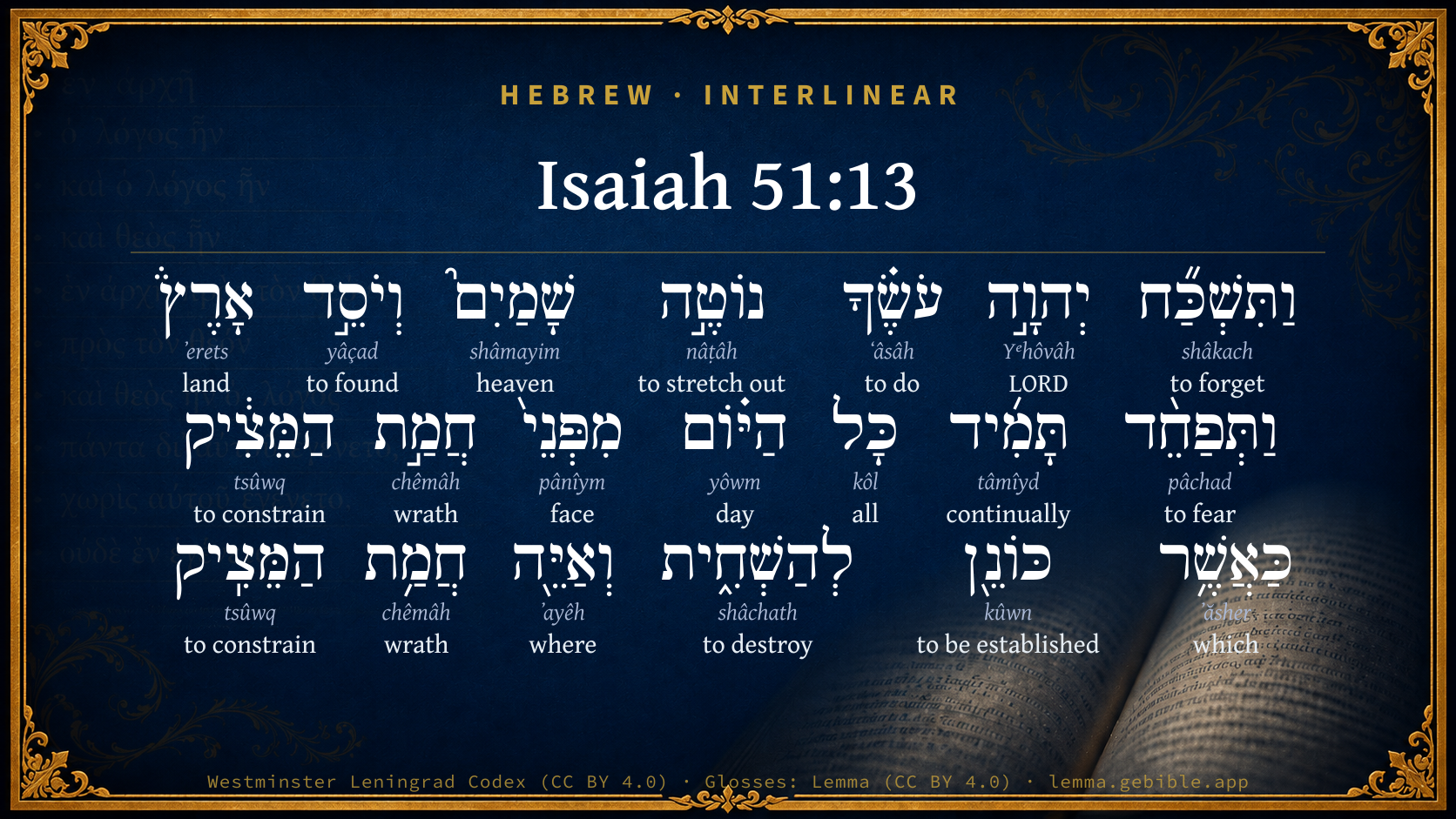
Isaiah 51:13

Hebrew (Westminster Leningrad Codex) Isaiah 51:13 appears in the Hebrew Old Testament. The text above is from the Westminster Leningrad Codex. Each word links to its Strong’s number, a concise gloss, and parsing drawn from the Open Scriptures Hebrew Bible morphology. Click any word for its full Brown-Driver-Briggs (BDB) entry.
Download image
Cite this verse

Isaiah 51:13 (World English Bible). Public Domain. Lemma interlinear Bible study tool, https://lemma.gebible.app/v/isaiah/51/13.

Show BibTeX & RIS
BibTeX
RIS
English Translation
and have forgotten Yahweh your Maker, who stretched forth the heavens, and laid the foundations of the earth; and fear continually all the day because of the fury of the oppressor, when he makes ready to destroy? and where is the fury of the oppressor?
World English Bible · Public Domain
Download a study sheet

One document with this verse’s original text, its word-by-word gloss line, the meaning frame, cross-references with their text, attributed commentary, and full source and license credits — printable, and it pastes into notes with its structure intact.

This verse Autodidact and up

Study sheet (.html) Plain text (.txt)

A passage Seminary Student

Up to 50 verses in one chapter. A passage sheet keeps up to 6 commentary sources and 12 cross-references per verse, in the order this page ranks them, and says so on the sheet whenever that leaves anything out. Ask for a single verse and you get the Autodidact verse sheet above.

Everything on this page stays free to read, with no account — the sheet is a download of what is already on screen, not access to it.

Want to remove ads? Support Godless Engineer
Compare translations 3

The same verse in 3 English versions, stacked beneath the original-language interlinear above. Click any original word for its lexicon entry.

Each is an independent rendering of the whole verse — the interlinear is not word-aligned to these translations.

Highlighted words mark where these versions differ — a whole-verse word diff, not a word-by-word alignment.

  • World English Bible Public Domain
    and have forgotten Yahweh your Maker, who stretched forth the heavens, and laid the foundations of the earth; and fear continually all the day because of the fury of the oppressor, when he makes ready to destroy? and where is the fury of the oppressor?
  • King James Version Public Domain
    And forgettest the LORD thy maker, that hath stretched forth the heavens, and laid the foundations of the earth; and hast feared continually every day because of the fury of the oppressor, as if he were ready to destroy? and where is the fury of the oppressor?
  • unfoldingWord Literal Text CC BY-SA 4.0
    that you should forget Yahweh your maker, the one having stretched out the heavens and having founded the earth; that you should fear continually, all of the day, from the face of the heat of the oppressor as he prepares to destroy? But where the heat of the oppressor?

unfoldingWord Literal Text — © unfoldingWord, licensed CC BY-SA 4.0. Word-aligned USFM3 via Door43 (git.door43.org/unfoldingWord/en_ult).

Versions to compare (up to 4)

3 of 4 selected

Show all 18 translations

Every available English version of this verse, each an independent rendering of the whole verse.

  • World English Bible Public Domain
    and have forgotten Yahweh your Maker, who stretched forth the heavens, and laid the foundations of the earth; and fear continually all the day because of the fury of the oppressor, when he makes ready to destroy? and where is the fury of the oppressor?
  • Berean Standard Bible Public Domain
    But you have forgotten the LORD, your Maker, who stretched out the heavens and laid the foundations of the earth. You live in terror all day long because of the fury of the oppressor who is bent on destruction. But where is the fury of the oppressor?
  • Majority Standard Bible Public Domain
    But you have forgotten the LORD, your Maker, who stretched out the heavens and laid the foundations of the earth. You live in terror all day long because of the fury of the oppressor who is bent on destruction. But where is the fury of the oppressor?
  • King James Version Public Domain
    And forgettest the LORD thy maker, that hath stretched forth the heavens, and laid the foundations of the earth; and hast feared continually every day because of the fury of the oppressor, as if he were ready to destroy? and where is the fury of the oppressor?
  • American Standard Version (1901) Public Domain
    and hast forgotten Jehovah thy Maker, that stretched forth the heavens, and laid the foundations of the earth; and fearest continually all the day because of the fury of the oppressor, when he maketh ready to destroy? and where is the fury of the oppressor?
  • Revised Version (1885) Public Domain
    and hast forgotten the LORD thy Maker, that stretched forth the heavens, and laid the foundations of the earth; and fearest continually all the day because of the fury of the oppressor, when he maketh ready to destroy? and where is the fury of the oppressor?
  • Geneva Bible (1599) Public Domain
    And forgettest the Lord thy maker, that hath spred out the heauens, and layde the foundations of the earth? and hast feared continually all the day, because of the rage of the oppressour, which is readie to destroy? Where is now the rage of the oppressour?
  • Douay-Rheims (1899) Public Domain
    And thou hast forgotten the Lord thy maker, who stretched out the heavens, and founded the earth: and thee hast been afraid continually all the day at the presence of his fury who afflicted thee, and had prepared himself to destroy thee: where is now the fury of the oppressor?
  • Young's Literal Translation Public Domain
    And thou dost forget Jehovah thy maker, Who is stretching out the heavens, and founding earth, And thou dost fear continually all the day, Because of the fury of the oppressor, As he hath prepared to destroy. And where `is' the fury of the oppressor?
  • Literal Standard Version CC BY-SA 4.0
    And you forget YHWH your Maker, || Who is stretching out the heavens, and founding earth, || And you continually fear all the day, || Because of the fury of the oppressor, || As he has prepared to destroy. And where [is] the fury of the oppressor?
  • Unlocked Literal Bible CC BY-SA 4.0
    Why have you forgotten Yahweh your Maker, who stretched out the heavens and laid the foundations of the earth? You are in constant dread every day because of the hot fury of the oppressor when he decides to destroy. Where is the fury of the oppressor?
  • unfoldingWord Literal Text CC BY-SA 4.0
    that you should forget Yahweh your maker, the one having stretched out the heavens and having founded the earth; that you should fear continually, all of the day, from the face of the heat of the oppressor as he prepares to destroy? But where the heat of the oppressor?
  • Darby Bible Public Domain
    and forgettest Jehovah thy Maker, who hath stretched out the heavens, and laid the foundations of the earth; and thou art afraid continually all the day because of the fury of the oppressor, when he prepareth to destroy? And where is the fury of the oppressor?
  • World Messianic Bible Public Domain
    Have you forgotten the LORD your Maker, who stretched out the heavens, and laid the foundations of the earth? Do you live in fear continually all day because of the fury of the oppressor, when he prepares to destroy? Where is the fury of the oppressor?
  • Webster's Bible Public Domain
    And forgettest the LORD thy maker, that hath stretched forth the heavens, and laid the foundations of the earth; and hast feared continually every day because of the fury of the oppressor, as if he were ready to destroy? and where is the fury of the oppressor?
  • Free Bible Version CC BY-SA 4.0
    You have forgotten the Lord, your Maker, who stretched out the heavens and who laid the foundations of the earth! That's why you shake with fear all day long, because you're threatened by the anger of those who oppress you, wanting to destroy you. But where are your oppressors and their anger now?
  • Bible in Basic English Public Domain
    And you have given no thought to the Lord your Maker, by whom the heavens were stretched out, and the earth placed on its base; and you went all day in fear of the wrath of the cruel one, when he was making ready for your destruction. And where is the wrath of the cruel one?
  • JPS Tanakh (1917) Public Domain
    And hast forgotten the LORD thy Maker, that stretched forth the heavens, and laid the foundations of the earth; and fearest continually all the day because of the fury of the oppressor, as he maketh ready to destroy? And where is the fury of the oppressor?

Literal Standard Version (2020), Covenant Press — licensed CC BY-SA 4.0. Text via the HelloAO Bible API (eBible.org). Unlocked Literal Bible (unfoldingWord) — licensed CC BY-SA 4.0. Text via the HelloAO Bible API (eBible.org). unfoldingWord Literal Text — © unfoldingWord, licensed CC BY-SA 4.0. Word-aligned USFM3 via Door43 (git.door43.org/unfoldingWord/en_ult). Free Bible Version, Dr. Jonathan Gallagher — licensed CC BY-SA 4.0. Text via the HelloAO Bible API (eBible.org).

Word by word

More ways to search: Search by grammar → Find every occurrence → Compare this word →

Practice this passage: Drill this verse → Learn its vocabulary →

הַמֵּצִ֔יק
tsûwq
H6693
“the · constraining”
Particle, Definite Article + Verb, Hiphil, Participle Active, Masculine, Singular, Absolute
Part of Speech
Particle + Verb
Stem
Hiphil
Form
Participle Active
Gender
Masculine
Number
Singular
State
Absolute
Full BDB Definition

Origin: a primitive root

TWOT: 1895

(Hiphil) to constrain, press, bring into straits, straiten, oppress
  1. וַתִּשְׁכַּ֞ח shâkach H7911 “and · to forget” Conjunction + Verb, Qal, Sequential Imperfect, 2nd Person, Masculine, Singular
  2. יְהוָ֣ה Yᵉhôvâh H3068 “LORD” Noun, Proper
  3. עֹשֶׂ֗ךָ ʻâsâh H6213 “doing · you” Verb, Qal, Participle Active, Masculine, Singular, Construct + Suffix, Personal, 2nd Person, Masculine, Singular
  4. נוֹטֶ֣ה nâṭâh H5186 “stretching out” Verb, Qal, Participle Active, Masculine, Singular, Absolute
  5. שָׁמַיִם֮ shâmayim H8064 “heaven(s)” Noun, Common, Masculine, Plural, Absolute
  6. וְיֹסֵ֣ד yâçad H3245 “and · founding” Conjunction + Verb, Qal, Participle Active, Masculine, Singular, Absolute
  7. אָרֶץ֒ ʼerets H776 “land” Noun, Common, Both, Singular, Absolute
  8. וַתְּפַחֵ֨ד pâchad H6342 “and · to fear” Conjunction + Verb, Piel, Sequential Imperfect, 2nd Person, Masculine, Singular
  9. תָּמִ֜יד tâmîyd H8548 “continually” Noun, Common, Masculine, Singular, Absolute
  10. כָּל kôl H3605 “all of” Noun, Common, Masculine, Singular, Construct
  11. הַיּ֗וֹם yôwm H3117 “the · day” Particle, Definite Article + Noun, Common, Masculine, Singular, Absolute
  12. מִפְּנֵי֙ pânîym H6440 “from · face(s) of” Preposition + Noun, Common, Both, Plural, Construct
  13. חֲמַ֣ת chêmâh H2534 “wrath of” Noun, Common, Feminine, Singular, Construct
  14. כַּאֲשֶׁ֥ר ʼăsher H834 “like/as · which” Preposition + Particle, Relative
  15. כּוֹנֵ֖ן kûwn H3559 “to be established” Verb, Polel, Perfect, 3rd Person, Masculine, Singular
  16. לְהַשְׁחִ֑ית shâchath H7843 “to destroy” Preposition + Verb, Hiphil, Infinitive Construct
  17. וְאַיֵּ֖ה ʼayêh H346 “and · where” Conjunction + Particle, Interrogative
  18. חֲמַ֥ת chêmâh H2534 “wrath of” Noun, Common, Feminine, Singular, Construct
  19. הַמֵּצִֽיק tsûwq H6693 “the · constraining” Particle, Definite Article + Verb, Hiphil, Participle Active, Masculine, Singular, Absolute

About this verse

These counts appear in no published source. They are computed here, from the morphology-tagged text and Lemma’s own curated glosses. What Lemma adds →

20
words
18
distinct lemmas
Prophets
section

Notable vocabulary

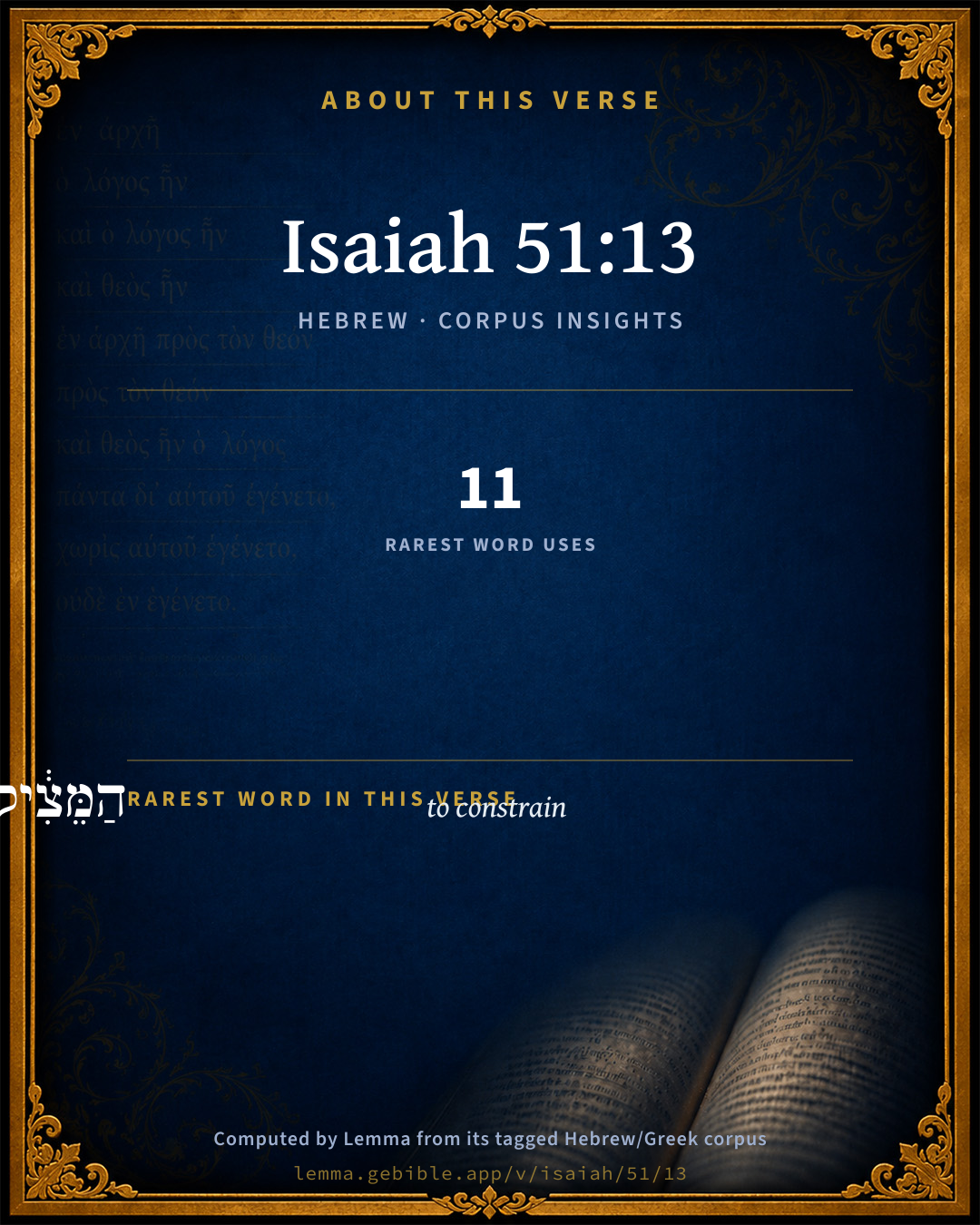
The rarest word here is הַמֵּצִ֔יק to constrain H6693 — appearing just 11 times in the whole Hebrew Bible.

Shared distinctive vocabulary

הַמֵּצִ֔יק to constrain H6693 occurs in 10 verses of the Hebrew Bible. Also found in:

Grammatical profile

  • 9 verbs
  • 9 nouns
  • 2 particles

Verb forms

  • וַתִּשְׁכַּ֞ח Qal · Sequential Imperfect
  • עֹשֶׂ֗ךָ Qal · Participle Active
  • נוֹטֶ֣ה Qal · Participle Active
  • וְיֹסֵ֣ד Qal · Participle Active
  • וַתְּפַחֵ֨ד Piel · Sequential Imperfect
  • הַמֵּצִ֔יק Hiphil · Participle Active
  • כּוֹנֵ֖ן Polel · Perfect
  • לְהַשְׁחִ֑ית Hiphil · Infinitive Construct
  • הַמֵּצִֽיק Hiphil · Participle Active

Repetition

Words recur within this verse — often emphatic in Hebrew:

  • חֲמַ֣ת wrath H2534 ×2
  • הַמֵּצִ֔יק to constrain H6693 ×2

Hebrew & Septuagint length

In English translation the verse runs 45 words from the Hebrew and 49 from the Septuagint (LXX English) — closely comparable.

A rough comparison of the two English renderings, which tokenize alike — not a word-level alignment.

Word counts can differ between the Hebrew and the Greek without any difference in meaning — e.g. the Hebrew direct-object marker אֵת has no separate Greek word, and Greek often adds the article ὁ.

Cross-references

41

Topical passages linked to Isaiah 51:13 in the Treasury of Scripture Knowledge — connected by theme and wording, ordered by reader-vote popularity; previews shown in the World English Bible.

  • Psalms 104:2 He covers himself with light as with a garment. He stretches out the heavens like a curtain.
  • Isaiah 17:10 For you have forgotten the God of your salvation, and have not been mindful of the rock of your strength; therefore you plant pleasant plants, and set it with strange slips.
  • Isaiah 40:22 [It is] he who sits above the circle of the earth, and the inhabitants of it are as grasshoppers; who stretches out the heavens as a curtain, and spreads them out as a tent to dwell in;
  • Isaiah 45:12 I have made the earth, and created man on it: I, even my hands, have stretched out the heavens; and all their host have I commanded.
  • Job 9:8 Who alone stretches out the heavens, Treads on the waves of the sea;
  • Isaiah 44:24 Thus says Yahweh, your Redeemer, and he who formed you from the womb: I am Yahweh, who makes all things; who stretches forth the heavens alone; who spreads abroad the earth (who is with me?);
  • Isaiah 48:13 Yes, my hand has laid the foundation of the earth, and my right hand has spread out the heavens: when I call to them, they stand up together.
  • Daniel 3:19 Then was Nebuchadnezzar full of fury, and the form of his visage was changed against Shadrach, Meshach, and Abednego: [therefore] he spoke, and commanded that they should heat the furnace seven times more than it was wont to be heated.
  • 1 Corinthians 1:20 Where is the wise? Where is the scribe? Where is the lawyer of this world? Hasn't God made foolish the wisdom of this world?
  • Isaiah 14:16–17 Those who see you shall gaze at you, they shall consider you, [saying], "Is this the man who made the earth to tremble, who shook kingdoms;
  • Isaiah 33:18–19 Your heart shall muse on the terror: Where is he who counted, where is he who weighed [the tribute]? where is he who counted the towers?
  • Isaiah 42:5 Thus says God Yahweh, he who created the heavens, and stretched them forth; he who spread abroad the earth and that which comes out of it; he who gives breath to the people on it, and spirit to those who walk therein:
  • Jeremiah 2:32 Can a virgin forget her ornaments, or a bride her attire? yet my people have forgotten me days without number.
  • Jeremiah 10:11–12 Thus shall you say to them, The gods that have not made the heavens and the earth, these shall perish from the earth, and from under the heavens.
  • Jeremiah 51:15 He has made the earth by his power, he has established the world by his wisdom, and by his understanding has he stretched out the heavens:
  • Daniel 3:15 Now if you are ready whenever you hear the sound of the horn, flute, zither, lyre, harp, pipe, and all kinds of music to you fall down and worship the image which I have made, [well]: but if you don't worship, you shall be cast the same hour into the midst of a burning fiery furnace; and who is that god that shall deliver you out of my hands?
  • Daniel 4:32–33 and you shall be driven from men; and they dwelling shall be with the animals of the field; you shall be made to eat grass as oxen; and seven times shall pass over you; until you know that the Most High rules in the kingdom of men, and gives it to whoever he will.
  • Matthew 2:16–20 Then Herod, when he saw that he was mocked by the wise men, was exceedingly angry, and sent out, and killed all the male children who were in Bethlehem and in all the surrounding countryside, from two years old and under, according to the exact time which he had learned from the wise men.
  • 1 Corinthians 15:55 "Death, where is your sting? Hades, where is your victory?"
  • Hebrews 1:9–12 You have loved righteousness, and hated iniquity; Therefore God, your God, has anointed you with the oil of gladness above your fellows."
  • Hebrews 11:15 If indeed they had been thinking of that country from which they went out, they would have had enough time to return.
  • Revelation 19:20 The beast was taken, and with him the false prophet who worked the signs in his sight, with which he deceived those who had received the mark of the beast and those who worshiped his image. These two were thrown alive into the lake of fire that burns with sulfur.
  • Revelation 20:9 They went up over the breadth of the earth, and surrounded the camp of the saints, and the beloved city. Fire came down out of heaven from God, and devoured them.
  • Exodus 14:10–13 When Pharaoh drew near, the children of Israel lifted up their eyes, and behold, the Egyptians were marching after them; and they were very afraid. The children of Israel cried out to Yahweh.
  • Exodus 15:9–10 The enemy said, 'I will pursue, I will overtake, I will divide the spoil. My desire shall be satisfied on them. I will draw my sword, my hand shall destroy them.'
  • Deuteronomy 32:18 Of the Rock that became your father, you are unmindful, Have forgotten God who gave you birth.
  • Esther 5:14 Then said Zeresh his wife and all his friends to him, Let a gallows be made fifty cubits high, and in the morning speak you to the king that Mordecai may be hanged thereon: then go you in merrily with the king to the banquet. The thing pleased Haman; and he caused the gallows to be made.
  • Esther 7:10 So they hanged Haman on the gallows that he had prepared for Mordecai. Then was the king's wrath pacified.
  • Job 20:5–9 That the triumphing of the wicked is short, The joy of the godless but for a moment?
  • Job 37:18 Can you, with him, spread out the sky, Which is strong as a cast metal mirror?
  • Psalms 9:6–7 The enemy is overtaken by endless ruin. The very memory of the cities which you have overthrown has perished.
  • Psalms 37:35–36 I have seen the wicked in great power, Spreading himself like a green tree in its native soil.
  • Psalms 76:10 Surely the wrath of man praises you. The survivors of your wrath are restrained.
  • Psalms 102:25–26 Of old, you laid the foundation of the earth. The heavens are the work of your hands.
  • Isaiah 7:4 Tell him, 'Be careful, and keep calm. Don't be afraid, neither let your heart be faint because of these two tails of smoking firebrands, for the fierce anger of Rezin and Syria, and of the son of Remaliah.
  • Isaiah 8:12–13 Don't you say, "A conspiracy!" concerning all about which this people shall say, "A conspiracy!" neither fear their fear, nor be in dread [of it].
  • Isaiah 10:29–34 they are gone over the pass; they have taken up their lodging at Geba; Ramah trembles; Gibeah of Saul is fled.
  • Isaiah 16:4 Let my outcasts dwell with you; as for Moab, be a covert to him from the face of the destroyer. For the extortioner is brought to nothing, destruction ceases, the oppressors are consumed out of the land.
  • Isaiah 37:36–38 The angel of Yahweh went forth, and struck in the camp of the Assyrians one hundred and eighty-five thousand; and when men arose early in the morning, behold, these were all dead bodies.
  • Isaiah 57:11 Of whom have you been afraid and in fear, that you lie, and have not remembered me, nor laid it to your heart? Haven't I held my peace even of long time, and you don't fear me?
  • Acts 12:23 Immediately an angel of the Lord struck him, because he didn't give God the glory, and he was eaten by worms and died.

Cross-references courtesy of OpenBible.info (CC BY 4.0).

Hebrew and Greek witnesses Masoretic Hebrew ↔ Greek Septuagint

The same verse in the two great witnesses to the Old Testament, shown verse-for-verse.

These are two independent witnesses, not word-aligned to each other, and the Septuagint is shown in lemma (dictionary) form.

Hebrew Isaiah 51:13 Masoretic · Westminster Leningrad Codex

וַתִּשְׁכַּ֞ח יְהוָ֣ה עֹשֶׂ֗ךָ נוֹטֶ֣ה שָׁמַיִם֮ וְיֹסֵ֣ד אָרֶץ֒ וַתְּפַחֵ֨ד תָּמִ֜יד כָּל הַיּ֗וֹם מִפְּנֵי֙ חֲמַ֣ת הַמֵּצִ֔יק כַּאֲשֶׁ֥ר כּוֹנֵ֖ן לְהַשְׁחִ֑ית וְאַיֵּ֖ה חֲמַ֥ת הַמֵּצִֽיק

and have forgotten Yahweh your Maker, who stretched forth the heavens, and laid the foundations of the earth; and fear continually all the day because of the fury of the oppressor, when he makes ready to destroy? and where is the fury of the oppressor?

World English Bible · Public Domain

Greek LXX Isaiah 51:13 Septuagint · lemma form

καί ἐπιλανθάνω θεός ὁ ποιέω σύ ὁ ποιέω ὁ οὐρανός καί θεμελιόω ὁ γῆ καί φοβέω ἀεί πᾶς ὁ ἡμέρα ὁ πρόσωπον ὁ θυμός ὁ θλίβω σύ ὅς τρόπος γάρ βουλεύω ὁ αἴρω σύ καί νῦν ποῦ ὁ θυμός ὁ θλίβω σύ

And you have forgotten God who made you, who made the sky and founded the earth; and you were continually afraid because of the wrath of him that afflicted you: for whereas he counselled to take you away, yet now where is the wrath of him that afflicted you?

LXX2012 (modern English Septuagint) · Public Domain

On this verse, Adam Clarke's Commentary discusses the Septuagint’s reading. Read the note in Commentary ↓

Hebrew: Westminster Leningrad Codex (CC BY 4.0). Greek: Septuagint (public domain); English from LXX2012 (modern English Septuagint) (Public Domain). How the Septuagint differs from the Hebrew →

Targum (Aramaic paraphrase)

1

The Targum is the ancient Jewish Aramaic paraphrase of the Hebrew Scriptures — an interpretive translation, not the Hebrew text itself. Onkelos (literal) and Pseudo-Jonathan (expansive) render the Torah, and Jonathan the Prophets. Coverage is partial: where no permissively-licensed English translation exists for a verse, only the Aramaic is shown. This is verse-level text, not a word-by-word alignment to the Hebrew.

  1. Targum Jonathan Prophets (Joshua–Malachi)
    וְאִתְנְשֵׁיתָא פּוּלְחָנָא דַייָ דְעָבְדָךְ דִתְלָא שְׁמַיָא וְשַׁכְלֵיל אַרְעָא וּדְחַלְתָּא תְדִירָא כָּל יוֹמָא מִן קֳדָם חֲמַת מְעִיקָא כְּמָא דִמְתַקְנִין לְחַבָּלָא וּכְעַן אָן הִיא חֲמַת דִמְעִיקָא:

    And that thou shouldest forget the worship of the Lord thy maker, who hath suspended the heavens and founded the earth; and shouldest fear continually all the day because of the fury of the oppressor, as if he were ready to destroy; and where is now the fury of the oppressor?

    Targum Jonathan — Aramaic: “Mikraot Gedolot” (public domain). English: “Sefaria Community Translation” (CC0 1.0 (public-domain dedication)); “London "Chaldee Paraphrase," 1871” (public domain). Text via Sefaria.

Commentary

Notes on Isaiah 51:13 from classic Christian and Jewish commentators (each source and its license shown beneath its notes). The classic Christian expositions comment on the surrounding passage and are grouped to its opening verse, so a note may address several verses; the Jewish commentaries on the Tanakh (Rashi and others) are per-verse, so they appear only where the commentator wrote on this verse.

Lemma curates 59 commentaries, every one of them public domain or Creative Commons licensed, each selected and text-cleaned for this edition rather than reprinted as found. About our sources →

Trapp's Complete Commentary

John Trapp

Isa 51:13 And forgettest the LORD thy maker, that hath stretched forth the heavens, and laid the foundations of the earth; and hast feared continually every day because of the fury of the oppressor, as if he were ready to destroy? and where [is] the fury of the oppressor?

Ver. 13. And forgettest the Lord thy maker.] Thou considerest not wisely (1.) How fearfully and wonderfully thou art made; (2.) What a mighty power God put forth in the creation of the whole world; all which he will rather unmake again than thou shalt want seasonable help.

And hast feared continually every day.] Peior est morte timor ipse mortis.

And where is the fury of the oppressor?] q.d., It is but fury, and not power, and that not illimited neither; for "in the thing wherein they deal proudly, I am above them." {Exo 18:11}

John Trapp, A Commentary or Exposition upon All the Books of the Old and New Testament (1647–1656) — public domain. Text from a community e-Sword module.

The Biblical Illustrator

Joseph S. Exell

Isa_51:13

And forgettest the Lord thy Maker

God the Creator

What is it to create the heavens and the earth?

Who has seen the process of creation? I see a man shape a piece of iron or of wood into a useful instrument, and the process seems simple enough. But here I see the hand that works and the material on which it works. But that is not creation--creation out of nothing. I see no hand shaping the trees and hills; I never see something rising out of nothing. I can watch the growth of a flower, as I can the building of a house. And I know that in the former case, as in the latter, there is some force in activity. But force is not God. Behind that force God is still hidden, and the mysterious question remains, Who is He! More mysterious still when I have to reflect that millions of flowers an the world over are being formed, and that a similar force is in operation through all the worlds of boundless space. And everywhere behind this force God is. God is my Maker too. I eat and drink, I live and grow, and feel the energy of life. And that, too, is God. So near to me--so immeasurably distant; and yet nowhere visible. How, then, shall I think of Him, and answer to my heart the question, Who is God? (S. Edger, B.A.)

The Biblical Illustrator, edited by Joseph S. Exell (c. 1880s–1900s) — public domain. Text from a community e-Sword module.

Tyndale Open Study Notes

Tyndale Open Resources

51:13 you have forgotten the Lord: The Lord will never forget Israel (see 44:21; 49:15), so they should not forget him. • The Creator of the world also created the nation Israel.

Tyndale Open Study Notes — © Tyndale Open Resources, licensed CC BY-SA 4.0. Text via the HelloAO Bible API.

Jamieson, Fausset & Brown

Robert Jamieson, A. R. Fausset & David Brown

(Isa 40:12, Isa 40:26, Isa 40:28), the same argument of comfort drawn from the omnipotence of the Creator.

as if . . . ready, &c.--literally, "when he directs," namely, his arrow, to destroy (Psa 21:12; Psa 7:13; Psa 11:2) [MAURER].

Jamieson, Fausset & Brown — Commentary Critical and Explanatory on the Whole Bible (1871) — public domain (CC PDM 1.0). Text via the HelloAO Bible API.

Adam Clarke's Commentary

Verse 13. Of the oppressor, as if he, c.] "The כ caph in כאשר keasher seems clearly to have changed its situation from the end of the preceding word to the beginning of this or rather, to have been omitted by mistake there, because it was here. That it was there the Septuagint show by rendering המציקך hammetsikech θλιβοντος, of him that oppressed thee. And so they render this word in both its places in this verse. The Vulgate also has the pronoun in the first instance; furoris ejus qui te tribulabat." Dr. Jubb. The correction seems well founded; I have not conformed the translation to it, because it makes little difference in the sense.

Adam Clarke's Commentary on the Bible (1810–1826) — public domain. Text from a community e-Sword/MySword module.

Ellicott's Commentary for English Readers

(13) As if he were ready.—Better, as he makes him ready to destroy. The Authorised version unduly minimises the amount of danger. In the case contemplated by the prophet, the oppressor was the Babylonian monarchy, which he sees as already belonging to the past; but the words have, of course, a far wider application.

A Bible Commentary for English Readers, edited by Charles John Ellicott (1878–1897) — public domain. Text from a community e-Sword module.

The Cambridge Bible for Schools and Colleges

gen. ed. J. J. S. Perowne

13. And forgettest the Lord] Not in the sense of apostatising from Him (as ch. Isa_17:10 and often), but of failing to realise His omnipotence as the Creator of all things (see ch. Isa_49:14).

that hath stretched forth the heavens &c.] Cf. Isa_40:22, Isa_42:5, Isa_44:24, Isa_45:12.

and hast feared … day] Better as R.V. and fearest continually all the day. The oppressor is of course the Chaldæan Empire (see ch. Isa_47:6), a proof that this part of the book was not written after the fall of Babylon.

as if he were ready to destroy] R.V. when he maketh ready to destroy; lit. “aims (his arrow) to destroy,” the verb being used technically of an archer directing his arrow; so Psa_21:13, cf. Psa_7:13; Psa_11:2.

and where is the fury of the oppressor?] Cf. ch. Isa_33:18. The question gives a weak ending to the verse, and indeed both in this clause and the preceding the soundness of the text is doubtful.

The Cambridge Bible for Schools and Colleges (gen. ed. J. J. S. Perowne; Cambridge University Press, 1878–1918) — public domain. Text from a community e-Sword module.

John Gill's Exposition

And forgettest the Lord thy Maker,.... That he is thy Maker, and therefore is able to protect and preserve thee; when the fear of man prevails God is forgotten, his power, his providence, his promises, and past instances of divine favour and goodness; were these more frequently recollected, considered, and thought of, they would prove an antidote against the fear of men; and especially when it is observed, that he that is our Maker is he

that hath stretched forth the heavens, and laid the foundations of the earth; these are amazing works of his hands; and what is it that he cannot do that has made these? these he upholds and maintains in being, and does all things in them as he pleases, and overrules all for his own glory and his people's good, and therefore they have nothing to fear from men; and yet they are afraid of them, such is their distrust and unbelief:

and hast feared continually every day; not only at some certain times, when the enemy has appeared very formidable, and threatened with destruction, or some terrible rumour has been spread, but every day, every hour, and every moment; and to be always in a panic must be very uncomfortable living, as well as very dishonourable:

because of the fury of the oppressor; either the king of Babylon, or antichrist:

as if he were ready to destroy: had drawn his sword, and just going to give the fatal blow:

and where, or "but where",

is the fury of the oppressor? where's the fury of Pharaoh, that great oppressor of God's Israel formerly? it is gone and vanished like smoke: where's the fury of Sennacherib king of Assyria, and his army, that threatened Jerusalem with ruin? it was over in a short time, in one night the whole host, or the greater part of it, were destroyed by an angel: and where is, or will be, the fury of the king of Babylon? it will not last always; nor the fury of the antichristian oppressor.

John Gill's Exposition of the Whole Bible (1746–1763) — public domain (CC PDM 1.0). Text via the HelloAO Bible API.

Albert Barnes' Notes on the Bible

And forgettest the Lord thy Maker - These verses are designed to rebuke that state of the mind - alas! too common, even among the people of God - where they are intimidated by the number and strength of their foes, and forget their dependence on God, and his promises of aid. In such circumstances God reproves them for their want of confidence in him, and calls on them to remember that he has made the heavens, and has all power to save them.

That hath stretched forth the heavens - (See the notes at Isa 40:12, Isa 40:26).

And hast feared continually every day - They had continually feared and trembled before their oppressors.

Because of the fury of the oppressor - Those who had oppressed them in Babylon.

As if he were ready to destroy - Margin, ‘Made himself ready,’ The idea is, that he was preparing to destroy the people - perhaps as a marksman is making ready his bow and arrows. The oppressor had been preparing to crush them in the dust, and they trembled, and did not remember that God was abundantly able to protect them.

And where is the fury of the oppressor? - What is there to dread? The idea is, that the enemies of the Jews would be cut off, and that they should therefore put their confidence in God, and rely on his promised aid.

Albert Barnes' Notes on the Bible (1834–1885) — public domain. Text from a community e-Sword/MySword module.

Haydock's Catholic Bible Commentary

Oppressor. If thou hadst not abandoned God, thou wouldst have had no reason to fear Nabuchodonosor; and his power is now gone.

George Leo Haydock (1774–1849), Haydock's Catholic Family Bible and Commentary, 1859 edition — public domain. Excludes Psalms (Douay-Rheims chapter numbering differs from Protestant) and Deuterocanonical books (Catholic canon only).

Matthew Poole's English Annotations

And forgettest the Lord thy Maker; and dost not consider the infinite power of that God who made thee, and who will plead thy cause.

As if he were ready to destroy; as if it were in his power to destroy thee in a moment.

Where is the fury of the oppressor? what is become of the power and rage of the Babylonians? Is it not all gone? Are not they broken, and thou delivered? He speaks of the thing as if it were already done, because it should certainly and suddenly be done. Where is it? It is no where, it is quite lost and gone, as this phrase is frequently used, as Psa 42:3; Zec 1:5; 1Co 15:55.

Matthew Poole's English Annotations on the Holy Bible (1683–1685) — public domain. Text from a community e-Sword/MySword module.

The Pulpit Commentary

And forgettest the Lord thy Maker. It is not so much apostasy as want of a lively and practical faith with which captive Israel is here reproached. They did not deny God they only left him out of sight, neglected him, forgot him. That hath stretched forth the heavens. (comp. Isa_40:22 Isa_42:5 Isa_44:24 Isa_45:12, etc.) And laid the foundations of the earth. (see Isa_48:13 Psa_102:25 Heb_1:10) And hast feared continually... because of the fury of the oppressor. (On the sufferings of the Israelites under their Babylonian oppressors, see the comment on Isa_42:22, and again on Isa_47:6) By the present passage it would appear that life itself was not safe from their cruel fury, when their victims had exasperated them. Where is the fury of the oppressor? All their violence and rage will come to nought, when they in their turn become subject to the conquering Persians.

The nervous temperament.

"Hast feared continually every day." We are not all constituted alike. The instrumentalities by which the great soul within us does its work are diverse in quality. In a material sense we are but dust, yet the dust itself has more steel in it with some than with others. Many have iron nerves and hereditary health, which make them strangers to the trepidations of others. They never walk those caves of terrible gloom in which others often are doomed to wander, nor have they felt the sensitiveness which often turns the experiences of life into torture. We are to meditate now on the nervous temperament, and to study especially the relation which the gospel occupies in relation to it. There may be other anodynes of consolation, physical and mental; but my argument will be this that the religion of Christ stands in special relationship of solace and succour to those who feel with the psalmist, "I am feeble and sore broken, because of the disquietness of my heart." We cannot help being, in one sense, what we were born. The mimosa plant cannot avoid being a mimosa plant, and nothing else. The sensitiveness of a highly wrought nervous system is born with many, and, do what they will, they must carry it with them to the grave. Often misunderstood and misrepresented, often verging on despair, they are bowed down greatly, and go mourning all the day long. Much depends, of course, on the law of association, and on relationships of persons and things. Much, too, depends on religious ideas. There is, for instance, a form of piety sincere enough in itself which feeds perpetual introspection, and is ever tremulous concerning its own state. How different this from the rest which comes from entire trust in Christ! Then, again, there are human relationships which, instead of being ministrants of consolation, strain the heart and irritate the nerves. Oh, the depression that must come, the anxiety that will do its wear and tear, which is derived from alliance with unthankful and foreboding hearts, from fellowship with those who, if they do not consciously know the science of disheartenment, are at all events au fait at its practice! When Moses spake with Israel on this side Jordan in the wilderness, he had in his thought the carping spirit of those whose criticism suggests difficulty and danger too great to be overcome. Some men always see lions in the way, and do an anticipative roaring themselves. Thus he spoke of some who said," Whither shall we go up? our brethren have discouraged our heart, saying, The people are greater and taller than we; the cities are great and walled up to heaven." What an insight this gives on those whose imagination creates giants! Now though we may apply specially the words of our text to a nervous temperament they simply represent a special occasion of depression in the prophet"s life; they represent inward fears.

I THE TRUE PHILOSOPHY OF LIFE IS LIFE IN CHRIST. Not in self. Not in society. But in Christ. We must go out of ourselves, out of our "moods" and "feelings," that we may look unto Christ and be saved! I am speaking of those who are ever nervously anxious and sensitive. First of all about their salvation, which, alas! is like a "variable quantity" with them. But I wish, also, to apply the idea to human life. Christ is a perfect Brother as well as a perfect Saviour. Redemption is his. Yes; and so is common home-life; so is the gift of daily bread. The great realm of providence is under his sceptre.

1. Meditate well on this dual aspect of the subject. First of all, when you are tempted to be morbid analysts of your own spiritual state, to use the scales of weight and measurement for the depth of your love and the height of your faith. There can be no escape from trepidatory alarms so long as we apply aquafortis to the gold of our affection, so long as we microscopically survey the minutiae of our neglected duties and our multitudinous sins. We must ponder the consolatory words, "As Moses lifted up the serpent in the wilderness, even so must the Son of man be lifted up: that whosoever believeth in him should not perish, but have eternal life." And this argument applies as much to the ordinary life of every day. Do things happen to us, or are our times in God"s hands? Our dread of fatalism, with its results of inertia and indifference, has sometimes hindered that quiet trust in God which is the secret of all true strength. Events are in his hand. You cannot make one hair black or white, or add one cubit to your stature. You will become worn and weary by retrospective fears. And what power have you over the dark, deep waves of coming tribulation, or over the advent-hours of grief and death? Be wise. Resolve with promptitude. Persevere with energy. Rise early with alacrity for the service of the day, but cast all anxious thoughts of to-morrow on your Lord.

2. I do not say that so doing all your fears will cease. No act of faith is so complete as to shut out all weakness of the soul. But I do say this will be your most perfect anodyne. Other things will help. The bracing air, the oxygen and ozone of the sea-coast, may tone your nerves, but it cannot create new ones. The gospel (and do the most, but even that cannot reorganize the physical frame, so fearfully and wonderfully made; but its atmosphere is the best one for bracing the heart and soothing the tretted, irritated nerve.

II THERE IS CONTINUITY OF FEAR. We none of us know how frail we are till trial comes. The blooming maiden little thought that care would so soon write itself on her forehead, and that the silvery lines would so early be discovered in her hair. Yet so it is. A mother now, she has had to endure the anxieties of home and the agonies of bereavement. There are some constitutions that can brave much; they keep hale and well, with the pulse even and the eye bright, amid difficulties that would overwhelm. others. Let them thank God for the perfectness of the physical frame. But there are some that only look robust and bright, and when tribulation comes their strength gives way with marvellous rapidity. The physician says the vascular system is excellent, the muscles strong, the frame perfect, but the nervous system is fragility itself.

1. Advent-days of trouble do come. Even sin in its first consciousness overwhelms some with fear and trembling. A great horror overwhelms them. The invisible realm of the spirit is suddenly revealed to them, and where before they saw nothing hideous or evil, now reptiles crawl! Yes; there is a revelation of sin now as of old. We know what the first sight of accident or death is: how severely it shocks the senses of a child! So sin may, and does, come with an overwhelming consciousness of guilt on some minds. The old cry is heard, "Depart from me; for I am a sinful man, O Lord!" How terrible, then, it" such souls fall into the hands, not of wise physicians, but of unwise irritators of the evil! The nerves will break down, and have broken down in thousands of cases, and mania ensues. Study the history of monasteries and convents. Study the history of some revivals. The mediaevalists worked upon many delicate nervous systems by their hideous pictures of hell and by their fearful harangues concerning it. Nor has the modem Church escaped the danger. At once the anxious soul should be led to him who says," Daughter, be of good cheer; thy sins be forgiven thee.

2. There are seasons when unforeseen calamity comes. No fleecy cloud presages the coming storm, no floating seaweed tells how near the vessel is to the rocks; but swift as the "bore" that rushes up the Hooghly from the Ganges, the water sweeps in with a swell, and engulfs the precious freights of unanchored vessels in its broadening wave. There are seasons when the nerves are made intensely sensitive. The heart is pierced by the coldness and neglect of some familiar friend. The spirit droops. Ingratitude has wounded, neglect has chilled, cruelty has crushed, and enmity has tried to slay reputation and renown. "The spirit of a man can sustain his infirmity, but a wounded spirit who can bear?" Who? Certainly not the anxious temperament. Surely at such times it is heart-rest to know the Brother born for adversity, the Friend that sticketh closer than a brother; then is the hour to feel the warm radiance of the love of Christ. One smile from the Saviour then is worth all the honour and flattery of a fickle world. Doubt simply means misery and darkness to the anxious temperament. And in such a world as this, where we never know what a day or an hour may bring forth, surely it is wise to obey the counsel concerning God, "Acquaint now thyself with him, and be at peace.

III THERE MAY BE MINISTRATIONS THAT ARE HUMAN AS WELL AS DIVINE. We can perform miracles of healing, not in the old sense, but wonders of restorative powers are within our reach. Is it a child that is nervous and sensitive? See to it, O parent, that you early discern the difference between that little trembling spirit and the stronger brother. Is it a life-companion? See that you do not treat this sensitiveness as a mere weakness to be cured by physical agencies alone the best curative will be a cheerful mind within, working outwards.

1. Settled melancholy is terrible, and it often prevails. Try and avert it by all ministries of hope and cheer and comfort that you can command. Try and do as Wilberforce is said to have done bring a ray of sunshine across every threshold you cross. We talk about courage, but we do not yet fully understand its true philosophy. It is altogether a related thing. If constitutionally brave that is not the highest courage. It is easy for some who are born strong to be physically brave; it is easy for some to be determined and defiant; it does not spoil their rest at night to fight battles for themselves or others. But with the nervous temperament to act out all the truth that is in them is a costly affair; it tears their strength to pieces. With them to bear the slight of neglect, or the wound of insult, is like a crown of thorns on the heart. With them happiness itself is as the life of a plant which has its nerve-centres in other hearts. The best medicine for many is to be understood and appreciated. You cannot talk down or laugh down nervousness. You cannot even argue down the sensitiveness that springs from it. You cannot do all you desire to do even; but you can do much; and the evening of life will bring you no sweeter reward than for your Lord"s sake to have fulfilled the scriptural command, "Bear ye one another"s burdens, and so fulfil the Law of Christ.

2. Christ"s spirit is little understood, and sometimes little honoured. You have but to study life to see how much h ardness and cruelty there is in it. Begin at the beginning. Take school life public school life! How are boys trained? Why, to admire the daring and defiant, to humiliate the weak, to laugh at sensibility as womanish, to deal with one another as brutes, where the strongest is lord. And it is said home-petting is cured by such means. Cured? I believe that Christ"s book of record will contain martyr-lives of school-days more terrible than the martyrdoms once and for ever made at the stake. Grown-up men do not like to talk of such things; but many look back with a creeping sense of horror at their school-time. The nervous and the sensitive have had their natures repressed and their hearts crushed, who entered public schools with beautiful, child-like, Christ-like spirits. Take a nation. Even when it is called Christian, how often is it braggart, defiant, imperious, proud of military strength! how little conciliation to smaller nations! that is thought to be unworthy of imperial greatness! We have to live and teach the cross, in its spirit as well as in its doctrine; in its beautiful revelation that he, the Highest and Strongest of all, suffered for us; that he was despised and rejected of men for us; that he gave himself for us. Remember, then, that you stand in Christian relationship to the timorous, the sensitive, and the anxious, and ever seek to manifest the spirit of him who would not break the bruised reed.

IV THERE MUST BE A STUDY OF THE DISEASE TO UNDERSTAND THE REMEDIES. That is why I ask you to meditate on the nervous temperament. How unreal are its images! How it trembles at the idea of solitude! How it fears to-morrow! How it bows in gloom before the advent of disease or death! You cannot see the delicate network of nerves; you cannot understand the mysterious functions of the brain. We are fearfully as well as wonderfully made; then let us remember how easily nervousness is promoted by self-indulgence and sloth, by morbid books, by strange tales told in childhood, by companionship with those who take foreboding views of life, and by the domination of "fixed ideas" so difficult to shake off. And all cannot afford change of scene and change of clime.

1. It is not in medicine to cure all this. It may alleviate, but it cannot recreate. Earthly appliances are wise in their own way; but the gospel of Christ is the relieving power that alone brings out fully the blessed revelation of the fatherhood of God. From the lips that cannot lie we hear the all-sustaining words, "He that hath seen me hath seen the Father." Christ is the great Physician. He can cure the very leprosy of sin, and make the Gehazis whole, so that the trembling child of guilt, whose sin has been of deepest dye, may hear the consoling words, "Son, be of good cheer; thy sins be forgiven thee." Christ can say to the leper, "Be thou dean." He gave purity to the penitent"s heart, and peace to the publican with conscience distracted about ill-gotten gains; for he is able to save to the uttermost all that come unto God by him.

2. Christ alone can interpret life in all its fulness and meaning. He knows how sad is hopelessness. He came not to save alone the hale, the righteous, the strong, He came also to take the lambs in his arms, and to carry them in his Bosom.:blessed Christ! Would he ever make amusement out of the nervous weaknesses of some? Would he ever say, "It cannot be helped; physical law is imperious, and must hold. on its way,"? Would he not rather comfort and hell the weak-hearted? Sometimes a sense of rectitude sustains us in trouble, for unquestionably the upright Corinthian column can bear a greater weight than the leaning one. That erect attitude of the soul which the Scriptures call" uprightness" will enable many a man to be strong. But this cannot do all. We have all sinned, and come short of the glory of God; and we have sinned against each other also. We want, above all else, a Saviour. Some suspect their own motives, and are questioners, not of their Lord"s Divinity, but of their own sincerity. Yea! and some are sensitively anxious concerning the very foundations of their first repentance towards God, and their faith in the Lord Jesus Christ. Study, then, Christ"s infinite compassion, his perfect knowledge of every human heart yes, of yours. "Cast thy burden upon the Lord, and he shall sustain thee." Never rest in yourself alone. Wait and pray! Not for ever will you tremblingly bear the burden of nervous sensibility. Not for ever will the immortal spirit dwell in so frail a tabernacle. In God"s own good time, you will be clothed upon with your house from heaven. The day will come when the poor harp will be restrung, sorrow and sighing will be done away; and there shall be no night there. W.M.S.

The Pulpit Commentary (1880–1919), ed. H.D.M. Spence-Jones & Joseph S. Exell — public domain. Text from a community e-Sword module.

John Wesley's Explanatory Notes

Where is the fury - Is it not all gone? He speaks of the thing as if it were already done, because it should certainly and suddenly be done.

John Wesley, Explanatory Notes Upon the Whole Bible (1754–1765) — public domain. Text via the GEBible commentary corpus.

J. A. Alexander on Isaiah

Joseph Addison Alexander

“And hast forgotten Jehovah thy Maker, spreading the heavens and founding the earth, and hast trembled continually all the day, from before the wrath of the oppressor, as he made ready to destroy? And where is (now) the wrath of the oppressor?” The form of expression in the first clause makes it still more clear that the statement in v. 12 is not merely hypothetical but historical, implying that they had actually feared man and forgotten God. The epithets added to God’s name are not merely ornamental, much less superfluous, but strictly appropriate, because suggestive of almighty power, which ensured the performance of His promise and the effectual protection of His people. ‘Continually all the day’ is an emphatic pleonasm, such as are occasionally used in every language. ‘From before’ is a common Hebrew idiom for ‘because of, on account of’; but may here be taken in its strict sense as expressive of alarm and flight before an enemy. (See Isa 2:19). Some render ca’asher ‘as if’ to which there are two objections: first, the want of any satisfactory authority from usage; and secondly, the fact that the words then imply that no such attempt has really been made. As if he could destroy would be appropriate enough, because it is merely an indirect denial of his power to do so; but it cannot be intended to deny that he had aimed at it. The word translated ‘make ready’, is particularly used in reference to the preparation of the bow for shooting by the adjustment of the arrow on the string; some suppose that it specifically signifies the act of taking aim. (Compare Psa 7:13; Psalms 112; Psa 21:13). The question at the close implies that the wrath is at an end, and the oppressor himself vanished. We have no authority for limiting this reference to any particular historical event. It is as if he had said, ‘How often have you trembled when your oppressors threatened to destroy you; and where are they now?’

Joseph Addison Alexander, The Prophecies of Isaiah (1846–1847; New York: Scribner, 1870–1878) — public domain. Text from a community e-Sword module.

unfoldingWord translationNotes

Door43 World Missions Community

General Information:

Yahweh continues speaking to the people of Israel.

Why have you forgotten Yahweh ... earth?

Yahweh uses a question to emphasize that they should not forget Yahweh. This may be written as a statement. AT: "You should not have forgotten Yahweh ... earth." (See: Rhetorical Question)

Maker

See how you translated this name for Yahweh in Isaiah 17:7.

who stretched out the heavens

"who spread out the sky." This speaks of Yahweh having created the heavens as if he had stretched them out in the same way one would stretch out a large garment. AT: "who stretched out the heavens like a garment" (See: Metaphor)

the foundations of the earth

The word "foundation" normally refers to a stone structure that gives support to a building from underneath. Here it describes a similar structure that was thought to support and hold the earth in place. See how you translated this phrase in Isaiah 24:18.

the hot fury of the oppressor when he decides to destroy

"the oppressor's hot fury when he decides to cause destruction"

hot fury

Here the word "hot" means "strong" or "great." AT: "great fury" (See: Idiom)

Where is the fury of the oppressor?

Yahweh uses a question to emphasize that the people should not fear those who want to oppress them. Their oppressors are no longer a threat to them. This may be written as a statement. AT: "The fury of the oppressor is not a threat!" (See: Rhetorical Question)

translationWords

Yahweh

heaven

found

earth

oppress

unfoldingWord translationNotes — © Distant Shores Media and the Door43 World Missions Community, licensed CC BY-SA 4.0. Source: git.door43.org/Door43/en_tn.

Rashi

Rabbi Shlomo Yitzchaki (Rashi)

And you forgot the Lord your Maker and you did not rely on Him.

the oppressor The rulers of the heathens (the nations of the world [Parshandatha, K’li Paz]) who subjugate you.

when he prepared Prepared himself.

Now where is the wrath of the oppressor Tomorrow comes and he is not here.

Rashi on the Tanakh — English translations: “The Judaica Press complete Tanach with Rashi, translated by A. J. Rosenberg” (CC BY 4.0); “Pentateuch with Rashi's commentary by M. Rosenbaum and A.M. Silbermann, 1929-1934” (public domain); “The Metsudah Tanach series, Lakewood, N.J” (CC BY 4.0); and “The Book of Joshua, Metsudah Publications, 1997” (CC BY 4.0). Text via Sefaria.

Ibn Ezra

Rabbi Abraham ibn Ezra

And forgottest. It is as if thou didst forget. The prophet, in his prophetical spirit, speaks thus to his own heart. The Lord thy Maker, who is omnipotent; for heaven and earth are in His power.

The oppressor. Comp. I gave my back to the smiters (50:6).

To destroy, that is, to kill men. And where is, etc. Where is now the fury of the oppressor.

Ibn Ezra on the Tanakh — English translations: “Sefaria Community Translation” (CC0 1.0 (public-domain dedication)); “Yalkut, Sifsei Chachomim Chumash, Metsudah Publications, 2009” (CC BY 4.0); and “Commentary of Ibn Ezra on Isaiah - trans. by M. Friedlander, 1873” (public domain). Text via Sefaria.

Lesson kit

Teaching starters — assembled from the data on this page, not authored interpretation. Every prompt links to the verse data it draws on. Edit before teaching.

Isaiah, in the Prophets, opens this verse with 20 words (18 distinct Hebrew lemmas). Its most distinctive word is tsûwq (“to constrain”). A historical commentator’s framing appears above. Read the whole chapter for the surrounding context.

Discussion questions

  1. How does “to constrain” (tsûwq) shape what this verse is saying?
  2. How does Deuteronomy 28:53, which shares the word «to constrain», read alongside this verse?
  3. What does the repetition of “wrath” (2× in this one verse) do in this verse?
  4. These translations render this verse differently. What is at stake in choosing one wording over another?
  5. «וַתִּשְׁכַּ֞ח» is a Qal Sequential Imperfect verb. How does that grammatical form shape the action described?
  6. Compare how Trapp's Complete Commentary and The Biblical Illustrator read this verse. Where do they agree or differ?

Things to notice

Reading settings

Reading text

Shown beneath each verse's original-language words.

Old Testament
Old Testament edition

Read the OT as the Masoretic Hebrew (MT) or the Greek Septuagint (LXX).

English shown for the Greek Septuagint (in the Hebrew ↔ Greek comparison).

Comparing translations? Open the Compare panel on any verse page to stack up to four side by side.