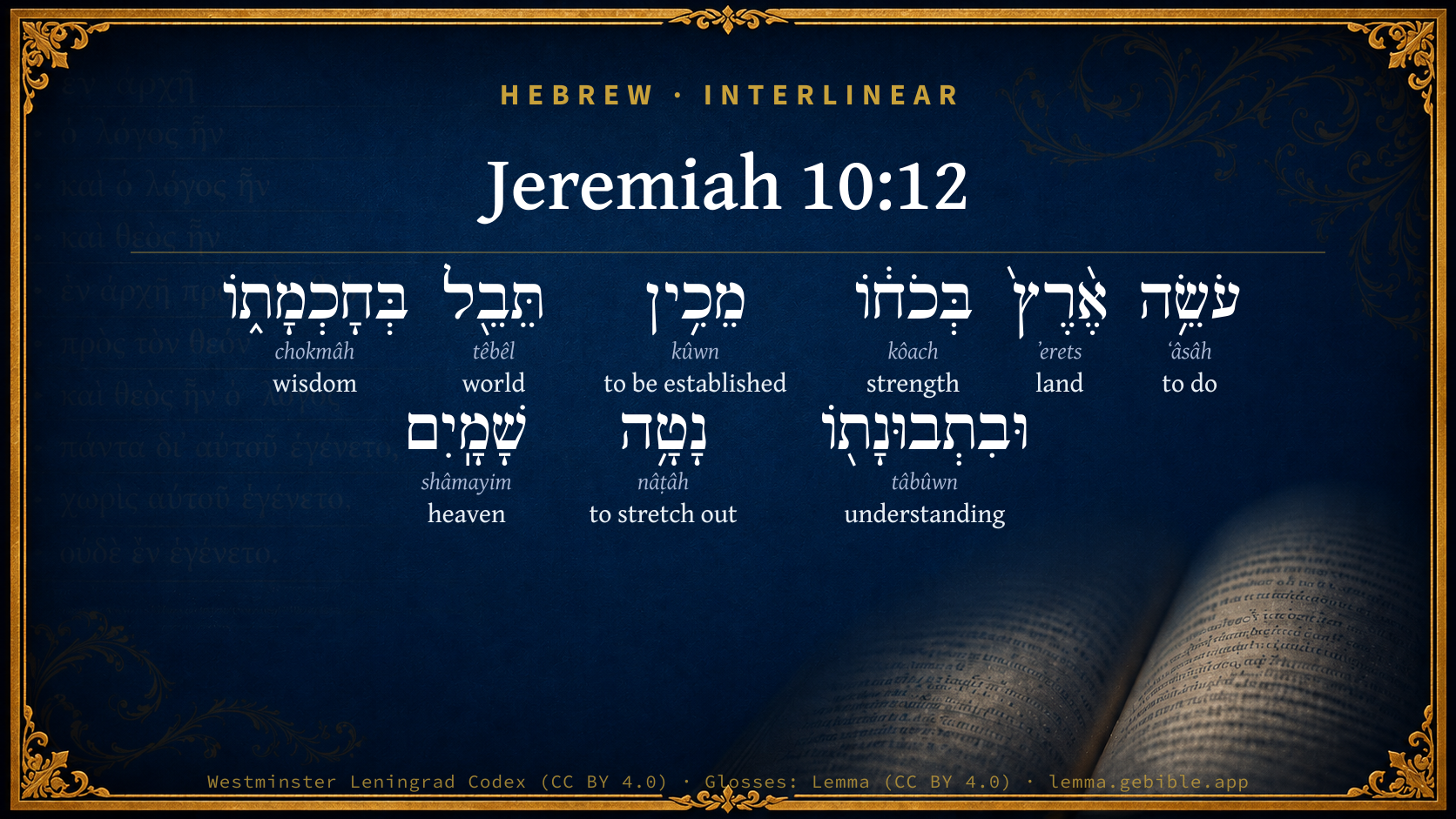
Jeremiah 10:12

Hebrew (Westminster Leningrad Codex) Jeremiah 10:12 appears in the Hebrew Old Testament. The text above is from the Westminster Leningrad Codex. Each word links to its Strong’s number, a concise gloss, and parsing drawn from the Open Scriptures Hebrew Bible morphology. Click any word for its full Brown-Driver-Briggs (BDB) entry.
Download image
Cite this verse

Jeremiah 10:12 (World English Bible). Public Domain. Lemma interlinear Bible study tool, https://lemma.gebible.app/v/jeremiah/10/12.

Show BibTeX & RIS
BibTeX
RIS
English Translation
He has made the earth by his power, he has established the world by his wisdom, and by his understanding has he stretched out the heavens:
World English Bible · Public Domain
Download a study sheet

One document with this verse’s original text, its word-by-word gloss line, the meaning frame, cross-references with their text, attributed commentary, and full source and license credits — printable, and it pastes into notes with its structure intact.

This verse Autodidact and up

Study sheet (.html) Plain text (.txt)

A passage Seminary Student

Up to 50 verses in one chapter. A passage sheet keeps up to 6 commentary sources and 12 cross-references per verse, in the order this page ranks them, and says so on the sheet whenever that leaves anything out. Ask for a single verse and you get the Autodidact verse sheet above.

Everything on this page stays free to read, with no account — the sheet is a download of what is already on screen, not access to it.

Want to remove ads? Support Godless Engineer
Compare translations 3

The same verse in 3 English versions, stacked beneath the original-language interlinear above. Click any original word for its lexicon entry.

Each is an independent rendering of the whole verse — the interlinear is not word-aligned to these translations.

Highlighted words mark where these versions differ — a whole-verse word diff, not a word-by-word alignment.

  • World English Bible Public Domain
    He has made the earth by his power, he has established the world by his wisdom, and by his understanding has he stretched out the heavens:
  • King James Version Public Domain
    He hath made the earth by his power, he hath established the world by his wisdom, and hath stretched out the heavens by his discretion.
  • unfoldingWord Literal Text CC BY-SA 4.0
    The maker of the earth by his strength, the establisher of the world by his wisdom, and by his understanding he stretched out the heavens.

unfoldingWord Literal Text — © unfoldingWord, licensed CC BY-SA 4.0. Word-aligned USFM3 via Door43 (git.door43.org/unfoldingWord/en_ult).

Versions to compare (up to 4)

3 of 4 selected

Show all 18 translations

Every available English version of this verse, each an independent rendering of the whole verse.

  • World English Bible Public Domain
    He has made the earth by his power, he has established the world by his wisdom, and by his understanding has he stretched out the heavens:
  • Berean Standard Bible Public Domain
    The LORD made the earth by His power; He established the world by His wisdom and stretched out the heavens by His understanding.
  • Majority Standard Bible Public Domain
    The LORD made the earth by His power; He established the world by His wisdom and stretched out the heavens by His understanding.
  • King James Version Public Domain
    He hath made the earth by his power, he hath established the world by his wisdom, and hath stretched out the heavens by his discretion.
  • American Standard Version (1901) Public Domain
    He hath made the earth by his power, he hath established the world by his wisdom, and by his understanding hath he stretched out the heavens:
  • Revised Version (1885) Public Domain
    He hath made the earth by his power, he hath established the world by his wisdom, and by his understanding hath he stretched out the heavens:
  • Geneva Bible (1599) Public Domain
    He hath made the earth by his power, and established the worlde by his wisedome, and hath stretched out the heauen by his discretion.
  • Douay-Rheims (1899) Public Domain
    He that maketh the earth by his power, that prepareth the world by his wisdom, and stretcheth out the heavens by his knowledge.
  • Young's Literal Translation Public Domain
    The maker of the earth by His power, The establisher of the world by His wisdom, Who, by His understanding, stretched forth the heavens,
  • Literal Standard Version CC BY-SA 4.0
    The Maker of the earth by His power, || The Establisher of the world by His wisdom, || Who, by His understanding, stretched forth the heavens—
  • Unlocked Literal Bible CC BY-SA 4.0
    But it was he who made the earth by his power, and he established the world by his wisdom, and by his understanding he stretched out the heavens.
  • unfoldingWord Literal Text CC BY-SA 4.0
    The maker of the earth by his strength, the establisher of the world by his wisdom, and by his understanding he stretched out the heavens.
  • Darby Bible Public Domain
    He hath made the earth by his power, he hath established the world by his wisdom, and hath stretched out the heavens by his understanding.
  • World Messianic Bible Public Domain
    God has made the earth by his power. He has established the world by his wisdom, and by his understanding has he stretched out the heavens.
  • Webster's Bible Public Domain
    He hath made the earth by his power, he hath established the world by his wisdom, and hath stretched out the heavens by his discretion.
  • Free Bible Version CC BY-SA 4.0
    It was God who made the earth by his power. He created the world by his wisdom and by his understanding he put the heavens in place.
  • Bible in Basic English Public Domain
    He has made the earth by his power, he has made the world strong in its place by his wisdom, and by his wise design the heavens have been stretched out.
  • JPS Tanakh (1917) Public Domain
    He that hath made the earth by His power, that hath established the world by His wisdom, and hath stretched out the heavens by His understanding;

Literal Standard Version (2020), Covenant Press — licensed CC BY-SA 4.0. Text via the HelloAO Bible API (eBible.org). Unlocked Literal Bible (unfoldingWord) — licensed CC BY-SA 4.0. Text via the HelloAO Bible API (eBible.org). unfoldingWord Literal Text — © unfoldingWord, licensed CC BY-SA 4.0. Word-aligned USFM3 via Door43 (git.door43.org/unfoldingWord/en_ult). Free Bible Version, Dr. Jonathan Gallagher — licensed CC BY-SA 4.0. Text via the HelloAO Bible API (eBible.org).

Word by word

More ways to search: Search by grammar → Find every occurrence → Compare this word →

Practice this passage: Drill this verse → Learn its vocabulary →

תֵּבֵ֖ל
têbêl
H8398
“world”
Noun, Common, Feminine, Singular, Absolute
Part of Speech
Noun
Type
Common
Gender
Feminine
Number
Singular
State
Absolute
Full BDB Definition

Origin: from H2986

TWOT: 835h

world
  1. עֹשֵׂ֥ה ʻâsâh H6213 “doing” Verb, Qal, Participle Active, Masculine, Singular, Construct
  2. אֶ֨רֶץ֙ ʼerets H776 “land” Noun, Common, Both, Singular, Absolute
  3. בְּכֹח֔וֹ kôach H3581 “in/at · strength · his” Preposition + Noun, Common, Masculine, Singular, Construct + Suffix, Personal, 3rd Person, Masculine, Singular
  4. מֵכִ֥ין kûwn H3559 “being established” Verb, Hiphil, Participle Active, Masculine, Singular, Absolute
  5. בְּחָכְמָת֑וֹ chokmâh H2451 “in/at · wisdom · his” Preposition + Noun, Common, Feminine, Singular, Construct + Suffix, Personal, 3rd Person, Masculine, Singular
  6. וּבִתְבוּנָת֖וֹ tâbûwn H8394 “and · in/at · understanding · his” Conjunction + Preposition + Noun, Common, Feminine, Singular, Construct + Suffix, Personal, 3rd Person, Masculine, Singular
  7. נָטָ֥ה nâṭâh H5186 “to stretch out” Verb, Qal, Perfect, 3rd Person, Masculine, Singular
  8. שָׁמָֽיִם shâmayim H8064 “heaven(s)” Noun, Common, Masculine, Plural, Absolute

About this verse

These counts appear in no published source. They are computed here, from the morphology-tagged text and Lemma’s own curated glosses. What Lemma adds →

9
words
9
distinct lemmas
Prophets
section

Shared distinctive vocabulary

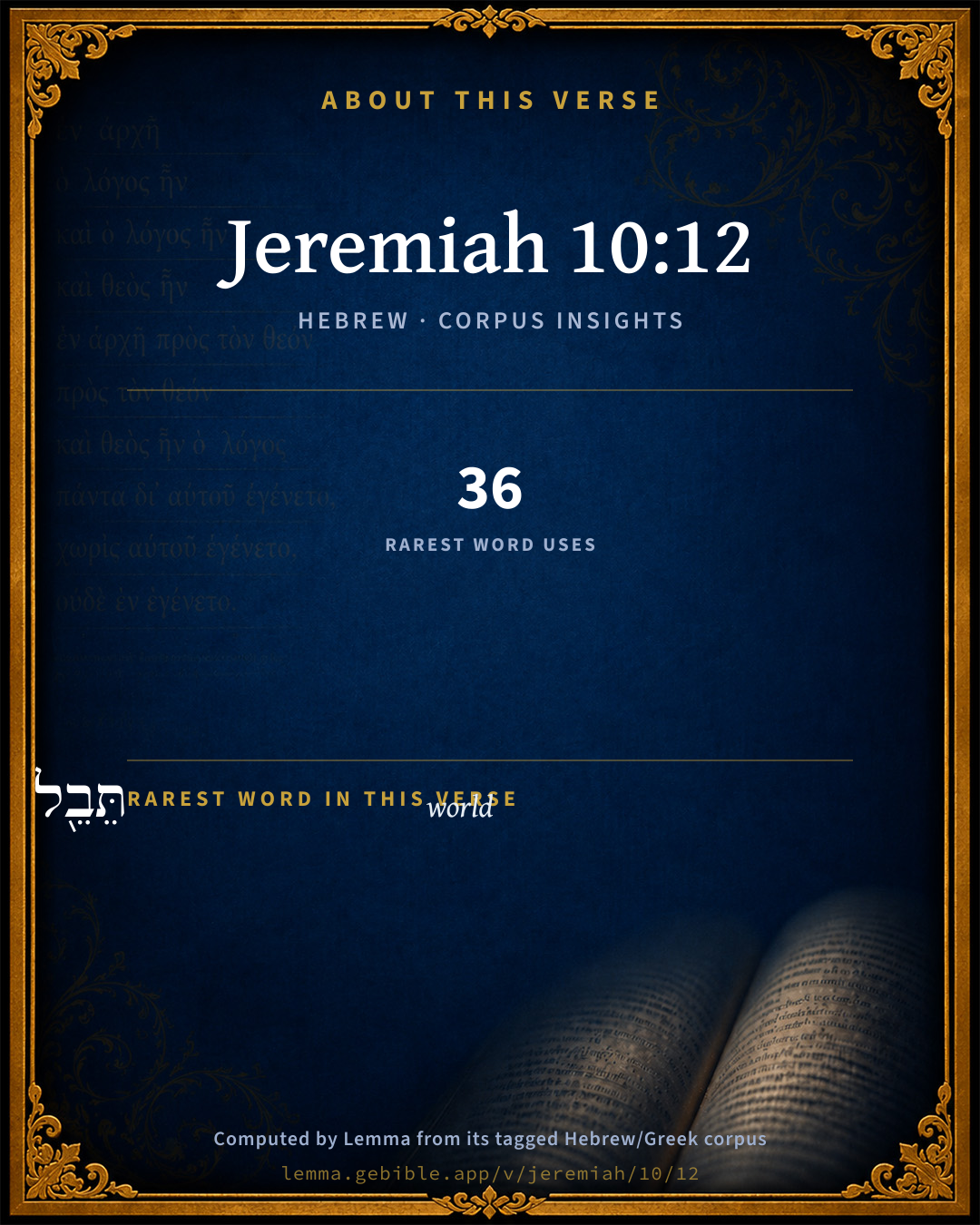
תֵּבֵ֖ל world H8398 occurs in 36 verses of the Hebrew Bible. Also found in:

Grammatical profile

  • 3 verbs
  • 6 nouns

Verb forms

  • עֹשֵׂ֥ה Qal · Participle Active
  • מֵכִ֥ין Hiphil · Participle Active
  • נָטָ֥ה Qal · Perfect

Cross-references

30

Topical passages linked to Jeremiah 10:12 in the Treasury of Scripture Knowledge — connected by theme and wording, ordered by reader-vote popularity; previews shown in the World English Bible.

  • Genesis 1:1 In the beginning God created the heavens and the earth.
  • Job 9:8 Who alone stretches out the heavens, Treads on the waves of the sea;
  • Proverbs 3:19 By wisdom Yahweh founded the earth. By understanding, he established the heavens.
  • Isaiah 40:22 [It is] he who sits above the circle of the earth, and the inhabitants of it are as grasshoppers; who stretches out the heavens as a curtain, and spreads them out as a tent to dwell in;
  • Psalms 24:2 For he has founded it on the seas, And established it on the floods.
  • John 1:3 All things were made through him. Without him was not anything made that has been made.
  • Colossians 1:16 For by him were all things created, in the heavens and on the earth, things visible and things invisible, whether thrones or dominions or principalities or powers; all things have been created through him, and for him.
  • Job 38:4–7 "Where were you when I laid the foundations of the earth? Declare, if you have understanding.
  • Psalms 33:6 By Yahweh's word the heavens were made; All their host by the breath of his mouth.
  • Psalms 104:24 Yahweh, how many are your works! In wisdom have you made them all. The earth is full of your riches.
  • Psalms 146:5–6 Happy is he who has the God of Jacob for his help, Whose hope is in Yahweh, his God:
  • Psalms 148:4–5 Praise him, you heavens of heavens, You waters that are above the heavens.
  • Isaiah 42:5 Thus says God Yahweh, he who created the heavens, and stretched them forth; he who spread abroad the earth and that which comes out of it; he who gives breath to the people on it, and spirit to those who walk therein:
  • Isaiah 44:24 Thus says Yahweh, your Redeemer, and he who formed you from the womb: I am Yahweh, who makes all things; who stretches forth the heavens alone; who spreads abroad the earth (who is with me?);
  • Isaiah 45:12 I have made the earth, and created man on it: I, even my hands, have stretched out the heavens; and all their host have I commanded.
  • Isaiah 45:18 For thus says Yahweh who created the heavens, the God who formed the earth and made it, who established it and didn't create it a waste, who formed it to be inhabited: I am Yahweh; and there is no one else.
  • Isaiah 48:13 Yes, my hand has laid the foundation of the earth, and my right hand has spread out the heavens: when I call to them, they stand up together.
  • Isaiah 49:8 Thus says Yahweh, In an acceptable time have I answered you, and in a day of salvation have I helped you; and I will preserve you, and give you for a covenant of the people, to raise up the land, to make them inherit the desolate heritage:
  • Jeremiah 32:17 Ah Lord Yahweh! behold, you have made the heavens and the earth by your great power and by your outstretched arm; there is nothing too hard for you,
  • Jeremiah 51:15–19 He has made the earth by his power, he has established the world by his wisdom, and by his understanding has he stretched out the heavens:
  • Zechariah 12:1 An oracle. The word of Yahweh concerning Israel. Yahweh, who stretches out the heavens, and lays the foundation of the earth, and forms the spirit of man within him says:
  • Job 26:7 He stretches out the north over empty space, And hangs the earth on nothing.
  • Psalms 78:69 He built his sanctuary like the heights, Like the earth which he has established forever.
  • Psalms 119:90 Your faithfulness is to all generations. You have established the earth, and it remains.
  • Psalms 136:5–6 To him who by understanding made the heavens; For his loving kindness endures forever:
  • Proverbs 30:4 Who has ascended up into heaven, and descended? Who has gathered the wind in his fists? Who has bound the waters in his garment? Who has established all the ends of the earth? What is his name, and what is his son's name, if you know?
  • Jeremiah 10:13 when he utters his voice, there is a tumult of waters in the heavens, and he causes the vapors to ascend from the ends of the earth; he makes lightnings for the rain, and brings forth the wind out of his treasuries.
  • Genesis 1:6–9 God said, "Let there be an expanse in the midst of the waters, and let it divide the waters from the waters."
  • Psalms 93:1 Yahweh reigns! He is clothed with majesty! Yahweh is armed with strength. The world also is established. It can't be moved.
  • Psalms 104:2 He covers himself with light as with a garment. He stretches out the heavens like a curtain.

Cross-references courtesy of OpenBible.info (CC BY 4.0).

Hebrew and Greek witnesses Masoretic Hebrew ↔ Greek Septuagint

The same verse in the two great witnesses to the Old Testament, shown verse-for-verse.

These are two independent witnesses, not word-aligned to each other, and the Septuagint is shown in lemma (dictionary) form.

Hebrew Jeremiah 10:12 Masoretic · Westminster Leningrad Codex

עֹשֵׂ֥ה אֶ֨רֶץ֙ בְּכֹח֔וֹ מֵכִ֥ין תֵּבֵ֖ל בְּחָכְמָת֑וֹ וּבִתְבוּנָת֖וֹ נָטָ֥ה שָׁמָֽיִם

He has made the earth by his power, he has established the world by his wisdom, and by his understanding has he stretched out the heavens:

World English Bible · Public Domain

Greek LXX Structure differs

In the Septuagint, Jeremiah is about an eighth shorter than the Hebrew and arranges its material differently — the Oracles Against the Nations (Hebrew chapters 46–51) appear in the middle of the Greek book, after 25:13. Because the chapter and verse boundaries do not line up, a verse-for-verse comparison with the Hebrew is not shown.

A verse-for-verse comparison isn’t shown here because the chapters and verses don’t line up. Switch to the LXX edition with the MT / LXX toggle above to read the Greek directly.

Hebrew: Westminster Leningrad Codex (CC BY 4.0). Greek: Septuagint (public domain); English from a public-domain English Septuagint. How the Septuagint differs from the Hebrew →

Targum (Aramaic paraphrase)

1

The Targum is the ancient Jewish Aramaic paraphrase of the Hebrew Scriptures — an interpretive translation, not the Hebrew text itself. Onkelos (literal) and Pseudo-Jonathan (expansive) render the Torah, and Jonathan the Prophets. Coverage is partial: where no permissively-licensed English translation exists for a verse, only the Aramaic is shown. This is verse-level text, not a word-by-word alignment to the Hebrew.

  1. Targum Jonathan Prophets (Joshua–Malachi)
    וְכִדְנָא תֵימְרוּן לְהוֹן אֲנַחְנָא פַּלְחִין לִדְעָבֵיד אַרְעָא בְּחֵילֵי שַׁכְלֵיל תֵּבֵל בְּחוּכְמָתֵיהּ בְּסוּכְלָתָנוּתֵיהּ תְּלָא שְׁמַיָא:

    (no public-domain English translation for this verse)

    Targum Jonathan — Aramaic: “Mikraot Gedolot” (public domain). English: “Sefaria Community Translation” (CC0 1.0 (public-domain dedication)); “London "Chaldee Paraphrase," 1871” (public domain). Text via Sefaria.

Commentary

Notes on Jeremiah 10:12 from classic Christian and Jewish commentators (each source and its license shown beneath its notes). The classic Christian expositions comment on the surrounding passage and are grouped to its opening verse, so a note may address several verses; the Jewish commentaries on the Tanakh (Rashi and others) are per-verse, so they appear only where the commentator wrote on this verse.

Lemma curates 59 commentaries, every one of them public domain or Creative Commons licensed, each selected and text-cleaned for this edition rather than reprinted as found. About our sources →

Trapp's Complete Commentary

John Trapp

Jer 10:12 He hath made the earth by his power, he hath established the world by his wisdom, and hath stretched out the heavens by his discretion.

Ver. 12. He hath made the earth by his power.] Here we have the true philosophy and right origin of things: Felix qui potuit rerum cognoscere causas. Almighty God made the earth, the main bulk and body of it. {Gen 1:1} He alone is the powerful Creator, the provident Disposer, the prudent Preserver of all things both in heaven and in earth; therefore the only true God.

John Trapp, A Commentary or Exposition upon All the Books of the Old and New Testament (1647–1656) — public domain. Text from a community e-Sword module.

Joseph Benson's Commentary

Jer 10:12-13. He hath made the earth, &c. — Here follows a noble and lofty description of God’s power and providence, whereby he sets forth his infinite pre-eminence above all the dead and senseless idols of the world. When he uttereth his voice, &c. — When he gives the word of command, and signifies his will and pleasure: see Job 38:34. Or, when he sends forth his thunder, called in Scripture the voice of God, the clouds immediately precipitate in torrents of rain, which, coming upon the ground that was scorched with heat before, not only cools and refreshes it, but renders it fruitful in all kinds of vegetable productions. He maketh lightnings with rain — And as he causes the vapours to ascend up in clouds from every quarter of the earth, so he joins two contrary things together, ordaining great flashes of lightning to break forth with the rain; the latter, by its moisture, preventing the ill effects that might otherwise proceed from the heat of the former. And bringeth forth the winds out of his treasures — As there is occasion for them, directing them all in such measures, and for such uses, as he thinks fit. In other words, “He makes great and mighty winds to come from unknown places and causes, as if he brought them out of a hidden treasure, or repository, where they had been laid up till he had occasion for them.” — Lowth.

Joseph Benson's Commentary on the Old and New Testaments (1811–1818) — public domain. Text from a community e-Sword module.

Whedon's Commentary on the Bible

Daniel D. Whedon

MANIFESTATIONS OF JEHOVAH’S ALMIGHTINESS, Jer_10:12-16.

12. Power… wisdom… discretion — This enumeration of the natural attributes of God as exhibited in the material creation is interesting. They are graded one above the other in true logical order. As through a window we look through this verse, and see how the revelations of God in his word and in his works are one; or if, in any sense, they are two, they are still harmonious. First, “power,” and its product is the dead earth; then “wisdom,” and its product is the organized world; finally, “discretion,” or constructive skill, and its product is the universe, with all its adjustments and the mutual adaptations of its various parts.

Daniel D. Whedon (gen. ed.), Commentary on the Old and New Testaments (1874–1909) — public domain. Text from a community e-Sword module.

Tyndale Open Study Notes

Tyndale Open Resources

10:12-16 This stanza contains several strong affirmations of God’s nature.

10:12 Jeremiah affirmed that the Lord’s power, wisdom, and understanding are the attributes with which he creates and sustains creation.

Tyndale Open Study Notes — © Tyndale Open Resources, licensed CC BY-SA 4.0. Text via the HelloAO Bible API.

Jamieson, Fausset & Brown

Robert Jamieson, A. R. Fausset & David Brown

Continuation of Jer 10:10, after the interruption of the thread of the discourse in Jer 10:11 (Psa 136:5-6).

Jamieson, Fausset & Brown — Commentary Critical and Explanatory on the Whole Bible (1871) — public domain (CC PDM 1.0). Text via the HelloAO Bible API.

John Calvin's Commentaries

Jeremiah speaks now again in Hebrew, for he on purpose spoke in Chaldee, to shew that the ungodly were not to be given way to, if they blasphemed and wantonly derided the holy name of God. But as it is necessary that the confession of the mouth should proceed from faith, as fruit from the root, the Prophet here reminds the Israelites that there is but one true God; for, besides him who created the earth, set in order the world, and extended the heavens, there is no other to be found. Since, then, this cannot be said except of one, it follows that all the deities which the world devises for itself, are false and mere inventions of Satan, by which he deludes mankind. And doubtless no one can courageously oppose such errors, except he who believes in the one true God. We know that there were formerly some among the philosophers who jocularly and facetiously ridiculed the delirious notions of the vulgar; but no one in earnest undertook this cause, nor could they take upon themselves the defense of God’s glory, for he was unknown to them. It is therefore necessary, as I have said, that we should be really and truly grounded in the faith before the building can be carried on; for the profession, by which we ascribe glory to God, is, as it were, the superstructure, but faith, concealed within the heart, is the foundation.

We now then understand the Prophet’s design in saying, that there is but one, who made the earth. He speaks indeed concisely; but what tie says has more force, when he does not mention God’s name, but sets before us his power, as though he had said, “There is one, there is one, who has created the earth; there is one, who has set in order the world and extended the heavens; as these things cannot be ascribed to many, it follows that men are very absurd in imagining that there are various gods.”

He says that God created the earth by his power He alludes to the solid state of the earth. The philosophers indeed hold that the earth stands naturally in the middle of creation, as it is the heaviest element; and the reason they give that the earth is suspended in mid-air, is, because the center of the world attracts what is most heavy; and these things indeed they wisely discuss. Yet we must go further: for the center of the earth is not the main part of creation; it hence follows that the earth has been suspended in the air, because it has so pleased God. When, therefore, the Prophet commends God’s power in fixing the earth, he refers to its firm state.

He then adds, There is one who hath by his wisdom set the world in order He does not indeed say that He is one, but this is what is implied. Though the term תבל, tabel, is taken for the earth, it has yet a wider meaning. The Prophet, I have no doubt, includes in it at least the sea. And we know that the Spirit has not spoken in the Law and the Prophets with rigorous exactness, but in a style suited to the common capacities of men. He says then that the world was set in order by God’s wisdom: for it is wonderful how the waters mingle with the earth, and yet retain their own habitation, and are restrained from covering the earth: in the earth also itself there is amazing variety; we see in one part mountains, in another small hills; there are meadows, forests, and fields for corn. Indeed, man’s industry contributes to this variety; but we see how God hath fitted the earth for different purposes, here then shines forth the wonderful wisdom of God. When again he speaks of the heavens, he says, that they have been expanded by God’s knowledge, He indeed employs various expressions, but he means the same thing, — that God’s singular wisdom may be seen in the earth and in the heavens.

Some connect the following verse and explain the verb נטה nuthe, differently, — that God extends the heavens when he covers them with clouds; for the verb תתו, tatu, which means the same thing, follows: but the infinite mood is often to be taken for the preterite. As then this is a strained explanation, and too far-fetched, I reject it. The Prophet, no doubt, speaks of the original formation of the heavens: for when God covers the heavens with clouds, their true form does not appear; besides, the meaning of the verb is perverted, when taken to express the obscuring of the heavens by clouds. They who will impartially examine the passage, will be ready to admit, that the Prophet speaks of the expanding of the heavens. So the Scripture everywhere sets forth God’s wisdom as displayed by this wonderfill workmanship; and the heaven is said to have been expanded over the earth, so that it covers it around. (Psalm 104:6.)

Now, though Jeremiah mentions only the word “heavens,” yet he includes the wonders which appear in them, such as that the sun performs its daily course — that it changes its track daily — that the planets have two motions — that they appear in different parts — and that the sun seems now to ascend and then to descend. In short, Jeremiah here extols all the secrets of astrology, when he says, that the heavens have been expanded by God, and expanded with singular and incomparable wisdom. Though, then, he only briefly touches on this wonderful workmanship of God, yet he would have us carefully to dwell on it in our meditations; for all errors and all fancies will soon vanish, when we duly consider the power and wisdom of God, as manifested in the creation of the heavens and of the earth, and in the order observable in the world.

John Calvin's Commentaries (1540-1563) — public domain. Text from the Calvin Translation Society English edition (1840s-50s) via the Christian Classics Ethereal Library (ccel.org). Calvin's coverage is partial (roughly two-thirds of the Bible); uncommented books and verses are honest gaps, never fabricated. The 19th-century editor's footnotes and remarks are omitted so the notes are faithfully Calvin's own voice.

Ellicott's Commentary for English Readers

(12) He hath made . . . he hath established.—The words are participial in form, making . . . establishing, and complete the list of divine attributes in Jer_10:10, contrasting the creative might of Jehovah with the impotence of the gods of the heathen.

The world.—As contrasted with the material earth, the inhabited world, the world considered in its relation to man, as in Pro_8:31.

Discretion.—Better, skill.

A Bible Commentary for English Readers, edited by Charles John Ellicott (1878–1897) — public domain. Text from a community e-Sword module.

The Cambridge Bible for Schools and Colleges

gen. ed. J. J. S. Perowne

12, 13. The creation of all things, and in particular the phenomena of the tempest, are appealed to as signs of Jehovah’s supremacy.

12–16. Repeated Jer_51:15-19.

The Cambridge Bible for Schools and Colleges (gen. ed. J. J. S. Perowne; Cambridge University Press, 1878–1918) — public domain. Text from a community e-Sword module.

John Gill's Exposition

He hath made the earth by his power,.... The Targum considers these words as a continuation of the answer of the Jews to the Chaldeans, paraphrasing them thus,

"and so shall ye say unto them, `we worship him who hath made the earth by his power':''

who stands opposed to the gods that made not the heavens and the earth, that had no title to deity, nor right to worship; but the true God has both; and his making the earth out of nothing, and hanging it upon nothing, and preserving it firm and stable, are proofs of his almighty power, and so of his deity; and consequently that he ought to be worshipped, and he only.

He hath established the world by his wisdom; upon the rivers and floods; or he hath poised it in the air; or he hath disposed it in an orderly, regular, and beautiful manner, as the word (u) used signifies; by making it terraqueous, partly land, and partly water; by opening in it fountains and rivers; by diversifying it with hills and vales, with wood and arable land, &c.; all which show the wisdom as well as the power of God.

And hath stretched out the heavens by his discretion; as a canopy over the earth, as a tent to dwell in; and which is beautifully bespangled with the luminaries in it; hence it has the name of expanse, or the firmament of heaven.

(u) "aptavit", Cocceius; "preparans", Schmidt; a "aptavit, disposuit", Gussetius.

John Gill's Exposition of the Whole Bible (1746–1763) — public domain (CC PDM 1.0). Text via the HelloAO Bible API.

Albert Barnes' Notes on the Bible

Discretion - Or, understanding. The three attributes ascribed to the Creator are very remarkable. The creation of the earth, the material world, is an act of “power;” the “establishing,” i. e., the ordering and arranging it as a place fit for man’s abode, is the work of his “wisdom;” while the spreading out the heavens over it like a tent is an act of “understanding,” or skill. Naturally, the consideration of these attributes has led many to see here an allusion to the Holy Trinity.

Albert Barnes' Notes on the Bible (1834–1885) — public domain. Text from a community e-Sword/MySword module.

Matthew Poole's English Annotations

In this and the next verse the prophet enumerates some particulars wherein he is transcendently above all creatures which he hath made, much more above idols, which are the works of man’s hands.

The earth, Act 14:15, i.e. the whole globe, consisting of waters as well as earth.

By his power: it must needs speak an almighty power to make such a vast body; where would the idols have found materials of which to have composed such a body and bulk? the true God was not at a loss, he drew them out of nothing, and commanded them into a being by the word of his power, Gen 1:1.

He hath established the world by his wisdom; either he hath made it firm, solid, and unmovable, i.e. off from its basis, or rather centre; (for it is out of our sphere and province here to meddle either with the fixation or the motion of it, that is left to the old and new philosophers to dispute among themselves;) or else by establishing we understand he hath appointed it its use, or hath prepared it to be every way subservient to the inhabitants thereof, both as to delight in prospect, and varieties of recreation, by its ornamental parts in mountains, little hills, woods, meadows, fields, &c., and necessity to accommodate man and beast with all things useful, both for habitation and provision, to sustain the natural life, and to praise and magnify the founder of it, Gen 1:11,12; all which cannot choose but greatly manifest the unsearchable wisdom of God. And hath stretched out the heavens by his discretion: these are

stretched out, i.e. expanded and spread over our head, through the whole circumference of the earth, with all their glorious furniture, and varieties of motions, moving regularly in their several orbs, i.e. not varying the least degree, either in time or space, from the order and law that God hath set them, even in those which are more eccentric and erratic; which must needs argue an unparalleled skill and understanding in God, which the word discretion doth here properly signify, Exo 36:1; Job 12:13; all which are his handiwork, and do declare his glory, Psa 19:1.

Matthew Poole's English Annotations on the Holy Bible (1683–1685) — public domain. Text from a community e-Sword/MySword module.

The Pulpit Commentary

Vers. 12-16. Repeated with a slight variation in Jer_51:15-19.

He hath made the earth, etc.. (comp. the frequent references to the Divine creatorship in the latter part of Isaiah Isa_40:22 Isa_42:5 Isa_44:24 Isa_45:12, 18 51:13) By his discretion; rather, by his understanding.

The Pulpit Commentary (1880–1919), ed. H.D.M. Spence-Jones & Joseph S. Exell — public domain. Text from a community e-Sword module.

Rashi

Rabbi Shlomo Yitzchaki (Rashi)

He stretched out Tendre in French.

Rashi on the Tanakh — English translations: “The Judaica Press complete Tanach with Rashi, translated by A. J. Rosenberg” (CC BY 4.0); “Pentateuch with Rashi's commentary by M. Rosenbaum and A.M. Silbermann, 1929-1934” (public domain); “The Metsudah Tanach series, Lakewood, N.J” (CC BY 4.0); and “The Book of Joshua, Metsudah Publications, 1997” (CC BY 4.0). Text via Sefaria.

Lesson kit

Teaching starters — assembled from the data on this page, not authored interpretation. Every prompt links to the verse data it draws on. Edit before teaching.

Jeremiah, in the Prophets, opens this verse with 9 words (9 distinct Hebrew lemmas). Its most distinctive word is têbêl (“world”). A historical commentator’s framing appears above. Read the whole chapter for the surrounding context.

Discussion questions

  1. The word têbêl carries the sense “world.” How does it shape the verse?
  2. How does 1 Samuel 2:8, which shares the word «world», read alongside this verse?
  3. The translations on this page render this verse differently — a whole-verse word diff, not a word-by-word alignment. What might account for the different wordings?
  4. «עֹשֵׂ֥ה» is a Qal Participle Active verb. How does that grammatical form shape the action described?
  5. Compare how Trapp's Complete Commentary and Joseph Benson's Commentary read this verse. Where do they agree or differ?

Things to notice

Reading settings

Reading text

Shown beneath each verse's original-language words.

Old Testament
Old Testament edition

Read the OT as the Masoretic Hebrew (MT) or the Greek Septuagint (LXX).

English shown for the Greek Septuagint (in the Hebrew ↔ Greek comparison).

Comparing translations? Open the Compare panel on any verse page to stack up to four side by side.