
Proverbs 7:21

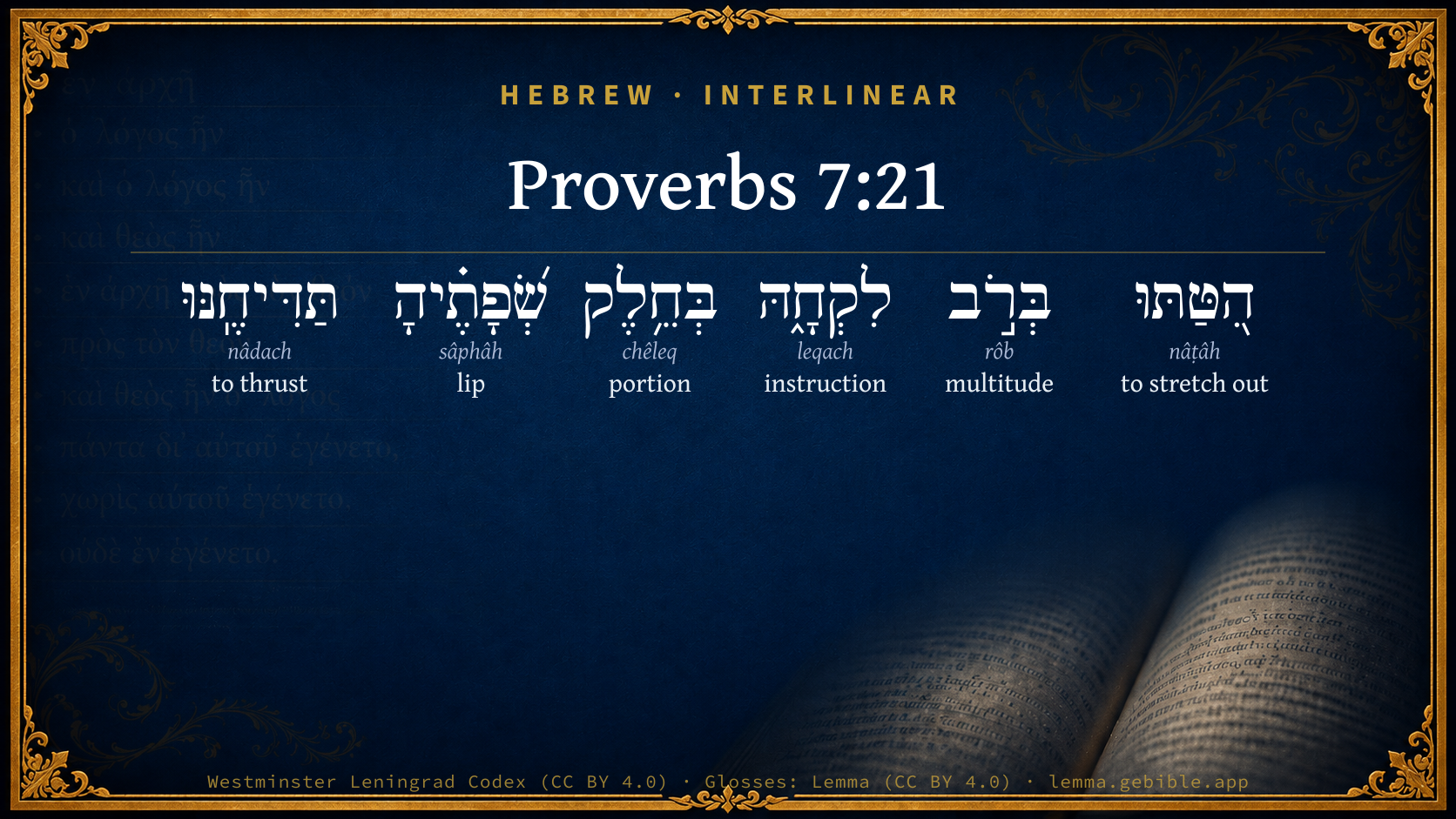
Hebrew (Westminster Leningrad Codex) Proverbs 7:21 appears in the Hebrew Old Testament. The text above is from the Westminster Leningrad Codex. Each word links to its Strong’s number, a concise gloss, and parsing drawn from the Open Scriptures Hebrew Bible morphology. Click any word for its full Brown-Driver-Briggs (BDB) entry.
Download image
Cite this verse

Proverbs 7:21 (World English Bible). Public Domain. Lemma interlinear Bible study tool, https://lemma.gebible.app/v/proverbs/7/21.

Show BibTeX & RIS
BibTeX
RIS
English Translation
With persuasive words, she led him astray. With the flattering of her lips, she seduced him.
World English Bible · Public Domain
Download a study sheet

One document with this verse’s original text, its word-by-word gloss line, the meaning frame, cross-references with their text, attributed commentary, and full source and license credits — printable, and it pastes into notes with its structure intact.

This verse Autodidact and up

Study sheet (.html) Plain text (.txt)

A passage Seminary Student

Up to 50 verses in one chapter. A passage sheet keeps up to 6 commentary sources and 12 cross-references per verse, in the order this page ranks them, and says so on the sheet whenever that leaves anything out. Ask for a single verse and you get the Autodidact verse sheet above.

Everything on this page stays free to read, with no account — the sheet is a download of what is already on screen, not access to it.

Want to remove ads? Support Godless Engineer
Compare translations 3

The same verse in 3 English versions, stacked beneath the original-language interlinear above. Click any original word for its lexicon entry.

Each is an independent rendering of the whole verse — the interlinear is not word-aligned to these translations.

Highlighted words mark where these versions differ — a whole-verse word diff, not a word-by-word alignment.

  • World English Bible Public Domain
    With persuasive words, she led him astray. With the flattering of her lips, she seduced him.
  • King James Version Public Domain
    With her much fair speech she caused him to yield, with the flattering of her lips she forced him.
  • unfoldingWord Literal Text CC BY-SA 4.0
    She leads him astray with the abundance of her instruction; with the smoothness of her lips she compels him.

unfoldingWord Literal Text — © unfoldingWord, licensed CC BY-SA 4.0. Word-aligned USFM3 via Door43 (git.door43.org/unfoldingWord/en_ult).

Versions to compare (up to 4)

3 of 4 selected

Show all 18 translations

Every available English version of this verse, each an independent rendering of the whole verse.

  • World English Bible Public Domain
    With persuasive words, she led him astray. With the flattering of her lips, she seduced him.
  • Berean Standard Bible Public Domain
    With her great persuasion she entices him; with her flattering lips she lures him.
  • Majority Standard Bible Public Domain
    With her great persuasion she entices him; with her flattering lips she lures him.
  • King James Version Public Domain
    With her much fair speech she caused him to yield, with the flattering of her lips she forced him.
  • American Standard Version (1901) Public Domain
    With her much fair speech she causeth him to yield; With the flattering of her lips she forceth him along.
  • Revised Version (1885) Public Domain
    With her much fair speech she causeth him to yield, with the flattering of her lips she forceth him away.
  • Geneva Bible (1599) Public Domain
    Thus with her great craft she caused him to yeelde, and with her flattering lips she entised him.
  • Douay-Rheims (1899) Public Domain
    She entangled him with many words, and drew him away with the flattery of her lips.
  • Young's Literal Translation Public Domain
    She turneth him aside with the abundance of her speech, With the flattery of her lips she forceth him.
  • Literal Standard Version CC BY-SA 4.0
    She turns him aside with the abundance of her speech, || She forces him with the flattery of her lips.
  • Unlocked Literal Bible CC BY-SA 4.0
    With much talk she turned him; with her smooth lips she misled him.
  • unfoldingWord Literal Text CC BY-SA 4.0
    She leads him astray with the abundance of her instruction; with the smoothness of her lips she compels him.
  • Darby Bible Public Domain
    With her much enticement she beguiled him; with the smoothness of her lips she constrained him.
  • World Messianic Bible Public Domain
    With persuasive words, she led him astray. With the flattering of her lips, she seduced him.
  • Webster's Bible Public Domain
    With her much fair speech she caused him to yield, with the flattering of her lips she impelled him.
  • Free Bible Version CC BY-SA 4.0
    She convinced him with all that she said; she seduced him with her smooth talking.
  • Bible in Basic English Public Domain
    With her fair words she overcame him, forcing him with her smooth lips.
  • JPS Tanakh (1917) Public Domain
    With her much fair speech she causeth him to yield, with the blandishment of her lips she enticeth him away.

Literal Standard Version (2020), Covenant Press — licensed CC BY-SA 4.0. Text via the HelloAO Bible API (eBible.org). Unlocked Literal Bible (unfoldingWord) — licensed CC BY-SA 4.0. Text via the HelloAO Bible API (eBible.org). unfoldingWord Literal Text — © unfoldingWord, licensed CC BY-SA 4.0. Word-aligned USFM3 via Door43 (git.door43.org/unfoldingWord/en_ult). Free Bible Version, Dr. Jonathan Gallagher — licensed CC BY-SA 4.0. Text via the HelloAO Bible API (eBible.org).

Word by word

More ways to search: Search by grammar → Find every occurrence → Compare this word →

Practice this passage: Drill this verse → Learn its vocabulary →

About this verse

These counts appear in no published source. They are computed here, from the morphology-tagged text and Lemma’s own curated glosses. What Lemma adds →

6
words
6
distinct lemmas
Wisdom
section

Notable vocabulary

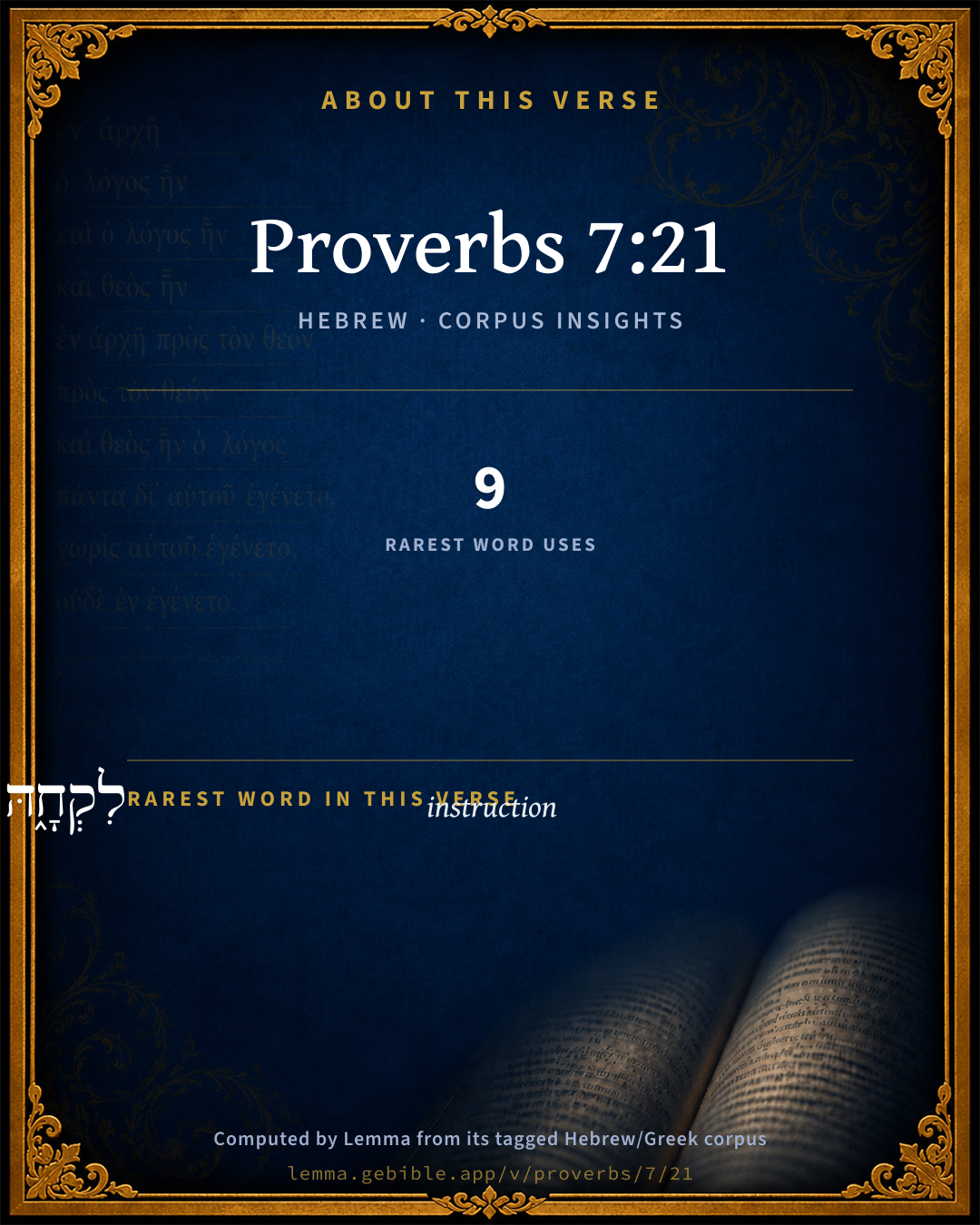
The rarest word here is לִקְחָ֑הּ instruction H3948 — appearing just 9 times in the whole Hebrew Bible.

Shared distinctive vocabulary

לִקְחָ֑הּ instruction H3948 occurs in 9 verses of the Hebrew Bible. Also found in:

Grammatical profile

  • 2 verbs
  • 4 nouns

Verb forms

  • הִ֭טַּתּוּ Hiphil · Perfect
  • תַּדִּיחֶֽנּוּ Hiphil · Imperfect

Hebrew & Septuagint length

In English translation the verse runs 16 words from the Hebrew and 24 from the Septuagint (LXX English) — the Septuagint runs noticeably longer here. See the side-by-side →

A rough comparison of the two English renderings, which tokenize alike — not a word-level alignment.

Word counts can differ between the Hebrew and the Greek without any difference in meaning — e.g. the Hebrew direct-object marker אֵת has no separate Greek word, and Greek often adds the article ὁ.

Cross-references

11

Topical passages linked to Proverbs 7:21 in the Treasury of Scripture Knowledge — connected by theme and wording, ordered by reader-vote popularity; previews shown in the World English Bible.

  • Proverbs 5:3 For the lips of an adulteress drip honey. Her mouth is smoother than oil,
  • Proverbs 7:5 That they may keep you from the strange woman, From the foreigner who flatters with her words.
  • 2 Kings 4:8 It fell on a day, that Elisha passed to Shunem, where was a great woman; and she constrained him to eat bread. So it was, that as often as he passed by, he turned in there to eat bread.
  • Psalms 12:2 Everyone lies to his neighbor. They speak with flattering lips, and with a double heart.
  • Luke 24:29 They urged him, saying, "Stay with us, for it is almost evening, and the day is almost over." He went in to stay with them.
  • Judges 16:15–17 She said to him, How can you say, I love you, when your heart is not with me? you have mocked me these three times, and have not told me in which your great strength lies.
  • Proverbs 6:24 To keep you from the immoral woman, From the flattery of the wayward wife's tongue.
  • 2 Corinthians 5:14 For the love of Christ constrains us; because we judge thus, that one died for all, therefore all died.
  • 1 Samuel 28:23 But he refused, and said, I will not eat. But his servants, together with the woman, constrained him; and he listened to their voice. So he arose from the earth, and sat on the bed.
  • Luke 14:23 "The lord said to the servant, 'Go out into the highways and hedges, and compel them to come in, that my house may be filled.
  • Acts 16:15 When she and her household were baptized, she begged us, saying, "If you have judged me to be faithful to the Lord, come into my house, and stay." So she persuaded us.

Cross-references courtesy of OpenBible.info (CC BY 4.0).

Hebrew and Greek witnesses Masoretic Hebrew ↔ Greek Septuagint

The same verse in the two great witnesses to the Old Testament, shown verse-for-verse.

Here the Septuagint runs noticeably longer than the Hebrew — LXX2012 (modern English Septuagint) 24 words vs World English Bible 16. A rough length comparison of the two English translations, not a word-level alignment — read both below.

These are two independent witnesses, not word-aligned to each other, and the Septuagint is shown in lemma (dictionary) form.

Hebrew Proverbs 7:21 Masoretic · Westminster Leningrad Codex

הִ֭טַּתּוּ בְּרֹ֣ב לִקְחָ֑הּ בְּחֵ֥לֶק שְׂ֝פָתֶ֗יהָ תַּדִּיחֶֽנּוּ

With persuasive words, she led him astray. With the flattering of her lips, she seduced him.

World English Bible · Public Domain

Greek LXX Proverbs 7:21 Septuagint · lemma form

ἀποπλανάω δέ αὐτός πολύς ὁμιλία βρόχος τε ὁ ἀπό χεῖλος ἐκὀκέλλω αὐτός

So with much converse she prevailed on him to go astray, and with the snares of her lips forced him from the right path.

LXX2012 (modern English Septuagint) · Public Domain

On this verse, Joseph Benson's Commentary discusses the Septuagint’s reading. Read the note in Commentary ↓

Hebrew: Westminster Leningrad Codex (CC BY 4.0). Greek: Septuagint (public domain); English from LXX2012 (modern English Septuagint) (Public Domain). How the Septuagint differs from the Hebrew →

Commentary

Notes on Proverbs 7:21 from classic Christian and Jewish commentators (each source and its license shown beneath its notes). The classic Christian expositions comment on the surrounding passage and are grouped to its opening verse, so a note may address several verses; the Jewish commentaries on the Tanakh (Rashi and others) are per-verse, so they appear only where the commentator wrote on this verse.

Lemma curates 59 commentaries, every one of them public domain or Creative Commons licensed, each selected and text-cleaned for this edition rather than reprinted as found. About our sources →

Trapp's Complete Commentary

John Trapp

Pro 7:21 With her much fair speech she caused him to yield, with the flattering of her lips she forced him.

Ver. 21. With much fair speech.] Fair words make fools fain. This Circe so enchanted the younker {a} with her fine language, that now she may do what she will with him, for he is wholly at her devotion.

{a} A young nobleman or gentleman, a youth of high rank.

John Trapp, A Commentary or Exposition upon All the Books of the Old and New Testament (1647–1656) — public domain. Text from a community e-Sword module.

The Biblical Illustrator

Joseph S. Exell

Pro_7:21

With her much fair speech she caused him to yield.

Good and bad speech

There is a force in words which it is often almost impossible to resist. Good words have a wonderful virtue in them to work upon the mind, and a great part of the good which we are called to do in the world is to be accomplished by means of that little member, the tongue. But corrupt minds are often found to have greater intelligence in persuading men to sin because human nature is depraved, and needs only a temptation to draw men to the practice of the worst of evils. No words have greater force in them to persuade men to sin than the flatteries of the strange woman, and therefore the apostle Paul, who directs us to strive against sin, calls loudly to us to flee youthful lusts. Such lusts can scarcely be conquered but by flight, because the temptations to them, when they meet with a simple mind and an impure heart, are like sparks of fire lighting upon stubble fully dry. The force that is in the tongue of the strange woman will not excuse the deluded youth; for his yielding to her is to be attributed to the depravity of his own heart, which inclines him to prefer the advice of a bad woman to the counsels of the Supreme and Eternal Wisdom. (G. Lawson.)

The Biblical Illustrator, edited by Joseph S. Exell (c. 1880s–1900s) — public domain. Text from a community e-Sword module.

Joseph Benson's Commentary

Pro 7:21-23. With her much fair speech — Which implies that her alluring words were more effectual with him than her impudent kisses, which possibly had a little alienated his mind from her; she caused him to yield — By this expression Solomon signifies that no provocation to sin is a sufficient excuse for it. With the flattering of her lips she forced him —

She prevailed over him; which argues that there was some reluctance in his judgment, or conscience, against yielding to her. He goeth after her straightway — Without delay or consideration; as an ox goeth to the slaughter — Going to it securely, as if it were going to a good pasture; or as a fool to the correction of the stocks — Or, which is more agreeable to the order of the words in the Hebrew text, as one in fetters, that is, bound with fetters, to the correction of a fool, namely, to receive such correction, or punishment, as belongs to fools. Which may imply, either, 1st, That he hath no more sense of the shame and mischief which he is bringing upon himself than a fool; or, 2d, That he can no more resist the temptation, or avoid the danger, than a man fast tied with chains and fetters can free himself, although his impotency be merely of a moral nature, and therefore voluntary. Till a dart strike through his liver — That is, his vital parts, whereof the liver is one. Till his life be lost, as it is explained in the next clause; as a bird hasteth to the snare — Like a silly bird, which, being greedy of the food laid to entice it, never minds the snare that is laid together with it; so he, eagerly longing to partake of her feast, and the following delights, had not so much as a thought that this was a design upon his life, and would not end but in miseries in finitely greater than all his joys. Dr. Grey, making a slight alteration in the text, renders these verses thus: “He goeth straightway, as an ox goeth to the slaughter, as a dog to the chain, and as a deer, till a dart strike through his liver: as a bird hasteth,” &c. “He considers the passage as including four similes, the ox, the dog, the deer, the bird; each of them filly resembling the case of a youth, reduced by an adulterous woman, and hastening to ruin without fear or thought. The circumstance of the dart, as applied to the deer, is beautiful and proper, which otherwise we are at a loss to dispose of. The LXX. and Syriac read, as a dog to the chains, or as a stag pierced through his liver with a dart.”

Joseph Benson's Commentary on the Old and New Testaments (1811–1818) — public domain. Text from a community e-Sword module.

Tyndale Open Study Notes

Tyndale Open Resources

7:21-23 The naive young man’s foolish actions might cost him his life (see 5:11; 6:32-35).

Tyndale Open Study Notes — © Tyndale Open Resources, licensed CC BY-SA 4.0. Text via the HelloAO Bible API.

Jamieson, Fausset & Brown

Robert Jamieson, A. R. Fausset & David Brown

caused . . . yield--or, "inclines."

flattering--(Compare Pro 5:3).

forced him--by persuasion overcoming his scruples.

Jamieson, Fausset & Brown — Commentary Critical and Explanatory on the Whole Bible (1871) — public domain (CC PDM 1.0). Text via the HelloAO Bible API.

Adam Clarke's Commentary

Verse 21. With her much fair speech] With her blandishments and lascivious talk, she overcame all his scruples, and constrained him to yield.

Adam Clarke's Commentary on the Bible (1810–1826) — public domain. Text from a community e-Sword/MySword module.

John Gill's Exposition

He goeth after her straightway,.... Or "suddenly" (g); and inconsiderately, giving himself no time to think of what would be the sad consequences of it;

as an ox goeth to the slaughter; as senseless and stupid as that; and as ignorant of the issue as that is, led by the butcher, as if it was going to a pasture, when it is going to the slaughter house. So such persons as are ensnared by harlots; they follow them in a view of pleasure, but it ends in ruin; if not in the loss of bodily life, by the revengeful husband or civil magistrate; yet in the destruction of their immortal souls;

or as a fool to the correction of the stocks; a drunken besotted fool, who, while he is leading to the stocks, is insensible whither he is going; but when he has been there awhile, and is come out of his drunken fit, then he is sensible of his punishment and his shame. Or, "as the stocks are for the correction of a fool" (h): or, as a man goes to "the stocks, to the correction of a fool" (i); so the young man went after the harlot: or, as "one fettered" (k), goes thither, bound hand and foot; he cannot help himself, nor avoid the shame. It denotes both the power of sin, there is no withstanding its allurements and blandishments, when once given way to, and the shame that attends or follows it. The Targum is,

"as a dog to a chain;''

and so the Septuagint, Syriac, and Arabic versions.

(g) "subito", Baynus, Junius & Tremellius, Piscator, Gejerus, Michaelis. (h) "sicut compes ad castigationem stulti", Pagninus, Montanus, Baynus. (i) "Abiens post cam, quasi veniens ad compedes ad castigationem stultorum", Gejerus. (k) "Velut compeditus", Junius & Tremellius; "velut in compede ibat", Michaelis; "tanquam constricto ad pedes capite", Schultens.

John Gill's Exposition of the Whole Bible (1746–1763) — public domain (CC PDM 1.0). Text via the HelloAO Bible API.

Albert Barnes' Notes on the Bible

Fair speech - The Hebrew word is usually translated “doctrine,” or “learning” Pro 1:5; Pro 4:2; Pro 9:9; possibly it is used here in keen irony.

Albert Barnes' Notes on the Bible (1834–1885) — public domain. Text from a community e-Sword/MySword module.

Matthew Poole's English Annotations

With her much fair speech; which implies that her alluring words were more effectual with him than her impudent kisses, which possibly had a little alienated his mind from her.

She caused him to yield; whereby he signifies that no provocation to sin is a sufficient excuse for sin.

She forced him; she prevailed over him; which argues that there was some reluctancy in his judgment or conscience against it.

Matthew Poole's English Annotations on the Holy Bible (1683–1685) — public domain. Text from a community e-Sword/MySword module.

Whedon's Commentary on the Bible

Daniel D. Whedon

21. Much fair speech — Literally, her much taking; a word sometimes rendered learning, as in Pro_1:5; Pro_4:2; Pro_9:9. Miller quaintly says, “Her taking ways.”

Caused him to yield — The idea is, that she played the orator with him, effectually arousing his passions and leading him captive.

Daniel D. Whedon (gen. ed.), Commentary on the Old and New Testaments (1874–1909) — public domain. Text from a community e-Sword module.

The Pulpit Commentary

Thus far we have had the adulteress introduced speaking; now the narrative proceeds. With her much fair speech she caused him to yield. First, she influenced his mind, and bent his will to her purpose by her evil eloquence. The Hebrew word means "doctrine, or learning devil"s pleading. (Pro_1:5 Pro_9:9) St. Jerome has irretivit, "she netted him;" Septuagint, "She caused him to go astray (apeplanhse ) by much converse." She talked him over, though indeed he had put himself in the way of temptation, and had now no power to resist her seductions. Then with the flattering of her lips she forced him; drew him away. His body followed the lead of his blinded mind; he acceded to her solicitations. Septuagint, "With the snares of her lips she ran him aground (exwkeile ), drove him headlong to ruin."

The Pulpit Commentary (1880–1919), ed. H.D.M. Spence-Jones & Joseph S. Exell — public domain. Text from a community e-Sword module.

Keil & Delitzsch

C. F. Keil & F. Delitzsch

The result: -

21 She beguiled him by the fulness of her talking,

By the smoothness of her lips she drew him away.

Here is a climax. First she brought him to yield, overcoming the resistance of his mind to the last point (cf. Kg1 11:3); then drove him, or, as we say, hurried him wholly away, viz., from the right path or conduct (cf. Deu 13:6, Deu 13:11). With הטּתּוּ (= הטּתהוּ) as the chief factum, the past imperf. is interchanged, 21b. Regarding לקח, see above, p. 56. Here is the rhetoric of sin (Zckler); and perhaps the לקח of 20a has suggested this antiphrastic לקח to the author (Hitzig), as חלק (the inverted לקח, formed like שׁפל, which is the abstr. of שׁפל as that is of חלק) and תּדּיחנּוּ are reciprocally conditioned, for the idea of the slippery (Psa 73:18) connects itself with חלק.

Keil & Delitzsch — Biblical Commentary on the Old Testament (1861–1891) — public domain (CC PDM 1.0). Text via the HelloAO Bible API. (Old Testament only.)

Rashi

Rabbi Shlomo Yitzchaki (Rashi)

She swayed him the one devoid of sense, to her.

with all her talk with which she is accustomed to familiarize men.

she entices him from the road.

Rashi on the Tanakh — English translations: “The Judaica Press complete Tanach with Rashi, translated by A. J. Rosenberg” (CC BY 4.0); “Pentateuch with Rashi's commentary by M. Rosenbaum and A.M. Silbermann, 1929-1934” (public domain); “The Metsudah Tanach series, Lakewood, N.J” (CC BY 4.0); and “The Book of Joshua, Metsudah Publications, 1997” (CC BY 4.0). Text via Sefaria.

Lesson kit

Teaching starters — assembled from the data on this page, not authored interpretation. Every prompt links to the verse data it draws on. Edit before teaching.

Proverbs, in the Wisdom, opens this verse with 6 words (6 distinct Hebrew lemmas). Its most distinctive word is leqach (“instruction”). The Greek Septuagint runs longer here. A historical commentator’s framing appears above. Read the whole chapter for the surrounding context.

Discussion questions

  1. How does “instruction” (leqach) shape what this verse is saying?
  2. How does Deuteronomy 32:2, which shares the word «instruction», read alongside this verse?
  3. The Septuagint runs longer here than the Hebrew. What might account for the difference?
  4. These translations render this verse differently. What is at stake in choosing one wording over another?
  5. «הִ֭טַּתּוּ» is a Hiphil Perfect verb. How does that grammatical form shape the action described?
  6. Compare how Trapp's Complete Commentary and The Biblical Illustrator read this verse. Where do they agree or differ?

Things to notice

Reading settings

Reading text

Shown beneath each verse's original-language words.

Old Testament
Old Testament edition

Read the OT as the Masoretic Hebrew (MT) or the Greek Septuagint (LXX).

English shown for the Greek Septuagint (in the Hebrew ↔ Greek comparison).

Comparing translations? Open the Compare panel on any verse page to stack up to four side by side.