
Psalms 119:51

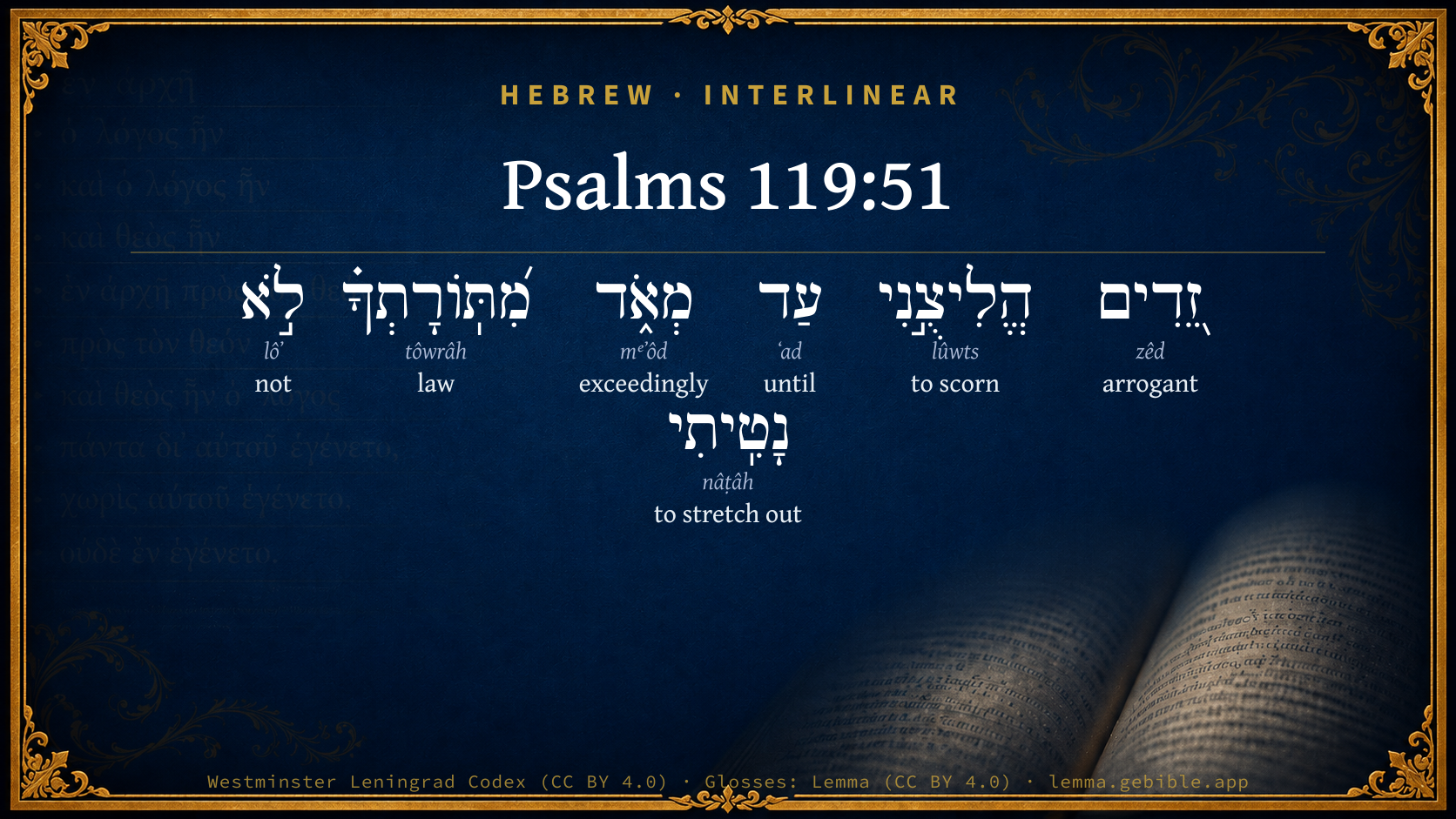
Hebrew (Westminster Leningrad Codex) Psalms 119:51 appears in the Hebrew Old Testament. The text above is from the Westminster Leningrad Codex. Each word links to its Strong’s number, a concise gloss, and parsing drawn from the Open Scriptures Hebrew Bible morphology. Click any word for its full Brown-Driver-Briggs (BDB) entry.
Download image
Cite this verse

Psalms 119:51 (World English Bible). Public Domain. Lemma interlinear Bible study tool, https://lemma.gebible.app/v/psalms/119/51.

Show BibTeX & RIS
BibTeX
RIS
English Translation
The arrogant mock me excessively, But I don't swerve from your law.
World English Bible · Public Domain
Download a study sheet

One document with this verse’s original text, its word-by-word gloss line, the meaning frame, cross-references with their text, attributed commentary, and full source and license credits — printable, and it pastes into notes with its structure intact.

This verse Autodidact and up

Study sheet (.html) Plain text (.txt)

A passage Seminary Student

Up to 50 verses in one chapter. A passage sheet keeps up to 6 commentary sources and 12 cross-references per verse, in the order this page ranks them, and says so on the sheet whenever that leaves anything out. Ask for a single verse and you get the Autodidact verse sheet above.

Everything on this page stays free to read, with no account — the sheet is a download of what is already on screen, not access to it.

Want to remove ads? Support Godless Engineer
Compare translations 3

The same verse in 3 English versions, stacked beneath the original-language interlinear above. Click any original word for its lexicon entry.

Each is an independent rendering of the whole verse — the interlinear is not word-aligned to these translations.

Highlighted words mark where these versions differ — a whole-verse word diff, not a word-by-word alignment.

  • World English Bible Public Domain
    The arrogant mock me excessively, But I don't swerve from your law.
  • King James Version Public Domain
    The proud have had me greatly in derision: yet have I not declined from thy law.
  • unfoldingWord Literal Text CC BY-SA 4.0
    The proud utterly scoff at me; from your teaching I do not turn aside.

unfoldingWord Literal Text — © unfoldingWord, licensed CC BY-SA 4.0. Word-aligned USFM3 via Door43 (git.door43.org/unfoldingWord/en_ult).

Versions to compare (up to 4)

3 of 4 selected

Show all 17 translations

Every available English version of this verse, each an independent rendering of the whole verse.

  • World English Bible Public Domain
    The arrogant mock me excessively, But I don't swerve from your law.
  • Berean Standard Bible Public Domain
    The arrogant utterly deride me, but I do not turn from Your law.
  • Majority Standard Bible Public Domain
    The arrogant utterly deride me, but I do not turn from Your law.
  • King James Version Public Domain
    The proud have had me greatly in derision: yet have I not declined from thy law.
  • American Standard Version (1901) Public Domain
    The proud have had me greatly in derision: `Yet' have I not swerved from thy law.
  • Revised Version (1885) Public Domain
    The proud have had me greatly in derision: yet have I not swerved from thy law.
  • Geneva Bible (1599) Public Domain
    The proude haue had me exceedingly in derision: yet haue I not declined from thy Lawe.
  • Young's Literal Translation Public Domain
    The proud have utterly scorned me, From Thy law I have not turned aside.
  • Literal Standard Version CC BY-SA 4.0
    The proud have utterly scorned me, || I have not turned aside from Your law.
  • Unlocked Literal Bible CC BY-SA 4.0
    The proud have scoffed at me, yet I have not turned away from your law.
  • unfoldingWord Literal Text CC BY-SA 4.0
    The proud utterly scoff at me; from your teaching I do not turn aside.
  • Darby Bible Public Domain
    The proud have derided me beyond measure: I have not declined from thy law.
  • World Messianic Bible Public Domain
    The arrogant mock me excessively, but I don’t swerve from your Torah.
  • Webster's Bible Public Domain
    The proud have had me greatly in derision: yet I have not declined from thy law.
  • Free Bible Version CC BY-SA 4.0
    Arrogant people mock me terribly, but I don't give up on your teachings.
  • Bible in Basic English Public Domain
    The men of pride have made great sport of me; but I have not been turned from your law.
  • JPS Tanakh (1917) Public Domain
    The proud have had me greatly in derision; yet have I not turned aside from Thy law.

Literal Standard Version (2020), Covenant Press — licensed CC BY-SA 4.0. Text via the HelloAO Bible API (eBible.org). Unlocked Literal Bible (unfoldingWord) — licensed CC BY-SA 4.0. Text via the HelloAO Bible API (eBible.org). unfoldingWord Literal Text — © unfoldingWord, licensed CC BY-SA 4.0. Word-aligned USFM3 via Door43 (git.door43.org/unfoldingWord/en_ult). Free Bible Version, Dr. Jonathan Gallagher — licensed CC BY-SA 4.0. Text via the HelloAO Bible API (eBible.org).

Word by word

More ways to search: Search by grammar → Find every occurrence → Compare this word →

Practice this passage: Drill this verse → Learn its vocabulary →

About this verse

These counts appear in no published source. They are computed here, from the morphology-tagged text and Lemma’s own curated glosses. What Lemma adds →

7
words
7
distinct lemmas
Wisdom
section

Notable vocabulary

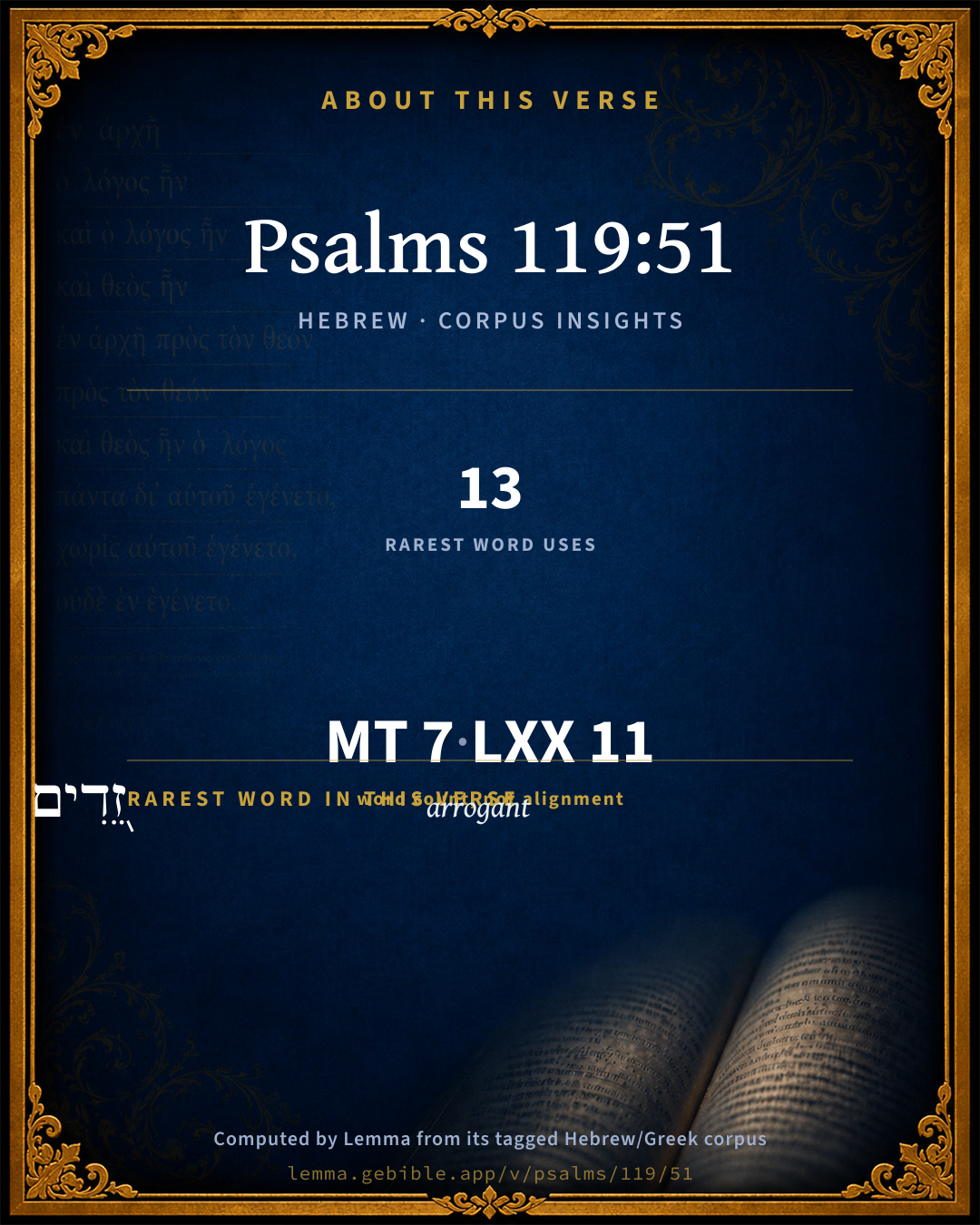
The rarest word here is זֵ֭דִים arrogant H2086 — appearing just 13 times in the whole Hebrew Bible.

Shared distinctive vocabulary

זֵ֭דִים arrogant H2086 occurs in 13 verses of the Hebrew Bible. Also found in:

Grammatical profile

  • 2 verbs
  • 1 noun
  • 1 adjective
  • 1 preposition
  • 1 adverb
  • 1 particle

Verb forms

  • הֱלִיצֻ֣נִי Hiphil · Perfect
  • נָטִֽיתִי Qal · Perfect

Hebrew & Septuagint length

In English translation the verse runs 12 words from the Hebrew and 12 from the Septuagint (LXX English) — the same length.

A rough comparison of the two English renderings, which tokenize alike — not a word-level alignment.

Word counts can differ between the Hebrew and the Greek without any difference in meaning — e.g. the Hebrew direct-object marker אֵת has no separate Greek word, and Greek often adds the article ὁ.

In the original languages it is 7 Hebrew tokens and 11 Greek tokens — but the two are counted differently (Hebrew bundles its prefixes and suffixes into one token; the Greek is in lemma form), so that isn’t a like-for-like length.

Cross-references

14

Topical passages linked to Psalms 119:51 in the Treasury of Scripture Knowledge — connected by theme and wording, ordered by reader-vote popularity; previews shown in the World English Bible.

  • Job 23:11 My foot has held fast to his steps. His way have I kept, and not turned aside.
  • Jeremiah 20:7 Yahweh, you have persuaded me, and I was persuaded; you are stronger than I, and have prevailed: I am become a laughing-stock all the day, every one mocks me.
  • Psalms 44:18 Our heart has not turned back, Neither have our steps strayed from your path,
  • Psalms 119:157 Many are my persecutors and my adversaries. I haven't swerved from your testimonies.
  • Psalms 119:21 You have rebuked the proud who are cursed, Who wander from your commandments.
  • Psalms 119:31 I cling to your statutes, Yahweh. Don't let me be disappointed.
  • Psalms 119:69 The proud have smeared a lie upon me. With my whole heart, I will keep your precepts.
  • Psalms 123:3–4 Have mercy on us, Yahweh, have mercy on us, For we have endured much contempt.
  • Isaiah 38:3 and said, Remember now, Yahweh, I beg you, how I have walked before you in truth and with a perfect heart, and have done that which is good in your sight. Hezekiah wept sore.
  • Isaiah 42:4 He will not fail nor be discouraged, until he have set justice in the earth; and the isles shall wait for his law.
  • Luke 16:14–15 The Pharisees, who were lovers of money, also heard all these things, and they scoffed at him.
  • Luke 23:35 The people stood watching. The rulers with them also scoffed at him, saying, "He saved others. Let him save himself, if this is the Christ of God, his chosen one!"
  • Acts 20:23–24 except that the Holy Spirit testifies in every city, saying that bonds and afflictions wait for me.
  • Hebrews 12:1–3 Therefore let us also, seeing we are surrounded by so great a cloud of witnesses, lay aside every weight and the sin which so easily entangles us, and let us run with patience the race that is set before us,

Cross-references courtesy of OpenBible.info (CC BY 4.0).

Hebrew and Greek witnesses Masoretic Hebrew ↔ Greek Septuagint

The same verse in the two great witnesses to the Old Testament, shown verse-for-verse.

You’re reading Greek Psalm 118 (Hebrew Psalm 119). The Septuagint counts the superscription, so verse numbers can differ from the Hebrew — chapter-level alignment, not verse-by-verse. Numbering follows Rahlfs.

These are two independent witnesses, not word-aligned to each other, and the Septuagint is shown in lemma (dictionary) form.

Hebrew Psalms 119:51 Masoretic · Westminster Leningrad Codex

זֵ֭דִים הֱלִיצֻ֣נִי עַד מְאֹ֑ד מִ֝תּֽוֹרָתְךָ֗ לֹ֣א נָטִֽיתִי

The arrogant mock me excessively, But I don't swerve from your law.

World English Bible · Public Domain

Greek LXX Greek Psalm 118:51 Septuagint · lemma form

ὑπερήφανος παρανομέω ἕως σφόδρα ἀπό δέ ὁ νόμος σύ οὐ ἐκκλίνω

The proud have transgressed exceedingly; but I swerved not from your law.

LXX2012 (modern English Septuagint) · Public Domain

On this verse, The Treasury of David discusses the Septuagint’s reading. Read the note in Commentary ↓

Hebrew: Westminster Leningrad Codex (CC BY 4.0). Greek: Septuagint (public domain); English from LXX2012 (modern English Septuagint) (Public Domain). How the Septuagint differs from the Hebrew →

Commentary

Notes on Psalms 119:51 from classic Christian and Jewish commentators (each source and its license shown beneath its notes). The classic Christian expositions comment on the surrounding passage and are grouped to its opening verse, so a note may address several verses; the Jewish commentaries on the Tanakh (Rashi and others) are per-verse, so they appear only where the commentator wrote on this verse.

Lemma curates 59 commentaries, every one of them public domain or Creative Commons licensed, each selected and text-cleaned for this edition rather than reprinted as found. About our sources →

Trapp's Complete Commentary

John Trapp

Psa 119:51 The proud have had me greatly in derision: [yet] have I not declined from thy law.

Ver. 51. The proud have had me greatly in derision] Scoffing proceedeth from pride, Pro 3:34, with 1Pe 5:5.

Yet have I not, &c.] They cannot flout me out of my zeal.

John Trapp, A Commentary or Exposition upon All the Books of the Old and New Testament (1647–1656) — public domain. Text from a community e-Sword module.

The Biblical Illustrator

Joseph S. Exell

Psa_119:51

The proud have had me greatly in derision; yet have I not declined from Thy law.

The contemptible and admirable in character

I. The contemptible. The proud.

1. Who are the despicably proud? Not the men who have formed a true estimate of their powers, and are nobly self-reliant, but the supercilious.

2. In the character of these men there are always two base elements.

(1) Servility. They cringe to their superiors; they are the flunkeys of society.

(2) Tyranny. Whilst they bow with a slavish spirit to those above them, they are contemptuous and despotic to those beneath.

II. The admirable. He is the true nobleman who will dare to pursue the right, regardless of the frowns or smiles of men. (Homilist.)

The Christian armed against ridicule

I. The persons who assail you. The proud. On the heart, which is so possessed, the Holy Spirit will not, cannot enter. Whether it be right to hearken go such a one rather than unto God, judge ye.

II. The means which they employ to draw you from the faith. Derision. Arguments against the truth of your religion you could have confuted; or, had you been defeated, would not have thought yourself disgraced;--but to have your judgment laughed at, the generosity of your spirit denied, your principles scorned, to be branded with the name of simple, coward, hypocrite,--alas! who is sufficient for these things?

III. The law from which they would drive you. If it be true that a revelation has been given by God to man, it is not for man to trifle in obedience. (G. Mathew, M. A.)

The Biblical Illustrator, edited by Joseph S. Exell (c. 1880s–1900s) — public domain. Text from a community e-Sword module.

Joseph Benson's Commentary

Psa 119:51-52. The proud have had me in derision — For my fear of thee and trust in thy word; yet have I not declined from thy law — From faith in, or obedience to, thy revealed will, in order to avoid that derision. I remembered thy judgments of old — Thy former and ancient dispensations to the children of men, in punishing the ungodly, and protecting and delivering thy faithful servants, and this has been my support and encouragement. Here then we have the great remedy against that temptation which arises from the reproaches of the ungodly and unbelieving, namely, a remembrance of God’s judgments of old; “whether we understand thereby the judgments of his mouth, or those of his hand; his righteous decrees for the punishment of bad and reward of good men, or the many and wonderful instances of his executing those decrees, from the beginning of the world, recorded in the sacred history. These are sources of real comfort upon such occasions; because nothing can happen to us which hath not happened to God’s people of old; no case of which there is not a precedent in Scripture, where we may read the process of similar trials, their issue, and the final sentence of the Judge, who is still the same, and whose rule of procedure and determination is invariable.” — Horne.

Joseph Benson's Commentary on the Old and New Testaments (1811–1818) — public domain. Text from a community e-Sword module.

J. A. Alexander on Psalms

Joseph Addison Alexander

51. (Psa 119:51) Proud (ones) deride me greatly; from thy law I swerve not. Both verbs are in the past tense, which would seem to indicate that the derision here complained of, although recent, had now ceased or been abated. The clause agrees well with the scorn excited in the heathen neighbours of the restored Jews by what seemed to be their mad attempt to build the temple. The omission of a connective makes the antithesis more pointed. Swerved, declined, or turned aside. See above, on Psa 44:18, and compare Psa 40:4. The first word in the verse is one commonly applied to presumptuous high-handed sinners. See above, on Psa 19:13.

Joseph Addison Alexander, The Psalms Translated and Explained (1850) — public domain. Text from a community e-Sword module.

Geneva Bible (1599)

Geneva Bible translators

Meaning, the wicked, which contemn God’s word, and tread his Religion under foot.

Geneva Bible (1599) marginal notes — public domain. Text via Bolls.life.

Matthew Henry's Commentary

David here tells us, and it will be of use to us to know it, 1. That he had been jeered for his religion. Though he was a man of honour, a man of great prudence, and had done eminent services to his country, yet, because he was a devout conscientious man, the proud had him greatly in derision; they ridiculed him, bantered him, and did all they could to expose him to contempt; they laughed at him for his praying, and called it cant, for his seriousness, and called it mopishness, for his strictness, and called it needless preciseness. They were the proud that sat in the scorner's seat and valued themselves on so doing. 2. That yet he had not been jeered out of his religion: "They have done all they could to make me quit it for shame, but none of these things move me: I have not declined from thy law for all this; but, if this be to be vile" (as he said when Michal had him greatly in derision), "I will be yet more vile." He not only had not quite forsaken the law, but had not so much as declined from it. We must never shrink from any duty, nor let slip an opportunity of doing good, for fear of the reproach of men, or their revilings. The traveller goes on his way though the dogs bark at him. Those can bear but little for Christ that cannot bear a hard word for him.

Matthew Henry's Commentary on the Whole Bible (1708–1710) — public domain (CC PDM 1.0). Text via the HelloAO Bible API.

Adam Clarke's Commentary

Verse 51. The proud have had me] We have been treated, not only with oppressive cruelty, but also with contempt, because we still professed to trust in thee, the living God, who because of our transgressions hadst been greatly displeased with us; yet we have not declined from thy law.

Adam Clarke's Commentary on the Bible (1810–1826) — public domain. Text from a community e-Sword/MySword module.

John Calvin's Commentaries

51. The proud have greatly scorned me This example is eminently useful, as it serves to inform us, that though our honesty may render us obnoxious to the insults of the ungodly, we ought, by our unflinching constancy, to repel their pride, lest we should take a dislike to the law of God. Many who, in other respects, would be disposed to fear God, yield to this temptation. The earth has always been filled with the impious contemners of God, and at this day it is almost overrun with them. Wherefore, if we do not disregard their reviling, there will be no stability in our faith. In calling unbelievers proud, he applies to them a very appropriate designation: for their wisdom consists in despising God, lightly esteeming his judgments, trampling all piety under foot, and, in short, pouring contempt upon the celestial kingdom. Were they not blinded with pride, they would not follow such a headlong course. We must interpret the words in this manner: Though the proud have treated me with scorn, I have not turned aside from thy law. We must not overlook the,, particle very much, or greatly, which imports, that he was harassed, not merely occasionally or for a short time, by the ungodly, but that the attack was continued from day to day. Let us learn from these words, that the wicked, in consequence of their forming the great majority of mankind, arrogate to themselves the greater liberty. The number of the godly who worship God reverently is always small. Hence we must hold out against a large troop and rabble of the impious if we would maintain our integrity.

John Calvin's Commentaries (1540-1563) — public domain. Text from the Calvin Translation Society English edition (1840s-50s) via the Christian Classics Ethereal Library (ccel.org). Calvin's coverage is partial (roughly two-thirds of the Bible); uncommented books and verses are honest gaps, never fabricated. The 19th-century editor's footnotes and remarks are omitted so the notes are faithfully Calvin's own voice.

The Cambridge Bible for Schools and Colleges

gen. ed. J. J. S. Perowne

51. have had me greatly in derision] Lit. have scorned me exceedingly. The ‘proud’ men of whom the Psalmist speaks belonged to the class of ‘scorners,’ the freethinkers who make what is good and holy the object of their ridicule. Cp. Pro_21:24; and note on Psa_1:1. Though they ridicule him, he does not swerve from his adherence to God’s law.

The Cambridge Bible for Schools and Colleges (gen. ed. J. J. S. Perowne; Cambridge University Press, 1878–1918) — public domain. Text from a community e-Sword module.

John Gill's Exposition

Horror hath taken hold upon me,.... Trembling, sorrow, and distress, to a great degree, like a storm, or a blustering, scorching, burning wind, as the word (h) signifies, which is very terrible;

because of the wicked that forsake thy law: not only transgress the law of the Lord, as every man does, more or less; but wilfully and obstinately despise it, and cast it behind their backs, and live in a continued course of disobedience to it; or who apostatize from the doctrine of the word of God; wilfully deny the truth, after they have had a speculative knowledge of it, whose punishment is very grievous, Heb 10:26; and now partly on account of the daring impiety of wicked men, who stretch out their hands against God, and strengthen themselves against the Almighty, and run upon him, even on the thick bosses of his bucklers; because of the shocking nature of their sins, the sad examples thereby set to others, the detriment they are of to themselves, and dishonour they bring to God; and partly because of the dreadful punishment that shall be inflicted on them here, and especially hereafter, when a horrible tempest of wrath will come upon them. Hence such trembling seized the psalmist; and often so it is, that good men tremble more for the wicked than they do for themselves; see Psa 119:120.

(h) "procella", Junius & Tremellius, Piscator, Schmidt; "horror tanquam procella", Cocceius.

John Gill's Exposition of the Whole Bible (1746–1763) — public domain (CC PDM 1.0). Text via the HelloAO Bible API.

Albert Barnes' Notes on the Bible

The proud have had me greatly in derision - Those of rank; those in high life: perhaps, as we should say, the frivolous and fashionable world. They have ridiculed me; they have held me up to contempt for my scruples, my seriousness, my conscientiousness, my unwillingness to mingle with them in the pursuits, the pastimes, the frivolities of life. It is now no new thing to be held in contempt by the “proud” and the frivolous, on account of serious piety; to be thus held in contempt has been rather the rule than the exception in the treatment which the friends of religion have received from the world.

Yet have I not declined from thy law - I have not been deterred from the avowal of my religious belief; I have not turned away from the duties of piety on account of the ridicule and scorn to which I have been exposed. Compare Psa 44:17-19.

Albert Barnes' Notes on the Bible (1834–1885) — public domain. Text from a community e-Sword/MySword module.

Matthew Poole's English Annotations

Greatly in derision, for my godliness and trust in thy word, as the following words imply.

Matthew Poole's English Annotations on the Holy Bible (1683–1685) — public domain. Text from a community e-Sword/MySword module.

The Treasury of David

Charles H. Spurgeon

Ver. 51. The proud have had me greatly in derision. The saints of God have complained of this in all ages: David of his busy mockers; the abjects jeered him. Job was disdained of those children whose fathers he would have scorned to set with the dogs of his flock, Job 30:1. Joseph was nicknamed a dreamer, Paul a babbler, Christ himself a Samaritan, and with intent of disgrace a carpenter...Michal was barren, yet she hath too many children, that scorn the habit and exercises of holiness. There cannot be a greater argument of a foul soul, than the deriding of religious services. Worldly hearts can see nothing in those actions, but folly and madness; piety hath no relish, but is distasteful to their palates. Thomas Adams.

Ver. 51. The proud, etc. Scoffing proceedeth from pride. Pr 3:34 1Pe 5:5. John Trapp.

Ver. 51. Greatly. The word notes "continually, "the Septuagint translates it by afuzra, the vulgar Latin by "usque valde", and "usque longe". They derided him with all possible bitterness; and day by day they had their scoffs for him, so that it was both a grievous and a perpetual temptation. Thomas Manton.

Ver. 51. Derision. David tells that he had been jeered for his religion, but yet he had not been jeered out of his religion. They laughed at him for his praying and called it cant, for his seriousness and called it mopishness, for his strictness and called it needless preciseness. Matthew Henry.

Ver. 51. It is a great thing in a soldier to behave well under fire; but it is a greater thing for a soldier of the cross to be unflinching in the day of his trial. It does not hurt the Christian to have the dogs bark at him. William S. Plumer.

Ver. 51. The proud man's contumely, and the gracious man's constancy.

Ver. 51. Fidelity in the face of contempt.

1. The proud deride the believer's subjection to God's law.

2. They ridicule the believer's delight, in God's service.

3. They are met by the believer's resolution to cleave to God. 2Sa 6:20, 22. C.A.D.

Psalms 119:52*

Charles H. Spurgeon's The Treasury of David (1869–1885) — public domain. Psalms only. Text from a community e-Sword/MySword module.

The Pulpit Commentary

The proud have had me greatly in derision; rather, proud men. There is no article. (For the "derision" to which the righteous are always exposed, see Job_30:1, 9 Psa_35:16 Psa_44:13, 14 Lam_3:14 Jer_20:7, etc.) Yet have I not declined (or, swerved) from thy Law (see the comment on ver. 31).

Steadfast goodness may be exposed to misunderstanding.

"The proud have had me greatly in derision." Throughout this psalm there is evidence that the writer was in circumstances of limitation and difficulty. He was evidently trying to live a godly life in depressing surroundings; no one about him seemed to be in sympathy with him; and some even scorned the persistency with which he ordered his life in accordance with God"s commandments. The condition may be represented by that of a godly prince in a godless court; but the thing is brought closer home to us if we take the position of a godly young man in a godless house of business. His companions will, as we say, "lead him a life;" will misrepresent his doings and sayings; call him names; point at him the finger of scorn.

I DERISION IS ONE OF THE MOST POTENT FORCES OF THE TEMPTER. We all want to stand well with others. We all love praise. It is right that we should. Many a man can bear blame, reproach, and denunciation, who is quite mastered by scorn and derision. Let a man "make fun" of him, and his amour propre is wounded. In this light, what a sublime triumph our Lord won by his patience on the cross when the scorners were all about it! But the godly man more especially wants to stand well with others, because in that way he testifies to them of the grace of God that is upon him. To be derided then seems to spoil his witness. So derision does two things, and serves the tempter"s purpose well.

1. It wounds the good man"s sensibilities.

2. It damages, and may even destroy, the good man"s witness. Young men have stood strong before open temptation who have bent like reeds before subtle, yet strangely powerful, derision. And they who deride and misunderstand are the proud a term which does not here suggest the "boaster," but rather the "self-confident." The man who relies on himself is ever ready to deride him who relies on God. Such reliance he cannot appreciate.

II STEADFAST GOODNESS HOPEFULLY RESISTS THIS TEMPTATION. Steadfast goodness is steadied goodness; and the steadying that is specially in mind in this psalm is that which comes from familiarity with God"s Word, love for it, and practiced skill in the use of it.

And the supreme instance of this steadying power is found in the temptation-scene of the Lord Jesus. R.T.

The Pulpit Commentary (1880–1919), ed. H.D.M. Spence-Jones & Joseph S. Exell — public domain. Text from a community e-Sword module.

unfoldingWord translationNotes

Door43 World Missions Community

The proud

This nominal adjective can be stated as an adjective. AT: "The proud people" (See: Nominal Adjectives)

scoffed at

to mock someone or something that is looked down on, doubted, or not honored

from ancient times

This is a reference to when the decrees, the Law, were given to Moses many years before. (See: Assumed Knowledge and Implicit Information)

translationWords

proud

turn

law

righteous

decree

Yahweh

unfoldingWord translationNotes — © Distant Shores Media and the Door43 World Missions Community, licensed CC BY-SA 4.0. Source: git.door43.org/Door43/en_tn.

Lesson kit

Teaching starters — assembled from the data on this page, not authored interpretation. Every prompt links to the verse data it draws on. Edit before teaching.

Psalms, in the Wisdom, opens this verse with 7 words (7 distinct Hebrew lemmas). Its most distinctive word is zêd (“arrogant”). A historical commentator’s framing appears above. Read the whole chapter for the surrounding context.

Discussion questions

  1. The word zêd carries the sense “arrogant.” How does it shape the verse?
  2. How does Psalms 19:13, which shares the word «arrogant», read alongside this verse?
  3. These translations render this verse differently. What is at stake in choosing one wording over another?
  4. «הֱלִיצֻ֣נִי» is a Hiphil Perfect verb. How does that grammatical form shape the action described?
  5. Compare how Trapp's Complete Commentary and The Biblical Illustrator read this verse. Where do they agree or differ?

Things to notice

Reading settings

Reading text

Shown beneath each verse's original-language words.

Old Testament
Old Testament edition

Read the OT as the Masoretic Hebrew (MT) or the Greek Septuagint (LXX).

English shown for the Greek Septuagint (in the Hebrew ↔ Greek comparison).

Comparing translations? Open the Compare panel on any verse page to stack up to four side by side.