
Isaiah 10:2

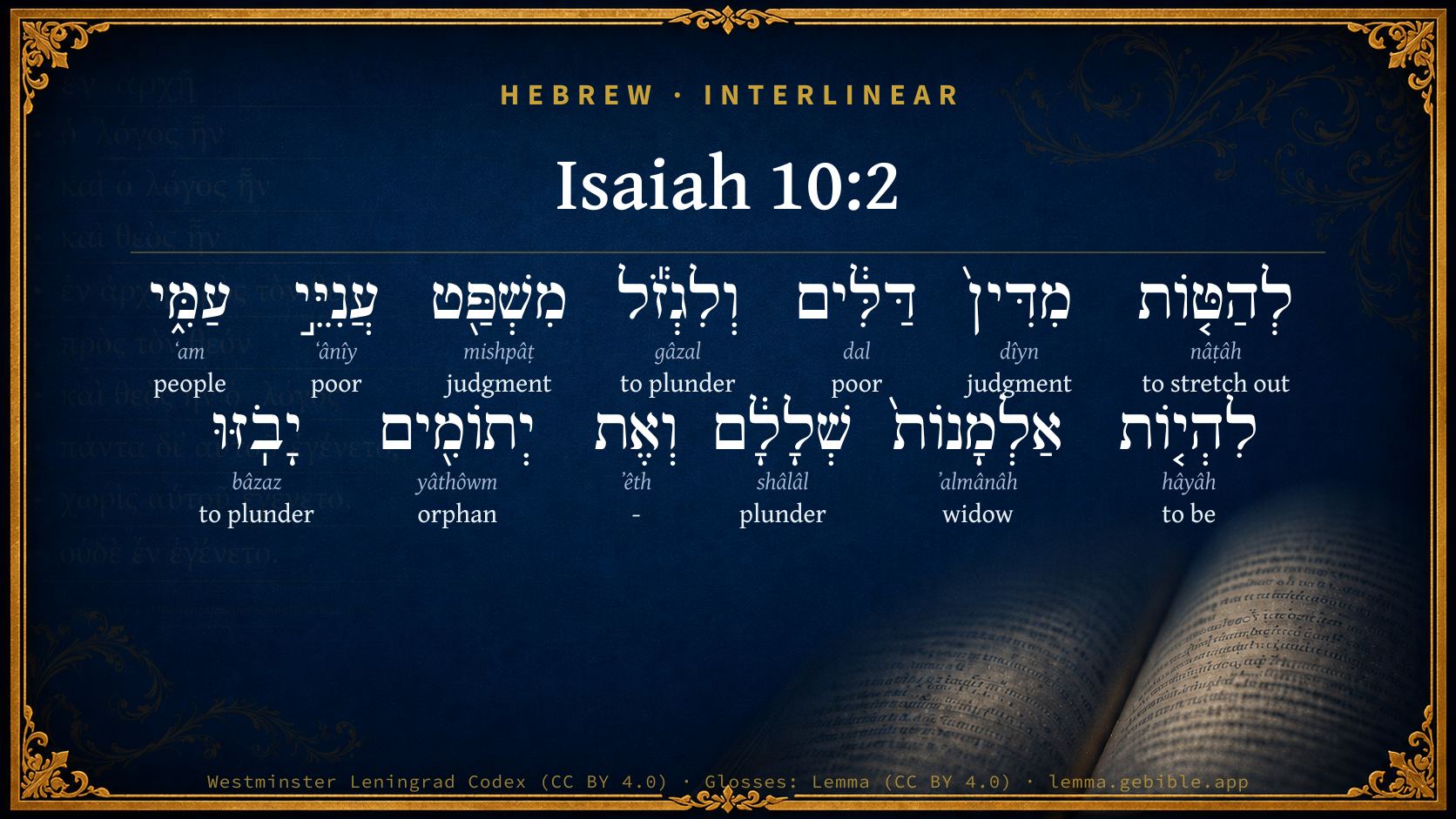
Hebrew (Westminster Leningrad Codex) Isaiah 10:2 appears in the Hebrew Old Testament. The text above is from the Westminster Leningrad Codex. Each word links to its Strong’s number, a concise gloss, and parsing drawn from the Open Scriptures Hebrew Bible morphology. Click any word for its full Brown-Driver-Briggs (BDB) entry.
Download image
Cite this verse

Isaiah 10:2 (World English Bible). Public Domain. Lemma interlinear Bible study tool, https://lemma.gebible.app/v/isaiah/10/2.

Show BibTeX & RIS
BibTeX
RIS
English Translation
to turn aside the needy from justice, and to rob the poor of my people of their right, that widows may be their spoil, and that they may make the fatherless their prey!
World English Bible · Public Domain
Download a study sheet

One document with this verse’s original text, its word-by-word gloss line, the meaning frame, cross-references with their text, attributed commentary, and full source and license credits — printable, and it pastes into notes with its structure intact.

This verse Autodidact and up

Study sheet (.html) Plain text (.txt)

A passage Seminary Student

Up to 50 verses in one chapter. A passage sheet keeps up to 6 commentary sources and 12 cross-references per verse, in the order this page ranks them, and says so on the sheet whenever that leaves anything out. Ask for a single verse and you get the Autodidact verse sheet above.

Everything on this page stays free to read, with no account — the sheet is a download of what is already on screen, not access to it.

Want to remove ads? Support Godless Engineer
Compare translations 3

The same verse in 3 English versions, stacked beneath the original-language interlinear above. Click any original word for its lexicon entry.

Each is an independent rendering of the whole verse — the interlinear is not word-aligned to these translations.

Highlighted words mark where these versions differ — a whole-verse word diff, not a word-by-word alignment.

  • World English Bible Public Domain
    to turn aside the needy from justice, and to rob the poor of my people of their right, that widows may be their spoil, and that they may make the fatherless their prey!
  • King James Version Public Domain
    To turn aside the needy from judgment, and to take away the right from the poor of my people, that widows may be their prey, and that they may rob the fatherless!
  • unfoldingWord Literal Text CC BY-SA 4.0
    to turn aside the needy from judgment and to rob the justice of the poor of my people, so that widows become their spoil and they may plunder orphans.

unfoldingWord Literal Text — © unfoldingWord, licensed CC BY-SA 4.0. Word-aligned USFM3 via Door43 (git.door43.org/unfoldingWord/en_ult).

Versions to compare (up to 4)

3 of 4 selected

Show all 18 translations

Every available English version of this verse, each an independent rendering of the whole verse.

  • World English Bible Public Domain
    to turn aside the needy from justice, and to rob the poor of my people of their right, that widows may be their spoil, and that they may make the fatherless their prey!
  • Berean Standard Bible Public Domain
    to deprive the poor of fair treatment and withhold justice from the oppressed of My people, to make widows their prey and orphans their plunder.
  • Majority Standard Bible Public Domain
    to deprive the poor of fair treatment and withhold justice from the oppressed of My people, to make widows their prey and orphans their plunder.
  • King James Version Public Domain
    To turn aside the needy from judgment, and to take away the right from the poor of my people, that widows may be their prey, and that they may rob the fatherless!
  • American Standard Version (1901) Public Domain
    to turn aside the needy from justice, and to rob the poor of my people of their right, that widows may be their spoil, and that they may make the fatherless their prey!
  • Revised Version (1885) Public Domain
    to turn aside the needy from judgment, and to take away the right of the poor of my people, that widows may be their spoil, and that they may make the fatherless their prey!
  • Geneva Bible (1599) Public Domain
    To keepe backe ye poore from iudgement, and to take away the iudgement of the poore of my people, that widowes may be their pray, and that they may spoyle the fatherlesse.
  • Douay-Rheims (1899) Public Domain
    To oppress the poor in judgment, and do violence to the cause of the humble of my people: that widows might be their prey, and that they might rob the fatherless.
  • Young's Literal Translation Public Domain
    To turn aside from judgment the poor, And to take violently away the judgment Of the afflicted of My people, That widows may be their prey, That the fatherless they may spoil.
  • Literal Standard Version CC BY-SA 4.0
    Of My people, || That widows may be their prey, || That they may spoil the fatherless.
  • Unlocked Literal Bible CC BY-SA 4.0
    They deprive the needy of justice, rob the poor of my people of their rights, plunder widows, and make the fatherless their prey!
  • unfoldingWord Literal Text CC BY-SA 4.0
    to turn aside the needy from judgment and to rob the justice of the poor of my people, so that widows become their spoil and they may plunder orphans.
  • Darby Bible Public Domain
    to turn away the poor from judgment, and to take away the right from the afflicted of my people; that widows may be their prey, and that they may rob the fatherless!
  • World Messianic Bible Public Domain
    to deprive the needy of justice, and to rob the poor among my people of their rights, that widows may be their plunder, and that they may make the fatherless their prey!
  • Webster's Bible Public Domain
    To turn aside the needy from judgment, and to take away the right from the poor of my people, that widows may be their prey, and that they may rob the fatherless!
  • Free Bible Version CC BY-SA 4.0
    They pervert the legal rights of the needy, and rob justice from the poor of my people. They steal from widows and cheat orphans.
  • Bible in Basic English Public Domain
    Who do wrong to the poor in their cause, and take away the right of the crushed among my people, so that they may have the property of widows, and get under their power those who have no father.
  • JPS Tanakh (1917) Public Domain
    To turn aside the needy from judgment, and to take away the right of the poor of My people, that widows may be their spoil, and that they may make the fatherless their prey!

Literal Standard Version (2020), Covenant Press — licensed CC BY-SA 4.0. Text via the HelloAO Bible API (eBible.org). Unlocked Literal Bible (unfoldingWord) — licensed CC BY-SA 4.0. Text via the HelloAO Bible API (eBible.org). unfoldingWord Literal Text — © unfoldingWord, licensed CC BY-SA 4.0. Word-aligned USFM3 via Door43 (git.door43.org/unfoldingWord/en_ult). Free Bible Version, Dr. Jonathan Gallagher — licensed CC BY-SA 4.0. Text via the HelloAO Bible API (eBible.org).

Word by word

More ways to search: Search by grammar → Find every occurrence → Compare this word →

Practice this passage: Drill this verse → Learn its vocabulary →

מִדִּין֙
dîyn
H1779
“from · judgment”
Preposition + Noun, Common, Masculine, Singular, Absolute
Part of Speech
Preposition + Noun
Type
Common
Gender
Masculine
Number
Singular
State
Absolute
Full BDB Definition

Origin: from H1777

TWOT: 426a

judgment - judgment - cause, plea - condemnation, judgment - dispute, legal suit, strife - government
  1. לְהַטּ֤וֹת nâṭâh H5186 “to stretch out” Preposition + Verb, Hiphil, Infinitive Construct
  2. דַּלִּ֔ים dal H1800 “poor” Adjective, Adjective, Masculine, Plural, Absolute
  3. וְלִגְזֹ֕ל gâzal H1497 “and · to plunder” Conjunction + Preposition + Verb, Qal, Infinitive Construct
  4. מִשְׁפַּ֖ט mishpâṭ H4941 “judgment of” Noun, Common, Masculine, Singular, Construct
  5. עֲנִיֵּ֣י ʻânîy H6041 “poor of” Adjective, Adjective, Masculine, Plural, Construct
  6. עַמִּ֑י ʻam H5971 “people · my” Noun, Common, Masculine, Singular, Construct + Suffix, Personal, 1st Person, Common, Singular
  7. לִהְי֤וֹת hâyâh H1961 “to be” Preposition + Verb, Qal, Infinitive Construct
  8. אַלְמָנוֹת֙ ʼalmânâh H490 “widows” Noun, Common, Feminine, Plural, Absolute
  9. שְׁלָלָ֔ם shâlâl H7998 “plunder · their” Noun, Common, Masculine, Singular, Construct + Suffix, Personal, 3rd Person, Masculine, Plural
  10. וְאֶת ʼêth H853 “and · -” Conjunction + Particle, Direct Object
  11. יְתוֹמִ֖ים yâthôwm H3490 “orphans” Noun, Common, Masculine, Plural, Absolute
  12. יָבֹֽזּוּ bâzaz H962 “to plunder” Verb, Qal, Imperfect, 3rd Person, Masculine, Plural

About this verse

These counts appear in no published source. They are computed here, from the morphology-tagged text and Lemma’s own curated glosses. What Lemma adds →

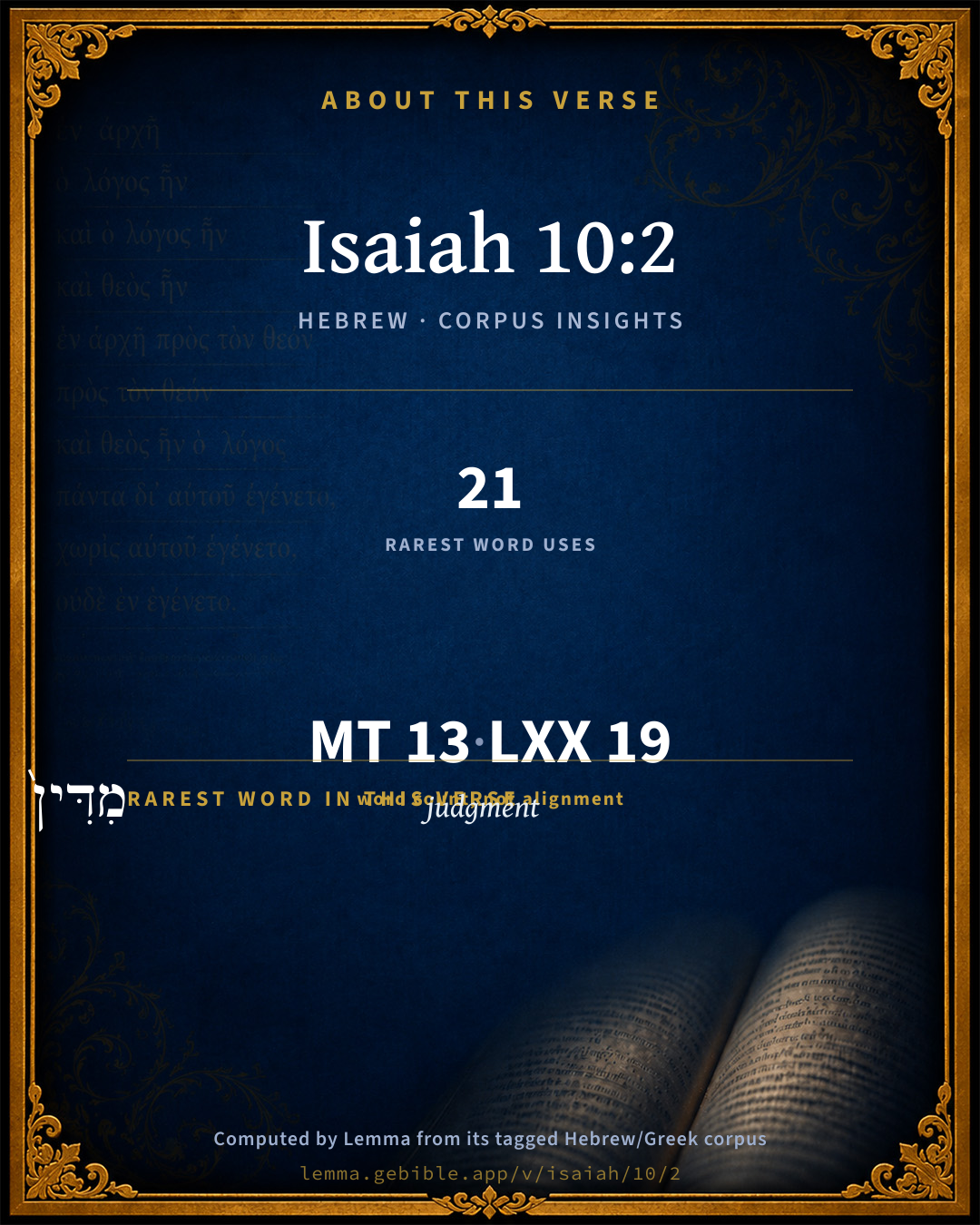
13
words
13
distinct lemmas
Prophets
section

Notable vocabulary

The rarest word here is מִדִּין֙ judgment H1779 — appearing just 21 times in the whole Hebrew Bible.

Shared distinctive vocabulary

מִדִּין֙ judgment H1779 occurs in 17 verses of the Hebrew Bible. Also found in:

Grammatical profile

  • 4 verbs
  • 6 nouns
  • 2 adjectives
  • 1 particle

Verb forms

  • לְהַטּ֤וֹת Hiphil · Infinitive Construct
  • וְלִגְזֹ֕ל Qal · Infinitive Construct
  • לִהְי֤וֹת Qal · Infinitive Construct
  • יָבֹֽזּוּ Qal · Imperfect

Hebrew & Septuagint length

In English translation the verse runs 33 words from the Hebrew and 31 from the Septuagint (LXX English) — closely comparable.

A rough comparison of the two English renderings, which tokenize alike — not a word-level alignment.

Word counts can differ between the Hebrew and the Greek without any difference in meaning — e.g. the Hebrew direct-object marker אֵת has no separate Greek word, and Greek often adds the article ὁ.

In the original languages it is 13 Hebrew tokens and 19 Greek tokens — but the two are counted differently (Hebrew bundles its prefixes and suffixes into one token; the Greek is in lemma form), so that isn’t a like-for-like length.

Cross-references

12

Topical passages linked to Isaiah 10:2 in the Treasury of Scripture Knowledge — connected by theme and wording, ordered by reader-vote popularity; previews shown in the World English Bible.

  • Malachi 3:5 I will come near to you to judgment; and I will be a swift witness against the sorcerers, and against the adulterers, and against the perjurers, and against those who oppress the hireling in his wages, the widow, and the fatherless, and who deprive the foreigner of justice, and don't fear me," says Yahweh of Hosts.
  • Isaiah 3:14 Yahweh will enter into judgment with the elders of his people, And their leaders: "It is you who have eaten up the vineyard. The spoil of the poor is in your houses.
  • Isaiah 1:23 Your princes are rebellious, and companions of thieves. Everyone loves bribes, and follows after rewards. They don't judge the fatherless, Neither does the cause of the widow come to them.
  • Isaiah 5:23 Who acquit the guilty for a bribe, But deny justice for the innocent!
  • Isaiah 29:21 that make a man an offender in [his] cause, and lay a snare for him who reproves in the gate, and turn aside the just with a thing of nothing.
  • Ezekiel 22:7 In you have they set light by father and mother; in the midst of you have they dealt by oppression with the foreigner; in you have they wronged the fatherless and the widow.
  • Isaiah 5:7 For the vineyard of Yahweh of Hosts is the house of Israel, And the men of Judah his pleasant plant: And he looked for justice, but, behold, oppression; For righteousness, but, behold, a cry of distress.
  • Jeremiah 7:6 if you don't oppress the foreigner, the fatherless, and the widow, and don't shed innocent blood in this place, neither walk after other gods to your own hurt:
  • Lamentations 3:35 To turn aside the right of a man before the face of the Most High,
  • Amos 2:7 They trample on the dust of the earth on the head of the poor, And deny justice to the oppressed; And a man and his father use the same maiden, to profane my holy name;
  • Amos 5:11–12 Forasmuch therefore as you trample on the poor, And take taxes from him of wheat: You have built houses of hewn stone, But you will not dwell in them. You have planted pleasant vineyards, But you shall not drink their wine.
  • Matthew 23:13 "Woe to you, scribes and Pharisees, hypocrites! For you devour widows' houses, and as a pretense you make long prayers. Therefore you will receive greater condemnation.

Cross-references courtesy of OpenBible.info (CC BY 4.0).

Hebrew and Greek witnesses Masoretic Hebrew ↔ Greek Septuagint

The same verse in the two great witnesses to the Old Testament, shown verse-for-verse.

These are two independent witnesses, not word-aligned to each other, and the Septuagint is shown in lemma (dictionary) form.

Hebrew Isaiah 10:2 Masoretic · Westminster Leningrad Codex

לְהַטּ֤וֹת מִדִּין֙ דַּלִּ֔ים וְלִגְזֹ֕ל מִשְׁפַּ֖ט עֲנִיֵּ֣י עַמִּ֑י לִהְי֤וֹת אַלְמָנוֹת֙ שְׁלָלָ֔ם וְאֶת יְתוֹמִ֖ים יָבֹֽזּוּ

to turn aside the needy from justice, and to rob the poor of my people of their right, that widows may be their spoil, and that they may make the fatherless their prey!

World English Bible · Public Domain

Greek LXX Isaiah 10:2 Septuagint · lemma form

ἐκκλίνω κρίσις πτωχός ἁρπάζω κρίμα πένης ὁ λαός ἐγώ ὥστε εἰμί αὐτός χήρα εἰς ἁρπαγή καί ὀρφανός εἰς προνομή

perverting the cause of the poor, violently wresting the judgment of the needy ones of my people, that the widow may be a prey to them, and the orphan a spoil.

LXX2012 (modern English Septuagint) · Public Domain

Hebrew: Westminster Leningrad Codex (CC BY 4.0). Greek: Septuagint (public domain); English from LXX2012 (modern English Septuagint) (Public Domain). How the Septuagint differs from the Hebrew →

Targum (Aramaic paraphrase)

1

The Targum is the ancient Jewish Aramaic paraphrase of the Hebrew Scriptures — an interpretive translation, not the Hebrew text itself. Onkelos (literal) and Pseudo-Jonathan (expansive) render the Torah, and Jonathan the Prophets. Coverage is partial: where no permissively-licensed English translation exists for a verse, only the Aramaic is shown. This is verse-level text, not a word-by-word alignment to the Hebrew.

  1. Targum Jonathan Prophets (Joshua–Malachi)
    לְאַסְטָאָה מִדִין מִסְכְּנִין וּלְמֵינַס מַה דִרָעָן מֵחֲשִׁיכֵי עַמָא בְּדִינָא לְמֶהֱוֵי אַרְמְלָן עֲדֵיהוֹן וְיַת נִכְסֵי יַתְמַיָא יִבְזוּן:

    To turn aside the needy from judgment, and to rob whatever the poor of my people desire in judgment, that widows may be their prey, and that they may rob the wealth of the orphans.

    Targum Jonathan — Aramaic: “Mikraot Gedolot” (public domain). English: “Sefaria Community Translation” (CC0 1.0 (public-domain dedication)); “London "Chaldee Paraphrase," 1871” (public domain). Text via Sefaria.

Commentary

Notes on Isaiah 10:2 from classic Christian and Jewish commentators (each source and its license shown beneath its notes). The classic Christian expositions comment on the surrounding passage and are grouped to its opening verse, so a note may address several verses; the Jewish commentaries on the Tanakh (Rashi and others) are per-verse, so they appear only where the commentator wrote on this verse.

Lemma curates 59 commentaries, every one of them public domain or Creative Commons licensed, each selected and text-cleaned for this edition rather than reprinted as found. About our sources →

Trapp's Complete Commentary

John Trapp

Isa 10:2 To turn aside the needy from judgment, and to take away the right from the poor of my people, that widows may be their prey, and [that] they may rob the fatherless!

Ver. 2. To turn away the needy from judgment.] To put them beside their right, because indigent, and overweighed by the wealthy ones: Quorum aureae literae apud tales iudices possunt omnia.

And to take away the right.] Heb., To tear it away by force.

And that they may rob the fatherless.] Rob the spittle, as we used to say. Unrighteous ruledom is but robbery with authority. {a}

{a} Iudex iniustus latro cum privilegio est. - Columel., lib. i.

John Trapp, A Commentary or Exposition upon All the Books of the Old and New Testament (1647–1656) — public domain. Text from a community e-Sword module.

Jamieson, Fausset & Brown

Robert Jamieson, A. R. Fausset & David Brown

To turn aside, &c.--The effect of their conduct is to pervert the cause of the needy [HORSLEY]. In English Version "from judgment" means "from obtaining justice."

take away the right--"make plunder of the right" (rightful claim) [HORSLEY].

Jamieson, Fausset & Brown — Commentary Critical and Explanatory on the Whole Bible (1871) — public domain (CC PDM 1.0). Text via the HelloAO Bible API.

Adam Clarke's Commentary

Verse 2. My people] Instead of עמי ammi, my people, many MSS., and one of my own, ancient, read עמו ammo, his people. But this is manifestly a corruption.

Adam Clarke's Commentary on the Bible (1810–1826) — public domain. Text from a community e-Sword/MySword module.

The Cambridge Bible for Schools and Colleges

gen. ed. J. J. S. Perowne

2. The effect and real purpose of this legislative activity.

To turn aside the needy from judgment] See on ch. Isa_1:23.

my people] as Isa_3:12; Isa_3:15.

The Cambridge Bible for Schools and Colleges (gen. ed. J. J. S. Perowne; Cambridge University Press, 1878–1918) — public domain. Text from a community e-Sword module.

John Gill's Exposition

To turn aside the needy from judgment,.... Such laws being made as discouraged them from any application for justice; and, when they did, were harassed with such long, vexatious, and expensive suits, as obliged them to desist, and the cause being generally given against them, and for the rich:

and to take away the right from the poor of my people; for not to do justice to the poor is the same as to rob and plunder them, and take away by force what of right belongs to them; wherefore it follows:

that widows may be their prey, and that they may rob the fatherless; who have none to protect and defend them, and whose protectors judges ought to be, in imitation of God, whom civil magistrates represent, who is the Judge of the widows and the fatherless; and therefore this is observed as an aggravation of their sin, which was very great indeed: it is very wicked in a judge to pervert the judgment of the poor and needy, the widow and the fatherless, contrary to laws that are made by God and men; but to make and prescribe wicked and unrighteous laws, that wickedness may be framed, and mischief committed by a law, that the poor and the needy, the widows and fatherless, may be injured under colour and pretence of law and justice, is the height of injustice. See Psa 94:20.

John Gill's Exposition of the Whole Bible (1746–1763) — public domain (CC PDM 1.0). Text via the HelloAO Bible API.

Albert Barnes' Notes on the Bible

To turn aside - Their sentences have the effect, and are designed to have, to pervert justice, and to oppress the poor, or to deprive them of their rights and just claims; compare Isa 29:21; Pro 27:5.

The needy - daliym - דלים dalı̂ym. Those of humble rank and circumstances; who have no powerful friends and defenders. “From judgment.” From obtaining justice.

And to take away - To take away by violence and oppression. The word גזל gāzal, is commonly applied to robbery, and to oppression; to the taking away of spoils in battle, etc.

That widows may be their prey - That they may rob widows, or obtain their property. This crime has always been one particularly offensive in the sight of God; see the note at Isa 1:23. The widow and the orphan are without protectors. Judges, by their office, are particularly bound to preserve their rights; and it, therefore, evinces special iniquity when they who should be their protectors become, in fact, their oppressors, and do injustice to them without the possibility of redress. Yet this was the character of the Jewish judges; and for this the vengeance of heaven was about to come upon the land.

Albert Barnes' Notes on the Bible (1834–1885) — public domain. Text from a community e-Sword/MySword module.

Matthew Poole's English Annotations

From judgment; or, from their right, as it is in the next clause; or, from obtaining a just sentence, because they either denied or delayed to hear their causes, or gave a wrong sentence.

From the poor, whom I have in a special manner committed to your care.

Of my people; of Israelites. who profess themselves to be my people, and whom I did take into covenant with myself; and therefore this is an injury not only to them, but to me also.

Matthew Poole's English Annotations on the Holy Bible (1683–1685) — public domain. Text from a community e-Sword/MySword module.

Whedon's Commentary on the Bible

Daniel D. Whedon

2. This verse specifies some of those decisions. See further on chapter Isa_29:21.

To take away — Or, tear away, the right. Or, as rendered in Ecc_5:8, violent perverting.

Daniel D. Whedon (gen. ed.), Commentary on the Old and New Testaments (1874–1909) — public domain. Text from a community e-Sword module.

The Pulpit Commentary

The poor... the widow... the fatherless. These were the classes who were the chief sufferers by the perversion of justice. (comp. Isa_1:17, Isa_1:23) They were exactly the classes for whom God had most compassion, and whom he had commended in the Law to the tender care of his people. (see note on Isa_9:17)

HOMILIES BY R. TUCK Ver. 2. The Divine avenger of the poor.

The idea of a goel, or avenger, belongs to the primitive conditions of society. When there was no settled government, no police, and no magistracy, each individual had to guard his life, liberty, and property as best he could. The first and simplest form that mutual protection took was "the family," and the principle was established that the nearest of kin to an injured or murdered person should avenge the injury or death. As this led to feuds among families and tribes lasting for generations, and as it was a kind of rough justice which often became injustice, Moses set the old custom under limitations, appointing proper courts for the settlement of disputes, and protecting the manslayer from the avenger until due examination could be made into the circumstances of his crime. In fully civilized society a regular system of law and magistracy is organized; the individual commits his right of personal avengement to the recognized authorities It is, therefore, of supreme importance to the welfare of any nation that justice should be free to all, should be perfectly fair, and should be a practical avenger of the poor, the distressed, and the wronged. The nature which Isaiah sets before us in this passage reveals a most perilous condition of society. "All the formalities of justice were observed punctiliously. The decision of the unjust Judge was duly given and recorded, but the outcome of it all was that the poor, the Widow, and the fatherless got no redress." "No people had statutes and judgments so righteous as they had, and yet corrupt judges found ways "to turn aside the needy from judgment," to hinder them from coming at their right and recovering what was their due, because they were needy and poor, and such as they could get nothing by nor expect any bribes from." "There is no surer sign of the misery of a people than is found in the corrupt administration of justice." And it may be added that a country is on the borders of revolution, or of calamity, when righteousness has forsaken its judgment-seats, and there are no avengers of social wrongs.

I THE STATE OF SOCIETY IN WHICH THE POOR FIND NO HELP IN MAN. Two cases are suggested.

1. Failure to obtain just judgment.

2. The painful condition of widows.

Where there is wealth and luxury there is sure to be poverty in marked and terrible features close beside it, as may be illustrated from the great and rich European cities of our day. Wealth has a tendency to go in the direction of classes; it drains away from some classes, and so alienates and embitters them, especially as the result of self indulgence is to harden a man"s heart against his neighbor. The condition of widows in the East is an extremely painful one, because they have no rights in their husband"s property, no social status, and are the prey of designing and wicked men. The retired life they lead unfits them for contending on behalf of their own rights, or those of their children. The picture of a national life in which the wronged have no judge, the poor no helpers, and the widows no friends, is an exceedingly painful one. Self-seeking, luxury, and class prejudice must have catch the heart out of such a kingdom.

II IN SUCH A STATE OF SOCIETY THE POOR HAVE HELP IN GOD. This may be illustrated along the following lines. God will help them by:

1. The working of his judgment-laws. In Greece despised helots multiply, and become at last a destructive force, for a time breaking up society. Slaves learn at last to combine, and take their own avengements on their persecutors. Down-trodden races heave awhile, like slumbering earthquakes, and presently burst forth in revolutions that are, in reality, Divine judgments.

2. By the orderings of Divine providence, which bring the nation into such a condition that reformation of its wrongs becomes immediately necessary to secure its continued existence.

3. By the raising up of human helpers. Men who plead the cause of the poor, and make their voice and their condition to be heard even in the high places of a land. At once thought turns to such men as Wilberforce, the friend of the slave, and Howard, the friend of the prisoner.

4. By special Divine consolations. The poor have their ameliorations, and even their superior advantages; and not the least of them is this they have little prejudice hindering the reception of Divine truth. To "the poor the gospel is preached," and in every age it is found true that "the common people heard Christ," and hear of Christ, "gladly. R.T.

The Pulpit Commentary (1880–1919), ed. H.D.M. Spence-Jones & Joseph S. Exell — public domain. Text from a community e-Sword module.

John Wesley's Explanatory Notes

Judgment - From obtaining a just sentence.

John Wesley, Explanatory Notes Upon the Whole Bible (1754–1765) — public domain. Text via the GEBible commentary corpus.

J. A. Alexander on Isaiah

Joseph Addison Alexander

As the first verse describes the sinners and their sin, so the second sets forth its effect upon the people. “To turn aside (or exclude) from judgment the weak, and to take away (by violence) the right of the poor (or afflicted) of my people, that widows may be (or so that widows are) their spoil, and the fatherless they plunder.” The infinitive indicates the tendency and actual effect of their conduct The phrase here used is to turn one aside from the judgment, and seems intended to express not so much the idea of judging wrongfully as that of refusing to judge at all. The same charge is brought against the rulers of Judah in Isaiah 23. The expression of ‘my people’ intimates, not only that the sufferers were Israelites, but that they sustained a peculiar relation to Jehovah, Who is frequently described in Scripture as the protector of the helpless, and especially of widows and orphans (Psa 68:5).

Joseph Addison Alexander, The Prophecies of Isaiah (1846–1847; New York: Scribner, 1870–1878) — public domain. Text from a community e-Sword module.

Rashi

Rabbi Shlomo Yitzchaki (Rashi)

To pervert through the false notes, the poor from the legal rights due them.

Rashi on the Tanakh — English translations: “The Judaica Press complete Tanach with Rashi, translated by A. J. Rosenberg” (CC BY 4.0); “Pentateuch with Rashi's commentary by M. Rosenbaum and A.M. Silbermann, 1929-1934” (public domain); “The Metsudah Tanach series, Lakewood, N.J” (CC BY 4.0); and “The Book of Joshua, Metsudah Publications, 1997” (CC BY 4.0). Text via Sefaria.

Ibn Ezra

Rabbi Abraham ibn Ezra

To turn aside, etc. They command the secretaries to write false documents for the orphans, widows and poor, who are powerless, and cannot open their mouths in defence of their rights.

Ibn Ezra on the Tanakh — English translations: “Sefaria Community Translation” (CC0 1.0 (public-domain dedication)); “Yalkut, Sifsei Chachomim Chumash, Metsudah Publications, 2009” (CC BY 4.0); and “Commentary of Ibn Ezra on Isaiah - trans. by M. Friedlander, 1873” (public domain). Text via Sefaria.

Lesson kit

Teaching starters — assembled from the data on this page, not authored interpretation. Every prompt links to the verse data it draws on. Edit before teaching.

Isaiah, in the Prophets, opens this verse with 13 words (13 distinct Hebrew lemmas). Its most distinctive word is dîyn (“judgment”). A historical commentator’s framing appears above. Read the whole chapter for the surrounding context.

Discussion questions

  1. The word dîyn carries the sense “judgment.” How does it shape the verse?
  2. Deuteronomy 17:8 shares the word «judgment» with this verse. How do the two illuminate each other?
  3. These translations render this verse differently. What is at stake in choosing one wording over another?
  4. The verb «לְהַטּ֤וֹת» is Hiphil Infinitive Construct. How does its form color the action?
  5. Reading how Trapp's Complete Commentary and Jamieson, Fausset & Brown read this verse, where do the two commentators agree and where do they part?

Things to notice

Reading settings

Reading text

Shown beneath each verse's original-language words.

Old Testament
Old Testament edition

Read the OT as the Masoretic Hebrew (MT) or the Greek Septuagint (LXX).

English shown for the Greek Septuagint (in the Hebrew ↔ Greek comparison).

Comparing translations? Open the Compare panel on any verse page to stack up to four side by side.