
Isaiah 40:22

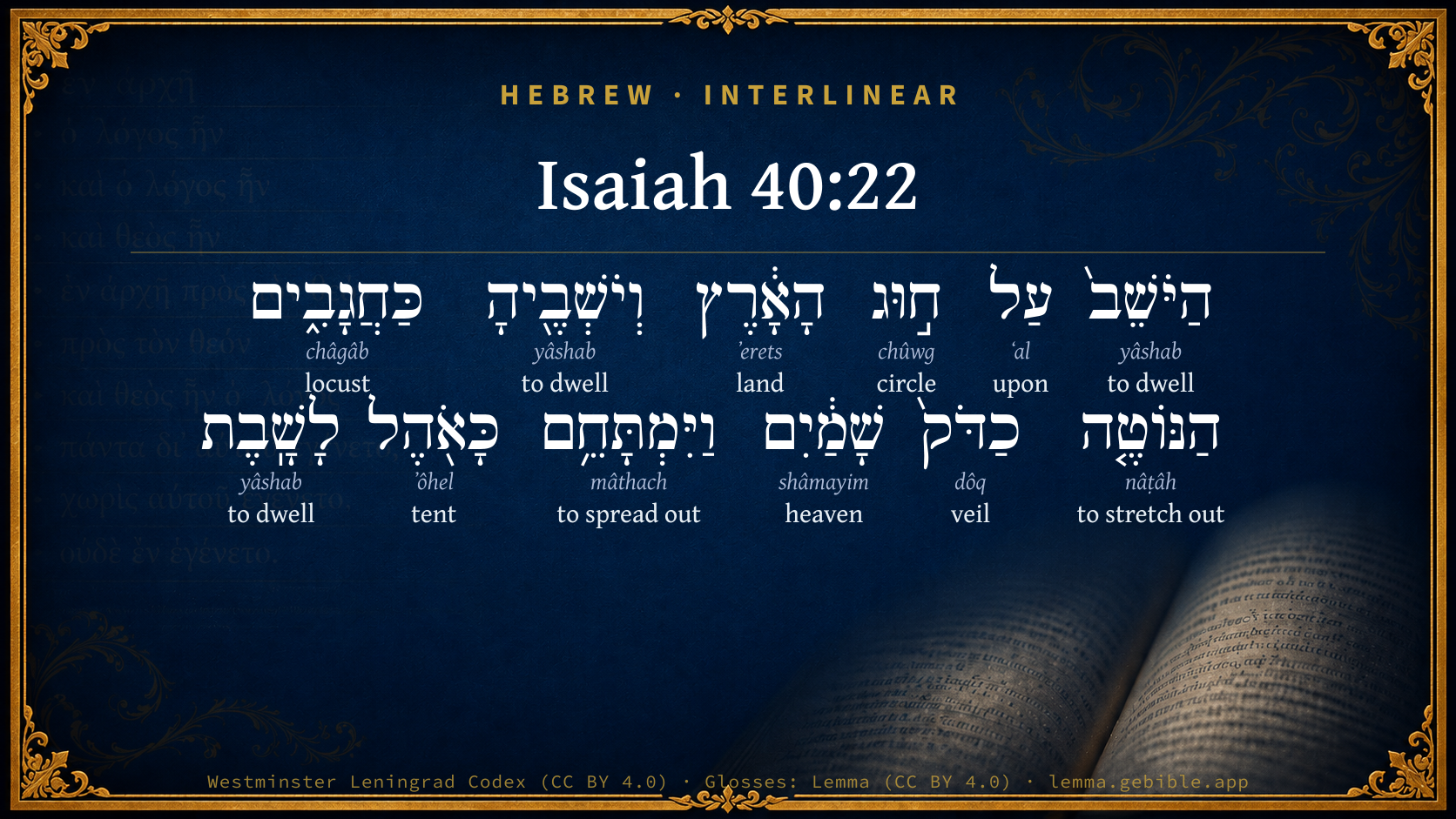
Hebrew (Westminster Leningrad Codex) Isaiah 40:22 appears in the Hebrew Old Testament. The text above is from the Westminster Leningrad Codex. Each word links to its Strong’s number, a concise gloss, and parsing drawn from the Open Scriptures Hebrew Bible morphology. Click any word for its full Brown-Driver-Briggs (BDB) entry.
Download image
Cite this verse

Isaiah 40:22 (World English Bible). Public Domain. Lemma interlinear Bible study tool, https://lemma.gebible.app/v/isaiah/40/22.

Show BibTeX & RIS
BibTeX
RIS
English Translation
[It is] he who sits above the circle of the earth, and the inhabitants of it are as grasshoppers; who stretches out the heavens as a curtain, and spreads them out as a tent to dwell in;
World English Bible · Public Domain
Highlights
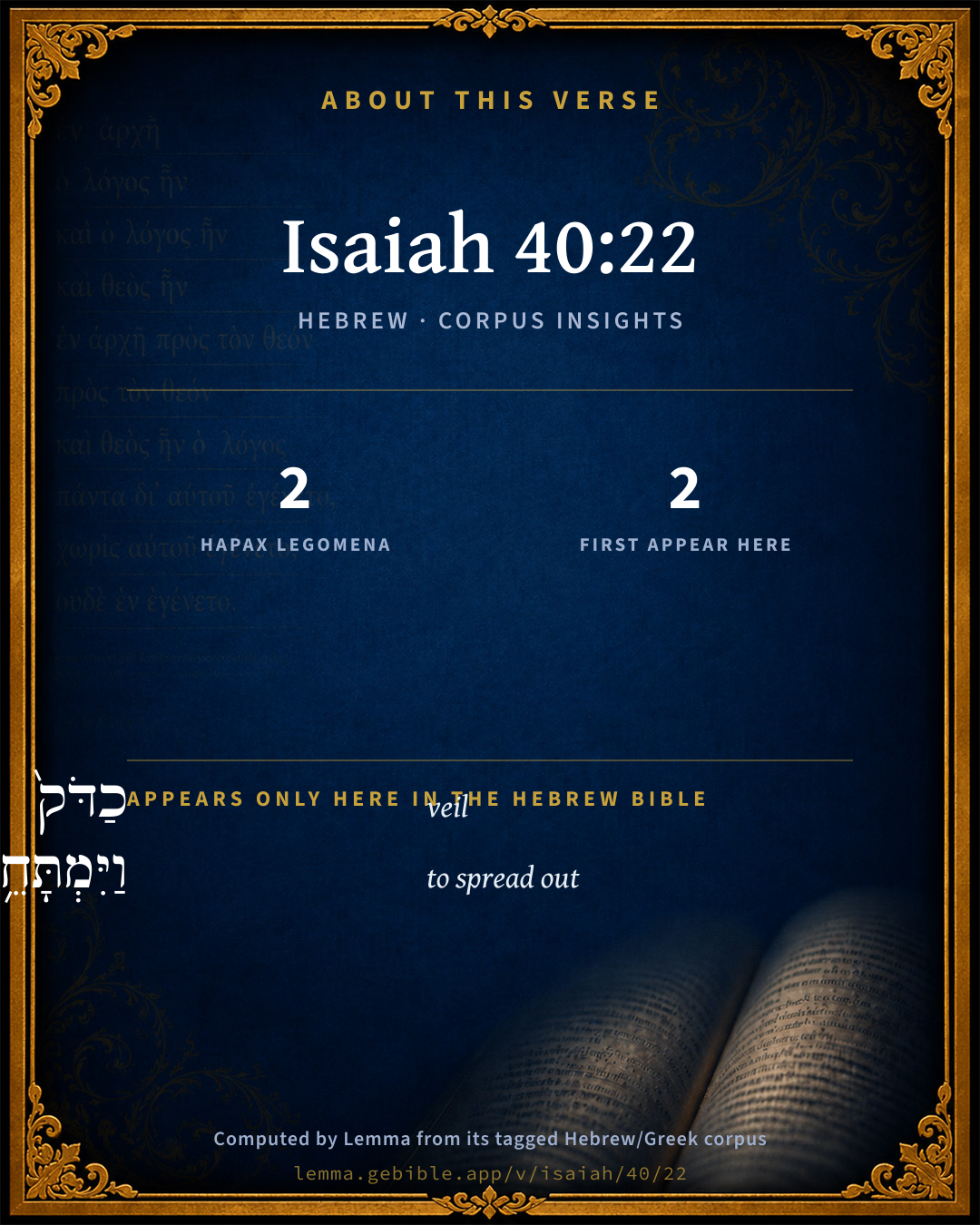
  • 2 hapax legomena — only here in the Hebrew Bible
  • 2 first appearances in the Hebrew Bible
Full analysis ↓
Download a study sheet

One document with this verse’s original text, its word-by-word gloss line, the meaning frame, cross-references with their text, attributed commentary, and full source and license credits — printable, and it pastes into notes with its structure intact.

This verse Autodidact and up

Study sheet (.html) Plain text (.txt)

A passage Seminary Student

Up to 50 verses in one chapter. A passage sheet keeps up to 6 commentary sources and 12 cross-references per verse, in the order this page ranks them, and says so on the sheet whenever that leaves anything out. Ask for a single verse and you get the Autodidact verse sheet above.

Everything on this page stays free to read, with no account — the sheet is a download of what is already on screen, not access to it.

Want to remove ads? Support Godless Engineer
Compare translations 3

The same verse in 3 English versions, stacked beneath the original-language interlinear above. Click any original word for its lexicon entry.

Each is an independent rendering of the whole verse — the interlinear is not word-aligned to these translations.

Highlighted words mark where these versions differ — a whole-verse word diff, not a word-by-word alignment.

  • World English Bible Public Domain
    [It is] he who sits above the circle of the earth, and the inhabitants of it are as grasshoppers; who stretches out the heavens as a curtain, and spreads them out as a tent to dwell in;
  • King James Version Public Domain
    It is he that sitteth upon the circle of the earth, and the inhabitants thereof are as grasshoppers; that stretcheth out the heavens as a curtain, and spreadeth them out as a tent to dwell in:
  • unfoldingWord Literal Text CC BY-SA 4.0
    The one sitting above the circle of the earth, and its dwellers like grasshoppers, the one stretching out the heavens like a curtain, and he spreads them out like a tent to dwell in,

unfoldingWord Literal Text — © unfoldingWord, licensed CC BY-SA 4.0. Word-aligned USFM3 via Door43 (git.door43.org/unfoldingWord/en_ult).

Versions to compare (up to 4)

3 of 4 selected

Show all 18 translations

Every available English version of this verse, each an independent rendering of the whole verse.

  • World English Bible Public Domain
    [It is] he who sits above the circle of the earth, and the inhabitants of it are as grasshoppers; who stretches out the heavens as a curtain, and spreads them out as a tent to dwell in;
  • Berean Standard Bible Public Domain
    He sits enthroned above the circle of the earth; its dwellers are like grasshoppers. He stretches out the heavens like a curtain, and spreads them out like a tent to dwell in.
  • Majority Standard Bible Public Domain
    He sits enthroned above the circle of the earth; its dwellers are like grasshoppers. He stretches out the heavens like a curtain, and spreads them out like a tent to dwell in.
  • King James Version Public Domain
    It is he that sitteth upon the circle of the earth, and the inhabitants thereof are as grasshoppers; that stretcheth out the heavens as a curtain, and spreadeth them out as a tent to dwell in:
  • American Standard Version (1901) Public Domain
    `It is' he that sitteth above the circle of the earth, and the inhabitants thereof are as grasshoppers; that stretcheth out the heavens as a curtain, and spreadeth them out as a tent to dwell in;
  • Revised Version (1885) Public Domain
    It is he that sitteth upon the circle of the earth, and the inhabitants thereof are as grasshoppers; that stretcheth out the heavens as a curtain, and spreadeth them out as a tent to dwell in:
  • Geneva Bible (1599) Public Domain
    He sitteth vpon the circle of the earth, and the inhabitants thereof are as grashoppers, hee stretcheth out ye heauens, as a curtaine, and spreadeth them out, as a tent to dwell in.
  • Douay-Rheims (1899) Public Domain
    It is he that sitteth upon the globe of the earth, and the inhabitants thereof are as locusts: he that stretcheth out the heavens as nothing, and spreadeth them out as a tent to dwell in.
  • Young's Literal Translation Public Domain
    He who is sitting on the circle of the earth, And its inhabitants `are' as grasshoppers, He who is stretching out as a thin thing the heavens, And spreadeth them as a tent to dwell in.
  • Literal Standard Version CC BY-SA 4.0
    He who is sitting on the circle of the earth, || And its inhabitants [are] as grasshoppers, || He who is stretching out the heavens as a thin thing, || And spreads them as a tent to dwell in.
  • Unlocked Literal Bible CC BY-SA 4.0
    He is the one who sits above the horizon of the earth; and the inhabitants are like grasshoppers before him. He stretches out the heavens like a curtain and spreads them out as a tent to live in.
  • unfoldingWord Literal Text CC BY-SA 4.0
    The one sitting above the circle of the earth, and its dwellers like grasshoppers, the one stretching out the heavens like a curtain, and he spreads them out like a tent to dwell in,
  • Darby Bible Public Domain
    [It is] he that sitteth upon the circle of the earth, and the inhabitants thereof are as grasshoppers; that stretcheth out the heavens as a gauze curtain, and spreadeth them out as a tent to dwell in;
  • World Messianic Bible Public Domain
    It is he who sits above the circle of the earth, and its inhabitants are like grasshoppers; who stretches out the heavens like a curtain, and spreads them out like a tent to dwell in,
  • Webster's Bible Public Domain
    It is he that sitteth upon the circle of the earth, and its inhabitants are as grasshoppers; that stretcheth out the heavens as a curtain, and spreadeth them out as a tent to dwell in:
  • Free Bible Version CC BY-SA 4.0
    God sits on his throne above the horizon of the earth; the people that live there are like grasshoppers. He stretches out the heavens like a curtain, spreading them out like a tent to live in.
  • Bible in Basic English Public Domain
    It is he who is seated over the arch of the earth, and the people in it are as small as locusts; by him the heavens are stretched out like an arch, and made ready like a tent for a living-place.
  • JPS Tanakh (1917) Public Domain
    It is He that sitteth above the circle of the earth, and the inhabitants thereof are as grasshoppers; that stretcheth out the heavens as a curtain, and spreadeth them out as a tent to dwell in;

Literal Standard Version (2020), Covenant Press — licensed CC BY-SA 4.0. Text via the HelloAO Bible API (eBible.org). Unlocked Literal Bible (unfoldingWord) — licensed CC BY-SA 4.0. Text via the HelloAO Bible API (eBible.org). unfoldingWord Literal Text — © unfoldingWord, licensed CC BY-SA 4.0. Word-aligned USFM3 via Door43 (git.door43.org/unfoldingWord/en_ult). Free Bible Version, Dr. Jonathan Gallagher — licensed CC BY-SA 4.0. Text via the HelloAO Bible API (eBible.org).

Word by word

More ways to search: Search by grammar → Find every occurrence → Compare this word →

Practice this passage: Drill this verse → Learn its vocabulary →

כַדֹּק֙
dôq
H1852
“like/as the · veil”
Preposition, Determined + Noun, Common, Masculine, Singular, Absolute
Part of Speech
Preposition + Noun
Type
Common
Gender
Masculine
Number
Singular
State
Absolute
Full BDB Definition

Origin: from H1854

TWOT: 448b

veil, curtain
  1. הַיֹּשֵׁב֙ yâshab H3427 “the · dwelling” Particle, Definite Article + Verb, Qal, Participle Active, Masculine, Singular, Absolute
  2. עַל ʻal H5921 “upon” Preposition
  3. ח֣וּג chûwg H2329 “circle of” Noun, Common, Masculine, Singular, Construct
  4. הָאָ֔רֶץ ʼerets H776 “the · land” Particle, Definite Article + Noun, Common, Both, Singular, Absolute
  5. וְיֹשְׁבֶ֖יהָ yâshab H3427 “and · dwelling · her” Conjunction + Verb, Qal, Participle Active, Masculine, Plural, Construct + Suffix, Personal, 3rd Person, Feminine, Singular
  6. כַּחֲגָבִ֑ים châgâb H2284 “like/as · locusts” Preposition + Noun, Common, Masculine, Plural, Absolute
  7. הַנּוֹטֶ֤ה nâṭâh H5186 “the · stretching out” Particle, Definite Article + Verb, Qal, Participle Active, Masculine, Singular, Absolute
  8. שָׁמַ֔יִם shâmayim H8064 “heaven(s)” Noun, Common, Masculine, Plural, Absolute
  9. וַיִּמְתָּחֵ֥ם mâthach H4969 “and · to spread out · them” Conjunction + Verb, Qal, Sequential Imperfect, 3rd Person, Masculine, Singular + Suffix, Personal, 3rd Person, Masculine, Plural
  10. כָּאֹ֖הֶל ʼôhel H168 “like/as the · tent” Preposition, Determined + Noun, Common, Masculine, Singular, Absolute
  11. לָשָֽׁבֶת yâshab H3427 “to dwell” Preposition + Verb, Qal, Infinitive Construct

About this verse

These counts appear in no published source. They are computed here, from the morphology-tagged text and Lemma’s own curated glosses. What Lemma adds →

12
words
10
distinct lemmas
Prophets
section

Notable vocabulary

2 hapax legomena — words that appear only here in the entire Hebrew Bible:

  • כַדֹּק֙ veil H1852
  • וַיִּמְתָּחֵ֥ם to spread out H4969

First appearance in Scripture

These words make their first canonical appearance in the Hebrew Bible here:

  • כַדֹּק֙ veil H1852
  • וַיִּמְתָּחֵ֥ם to spread out H4969

Shared distinctive vocabulary

ח֣וּג circle H2329 occurs in 3 verses of the Hebrew Bible. Also found in:

Grammatical profile

  • 5 verbs
  • 6 nouns
  • 1 preposition

Verb forms

  • הַיֹּשֵׁב֙ Qal · Participle Active
  • וְיֹשְׁבֶ֖יהָ Qal · Participle Active
  • הַנּוֹטֶ֤ה Qal · Participle Active
  • וַיִּמְתָּחֵ֥ם Qal · Sequential Imperfect
  • לָשָֽׁבֶת Qal · Infinitive Construct

Repetition

A word recurs within this verse — often emphatic in Hebrew:

  • הַיֹּשֵׁב֙ to dwell H3427 ×3

Hebrew & Septuagint length

In English translation the verse runs 37 words from the Hebrew and 37 from the Septuagint (LXX English) — the same length.

A rough comparison of the two English renderings, which tokenize alike — not a word-level alignment.

Word counts can differ between the Hebrew and the Greek without any difference in meaning — e.g. the Hebrew direct-object marker אֵת has no separate Greek word, and Greek often adds the article ὁ.

Cross-references

22

Topical passages linked to Isaiah 40:22 in the Treasury of Scripture Knowledge — connected by theme and wording, ordered by reader-vote popularity; previews shown in the World English Bible.

  • Proverbs 8:27 When he established the heavens, I was there; When he set a circle on the surface of the deep,
  • Psalms 104:2 He covers himself with light as with a garment. He stretches out the heavens like a curtain.
  • Isaiah 42:5 Thus says God Yahweh, he who created the heavens, and stretched them forth; he who spread abroad the earth and that which comes out of it; he who gives breath to the people on it, and spirit to those who walk therein:
  • Isaiah 66:1 Thus says Yahweh, heaven is my throne, and the earth is my footstool: what manner of house will you build to me? and what place shall be my rest?
  • Job 22:14 Thick clouds are a covering to him, so that he doesn't see. He walks on the vault of the sky.'
  • Jeremiah 10:12 He has made the earth by his power, he has established the world by his wisdom, and by his understanding has he stretched out the heavens:
  • Numbers 13:33 There we saw the Nephilim, the sons of Anak, who come of the Nephilim: and we were in our own sight as grasshoppers, and so we were in their sight.
  • Job 9:8 Who alone stretches out the heavens, Treads on the waves of the sea;
  • Job 38:4–9 "Where were you when I laid the foundations of the earth? Declare, if you have understanding.
  • Psalms 68:33 To him who rides on the heaven of heavens, which are of old; Behold, he utters his voice, a mighty voice.
  • Isaiah 40:15 Behold, the nations are as a drop of a bucket, and are accounted as the small dust of the balance: Behold, he takes up the isles as a very little thing.
  • Isaiah 44:24 Thus says Yahweh, your Redeemer, and he who formed you from the womb: I am Yahweh, who makes all things; who stretches forth the heavens alone; who spreads abroad the earth (who is with me?);
  • Isaiah 51:13 and have forgotten Yahweh your Maker, who stretched forth the heavens, and laid the foundations of the earth; and fear continually all the day because of the fury of the oppressor, when he makes ready to destroy? and where is the fury of the oppressor?
  • Hebrews 1:10–12 And, "You, Lord, in the beginning, laid the foundation of the earth. The heavens are the works of your hands.
  • Psalms 29:10 Yahweh sat enthroned at the Flood. Yes, Yahweh sits as King forever.
  • Psalms 102:25–26 Of old, you laid the foundation of the earth. The heavens are the work of your hands.
  • Isaiah 40:17 All the nations are as nothing before him; they are accounted by him as less than nothing, and vanity.
  • Zechariah 12:1 An oracle. The word of Yahweh concerning Israel. Yahweh, who stretches out the heavens, and lays the foundation of the earth, and forms the spirit of man within him says:
  • Job 36:29 Yes, can any understand the spreading of the clouds, And the thunderings of his pavilion?
  • Psalms 2:4 He who sits in the heavens will laugh. The Lord will have them in derision.
  • Job 37:18 Can you, with him, spread out the sky, Which is strong as a cast metal mirror?
  • Isaiah 19:1 The burden of Egypt. Behold, Yahweh rides on a swift cloud, and comes to Egypt: and the idols of Egypt shall tremble at his presence; and the heart of Egypt shall melt in the midst of it.

Cross-references courtesy of OpenBible.info (CC BY 4.0).

Hebrew and Greek witnesses Masoretic Hebrew ↔ Greek Septuagint

The same verse in the two great witnesses to the Old Testament, shown verse-for-verse.

These are two independent witnesses, not word-aligned to each other, and the Septuagint is shown in lemma (dictionary) form.

Hebrew Isaiah 40:22 Masoretic · Westminster Leningrad Codex

הַיֹּשֵׁב֙ עַל ח֣וּג הָאָ֔רֶץ וְיֹשְׁבֶ֖יהָ כַּחֲגָבִ֑ים הַנּוֹטֶ֤ה כַדֹּק֙ שָׁמַ֔יִם וַיִּמְתָּחֵ֥ם כָּאֹ֖הֶל לָשָֽׁבֶת

[It is] he who sits above the circle of the earth, and the inhabitants of it are as grasshoppers; who stretches out the heavens as a curtain, and spreads them out as a tent to dwell in;

World English Bible · Public Domain

Greek LXX Isaiah 40:22 Septuagint · lemma form

ὁ καταἔχω ὁ γῦρος ὁ γῆ καί ὁ ἐνοἰκέω ἐν αὐτός ὡς ἀκρίς ὁ ἵστημι ὡς καμάρα ὁ οὐρανός καί διατείνω ὡς σκηνή καταοἰκέω

It is he that comprehends the circle of the earth, and the inhabitants in it are as grasshoppers; he that set up the heaven as a chamber, and stretched it out as a tent to dwell in:

LXX2012 (modern English Septuagint) · Public Domain

On this verse, Haydock's Catholic Bible Commentary discusses the Septuagint’s reading. Read the note in Commentary ↓

Hebrew: Westminster Leningrad Codex (CC BY 4.0). Greek: Septuagint (public domain); English from LXX2012 (modern English Septuagint) (Public Domain). How the Septuagint differs from the Hebrew →

Targum (Aramaic paraphrase)

1

The Targum is the ancient Jewish Aramaic paraphrase of the Hebrew Scriptures — an interpretive translation, not the Hebrew text itself. Onkelos (literal) and Pseudo-Jonathan (expansive) render the Torah, and Jonathan the Prophets. Coverage is partial: where no permissively-licensed English translation exists for a verse, only the Aramaic is shown. This is verse-level text, not a word-by-word alignment to the Hebrew.

  1. Targum Jonathan Prophets (Joshua–Malachi)
    דְאַשְׁרֵי בִּתְקוֹף רוּמָא שְׁכִינַת יְקָרֵהּ וְכָל יַתְבֵי אַרְעָא חֲשִׁיבִין קֳדָמוֹהִי כְּקַמְצִין דְמָתַח כִּזְעֵיר שְׁמַיָא וּפַרְסִינוּן כְּמַשְׁכַּן יְקָרָא לְבֵית שְׁכִינְתָּא:

    Who maketh the Shekinah of His glory to dwell in exalted strength, and all the inhabitants of the earth are in His estimation as locusts; He that stretched out the heavens as a little thing, and spreadeth them out as the tent of the glory of the house of the Shekinah.

    Targum Jonathan — Aramaic: “Mikraot Gedolot” (public domain). English: “Sefaria Community Translation” (CC0 1.0 (public-domain dedication)); “London "Chaldee Paraphrase," 1871” (public domain). Text via Sefaria.

Commentary

Notes on Isaiah 40:22 from classic Christian and Jewish commentators (each source and its license shown beneath its notes). The classic Christian expositions comment on the surrounding passage and are grouped to its opening verse, so a note may address several verses; the Jewish commentaries on the Tanakh (Rashi and others) are per-verse, so they appear only where the commentator wrote on this verse.

Lemma curates 59 commentaries, every one of them public domain or Creative Commons licensed, each selected and text-cleaned for this edition rather than reprinted as found. About our sources →

Trapp's Complete Commentary

John Trapp

Isa 40:22 [It is] he that sitteth upon the circle of the earth, and the inhabitants thereof [are] as grasshoppers; that stretcheth out the heavens as a curtain, and spreadeth them out as a tent to dwell in:

Ver. 22. It is he that sitteth upon the circle of the earth.] As sovereign, and is he fit to be portrayed? In Thebes, a town of Egypt, they painted God in the likeness of a man blowing an egg out of his mouth, to signify that he made the round world by his word. {a} Others set him forth as an emperor with a globe in one hand, and a light bolt in the other. Peucer and others tell us, that if there were a path made round the circle of the earth, an able footman might easily go it in nine hundred days.

{a} Plut. in Numa.

John Trapp, A Commentary or Exposition upon All the Books of the Old and New Testament (1647–1656) — public domain. Text from a community e-Sword module.

The Biblical Illustrator

Joseph S. Exell

Isa_40:22

It is He that sitteth upon the circle of the earth

The circle

While yet people thought that the world was fiat, and thousands of years before they found out that it was round, Isaiah intimated the shape of it.

The most beautiful figure in all geometry is the circle. God made the universe on the plan of a circle. There are in the natural world straight lines, angles, parallelograms, diagonals, quadrangles; but these evidently are not Gods favourites. Out of a great many figures God seems to have selected the circle as the best. It is He that sitteth upon the circle of the earth. The stars in a circle, the moon in a circle, the sun in a circle, the universe in a circle, and the throne of God the centre of that circle.

1. The history of the world goes in a circle. If the world stands long enough we may have a city as large as they had in old times--Babylon, five times the size of London. You go into the potteries at Burslem, England, and you will find them making cups and vases after the style of the cups and vases exhumed from Pompeii. The world is not going back. But it is swinging in a circle, and will come back to the styles of pottery known so long ago as the days of Pompeii. The world must keep on progressing until it makes the complete circuit.

2. What is true in the material universe is true in Gods moral government and spiritual arrangement. That is the meaning of Ezekiels wheel; the wheel means Gods providence. But a wheel is of no use unless it turns around, and if it turns around it moves in a circle. These bad or good actions may make the circuit of many years, but come back to us they will, as certainly as that God sits on the circle of the earth. Jezebel, the worst woman of the Bible, slew Naboth because she wanted his vineyard. While the dogs were eating the body of Naboth, Elijah the prophet put down his compass, and marked a circle from those dogs clear around to the dogs that should eat the body of Jezebel the murderess. But it is sometimes the case that this circle sweeps through a century, or through many centuries. People got tired of a theocracy. They said--We dont want God directly interfering with the affairs of the world; give us a monarchy. The world had a monarchy. From a monarchy it is going to have a limited monarchy. After a while the limited monarchy will be given up, and the republican form of government will be everywhere recognised. Then the world will get tired of the republican form of government, and it will have an anarchy, which is no government at all. And then, all nations, finding out that man is not capable of righteously governing man, will cry out again for a theocracy, and say, Let God come back and conduct the affairs of the world. But do not become impatient because you cannot see the course of events, and therefore conclude that Gods government is going to break down. History tells us that in the making of the pyramids it took two thousand men two years to drag one great stone from the quarry and put it into the pyramids. If men short-lived can afford to work so slowly as that, cannot God, in the building of the eternities, afford to wait? What though God should take ten thousand years to draw a circle! But it is often the case that the rebound is much quicker than that. The circle is sooner completed. You resolve that you will do what good you can. In one week you put a word of counsel in the heart of a Sabbath-school child. During that same week you give a letter of introduction to a young man struggling in business. During the same week you make an exhortation in a prayer- meeting. It is all gone; you will never hear of it, perhaps, you think. A few years after a man comes up to you and says, You dont know me, do you? You say, No, I dont remember ever to have seen you. Why, he says, I was in the Sabbath-school class over which you were the teacher; one Sunday you invited me to Christ. What is true of the good is just as true of the bad. You utter a slander against your neighbour. It has gone forth from your teeth; it will never come back, you think. You think it will never do you any harm. But I am watching that word, and I see it beginning to curve, and it curves around, and it is aiming at your heart. You maltreat an aged parent. You begrudge him the room in your house. But God has an account to settle with you on that subject. What are those rough words with which your children are accosting you? They are the echo of the very words you used in the ear of your old father forty years ago. Retribution in a circle! I would like to see Paul, the invalid missionary, at the moment when his influence comes to full orb--his influence rolling out through Antioch, Cyprus, Syria, Corinth, Athens, through Asia, through Europe, through five centuries, through twenty centuries, through all the succeeding centuries, through earth, through heaven, and at last, the wave of influence, having made full circuit, strikes his great soul. I should not want to see Voltaire when his influence comes to full orb. No one can tell how that bad mans influence girded the earth, save the One who is seated on the circle of the earth. (T. De Witt Talmage, D. D.)

The inhabitants thereof are as grasshoppers

Men as grasshoppers:--

1. So little and inconsiderable.

2. Of such small value.

3. Of such little use.

4. So easily crushed. Proud mens lifting up themselves is but like the grasshoppers leap; in an instant they must down to the earth again. (M. Henry.)

The Biblical Illustrator, edited by Joseph S. Exell (c. 1880s–1900s) — public domain. Text from a community e-Sword module.

Tyndale Open Study Notes

Tyndale Open Resources

40:22 God sits enthroned as King over all the earth (see 6:1; Pss 2:4; 80:1; 99:1; 102:12; 113:5). God is so immense and awesome that humans are like grasshoppers in comparison. • Belief in God as creator of the heavens and earth contradicts the popular Babylonian and Egyptian belief that the sun, moon, and stars represent gods. • like a curtain . . . his tent: See also Ps 104:2.

Tyndale Open Study Notes — © Tyndale Open Resources, licensed CC BY-SA 4.0. Text via the HelloAO Bible API.

Jamieson, Fausset & Brown

Robert Jamieson, A. R. Fausset & David Brown

It is he--rather, connected with last verse, "Have ye not known?"--have ye not understood Him that sitteth . . .? (Isa 40:26) [MAURER].

circle--applicable to the globular form of the earth, above which, and the vault of sky around it, He sits. For "upon" translate "above."

as grasshoppers--or locusts in His sight (Num 13:33), as He looks down from on high (Psa 33:13-14; Psa 113:4-6).

curtain--referring to the awning which the Orientals draw over the open court in the center of their houses as a shelter in rain or hot weather.

Jamieson, Fausset & Brown — Commentary Critical and Explanatory on the Whole Bible (1871) — public domain (CC PDM 1.0). Text via the HelloAO Bible API.

Adam Clarke's Commentary

Verse 22. As a curtain - "As a thin veil"] "It is usual in the summer season, and upon all occasions when a large company is to be received, to have the court sheltered from heat or inclemency of the weather by a velum, umbrella, or veil, as I shall call it; which being expanded on ropes from one side of the parapet wall to the other, may be folded or unfolded at pleasure. The psalmist seems to allude to some covering of this kind in that beautiful expression of spreading out the heavens like a curtain." - Shaw's Travels, p. 274.

Adam Clarke's Commentary on the Bible (1810–1826) — public domain. Text from a community e-Sword/MySword module.

Ellicott's Commentary for English Readers

(22) The circle of the earth—i.e., the vault of heaven over-arching the earth (Job_22:14; Pro_8:27).

As grasshoppers.—The word indicates some insect of the locust tribe. The comparison may have been suggested by Num_13:33.

That stretcheth out the heavens.—A favourite phrase of 2 Isaiah (Isa_42:5, Isa_44:24, et al.), taken probably from Psa_104:2.

As a curtain . . . as a tent.—The words indicate a clearer perception of space than the older Hebrew word for the “firmament” of Gen_1:7. The visible heavens are thought of as a thin, filmy veil of gauze, the curtains of the tent of God.

A Bible Commentary for English Readers, edited by Charles John Ellicott (1878–1897) — public domain. Text from a community e-Sword module.

The Cambridge Bible for Schools and Colleges

gen. ed. J. J. S. Perowne

22, 23. The majesty of the God who reveals Himself in Creation and Providence is described in interjectional participial clauses, the force of which should not be blunted by the superfluous “It is” of E.V.

upon (rather: above, R.V. marg.) the circle of the earth] i. e. the horizon, where earth and heaven meet (see Pro_8:27), “at the confines of light and darkness” (Job_26:10). The earth with its surrounding ocean is conceived as a flat disc, on which the arch of heaven comes down. The rendering “on the vault of the earth” (see Job_22:14, “vault of heaven,” the same word) is possible, though not so good.

and (so that) the inhabitants thereof are as grasshoppers] Comp. for the expression Num_13:33, and for the thought Psa_113:5 f.

as a curtain] like gauze (lit. fine cloth).

a tent to dwell in] i.e. simply “a habitable tent.”

The Cambridge Bible for Schools and Colleges (gen. ed. J. J. S. Perowne; Cambridge University Press, 1878–1918) — public domain. Text from a community e-Sword module.

John Gill's Exposition

It is he that sitteth upon the circle of the earth,.... Or, "the globe (z)" of it; for the earth is spherical or globular: not a flat plain, but round, hung as a ball in the air; here Jehovah sits as the Lord and Sovereign; being the Maker of it, he is above it, orders and directs its motion, and governs all things in it: Kimchi rightly observes, that the heavens are the circle of the earth, which is the centre of them, and around which they are; and so it signifies, that the Lord sits or dwells in the heavens, from whence he beholds the children of men:

and the inhabitants thereof are as grasshoppers; or "locusts (a)"; as one upon a very great eminence looking down beholds creatures as exceeding small and little; and if the Israelites were to the "anakim" or giants as grasshoppers, Num 13:33, much more must puny mortals be such in the sight of God, and in comparison of him; and this may denote, not only the minuteness of men, but what weak, impotent, useless, worthless, and short lived creatures men are:

that stretcheth out the heavens as a curtain; alluding to the firmament or expanse made at the creation, and still continued; which is as a curtain to himself, which he draws around himself, he dwelling in the highest heavens, and in light inaccessible to mortals; and which he stretches out as a canopy around this earth, for the use of the inhabitants of it: or, "as a little thing"; or, as a little skin (b); and which he stretches out as easily as a man can stretch out that:

and spreadeth them out as a tent to dwell in it; for himself to dwell in, and so stretches out the heavens like curtains about him; tents being made of such, and often of skins.

(z) "super sphaeram", Pagninus; "globum", Montanus Vatablus; "super orbem telluris", Vitringa. (a) "ut locustae", Pagninus, Montanus, Cocceius, Vitringa; "tanquam locustae", Munster; "velut locustae", Junius & Tremellius, Piscator. (b) "velut tenue", Montanus; "tenuissimum", Vatablus; "pellem." Munster; so some in Vatablus; "pellculam", Gataker.

John Gill's Exposition of the Whole Bible (1746–1763) — public domain (CC PDM 1.0). Text via the HelloAO Bible API.

Albert Barnes' Notes on the Bible

It is he that sitteth - Margin, ‘Him that sitteth,’ that is, have you not known him? The Hebrew literally means ‘the sitter, or he sitting on the circle of the each;’ and it may be connected either with Isa 40:21, ‘Have ye not known him sitting on the circle of the earth?’ or with Isa 40:18, ‘What likeness will ye compare to him that sitteth on the circle of the earth?’ In either case the phrase is designed to show the majesty and glory of God. The word ‘sitteth’ refers to God as a sovereign or monarch, making the circle of the earth his throne.

The circle of the earth - Or rather, “above” (על ‛al) the circle of the earth. The word rendered ‘circle’ (חוּג chûg) denotes “a circle, sphere, or arch”; and is applied to the arch or vault of the heavens, in Pro 8:27; Job 22:14. The phrase ‘circle,’ or ‘circuit of the earth,’ here seems to be used in the same sense as the phrase orbis terrarum by the Latins; not as denoting a sphere, or not as implying that the earth was a globe, but that it was an extended plain surrounded by oceans and mighty waters. The globular form of the earth was then unknown; and the idea is, that God sat above this extended circuit, or circle; and that the vast earth was beneath his feet.

And the inhabitants thereof are like grasshoppers - Or rather, like locusts, for so the Hebrew word properly means. This is designed to show that the inhabitants of the earth, numerous and mighty as they are, are as nothing compared with God. The idea is that God is so exalted, that, as he looks down from that elevated station, all the inhabitants of the world appear to him as locusts - a busy, agirated, moving, impatient multitude, spread over the vast circle of the earth beneath him - as locusts spread in almost interminable bands over the plains in the East. What a striking illustration of the insignificance of man as he is viewed from the heavens! What an impressive description of the nothingness of his mighty plans, and of the vanity of his mightiest works!

That stretcheth out the heavens - Referring to the firmament above, as that which seems to be stretched out, or expanded over our heads. The heavens above are often thus compared to an expanse - either solid Gen 1:7, or to a curtain, or tent (compare the note at Isa 34:4).

As a curtain - The word used here (דק doq) denotes properly fineness, thinness; and then a fine or thin cloth, or curtain. Here it means a thin canopy that is stretched over us. The same expression occurs in Psa 104:2 (compare Job 9:8; Isa 44:24). Probably the reference here is to the veil, curtain, or awning which the Orientals are accustomed to draw over the court in their houses. Their houses are constructed with an open court in the center, with the rooms ranged round it. In that court or open square there are usually fountains, if the situation is so that they can be constructed; and they are cool and refreshing places for the family to sit in the heat of the summer. In hot or rainy weather, a curtain or awning is drawn over this area. According to the imago of the prophet here, the heavens are spread out over our heads as such an awning.

And spreadeth them out as a tent - As a tent that is made for a habitation. Perhaps the idea is, that the heavens are extended like a tent in order to furnish a dwelling-place for God. Thus the Chaldee renders it. If so, it proves that the universe, so vast, was suited up to be the dwelling-place of the High and Holy One, and is a most impressive representation of his immensity.

Albert Barnes' Notes on the Bible (1834–1885) — public domain. Text from a community e-Sword/MySword module.

Haydock's Catholic Bible Commentary

Locusts, compared with the greatest animals. --- Nothing. Hebrew, "a curtain." Septuagint, Syriac, "vault, (Calmet) or chamber," Greek: kamaran.

George Leo Haydock (1774–1849), Haydock's Catholic Family Bible and Commentary, 1859 edition — public domain. Excludes Psalms (Douay-Rheims chapter numbering differs from Protestant) and Deuterocanonical books (Catholic canon only).

Matthew Poole's English Annotations

That sitteth, as a judge or governor upon his throne,

upon the circle of the earth; or, above the circle &c.; far above this round earth, even in the highest heavens; from whence he looketh down upon the earth, where men appear to him like grasshoppers. He alludes to one that looks down upon the earth below him from some high place. As here we have the circle of the earth, so elsewhere we read of the circle of heaven, Job 22:14, and of the circle of the deep, or sea, Pro 8:27, because the form of the heaven, and earth, and sea is circular and round, as is evident both from sense, and from the principles of philosophy.

As grasshoppers; small and contemptible in his sight. Compare Num 13:33.

Stretcheth out the heavens as a curtain, and spreadeth them out as a tent to dwell in, for the benefit of the earth and of mankind, that all parts might partake of its comfortable influences. See Poole "Job 9:8"; See Poole "Psa 104:2".

Matthew Poole's English Annotations on the Holy Bible (1683–1685) — public domain. Text from a community e-Sword/MySword module.

Whedon's Commentary on the Bible

Daniel D. Whedon

22. He that sitteth — This verse contains the fact that should have been known by all men. It is He alone that is enthroned above the vault of the earth, etc. In the old cosmogony of the Hebrews, the heaven was a circular arch which rested on the waters that surrounded the flat, round (not globular) earth.

Are as grasshoppers — The comparison is, as the weak locust is to man, so is weak man to God.

As a curtain — In Eastern houses the court is sometimes sheltered from heat by a veil of tent cloth, which may be folded and unfolded at pleasure by means of ropes from one side of the parapet wall to the other, and the image is thus furnished of God’s spreading out the veil of the heavens.

Daniel D. Whedon (gen. ed.), Commentary on the Old and New Testaments (1874–1909) — public domain. Text from a community e-Sword module.

The Pulpit Commentary

It is he that sitteth upon the circle of the earth; rather, above the vault of the earth; above the vault of sky which seems to arch over the earth. As grasshoppers; i.e. minute, scarcely visible. (comp. Num_13:33) That stretcheth out the heavens as a curtain. So in Psa_104:2, only that here the "curtain" is represented as one of thin gauze. The idea is common to Isaiah with Job, (Job_9:8) Jeremiah, (Jer_10:12 Jer_51:15) and Zechariah, (Zec_12:1) and is a favourite one in these later chapters. (comp. Isa_42:5 Isa_44:24 Isa_45:12 Isa_51:13) As a tent. (comp. Psa_19:4, where God is said to have set in the heavens a "tabernacle, the word used here for the sun)

The Pulpit Commentary (1880–1919), ed. H.D.M. Spence-Jones & Joseph S. Exell — public domain. Text from a community e-Sword module.

John Wesley's Explanatory Notes

Sitteth - Far above this round earth, even in the highest heavens; from whence he looketh down upon the earth, where men appear to him like grasshoppers. As here we have the circle of the earth, so elsewhere we read of the circle of heaven, Job xxii, 14, and of the circle of the deep, or sea, Prov. viii, 27, because the form of the heaven, and earth and sea is circular. Spreadeth - For the benefit of the earth and of mankind, that all parts might partake of its comfortable influences.

John Wesley, Explanatory Notes Upon the Whole Bible (1754–1765) — public domain. Text via the GEBible commentary corpus.

Keil & Delitzsch

C. F. Keil & F. Delitzsch

The prophet now proceeds to describe the God whom both His works and word proclaim. The participles which follow are predicates of the subject, which filled the consciousness of the prophet as well as that of every believer. "He who is enthroned above the vault of the earth, and its inhabitants resemble grasshoppers; who has spread out the heavens like gauze, and stretched them out like a tent-roof to dwell in." He, the manifested and yet unknown, is He who has for His throne the circle of the heavens (chūg shâmayim, Job 22:14), which arches over the earth, and to whom from His inaccessible height men appear as diminutive as grasshoppers (Num 13:33); He who has spread out the blue sky like a thin transparent garment (dōq, a thin fabric, like daq, fine dust, in Isa 40:15), and stretched it out above the earth like a tent for dwelling in ('ōhel

(Note: The noun 'ōhel is derived from the root אל, from which come Arab. 'wl, coaluit, cohaesit, to thicken within or gain consistency (hence, regarded on another side, to lose in outward extent or outward bulk, to shrink; to go back to its original or essential condition; to issue in something as the final result; or generally, to draw back or return from a distance), and Arab. 'h', to attach one's self or accustom one's self to a person or thing, equivalent to alifa and anisa; to take up one's abode in a place, or absolutely, to commence housekeeping by marrying, like the Italian accasarsi, Turkish ewlenmek (from ew, a house); or, when applied to a place itself, to be habitable, inhabited, and cultivated (= pass. uhila, more especially in the participle âhil, = ‛âmir = ma‛mūr). (Hence ahl, one who belongs to a person or place, with its numerous applications, and also אהל, a tent (primarily a dwelling generally, Engl. abode), which stands at the end of this etymological series.)

lâshebheth). The participle brings to view the actions and circumstances of all times. In the present instance, where it is continued in the historical sense, it is to be resolved into the perfect; in other cases, the preservation of the world is evidently thought of as a creatio continua (see Psychol. P. 111).

Keil & Delitzsch — Biblical Commentary on the Old Testament (1861–1891) — public domain (CC PDM 1.0). Text via the HelloAO Bible API. (Old Testament only.)

J. A. Alexander on Isaiah

Joseph Addison Alexander

“The (one) sitting on (or over) the circle of the earth, and its inhabitants (are) as grasshoppers (or locusts); the one spreading like a veil (or awning) the heavens, and He stretches them out like the tent to dwell in.” The circle of the earth may either mean the earth itself, or the heavens by which it is surmounted and encompassed. The same comparison occurs in Num 13:33. It has been disputed whether the last words of the verse mean for Himself to dwell in, or for man to dwell in. But they really form part, not of the direct description, but of the comparison, like a tent pitched for dwelling in. With this verse compare Isa 42:5; Isa 44:24; Job 9:8; Psa 104:2.

Joseph Addison Alexander, The Prophecies of Isaiah (1846–1847; New York: Scribner, 1870–1878) — public domain. Text from a community e-Sword module.

Scofield Reference Notes

C. I. Scofield

circle

A remarkable reference to the sphericity of the earth. See, also, Isa 42:5; Isa 44:24; Isa 51:13; Job 9:8; Psa 104:2; Jer 10:12.

The Scofield Reference Bible (1917 edition), notes by C. I. Scofield — public domain. Text from a community e-Sword module.

Rashi

Rabbi Shlomo Yitzchaki (Rashi)

the circle Heb. חוּג, an expression similar to (infra 44:13) “And with a compass (וּבַמְּחוּגָה),” a circle (compas in O.F.).

and whose inhabitants are to Him [lit. before Him] like grasshoppers.

like a curtain Heb. כַדֹּק, a curtain, toile in French.

Rashi on the Tanakh — English translations: “The Judaica Press complete Tanach with Rashi, translated by A. J. Rosenberg” (CC BY 4.0); “Pentateuch with Rashi's commentary by M. Rosenbaum and A.M. Silbermann, 1929-1934” (public domain); “The Metsudah Tanach series, Lakewood, N.J” (CC BY 4.0); and “The Book of Joshua, Metsudah Publications, 1997” (CC BY 4.0). Text via Sefaria.

Ibn Ezra

Rabbi Abraham ibn Ezra

חוג Circle. Comp. מחוגה compass (44:13), the instrument, which is used to describe a circle.—Here it is stated that the earth is round and not square, though no verse is required for the support of this statement; for it is known by convincing proofs. He who sitteth upon the circle of the earth. He whose glory fills the whole earth.

כדוק As a curtain. Resembling the form of a tent.—The heavens mentioned here are not the Ofanim.

וימתחם And spreadeth them out,

as a tent to dwell under them.—The meaning of the whole passage is: The Lord is He who sitteth, etc.

Ibn Ezra on the Tanakh — English translations: “Sefaria Community Translation” (CC0 1.0 (public-domain dedication)); “Yalkut, Sifsei Chachomim Chumash, Metsudah Publications, 2009” (CC BY 4.0); and “Commentary of Ibn Ezra on Isaiah - trans. by M. Friedlander, 1873” (public domain). Text via Sefaria.

Lesson kit

Teaching starters — assembled from the data on this page, not authored interpretation. Every prompt links to the verse data it draws on. Edit before teaching.

Isaiah, in the Prophets, opens this verse with 12 words (10 distinct Hebrew lemmas). Its most distinctive word is dôq (“veil”). A historical commentator’s framing appears above. Read the whole chapter for the surrounding context.

Discussion questions

  1. What does “veil” (dôq) contribute to the verse as a whole?
  2. 2 words here appear nowhere else in the Hebrew Bible. Why might the author reach for such rare wording?
  3. 2 words make their first appearance in Scripture here. What does this debut establish?
  4. How does Job 22:14, which shares the word «circle», read alongside this verse?
  5. What does the repetition of “to dwell” (3× in this one verse) do in this verse?
  6. These translations render this verse differently. What is at stake in choosing one wording over another?
  7. «הַיֹּשֵׁב֙» is a Qal Participle Active verb. How does that grammatical form shape the action described?
  8. Compare how Trapp's Complete Commentary and The Biblical Illustrator read this verse. Where do they agree or differ?

Things to notice

  • 2 words in this verse appear nowhere else in the Hebrew Bible.
  • 2 words make their first canonical appearance in Scripture here.
  • These translations choose different wording for 16 words in this verse.
  • “to dwell” occurs 3× in this single verse.
  • 10 distinct Hebrew lemmas span 12 words in this verse.

Reading settings

Reading text

Shown beneath each verse's original-language words.

Old Testament
Old Testament edition

Read the OT as the Masoretic Hebrew (MT) or the Greek Septuagint (LXX).

English shown for the Greek Septuagint (in the Hebrew ↔ Greek comparison).

Comparing translations? Open the Compare panel on any verse page to stack up to four side by side.