Isaiah 23:11

Hebrew (Westminster Leningrad Codex) Isaiah 23:11 appears in the Hebrew Old Testament. The text above is from the Westminster Leningrad Codex. Each word links to its Strong’s number, a concise gloss, and parsing drawn from the Open Scriptures Hebrew Bible morphology. Click any word for its full Brown-Driver-Briggs (BDB) entry.
Download image
Cite this verse

Isaiah 23:11 (World English Bible). Public Domain. Lemma interlinear Bible study tool, https://lemma.gebible.app/v/isaiah/23/11.

Show BibTeX & RIS
BibTeX
RIS
English Translation
He has stretched out his hand over the sea, he has shaken the kingdoms: Yahweh has given commandment concerning Canaan, to destroy the strongholds of it.
World English Bible · Public Domain
Download a study sheet

One document with this verse’s original text, its word-by-word gloss line, the meaning frame, cross-references with their text, attributed commentary, and full source and license credits — printable, and it pastes into notes with its structure intact.

This verse Autodidact and up

Study sheet (.html) Plain text (.txt)

A passage Seminary Student

Up to 50 verses in one chapter. A passage sheet keeps up to 6 commentary sources and 12 cross-references per verse, in the order this page ranks them, and says so on the sheet whenever that leaves anything out. Ask for a single verse and you get the Autodidact verse sheet above.

Everything on this page stays free to read, with no account — the sheet is a download of what is already on screen, not access to it.

Want to remove ads? Support Godless Engineer
Compare translations 3

The same verse in 3 English versions, stacked beneath the original-language interlinear above. Click any original word for its lexicon entry.

Each is an independent rendering of the whole verse — the interlinear is not word-aligned to these translations.

Highlighted words mark where these versions differ — a whole-verse word diff, not a word-by-word alignment.

  • World English Bible Public Domain
    He has stretched out his hand over the sea, he has shaken the kingdoms: Yahweh has given commandment concerning Canaan, to destroy the strongholds of it.
  • King James Version Public Domain
    He stretched out his hand over the sea, he shook the kingdoms: the LORD hath given a commandment against the merchant city, to destroy the strong holds thereof.
  • unfoldingWord Literal Text CC BY-SA 4.0
    He stretched out his hand over the sea; he made kingdoms tremble. Yahweh commanded concerning the merchant to destroy its strongholds.

unfoldingWord Literal Text — © unfoldingWord, licensed CC BY-SA 4.0. Word-aligned USFM3 via Door43 (git.door43.org/unfoldingWord/en_ult).

Versions to compare (up to 4)

3 of 4 selected

Show all 18 translations

Every available English version of this verse, each an independent rendering of the whole verse.

  • World English Bible Public Domain
    He has stretched out his hand over the sea, he has shaken the kingdoms: Yahweh has given commandment concerning Canaan, to destroy the strongholds of it.
  • Berean Standard Bible Public Domain
    The LORD has stretched out His hand over the sea; He has made kingdoms tremble. He has given a command that the strongholds of Canaan be destroyed.
  • Majority Standard Bible Public Domain
    The LORD has stretched out His hand over the sea; He has made kingdoms tremble. He has given a command that the strongholds of Canaan be destroyed.
  • King James Version Public Domain
    He stretched out his hand over the sea, he shook the kingdoms: the LORD hath given a commandment against the merchant city, to destroy the strong holds thereof.
  • American Standard Version (1901) Public Domain
    He hath stretched out his hand over the sea, he hath shaken the kingdoms: Jehovah hath given commandment concerning Canaan, to destroy the strongholds thereof.
  • Revised Version (1885) Public Domain
    He hath stretched out his hand over the sea, he hath shaken the kingdoms: the LORD hath given commandment concerning Canaan, to destroy the strong holds thereof.
  • Geneva Bible (1599) Public Domain
    He stretched out his hand vpon the sea: he shooke the kingdomes: the Lord hath giuen a commandement concerning the place of marchandise, to destroy the power thereof.
  • Douay-Rheims (1899) Public Domain
    He stretched out his hand over the sea, he troubled kingdoms: the Lord hath given a charge against Chanaan, to destroy the strong ones thereof.
  • Young's Literal Translation Public Domain
    His hand He hath stretched out over the sea, He hath caused kingdoms to tremble, Jehovah hath charged concerning the merchant one, To destroy her strong places.
  • Literal Standard Version CC BY-SA 4.0
    He has stretched out His hand over the sea, || He has caused kingdoms to tremble, || YHWH has charged concerning the merchant one, || To destroy her strong places.
  • Unlocked Literal Bible CC BY-SA 4.0
    Yahweh has reached out with his hand over the sea, and he has shaken the kingdoms; he has given a command concerning Phoenicia, to destroy the strongholds.
  • unfoldingWord Literal Text CC BY-SA 4.0
    He stretched out his hand over the sea; he made kingdoms tremble. Yahweh commanded concerning the merchant to destroy its strongholds.
  • Darby Bible Public Domain
    He hath stretched out his hand over the sea, he shaketh the kingdoms. Jehovah hath given a commandment concerning Canaan, to destroy the strongholds thereof,
  • World Messianic Bible Public Domain
    He has stretched out his hand over the sea. He has shaken the kingdoms. The LORD has ordered the destruction of Canaan’s strongholds.
  • Webster's Bible Public Domain
    He stretched his hand over the sea, he shook the kingdoms: the LORD hath given a commandment against the merchant city, to destroy its strong holds.
  • Free Bible Version CC BY-SA 4.0
    The Lord held his hand out over the sea and shook kingdoms. He has condemned Phoenicia, giving the order to destroy their fortresses.
  • Bible in Basic English Public Domain
    His hand is stretched out over the sea, the kingdoms are shaking: the Lord has given orders about Canaan, to make waste its strong places.
  • JPS Tanakh (1917) Public Domain
    He hath stretched out His hand over the sea, He hath shaken the kingdoms; the LORD hath given commandment concerning Canaan, to destroy the strongholds thereof;

Literal Standard Version (2020), Covenant Press — licensed CC BY-SA 4.0. Text via the HelloAO Bible API (eBible.org). Unlocked Literal Bible (unfoldingWord) — licensed CC BY-SA 4.0. Text via the HelloAO Bible API (eBible.org). unfoldingWord Literal Text — © unfoldingWord, licensed CC BY-SA 4.0. Word-aligned USFM3 via Door43 (git.door43.org/unfoldingWord/en_ult). Free Bible Version, Dr. Jonathan Gallagher — licensed CC BY-SA 4.0. Text via the HelloAO Bible API (eBible.org).

Word by word

More ways to search: Search by grammar → Find every occurrence → Compare this word →

Practice this passage: Drill this verse → Learn its vocabulary →

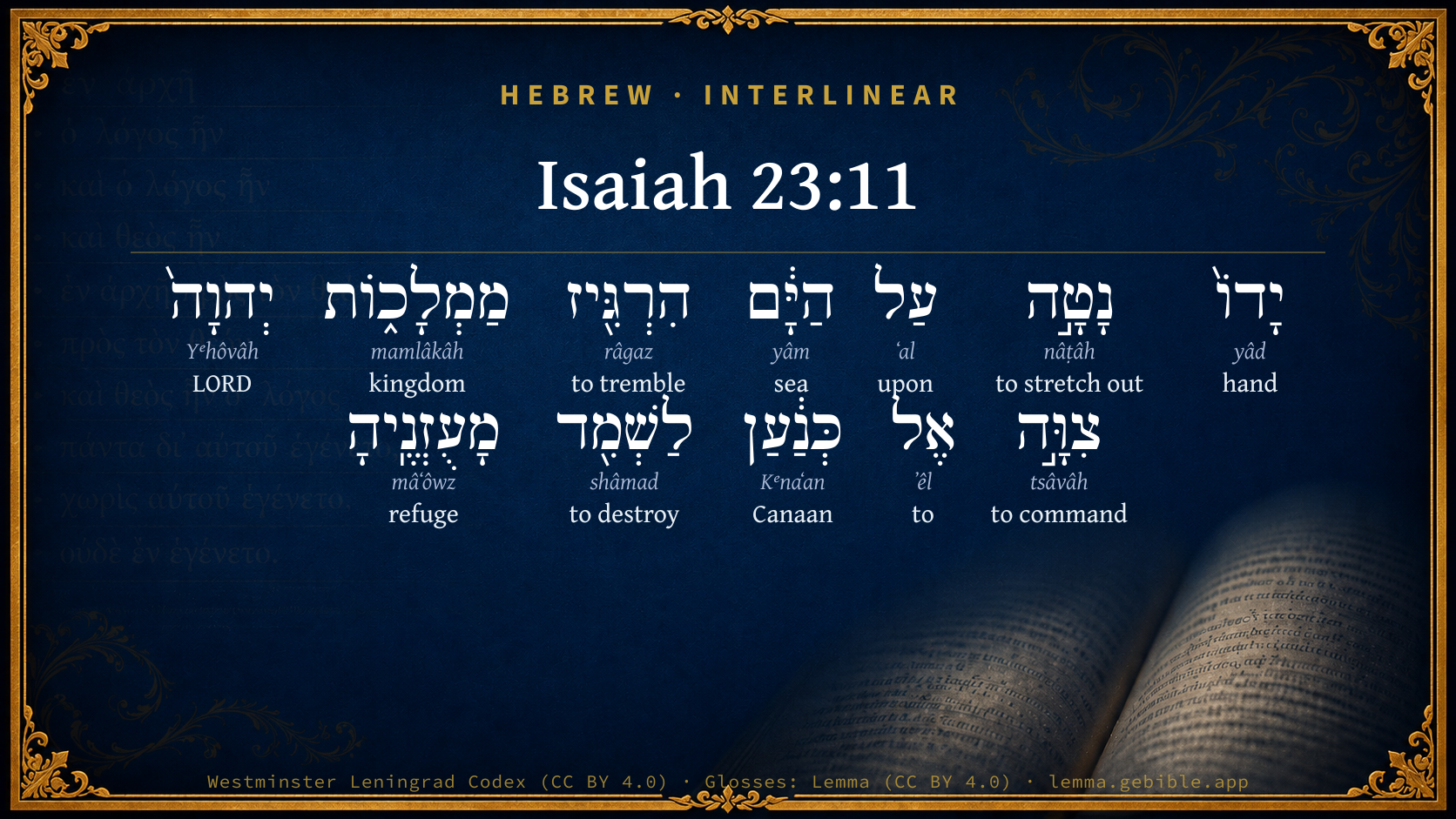
מָעֻזְנֶֽיהָ
mâʻôwz
H4581
“refuges · her”
Noun, Common, Masculine, Plural, Construct + Suffix, Personal, 3rd Person, Feminine, Singular
Part of Speech
Noun
Type
Common
Gender
Masculine
Number
Plural
State
Construct
Full BDB Definition

Origin: from H5810

TWOT: 1578a

place or means of safety, protection, refuge, stronghold - place of safety, fastness, harbour, stronghold - refuge (of God) (figuratively) - human protection (figuratively)
  1. יָדוֹ֙ yâd H3027 “hand · his” Noun, Common, Both, Singular, Construct + Suffix, Personal, 3rd Person, Masculine, Singular
  2. נָטָ֣ה nâṭâh H5186 “to stretch out” Verb, Qal, Perfect, 3rd Person, Masculine, Singular
  3. עַל ʻal H5921 “upon” Preposition
  4. הַיָּ֔ם yâm H3220 “the · sea” Particle, Definite Article + Noun, Common, Masculine, Singular, Absolute
  5. הִרְגִּ֖יז râgaz H7264 “to tremble” Verb, Hiphil, Perfect, 3rd Person, Masculine, Singular
  6. מַמְלָכ֑וֹת mamlâkâh H4467 “kingdoms” Noun, Common, Feminine, Plural, Absolute
  7. יְהוָה֙ Yᵉhôvâh H3068 “LORD” Noun, Proper
  8. צִוָּ֣ה tsâvâh H6680 “to command” Verb, Piel, Perfect, 3rd Person, Masculine, Singular
  9. אֶל ʼêl H413 “to” Preposition
  10. כְּנַ֔עַן Kᵉnaʻan H3667 “Canaan” Noun, Proper
  11. לַשְׁמִ֖ד shâmad H8045 “to destroy” Preposition + Verb, Hiphil, Infinitive Construct

About this verse

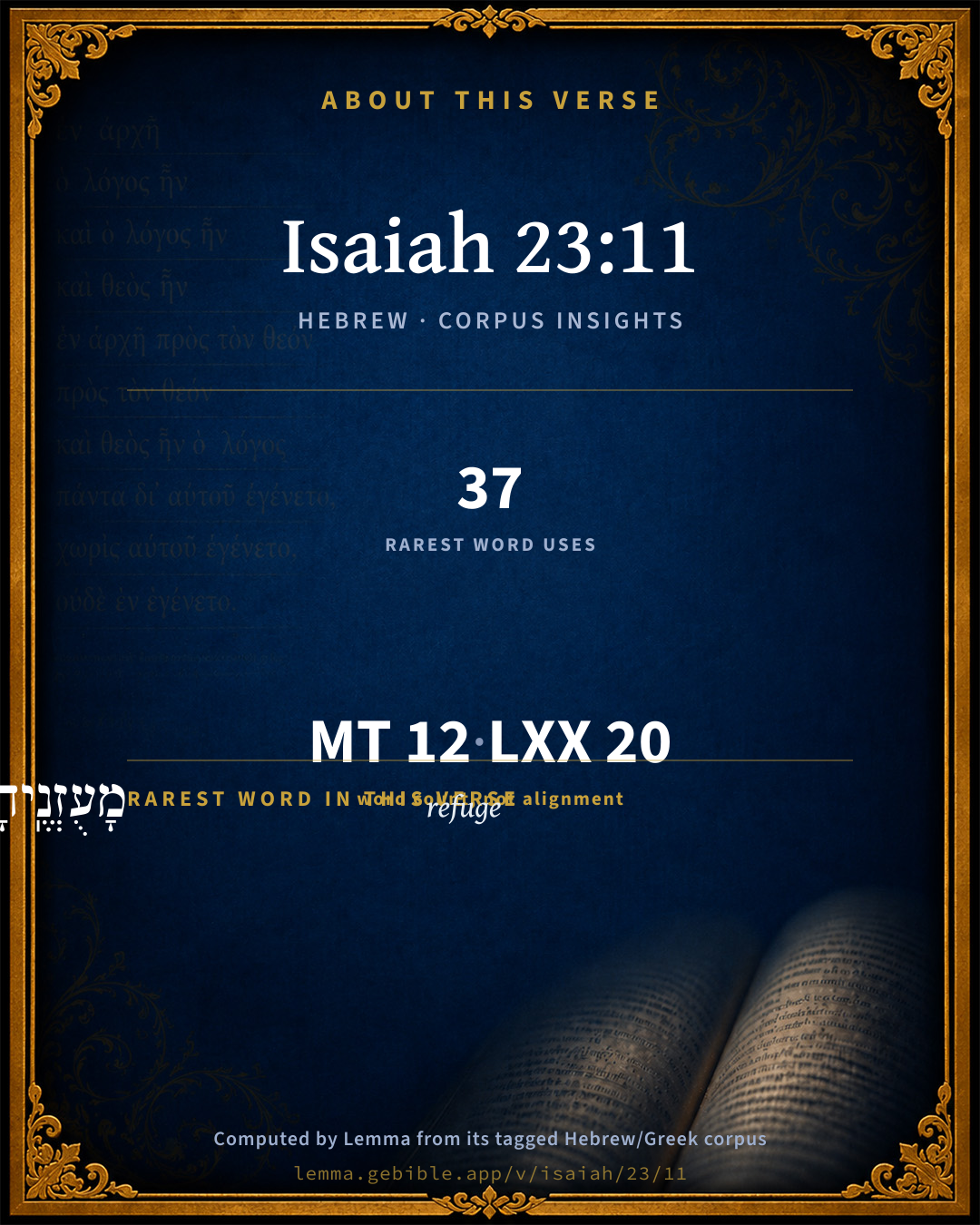
These counts appear in no published source. They are computed here, from the morphology-tagged text and Lemma’s own curated glosses. What Lemma adds →

12
words
12
distinct lemmas
Prophets
section

Shared distinctive vocabulary

מָעֻזְנֶֽיהָ refuge H4581 occurs in 35 verses of the Hebrew Bible. Also found in:

Grammatical profile

  • 4 verbs
  • 6 nouns
  • 2 prepositions

Verb forms

  • נָטָ֣ה Qal · Perfect
  • הִרְגִּ֖יז Hiphil · Perfect
  • צִוָּ֣ה Piel · Perfect
  • לַשְׁמִ֖ד Hiphil · Infinitive Construct

Hebrew & Septuagint length

In English translation the verse runs 26 words from the Hebrew and 26 from the Septuagint (LXX English) — the same length.

A rough comparison of the two English renderings, which tokenize alike — not a word-level alignment.

Word counts can differ between the Hebrew and the Greek without any difference in meaning — e.g. the Hebrew direct-object marker אֵת has no separate Greek word, and Greek often adds the article ὁ.

In the original languages it is 12 Hebrew tokens and 20 Greek tokens — but the two are counted differently (Hebrew bundles its prefixes and suffixes into one token; the Greek is in lemma form), so that isn’t a like-for-like length.

Cross-references

23

Topical passages linked to Isaiah 23:11 in the Treasury of Scripture Knowledge — connected by theme and wording, ordered by reader-vote popularity; previews shown in the World English Bible.

  • Zechariah 9:3–4 Tyre built herself a stronghold, And heaped up silver like the dust, And fine gold like the mire of the streets.
  • Exodus 14:21 Moses stretched out his hand over the sea, and Yahweh caused the sea to go back by a strong east wind all the night, and made the sea dry land, and the waters were divided.
  • Genesis 9:25 He said, "Cursed be Canaan; A servant of servants will he be to his brothers."
  • Genesis 10:15–19 Canaan became the father of Sidon (his firstborn), Heth,
  • Exodus 15:8–10 With the blast of your nostrils the waters were piled up. The floods stood upright as a heap. The deeps were congealed in the heart of the sea.
  • Psalms 46:6 The nations raged. The kingdoms were moved. He lifted his voice, and the earth melted.
  • Psalms 71:3 Be to me a rock of refuge to which I may always go. Give the command to save me, For you are my rock and my fortress.
  • Isaiah 2:19 Men shall go into the caves of the rocks, And into the holes of the earth, From before the terror of Yahweh, And from the glory of his majesty, When he arises to shake the earth mightily.
  • Isaiah 10:6 I will send him against a profane nation, and against the people of my wrath will I give him a charge, to take the spoil, and to take the prey, and to tread them down like the mire of the streets.
  • Isaiah 14:16–17 Those who see you shall gaze at you, they shall consider you, [saying], "Is this the man who made the earth to tremble, who shook kingdoms;
  • Isaiah 23:3 On great waters the seed of the Shihor, the harvest of the Nile, was her revenue; and she was the market of nations.
  • Isaiah 25:2 For you have made of a city a heap, of a fortified city a ruin, a palace of strangers to be no city; it shall never be built.
  • Jeremiah 47:7 How can you be quiet, seeing Yahweh has given you a charge? Against Ashkelon, and against the sea-shore, there has he appointed it.
  • Ezekiel 26:10 By reason of the abundance of his horses their dust shall cover you: your walls shall shake at the noise of the horsemen, and of the wagons, and of the chariots, when he shall enter into your gates, as men enter into a city in which is made a breach.
  • Ezekiel 26:15–19 Thus says the Lord Yahweh to Tyre: shall not the isles shake at the sound of your fall, when the wounded groan, when the slaughter is made in the midst of you?
  • Ezekiel 27:34–35 In the time that you were broken by the seas in the depths of the waters, your merchandise and all your company did fall in the midst of you.
  • Ezekiel 31:16 I made the nations to shake at the sound of his fall, when I cast him down to Sheol with those who descend into the pit; and all the trees of Eden, the choice and best of Lebanon, all that drink water, were comforted in the lower parts of the earth.
  • Hosea 12:7–8 A merchant has dishonest scales in his hand. He loves to defraud.
  • Nahum 1:14 Yahweh has commanded concerning you: "No more descendants will bear your name. Out of the house of your gods, will I cut off the engraved image and the molten image. I will make your grave, for you are vile."
  • Haggai 2:7 and I will shake all nations. The precious things of all nations will come, and I will fill this house with glory, says Yahweh of Hosts.
  • Zechariah 14:21 Yes, every pot in Jerusalem and in Judah will be holy to Yahweh of Hosts; and all those who sacrifice will come and take of them, and cook in them. In that day there will no longer be a Canaanite in the house of Yahweh of Hosts.
  • Mark 11:17 He taught, saying to them, "Isn't it written, 'My house will be called a house of prayer for all the nations?' But you have made it a den of robbers!"
  • John 2:16 To those who sold the doves, he said, "Take these things out of here! Don't make my Father's house a marketplace!"

Cross-references courtesy of OpenBible.info (CC BY 4.0).

Hebrew and Greek witnesses Masoretic Hebrew ↔ Greek Septuagint

The same verse in the two great witnesses to the Old Testament, shown verse-for-verse.

These are two independent witnesses, not word-aligned to each other, and the Septuagint is shown in lemma (dictionary) form.

Hebrew Isaiah 23:11 Masoretic · Westminster Leningrad Codex

יָדוֹ֙ נָטָ֣ה עַל הַיָּ֔ם הִרְגִּ֖יז מַמְלָכ֑וֹת יְהוָה֙ צִוָּ֣ה אֶל כְּנַ֔עַן לַשְׁמִ֖ד מָעֻזְנֶֽיהָ

He has stretched out his hand over the sea, he has shaken the kingdoms: Yahweh has given commandment concerning Canaan, to destroy the strongholds of it.

World English Bible · Public Domain

Greek LXX Isaiah 23:11 Septuagint · lemma form

ὁ δέ χείρ σύ οὐκέτι ἰσχύω κατά θάλασσα ὁ παραὀξύνω βασιλεύς κύριος σαβαωθ ἐντέλλομαι περί χανααν ἀποὀλλύω αὐτός ὁ ἰσχύς

And your hand prevails no more by sea, which troubled kings: the Lord of hosts has given a command concerning Chanaan, to destroy the strength thereof.

LXX2012 (modern English Septuagint) · Public Domain

On this verse, Ellicott's Commentary for English Readers discusses the Septuagint’s reading. Read the note in Commentary ↓

Hebrew: Westminster Leningrad Codex (CC BY 4.0). Greek: Septuagint (public domain); English from LXX2012 (modern English Septuagint) (Public Domain). How the Septuagint differs from the Hebrew →

Targum (Aramaic paraphrase)

1

The Targum is the ancient Jewish Aramaic paraphrase of the Hebrew Scriptures — an interpretive translation, not the Hebrew text itself. Onkelos (literal) and Pseudo-Jonathan (expansive) render the Torah, and Jonathan the Prophets. Coverage is partial: where no permissively-licensed English translation exists for a verse, only the Aramaic is shown. This is verse-level text, not a word-by-word alignment to the Hebrew.

  1. Targum Jonathan Prophets (Joshua–Malachi)
    גְבוּרְתֵּהּ מְרַמְמָא עַל יַמָא לַאֲזָעָא מַלְכְּוָתָא יְיָ פַּקֵיד עַל כְּנַעֲנָאָה לְשֵׁיצָאָה תּוּקְפָאָה:

    His power is lifted up against the sea, to make the kingdom to tremble; the Lord has given the command concerning the merchant city, to make an end of her strength.

    Targum Jonathan — Aramaic: “Mikraot Gedolot” (public domain). English: “Sefaria Community Translation” (CC0 1.0 (public-domain dedication)); “London "Chaldee Paraphrase," 1871” (public domain). Text via Sefaria.

Commentary

Notes on Isaiah 23:11 from classic Christian and Jewish commentators (each source and its license shown beneath its notes). The classic Christian expositions comment on the surrounding passage and are grouped to its opening verse, so a note may address several verses; the Jewish commentaries on the Tanakh (Rashi and others) are per-verse, so they appear only where the commentator wrote on this verse.

Lemma curates 59 commentaries, every one of them public domain or Creative Commons licensed, each selected and text-cleaned for this edition rather than reprinted as found. About our sources →

Trapp's Complete Commentary

John Trapp

Isa 23:11 He stretched out his hand over the sea, he shook the kingdoms: the LORD hath given a commandment against the merchant [city], to destroy the strong holds thereof.

Ver. 11. He stretched out his hand.] That "mighty hand" of his, {1Pe 5:6} wherewith he spanneth the heavens, {Isa 48:13} brought the Red Sea upon the Egyptians, {Exo 14:26} and still shaketh the wicked out of the earth, as by a canvas. {Job 38:13}

He shook the kingdoms.] Shook and shattered them - viz., by Nebuchadnezzar; the kingdom of Tyre especially, to the terror of others. {Eze 26:15}

The Lord.] "That man of war." {Exo 15:3} "Mighty in battle." {Psa 24:8}

Hath given a commandment.] Bidding his forces fall on.

Against the merchant city.] Heb., Against, or concerning, Canaan; so he calleth Tyre the posterity of the old Canaanites, and a place of great merchandise. See Hos 12:7.

John Trapp, A Commentary or Exposition upon All the Books of the Old and New Testament (1647–1656) — public domain. Text from a community e-Sword module.

Joseph Benson's Commentary

Isa 23:11-12. He — Namely, the Lord, mentioned in the latter part of the verse; stretched out his hand over the sea — That is, Tyre, called the sea, (Isa 23:4,) to overthrow it. He shook — Hebrew, הרגיז, he made to tremble, the kingdoms — Either the two kingdoms of Tyre and Zidon, or the neighbouring and confederate kingdoms, which might justly quake at her fall, for the dreadfulness and unexpectedness of the event, and because Tyre was a bulwark and a refuge to them. The Lord hath given a commandment, to destroy, &c. — Hath put this design into the hearts of her enemies, and given them courage to attempt, and strength to execute it. Thou shalt no more rejoice, oppressed virgin — He calls her a virgin, because she had hitherto never borne the yoke of a conquering enemy; though withal he signifies that she should be oppressed, and, as it were, ravished, by her enemies. Daughter of Zidon — Tyre is called the daughter of Zidon, because she was first built and inhabited by a colony of the Zidonians; as Pliny calls Carthage the daughter of Tyre, because she was built by a colony of Tyrians. “It is certain,” says Lowth, “that of the two cities, Zidon was much the most ancient, being mentioned by Moses in his account of the peopling of the world after the flood, Gen 10:19; and again, chap. 49:13. Afterward it is called by Joshua, great Zidon, Jos 11:8 : Homer likewise takes notice of Zidon, but not of Tyre; and the authority of Strabo is express to the same purpose.” Arise, pass over to Chittim, &c. — See on Isa 23:1; Isa 23:6. “Of all the Phenicians,” says Bishop Newton, “the Tyrians were the most celebrated for their shipping and colonies. Tyre exceeded Zidon in this respect, as Strabo testifies, and sent forth colonies into Africa and Spain, unto and beyond the pillars of Hercules: and Quintus Curtius says that her colonies were diffused almost over the whole world. The Tyrians, therefore, having planted colonies at Tarshish, and upon the coasts of Chittim, it was natural for them, when they were pressed with dangers and difficulties at home, to flee to their friends and countrymen abroad for protection. That they really did so, St. Jerome asserts, upon the authority of Assyrian histories, which are now lost. But,” it is here foretold, that, “though they should pass over to Chittim, yet even there they should find no quiet settlement; There also shalt thou have no rest — Megasthenes (an historian who lived about 300 years before Christ) is quoted by several ancient authors, for saying that Nebuchadnezzar subdued a great part of Africa and Spain, and proceeded as far as the pillars of Hercules. After he had subdued Tyre and Egypt, we may suppose he carried his arms further westward; and if he proceeded as far as Megasthenes reports, the Tyrians might well be said to have no rest, their conqueror pursuing them from one country to another. But besides this, and after this, the Carthaginians, and other colonies of the Tyrians, lived in a very unsettled state. Their history is made up of little but wars and tumults, even before their three fatal wars with the Romans, in every one of which their affairs grew worse and worse. Sicily and Spain, Europe and Africa, the land, and their own element, the sea, were theatres of their calamities and miseries; till, at last, not only the new, but old Carthage too, was utterly destroyed. As the Carthaginians sprung from the Tyrians, and the Tyrians from the Zidonians, and Zidon was the firstborn of Canaan, (Gen 10:15,) so the curse upon Canaan seems to have pursued them to the most distant parts of the earth.”

Joseph Benson's Commentary on the Old and New Testaments (1811–1818) — public domain. Text from a community e-Sword module.

Tyndale Open Study Notes

Tyndale Open Resources

23:11 Phoenicia was the region north of Israel. Tyre and Sidon were its main cities.

Tyndale Open Study Notes — © Tyndale Open Resources, licensed CC BY-SA 4.0. Text via the HelloAO Bible API.

Jamieson, Fausset & Brown

Robert Jamieson, A. R. Fausset & David Brown

He--Jehovah.

kingdoms--the Phœnician cities and colonies.

the merchant city--rather, Canaan, meaning the north of it, namely, Phœnicia. On their coins, they call their country Canaan.

Jamieson, Fausset & Brown — Commentary Critical and Explanatory on the Whole Bible (1871) — public domain (CC PDM 1.0). Text via the HelloAO Bible API.

Ellicott's Commentary for English Readers

(11) He shook the kingdoms.—The picture of the great convulsion of the time includes more than Tyre and its subject states. Egypt, Ethiopia, Babylon, Syria, Israel, Judah, were all affected, shaken as to their very foundations, by the rapid progress of the restored Assyrian empire under Tiglath-pileser and his successors.

Against the merchant city.—Literally, Canaan (the word “city” being an interpolation), taken here as equivalent to Phœnicia. So in Jos_5:1, the LXX. translates “Canaanites” by “Phœnicia.”

A Bible Commentary for English Readers, edited by Charles John Ellicott (1878–1897) — public domain. Text from a community e-Sword module.

The Cambridge Bible for Schools and Colleges

gen. ed. J. J. S. Perowne

11. He stretched out his hand, &c.] R.V. he hath stretched out … hath shaken. Cf. ch. Isa_5:25, Isa_14:26-27. The kingdoms are specially Phœnicia and its dependencies.

the merchant city] Read Canaan and see on Isa_23:8. “Canaan” is the name used by the Phœnicians of themselves and their colonists, but this is the only example in the Old Test. of its restriction to Phœnicia.

The Cambridge Bible for Schools and Colleges (gen. ed. J. J. S. Perowne; Cambridge University Press, 1878–1918) — public domain. Text from a community e-Sword module.

John Gill's Exposition

He stretched out his hand over the sea,.... That is, the Lord of hosts, who had purposed to destroy Tyre, stretched out his hand of power over it, called the sea, as in Isa 23:4 because situated in it, supported by it, and had the sovereignty of it; in like manner as he stretched out his hand on the Red Sea, and destroyed Pharaoh and the Egyptians in it; to which the allusion may be:

he shook the kingdoms; of Tyre and Zidon, which were both kingdoms, and distinct ones; and also made other neighbouring kingdoms shake and tremble when these fell, fearing it would be their case next. Some understand this of the moving of Nebuchadnezzar, and of the kings of the provinces under him, to come against Tyre:

the Lord hath given a commandment against the merchant city; the city of Tyre, so famous for merchandise, that it was the mart of nations, as in Isa 23:3 or "against Canaan", in which country Tyre and Zidon were, being originally built and inhabited by the posterity of Canaan, Gen 10:15,

to destroy the strong holds thereof; either of the merchant city Tyre, whose fortifications were strong, both by nature and art; or "of Canaan", whose strong holds, or fortified cities, the principal of them were Tyre and Zidon; so Jarchi: and if the Lord of hosts gives a commandment to destroy it and its strong holds, as he did to Nebuchadnezzar and his army, and afterwards to Alexander and his, who could save them? that is, God said it, who gave commandment to destroy it.

John Gill's Exposition of the Whole Bible (1746–1763) — public domain (CC PDM 1.0). Text via the HelloAO Bible API.

Albert Barnes' Notes on the Bible

He stretched out his hand - That is, Yahweh (see Isa 23:9). To stretch out the hand is indicative of punishment (see the notes at Isa 5:25; Isa 9:12), and means that God has resolved to inflict exemplary punishment on Tyre and its dependent colonies.

Over the sea - That is, over the sea coast of Phenicia; or over the cities that were built on the coast. This alludes to the fact that Nebuchadnezzar would lay siege to these cities, and would ravage the maritime coast of Phenicia. It is not improbable also that, having taken Tyre, he would extend his conquests to Citium, on the island of Cyprus, and destroy as many of the dependent cities of Tyre as possible.

The Lord hath given a commandment - The control here asserted over Nebuchadnezzar is similar to that which he asserted over the Assyrian Sennacherib (see the note at Isa 10:5).

Against the merchant city - Hebrew, ‘Against Canaan’ (על־כנען 'el-kena‛an). The word ‘Canaan’ may here be used as in Isa 23:8, to denote a place given to merchandise or traffic, since this was the principal employment of the inhabitants of this region; but it is rather to be taken in its obvious and usual sense in the Scriptures, as denoting the land of Canaan, and as denoting that Nebuchadnezzar would be sent against that, and especially the maritime parts of it, to lay it waste.

To destroy the strongholds thereof - That is, the strongholds of Canaan; as Tyre, Sidon, Accho, etc. Tyre, especially, was strongly fortified, and was able long to resist the arms of the Chaldeans.

Albert Barnes' Notes on the Bible (1834–1885) — public domain. Text from a community e-Sword/MySword module.

Matthew Poole's English Annotations

He, the Lord, expressed Isa 23:9, stretched out his hand to strike it, the antecedent being put for the consequent,

over the sea; or, against the sea, i.e. against Tyrus, the daughter of the sea, as she was now called; and consequently against all those ships and men which used to traffic with Tyrus, and were enriched by that trade, and therefore suffered in her fall.

He shook the kingdoms, Heb. he made the kingdoms to tremble; either,

1. The two kingdoms of Tyre and Sidon; or rather,

2. The neighbouring and confederate kingdoms, as appears by comparing this with Eze 26:15-18, who might justly quake at her fall, partly, for the dreadfulness and unexpectedness of the thing; partly, because Tyre was a bulwark, and a refuge, and a great advantage to them; and partly, because her fall made way for their ruin, as being destroyed by their common enemy.

Hath given a commandment; hath contrived and purposed it, as was said, Isa 23:8,9; hath put this design into the heads and hearts of her enemies, and given them courage to attempt, and strength to execute, so difficult an enterprise.

Against the merchant city, Heb. against Canaan; the word Canaan being taken either,

1. For a merchant, as it is used, Job 41:6; Hos 12:7; or rather,

2. For the proper name of a place or people, as it is generally used; for the Tyrians and Sidonians were descended from Canaan, Gen 10:15, and were the only considerable remainders of that cursed race whom God had devoted to destruction. And so this phrase may be here used both as all evidence and as an argument of their intended and approaching ruin.

Matthew Poole's English Annotations on the Holy Bible (1683–1685) — public domain. Text from a community e-Sword/MySword module.

Whedon's Commentary on the Bible

Daniel D. Whedon

11. He stretched out his hand — The subject of the verb is Jehovah. The gesture here, quite a common representation with Isaiah, intends punishment and correction.

Over the sea — Over the domain of Tyrian commerce, more especially Phoenician cities on the sea.

Shook the kingdoms — The whole of Phoenicia, by means of noted warriors whose selfish aims at conquest were divinely overruled for correction.

Daniel D. Whedon (gen. ed.), Commentary on the Old and New Testaments (1874–1909) — public domain. Text from a community e-Sword module.

The Pulpit Commentary

He stretched out his hand over the sea, By "he" we must understand "Jehovah" (see ver. 9). God has smitten Tyro the great maritime power destroyed its dominion, and set its subject cities free. He shook the kingdoms; i.e. not only Tyre, but the other cities of the Phoenician coast, each of which had its own king (Herod., 7:98; Strab., 16. p. 754). Against the merchant city; rather, against Canaan. Phoenicia is called "Canaan," as England is often called "Britain." So the "SyroPhoenician woman" of Mar_7:26 is "a woman of Canaan" in Mat_15:22.

The Pulpit Commentary (1880–1919), ed. H.D.M. Spence-Jones & Joseph S. Exell — public domain. Text from a community e-Sword module.

John Wesley's Explanatory Notes

He - The Lord. Shook - Hebrew. he made the kingdoms to tremble; the neighbouring and confederate kingdoms, who might justly quake at her fall, for the dreadfulness and unexpectedness of the thing; and because Tyre was a bulwark, and a refuge to them. A commandment - Hath put this design into the hearts of her enemies, and given them courage to attempt, and strength to execute it.

John Wesley, Explanatory Notes Upon the Whole Bible (1754–1765) — public domain. Text via the GEBible commentary corpus.

Keil & Delitzsch

C. F. Keil & F. Delitzsch

The prophet now proceeds to relate, as it were, to the Pheonicio-Spanish colony, the daughter, i.e., the population of Tartessus, what has happened to the mother country. "His hand hath He stretched over the sea, thrown kingdoms into trembling; Jehovah hath given commandment concerning Kena'an, to destroy her fortresses. And He said, Thou shalt not rejoice any further, thou disgraced one, virgin daughter of Sidon! Get up to Kittim, go over; there also shalt thou not find rest." There is no ground whatever for restricting the "kingdoms" (mamlâcoth) to the several small Phoenician states (compare Isa 19:2). Jehovah, reaching over the sea, has thrown the lands of Hither Asia and Egypto-Ethiopia into a state of the most anxious excitement, and has summoned them as instruments of destruction with regard to Kenaēan (אל, like על in Est 4:5). Phoenicia called itself Kena‛an (Canaan); but this is the only passage in the Old Testament in which the name occurs in this most restricted sense. לשׁמיד, for להשׁמיד, as in Num 5:22; Amo 8:4. The form מעזניה is more rare, but it is not a deformity, as Knobel and others maintain. There are other examples of the same resolution of the reduplication and transposition of the letters (it stands for מענזיה, possibly a Phoenician word; see Hitzig, Grabschrift, p. 16, and Levi, Phoenizische Studien, p. 17), viz., תּמנוּ in Lam 3:22 (vid., at Psa 64:7), and קבנו in Num 23:13, at least according to the Jewish grammar (see, however, Ewald, 250, b).

(Note: Bttcher derives the form from מעזן, a supposed diminutive; see, however, Jesurun, pp. 212-216.)

"Virgin of the daughter of Sidon" (equivalent to "virgin daughter of Sidon," two epexegetical genitives; Ewald, 289, c) is synonymous with Kena‛an. The name of the ancestral city (compare Isa 37:22) has here become the name of the whole nation that has sprung from it. Hitherto this nation has been untouched, like a virgin, but now it resembles one ravished and defiled. If now they flee across to Cyprus (cittiyim or cittim), there will be no rest for them even there, because the colony, emancipated from the Phoenician yoke, will only be too glad to rid herself to the unwelcome guests from the despotic mother country.

Keil & Delitzsch — Biblical Commentary on the Old Testament (1861–1891) — public domain (CC PDM 1.0). Text via the HelloAO Bible API. (Old Testament only.)

J. A. Alexander on Isaiah

Joseph Addison Alexander

“His hand He stretched out over the sea; He made kingdoms tremble.” Jehovah commanded respecting Canaan to destroy her strongholds. The subject of the verbs in the first clause is the same as in the last.

Joseph Addison Alexander, The Prophecies of Isaiah (1846–1847; New York: Scribner, 1870–1878) — public domain. Text from a community e-Sword module.

Rashi

Rabbi Shlomo Yitzchaki (Rashi)

He stretched His hand He Who stretched out.

the Lord commanded upon Canaan He commanded His summoned ones upon Canaan.

to destroy (לַשְׁמִד), like לְהַשְׁמִיד. Comp. (II Kings 9: 15) “To go and tell (לַגִּיד) in Jezreel,” like לְהַגִּיד. And so (Psalms 26:7), “To make heard (לַשְׁמִיעַ) with a voice of thanksgiving,” like לְהַשְׁמִיעַ.

its strongholds Tyre and Zidon were of Canaan, as it is stated (Gen. 10:15): “Zidon his first born.”

Rashi on the Tanakh — English translations: “The Judaica Press complete Tanach with Rashi, translated by A. J. Rosenberg” (CC BY 4.0); “Pentateuch with Rashi's commentary by M. Rosenbaum and A.M. Silbermann, 1929-1934” (public domain); “The Metsudah Tanach series, Lakewood, N.J” (CC BY 4.0); and “The Book of Joshua, Metsudah Publications, 1997” (CC BY 4.0). Text via Sefaria.

Ibn Ezra

Rabbi Abraham ibn Ezra

He stretched out His hand. God stretched out His hand, that is, He brought the punishment.

מעזניה The strongholds thereof. The fortresses of Tyre.—The נ in מעזניה is instead of the Dagesh in the.ז כנען Merchant city. According to some, ארחת כנען ═ כנען, the caravan of Canaan, because of the feminine pronoun in מעזניהֹ her strongholds.

Ibn Ezra on the Tanakh — English translations: “Sefaria Community Translation” (CC0 1.0 (public-domain dedication)); “Yalkut, Sifsei Chachomim Chumash, Metsudah Publications, 2009” (CC BY 4.0); and “Commentary of Ibn Ezra on Isaiah - trans. by M. Friedlander, 1873” (public domain). Text via Sefaria.

Lesson kit

Teaching starters — assembled from the data on this page, not authored interpretation. Every prompt links to the verse data it draws on. Edit before teaching.

Isaiah, in the Prophets, opens this verse with 12 words (12 distinct Hebrew lemmas). Its most distinctive word is mâʻôwz (“refuge”). A historical commentator’s framing appears above. Read the whole chapter for the surrounding context.

Discussion questions

  1. How does “refuge” (mâʻôwz) shape what this verse is saying?
  2. Judges 6:26 shares the word «refuge» with this verse. How do the two illuminate each other?
  3. The translations on this page render this verse differently — a whole-verse word diff, not a word-by-word alignment. What might account for the different wordings?
  4. The verb «נָטָ֣ה» is Qal Perfect. How does its form color the action?
  5. Reading how Trapp's Complete Commentary and Joseph Benson's Commentary read this verse, where do the two commentators agree and where do they part?

Things to notice

Reading settings

Reading text

Shown beneath each verse's original-language words.

Old Testament
Old Testament edition

Read the OT as the Masoretic Hebrew (MT) or the Greek Septuagint (LXX).

English shown for the Greek Septuagint (in the Hebrew ↔ Greek comparison).

Comparing translations? Open the Compare panel on any verse page to stack up to four side by side.