Jeremiah 44:5

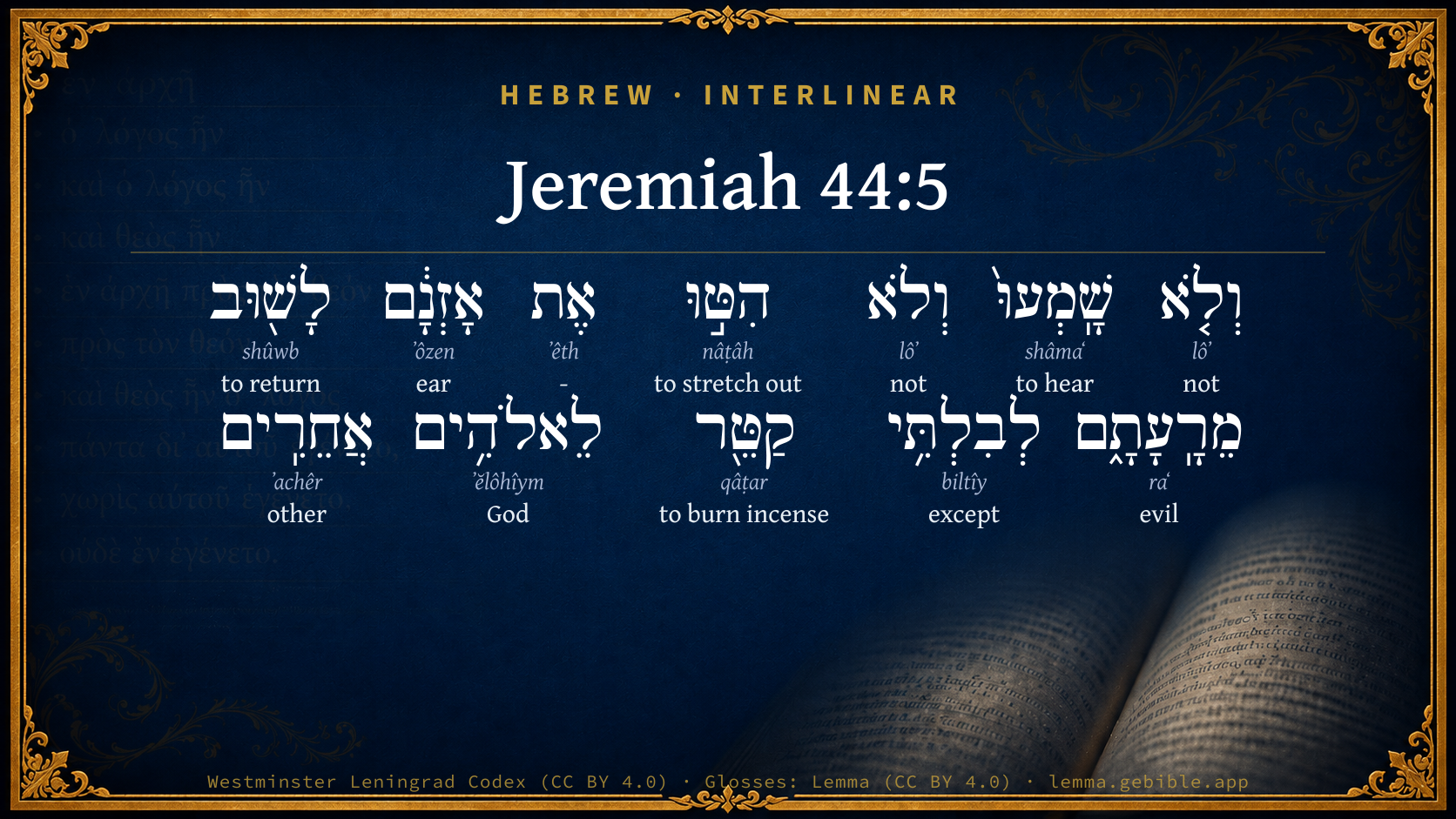
Hebrew (Westminster Leningrad Codex) Jeremiah 44:5 appears in the Hebrew Old Testament. The text above is from the Westminster Leningrad Codex. Each word links to its Strong’s number, a concise gloss, and parsing drawn from the Open Scriptures Hebrew Bible morphology. Click any word for its full Brown-Driver-Briggs (BDB) entry.
Download image
Cite this verse

Jeremiah 44:5 (World English Bible). Public Domain. Lemma interlinear Bible study tool, https://lemma.gebible.app/v/jeremiah/44/5.

Show BibTeX & RIS
BibTeX
RIS
English Translation
But they didn't listen, nor inclined their ear to turn from their wickedness, to burn no incense to other gods.
World English Bible · Public Domain
Download a study sheet

One document with this verse’s original text, its word-by-word gloss line, the meaning frame, cross-references with their text, attributed commentary, and full source and license credits — printable, and it pastes into notes with its structure intact.

This verse Autodidact and up

Study sheet (.html) Plain text (.txt)

A passage Seminary Student

Up to 50 verses in one chapter. A passage sheet keeps up to 6 commentary sources and 12 cross-references per verse, in the order this page ranks them, and says so on the sheet whenever that leaves anything out. Ask for a single verse and you get the Autodidact verse sheet above.

Everything on this page stays free to read, with no account — the sheet is a download of what is already on screen, not access to it.

Want to remove ads? Support Godless Engineer
Compare translations 3

The same verse in 3 English versions, stacked beneath the original-language interlinear above. Click any original word for its lexicon entry.

Each is an independent rendering of the whole verse — the interlinear is not word-aligned to these translations.

Highlighted words mark where these versions differ — a whole-verse word diff, not a word-by-word alignment.

  • World English Bible Public Domain
    But they didn't listen, nor inclined their ear to turn from their wickedness, to burn no incense to other gods.
  • King James Version Public Domain
    But they hearkened not, nor inclined their ear to turn from their wickedness, to burn no incense unto other gods.
  • unfoldingWord Literal Text CC BY-SA 4.0
    But they did not listen. They refused to pay attention or turn from their wickedness in burning incense to other gods.

unfoldingWord Literal Text — © unfoldingWord, licensed CC BY-SA 4.0. Word-aligned USFM3 via Door43 (git.door43.org/unfoldingWord/en_ult).

Versions to compare (up to 4)

3 of 4 selected

Show all 18 translations

Every available English version of this verse, each an independent rendering of the whole verse.

  • World English Bible Public Domain
    But they didn't listen, nor inclined their ear to turn from their wickedness, to burn no incense to other gods.
  • Berean Standard Bible Public Domain
    But they did not listen or incline their ears; they did not turn from their wickedness or stop burning incense to other gods.
  • Majority Standard Bible Public Domain
    But they did not listen or incline their ears; they did not turn from their wickedness or stop burning incense to other gods.
  • King James Version Public Domain
    But they hearkened not, nor inclined their ear to turn from their wickedness, to burn no incense unto other gods.
  • American Standard Version (1901) Public Domain
    But they hearkened not, nor inclined their ear to turn from their wickedness, to burn no incense unto other gods.
  • Revised Version (1885) Public Domain
    But they hearkened not, nor inclined their ear to turn from their wickedness, to burn no incense unto other gods.
  • Geneva Bible (1599) Public Domain
    But they would not heare nor incline their eare to turne from their wickednes, and to burne no more incense vnto other gods.
  • Douay-Rheims (1899) Public Domain
    But they heard not, nor inclined their ear to turn from their evil ways, and not to sacrifice to strange gods.
  • Young's Literal Translation Public Domain
    and they have not hearkened nor inclined their ear, to turn back from their wickedness, not to make perfume to other gods,
  • Literal Standard Version CC BY-SA 4.0
    and they have not listened nor inclined their ear to turn back from their wickedness, not to make incense to other gods,
  • Unlocked Literal Bible CC BY-SA 4.0
    But they did not listen. They refused to pay attention or turn from their wickedness in burning incense to other gods.
  • unfoldingWord Literal Text CC BY-SA 4.0
    But they did not listen. They refused to pay attention or turn from their wickedness in burning incense to other gods.
  • Darby Bible Public Domain
    But they hearkened not, nor inclined their ear to turn from their wickedness, to burn no incense unto other gods.
  • World Messianic Bible Public Domain
    But they didn’t listen and didn’t incline their ear. They didn’t turn from their wickedness, to stop burning incense to other gods.
  • Webster's Bible Public Domain
    But they hearkened not, nor inclined their ear to turn from their wickedness, to burn no incense to other gods.
  • Free Bible Version CC BY-SA 4.0
    But you refused to listen or to pay attention. You didn't stop their wickedness or burning incense in worship of other gods.
  • Bible in Basic English Public Domain
    But they gave no attention, and their ears were not open so that they might be turned from their evil-doing and from burning perfume to other gods.
  • JPS Tanakh (1917) Public Domain
    But they hearkened not, nor inclined their ear to turn from their wickedness, to forbear offering unto other gods.

Literal Standard Version (2020), Covenant Press — licensed CC BY-SA 4.0. Text via the HelloAO Bible API (eBible.org). Unlocked Literal Bible (unfoldingWord) — licensed CC BY-SA 4.0. Text via the HelloAO Bible API (eBible.org). unfoldingWord Literal Text — © unfoldingWord, licensed CC BY-SA 4.0. Word-aligned USFM3 via Door43 (git.door43.org/unfoldingWord/en_ult). Free Bible Version, Dr. Jonathan Gallagher — licensed CC BY-SA 4.0. Text via the HelloAO Bible API (eBible.org).

Word by word

More ways to search: Search by grammar → Find every occurrence → Compare this word →

Practice this passage: Drill this verse → Learn its vocabulary →

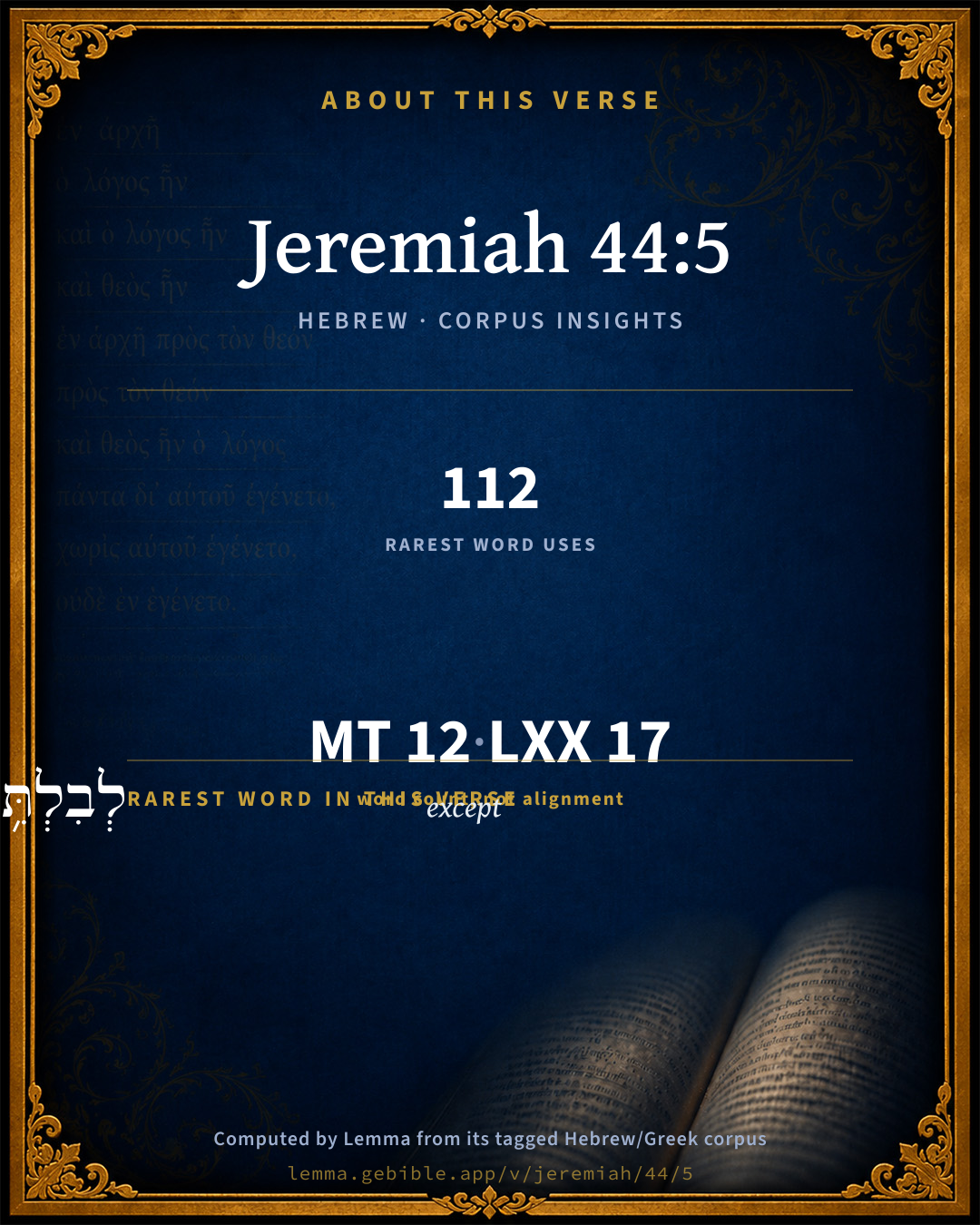
לְבִלְתִּ֥י
biltîy
H1115
“to/for · except”
Preposition + Conjunction
Part of Speech
Preposition + Conjunction
Full BDB Definition

Origin: constructive fem. of H1086 (equivalent to H1097 )

TWOT: 246i

not, except (substantive) - not (adverb) - except (after preceding negation) (adverb) - except (after an implied or expressed negation) (conjunction) - so as not, in order not (with preposition) - an account of not, because...not (with preposition) - until not (with preposition)
  1. וְלֹ֤א lôʼ H3808 “and · not” Conjunction + Particle, Negative
  2. שָֽׁמְעוּ֙ shâmaʻ H8085 “to hear” Verb, Qal, Perfect, 3rd Person, Common, Plural
  3. וְלֹא lôʼ H3808 “and · not” Conjunction + Particle, Negative
  4. הִטּ֣וּ nâṭâh H5186 “to stretch out” Verb, Hiphil, Perfect, 3rd Person, Common, Plural
  5. אֶת ʼêth H853 “-” Particle, Direct Object
  6. אָזְנָ֔ם ʼôzen H241 “ear · their” Noun, Common, Feminine, Singular, Construct + Suffix, Personal, 3rd Person, Masculine, Plural
  7. לָשׁ֖וּב shûwb H7725 “to return” Preposition + Verb, Qal, Infinitive Construct
  8. מֵרָֽעָתָ֑ם raʻ H7451 “from · evil · their” Preposition + Noun, Common, Feminine, Singular, Construct + Suffix, Personal, 3rd Person, Masculine, Plural
  9. קַטֵּ֖ר qâṭar H6999 “to burn incense” Verb, Piel, Infinitive Construct
  10. לֵאלֹהִ֥ים ʼĕlôhîym H430 “to/for · God(s)” Preposition + Noun, Common, Masculine, Plural, Absolute
  11. אֲחֵרִֽים ʼachêr H312 “other” Adjective, Adjective, Masculine, Plural, Absolute

About this verse

These counts appear in no published source. They are computed here, from the morphology-tagged text and Lemma’s own curated glosses. What Lemma adds →

12
words
11
distinct lemmas
Prophets
section

Grammatical profile

  • 4 verbs
  • 3 nouns
  • 1 adjective
  • 1 conjunction
  • 3 particles

Verb forms

  • שָֽׁמְעוּ֙ Qal · Perfect
  • הִטּ֣וּ Hiphil · Perfect
  • לָשׁ֖וּב Qal · Infinitive Construct
  • קַטֵּ֖ר Piel · Infinitive Construct

Repetition

A word recurs within this verse — often emphatic in Hebrew:

  • וְלֹ֤א not H3808 ×2

Hebrew & Septuagint length

In the original languages it is 12 Hebrew tokens and 17 Greek tokens — but the two are counted differently (Hebrew bundles its prefixes and suffixes into one token; the Greek is in lemma form), so that isn’t a like-for-like length.

Cross-references

11

Topical passages linked to Jeremiah 44:5 in the Treasury of Scripture Knowledge — connected by theme and wording, ordered by reader-vote popularity; previews shown in the World English Bible.

  • Jeremiah 11:10 They are turned back to the iniquities of their forefathers, who refused to hear my words; and they are gone after other gods to serve them: the house of Israel and the house of Judah have broken my covenant which I made with their fathers.
  • Jeremiah 19:13 and the houses of Jerusalem, and the houses of the kings of Judah, which are defiled, shall be as the place of Topheth, even all the houses on whose roofs they have burned incense to all the host of the sky, and have poured out drink-offerings to other gods.
  • 2 Chronicles 36:16 but they mocked the messengers of God, and despised his words, and scoffed at his prophets, until the wrath of Yahweh arose against his people, until there was no remedy.
  • Psalms 81:11–13 But my people didn't listen to my voice. Israel desired none of me.
  • Isaiah 48:4 Because I knew that you are obstinate, and your neck is an iron sinew, and your brow brass;
  • Isaiah 48:18 Oh that you had listened to my commandments! then had your peace been as a river, and your righteousness as the waves of the sea:
  • Jeremiah 7:24 But they didn't listen nor turn their ear, but walked in [their own] counsels [and] in the stubbornness of their evil heart, and went backward, and not forward.
  • Jeremiah 11:8 Yet they didn't obey, nor turn their ear, but walked everyone in the stubbornness of their evil heart: therefore I brought on them all the words of this covenant, which I commanded them to do, but they didn't do them.
  • Jeremiah 44:17–21 But we will certainly perform every word that is gone forth out of our mouth, to burn incense to the queen of the sky, and to pour out drink-offerings to her, as we have done, we and our fathers, our kings and our princes, in the cities of Judah, and in the streets of Jerusalem; for then had we plenty of food, and were well, and saw no evil.
  • Zechariah 7:11–12 But they refused to listen, and turned their backs, and stopped their ears, that they might not hear.
  • Revelation 2:21–22 I gave her time to repent, but she refuses to repent of her sexual immorality.

Cross-references courtesy of OpenBible.info (CC BY 4.0).

Hebrew and Greek witnesses Masoretic Hebrew ↔ Greek Septuagint

The same verse in the two great witnesses to the Old Testament, shown verse-for-verse.

These are two independent witnesses, not word-aligned to each other, and the Septuagint is shown in lemma (dictionary) form.

Hebrew Jeremiah 44:5 Masoretic · Westminster Leningrad Codex

וְלֹ֤א שָֽׁמְעוּ֙ וְלֹא הִטּ֣וּ אֶת אָזְנָ֔ם לָשׁ֖וּב מֵרָֽעָתָ֑ם לְבִלְתִּ֥י קַטֵּ֖ר לֵאלֹהִ֥ים אֲחֵרִֽים

But they didn't listen, nor inclined their ear to turn from their wickedness, to burn no incense to other gods.

World English Bible · Public Domain

Greek LXX Structure differs

In the Septuagint, Jeremiah is about an eighth shorter than the Hebrew and arranges its material differently — the Oracles Against the Nations (Hebrew chapters 46–51) appear in the middle of the Greek book, after 25:13. Because the chapter and verse boundaries do not line up, a verse-for-verse comparison with the Hebrew is not shown.

A verse-for-verse comparison isn’t shown here because the chapters and verses don’t line up. Switch to the LXX edition with the MT / LXX toggle above to read the Greek directly.

Hebrew: Westminster Leningrad Codex (CC BY 4.0). Greek: Septuagint (public domain); English from a public-domain English Septuagint. How the Septuagint differs from the Hebrew →

Targum (Aramaic paraphrase)

1

The Targum is the ancient Jewish Aramaic paraphrase of the Hebrew Scriptures — an interpretive translation, not the Hebrew text itself. Onkelos (literal) and Pseudo-Jonathan (expansive) render the Torah, and Jonathan the Prophets. Coverage is partial: where no permissively-licensed English translation exists for a verse, only the Aramaic is shown. This is verse-level text, not a word-by-word alignment to the Hebrew.

  1. Targum Jonathan Prophets (Joshua–Malachi)
    וְלָא קַבִּילוּ וְלָא אַרְכִינוּ יַת אוּדְנֵיהוֹן לְמֵיתַב מִבִּשְׁתְּהוֹן בְּדִיל דְלָא לְאַסָקָא בּוּסְמִין לְטַעֲוַת פַּלְחֵי כּוֹכְבַיָא:

    (no public-domain English translation for this verse)

    Targum Jonathan — Aramaic: “Mikraot Gedolot” (public domain). English: “Sefaria Community Translation” (CC0 1.0 (public-domain dedication)); “London "Chaldee Paraphrase," 1871” (public domain). Text via Sefaria.

Commentary

Notes on Jeremiah 44:5 from classic Christian and Jewish commentators (each source and its license shown beneath its notes). The classic Christian expositions comment on the surrounding passage and are grouped to its opening verse, so a note may address several verses; the Jewish commentaries on the Tanakh (Rashi and others) are per-verse, so they appear only where the commentator wrote on this verse.

Lemma curates 59 commentaries, every one of them public domain or Creative Commons licensed, each selected and text-cleaned for this edition rather than reprinted as found. About our sources →

Trapp's Complete Commentary

John Trapp

Jer 44:5 But they hearkened not, nor inclined their ear to turn from their wickedness, to burn no incense unto other gods.

Ver. 5. But they hearkened not.] See Jer 7:24; Jer 7:26.

John Trapp, A Commentary or Exposition upon All the Books of the Old and New Testament (1647–1656) — public domain. Text from a community e-Sword module.

Adam Clarke's Commentary

Verse 5. But they hearkened not]

1. They disregarded the authority of their God.

2. They were not moved by the entreaties of their most affectionate Father.

3. In abominations they delighted. And,

4. They loved that which God hated; and, apparently, because he hated it.

Adam Clarke's Commentary on the Bible (1810–1826) — public domain. Text from a community e-Sword/MySword module.

John Calvin's Commentaries

And he adds, But they hearkened not, nor inclined their ear to turn from their wickedness, to burn no incense to alien gods Here God charges the Jews with irreclaimable obstinacy, for the teaching of the Law did not retain them in obedience, nor did they attend to it, though often and at different times warned and admonished by the Prophets. And their perverseness he still more clearly sets forth by the second clause, when he says that they did not incline their ear Had he said, “They have not hearkened,” it would have been quite sufficient; but when he adds, “They have not inclined their ear,” he expresses, as I have said, something worse than contempt, even that they designedly rejected the teaching of the Prophets, that they disdained to hear the Prophets or to listen to their admonitions, but became willingly deaf, nay, closed up their ears, as rebels do, who are said elsewhere to harden their heart. We now then understand the import of this verse.

John Calvin's Commentaries (1540-1563) — public domain. Text from the Calvin Translation Society English edition (1840s-50s) via the Christian Classics Ethereal Library (ccel.org). Calvin's coverage is partial (roughly two-thirds of the Bible); uncommented books and verses are honest gaps, never fabricated. The 19th-century editor's footnotes and remarks are omitted so the notes are faithfully Calvin's own voice.

John Gill's Exposition

But they hearkened not, nor inclined their ear,.... To the prophets sent unto them; to God by the prophets; to the words of his mouth, particularly to the above pathetic expostulation with them; at least, if they heard the words said, they did not attend unto them; they had not such an effect upon them, nor were they wrought upon by them, so as

to turn from their wickedness, to burn no incense to other gods; to turn from their sins in general, and from their idolatry in particular; one instance of which is given, and which is put for the whole of idolatrous worship.

John Gill's Exposition of the Whole Bible (1746–1763) — public domain (CC PDM 1.0). Text via the HelloAO Bible API.

Matthew Poole's English Annotations

These two verses contain another aggravation of this people’s sin, viz. that they did this against light, and admonitions to the contrary. God had by his prophets let them know that this was an abominable thing, a thing which he hated, and that not with an ordinary degree of hatred; yet they would not hear, so as to yield obedience to God, but went on in their idolatries.

Matthew Poole's English Annotations on the Holy Bible (1683–1685) — public domain. Text from a community e-Sword/MySword module.

Lesson kit

Teaching starters — assembled from the data on this page, not authored interpretation. Every prompt links to the verse data it draws on. Edit before teaching.

Jeremiah, in the Prophets, opens this verse with 12 words (11 distinct Hebrew lemmas). Its most distinctive word is biltîy (“except”). A historical commentator’s framing appears above. Read the whole chapter for the surrounding context.

Discussion questions

  1. How does “except” (biltîy) shape what this verse is saying?
  2. Jeremiah 11:10 shares this passage’s theme. How do the two illuminate each other?
  3. “not” occurs 2× in this one verse. What is the effect of the repetition?
  4. The translations on this page render this verse differently — a whole-verse word diff, not a word-by-word alignment. What might account for the different wordings?
  5. The verb «שָֽׁמְעוּ֙» is Qal Perfect. How does its form color the action?
  6. Reading how Trapp's Complete Commentary and Adam Clarke's Commentary read this verse, where do the two commentators agree and where do they part?

Things to notice

Reading settings

Reading text

Shown beneath each verse's original-language words.

Old Testament
Old Testament edition

Read the OT as the Masoretic Hebrew (MT) or the Greek Septuagint (LXX).

English shown for the Greek Septuagint (in the Hebrew ↔ Greek comparison).

Comparing translations? Open the Compare panel on any verse page to stack up to four side by side.