
Psalms 71:2

Hebrew (Westminster Leningrad Codex) Psalms 71:2 appears in the Hebrew Old Testament. The text above is from the Westminster Leningrad Codex. Each word links to its Strong’s number, a concise gloss, and parsing drawn from the Open Scriptures Hebrew Bible morphology. Click any word for its full Brown-Driver-Briggs (BDB) entry.
Download image
Cite this verse

Psalms 71:2 (World English Bible). Public Domain. Lemma interlinear Bible study tool, https://lemma.gebible.app/v/psalms/71/2.

Show BibTeX & RIS
BibTeX
RIS
English Translation
Deliver me in your righteousness, and rescue me. Turn your ear to me, and save me.
World English Bible · Public Domain
Download a study sheet

One document with this verse’s original text, its word-by-word gloss line, the meaning frame, cross-references with their text, attributed commentary, and full source and license credits — printable, and it pastes into notes with its structure intact.

This verse Autodidact and up

Study sheet (.html) Plain text (.txt)

A passage Seminary Student

Up to 50 verses in one chapter. A passage sheet keeps up to 6 commentary sources and 12 cross-references per verse, in the order this page ranks them, and says so on the sheet whenever that leaves anything out. Ask for a single verse and you get the Autodidact verse sheet above.

Everything on this page stays free to read, with no account — the sheet is a download of what is already on screen, not access to it.

Want to remove ads? Support Godless Engineer
Compare translations 3

The same verse in 3 English versions, stacked beneath the original-language interlinear above. Click any original word for its lexicon entry.

Each is an independent rendering of the whole verse — the interlinear is not word-aligned to these translations.

Highlighted words mark where these versions differ — a whole-verse word diff, not a word-by-word alignment.

  • World English Bible Public Domain
    Deliver me in your righteousness, and rescue me. Turn your ear to me, and save me.
  • King James Version Public Domain
    Deliver me in thy righteousness, and cause me to escape: incline thine ear unto me, and save me.
  • unfoldingWord Literal Text CC BY-SA 4.0
    In your righteousness, deliver me and rescue me; incline your ear to me and save me.

unfoldingWord Literal Text — © unfoldingWord, licensed CC BY-SA 4.0. Word-aligned USFM3 via Door43 (git.door43.org/unfoldingWord/en_ult).

Versions to compare (up to 4)

3 of 4 selected

Show all 18 translations

Every available English version of this verse, each an independent rendering of the whole verse.

  • World English Bible Public Domain
    Deliver me in your righteousness, and rescue me. Turn your ear to me, and save me.
  • Berean Standard Bible Public Domain
    In Your justice, rescue and deliver me; incline Your ear and save me.
  • Majority Standard Bible Public Domain
    In Your justice, rescue and deliver me; incline Your ear and save me.
  • King James Version Public Domain
    Deliver me in thy righteousness, and cause me to escape: incline thine ear unto me, and save me.
  • American Standard Version (1901) Public Domain
    Deliver me in thy righteousness, and rescue me: Bow down thine ear unto me, and save me.
  • Revised Version (1885) Public Domain
    Deliver me in thy righteousness, and rescue me: bow down thine ear unto me, and save me.
  • Geneva Bible (1599) Public Domain
    Rescue mee and deliuer me in thy righteousnes: incline thine eare vnto me and saue me.
  • Douay-Rheims (1899) Public Domain
    deliver me in thy justice, and rescue me. Incline thy ear unto me, and save me.
  • Young's Literal Translation Public Domain
    In Thy righteousness Thou dost deliver me, And dost cause me to escape, Incline unto me Thine ear, and save me.
  • Literal Standard Version CC BY-SA 4.0
    You deliver me in Your righteousness, || And cause me to escape, || Incline Your ear to me, and save me.
  • Unlocked Literal Bible CC BY-SA 4.0
    Rescue me and make me safe in your righteousness; turn your ear to me and save me.
  • unfoldingWord Literal Text CC BY-SA 4.0
    In your righteousness, deliver me and rescue me; incline your ear to me and save me.
  • Darby Bible Public Domain
    Deliver me in thy righteousness, and rescue me; incline thine ear unto me, and save me.
  • World Messianic Bible Public Domain
    Deliver me in your righteousness, and rescue me. Turn your ear to me, and save me.
  • Webster's Bible Public Domain
    Deliver me in thy righteousness, and cause me to escape: incline thy ear to me, and save me.
  • Free Bible Version CC BY-SA 4.0
    Save me, rescue me, because you always do what is right.
  • Bible in Basic English Public Domain
    Keep me safe in your righteousness, and come to my help; give ear to my voice, and be my saviour.
  • JPS Tanakh (1917) Public Domain
    Deliver me in Thy righteousness, and rescue me; incline Thine ear unto me, and save me.

Literal Standard Version (2020), Covenant Press — licensed CC BY-SA 4.0. Text via the HelloAO Bible API (eBible.org). Unlocked Literal Bible (unfoldingWord) — licensed CC BY-SA 4.0. Text via the HelloAO Bible API (eBible.org). unfoldingWord Literal Text — © unfoldingWord, licensed CC BY-SA 4.0. Word-aligned USFM3 via Door43 (git.door43.org/unfoldingWord/en_ult). Free Bible Version, Dr. Jonathan Gallagher — licensed CC BY-SA 4.0. Text via the HelloAO Bible API (eBible.org).

Word by word

More ways to search: Search by grammar → Find every occurrence → Compare this word →

Practice this passage: Drill this verse → Learn its vocabulary →

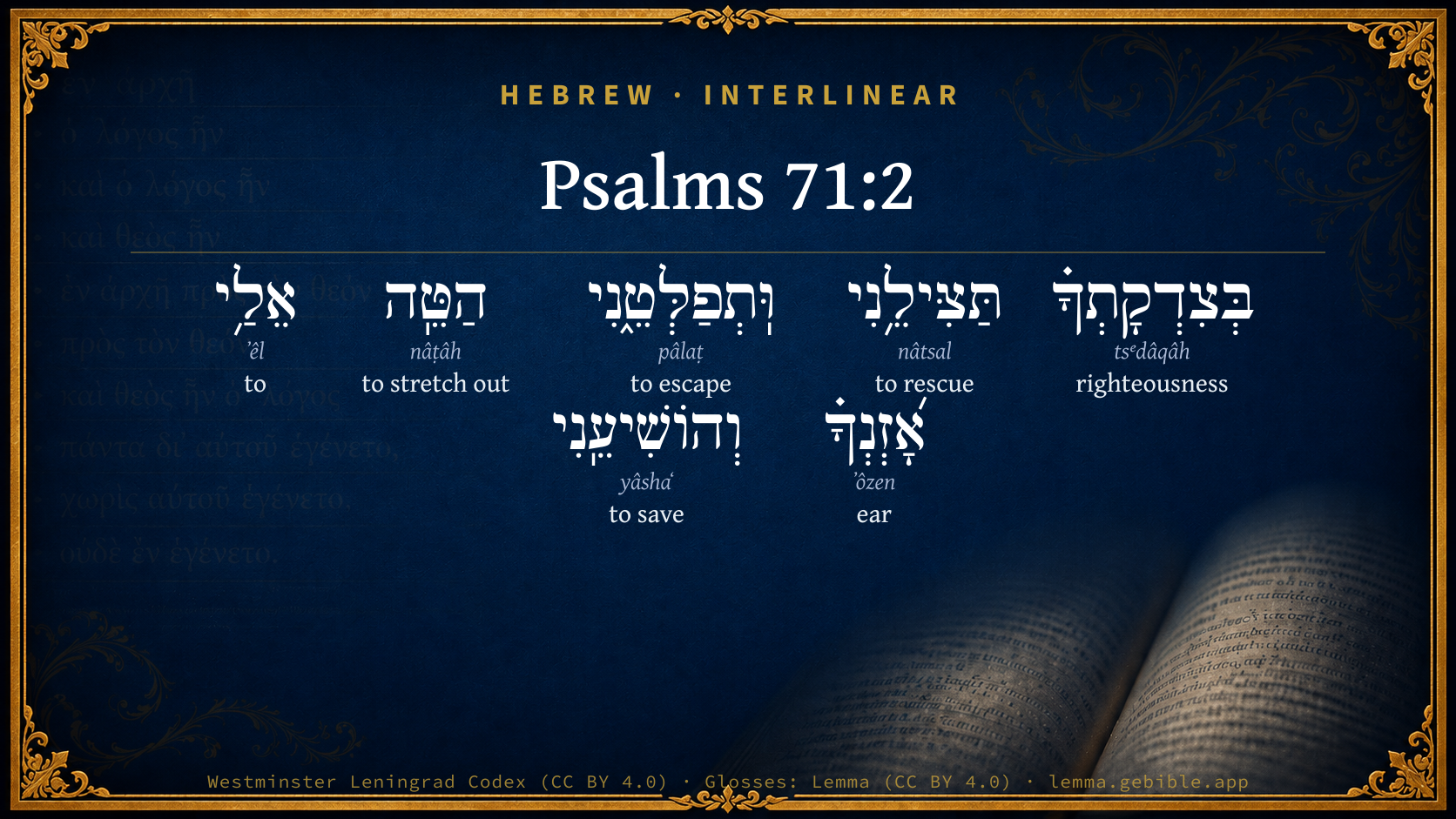
וּֽתְפַלְּטֵ֑נִי
pâlaṭ
H6403
“and · to escape · me”
Conjunction + Verb, Piel, Imperfect, 2nd Person, Masculine, Singular + Suffix, Personal, 1st Person, Common, Singular
Part of Speech
Conjunction + Verb
Stem
Piel
Form
Imperfect
Person
2nd Person
Gender
Masculine
Number
Singular
Full BDB Definition

Origin: a primitive root

TWOT: 1774

to escape, save, deliver, slip away - (Qal) to escape - (Piel) - to bring into security, deliver - to cause to escape, cast forth - to be delivered - to slip away - (Hiphil) to bring into security, bring to safety
  1. בְּצִדְקָתְךָ֗ tsᵉdâqâh H6666 “in/at · righteousness · your” Preposition + Noun, Common, Feminine, Singular, Construct + Suffix, Personal, 2nd Person, Masculine, Singular
  2. תַּצִּילֵ֥נִי nâtsal H5337 “to rescue · me” Verb, Hiphil, Imperfect, 2nd Person, Masculine, Singular + Suffix, Personal, 1st Person, Common, Singular
  3. הַטֵּֽה nâṭâh H5186 “stretch out” Verb, Hiphil, Imperative, 2nd Person, Masculine, Singular
  4. אֵלַ֥י ʼêl H413 “to · me” Preposition + Suffix, Personal, 1st Person, Common, Singular
  5. אָ֝זְנְךָ֗ ʼôzen H241 “ear · your” Noun, Common, Feminine, Singular, Construct + Suffix, Personal, 2nd Person, Masculine, Singular
  6. וְהוֹשִׁיעֵֽנִי yâshaʻ H3467 “and · save · me” Conjunction + Verb, Hiphil, Imperative, 2nd Person, Masculine, Singular + Suffix, Personal, 1st Person, Common, Singular

About this verse

These counts appear in no published source. They are computed here, from the morphology-tagged text and Lemma’s own curated glosses. What Lemma adds →

7
words
7
distinct lemmas
Wisdom
section

Notable vocabulary

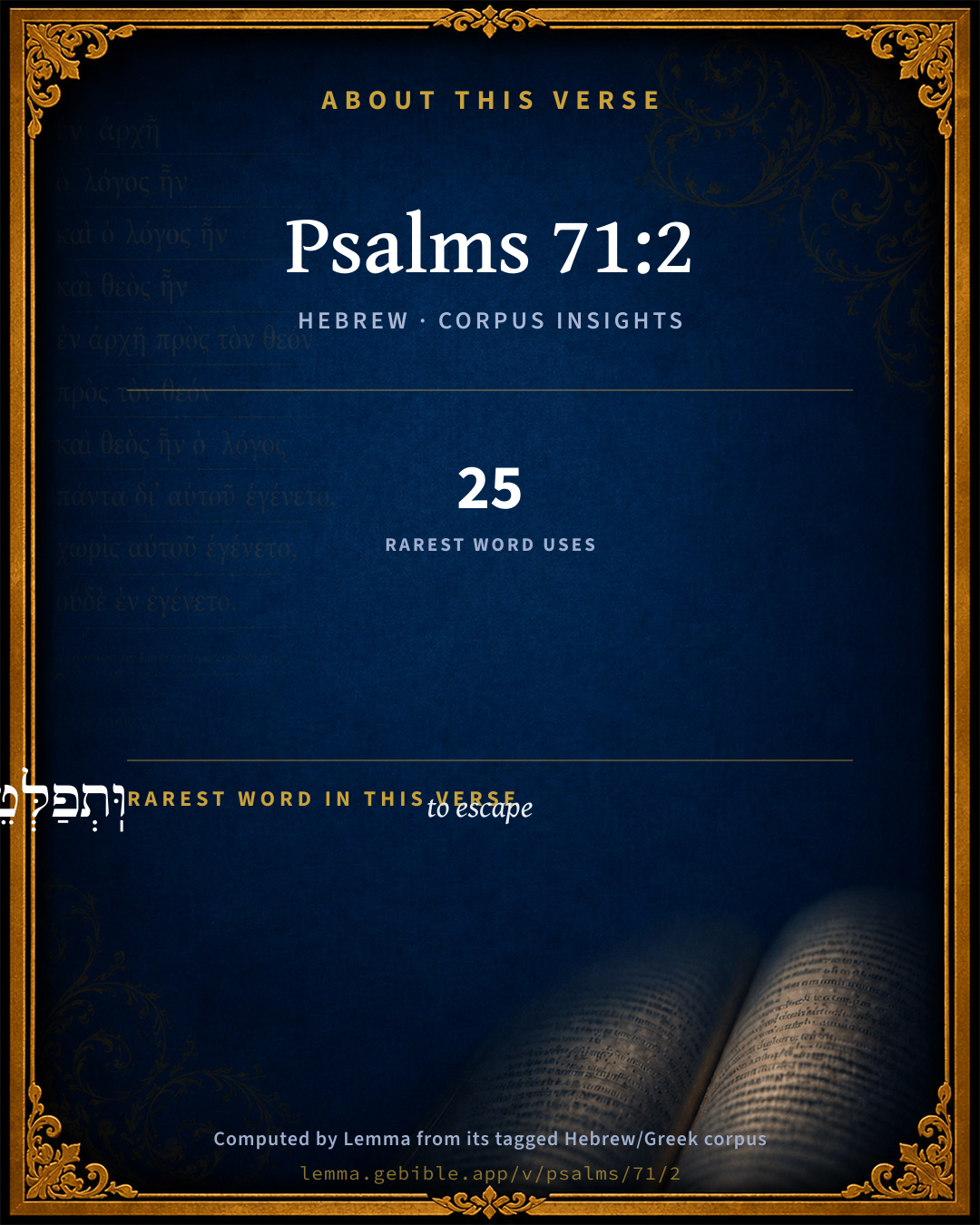
The rarest word here is וּֽתְפַלְּטֵ֑נִי to escape H6403 — appearing just 25 times in the whole Hebrew Bible.

Shared distinctive vocabulary

וּֽתְפַלְּטֵ֑נִי to escape H6403 occurs in 23 verses of the Hebrew Bible. Also found in:

Grammatical profile

  • 4 verbs
  • 2 nouns
  • 1 preposition

Verb forms

  • תַּצִּילֵ֥נִי Hiphil · Imperfect
  • וּֽתְפַלְּטֵ֑נִי Piel · Imperfect
  • הַטֵּֽה Hiphil · Imperative
  • וְהוֹשִׁיעֵֽנִי Hiphil · Imperative

Hebrew & Septuagint length

In English translation the verse runs 16 words from the Hebrew and 16 from the Septuagint (LXX English) — the same length.

A rough comparison of the two English renderings, which tokenize alike — not a word-level alignment.

Word counts can differ between the Hebrew and the Greek without any difference in meaning — e.g. the Hebrew direct-object marker אֵת has no separate Greek word, and Greek often adds the article ὁ.

Cross-references

11

Topical passages linked to Psalms 71:2 in the Treasury of Scripture Knowledge — connected by theme and wording, ordered by reader-vote popularity; previews shown in the World English Bible.

  • Psalms 31:1 In you, Yahweh, I take refuge. Let me never be disappointed: Deliver me in your righteousness.
  • Psalms 17:6 I have called on you, for you will answer me, God: Turn your ear to me. Hear my speech.
  • Psalms 116:1–2 I love Yahweh, because he listens to my voice, And my cries for mercy.
  • Psalms 143:11 Revive me, Yahweh, for your name's sake. In your righteousness, bring my soul out of trouble.
  • Psalms 10:17–18 Yahweh, you have heard the desire of the humble. You will prepare their heart. You will cause your ear to hear,
  • Psalms 17:2 Let my sentence come forth from your presence; Let your eyes look on equity.
  • Psalms 34:15 Yahweh's eyes are toward the righteous. His ears listen to their cry.
  • Psalms 43:1 Vindicate me, God, and plead my cause against an ungodly nation. Oh, deliver me from deceitful and wicked men.
  • Psalms 143:1 Hear my prayer, Yahweh. Listen to my petitions. In your faithfulness and righteousness, relieve me.
  • 1 Corinthians 10:13 No temptation has taken you except what is common to man. God is faithful, who will not allow you to be tempted above what you are able, but will with the temptation also make the way of escape, that you may be able to endure it.
  • Daniel 9:16 Lord, according to all your righteousness, let your anger and please let your wrath be turned away from your city Jerusalem, your holy mountain; because for our sins, and for the iniquities of our fathers, Jerusalem and your people are become a reproach to all who are round about us.

Cross-references courtesy of OpenBible.info (CC BY 4.0).

Hebrew and Greek witnesses Masoretic Hebrew ↔ Greek Septuagint

The same verse in the two great witnesses to the Old Testament, shown verse-for-verse.

You’re reading Greek Psalm 70 (Hebrew Psalm 71). The Septuagint counts the superscription, so verse numbers can differ from the Hebrew — chapter-level alignment, not verse-by-verse. Numbering follows Rahlfs.

These are two independent witnesses, not word-aligned to each other, and the Septuagint is shown in lemma (dictionary) form.

Hebrew Psalms 71:2 Masoretic · Westminster Leningrad Codex

בְּצִדְקָתְךָ֗ תַּצִּילֵ֥נִי וּֽתְפַלְּטֵ֑נִי הַטֵּֽה אֵלַ֥י אָ֝זְנְךָ֗ וְהוֹשִׁיעֵֽנִי

Deliver me in your righteousness, and rescue me. Turn your ear to me, and save me.

World English Bible · Public Domain

Greek LXX Greek Psalm 70:2 Septuagint · lemma form

ἐν ὁ δικαιοσύνη σύ ῥύομαι ἐγώ καί ἐκαἱρέω ἐγώ κλίνω πρός ἐγώ ὁ οὖς σύ καί σώζω ἐγώ

In your righteousness deliver me and rescue me: incline your ear to me, and save me.

LXX2012 (modern English Septuagint) · Public Domain

Hebrew: Westminster Leningrad Codex (CC BY 4.0). Greek: Septuagint (public domain); English from LXX2012 (modern English Septuagint) (Public Domain). How the Septuagint differs from the Hebrew →

Commentary

Notes on Psalms 71:2 from classic Christian and Jewish commentators (each source and its license shown beneath its notes). The classic Christian expositions comment on the surrounding passage and are grouped to its opening verse, so a note may address several verses; the Jewish commentaries on the Tanakh (Rashi and others) are per-verse, so they appear only where the commentator wrote on this verse.

Lemma curates 59 commentaries, every one of them public domain or Creative Commons licensed, each selected and text-cleaned for this edition rather than reprinted as found. About our sources →

The Cambridge Bible for Schools and Colleges

gen. ed. J. J. S. Perowne

2. Deliver me &c.] In thy righteousness wilt thou deliver me and rescue me: an expansion of the simpler rescue me in Psa_31:1. In thy righteousness stands emphatically at the beginning of the sentence in the Heb. The righteousness of God is a thought upon which this Psalmist loves to dwell (Psa_71:2; Psa_71:15-16; Psa_71:19; Psa_71:24). In virtue of that unchanging rectitude which is an inalienable attribute of Deity, He cannot desert His servant. He must be true to His promise. Cp. 2Ti_2:13.

incline] Or, bow down, as in Psa_31:2 : i.e. ‘bend a listening ear.’

save me] In Psa_31:2, deliver me speedily.

The Cambridge Bible for Schools and Colleges (gen. ed. J. J. S. Perowne; Cambridge University Press, 1878–1918) — public domain. Text from a community e-Sword module.

Trapp's Complete Commentary

John Trapp

Psa 71:2 Deliver me in thy righteousness, and cause me to escape: incline thine ear unto me, and save me.

Ver. 2. Deliver me in thy righteousness] Let my deliverance be the fruit of thy promise and of my prayer; and so it will be much the sweeter.

John Trapp, A Commentary or Exposition upon All the Books of the Old and New Testament (1647–1656) — public domain. Text from a community e-Sword module.

J. A. Alexander on Psalms

Joseph Addison Alexander

Psa 71:2. In thy righteousness thou wilt deliver me and cause me to escape; incline to me thine ear and save me. See above, on Psa 31:1-2, where the imperative form of the preceding clause is still retained, instead of being changed, as here, into the future. The verb deliver me there occurs in what is here the second clause; and the qualifying term, haste or quickly, is omitted in the case before us. The division of the sentences is also different, so that the verses do not exactly correspond.

Joseph Addison Alexander, The Psalms Translated and Explained (1850) — public domain. Text from a community e-Sword module.

Geneva Bible (1599)

Geneva Bible translators

By declaring thyself true of promise.

Geneva Bible (1599) marginal notes — public domain. Text via Bolls.life.

John Gill's Exposition

Deliver me in thy righteousness,.... By it, or "for the sake of it" (q); See Gill on Psa 31:1;

and cause me to escape; present danger, and out of the hands of enemies, as well as wrath to come, and eternal death; which nothing but the righteousness of God can deliver from, or cause to escape;

incline thine ear unto me; or "bow it"; See Gill on Psa 31:2;

and save me; out of all troubles and afflictions, and from wicked and unreasonable men.

(q) "propter justitiam tuam", Pagninus, Piscator; so Schmidt.

John Gill's Exposition of the Whole Bible (1746–1763) — public domain (CC PDM 1.0). Text via the HelloAO Bible API.

Albert Barnes' Notes on the Bible

Deliver me in thy righteousness - See the notes at Psa 31:1. The first three verses of this psalm seem in fact to have been taken, with slight variations, from the first three verses of Ps. 31.

And cause me to escape - That is, from impending dangers; from the power of my enemies.

Incline thine ear unto me - In Psa 31:2, this is, “Bow down thine ear to me.” The idea is the same. See the notes at that place. Compare the notes at Psa 17:6.

And save me - In Psa 31:2, this is, “Deliver me speedily.”

Albert Barnes' Notes on the Bible (1834–1885) — public domain. Text from a community e-Sword/MySword module.

The Treasury of David

Charles H. Spurgeon

Ver. 2. Deliver me in thy righteousness, and cause me to escape. Be true, O God, to thy word. It is a righteous thing in thee to keep the promises which thou hast made unto thy servants. I have trusted thee, and thou wilt not be unrighteous to forget my faith. I am taken as in a net, but do thou liberate me from the malice of my persecutors.

Incline thine ear unto me, and save me. Stoop to my feebleness, and hear my faint whispers; be gracious to my infirmities, and smile upon me: I ask salvation; listen thou to my petitions, and save me. Like one wounded and left for dead by mine enemies, I need that thou bend over me and bind up my wounds. These mercies are asked on the plea of faith, and they cannot, therefore, be denied.

Ver. 2. Deliver me in thy righteousness. Incline thine ear. Let my deliverance be the fruit of thy promise, and of my prayer; and so it will be much the sweeter. John Trapp.

Ver. 2. In thy righteousness. The righteousness of God is in this place that virtue by which he makes good his promises-- revenges injuries and rewards piety--which is elsewhere called his veracity. Upon this perfection David here calls, not because he was innocent before God, but because God had bound himself to him by promises, as if he were, in the presence of the men who were persecuting him, both innocent and righteous; and, therefore, worthy of being delivered from this last terrible calamity into which he has fallen through Absalom, since God had thus acted towards him. Hermann Venema.

Ver. 2. Thy righteousness. Not mine. He knew that he was being chastened for his sin against Uriah. He pleads no merit of his own. Simon de Muis.

Ver. 2. Incline thine ear. And since I am so wounded that I am not able to send up my cry to thee, the Most High, do thou incline thine ear to me as I lie half dead, left by the robbers who have wounded and spoiled me. Gerhohus.

Ver. 2. An appeal.

I. To the power of God: Deliver me.

II. To the faithfulness of God: In thy righteousness.

III. To the providence of God: Cause me to escape.

IV. To the condescension of God: Incline thine ear.

V. To the mercy of God: Save me.

Ver. 2. Cause me to escape. From whom? From what? How? By what power? For what end?

Psalms 71:3*

Charles H. Spurgeon's The Treasury of David (1869–1885) — public domain. Psalms only. Text from a community e-Sword/MySword module.

The Pulpit Commentary

Deliver me in thy righteousness. Identical with the last clause cf. Psa_31:1. And cause me to escape. The danger seems to be pressing, and such as characterized Absalom"s rather than Adonijah"s rebellion. Incline thine ear unto me, and save me. (comp. Psa_31:2)

The Pulpit Commentary (1880–1919), ed. H.D.M. Spence-Jones & Joseph S. Exell — public domain. Text from a community e-Sword module.

Lesson kit

Teaching starters — assembled from the data on this page, not authored interpretation. Every prompt links to the verse data it draws on. Edit before teaching.

Psalms, in the Wisdom, opens this verse with 7 words (7 distinct Hebrew lemmas). Its most distinctive word is pâlaṭ (“to escape”). A historical commentator’s framing appears above. Read the whole chapter for the surrounding context.

Discussion questions

  1. How does “to escape” (pâlaṭ) shape what this verse is saying?
  2. 2 Samuel 22:2 shares the word «to escape» with this verse. How do the two illuminate each other?
  3. The translations on this page render this verse differently — a whole-verse word diff, not a word-by-word alignment. What might account for the different wordings?
  4. The verb «תַּצִּילֵ֥נִי» is Hiphil Imperfect. How does its form color the action?
  5. Reading how The Cambridge Bible for Schools and Colleges and Trapp's Complete Commentary read this verse, where do the two commentators agree and where do they part?

Things to notice

Reading settings

Reading text

Shown beneath each verse's original-language words.

Old Testament
Old Testament edition

Read the OT as the Masoretic Hebrew (MT) or the Greek Septuagint (LXX).

English shown for the Greek Septuagint (in the Hebrew ↔ Greek comparison).

Comparing translations? Open the Compare panel on any verse page to stack up to four side by side.