
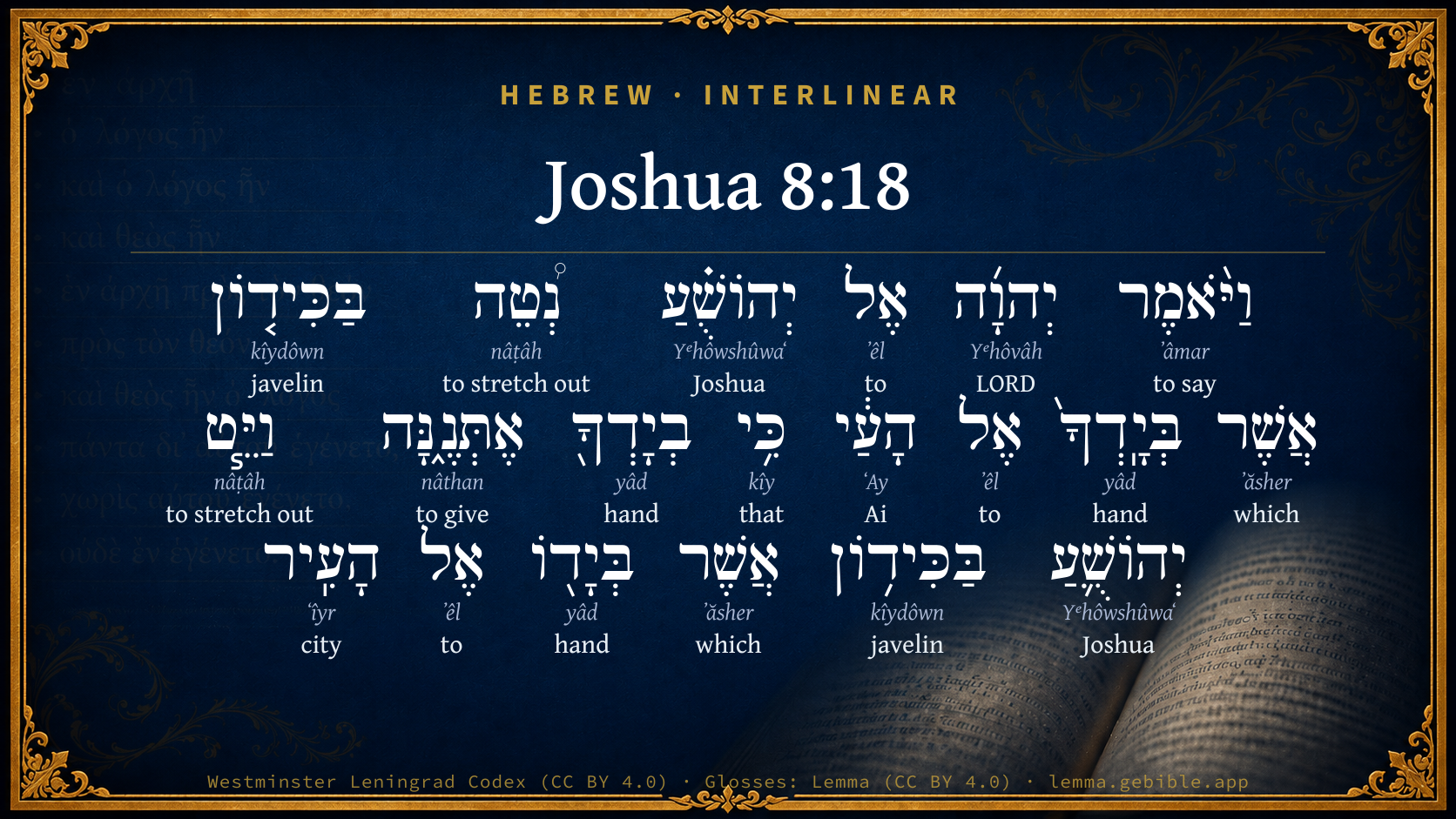
Joshua 8:18

Hebrew (Westminster Leningrad Codex) Joshua 8:18 appears in the Hebrew Old Testament. The text above is from the Westminster Leningrad Codex. Each word links to its Strong’s number, a concise gloss, and parsing drawn from the Open Scriptures Hebrew Bible morphology. Click any word for its full Brown-Driver-Briggs (BDB) entry.
Download image
Cite this verse

Joshua 8:18 (World English Bible). Public Domain. Lemma interlinear Bible study tool, https://lemma.gebible.app/v/joshua/8/18.

Show BibTeX & RIS
BibTeX
RIS
English Translation
Yahweh said to Joshua, Stretch out the javelin that is in your hand toward Ai; for I will give it into your hand. Joshua stretched out the javelin that was in his hand toward the city.
World English Bible · Public Domain
Highlights
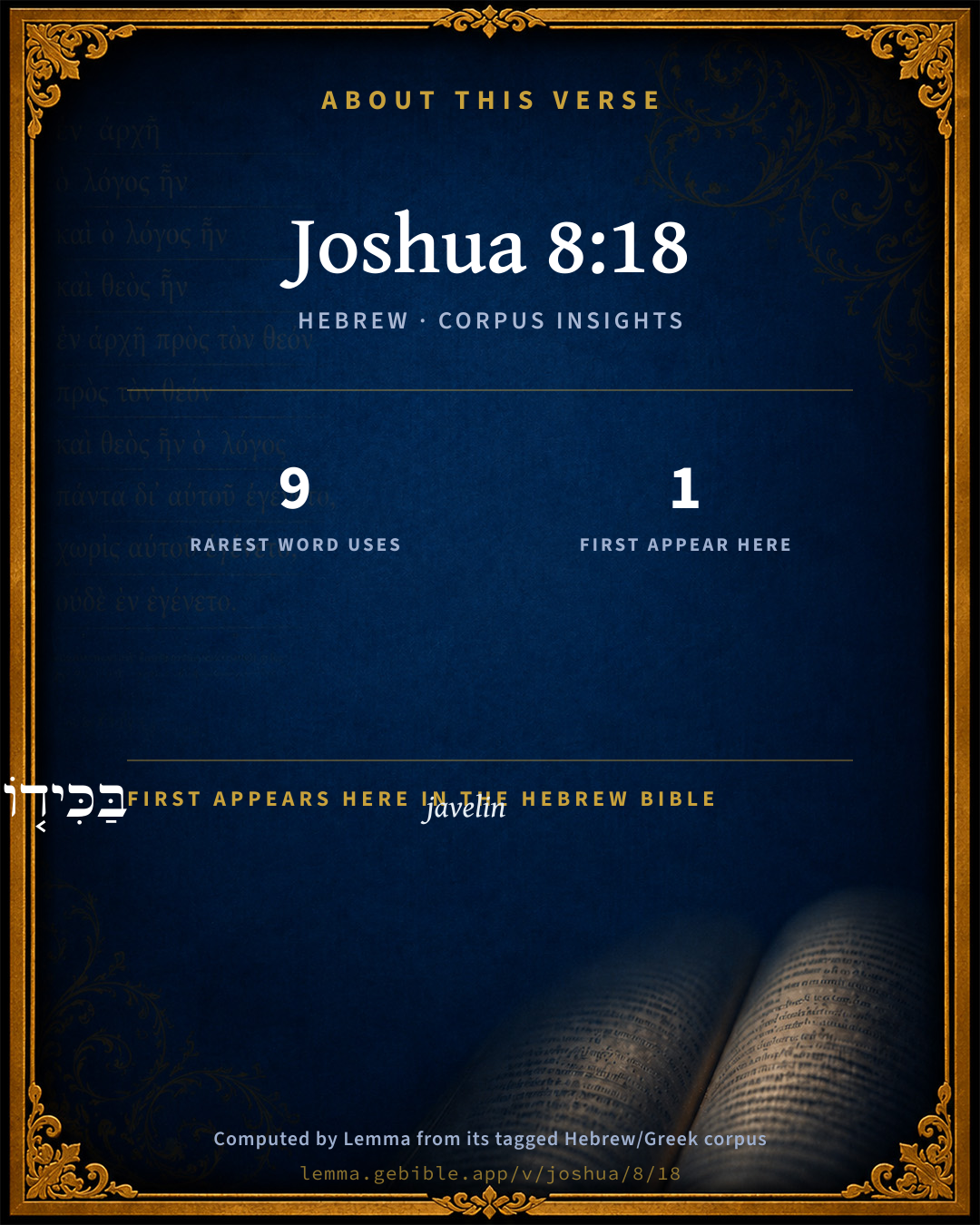
  • 1 first appearance in the Hebrew Bible
Full analysis ↓
Download a study sheet

One document with this verse’s original text, its word-by-word gloss line, the meaning frame, cross-references with their text, attributed commentary, and full source and license credits — printable, and it pastes into notes with its structure intact.

This verse Autodidact and up

Study sheet (.html) Plain text (.txt)

A passage Seminary Student

Up to 50 verses in one chapter. A passage sheet keeps up to 6 commentary sources and 12 cross-references per verse, in the order this page ranks them, and says so on the sheet whenever that leaves anything out. Ask for a single verse and you get the Autodidact verse sheet above.

Everything on this page stays free to read, with no account — the sheet is a download of what is already on screen, not access to it.

Want to remove ads? Support Godless Engineer
Compare translations 3

The same verse in 3 English versions, stacked beneath the original-language interlinear above. Click any original word for its lexicon entry.

Each is an independent rendering of the whole verse — the interlinear is not word-aligned to these translations.

Highlighted words mark where these versions differ — a whole-verse word diff, not a word-by-word alignment.

  • World English Bible Public Domain
    Yahweh said to Joshua, Stretch out the javelin that is in your hand toward Ai; for I will give it into your hand. Joshua stretched out the javelin that was in his hand toward the city.
  • King James Version Public Domain
    And the LORD said unto Joshua, Stretch out the spear that is in thy hand toward Ai; for I will give it into thine hand. And Joshua stretched out the spear that he had in his hand toward the city.
  • unfoldingWord Literal Text CC BY-SA 4.0
    And Yahweh said to Joshua, “Stretch out with the curved sword that is in your hand toward Ai, because I will give it into your hand.” And Joshua stretched out with the curved sword that was in his hand toward the city.

unfoldingWord Literal Text — © unfoldingWord, licensed CC BY-SA 4.0. Word-aligned USFM3 via Door43 (git.door43.org/unfoldingWord/en_ult).

Versions to compare (up to 4)

3 of 4 selected

Show all 18 translations

Every available English version of this verse, each an independent rendering of the whole verse.

  • World English Bible Public Domain
    Yahweh said to Joshua, Stretch out the javelin that is in your hand toward Ai; for I will give it into your hand. Joshua stretched out the javelin that was in his hand toward the city.
  • Berean Standard Bible Public Domain
    Then the LORD said to Joshua, “Hold out your battle lance toward Ai, for into your hand I will deliver the city.” So Joshua held out his battle lance toward Ai,
  • Majority Standard Bible Public Domain
    Then the LORD said to Joshua, “Hold out your battle lance toward Ai, for into your hand I will deliver the city.” So Joshua held out his battle lance toward Ai,
  • King James Version Public Domain
    And the LORD said unto Joshua, Stretch out the spear that is in thy hand toward Ai; for I will give it into thine hand. And Joshua stretched out the spear that he had in his hand toward the city.
  • American Standard Version (1901) Public Domain
    And Jehovah said unto Joshua, Stretch out the javelin that is in thy hand toward Ai; for I will give it into thy hand. And Joshua stretched out the javelin that was in his hand toward the city.
  • Revised Version (1885) Public Domain
    And the LORD said unto Joshua, Stretch out the javelin that is in thy hand toward Ai; for I will give it into thine hand. And Joshua stretched out the javelin that was in his hand toward the city.
  • Geneva Bible (1599) Public Domain
    Then the Lord said vnto Ioshua, Stretch out the speare that is in thine hande, towarde Ai: for I wil giue it into thine hand: and Ioshua stretched out the speare that hee had in his hand, toward the citie.
  • Douay-Rheims (1899) Public Domain
    The Lord said to Josue: Lift up the shield that is in thy hand, towards the city of Hai, for I will deliver it to thee.
  • Young's Literal Translation Public Domain
    And Jehovah saith unto Joshua, `Stretch out with the javelin which `is' in thy hand towards Ai, for into thy hand I give it;' and Joshua stretcheth out with the javelin which `is' in his hand toward the city,
  • Literal Standard Version CC BY-SA 4.0
    And YHWH says to Joshua, “Stretch out with the javelin which [is] in your hand toward Ai, for I give it into your hand”; and Joshua stretches out with the javelin which [is] in his hand toward the city,
  • Unlocked Literal Bible CC BY-SA 4.0
    Yahweh said to Joshua, “Point that spear in your hand toward Ai, for I will give Ai into your hand.” Joshua held out the spear that was in his hand toward the city.
  • unfoldingWord Literal Text CC BY-SA 4.0
    And Yahweh said to Joshua, “Stretch out with the curved sword that is in your hand toward Ai, because I will give it into your hand.” And Joshua stretched out with the curved sword that was in his hand toward the city.
  • Darby Bible Public Domain
    And Jehovah said to Joshua, Stretch out the javelin that is in thy hand toward Ai; for I will give it into thy hand. And Joshua stretched out the javelin that he had in his hand toward the city.
  • World Messianic Bible Public Domain
    The LORD said to Joshua, “Stretch out the javelin that is in your hand toward Ai, for I will give it into your hand.” Joshua stretched out the javelin that was in his hand toward the city.
  • Webster's Bible Public Domain
    And the LORD said to Joshua, Stretch out the spear that is in thy hand towards Ai; for I will give it into thy hand. And Joshua stretched out the spear that he had in his hand towards the city.
  • Free Bible Version CC BY-SA 4.0
    Then the Lord told Joshua, “Hold up the spear in your hand and point it at Ai, because I'm giving it to you.” So Joshua held up the spear in his hand and pointed it at the town.
  • Bible in Basic English Public Domain
    And the Lord said to Joshua, Let your spear be stretched out against Ai; for I will give it into your hands. So Joshua took up his spear, stretching it out in the direction of the town.
  • JPS Tanakh (1917) Public Domain
    And the LORD said unto Joshua: 'Stretch out the javelin that is in thy hand toward Ai; for I will give it into thy hand.' And Joshua stretched out the javelin that was in his hand toward the city.

Literal Standard Version (2020), Covenant Press — licensed CC BY-SA 4.0. Text via the HelloAO Bible API (eBible.org). Unlocked Literal Bible (unfoldingWord) — licensed CC BY-SA 4.0. Text via the HelloAO Bible API (eBible.org). unfoldingWord Literal Text — © unfoldingWord, licensed CC BY-SA 4.0. Word-aligned USFM3 via Door43 (git.door43.org/unfoldingWord/en_ult). Free Bible Version, Dr. Jonathan Gallagher — licensed CC BY-SA 4.0. Text via the HelloAO Bible API (eBible.org).

Word by word

More ways to search: Search by grammar → Find every occurrence → Compare this word →

Practice this passage: Drill this verse → Learn its vocabulary →

בַּכִּיד֤וֹן
kîydôwn
H3591
“in/at the · javelin”
Preposition, Determined + Noun, Common, Masculine, Singular, Absolute
Part of Speech
Preposition + Noun
Type
Common
Gender
Masculine
Number
Singular
State
Absolute
Full BDB Definition

Origin: from the same as H3589

TWOT: 977b

javelin, short sword, dart - gorget, a piece of armour for the throat (1Sam Job 17:6 )
  1. וַיֹּ֨אמֶר ʼâmar H559 “and · to say” Conjunction + Verb, Qal, Sequential Imperfect, 3rd Person, Masculine, Singular
  2. יְהוָ֜ה Yᵉhôvâh H3068 “LORD” Noun, Proper
  3. אֶל ʼêl H413 “to” Preposition
  4. יְהוֹשֻׁ֗עַ Yᵉhôwshûwaʻ H3091 “Joshua” Noun, Proper
  5. נְ֠טֵה nâṭâh H5186 “stretch out” Verb, Qal, Imperative, 2nd Person, Masculine, Singular
  6. אֲשֶׁר ʼăsher H834 “which” Particle, Relative
  7. בְּיָֽדְךָ֙ yâd H3027 “in/at · hand · your” Preposition + Noun, Common, Both, Singular, Construct + Suffix, Personal, 2nd Person, Masculine, Singular
  8. אֶל ʼêl H413 “to” Preposition
  9. הָעַ֔י ʻAy H5857 “the · Ai” Particle, Definite Article + Noun, Proper
  10. כִּ֥י kîy H3588 “that” Conjunction
  11. בְיָדְךָ֖ yâd H3027 “in/at · hand · your” Preposition + Noun, Common, Both, Singular, Construct + Suffix, Personal, 2nd Person, Masculine, Singular
  12. אֶתְּנֶ֑נָּה nâthan H5414 “to give · her” Verb, Qal, Imperfect, 1st Person, Common, Singular + Suffix, Personal, 3rd Person, Feminine, Singular
  13. וַיֵּ֧ט nâṭâh H5186 “and · to stretch out” Conjunction + Verb, Qal, Sequential Imperfect, 3rd Person, Masculine, Singular
  14. יְהוֹשֻׁ֛עַ Yᵉhôwshûwaʻ H3091 “Joshua” Noun, Proper
  15. בַּכִּיד֥וֹן kîydôwn H3591 “in/at the · javelin” Preposition, Determined + Noun, Common, Masculine, Singular, Absolute
  16. אֲשֶׁר ʼăsher H834 “which” Particle, Relative
  17. בְּיָד֖וֹ yâd H3027 “in/at · hand · his” Preposition + Noun, Common, Both, Singular, Construct + Suffix, Personal, 3rd Person, Masculine, Singular
  18. אֶל ʼêl H413 “to” Preposition
  19. הָעִֽיר ʻîyr H5892 “the · city” Particle, Definite Article + Noun, Common, Feminine, Singular, Absolute

About this verse

These counts appear in no published source. They are computed here, from the morphology-tagged text and Lemma’s own curated glosses. What Lemma adds →

20
words
12
distinct lemmas
Historical
section

Notable vocabulary

The rarest word here is בַּכִּיד֤וֹן javelin H3591 — appearing just 9 times in the whole Hebrew Bible.

First appearance in Scripture

This word makes its first canonical appearance in the Hebrew Bible here:

  • בַּכִּיד֤וֹן javelin H3591

Shared distinctive vocabulary

בַּכִּיד֤וֹן javelin H3591 occurs in 8 verses of the Hebrew Bible. Also found in:

Grammatical profile

  • 4 verbs
  • 10 nouns
  • 3 prepositions
  • 1 conjunction
  • 2 particles

Verb forms

  • וַיֹּ֨אמֶר Qal · Sequential Imperfect
  • נְ֠טֵה Qal · Imperative
  • אֶתְּנֶ֑נָּה Qal · Imperfect
  • וַיֵּ֧ט Qal · Sequential Imperfect

Repetition

Words recur within this verse — often emphatic in Hebrew:

  • בְּיָֽדְךָ֙ hand H3027 ×3
  • יְהוֹשֻׁ֗עַ Joshua H3091 ×2
  • נְ֠טֵה to stretch out H5186 ×2
  • בַּכִּיד֤וֹן javelin H3591 ×2
  • אֶל to H413 ×3
  • אֲשֶׁר which H834 ×2

Hebrew & Septuagint length

In English translation the verse runs 36 words from the Hebrew and 42 from the Septuagint (LXX English) — closely comparable.

A rough comparison of the two English renderings, which tokenize alike — not a word-level alignment.

Word counts can differ between the Hebrew and the Greek without any difference in meaning — e.g. the Hebrew direct-object marker אֵת has no separate Greek word, and Greek often adds the article ὁ.

Cross-references

10

Topical passages linked to Joshua 8:18 in the Treasury of Scripture Knowledge — connected by theme and wording, ordered by reader-vote popularity; previews shown in the World English Bible.

  • Joshua 8:26 For Joshua didn't draw back his hand, with which he stretched out the javelin, until he had utterly destroyed all the inhabitants of Ai.
  • Job 15:25 Because he has stretched out his hand against God, And behaves himself proudly against the Almighty;
  • Exodus 8:5 Yahweh said to Moses, "Tell Aaron, 'Stretch forth your hand with your rod over the rivers, over the streams, and over the pools, and cause frogs to come up on the land of Egypt.'"
  • Exodus 14:16 Lift up your rod, and stretch out your hand over the sea, and divide it: and the children of Israel shall go into the midst of the sea on dry ground.
  • Exodus 17:9–12 Moses said to Joshua, "Choose men for us, and go out, fight with Amalek. Tomorrow I will stand on the top of the hill with God's rod in my hand."
  • Joshua 8:7 and you shall rise up from the ambush, and take possession of the city: for Yahweh your God will deliver it into your hand.
  • 1 Samuel 17:6 He had brass shin-armor on his legs, and a javelin of brass between his shoulders.
  • 1 Samuel 17:41 The Philistine came on and drew near to David; and the man who bore the shield went before him.
  • 1 Samuel 17:45 Then said David to the Philistine, You come to me with a sword, and with a spear, and with a javelin: but I come to you in the name of Yahweh of hosts, the God of the armies of Israel, whom you have defied.
  • Job 39:23 The quiver rattles against him, The flashing spear and the javelin.

Cross-references courtesy of OpenBible.info (CC BY 4.0).

Hebrew and Greek witnesses Masoretic Hebrew ↔ Greek Septuagint

The same verse in the two great witnesses to the Old Testament, shown verse-for-verse.

These are two independent witnesses, not word-aligned to each other, and the Septuagint is shown in lemma (dictionary) form.

Hebrew Joshua 8:18 Masoretic · Westminster Leningrad Codex

וַיֹּ֨אמֶר יְהוָ֜ה אֶל יְהוֹשֻׁ֗עַ נְ֠טֵה בַּכִּיד֤וֹן אֲשֶׁר בְּיָֽדְךָ֙ אֶל הָעַ֔י כִּ֥י בְיָדְךָ֖ אֶתְּנֶ֑נָּה וַיֵּ֧ט יְהוֹשֻׁ֛עַ בַּכִּיד֥וֹן אֲשֶׁר בְּיָד֖וֹ אֶל הָעִֽיר

Yahweh said to Joshua, Stretch out the javelin that is in your hand toward Ai; for I will give it into your hand. Joshua stretched out the javelin that was in his hand toward the city.

World English Bible · Public Domain

Greek LXX Joshua 8:18 Septuagint · lemma form

καί εἶπον κύριος πρός ἰησοῦς ἐκτείνω ὁ χείρ σύ ἐν ὁ γαῖσος ὁ ἐν ὁ χείρ σύ ἐπί ὁ πόλις εἰς γάρ ὁ χείρ σύ παραδίδωμι αὐτός καί ὁ ἔνεδρον ἐκ ἀναἵστημι ἐν τάχος ἐκ ὁ τόπος αὐτός καί ἐκτείνω ἰησοῦς ὁ χείρ αὐτός ὁ γαῖσος ἐπί ὁ πόλις

And the Lord said to Joshua, Stretch forth your hand with the spear that is in your hand toward the city, for I have delivered it into your hands; and the liers in wait shall rise up quickly out of their place.

LXX2012 (modern English Septuagint) · Public Domain

On this verse, The Cambridge Bible for Schools and Colleges discusses the Septuagint’s reading. Read the note in Commentary ↓

Hebrew: Westminster Leningrad Codex (CC BY 4.0). Greek: Septuagint (public domain); English from LXX2012 (modern English Septuagint) (Public Domain). How the Septuagint differs from the Hebrew →

Targum (Aramaic paraphrase)

1

The Targum is the ancient Jewish Aramaic paraphrase of the Hebrew Scriptures — an interpretive translation, not the Hebrew text itself. Onkelos (literal) and Pseudo-Jonathan (expansive) render the Torah, and Jonathan the Prophets. Coverage is partial: where no permissively-licensed English translation exists for a verse, only the Aramaic is shown. This is verse-level text, not a word-by-word alignment to the Hebrew.

  1. Targum Jonathan Prophets (Joshua–Malachi)
    וַאֲמַר יְיָ לִיהוֹשֻׁעַ אֲרֵים בְּרוּמְחָא דִי בִידָךְ עַל עַי אֲרֵי בִּידָךְ אִמְסְרִינָה וַאֲרֵים יְהוֹשֻׁעַ בְּרוּמְחָא דְבִידֵיהּ עַל קַרְתָּא:

    (no public-domain English translation for this verse)

    Targum Jonathan — Aramaic: “Mikraot Gedolot” (public domain). English: “Sefaria Community Translation” (CC0 1.0 (public-domain dedication)); “London "Chaldee Paraphrase," 1871” (public domain). Text via Sefaria.

Commentary

Notes on Joshua 8:18 from classic Christian and Jewish commentators (each source and its license shown beneath its notes). The classic Christian expositions comment on the surrounding passage and are grouped to its opening verse, so a note may address several verses; the Jewish commentaries on the Tanakh (Rashi and others) are per-verse, so they appear only where the commentator wrote on this verse.

Lemma curates 59 commentaries, every one of them public domain or Creative Commons licensed, each selected and text-cleaned for this edition rather than reprinted as found. About our sources →

Trapp's Complete Commentary

John Trapp

Jos 8:18 And the LORD said unto Joshua, Stretch out the spear that [is] in thy hand toward Ai; for I will give it into thine hand. And Joshua stretched out the spear that [he had] in his hand toward the city.

Ver. 18. Stretch out the spear.] Hastam vexillarem, the spear whereon hung the colours, for a sign to the soldiers, those of the ambush to enter, and those of the army to turn head against the enemy. By this means, saith one, as by Moses’s rod, it pleased God to work for his people.

John Trapp, A Commentary or Exposition upon All the Books of the Old and New Testament (1647–1656) — public domain. Text from a community e-Sword module.

Joseph Benson's Commentary

Jos 8:18. Stretch out thy spear — Probably a long spear, with a flag or streamer at the top of it, for a signal to the liers in wait, as well as for a sign to his host present to stop their flight, and make head against the pursuers, and as a token of God’s presence and assistance with them, and of their victory. The Hebrew word כידון, kidon, however, here rendered spear, also signifies a shield, and is so interpreted in the Vulgate. This, if made of polished brass or steel, might be seen from a great distance, by reason of its brightness.

Joseph Benson's Commentary on the Old and New Testaments (1811–1818) — public domain. Text from a community e-Sword module.

Tyndale Open Study Notes

Tyndale Open Resources

8:18-19 Israel succeeded in this second attack on Ai because this time God directed the battle.

Tyndale Open Study Notes — © Tyndale Open Resources, licensed CC BY-SA 4.0. Text via the HelloAO Bible API.

Geneva Bible (1599)

Geneva Bible translators

Or, lift up the banner, to signify when they shall invade the city.

Geneva Bible (1599) marginal notes — public domain. Text via Bolls.life.

Jamieson, Fausset & Brown

Robert Jamieson, A. R. Fausset & David Brown

Joshua stretched out the spear that he had in his hand toward the city--The uplifted spear had probably a flag, or streamer on it, to render it the more conspicuous from the height where he stood. At the sight of this understood signal the ambush nearest the city, informed by their scouts, made a sudden rush and took possession of the city, telegraphing to their brethren by raising a smoke from the walls. Upon seeing this, the main body, who had been reigning a flight, turned round at the head of the pass upon their pursuers, while the twenty-five thousand issuing from their ambuscade, fell back upon their rear. The Ai-ites surprised, looked back, and found their situation now desperate.

Jamieson, Fausset & Brown — Commentary Critical and Explanatory on the Whole Bible (1871) — public domain (CC PDM 1.0). Text via the HelloAO Bible API.

Adam Clarke's Commentary

Verse 18. Stretch out the spear] It is very probable that Joshua had a flag or ensign at the end of his spear, which might be easily seen at a considerable distance; and that the unfurling or waving of this was the sign agreed on between him and the ambush. (see Jos 8:13, and the preceding observations on Jos 8:1, observation 6;) and on seeing this flag or ensign unfurled, the men who lay in ambush arose and entered the city, making the fire previously agreed on. See Jos 8:8.

Adam Clarke's Commentary on the Bible (1810–1826) — public domain. Text from a community e-Sword/MySword module.

John Calvin's Commentaries

18. And the Lord said unto Joshua, etc This passage shows, that owing either to the strong fortifications of the city, or the valor of its inhabitants, or the trepidation of the Israelites, the victory was difficult, since God promises that he himself would take it by the lifting up of a spear. Had success been beyond doubt, the symbol would have been superfluous; their minds must therefore have been anxious and perplexed, since the Lord, to prevent them from fainting, raises up a banner of confidence in the hand of Joshua. It is true, indeed, that shortly after a different motive for raising the spear is mentioned, when it is said, that in this way a signal was given to the ambuscade, which accordingly rushed forth. But if it really was so used as a signal, it will scarcely do to regard the spear as a manifestation of the victorious power of God dispelling all doubt. Still, however, as it is not expressly said that the spear was the cause which brought forth the soldiers who had been placed in ambuscade, the truth may be that they came forth of their own accord, either because it was the suitable time, or because the shouting and noise made them aware that the battle had actually commenced. For it is scarcely possible to believe that the spear was seen by them, when we consider the long space which intervened, and more especially that Joshua was standing in a valley. Moreover, if we hold that the lifting up of the spear, though intended for a different purpose, had also the effect of inspiring them with additional courage, there will be no absurdity in it.

This much ought to be regarded as certain, first, that by this solemn badge they were rendered more certain of the happy issue of the battle; and secondly, that Joshua had no other intention than to incite his troops according to the command of God. For it is at last added, that Joshua did not draw back his hand until the city was taken, the enemy everywhere destroyed, and the war itself terminated. Hence it appears that he exhibited it in the middle of the conflict as an ensign of triumph, that the Israelites might have no doubt of success. For although he ordered them to engage and use their arms bravely, he at the same time distinctly declared that they had already conquered.

The course of the battle is rendered somewhat obscure by the same thing being told twice, but the substance is sufficiently plain. The children of Israel retreated feigning fear, and the battle had not actually commenced before the inhabitants of Ai were precluded from returning and defending their city. After the two armies had come to close quarters, the ambuscade arose and made such haste that the flames of the conflagration were rising from the city when the enemy turned their backs. From this we may infer that the city was in the possession of the Israelites, but that the chief slaughter took place when those who were in the city came forth to take part in the battle, because the inhabitants, hemmed in on all sides, found resistance and flight equally unavailing. They were thus seized with despair, and, huddled together in a narrow space, were everywhere cut down.

The statement, that the slaughter did not take place in the city before those who had feigned flight returned, I understand to mean, that the whole troops uniting their forces rushed in, seized the prey, and slew all who might have been left. If any one objects that the city was burnt while the battle was going on, I answer, that the fire was indeed applied so as to let both armies know that the city was in possession of the Israelites, but it was not actually destroyed by fire. It was not practicable in a moment of time to seize and carry off the booty, nay, to bring the vessels and a large part of the property without the walls; and it would have been absurd voluntarily to destroy spoils which God had granted. We see, then, that the first fire was not kindled for the purpose of destroying the whole city, but was merely a partial conflagration giving intimation of its capture, and that the Israelites entered at the open gates without bloodshed or a struggle. This is confirmed shortly after, when the burning is ascribed to Joshua himself, not only because it was burnt under his command, but because he was careful, after returning from the battle, to see that it was utterly destroyed; as it is immediately added that he made it a heap of stones in order that it might be a perpetual desolation.

John Calvin's Commentaries (1540-1563) — public domain. Text from the Calvin Translation Society English edition (1840s-50s) via the Christian Classics Ethereal Library (ccel.org). Calvin's coverage is partial (roughly two-thirds of the Bible); uncommented books and verses are honest gaps, never fabricated. The 19th-century editor's footnotes and remarks are omitted so the notes are faithfully Calvin's own voice.

Ellicott's Commentary for English Readers

(18) And the Lord said unto Joshua, Stretch out the spear.—In the capture of Ai, as in that of Jericho, each stage of the process must be ordered by the Lord. In the former case the hand of Jehovah alone does the work. The ark is borne round the walls until they fall down before it. Against Ai, the hand of Israel is employed, and first of all in Israel the hand of Joshua. He seems to have stretched it out, with the light spear or javelin which he carried, somewhat as Moses stretched forth the rod of God over the contending hosts of Amalek and Israel, until the enemy was discomfited with the edge of the sword.

A Bible Commentary for English Readers, edited by Charles John Ellicott (1878–1897) — public domain. Text from a community e-Sword module.

The Cambridge Bible for Schools and Colleges

gen. ed. J. J. S. Perowne

18. the spear] Heb. Cidôn, a dart, or javelin which is hurled, lighter than the Chanith, or spear of the largest kind like that of Goliath, 1Sa_17:7; 1Sa_17:45, or king Saul, 1Sa_26:7-8. The Cidôn could easily be held outstretched for some considerable time and was probably furnished with a flag. When not in action, it was carried on the back of the warrior between the shoulders (1Sa_17:6). The LXX. renders the word by Gaison, a short javelin or lance, the Vulg. by sceptrum.

The Cambridge Bible for Schools and Colleges (gen. ed. J. J. S. Perowne; Cambridge University Press, 1878–1918) — public domain. Text from a community e-Sword module.

John Gill's Exposition

And the Lord said unto Joshua, stretch out the spear that is in thy hand towards Ai,.... On which was a flag, as Abarbinel and Ben Melech think; and which is not improbable, and served for a signal for the ambush to come out and seize the city, as both they and Jarchi observe, as well as a signal also to the army of Israel to prepare to turn and face about, and engage with the enemy; though they did not actually do this until they saw the smoke of the city, Jos 8:21,

for I will give it into thine hand; of which the stretching out of his spear seems also to be a confirming sign to him, and which he kept stretched out until all the inhabitants of Ai were destroyed, Jos 8:26,

and Joshua stretched out the spear that he had in his hand toward the city: and therefore must turn himself towards it; and it is highly probable that at the same time there was a full stop of the army, and that they immediately turned or prepared to turn about.

John Gill's Exposition of the Whole Bible (1746–1763) — public domain (CC PDM 1.0). Text via the HelloAO Bible API.

Albert Barnes' Notes on the Bible

No doubt Joshua had ascended the heights, most likely those to the north of the valley, so as to separate himself from the flying Israelites on the lower ground, and to be visible to the men in ambush behind the city. He now, at the command of God, gives the appointed signal to the ambush.

Albert Barnes' Notes on the Bible (1834–1885) — public domain. Text from a community e-Sword/MySword module.

Haydock's Catholic Bible Commentary

Shield, as Moses lifted up his hands, Exodus xvii. 11. Some translate, "dart, spear," or "sword." (Septuagint; Ecclesiasticus xvi. 3.) (Calmet) --- The buckler might be suspended on a spear, (Menochius) that it might be seen afar off (Worthington) by some appointed to keep watch on purpose. (Haydock)

George Leo Haydock (1774–1849), Haydock's Catholic Family Bible and Commentary, 1859 edition — public domain. Excludes Psalms (Douay-Rheims chapter numbering differs from Protestant) and Deuterocanonical books (Catholic canon only).

Matthew Poole's English Annotations

The spear, or, thy banner; or there might be some banner in the end of his spear. This was prescribed and practised, either,

1. For a sign to his host present with him, to stop their flight, and make head against the pursuers; or,

2. For a signal to the liers in wait, as may seem from Jos 8:19, who, though they were at some distance, might know this from persons whom they had set in some high and convenient places to observe Joshua’s motion, and to give notice from one to another, and that speedily, as is common in such cases, until it came to the whole ambush; or,

3. As a mystical token of God’s presence and assistance with them, and of their victory; or as a mean by God’s appointment contributing to their good success, as the like posture of Moses lifting up his hand was, Exo 17:11,12, which may be the reason why he continued this posture till the enemies were all destroyed, Jos 8:26; whereas if it had been a signal only, it was sufficient to do it for a little while. I know no reason why all these ends might not be joined together.

Matthew Poole's English Annotations on the Holy Bible (1683–1685) — public domain. Text from a community e-Sword/MySword module.

Whedon's Commentary on the Bible

Daniel D. Whedon

18. The Lord said — As there were probably no facilities for consulting the Lord by means of the urim and thummim, we infer that there was an immediate communication to Joshua of this divine command.

Stretch out the spear — This was the concerted signal for the ambush to arise and seize the city. The Hebrew word for spear has been variously explained. See note on 1Sa_17:6. The translator of the Vulgate, and several others, have rendered it shield. Others suppose that a shield was elevated on the spear. Gesenius suggests that the spear supported a small flag, like that of the modern lance. This could be seen by the distant liers in wait, who were, doubtless, instructed to watch for the signal.

Toward the city — An act symbolical of the terrible blow which was now to ruin it forever.

Daniel D. Whedon (gen. ed.), Commentary on the Old and New Testaments (1874–1909) — public domain. Text from a community e-Sword module.

The Pulpit Commentary

The spear. wOdyki, a kind of long and slender lance, probably, like those of our lancers, with a flag attached. It is thus described by Kimchi. Jahn, in his "Archesologia Biblica," takes this view (sec. 276). But the Vulgate here, followed apparently by Grotius and Masius, suppose it to be a shield, though the LXX render by gaisov . In 1Sa_17:6 the LXX render by aspiv , and our version by target. It is to be distinguished from the lighter tynj or flexible javelin (see, for instance, 1Sa_13:22, 1Sa_18:10, which was thrown at the adversary, whereas the woOdyki was used to transfix him in close combat.

The Pulpit Commentary (1880–1919), ed. H.D.M. Spence-Jones & Joseph S. Exell — public domain. Text from a community e-Sword module.

John Wesley's Explanatory Notes

Stretch out the spear - This was, either,

1. for a sign to his host present with him, to stop their flight, and make head against the pursuers: or,

2. for a signal to the liers in wait, or,

3. as a token of God's presence and assistance with them, and of their victory.

John Wesley, Explanatory Notes Upon the Whole Bible (1754–1765) — public domain. Text via the GEBible commentary corpus.

unfoldingWord translationNotes

Door43 World Missions Community

I will give Ai into your hand

Giving Ai into Israel's hand represents giving Israel victory and control over Ai. AT: "I will give you victory over Ai" or "I will cause you to capture Ai" (See: Metonymy)

translationWords

Yahweh

Joshua

spear

Ai

unfoldingWord translationNotes — © Distant Shores Media and the Door43 World Missions Community, licensed CC BY-SA 4.0. Source: git.door43.org/Door43/en_tn.

Rashi

Rabbi Shlomo Yitzchaki (Rashi)

Stretch out the spear. This was the signal to the ambush party. They were to leave the ambush when they saw the spear stretched out toward the city. כִּידוֹן is espida, a sword.

Rashi on the Tanakh — English translations: “The Judaica Press complete Tanach with Rashi, translated by A. J. Rosenberg” (CC BY 4.0); “Pentateuch with Rashi's commentary by M. Rosenbaum and A.M. Silbermann, 1929-1934” (public domain); “The Metsudah Tanach series, Lakewood, N.J” (CC BY 4.0); and “The Book of Joshua, Metsudah Publications, 1997” (CC BY 4.0). Text via Sefaria.

Lesson kit

Teaching starters — assembled from the data on this page, not authored interpretation. Every prompt links to the verse data it draws on. Edit before teaching.

Joshua, in the Historical, opens this verse with 20 words (12 distinct Hebrew lemmas). Its most distinctive word is kîydôwn (“javelin”). A historical commentator’s framing appears above. Read the whole chapter for the surrounding context.

Discussion questions

  1. What does “javelin” (kîydôwn) contribute to the verse as a whole?
  2. This is the first place “javelin” appears in Scripture (first appears here). What does its debut here establish?
  3. How does Joshua 8:26, which shares the word «javelin», read alongside this verse?
  4. What does the repetition of “hand” (3× in this one verse) do in this verse?
  5. The translations on this page render this verse differently — a whole-verse word diff, not a word-by-word alignment. What might account for the different wordings?
  6. «וַיֹּ֨אמֶר» is a Qal Sequential Imperfect verb. How does that grammatical form shape the action described?
  7. Compare how Trapp's Complete Commentary and Joseph Benson's Commentary read this verse. Where do they agree or differ?

Things to notice

  • 1 word makes its first canonical appearance in Scripture here.
  • These translations choose different wording for 8 words in this verse.
  • “hand” occurs 3× in this single verse.
  • 12 distinct Hebrew lemmas span 20 words in this verse.

Reading settings

Reading text

Shown beneath each verse's original-language words.

Old Testament
Old Testament edition

Read the OT as the Masoretic Hebrew (MT) or the Greek Septuagint (LXX).

English shown for the Greek Septuagint (in the Hebrew ↔ Greek comparison).

Comparing translations? Open the Compare panel on any verse page to stack up to four side by side.