1 Samuel 8:3

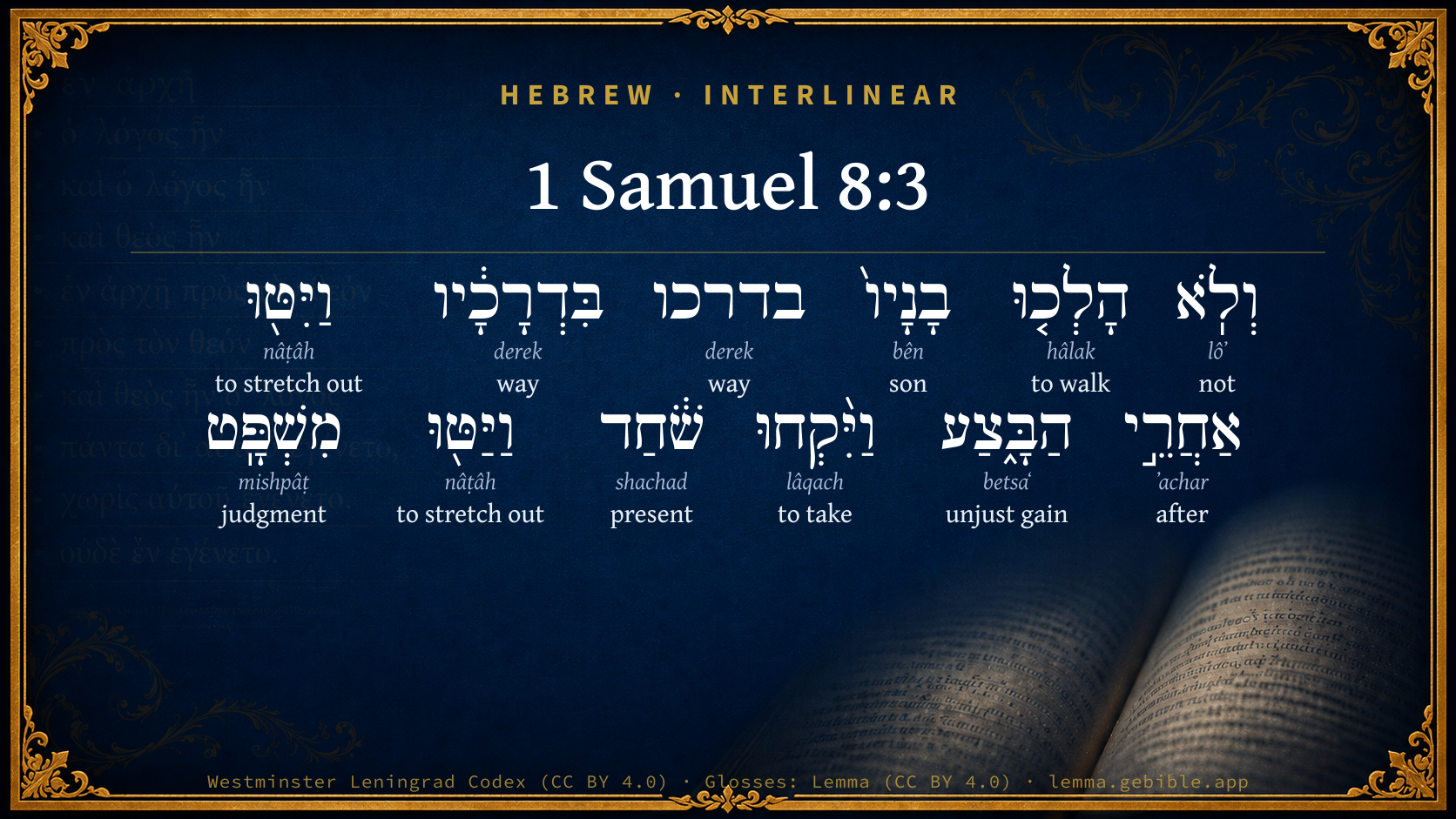
Hebrew (Westminster Leningrad Codex) 1 Samuel 8:3 appears in the Hebrew Old Testament. The text above is from the Westminster Leningrad Codex. Each word links to its Strong’s number, a concise gloss, and parsing drawn from the Open Scriptures Hebrew Bible morphology. Click any word for its full Brown-Driver-Briggs (BDB) entry.
Download image
Cite this verse

1 Samuel 8:3 (World English Bible). Public Domain. Lemma interlinear Bible study tool, https://lemma.gebible.app/v/1-samuel/8/3.

Show BibTeX & RIS
BibTeX
RIS
English Translation
His sons didn't walk in his ways, but turned aside after lucre, and took bribes, and perverted justice.
World English Bible · Public Domain
Download a study sheet

One document with this verse’s original text, its word-by-word gloss line, the meaning frame, cross-references with their text, attributed commentary, and full source and license credits — printable, and it pastes into notes with its structure intact.

This verse Autodidact and up

Study sheet (.html) Plain text (.txt)

A passage Seminary Student

Up to 50 verses in one chapter. A passage sheet keeps up to 6 commentary sources and 12 cross-references per verse, in the order this page ranks them, and says so on the sheet whenever that leaves anything out. Ask for a single verse and you get the Autodidact verse sheet above.

Everything on this page stays free to read, with no account — the sheet is a download of what is already on screen, not access to it.

Want to remove ads? Support Godless Engineer
Compare translations 3

The same verse in 3 English versions, stacked beneath the original-language interlinear above. Click any original word for its lexicon entry.

Each is an independent rendering of the whole verse — the interlinear is not word-aligned to these translations.

Highlighted words mark where these versions differ — a whole-verse word diff, not a word-by-word alignment.

  • World English Bible Public Domain
    His sons didn't walk in his ways, but turned aside after lucre, and took bribes, and perverted justice.
  • King James Version Public Domain
    And his sons walked not in his ways, but turned aside after lucre, and took bribes, and perverted judgment.
  • unfoldingWord Literal Text CC BY-SA 4.0
    But his sons did not walk in his ways, for they turned aside after dishonest gain, and they took a bribe, and they turned aside justice.

unfoldingWord Literal Text — © unfoldingWord, licensed CC BY-SA 4.0. Word-aligned USFM3 via Door43 (git.door43.org/unfoldingWord/en_ult).

Versions to compare (up to 4)

3 of 4 selected

Show all 18 translations

Every available English version of this verse, each an independent rendering of the whole verse.

  • World English Bible Public Domain
    His sons didn't walk in his ways, but turned aside after lucre, and took bribes, and perverted justice.
  • Berean Standard Bible Public Domain
    But his sons did not walk in his ways; they turned aside toward dishonest gain, accepting bribes and perverting justice.
  • Majority Standard Bible Public Domain
    But his sons did not walk in his ways; they turned aside toward dishonest gain, accepting bribes and perverting justice.
  • King James Version Public Domain
    And his sons walked not in his ways, but turned aside after lucre, and took bribes, and perverted judgment.
  • American Standard Version (1901) Public Domain
    And his sons walked not in his ways, but turned aside after lucre, and took bribes, and perverted justice.
  • Revised Version (1885) Public Domain
    And his sons walked not in his ways, but turned aside after lucre, and took bribes, and perverted judgment.
  • Geneva Bible (1599) Public Domain
    And his sonnes walked not in his wayes, but turned aside after lucre, and tooke rewards, and peruerted the iudgement.
  • Douay-Rheims (1899) Public Domain
    And his sons walked not in his ways: but they turned aside after lucre, and took bribes, and perverted judgment.
  • Young's Literal Translation Public Domain
    and his sons have not walked in his ways, and turn aside after the dishonest gain, and take a bribe, and turn aside judgment.
  • Literal Standard Version CC BY-SA 4.0
    and his sons have not walked in his ways, and turn aside after the dishonest gain, and take a bribe, and turn aside judgment.
  • Unlocked Literal Bible CC BY-SA 4.0
    His sons did not walk in his ways, but chased after dishonest gain. They took bribes and perverted justice.
  • unfoldingWord Literal Text CC BY-SA 4.0
    But his sons did not walk in his ways, for they turned aside after dishonest gain, and they took a bribe, and they turned aside justice.
  • Darby Bible Public Domain
    And his sons walked not in his ways, but turned aside after lucre, and took bribes, and perverted justice.
  • World Messianic Bible Public Domain
    His sons didn’t walk in his ways, but turned away after dishonest gain, took bribes, and perverted justice.
  • Webster's Bible Public Domain
    And his sons walked not in his ways, but turned aside after lucre, and took bribes, and perverted judgment.
  • Free Bible Version CC BY-SA 4.0
    However, his sons did not follow his ways. They were corrupt, making money by accepting bribes and perverting justice.
  • Bible in Basic English Public Domain
    And his sons did not go in his ways, but moved by the love of money took rewards, and were not upright in judging.
  • JPS Tanakh (1917) Public Domain
    And his sons walked not in his ways, but turned aside after lucre, and took bribes, and perverted justice.

Literal Standard Version (2020), Covenant Press — licensed CC BY-SA 4.0. Text via the HelloAO Bible API (eBible.org). Unlocked Literal Bible (unfoldingWord) — licensed CC BY-SA 4.0. Text via the HelloAO Bible API (eBible.org). unfoldingWord Literal Text — © unfoldingWord, licensed CC BY-SA 4.0. Word-aligned USFM3 via Door43 (git.door43.org/unfoldingWord/en_ult). Free Bible Version, Dr. Jonathan Gallagher — licensed CC BY-SA 4.0. Text via the HelloAO Bible API (eBible.org).

Word by word

More ways to search: Search by grammar → Find every occurrence → Compare this word →

Practice this passage: Drill this verse → Learn its vocabulary →

הַבָּ֑צַע
betsaʻ
H1215
“the · unjust gain”
Particle, Definite Article + Noun, Common, Masculine, Singular, Absolute
Part of Speech
Particle + Noun
Type
Common
Gender
Masculine
Number
Singular
State
Absolute
Full BDB Definition

Origin: from H1214

TWOT: 267a

profit, unjust gain, gain (profit) acquired by violence
  1. וְלֹֽא lôʼ H3808 “and · not” Conjunction + Particle, Negative
  2. הָלְכ֤וּ hâlak H1980 “to walk” Verb, Qal, Perfect, 3rd Person, Common, Plural
  3. בָנָיו֙ bên H1121 “sons · his” Noun, Common, Masculine, Plural, Construct + Suffix, Personal, 3rd Person, Masculine, Singular
  4. בדרכו derek H1870 “in/at · way · his” Preposition + Noun, Common, Both, Singular, Construct + Suffix, Personal, 3rd Person, Masculine, Singular
  5. בִּדְרָכָ֔יו derek H1870 “in/at · ways · his” Preposition + Noun, Common, Both, Plural, Construct + Suffix, Personal, 3rd Person, Masculine, Singular
  6. וַיִּטּ֖וּ nâṭâh H5186 “and · to stretch out” Conjunction + Verb, Qal, Sequential Imperfect, 3rd Person, Masculine, Plural
  7. אַחֲרֵ֣י ʼachar H310 “after” Preposition
  8. וַיִּ֨קְחוּ lâqach H3947 “and · to take” Conjunction + Verb, Qal, Sequential Imperfect, 3rd Person, Masculine, Plural
  9. שֹׁ֔חַד shachad H7810 “present” Noun, Common, Masculine, Singular, Absolute
  10. וַיַּטּ֖וּ nâṭâh H5186 “and · to stretch out” Conjunction + Verb, Hiphil, Sequential Imperfect, 3rd Person, Masculine, Plural
  11. מִשְׁפָּֽט mishpâṭ H4941 “judgment” Noun, Common, Masculine, Singular, Absolute

About this verse

These counts appear in no published source. They are computed here, from the morphology-tagged text and Lemma’s own curated glosses. What Lemma adds →

12
words
10
distinct lemmas
Historical
section

Notable vocabulary

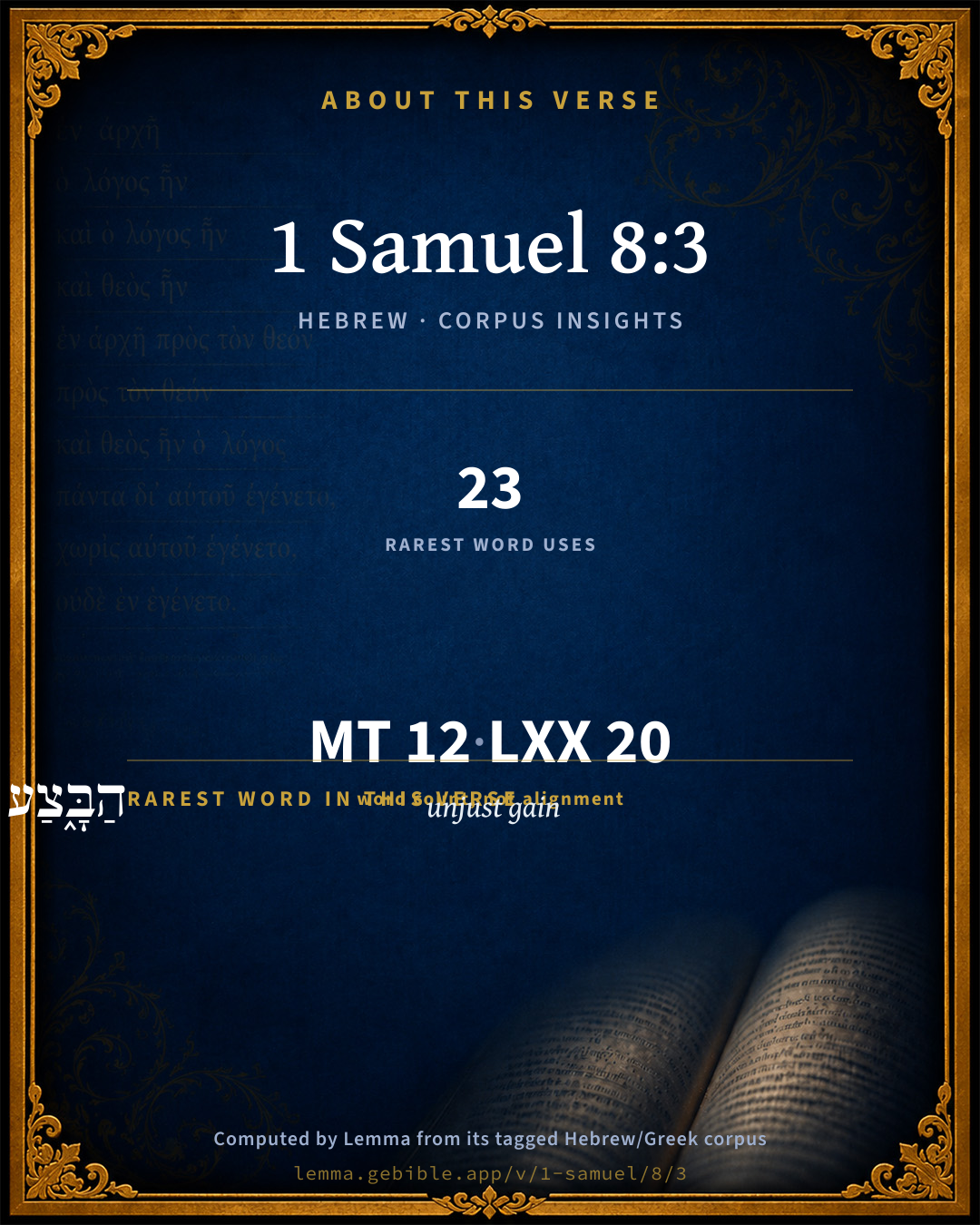
The rarest word here is הַבָּ֑צַע unjust gain H1215 — appearing just 23 times in the whole Hebrew Bible.

Shared distinctive vocabulary

הַבָּ֑צַע unjust gain H1215 occurs in 23 verses of the Hebrew Bible. Also found in:

Grammatical profile

  • 4 verbs
  • 6 nouns
  • 1 preposition
  • 1 particle

Verb forms

  • הָלְכ֤וּ Qal · Perfect
  • וַיִּטּ֖וּ Qal · Sequential Imperfect
  • וַיִּ֨קְחוּ Qal · Sequential Imperfect
  • וַיַּטּ֖וּ Hiphil · Sequential Imperfect

Repetition

Words recur within this verse — often emphatic in Hebrew:

  • בדרכו way H1870 ×2
  • וַיִּטּ֖וּ to stretch out H5186 ×2

Hebrew & Septuagint length

In English translation the verse runs 18 words from the Hebrew and 21 from the Septuagint (LXX English) — closely comparable.

A rough comparison of the two English renderings, which tokenize alike — not a word-level alignment.

Word counts can differ between the Hebrew and the Greek without any difference in meaning — e.g. the Hebrew direct-object marker אֵת has no separate Greek word, and Greek often adds the article ὁ.

In the original languages it is 12 Hebrew tokens and 20 Greek tokens — but the two are counted differently (Hebrew bundles its prefixes and suffixes into one token; the Greek is in lemma form), so that isn’t a like-for-like length.

Cross-references

13

Topical passages linked to 1 Samuel 8:3 in the Treasury of Scripture Knowledge — connected by theme and wording, ordered by reader-vote popularity; previews shown in the World English Bible.

  • Deuteronomy 16:19 You shall not wrest justice: you shall not respect persons; neither shall you take a bribe; for a bribe does blind the eyes of the wise, and pervert the words of the righteous.
  • Psalms 15:5 He who doesn't lend out his money for usury, Nor take a bribe against the innocent. He who does these things shall never be shaken.
  • 1 Timothy 6:10 For the love of money is a root of all kinds of evil. Some have been led astray from the faith in their greed, and have pierced themselves through with many sorrows.
  • Exodus 18:21 Moreover you shall provide out of all the people able men, such as fear God: men of truth, hating unjust gain; and place such over them, to be rulers of thousands, rulers of hundreds, rulers of fifties, and rulers of tens.
  • Exodus 23:8 You shall take no bribe, for a bribe blinds those who have sight and perverts the words of the righteous.
  • 2 Samuel 15:4 Absalom said moreover, Oh that I were made judge in the land, that every man who has any suit or cause might come to me, and I would do him justice!
  • Isaiah 33:15 He who walks righteously, and speaks blamelessly; he who despises the gain of oppressions, who shakes his hands from taking a bribe, who stops his ears from hearing of blood, and shuts his eyes from looking on evil:
  • 1 Timothy 3:3 not a drinker, not violent, not greedy for money, but gentle, not quarrelsome, not covetous;
  • Ecclesiastes 2:19 Who knows whether he will be a wise man or a fool? Yet he will have rule over all of my labor in which I have labored, and in which I have shown myself wise under the sun. This also is vanity.
  • Jeremiah 22:15–17 Shall you reign, because you strive to excel in cedar? Didn't your father eat and drink, and do justice and righteousness? then it was well with him.
  • 1 Kings 12:6–11 King Rehoboam took counsel with the old men, who had stood before Solomon his father while he yet lived, saying, What counsel give you me to return answer to this people?
  • 2 Kings 21:1–3 Manasseh was twelve years old when he began to reign; and he reigned fifty-five years in Jerusalem: and his mother's name was Hephzibah.
  • Psalms 26:10 In whose hands is wickedness, Their right hand is full of bribes.

Cross-references courtesy of OpenBible.info (CC BY 4.0).

Hebrew and Greek witnesses Masoretic Hebrew ↔ Greek Septuagint

The same verse in the two great witnesses to the Old Testament, shown verse-for-verse.

These are two independent witnesses, not word-aligned to each other, and the Septuagint is shown in lemma (dictionary) form.

Hebrew 1 Samuel 8:3 Masoretic · Westminster Leningrad Codex

וְלֹֽא הָלְכ֤וּ בָנָיו֙ בדרכו בִּדְרָכָ֔יו וַיִּטּ֖וּ אַחֲרֵ֣י הַבָּ֑צַע וַיִּ֨קְחוּ שֹׁ֔חַד וַיַּטּ֖וּ מִשְׁפָּֽט

His sons didn't walk in his ways, but turned aside after lucre, and took bribes, and perverted justice.

World English Bible · Public Domain

Greek LXX 1 Samuel 8:3 Septuagint · lemma form

καί οὐ πορεύομαι ὁ υἱός αὐτός ἐν ὁδός αὐτός καί ἐκκλίνω ὀπίσω ὁ συντέλεια καί λαμβάνω δῶρον καί ἐκκλίνω δικαίωμα

And his sons did not walk in his way; and they turned aside after gain, and took gifts, and perverted judgments.

LXX2012 (modern English Septuagint) · Public Domain

Hebrew: Westminster Leningrad Codex (CC BY 4.0). Greek: Septuagint (public domain); English from LXX2012 (modern English Septuagint) (Public Domain). How the Septuagint differs from the Hebrew →

Targum (Aramaic paraphrase)

1

The Targum is the ancient Jewish Aramaic paraphrase of the Hebrew Scriptures — an interpretive translation, not the Hebrew text itself. Onkelos (literal) and Pseudo-Jonathan (expansive) render the Torah, and Jonathan the Prophets. Coverage is partial: where no permissively-licensed English translation exists for a verse, only the Aramaic is shown. This is verse-level text, not a word-by-word alignment to the Hebrew.

  1. Targum Jonathan Prophets (Joshua–Malachi)
    וְלָא הֲלִיכוּ בְנוֹהִי בְּאוֹרְחָתֵיהּ וְאִתְפְּנִיאוּ בָּתַר מָמוֹן דִשְׁקָר וְקַבִילוּ שׁוֹחֲדָא וְצַלוּ דִינָא:

    (no public-domain English translation for this verse)

    Targum Jonathan — Aramaic: “Mikraot Gedolot” (public domain). English: “Sefaria Community Translation” (CC0 1.0 (public-domain dedication)); “London "Chaldee Paraphrase," 1871” (public domain). Text via Sefaria.

Commentary

Notes on 1 Samuel 8:3 from classic Christian and Jewish commentators (each source and its license shown beneath its notes). The classic Christian expositions comment on the surrounding passage and are grouped to its opening verse, so a note may address several verses; the Jewish commentaries on the Tanakh (Rashi and others) are per-verse, so they appear only where the commentator wrote on this verse.

Lemma curates 59 commentaries, every one of them public domain or Creative Commons licensed, each selected and text-cleaned for this edition rather than reprinted as found. About our sources →

Trapp's Complete Commentary

John Trapp

1Sa 8:3 And his sons walked not in his ways, but turned aside after lucre, and took bribes, and perverted judgment.

Ver. 3. And his sons walked not in his ways.] Heroum filii noxae. Grace is by gift, not inheritance. {See Trapp on "1Sa 3:12"} This was no fault of Samuel’s, as hath been said. Plato worthily blameth Darius for so ill breeding his son Xerxes, whereas he had seen the evil consequence in Cyrus’s breeding Cambyses, whom Darius succeeded in the empire.

But turned aside after lucre.] Whereas a public person, as he should have nothing to lose, so nothing to get: he should be above all price or sale. Nec prece, nec precio, should be his motto.

And perverted judgment.] Which to prevent, the Areopagites judged always in the dark, that they might neither respect persons nor take gifts.

John Trapp, A Commentary or Exposition upon All the Books of the Old and New Testament (1647–1656) — public domain. Text from a community e-Sword module.

Joseph Benson's Commentary

1Sa 8:3. Took bribes — Opportunity and temptation discovered that corruption in them which, till now, was hid from their father, and, it may be, from themselves. It has often been the grief of holy men, that their children did not tread in their steps. So far from it, that the sons of eminently good men have been often eminently wicked.

Joseph Benson's Commentary on the Old and New Testaments (1811–1818) — public domain. Text from a community e-Sword module.

Tyndale Open Study Notes

Tyndale Open Resources

8:3 they were not like their father: They were more like Eli’s two sons (2:12-17). Their corruption was a primary reason the era of the judges ended.

Tyndale Open Study Notes — © Tyndale Open Resources, licensed CC BY-SA 4.0. Text via the HelloAO Bible API.

Adam Clarke's Commentary

Verse 3. His sons walked not in his ways] Their iniquity is pointed out in three words:

1. They turned aside after lucre; the original (בצע batsa) signifies to cut, clip, break off; and therefore Mr. Parkhurst thinks that it means nearly the same with our clipping of coin. It however expresses here the idea of avarice, of getting money by hook or by crook. The Targum says, "They looked after ממון דשקר mamon dishkar, the mammon of unrighteousness;" of which they did not make unto themselves friends but enemies; See Clarke on Mt 6:24.

2. They took bribes; שחד shochad, gifts or presents, to blind their eyes.

3. They perverted judgment - they turned judgment aside; they put it out of its regular path; they sold it to the highest bidder: thus the wicked rich man had his cause, and the poor man was oppressed and deprived of his right.

This was the custom in our own country before MAGNA CHARTA was obtained; he that would speed in the king's court must bribe all the officers, and fee both the king and queen! I have found in our ancient records the most barefaced and shameful examples of this kind; but it was totally abolished, invito rege, by that provision in the above charter which states, Nulli vendemus, nulli negabimvs ant differemus rectum aut judicium; "To no man will we sell, to no man will we deny or defer, justice and right." It was customary in those inauspicious times, for judgment to be delayed in banco regis, in the king's court, as long as there was any hope that more money would be paid in order to bring it to issue. And there were cases, where the king did not like the party, in which he denied justice and judgment entirely! Magna Charta brought them to book, and brought the subject to his right.

Of those times it might well be said, as Homer did, Iliad xvi., ver. 387.

Οἱ βιῃ αγορη σκολιας κρινωσι θεμιστας,

Εκ δε δικην ελασωσι, θεων οπιν ουκ αλεγοντες.

"When guilty mortals break the eternal laws,

Or judges, bribed, betray the righteous cause."

"When the laws are perverted by force; when justice is expelled from her seat; when judges are swayed from the right, regardless of the vengeance of Heaven." Or, in other words, these were times in which the streams of justice were poisoned in their source, and judges neither feared God nor regarded man.

Adam Clarke's Commentary on the Bible (1810–1826) — public domain. Text from a community e-Sword/MySword module.

Ellicott's Commentary for English Readers

(3) Took bribes, and perverted judgment.—This sin, at all times a fatally common one in the East, was especially denounced in the Law. (See Exo_23:6-8; Deu_16:19.) It is strange that the same ills that ruined Eli’s house, owing to the evil conduct of his children, now threatened Samuel. The prophet-judge, however, acted differently to the high priestly judge. The sons of Samuel were evidently, through their father’s action in procuring the election of Saul, quickly deposed from their authority. The punishment seems to have been successful in correcting the corrupt tendencies of these men, for we hear in after days of the high position occupied at the court of David by the distinguished descendants of the noble and disinterested prophet. (See the notices in 1Ch_6:33; 1Ch_25:4-5, respecting Heman, the grandson of Samuel, the king’s seer, who was chief of the choir of the Psalmist-king in the house of God.)

A Bible Commentary for English Readers, edited by Charles John Ellicott (1878–1897) — public domain. Text from a community e-Sword module.

The Cambridge Bible for Schools and Colleges

gen. ed. J. J. S. Perowne

3. turned aside after Lucre] From the straight-forward path of their father’s example. Lucre (from Lat. lucrum) is only used in the E. V. in a bad sense of ill-gotten gain.

took bribes and perverted judgment] The same phrases are coupled together in Deu_16:19, though differently translated in the E. V. “Thou shalt not wrest judgment … nor take a gift.” Cp. Exo_23:6; Exo_23:8.

The Cambridge Bible for Schools and Colleges (gen. ed. J. J. S. Perowne; Cambridge University Press, 1878–1918) — public domain. Text from a community e-Sword module.

John Gill's Exposition

And his sons walked not in his ways,.... The meaning of which is not that they did not go the circuit he did, which is too low a sense of the words some Jewish writers give; but they did not walk in the fear of God, in the paths of religion and righteousness, truth and holiness; they neither served God, nor did justice to men, as Samuel had done:

but turned aside after lucre, and took bribes, and perverted judgment; indulged to covetousness, sought to get riches at any rate, took bribes, which blind the eyes of judges; and so passed wrong judgment, and gave the cause to those that gave the largest gifts, right or wrong.

John Gill's Exposition of the Whole Bible (1746–1763) — public domain (CC PDM 1.0). Text via the HelloAO Bible API.

Haydock's Catholic Bible Commentary

Judgment. Samuel was not to blame, and hence he was not punished like Heli. (Menochius) --- However, the misconduct of the children of these two judges, in succession, (Haydock) gave occasion to the people to demand a king, who might not be tempted by bribes. (Worthington) --- It is surprising that most of the great men who are mentioned in history, had degenerate children. (Calmet) --- Such were some of David’s sons, as well as Cambyses, the son of Cyrus, &c. (Haydock) --- Was it because their fathers were too much taken up with the affairs of state, to watch over the education of their children? or rather, because these young men confided too much on the merits of their family, and took no pains to tread in the footsteps of their parents? (Calmet) --- "We have here, says Josephus, a manifest proof that children do not always resemble their parents, but sometimes good men spring from the wicked; and on the contrary, the virtuous have an evil progeny."

George Leo Haydock (1774–1849), Haydock's Catholic Family Bible and Commentary, 1859 edition — public domain. Excludes Psalms (Douay-Rheims chapter numbering differs from Protestant) and Deuterocanonical books (Catholic canon only).

Matthew Poole's English Annotations

Opportunity and temptation drew forth and discovered the corruption in them, which till now was hid from their father, and, it may be, from themselves.

Matthew Poole's English Annotations on the Holy Bible (1683–1685) — public domain. Text from a community e-Sword/MySword module.

Whedon's Commentary on the Bible

Daniel D. Whedon

3. Turned aside after lucre… took bribes… perverted judgment — Three evils which cannot be too strongly reprobated in a judge. The Hebrew word בצע, here translated lucre, means properly ill-gotten gain — that which is obtained by violence or fraud. The judge who covetously puts his hand on ill-gotten gain will be easily overcome with bribery, and he who takes bribes will necessarily pervert judgment and truth.

Daniel D. Whedon (gen. ed.), Commentary on the Old and New Testaments (1874–1909) — public domain. Text from a community e-Sword module.

The Pulpit Commentary

His sonstook bribes. This sin was expressly forbidden in Exo_23:6, Exo_23:8; Deu_16:19, and it marks the high spirit of the nation that it was so indignant at justice being thus perverted. They walked not in his way (singular so the written text) for Samuel"s own administration of justice had been most upright, (1Sa_12:4) nor is it laid to his charge that he connived at the misconduct of his sons. On the contrary, after remonstrance indeed, not for his sons" sake, but for the honour of the theocracy, and that the people might be on their guard against a despotic exercise of the power with which they were about to intrust a single man, he superseded not them only, but also himself. His conduct in this trying conjuncture was most admirable, and few commentators have done justice to the man, who, possessed of what was virtually kingly power, yet gave it over for the nation"s good into the hands of another.

The Pulpit Commentary (1880–1919), ed. H.D.M. Spence-Jones & Joseph S. Exell — public domain. Text from a community e-Sword module.

John Wesley's Explanatory Notes

Took bribes - Opportunity and temptation discovered that corruption in them which 'till now was hid from their father. It has often been the grief of holy men, that their children did not tread in their steps. So far from it, that the sons of eminently good men, have been often eminently wicked.

John Wesley, Explanatory Notes Upon the Whole Bible (1754–1765) — public domain. Text via the GEBible commentary corpus.

Rashi

Rabbi Shlomo Yitzchaki (Rashi)

They were swayed. Themselves.

[They] perverted. Something else, i.e., justice. Our Rabbis said that Shmuel's sons did not sin. They merely did not follow in their father's ways. Their father would travel to all places in Yisroel, and judge them in their cities. But they did not do so, in order to increase the income of their agents and scribes.

Rashi on the Tanakh — English translations: “The Judaica Press complete Tanach with Rashi, translated by A. J. Rosenberg” (CC BY 4.0); “Pentateuch with Rashi's commentary by M. Rosenbaum and A.M. Silbermann, 1929-1934” (public domain); “The Metsudah Tanach series, Lakewood, N.J” (CC BY 4.0); and “The Book of Joshua, Metsudah Publications, 1997” (CC BY 4.0). Text via Sefaria.

Lesson kit

Teaching starters — assembled from the data on this page, not authored interpretation. Every prompt links to the verse data it draws on. Edit before teaching.

1 Samuel, in the Historical, opens this verse with 12 words (10 distinct Hebrew lemmas). Its most distinctive word is betsaʻ (“unjust gain”). A historical commentator’s framing appears above. Read the whole chapter for the surrounding context.

Discussion questions

  1. How does “unjust gain” (betsaʻ) shape what this verse is saying?
  2. How does Genesis 37:26, which shares the word «unjust gain», read alongside this verse?
  3. What does the repetition of “way” (2× in this one verse) do in this verse?
  4. The translations on this page render this verse differently — a whole-verse word diff, not a word-by-word alignment. What might account for the different wordings?
  5. «הָלְכ֤וּ» is a Qal Perfect verb. How does that grammatical form shape the action described?
  6. Compare how Trapp's Complete Commentary and Joseph Benson's Commentary read this verse. Where do they agree or differ?

Things to notice

Reading settings

Reading text

Shown beneath each verse's original-language words.

Old Testament
Old Testament edition

Read the OT as the Masoretic Hebrew (MT) or the Greek Septuagint (LXX).

English shown for the Greek Septuagint (in the Hebrew ↔ Greek comparison).

Comparing translations? Open the Compare panel on any verse page to stack up to four side by side.