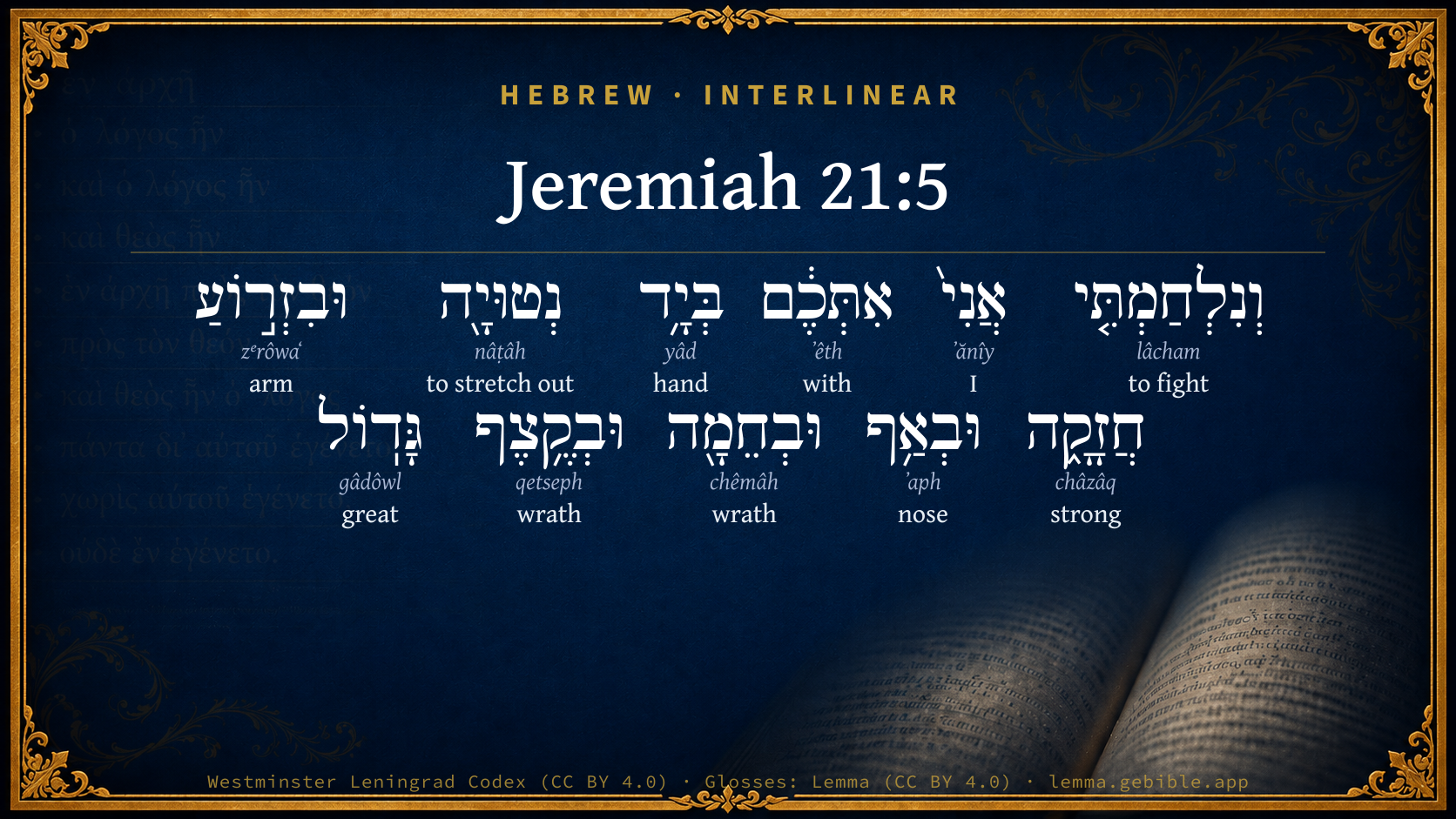
Jeremiah 21:5

Hebrew (Westminster Leningrad Codex) Jeremiah 21:5 appears in the Hebrew Old Testament. The text above is from the Westminster Leningrad Codex. Each word links to its Strong’s number, a concise gloss, and parsing drawn from the Open Scriptures Hebrew Bible morphology. Click any word for its full Brown-Driver-Briggs (BDB) entry.
Download image
Cite this verse

Jeremiah 21:5 (World English Bible). Public Domain. Lemma interlinear Bible study tool, https://lemma.gebible.app/v/jeremiah/21/5.

Show BibTeX & RIS
BibTeX
RIS
English Translation
I myself will fight against you with an outstretched hand and with a strong arm, even in anger, and in wrath, and in great indignation.
World English Bible · Public Domain
Download a study sheet

One document with this verse’s original text, its word-by-word gloss line, the meaning frame, cross-references with their text, attributed commentary, and full source and license credits — printable, and it pastes into notes with its structure intact.

This verse Autodidact and up

Study sheet (.html) Plain text (.txt)

A passage Seminary Student

Up to 50 verses in one chapter. A passage sheet keeps up to 6 commentary sources and 12 cross-references per verse, in the order this page ranks them, and says so on the sheet whenever that leaves anything out. Ask for a single verse and you get the Autodidact verse sheet above.

Everything on this page stays free to read, with no account — the sheet is a download of what is already on screen, not access to it.

Want to remove ads? Support Godless Engineer
Compare translations 3

The same verse in 3 English versions, stacked beneath the original-language interlinear above. Click any original word for its lexicon entry.

Each is an independent rendering of the whole verse — the interlinear is not word-aligned to these translations.

Highlighted words mark where these versions differ — a whole-verse word diff, not a word-by-word alignment.

  • World English Bible Public Domain
    I myself will fight against you with an outstretched hand and with a strong arm, even in anger, and in wrath, and in great indignation.
  • King James Version Public Domain
    And I myself will fight against you with an outstretched hand and with a strong arm, even in anger, and in fury, and in great wrath.
  • unfoldingWord Literal Text CC BY-SA 4.0
    And I, I will fight against you with an outstretched hand and with a strong arm, and in nose and in wrath and in great fury.

unfoldingWord Literal Text — © unfoldingWord, licensed CC BY-SA 4.0. Word-aligned USFM3 via Door43 (git.door43.org/unfoldingWord/en_ult).

Versions to compare (up to 4)

3 of 4 selected

Show all 18 translations

Every available English version of this verse, each an independent rendering of the whole verse.

  • World English Bible Public Domain
    I myself will fight against you with an outstretched hand and with a strong arm, even in anger, and in wrath, and in great indignation.
  • Berean Standard Bible Public Domain
    And I Myself will fight against you with an outstretched hand and a mighty arm, with anger, fury, and great wrath.
  • Majority Standard Bible Public Domain
    And I Myself will fight against you with an outstretched hand and a mighty arm, with anger, fury, and great wrath.
  • King James Version Public Domain
    And I myself will fight against you with an outstretched hand and with a strong arm, even in anger, and in fury, and in great wrath.
  • American Standard Version (1901) Public Domain
    And I myself will fight against you with an outstretched hand and with a strong arm, even in anger, and in wrath, and in great indignation.
  • Revised Version (1885) Public Domain
    And I myself will fight against you with an outstretched hand and with a strong arm, even in anger, and in fury, and in great wrath.
  • Geneva Bible (1599) Public Domain
    And I my selfe will fight against you with an outstretched hand, and with a mighty arme, eue in anger and in wrath, and in great indignation.
  • Douay-Rheims (1899) Public Domain
    And I myself will fight against you with an outstretched hand, and with a strong arm, and in fury, and in indignation, and in great wrath.
  • Young's Literal Translation Public Domain
    And I -- I have fought against you, With a stretched-out hand, and with a strong arm, And in anger, and in fury, and in great wrath,
  • Literal Standard Version CC BY-SA 4.0
    And I have fought against you, || With an outstretched hand, and with a strong arm, || And in anger, and in fury, and in great wrath,
  • Unlocked Literal Bible CC BY-SA 4.0
    Then I myself will fight against you with a raised hand and a strong arm, and with wrath, fury, and great anger.
  • unfoldingWord Literal Text CC BY-SA 4.0
    And I, I will fight against you with an outstretched hand and with a strong arm, and in nose and in wrath and in great fury.
  • Darby Bible Public Domain
    And I myself will fight against you with a stretched-out hand, and with a strong arm, and in anger, and in fury, and in great wrath.
  • World Messianic Bible Public Domain
    I myself will fight against you with an outstretched hand and with a strong arm, even in anger, in wrath, and in great indignation.
  • Webster's Bible Public Domain
    And I myself will fight against you with an out-stretched hand and with a strong arm, even in anger, and in fury, and in great wrath.
  • Free Bible Version CC BY-SA 4.0
    I myself will fight against you with all my power and might, with the full force of my furious anger.
  • Bible in Basic English Public Domain
    And I myself will be fighting against you with an outstretched hand and with a strong arm, even with angry feeling and passion and in great wrath.
  • JPS Tanakh (1917) Public Domain
    And I myself will fight against you with an outstretched hand and with a strong arm, even in anger, and in fury, and in great wrath.

Literal Standard Version (2020), Covenant Press — licensed CC BY-SA 4.0. Text via the HelloAO Bible API (eBible.org). Unlocked Literal Bible (unfoldingWord) — licensed CC BY-SA 4.0. Text via the HelloAO Bible API (eBible.org). unfoldingWord Literal Text — © unfoldingWord, licensed CC BY-SA 4.0. Word-aligned USFM3 via Door43 (git.door43.org/unfoldingWord/en_ult). Free Bible Version, Dr. Jonathan Gallagher — licensed CC BY-SA 4.0. Text via the HelloAO Bible API (eBible.org).

Word by word

More ways to search: Search by grammar → Find every occurrence → Compare this word →

Practice this passage: Drill this verse → Learn its vocabulary →

וּבְקֶ֥צֶף
qetseph
H7110
“and · in/at · wrath”
Conjunction + Preposition + Noun, Common, Masculine, Singular, Absolute
Part of Speech
Conjunction + Preposition + Noun
Type
Common
Gender
Masculine
Number
Singular
State
Absolute
Full BDB Definition

Origin: from H7107

TWOT: 2058a , 2059b

wrath, anger - of God - of man - splinter, twig, broken twig - meaning dubious
  1. וְנִלְחַמְתִּ֤י lâcham H3898 “and · to fight” Conjunction + Verb, Niphal, Sequential Perfect, 1st Person, Common, Singular
  2. אֲנִי֙ ʼănîy H589 “I” Pronoun, Personal, 1st Person, Common, Singular
  3. אִתְּכֶ֔ם ʼêth H854 “with · you” Preposition + Suffix, Personal, 2nd Person, Masculine, Plural
  4. בְּיָ֥ד yâd H3027 “in/at · hand” Preposition + Noun, Common, Both, Singular, Absolute
  5. נְטוּיָ֖ה nâṭâh H5186 “stretched out” Verb, Qal, Participle Passive, Feminine, Singular, Absolute
  6. וּבִזְר֣וֹעַ zᵉrôwaʻ H2220 “and · in/at · arm” Conjunction + Preposition + Noun, Common, Both, Singular, Absolute
  7. חֲזָקָ֑ה châzâq H2389 “strong” Adjective, Adjective, Feminine, Singular, Absolute
  8. וּבְאַ֥ף ʼaph H639 “and · in/at · nose” Conjunction + Preposition + Noun, Common, Masculine, Singular, Absolute
  9. וּבְחֵמָ֖ה chêmâh H2534 “and · in/at · wrath” Conjunction + Preposition + Noun, Common, Feminine, Singular, Absolute
  10. גָּדֽוֹל gâdôwl H1419 “great” Adjective, Adjective, Masculine, Singular, Absolute

About this verse

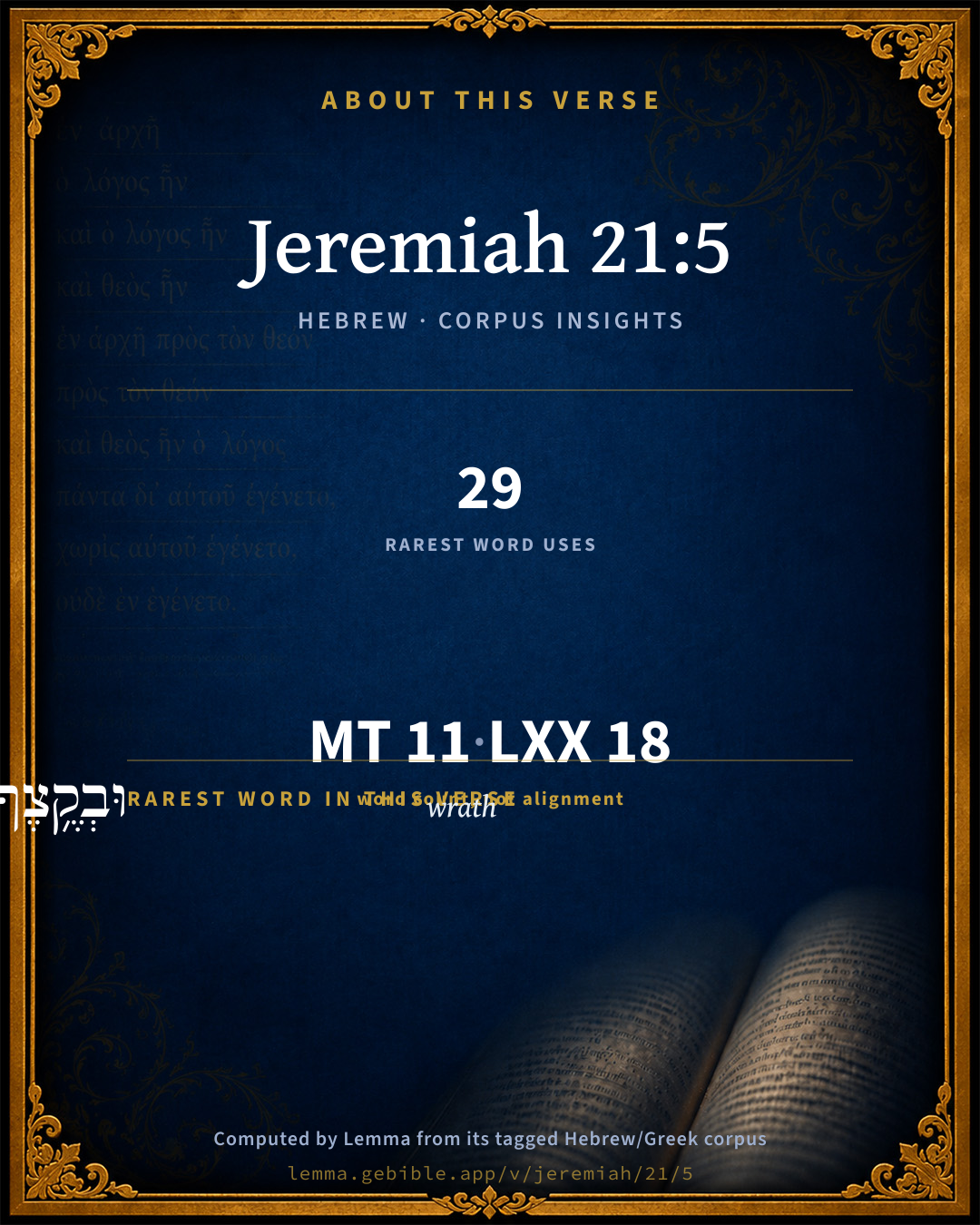
These counts appear in no published source. They are computed here, from the morphology-tagged text and Lemma’s own curated glosses. What Lemma adds →

11
words
11
distinct lemmas
Prophets
section

Shared distinctive vocabulary

וּבְקֶ֥צֶף wrath H7110 occurs in 29 verses of the Hebrew Bible. Also found in:

Grammatical profile

  • 2 verbs
  • 5 nouns
  • 2 adjectives
  • 1 pronoun
  • 1 preposition

Verb forms

  • וְנִלְחַמְתִּ֤י Niphal · Sequential Perfect
  • נְטוּיָ֖ה Qal · Participle Passive

Hebrew & Septuagint length

In the original languages it is 11 Hebrew tokens and 18 Greek tokens — but the two are counted differently (Hebrew bundles its prefixes and suffixes into one token; the Greek is in lemma form), so that isn’t a like-for-like length.

Cross-references

16

Topical passages linked to Jeremiah 21:5 in the Treasury of Scripture Knowledge — connected by theme and wording, ordered by reader-vote popularity; previews shown in the World English Bible.

  • Isaiah 63:10 But they rebelled, and grieved his holy Spirit: therefore he was turned to be their enemy, [and] himself fought against them.
  • Exodus 6:6 Therefore tell the children of Israel, 'I am Yahweh, and I will bring you out from under the burdens of the Egyptians, and I will rid you out of their bondage, and I will redeem you with an outstretched arm, and with great judgments:
  • Isaiah 5:25 Therefore Yahweh's anger burns against his people, And he has stretched out his hand against them, and has struck them. The mountains tremble, And their dead bodies are as refuse in the midst of the streets. For all this, his anger is not turned away, But his hand is still stretched out.
  • Jeremiah 32:17 Ah Lord Yahweh! behold, you have made the heavens and the earth by your great power and by your outstretched arm; there is nothing too hard for you,
  • Exodus 9:15 For now I would have put forth my hand, and struck you and your people with pestilence, and you would have been cut off from the earth;
  • Deuteronomy 4:34 Or has God tried to go and take him a nation from the midst of [another] nation, by trials, by signs, and by wonders, and by war, and by a mighty hand, and by an outstretched arm, and by great terrors, according to all that Yahweh your God did for you in Egypt before your eyes?
  • Isaiah 9:17 Therefore the Lord will not rejoice over their young men, neither will he have compassion on their fatherless and widows; for everyone is profane and an evil-doer, and every mouth speaks folly. For all this his anger is not turned away, but his hand is stretched out still.
  • Isaiah 9:21 Manasseh, Ephraim; and Ephraim, Manasseh; and they together shall be against Judah. For all this his anger is not turned away, but his hand is stretched out still.
  • Jeremiah 6:12 Their houses shall be turned to others, their fields and their wives together; for I will stretch out my hand on the inhabitants of the land, says Yahweh.
  • Deuteronomy 4:23 Take heed to yourselves, lest you forget the covenant of Yahweh your God, which he made with you, and make you an engraved image in the form of anything which Yahweh your God has forbidden you.
  • Isaiah 9:12 the Syrians before, and the Philistines behind; and they shall devour Israel with open mouth. For all this his anger is not turned away, but his hand is stretched out still.
  • Isaiah 10:4 They shall only bow down under the prisoners, and shall fall under the slain. For all this his anger is not turned away, but his hand is stretched out still.
  • Jeremiah 32:37 Behold, I will gather them out of all the countries, where I have driven them in my anger, and in my wrath, and in great indignation; and I will bring them again to this place, and I will cause them to dwell safely:
  • Lamentations 2:4–5 He has bent his bow like an enemy, he has stood with his right hand as an adversary, Has killed all that were pleasant to the eye: In the tent of the daughter of Zion he has poured out his wrath like fire.
  • Ezekiel 20:33–34 As I live, says the Lord Yahweh, surely with a mighty hand, and with an outstretched arm, and with wrath poured out, will I be king over you:
  • Nahum 1:5–6 The mountains quake before him, and the hills melt away. The earth trembles at his presence, yes, the world, and all who dwell in it.

Cross-references courtesy of OpenBible.info (CC BY 4.0).

Hebrew and Greek witnesses Masoretic Hebrew ↔ Greek Septuagint

The same verse in the two great witnesses to the Old Testament, shown verse-for-verse.

These are two independent witnesses, not word-aligned to each other, and the Septuagint is shown in lemma (dictionary) form.

Hebrew Jeremiah 21:5 Masoretic · Westminster Leningrad Codex

וְנִלְחַמְתִּ֤י אֲנִי֙ אִתְּכֶ֔ם בְּיָ֥ד נְטוּיָ֖ה וּבִזְר֣וֹעַ חֲזָקָ֑ה וּבְאַ֥ף וּבְחֵמָ֖ה וּבְקֶ֥צֶף גָּדֽוֹל

I myself will fight against you with an outstretched hand and with a strong arm, even in anger, and in wrath, and in great indignation.

World English Bible · Public Domain

Greek LXX Structure differs

In the Septuagint, Jeremiah is about an eighth shorter than the Hebrew and arranges its material differently — the Oracles Against the Nations (Hebrew chapters 46–51) appear in the middle of the Greek book, after 25:13. Because the chapter and verse boundaries do not line up, a verse-for-verse comparison with the Hebrew is not shown.

A verse-for-verse comparison isn’t shown here because the chapters and verses don’t line up. Switch to the LXX edition with the MT / LXX toggle above to read the Greek directly.

Hebrew: Westminster Leningrad Codex (CC BY 4.0). Greek: Septuagint (public domain); English from a public-domain English Septuagint. How the Septuagint differs from the Hebrew →

Targum (Aramaic paraphrase)

1

The Targum is the ancient Jewish Aramaic paraphrase of the Hebrew Scriptures — an interpretive translation, not the Hebrew text itself. Onkelos (literal) and Pseudo-Jonathan (expansive) render the Torah, and Jonathan the Prophets. Coverage is partial: where no permissively-licensed English translation exists for a verse, only the Aramaic is shown. This is verse-level text, not a word-by-word alignment to the Hebrew.

  1. Targum Jonathan Prophets (Joshua–Malachi)
    וַאֲגִיחַ אֲנָא עִמְכוֹן בְּיַד מְרַמְמָא וּבִדְרַע תַּקִּיפָא וּבִרְגַז וּבְחֵמָה וּבִתְקוֹף רָב:

    (no public-domain English translation for this verse)

    Targum Jonathan — Aramaic: “Mikraot Gedolot” (public domain). English: “Sefaria Community Translation” (CC0 1.0 (public-domain dedication)); “London "Chaldee Paraphrase," 1871” (public domain). Text via Sefaria.

Commentary

Notes on Jeremiah 21:5 from classic Christian and Jewish commentators (each source and its license shown beneath its notes). The classic Christian expositions comment on the surrounding passage and are grouped to its opening verse, so a note may address several verses; the Jewish commentaries on the Tanakh (Rashi and others) are per-verse, so they appear only where the commentator wrote on this verse.

Lemma curates 59 commentaries, every one of them public domain or Creative Commons licensed, each selected and text-cleaned for this edition rather than reprinted as found. About our sources →

Trapp's Complete Commentary

John Trapp

Jer 21:5 And I myself will fight against you with an outstretched hand and with a strong arm, even in anger, and in fury, and in great wrath.

Ver. 5. And I myself will fight against you.] This was heavy tidings to Zedekiah and his courtiers. Optassent sibi prophetas qui dixissent laeta, saith Oecolampadius; they could have wished for more pleasing prophecies; but those that do what they should not must look to hear what they would not. Such bitter answers as this they must look for who seek to God only in a time of necessity. Silence, or else sad answers, they shall be sure of.

John Trapp, A Commentary or Exposition upon All the Books of the Old and New Testament (1647–1656) — public domain. Text from a community e-Sword module.

Jamieson, Fausset & Brown

Robert Jamieson, A. R. Fausset & David Brown

The Jews shall have not merely the Chaldees, but Jehovah Himself in wrath at their provocations, fighting against them. Every word enhances the formidable character of God's opposition, "I myself . . . outstretched hand . . . strong arm (no longer as in Exo 6:6, and in the case of Sennacherib, in your behalf, but) in anger . . . fury . . . great wrath."

Jamieson, Fausset & Brown — Commentary Critical and Explanatory on the Whole Bible (1871) — public domain (CC PDM 1.0). Text via the HelloAO Bible API.

John Calvin's Commentaries

He proceeds with the subject; and though he afterwards is more diffuse, he yet confirms here what we have just seen, — even that God was the leader of the war, and that the Chaldeans were, as it were, his hired soldiers, whom he guided by his own hand, and to whom he would give the signal to fight.

I, myself he says, will fight against you He put this in opposition to the wonderful works which Zedekiah had mentioned. God, indeed, had formerly been in a wonderful way present with his Church, not only once, but a thousand times; but he says now, “whatever power I have, it shall be exercised now against you; expect, therefore, no aid from me, but know that I am armed, and shall wholly destroy you.” He adds, with an extended hand and a strong arm; as though he had said, “your fathers found wonderful works done for their safety; but you shall by experience learn how great is my power to destroy you.” In short, he means that all God’s power would be a cause of terror to the Jews, and that therefore they could not escape, as there is nothing more dreadful than to have God’s hand opposed to us. To the same purpose is what follows, in wrath, and in fury, and in great indignation God intimates in these words that he would be implacable, and that hence Zedekiah was mistaken when he thought that the end of their evils was nigh at hand.

He might indeed have said briefly, “I will fight with an extended hand and with wrath;” but he mentioned wrath three times in various words. Hence what I have said appears evident, that Zedekiah was deprived of every hope, lest he should deceive himself, as though he would somehow propitiate God, who had already given up the city to final destruction. But we shall see that the Prophet had not ceased from the discharge of his office, and that he had allowed some room for repentance. But he made expressly this answer, for the king could not have been otherwise awakened. We shall see how he explained himself; but this beginning was as it were a thunderclap to lay prostrate the pride of the king and of the people. They had become first torpid in their evils, and then such was their contumacy that they sought to subject God to themselves. As then their stupidity and their obstinacy were so great, the Prophet could not, with any hope of success, have exhorted them to repent and offered them the mercy of God; it was therefore necessary for them to be so smitten as to perceive that they were wholly lost, and that God was so angry with them that they could not be saved by any human means. But we must defer the rest till to-morrow.

John Calvin's Commentaries (1540-1563) — public domain. Text from the Calvin Translation Society English edition (1840s-50s) via the Christian Classics Ethereal Library (ccel.org). Calvin's coverage is partial (roughly two-thirds of the Bible); uncommented books and verses are honest gaps, never fabricated. The 19th-century editor's footnotes and remarks are omitted so the notes are faithfully Calvin's own voice.

The Cambridge Bible for Schools and Colleges

gen. ed. J. J. S. Perowne

5. with an outstretched … arm] a phrase of Deut. (Deu_4:34, Deu_5:15, Deu_26:8).

The Cambridge Bible for Schools and Colleges (gen. ed. J. J. S. Perowne; Cambridge University Press, 1878–1918) — public domain. Text from a community e-Sword module.

John Gill's Exposition

And myself will fight against you,.... So far from being entreated to do for them according to his wondrous works in times past, as their friend; that he will set himself against them as their enemy; and sad it is to have God for an enemy: if God be for a people, none can be against them to do them any hurt; but if he is against them, it signifies nothing who is for them: this must be much more terrible to them than the whole Chaldean army, and the king of Babylon at the head of them:

with an outstretched hand, and with a strong arm; such as he had used formerly in delivering Israel out of Egypt, but now in delivering them into the hands of their enemies; and out of the reach of such a hand there is no getting; and under the weight of such an arm there is no supporting; see Exo 6:6;

even in anger, and in fury, and in great wrath; because of their sins and iniquities. This heap of words is used to show the greatness of his indignation: this was not the chastisement of a father, but the rebuke of an enemy; not a correction in love, but in hot displeasure; a punishment inflicted in vindictive wrath by a righteous Judge, appearing in a warlike manner.

John Gill's Exposition of the Whole Bible (1746–1763) — public domain (CC PDM 1.0). Text via the HelloAO Bible API.

Matthew Poole's English Annotations

I will fight against you, ( as a prince is said to fight against a nation whose captains fight against it, though himself stirreth not from his royal palace; yea, more than so,) animating and influencing the Babylonians and Chaldeans, whom I have sent to fight against you, and discouraging and dispiriting your armies.

With an outstretched hand and with a strong arm, even in anger, and in fury, and in great wrath; with such a hand and power as I manifested for my ancient Israel, Exo 6:6. God is here spoken of in a dialect which maketh him more intelligible to us. He hath no hands, no arms, neither are anger and fury in him considered as turbulent passions, as they are in us; but as men stretch out their hands and arms when they intend to give smart and terrible strokes, and are egged to such blows from their passions and excessive wrath, so God is set out to us by expressions proper to men, and in him significative only of his just will to be revenged severely upon a sinful people. The sense is no more, than that an end was now come, and God was resolved no longer to bear with such a provoking people, but to bring his utmost wrath upon them, and to deal with them no longer according to his wondrous works of mercy, but in wondrous works of justice, which in men would look like the effects of wrath and fury.

Matthew Poole's English Annotations on the Holy Bible (1683–1685) — public domain. Text from a community e-Sword/MySword module.

Whedon's Commentary on the Bible

Daniel D. Whedon

5. With an outstretched… arm — The same “arm” which of old was outstretched for their deliverance from Egyptian bondage will be stretched to sweep them into captivity.

Daniel D. Whedon (gen. ed.), Commentary on the Old and New Testaments (1874–1909) — public domain. Text from a community e-Sword module.

Lesson kit

Teaching starters — assembled from the data on this page, not authored interpretation. Every prompt links to the verse data it draws on. Edit before teaching.

Jeremiah, in the Prophets, opens this verse with 11 words (11 distinct Hebrew lemmas). Its most distinctive word is qetseph (“wrath”). A historical commentator’s framing appears above. Read the whole chapter for the surrounding context.

Discussion questions

  1. What does “wrath” (qetseph) contribute to the verse as a whole?
  2. How does Numbers 1:53, which shares the word «wrath», read alongside this verse?
  3. These translations render this verse differently. What is at stake in choosing one wording over another?
  4. «וְנִלְחַמְתִּ֤י» is a Niphal Sequential Perfect verb. How does that grammatical form shape the action described?
  5. Compare how Trapp's Complete Commentary and Jamieson, Fausset & Brown read this verse. Where do they agree or differ?

Things to notice

Reading settings

Reading text

Shown beneath each verse's original-language words.

Old Testament
Old Testament edition

Read the OT as the Masoretic Hebrew (MT) or the Greek Septuagint (LXX).

English shown for the Greek Septuagint (in the Hebrew ↔ Greek comparison).

Comparing translations? Open the Compare panel on any verse page to stack up to four side by side.