
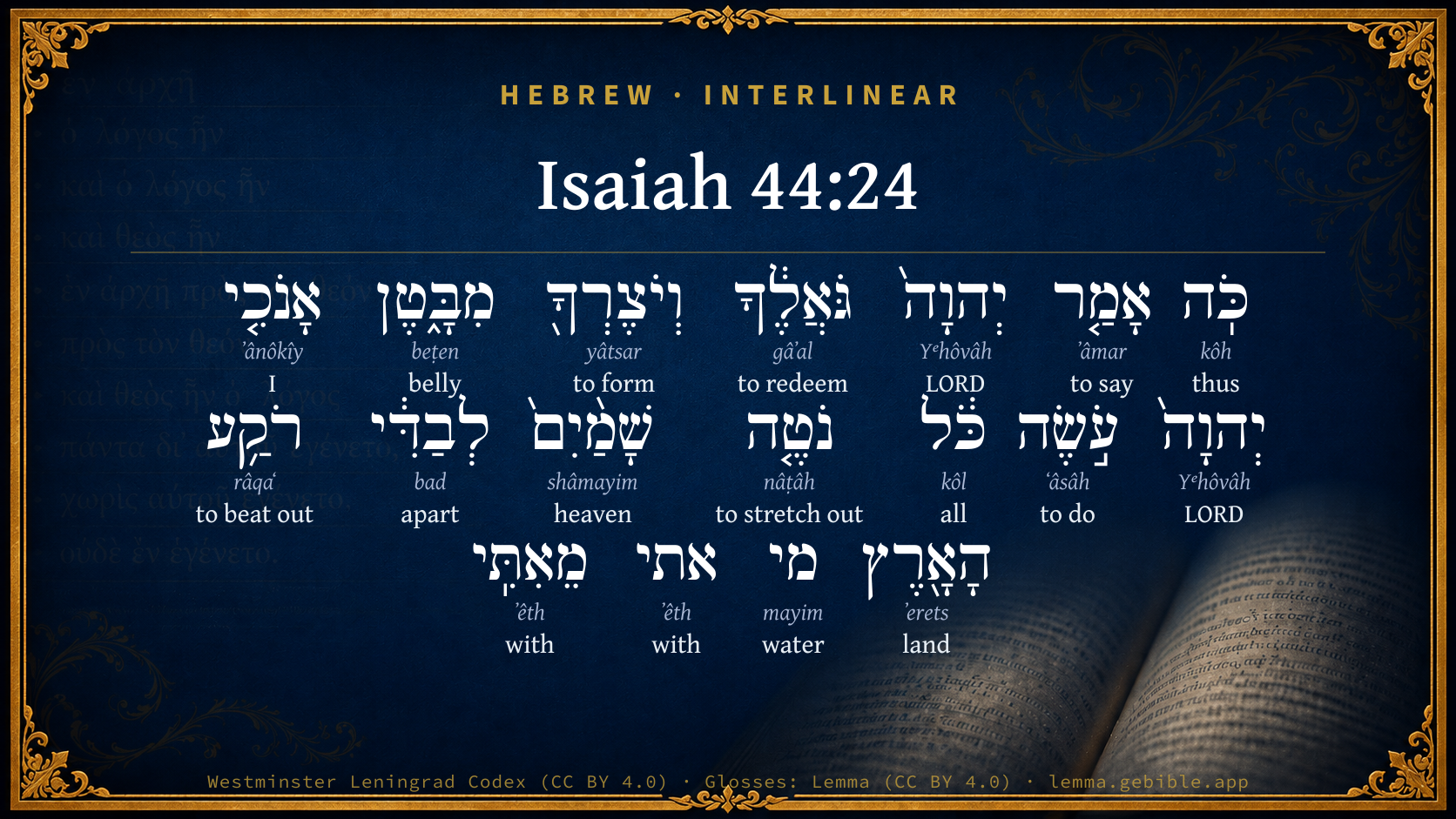
Isaiah 44:24

Hebrew (Westminster Leningrad Codex) Isaiah 44:24 appears in the Hebrew Old Testament. The text above is from the Westminster Leningrad Codex. Each word links to its Strong’s number, a concise gloss, and parsing drawn from the Open Scriptures Hebrew Bible morphology. Click any word for its full Brown-Driver-Briggs (BDB) entry.
Download image
Cite this verse

Isaiah 44:24 (World English Bible). Public Domain. Lemma interlinear Bible study tool, https://lemma.gebible.app/v/isaiah/44/24.

Show BibTeX & RIS
BibTeX
RIS
English Translation
Thus says Yahweh, your Redeemer, and he who formed you from the womb: I am Yahweh, who makes all things; who stretches forth the heavens alone; who spreads abroad the earth (who is with me?);
World English Bible · Public Domain
Download a study sheet

One document with this verse’s original text, its word-by-word gloss line, the meaning frame, cross-references with their text, attributed commentary, and full source and license credits — printable, and it pastes into notes with its structure intact.

This verse Autodidact and up

Study sheet (.html) Plain text (.txt)

A passage Seminary Student

Up to 50 verses in one chapter. A passage sheet keeps up to 6 commentary sources and 12 cross-references per verse, in the order this page ranks them, and says so on the sheet whenever that leaves anything out. Ask for a single verse and you get the Autodidact verse sheet above.

Everything on this page stays free to read, with no account — the sheet is a download of what is already on screen, not access to it.

Want to remove ads? Support Godless Engineer
Compare translations 3

The same verse in 3 English versions, stacked beneath the original-language interlinear above. Click any original word for its lexicon entry.

Each is an independent rendering of the whole verse — the interlinear is not word-aligned to these translations.

Highlighted words mark where these versions differ — a whole-verse word diff, not a word-by-word alignment.

  • World English Bible Public Domain
    Thus says Yahweh, your Redeemer, and he who formed you from the womb: I am Yahweh, who makes all things; who stretches forth the heavens alone; who spreads abroad the earth (who is with me?);
  • King James Version Public Domain
    Thus saith the LORD, thy redeemer, and he that formed thee from the womb, I am the LORD that maketh all things; that stretcheth forth the heavens alone; that spreadeth abroad the earth by myself;
  • unfoldingWord Literal Text CC BY-SA 4.0
    Thus says Yahweh, your Redeemer and your fashioner from the womb: “I Yahweh, the maker of all, the one having stretched out the heavens by myself, the one having beaten out the earth—who with me?—

unfoldingWord Literal Text — © unfoldingWord, licensed CC BY-SA 4.0. Word-aligned USFM3 via Door43 (git.door43.org/unfoldingWord/en_ult).

Versions to compare (up to 4)

3 of 4 selected

Show all 18 translations

Every available English version of this verse, each an independent rendering of the whole verse.

  • World English Bible Public Domain
    Thus says Yahweh, your Redeemer, and he who formed you from the womb: I am Yahweh, who makes all things; who stretches forth the heavens alone; who spreads abroad the earth (who is with me?);
  • Berean Standard Bible Public Domain
    Thus says the LORD, your Redeemer who formed you from the womb: “I am the LORD, who has made all things, who alone stretched out the heavens, who by Myself spread out the earth,
  • Majority Standard Bible Public Domain
    Thus says the LORD, your Redeemer who formed you from the womb: “I am the LORD, who has made all things, who alone stretched out the heavens, who by Myself spread out the earth,
  • King James Version Public Domain
    Thus saith the LORD, thy redeemer, and he that formed thee from the womb, I am the LORD that maketh all things; that stretcheth forth the heavens alone; that spreadeth abroad the earth by myself;
  • American Standard Version (1901) Public Domain
    Thus saith Jehovah, thy Redeemer, and he that formed thee from the womb: I am Jehovah, that maketh all things; that stretcheth forth the heavens alone; that spreadeth abroad the earth (who is with me?);
  • Revised Version (1885) Public Domain
    Thus saith the LORD, thy redeemer, and he that formed thee from the womb: I am the LORD, that maketh all things; that stretcheth forth the heavens alone; that spreadeth abroad the earth; who is with me?
  • Geneva Bible (1599) Public Domain
    Thus sayeth the Lord thy redeemer and he that formed thee from the wombe, I am the Lord, that made all things, that spred out the heauens alone, and stretched out the earth by my selfe.
  • Douay-Rheims (1899) Public Domain
    Thus saith the Lord thy redeemer, and thy maker, from the womb: I am the Lord, that make all things, that alone stretch out the heavens, that establish the earth, and there is none with me.
  • Young's Literal Translation Public Domain
    Thus said Jehovah, thy redeemer, And thy framer from the womb: `I `am' Jehovah, doing all things, Stretching out the heavens by Myself, Spreading out the earth -- who `is' with Me?
  • Literal Standard Version CC BY-SA 4.0
    Thus said YHWH, your Redeemer, || And your Framer from the womb: “I [am] YHWH, doing all things, || Stretching out the heavens by Myself, || Spreading out the earth—who [is] with Me?
  • Unlocked Literal Bible CC BY-SA 4.0
    This is what Yahweh says, your Redeemer, he who formed you from the womb: “I am Yahweh, who made everything, who alone stretched out the heavens, who alone fashioned the earth.
  • unfoldingWord Literal Text CC BY-SA 4.0
    Thus says Yahweh, your Redeemer and your fashioner from the womb: “I Yahweh, the maker of all, the one having stretched out the heavens by myself, the one having beaten out the earth—who with me?—
  • Darby Bible Public Domain
    Thus saith Jehovah, thy Redeemer, and he that formed thee from the womb: I [am] Jehovah, the maker of all things; who alone stretched out the heavens, who did spread forth the earth by myself;
  • World Messianic Bible Public Domain
    The LORD, your Redeemer, and he who formed you from the womb says: “I am the LORD, who makes all things; who alone stretches out the heavens; who spreads out the earth by myself;
  • Webster's Bible Public Domain
    Thus saith the LORD thy Redeemer, and he that formed thee from the womb, I am the LORD that maketh all things; that stretcheth forth the heavens alone; that spreadeth abroad the earth by myself:
  • Free Bible Version CC BY-SA 4.0
    This is what the Lord says, your Redeemer, who shaped you in the womb: “I am the Lord, the Creator of everything. I alone made the heavens, and I myself formed the earth.
  • Bible in Basic English Public Domain
    The Lord, who has taken up your cause, and who gave you life in your mother's body, says, I am the Lord who makes all things; stretching out the heavens by myself, and giving the earth its limits; who was with me?
  • JPS Tanakh (1917) Public Domain
    Thus saith the LORD, thy Redeemer, and He that formed thee from the womb: I am the LORD, that maketh all things; that stretched forth the heavens alone; that spread abroad the earth by Myself;

Literal Standard Version (2020), Covenant Press — licensed CC BY-SA 4.0. Text via the HelloAO Bible API (eBible.org). Unlocked Literal Bible (unfoldingWord) — licensed CC BY-SA 4.0. Text via the HelloAO Bible API (eBible.org). unfoldingWord Literal Text — © unfoldingWord, licensed CC BY-SA 4.0. Word-aligned USFM3 via Door43 (git.door43.org/unfoldingWord/en_ult). Free Bible Version, Dr. Jonathan Gallagher — licensed CC BY-SA 4.0. Text via the HelloAO Bible API (eBible.org).

Word by word

More ways to search: Search by grammar → Find every occurrence → Compare this word →

Practice this passage: Drill this verse → Learn its vocabulary →

רֹקַ֥ע
râqaʻ
H7554
“beating out”
Verb, Qal, Participle Active, Masculine, Singular, Construct
Part of Speech
Verb
Stem
Qal
Form
Participle Active
Gender
Masculine
Number
Singular
State
Construct
Full BDB Definition

Origin: a primitive root

TWOT: 2217

to beat, stamp, beat out, spread out, stretch - (Qal) - to stamp, beat out - one who beats out (participle) - (Piel) to overlay, beat out (for plating) - (Pual) beaten out (participle) - (Hiphil) to make a spreading (of clouds)
  1. כֹּֽה kôh H3541 “thus” Adverb
  2. אָמַ֤ר ʼâmar H559 “to say” Verb, Qal, Perfect, 3rd Person, Masculine, Singular
  3. יְהוָה֙ Yᵉhôvâh H3068 “LORD” Noun, Proper
  4. גֹּאֲלֶ֔ךָ gâʼal H1350 “redeeming · you” Verb, Qal, Participle Active, Masculine, Singular, Construct + Suffix, Personal, 2nd Person, Masculine, Singular
  5. וְיֹצֶרְךָ֖ yâtsar H3335 “and · forming · you” Conjunction + Verb, Qal, Participle Active, Masculine, Singular, Construct + Suffix, Personal, 2nd Person, Masculine, Singular
  6. מִבָּ֑טֶן beṭen H990 “from · belly” Preposition + Noun, Common, Feminine, Singular, Absolute
  7. אָנֹכִ֤י ʼânôkîy H595 “I” Pronoun, Personal, 1st Person, Common, Singular
  8. יְהוָה֙ Yᵉhôvâh H3068 “LORD” Noun, Proper
  9. עֹ֣שֶׂה ʻâsâh H6213 “doing” Verb, Qal, Participle Active, Masculine, Singular, Absolute
  10. כֹּ֔ל kôl H3605 “all” Noun, Common, Masculine, Singular, Absolute
  11. נֹטֶ֤ה nâṭâh H5186 “stretching out” Verb, Qal, Participle Active, Masculine, Singular, Absolute
  12. שָׁמַ֨יִם֙ shâmayim H8064 “heaven(s)” Noun, Common, Masculine, Plural, Absolute
  13. לְבַדִּ֔י bad H905 “to/for · apart · my” Preposition + Noun, Common, Masculine, Singular, Construct + Suffix, Personal, 1st Person, Common, Singular
  14. הָאָ֖רֶץ ʼerets H776 “the · land” Particle, Definite Article + Noun, Common, Both, Singular, Absolute
  15. מי mayim H4325 “water(s) of” Noun, Common, Masculine, Plural, Construct
  16. אתי ʼêth H854 “with · me” Preposition + Suffix, Personal, 1st Person, Common, Singular
  17. מֵאִתִּֽי ʼêth H854 “from · with · me” Preposition + Preposition + Suffix, Personal, 1st Person, Common, Singular

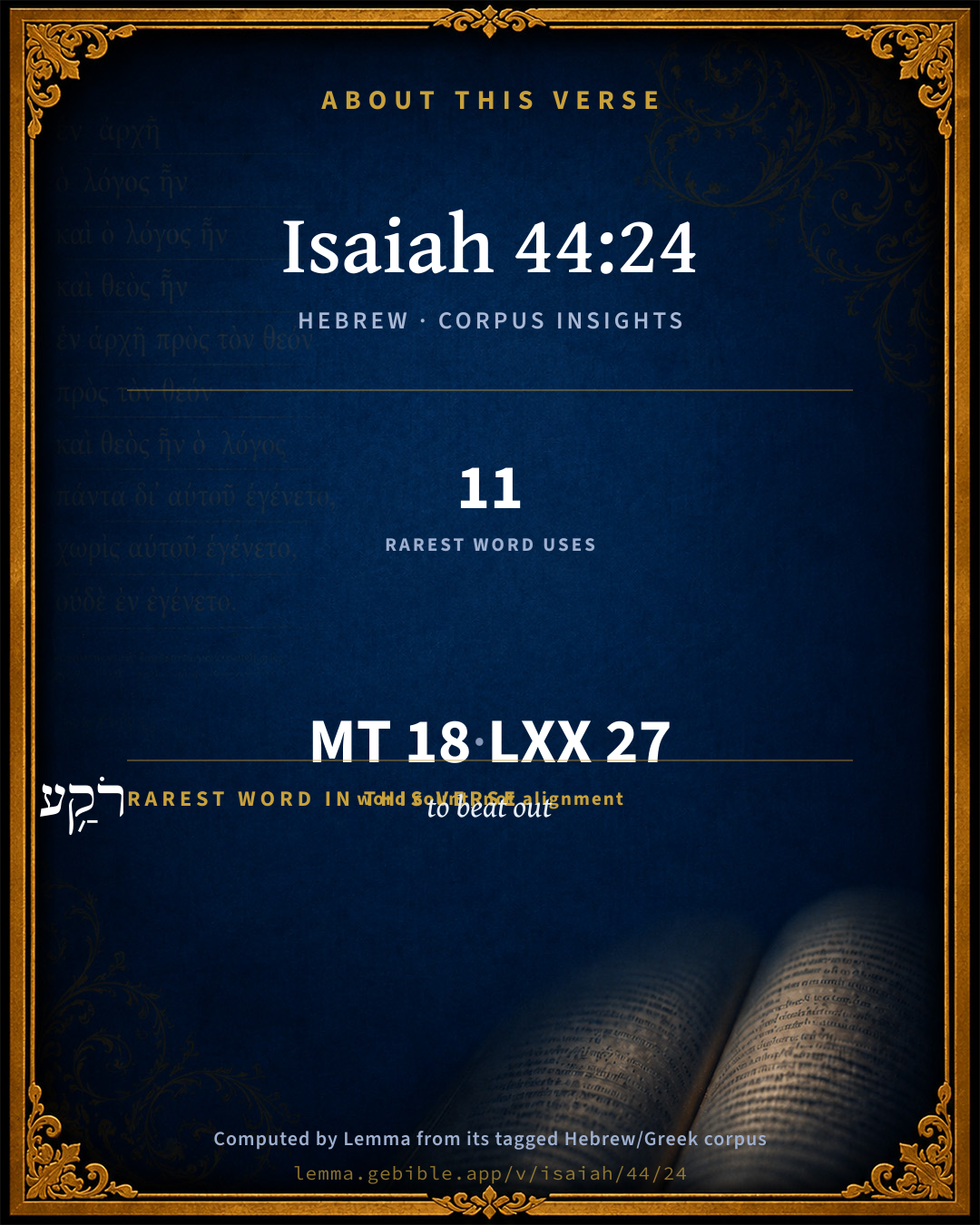
About this verse

These counts appear in no published source. They are computed here, from the morphology-tagged text and Lemma’s own curated glosses. What Lemma adds →

18
words
16
distinct lemmas
Prophets
section

Notable vocabulary

The rarest word here is רֹקַ֥ע to beat out H7554 — appearing just 11 times in the whole Hebrew Bible.

Shared distinctive vocabulary

רֹקַ֥ע to beat out H7554 occurs in 11 verses of the Hebrew Bible. Also found in:

Grammatical profile

  • 6 verbs
  • 8 nouns
  • 1 pronoun
  • 2 prepositions
  • 1 adverb

Verb forms

  • אָמַ֤ר Qal · Perfect
  • גֹּאֲלֶ֔ךָ Qal · Participle Active
  • וְיֹצֶרְךָ֖ Qal · Participle Active
  • עֹ֣שֶׂה Qal · Participle Active
  • נֹטֶ֤ה Qal · Participle Active
  • רֹקַ֥ע Qal · Participle Active

Repetition

Words recur within this verse — often emphatic in Hebrew:

  • יְהוָה֙ LORD H3068 ×2
  • אתי with H854 ×2

Hebrew & Septuagint length

In English translation the verse runs 35 words from the Hebrew and 32 from the Septuagint (LXX English) — closely comparable.

A rough comparison of the two English renderings, which tokenize alike — not a word-level alignment.

Word counts can differ between the Hebrew and the Greek without any difference in meaning — e.g. the Hebrew direct-object marker אֵת has no separate Greek word, and Greek often adds the article ὁ.

In the original languages it is 18 Hebrew tokens and 27 Greek tokens — but the two are counted differently (Hebrew bundles its prefixes and suffixes into one token; the Greek is in lemma form), so that isn’t a like-for-like length.

Cross-references

37

Topical passages linked to Isaiah 44:24 in the Treasury of Scripture Knowledge — connected by theme and wording, ordered by reader-vote popularity; previews shown in the World English Bible.

  • Isaiah 42:5 Thus says God Yahweh, he who created the heavens, and stretched them forth; he who spread abroad the earth and that which comes out of it; he who gives breath to the people on it, and spirit to those who walk therein:
  • Isaiah 45:12 I have made the earth, and created man on it: I, even my hands, have stretched out the heavens; and all their host have I commanded.
  • Isaiah 54:5 For your Maker is your husband; Yahweh of Hosts is his name: and the Holy One of Israel is your Redeemer; the God of the whole earth shall he be called.
  • Isaiah 45:18 For thus says Yahweh who created the heavens, the God who formed the earth and made it, who established it and didn't create it a waste, who formed it to be inhabited: I am Yahweh; and there is no one else.
  • Isaiah 44:2 Thus says Yahweh who made you, and formed you from the womb, who will help you: Don't be afraid, Jacob my servant; and you, Jeshurun, whom I have chosen.
  • Job 9:8 Who alone stretches out the heavens, Treads on the waves of the sea;
  • Isaiah 43:14 Thus says Yahweh, your Redeemer, the Holy One of Israel: For your sake I have sent to Babylon, and I will bring down all of them as fugitives, even the Chaldeans, in the ships of their rejoicing.
  • Isaiah 51:13 and have forgotten Yahweh your Maker, who stretched forth the heavens, and laid the foundations of the earth; and fear continually all the day because of the fury of the oppressor, when he makes ready to destroy? and where is the fury of the oppressor?
  • Revelation 5:9 They sang a new song, saying, "You are worthy to take the book, And to open its seals: For you were killed, And bought us for God with your blood, Out of every tribe, language, people, and nation,
  • Isaiah 40:22 [It is] he who sits above the circle of the earth, and the inhabitants of it are as grasshoppers; who stretches out the heavens as a curtain, and spreads them out as a tent to dwell in;
  • Job 26:7 He stretches out the north over empty space, And hangs the earth on nothing.
  • Isaiah 43:1 But now thus says Yahweh who created you, Jacob, and he who formed you, Israel: Don't be afraid, for I have redeemed you; I have called you by your name, you are mine.
  • Isaiah 44:6 Thus says Yahweh, the King of Israel, and his Redeemer, Yahweh of Hosts: I am the first, and I am the last; and besides me there is no God.
  • Isaiah 48:13 Yes, my hand has laid the foundation of the earth, and my right hand has spread out the heavens: when I call to them, they stand up together.
  • Jeremiah 51:15 He has made the earth by his power, he has established the world by his wisdom, and by his understanding has he stretched out the heavens:
  • John 1:3 All things were made through him. Without him was not anything made that has been made.
  • Ephesians 3:9 and to make all men see what is the administration of the mystery which for ages has been hidden in God, who created all things through Jesus Christ;
  • Colossians 1:16–17 For by him were all things created, in the heavens and on the earth, things visible and things invisible, whether thrones or dominions or principalities or powers; all things have been created through him, and for him.
  • Hebrews 1:2 has at the end of these days spoken to us by his Son, whom he appointed heir of all things, through whom also he made the worlds.
  • Hebrews 1:10–12 And, "You, Lord, in the beginning, laid the foundation of the earth. The heavens are the works of your hands.
  • Psalms 104:2 He covers himself with light as with a garment. He stretches out the heavens like a curtain.
  • Galatians 1:15 But when it was the good pleasure of God, who separated me from my mother's womb, and called me through his grace,
  • Isaiah 49:1 Listen, isles, to me; and listen, you peoples, from far: Yahweh has called me from the womb; from the bowels of my mother has he made mention of my name:
  • Isaiah 63:16 For you are our Father, though Abraham doesn't know us, and Israel does not acknowledge us: you, Yahweh, are our Father; our Redeemer from everlasting is your name.
  • Jeremiah 50:34 Their Redeemer is strong; Yahweh of Hosts is his name: he will thoroughly plead their cause, that he may give rest to the earth, and disquiet the inhabitants of Babylon.
  • Psalms 71:6 I have relied on you from the womb. You are he who took me out of my mother's womb. I will always praise you.
  • Psalms 78:35 They remembered that God was their rock, The Most High God their redeemer.
  • Psalms 139:13–16 For you formed my inmost being. You knit me together in my mother's womb.
  • Isaiah 43:7 everyone who is called by my name, and whom I have created for my glory, whom I have formed, yes, whom I have made.
  • Isaiah 59:20 A Redeemer will come to Zion, and to those who turn from disobedience in Jacob, says Yahweh.
  • Isaiah 60:16 You shall also suck the milk of the nations, and shall suck the breast of kings; and you shall know that I, Yahweh, am your Savior, and your Redeemer, the Mighty One of Jacob.
  • Job 31:15 Didn't he who made me in the womb make him? Didn't one fashion us in the womb?
  • Isaiah 46:3–4 Listen to me, house of Jacob, and all the remnant of the house of Israel, that have been borne [by me] from their birth, that have been carried from the womb;
  • Isaiah 48:17 Thus says Yahweh, your Redeemer, the Holy One of Israel: I am Yahweh your God, who teaches you to profit, who leads you by the way that you should go.
  • Isaiah 49:7 Thus says Yahweh, the Redeemer of Israel, [and] his Holy One, to him whom man despises, to him whom the nation abhors, to a servant of rulers: Kings shall see and arise; princes, and they shall worship; because of Yahweh who is faithful, [even] the Holy One of Israel, who has chosen you.
  • Isaiah 49:26 I will feed those who oppress you with their own flesh; and they shall be drunken with their own blood, as with sweet wine: and all flesh shall know that I, Yahweh, am your Savior, and your Redeemer, the Mighty One of Jacob.
  • Isaiah 54:8 In overflowing wrath I hid my face from you for a moment; but with everlasting loving kindness will I have mercy on you, says Yahweh your Redeemer.

Cross-references courtesy of OpenBible.info (CC BY 4.0).

Hebrew and Greek witnesses Masoretic Hebrew ↔ Greek Septuagint

The same verse in the two great witnesses to the Old Testament, shown verse-for-verse.

These are two independent witnesses, not word-aligned to each other, and the Septuagint is shown in lemma (dictionary) form.

Hebrew Isaiah 44:24 Masoretic · Westminster Leningrad Codex

כֹּֽה אָמַ֤ר יְהוָה֙ גֹּאֲלֶ֔ךָ וְיֹצֶרְךָ֖ מִבָּ֑טֶן אָנֹכִ֤י יְהוָה֙ עֹ֣שֶׂה כֹּ֔ל נֹטֶ֤ה שָׁמַ֨יִם֙ לְבַדִּ֔י רֹקַ֥ע הָאָ֖רֶץ מי אתי מֵאִתִּֽי

Thus says Yahweh, your Redeemer, and he who formed you from the womb: I am Yahweh, who makes all things; who stretches forth the heavens alone; who spreads abroad the earth (who is with me?);

World English Bible · Public Domain

Greek LXX Isaiah 44:24 Septuagint · lemma form

οὕτως λέγω κύριος ὁ λυτρόω σύ καί ὁ πλάσσω σύ ἐκ κοιλία ἐγώ κύριος ὁ συντελέω πᾶς ἐκτείνω ὁ οὐρανός μόνος καί στερεόω ὁ γῆ τίς ἕτερος

Thus says the Lord that redeems you, and who formed you from the womb, I am the Lord that performs all things: I stretched out the heaven alone, and established the earth.

LXX2012 (modern English Septuagint) · Public Domain

On this verse, Keil & Delitzsch discusses the Septuagint’s reading. Read the note in Commentary ↓

Hebrew: Westminster Leningrad Codex (CC BY 4.0). Greek: Septuagint (public domain); English from LXX2012 (modern English Septuagint) (Public Domain). How the Septuagint differs from the Hebrew →

Targum (Aramaic paraphrase)

1

The Targum is the ancient Jewish Aramaic paraphrase of the Hebrew Scriptures — an interpretive translation, not the Hebrew text itself. Onkelos (literal) and Pseudo-Jonathan (expansive) render the Torah, and Jonathan the Prophets. Coverage is partial: where no permissively-licensed English translation exists for a verse, only the Aramaic is shown. This is verse-level text, not a word-by-word alignment to the Hebrew.

  1. Targum Jonathan Prophets (Joshua–Malachi)
    כִּדְנַן אֲמַר יְיָ דְפַרְקָךְ וּדְאַתְקְנָךְ מִמְעַיִין אֲנָא יְיָ עָבֵיד כּוֹלָא תְּלֵית שְׁמַיָא בְּמֵימְרִי שַׁכְלְלֵית אַרְעָא בִּגְבוּרְתִּי:

    Thus saith the Lord, who hath redeemed thee, and who hath prepared thee from the womb, I am the Lord that maketh all things, I have suspended the heavens by my WORD, I have laid the foundations of the earth by my strength;

    Targum Jonathan — Aramaic: “Mikraot Gedolot” (public domain). English: “Sefaria Community Translation” (CC0 1.0 (public-domain dedication)); “London "Chaldee Paraphrase," 1871” (public domain). Text via Sefaria.

Commentary

Notes on Isaiah 44:24 from classic Christian and Jewish commentators (each source and its license shown beneath its notes). The classic Christian expositions comment on the surrounding passage and are grouped to its opening verse, so a note may address several verses; the Jewish commentaries on the Tanakh (Rashi and others) are per-verse, so they appear only where the commentator wrote on this verse.

Lemma curates 59 commentaries, every one of them public domain or Creative Commons licensed, each selected and text-cleaned for this edition rather than reprinted as found. About our sources →

Trapp's Complete Commentary

John Trapp

Isa 44:24 Thus saith the LORD, thy redeemer, and he that formed thee from the womb, I [am] the LORD that maketh all [things]; that stretcheth forth the heavens alone; that spreadeth abroad the earth by myself;

Ver. 24. Thus saith the Lord, thy Redeemer.] All this God had said oft before, see Isa 42:5; but, for the further confirmation of some who were unsettled by the contrary predictions of some vain diviners and wizards, he saith it over again.

John Trapp, A Commentary or Exposition upon All the Books of the Old and New Testament (1647–1656) — public domain. Text from a community e-Sword module.

The Biblical Illustrator

Joseph S. Exell

Isa_44:24

I am the Lord that maketh all things

The Maker of heaven and earth

Our object is, not so much to discover from the creation the truth of the being and character of the Creator, as to see how the Christian belief in Him as Maker must influence us about the world He has made.

Trust Him as the Fatherly God, who is indeed Maker of heaven and earth, and what will follow?

I. SUCH A TRUST WILL ENSURE YOUR RIGHT ATTITUDE WITH REGARD TO SCIENCE.

1. It will free you from all alarm as to the contradictions between science and the Scripture.

2. But our Christian belief should not only take away all dread of science, it should inspire its earnest pursuit. For it is the study of the work of God; a solution of His problems. The stars gleam with the glory of God, the flowers are fragrant with His sweetness; so that astronomy and botany, as well as all the sciences, have been well called sections of theology.

II. SUCH A TRUST IN GOD AS THE MAKER OF HEAVEN AND EARTH QUALIFIES YOU FOR RIGHT USE AND ENJOYMENT OF NATURE. He who believes in the Creator with all his heart will be altogether a different man in trade or travel, in manufacture of the earths productions, search into her secrets, or enjoyment of her scenery, from the man who darkly doubts--not to say from the man who impiously denies. For such a belief excludes the Manichaean heresy, that matter is the creation of evil. It gives to man that vision and voice about nature that were vouchsafed to Peter when he was taught to call nothing common or unclean. He who has the spirit of Jesus Christ, who is reconciled by Him and taught by Him about God, will cherish Christs spirit about nature.

III. SUCH A TRUST IN GOD INSPIRES WITH HOPE ABOUT THE DESTINY OF CREATION. There is much that is saddening and bewildering in some of the aspects of creation. The whole creation groaneth and travaileth in pain. In the midst of such reflections, a great hope glows in the heart that believes in God as the maker of heaven and earth. For then He is not only seen as a Redeemer mercifully interposing to alleviate misfortune and to restore some from ruin; but He is known to be the utterly good God, whose goodness is over all His works, over creation as much as over redemption. He is a faithful Creator. He will care for His own; will bring it to the destiny for which He made it.

IV. SUCH A TRUST IN GOD IS COMPLETELY POSSIBLE THROUGH OUR LORD JESUS CHRIST. Jesus has to do with nature, with us, and with God. He is the Door into nature. Connect all with Jesus, and we shall connect all with God. (U. R. Thomas, B. A.)

The Biblical Illustrator, edited by Joseph S. Exell (c. 1880s–1900s) — public domain. Text from a community e-Sword module.

Joseph Benson's Commentary

Isa 44:24-27. I am the Lord that maketh all things — And therefore I can save thee without the help of any other gods, or any creature; that frustrateth the tokens of the liars — Of the magicians and astrologers, who were numerous and greatly esteemed in Babylon, and who had foretold the long continuance and prosperity of the Chaldean empire. And maketh the diviners mad — With grief for the disappointment of their predictions, and their disgrace which followed it. That turneth wise men backward — Stopping their way, and blasting their designs. That confirmeth the word of his servants — The prophets, as appears from the next clause, namely, Isaiah, Jeremiah, and others, whom God sent to foretel the destruction of Babylon, and the redemption of his people. The connection of this with Isa 44:25, is, As God discovers the folly and madness of such false prophets, so he punctually fulfils the predictions of his own prophets. That saith to the deep, Be dry — That with a word can dry up the sea and rivers, and remove all impediments. “Cyrus took Babylon by laying the bed of the Euphrates dry, and leading his army into the city by night, through the empty channel of the river. This remarkable circumstance, in which the event so exactly corresponded with the prophecy, was also noted by Jeremiah. A drought shall be upon her waters, and they shall be dried up: I will lay her sea dry; and I will scorch up her springs, Jer 50:38; Jer 51:36. It is proper here to give some account of the method by which the stratagem of Cyrus was effected. The Euphrates, in the middle of summer, from the melting of the snows on the mountains of Armenia, like the Nile, overflows the country. In order to diminish the inundation, and carry off the waters, two canals were made by Nebuchadnezzar a hundred miles above the city; the first on the eastern side, called Naharmalca, or the Royal river, by which the Euphrates was let into the Tigris; the other on the western side, called Pallacopas, or Naharaga, (Hebrew, נהר אגם, the river of the pool,) by which the redundant waters were carried into a vast lake, forty miles square, contrived, not only to lessen the inundation, but for a reservoir, with sluices to water the barren country on the Arabian side. Cyrus, by turning the whole river into the latter lake, laid the channel, where it ran through the city, almost dry; so that his army entered it both above and below by the bed of the river, the water not reaching above the middle of the thigh. By the great quantity of water let into the lake, the sluices and dams were destroyed; and being never repaired afterward, the waters spread over the whole country below, and reduced it into a morass, in which the river is lost.” — Bishop Lowth.

Joseph Benson's Commentary on the Old and New Testaments (1811–1818) — public domain. Text from a community e-Sword module.

Keil & Delitzsch

C. F. Keil & F. Delitzsch

The promise takes a new turn here, acquiring greater and greater speciality. It is introduced as the word of Jehovah, who first gave existence to Israel, and has not let it go to ruin. "Thus saith Jehovah, thy Redeemer, and He that formed thee from the womb, I Jehovah am He that accomplisheth all; who stretched out the heavens alone, spread out the earth by Himself; who bringeth to nought the signs of the prophets of lies, and exposeth the soothsayers as raging mad; who turneth back the wise men, and maketh their science folly; who realizeth the word of His servant, and accomplisheth the prediction of His messengers; who saith to Jerusalem, She shall be inhabited! and to the cities of Judah, They shall be built, and their ruins I raise up again! who saith to the whirlpool, Dry up; and I dry its streams! who saith to Koresh, My shepherd and he will perform all my will; and will say to Jerusalem, She shall be built, and the temple founded!" The prophecy which commences with Isa 44:24 is carried on through this group of vv. in a series of participial predicates to אנכי (I) Jehovah is ‛ōseh kōl, accomplishing all (perficiens omnia), so that there is nothing that is not traceable to His might and wisdom as the first cause. It was He who alone, without the co-operation of any other being, stretched out the heavens, who made the earth into a wide plain by Himself, i.e., so that it proceeded from Himself alone: מאתּי, as in Jos 11:20 (compare מני, Isa 30:1; and mimmennı̄ in Hos 8:4), chethib אתּי מי, "who was with me," or "who is it beside me?" The Targum follows the keri; the Septuagint the chethib, attaching it to the following words, τίς ἕτερος διασκεδάσει. Isa 44:25 passes on from Him whom creation proves to be God, to Him who is proving Himself to be so in history also, and that with obvious reference to the Chaldean soothsayers and wise men (Isa 47:9-10), who held out to proud Babylon the most splendid and hopeful prognostics. "Who brings to nought (mēphēr, opp. mēqı̄m) the signs," i.e., the marvellous proofs of their divine mission which the false prophets adduced by means of fraud and witchcraft. The lxx render baddı̄m, ἐγγαστριμύθων, Targ. bı̄dı̄n (in other passages = 'ōb, Lev 20:27; 'ōbōth, Lev 19:31; hence = πύθων πύθωνες). At Isa 16:6 and Job 11:3 we have derived it as a common noun from בּדה = בּטא, to speak at random; but it is possible that בּדה may originally have signified to produce or bring forth, without any reference to βαττολογεῖν, then to invent, to fabricate, so that baddı̄m as a personal name (as in Jer 50:36) would be synonymous with baddâ'ı̄m, mendaces. On qōsemı̄m, see Isa 3:2; on yehōlēl, (Job 12:17, where it occurs in connection with a similar predicative description of God according to His works.

Keil & Delitzsch — Biblical Commentary on the Old Testament (1861–1891) — public domain (CC PDM 1.0). Text via the HelloAO Bible API. (Old Testament only.)

Tyndale Open Study Notes

Tyndale Open Resources

44:24–45:8 The Lord alone is sovereign over history. He raised up Cyrus of Persia to execute judgment on Babylon and restore Israel to the Holy Land.

Tyndale Open Study Notes — © Tyndale Open Resources, licensed CC BY-SA 4.0. Text via the HelloAO Bible API.

Jamieson, Fausset & Brown

Robert Jamieson, A. R. Fausset & David Brown

Confirmation of His promises to the Church and Israel, by various instances of His omnipotence; among these the restoration of the Jews by Cyrus.

alone--literally, "Who was with Me?" namely, when I did it; answering to "by Myself," in the parallel clause (compare similar phrases, Hos 8:4; Joh 5:30) [MAURER].

Jamieson, Fausset & Brown — Commentary Critical and Explanatory on the Whole Bible (1871) — public domain (CC PDM 1.0). Text via the HelloAO Bible API.

Adam Clarke's Commentary

Verse 24. By myself] Thirteen MSS., six ancient, confirm the reading of the Keri, מאתי meittai.

Adam Clarke's Commentary on the Bible (1810–1826) — public domain. Text from a community e-Sword/MySword module.

Ellicott's Commentary for English Readers

(24) Thus saith the Lord.—A new section begins, which is carried on to the end of Isaiah 45. The contrast between the foreknowledge of Jehovah and the no-knowledge of the worshippers of idols culminates in the proclamation, in Isa_44:28, of the name of the deliverer and his restoration of the Temple.

That spreadeth abroad the earth by myself.—The Hebrew written text gives the more emphatic reading: that spreadeth forth the earth; who was with me? (Comp. Isa_40:13; Isa_63:3; and Job_9:8.)

A Bible Commentary for English Readers, edited by Charles John Ellicott (1878–1897) — public domain. Text from a community e-Sword module.

The Cambridge Bible for Schools and Colleges

gen. ed. J. J. S. Perowne

24–28. Jehovah, the God of creation and of prophecy, has chosen Cyrus to execute his purpose with regard to Israel.

thy redeemer] See on ch. Isa_41:14. formed thee from the womb] as in Isa_44:2.

that stretcheth … alone] Cf. ch. Isa_40:22; Isa_42:5; Job_9:8.

by myself] The A.V. here follows the reading presupposed by the vowel-points (Qìrê). The R.V. rightly goes back to the consonantal text (Kĕthîb) which is preserved in the LXX. and Vulg. and some Hebrew MSS. Render accordingly: who was with me? i.e. there was none to help me.

The Cambridge Bible for Schools and Colleges (gen. ed. J. J. S. Perowne; Cambridge University Press, 1878–1918) — public domain. Text from a community e-Sword module.

John Gill's Exposition

Thus saith the Lord, thy Redeemer,.... These are the words of the Son of God, of Christ, the Redeemer of his people; and the following show him to be the mighty God, and so able to redeem them, and therefore was appointed to this work, and undertook it:

and he that formed thee from the womb; that formed thee in it, and brought thee out of it, separated thee from it, and called thee by his grace:

I am the Lord that maketh all things; that made all things out of nothing at first; for without Christ was not anything made that was made; all things in heaven, and earth, and sea, were made by him; and he continues all creatures in their being, and provides for them, and governs all by his power; he works hitherto, and continues working with his divine Father, Joh 1:1,

that stretcheth forth the heavens alone, that spreadeth abroad the earth by myself; not to the exclusion of the Father and the Holy Spirit, but of all creatures, angels and men; of himself, and by his own strength and power, and, without the help of these, he stretched out the vast space of the heavens as a curtain, and spread out the earth in its length and breadth, and the large surface of it, to that great circumference which it has; a full proof of his proper deity! A man cannot stretch out a curtain, or piece of tapestry, of any size, without the help of another; and much less can a creature stretch out the heavens and the earth.

John Gill's Exposition of the Whole Bible (1746–1763) — public domain (CC PDM 1.0). Text via the HelloAO Bible API.

Albert Barnes' Notes on the Bible

Thy Redeemer - (See the note at Isa 43:1).

And he that formed thee from thee womb - (See the note at Isa 44:2).

That stretcheth forth the heavens - (See the note at Isa 40:22).

That spreadeth abroad the earth - Representing the earth, as is often done in the Scriptures, as a plain. God here appeals to the fact that he alone had made the heavens and the earth, as the demonstration that he is able to accomplish what is here said of the deliverance of his people. The same God that made the heavens is the Redeemer and Protector of the church, and therefore the church is safe.

Albert Barnes' Notes on the Bible (1834–1885) — public domain. Text from a community e-Sword/MySword module.

Matthew Poole's English Annotations

That formed thee from the womb; of which phrase See Poole "Isa 44:2".

That maketh all things, & c.; and therefore I can save thee without the help of any other gods or men.

Matthew Poole's English Annotations on the Holy Bible (1683–1685) — public domain. Text from a community e-Sword/MySword module.

Whedon's Commentary on the Bible

Daniel D. Whedon

24-28. The remaining verses of the chapter virtually make a single paragraph, unbroken in sense; the sense being a confirmation of the divine promises to Israel — that is, to the Church — by instances cited of God’s omnipotence exercised in Israel’s peculiar behalf. They are the original forming of Israel by the Maker of all things, who made the heavens, (as well as man,) and phenomenally spread them out; and the earth also.

By myself — That is, by himself alone, no one being in existence besides him.

Frustrateth the tokens of the liars — Putting diviners to flight and shame; but, on the other hand, aiding his servants the prophets to foretell that Jerusalem shall be built, and Zion again occupied.

That saith to the deep, Be dry — Removeth all barriers to the return, seas and rivers opening dry passages therefor, (referring to Israel’s history, first at the Red Sea and the Jordan, and last at the Euphrates,) and who, at last, names the deliverer, Cyrus, God’s fold-builder for the flock.

CONTINUATION IN REGARD TO CYRUS.

The mention of Cyrus by name at the close (Isa_44:28) of an array of divine titles and perfections is no trivial circumstance — no dim prediction of this personage — one hundred and seventy years before his coming. There is significance in his coming and in his reign at such a time of the greatest importance to the world’s civilization. The character of Cyrus is variously drawn in the fragments of the old histories, but in none of them is there any thing otherwise than what, in the hands of divine providence, he could have been with full free will shaped to be a coadjutor of Jehovah — the Lord’s servant. Prior to his connexion with the Jews he is represented as a great conqueror and organizer, but not wanting in humane and noble feelings toward his subjects — to the Jews especially: who, both as colonists in Palestine and as citizens and residents in the East, adhered patriotically to him amid all attempted revolts.

The liberation from exile was a thing small, indeed, in itself, when compared with the other great events of his reign, yet it ranks with the greatest events as seen in its issues to mankind. Naturally endowed with great special gifts, and these sanctified measurably by the divinity which rules over as well as in men, he was prepared to be thus “the anointed of Jehovah” in the special work of furthering the redemption of mankind.

Speculations as to the name Cyrus, from Kur or Kuru, (Persian,) and this Hebraized in Koresh, may be waived; but the ancient references to him may well be noted as to his character. Eschylus (Persae) says, “He was naturally gentle;” Plutarch and Diodorus preserve traditions greatly favourable. Josephus also. Thus he was eminently fitted to facilitate the progress of the redemptive work of Christ. Melchizedec and Cyrus (both of them Gentiles outside the sacred enclosure from Abraham) were certainly proper to be called types of Christ at points in which they shadowed the Christ-like character. How came Cyrus to so touch at those points? By direct providential ordering leading to his consent to be so fashioned of God.

God “raised him up in righteousness.” (Isa_45:13.) God chose him “to perform his will in Babylon.” (Isa_48:14.) See also 2Ch_36:22-23, and first verse in Ezra 1. Not unlikely Cyrus was in direct communication with Daniel (So Josephus.) Doubtless Cyrus was not a polytheist. His religion, (if that were Zoroastrianism,) did not allow it as heathenism allows it. It is conceivable that, through Daniel, those chapters in Isaiah were exhibited to Cyrus. Daniel, though then, it may be, in his last years, could not but be serviceable and influential with the young conqueror; for Daniel was a sage, a statesman, a tried man as to his own religion, and so far himself also a conqueror.

Daniel D. Whedon (gen. ed.), Commentary on the Old and New Testaments (1874–1909) — public domain. Text from a community e-Sword module.

The Pulpit Commentary

Thus saith the Lord. This is not a new prophecy entirely unconnected with the preceding, as Delitzsch supposes, lint a declaration to which the prophet has been working up, and which he intends as the crown and climax of all that he has been announcing with respect to Israel"s deliverance. Not only is the deliverance absolutely determined on in God"s counsels, but the Deliverer himself is already chosen and designated. He that formed thee from the womb (comp. ver. 2). I am the Lord that maketh all things rather, I the Lord am he that doeth all things; i.e. I am he that executeth whatever he designsthat stretcheth forth the heavens alone, (comp. Job_9:8) that spreadeth abroad the earth by myself. God did not delegate the creation of the heaven and the earth to an inferior spirit, a dhmiourgov , as the Greeks generally taught. He did not even call in the co operation of a helper. Singly and solely by his own power he created all things.

The Pulpit Commentary (1880–1919), ed. H.D.M. Spence-Jones & Joseph S. Exell — public domain. Text from a community e-Sword module.

J. A. Alexander on Isaiah

Joseph Addison Alexander

“Thus saith Jehovah thy redeemer, and thy former from the womb, I Jehovah, making all: stretching the heavens alone, spreading the earth by myself (or who was with me?).” Some refer thus saith to the preceding promises, and take all that follows until the end of the chapter as a description of the Being who uttered them. Others refer thus saith to what follows, supply the verb ‘am’ before Jehovah, and regard the last clause of the verse as the divine declaration. A third conceivable construction would restrict it to the closing question, ‘who (is) with me?’ (i.e., who can claim equality or likeness with me?) ‘Who (is or was) with me?’ implying strong negation and equivalent in meaning to the affirmation, ‘there was no one with me.’

Joseph Addison Alexander, The Prophecies of Isaiah (1846–1847; New York: Scribner, 1870–1878) — public domain. Text from a community e-Sword module.

Kretzmann's Popular Commentary

Paul E. Kretzmann

The Promise to have Jerusalem Rebuilt

This section, according to a careful analysis, belongs to the next chapter, for it takes up the deliverance of Israel as effected in consequence of the decree of Cyrus.

v. 24. Thus saith the Lord, thy Redeemer, and He that formed thee from the womb, Cf v. 2: I am the Lord that maketh all things, the supreme Ruler and Guide of the universe, the Sovereign of the world and all it contains; that stretcheth forth the heavens alone, 40:22; 42:5; that spreadeth abroad the earth by Myself, without assistance,

v. 25. that frustrateth the tokens of the liars, of the vain talkers, especially the necromancers, and maketh diviners mad, so that they appear as fools with their false prophecies; that turneth wise men backward, so that they are relegated to the background, and maketh their knowledge foolish, exhibiting their ignorance before the whole world;

v. 26. that, by way of contrast, confirmeth the word of His servant, establishing the prophetic message which His prophets proclaimed, and performeth the counsel of His messengers, so that not one of His words falls to the ground; that saith to Jerusalem, Thou shalt be inhabited, rising once more out of the ruins, and to the cities of Judah, which had likewise been plundered and sacked, Ye shall be built, and I will raise up the decayed places thereof;

v. 27. that saith to the deep, in another exhibition of His power, Be dry, and I will dry up thy rivers, to serve His purpose at all times;

v. 28. that saith of Cyrus, the prophecy here giving the exact words of the Lord’s command to him as it came to pass more than a century later, He Is My shepherd, the designation referring to his leadership of nations, and shall perform all My pleasure, namely, in bringing about the deliverance of Israel; even saying to Jerusalem, Thou shalt be built, and to the Temple, Thy foundation shall be laid. This prophecy was literally fulfilled; for the rebuilding of the city of Jerusalem and of the Temple took place in accordance with the express command of Cyrus. That his name is mentioned so many years in advance need cause no more surprise than the fact that Josiah’s work of reformation was predicted at the time of Jeroboam I, more than three centuries intervening between prophecy and fulfillment. The God of prophecy is the omniscient God, before whom nothing is hidden.

Paul E. Kretzmann, Popular Commentary of the Bible (1921–1924) — public domain. Text from a community e-Sword module.

unfoldingWord translationNotes

Door43 World Missions Community

Redeemer

See how you translated this word in Isaiah 41:14.

he who formed you from the womb

Yahweh speaks of creating the nation of Israel as if it were forming the nation as a baby in its mother's womb. See how you translated a similar phrase in Isaiah 44:2. AT: "he who made you, as I form a baby in the womb" (See: Metaphor)

who alone stretched out the heavens

Yahweh speaks of creating the heavens as if they were fabric which he stretched out. See how you translated a similar phrase in Isaiah 42:5. (See: Metaphor)

omens

These are signs that people used to attempt to predict the future.

the empty talkers

This refers to people who say things that are meaningless.

translationWords

Yahweh

redeem

wise

advice

fool

unfoldingWord translationNotes — © Distant Shores Media and the Door43 World Missions Community, licensed CC BY-SA 4.0. Source: git.door43.org/Door43/en_tn.

Rashi

Rabbi Shlomo Yitzchaki (Rashi)

and the One Who formed you from the womb From the time that (Gen. 25:22) “the children struggled within her,” I was your help and I chose you.

Rashi on the Tanakh — English translations: “The Judaica Press complete Tanach with Rashi, translated by A. J. Rosenberg” (CC BY 4.0); “Pentateuch with Rashi's commentary by M. Rosenbaum and A.M. Silbermann, 1929-1934” (public domain); “The Metsudah Tanach series, Lakewood, N.J” (CC BY 4.0); and “The Book of Joshua, Metsudah Publications, 1997” (CC BY 4.0). Text via Sefaria.

Ibn Ezra

Rabbi Abraham ibn Ezra

That maketh all things, which I desire; you may infer it from the fact, that I, by myself, stretch forth the heaven.

מאתי By myself. Lit., from myself, that is, by my strength; for God is incorporeal. It is written in two words, מי אתי. who is with me, which is the same as I alone. Consider well the words of the text: who stretcheth forth the heavens and spreadeth abroad the earth; they teach us that it is God who is continually keeping heaven and earth in existence.

Ibn Ezra on the Tanakh — English translations: “Sefaria Community Translation” (CC0 1.0 (public-domain dedication)); “Yalkut, Sifsei Chachomim Chumash, Metsudah Publications, 2009” (CC BY 4.0); and “Commentary of Ibn Ezra on Isaiah - trans. by M. Friedlander, 1873” (public domain). Text via Sefaria.

Lesson kit

Teaching starters — assembled from the data on this page, not authored interpretation. Every prompt links to the verse data it draws on. Edit before teaching.

Isaiah, in the Prophets, opens this verse with 18 words (16 distinct Hebrew lemmas). Its most distinctive word is râqaʻ (“to beat out”). A historical commentator’s framing appears above. Read the whole chapter for the surrounding context.

Discussion questions

  1. What does “to beat out” (râqaʻ) contribute to the verse as a whole?
  2. How does Exodus 39:3, which shares the word «to beat out», read alongside this verse?
  3. What does the repetition of “LORD” (2× in this one verse) do in this verse?
  4. The translations on this page render this verse differently — a whole-verse word diff, not a word-by-word alignment. What might account for the different wordings?
  5. «אָמַ֤ר» is a Qal Perfect verb. How does that grammatical form shape the action described?
  6. Compare how Trapp's Complete Commentary and The Biblical Illustrator read this verse. Where do they agree or differ?

Things to notice

Reading settings

Reading text

Shown beneath each verse's original-language words.

Old Testament
Old Testament edition

Read the OT as the Masoretic Hebrew (MT) or the Greek Septuagint (LXX).

English shown for the Greek Septuagint (in the Hebrew ↔ Greek comparison).

Comparing translations? Open the Compare panel on any verse page to stack up to four side by side.