Isaiah 14:27

Hebrew (Westminster Leningrad Codex) Isaiah 14:27 appears in the Hebrew Old Testament. The text above is from the Westminster Leningrad Codex. Each word links to its Strong’s number, a concise gloss, and parsing drawn from the Open Scriptures Hebrew Bible morphology. Click any word for its full Brown-Driver-Briggs (BDB) entry.
Download image
Cite this verse

Isaiah 14:27 (World English Bible). Public Domain. Lemma interlinear Bible study tool, https://lemma.gebible.app/v/isaiah/14/27.

Show BibTeX & RIS
BibTeX
RIS
English Translation
For Yahweh of Hosts has purposed, and who shall annul it? and his hand is stretched out, and who shall turn it back?
World English Bible · Public Domain
Download a study sheet

One document with this verse’s original text, its word-by-word gloss line, the meaning frame, cross-references with their text, attributed commentary, and full source and license credits — printable, and it pastes into notes with its structure intact.

This verse Autodidact and up

Study sheet (.html) Plain text (.txt)

A passage Seminary Student

Up to 50 verses in one chapter. A passage sheet keeps up to 6 commentary sources and 12 cross-references per verse, in the order this page ranks them, and says so on the sheet whenever that leaves anything out. Ask for a single verse and you get the Autodidact verse sheet above.

Everything on this page stays free to read, with no account — the sheet is a download of what is already on screen, not access to it.

Want to remove ads? Support Godless Engineer
Compare translations 3

The same verse in 3 English versions, stacked beneath the original-language interlinear above. Click any original word for its lexicon entry.

Each is an independent rendering of the whole verse — the interlinear is not word-aligned to these translations.

Highlighted words mark where these versions differ — a whole-verse word diff, not a word-by-word alignment.

  • World English Bible Public Domain
    For Yahweh of Hosts has purposed, and who shall annul it? and his hand is stretched out, and who shall turn it back?
  • King James Version Public Domain
    For the LORD of hosts hath purposed, and who shall disannul it? and his hand is stretched out, and who shall turn it back?
  • unfoldingWord Literal Text CC BY-SA 4.0
    For Yahweh of Armies has determined, so who will thwart? And his hand stretched out, so who will turn it back?

unfoldingWord Literal Text — © unfoldingWord, licensed CC BY-SA 4.0. Word-aligned USFM3 via Door43 (git.door43.org/unfoldingWord/en_ult).

Versions to compare (up to 4)

3 of 4 selected

Show all 18 translations

Every available English version of this verse, each an independent rendering of the whole verse.

  • World English Bible Public Domain
    For Yahweh of Hosts has purposed, and who shall annul it? and his hand is stretched out, and who shall turn it back?
  • Berean Standard Bible Public Domain
    The LORD of Hosts has purposed, and who can thwart Him? His hand is outstretched, so who can turn it back?
  • Majority Standard Bible Public Domain
    The LORD of Hosts has purposed, and who can thwart Him? His hand is outstretched, so who can turn it back?
  • King James Version Public Domain
    For the LORD of hosts hath purposed, and who shall disannul it? and his hand is stretched out, and who shall turn it back?
  • American Standard Version (1901) Public Domain
    For Jehovah of hosts hath purposed, and who shall annul it? and his hand is stretched out, and who shall turn it back?
  • Revised Version (1885) Public Domain
    For the LORD of hosts hath purposed, and who shall disannul it? and his hand is stretched out, and who shall turn it back?
  • Geneva Bible (1599) Public Domain
    Because the Lord of hostes hath determined it, and who shall disanull it? and his hande is stretched out, and who shall turne it away?
  • Douay-Rheims (1899) Public Domain
    For the Lord of hosts hath decreed, and who can disannul it? and his hand is stretched out: and who shall turn it away?
  • Young's Literal Translation Public Domain
    For Jehovah of Hosts hath purposed, And who doth make void? And His hand that is stretched out, Who doth turn it back?'
  • Literal Standard Version CC BY-SA 4.0
    For YHWH of Hosts has purposed, || And who makes void? And His hand that is stretched out, || Who turns it back?”
  • Unlocked Literal Bible CC BY-SA 4.0
    For Yahweh of hosts has planned this; who will stop him? His hand is raised, and who will turn it back?
  • unfoldingWord Literal Text CC BY-SA 4.0
    For Yahweh of Armies has determined, so who will thwart? And his hand stretched out, so who will turn it back?
  • Darby Bible Public Domain
    For Jehovah of hosts hath purposed, and who shall frustrate [it]? And his hand is stretched out, and who shall turn it back?
  • World Messianic Bible Public Domain
    For the LORD of Hosts has planned, and who can stop it? His hand is stretched out, and who can turn it back?”
  • Webster's Bible Public Domain
    For the LORD of hosts hath purposed, and who shall disannul it? and his hand is stretched out, and who shall turn it back?
  • Free Bible Version CC BY-SA 4.0
    The Lord Almighty has made his plan, and who will block it? His hand stretches out, and who will push back against it?
  • Bible in Basic English Public Domain
    For it is the purpose of the Lord of armies, and who will make it of no effect? when his hand is stretched out, by whom may it be turned back?
  • JPS Tanakh (1917) Public Domain
    For the LORD of hosts hath purposed, and who shall disannul it? And His hand is stretched out, and who shall turn it back?

Literal Standard Version (2020), Covenant Press — licensed CC BY-SA 4.0. Text via the HelloAO Bible API (eBible.org). Unlocked Literal Bible (unfoldingWord) — licensed CC BY-SA 4.0. Text via the HelloAO Bible API (eBible.org). unfoldingWord Literal Text — © unfoldingWord, licensed CC BY-SA 4.0. Word-aligned USFM3 via Door43 (git.door43.org/unfoldingWord/en_ult). Free Bible Version, Dr. Jonathan Gallagher — licensed CC BY-SA 4.0. Text via the HelloAO Bible API (eBible.org).

Word by word

More ways to search: Search by grammar → Find every occurrence → Compare this word →

Practice this passage: Drill this verse → Learn its vocabulary →

יָפֵ֑ר
pârar
H6565
“to break”
Verb, Hiphil, Imperfect, 3rd Person, Masculine, Singular
Part of Speech
Verb
Stem
Hiphil
Form
Imperfect
Person
3rd Person
Gender
Masculine
Number
Singular
Full BDB Definition

Origin: a primitive root

TWOT: 1829 , 1830 , 1831

to break, frustrate - (Hiphil) - to break, violate - to frustrate, make ineffectual - (Hophal) - to be frustrated - to be broken - to break - (Pilpel) to break to bits, shatter - to split, divide - (Qal) to split, crack through - (Poel) to break apart - (Hithpoel) to be split, be cracked through
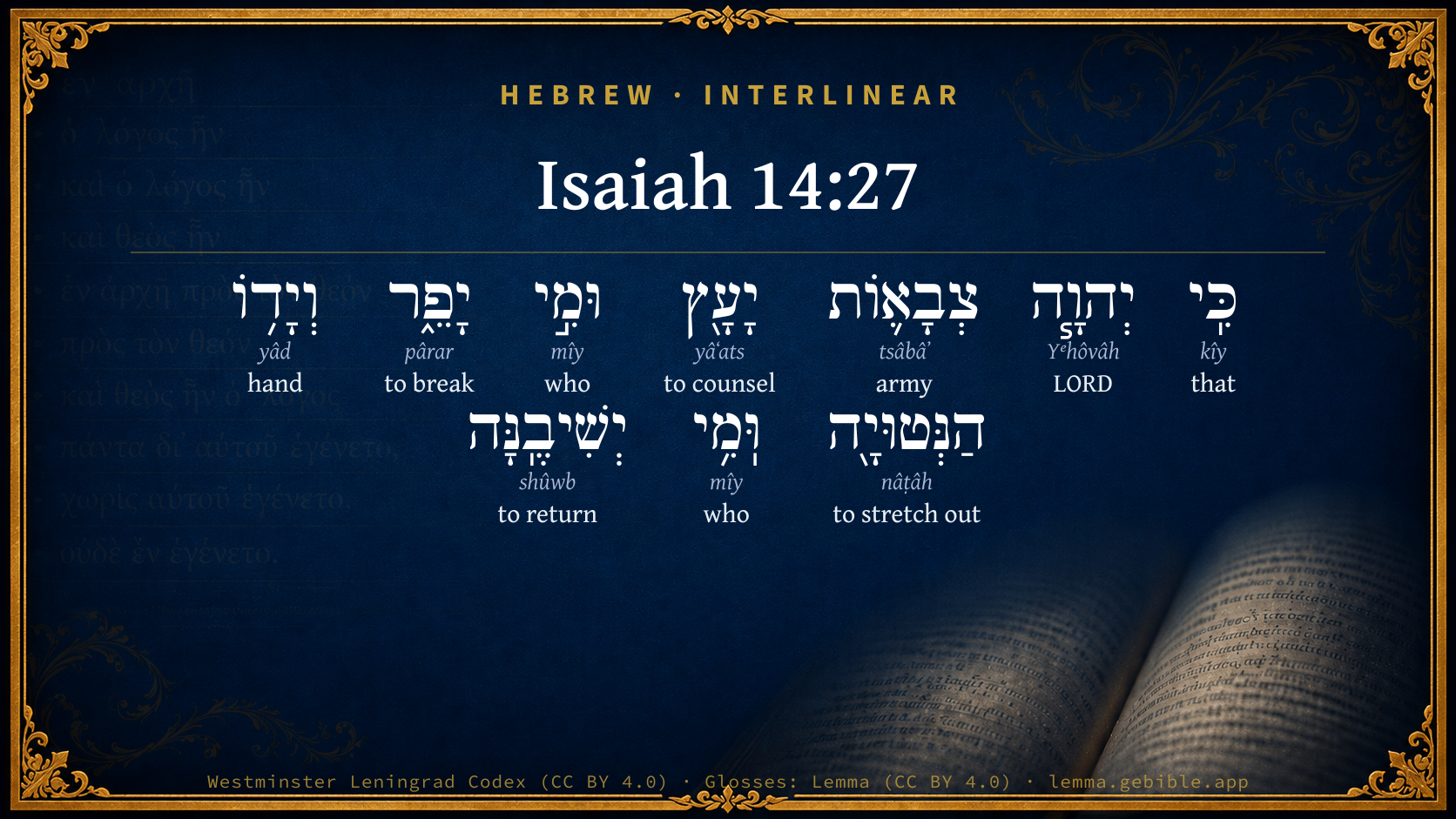
  1. כִּֽי kîy H3588 “that” Conjunction
  2. יְהוָ֧ה Yᵉhôvâh H3068 “LORD” Noun, Proper
  3. צְבָא֛וֹת tsâbâʼ H6635 “armies” Noun, Common, Both, Plural, Absolute
  4. יָעָ֖ץ yâʻats H3289 “to counsel” Verb, Qal, Perfect, 3rd Person, Masculine, Singular
  5. וּמִ֣י mîy H4310 “and · who” Conjunction + Particle, Interrogative
  6. וְיָד֥וֹ yâd H3027 “and · hand · his” Conjunction + Noun, Common, Both, Singular, Construct + Suffix, Personal, 3rd Person, Masculine, Singular
  7. הַנְּטוּיָ֖ה nâṭâh H5186 “the · stretched out” Particle, Definite Article + Verb, Qal, Participle Passive, Feminine, Singular, Absolute
  8. וּֽמִ֥י mîy H4310 “and · who” Conjunction + Particle, Interrogative
  9. יְשִׁיבֶֽנָּה shûwb H7725 “to return · her” Verb, Hiphil, Imperfect, 3rd Person, Masculine, Singular + Suffix, Personal, 3rd Person, Feminine, Singular

About this verse

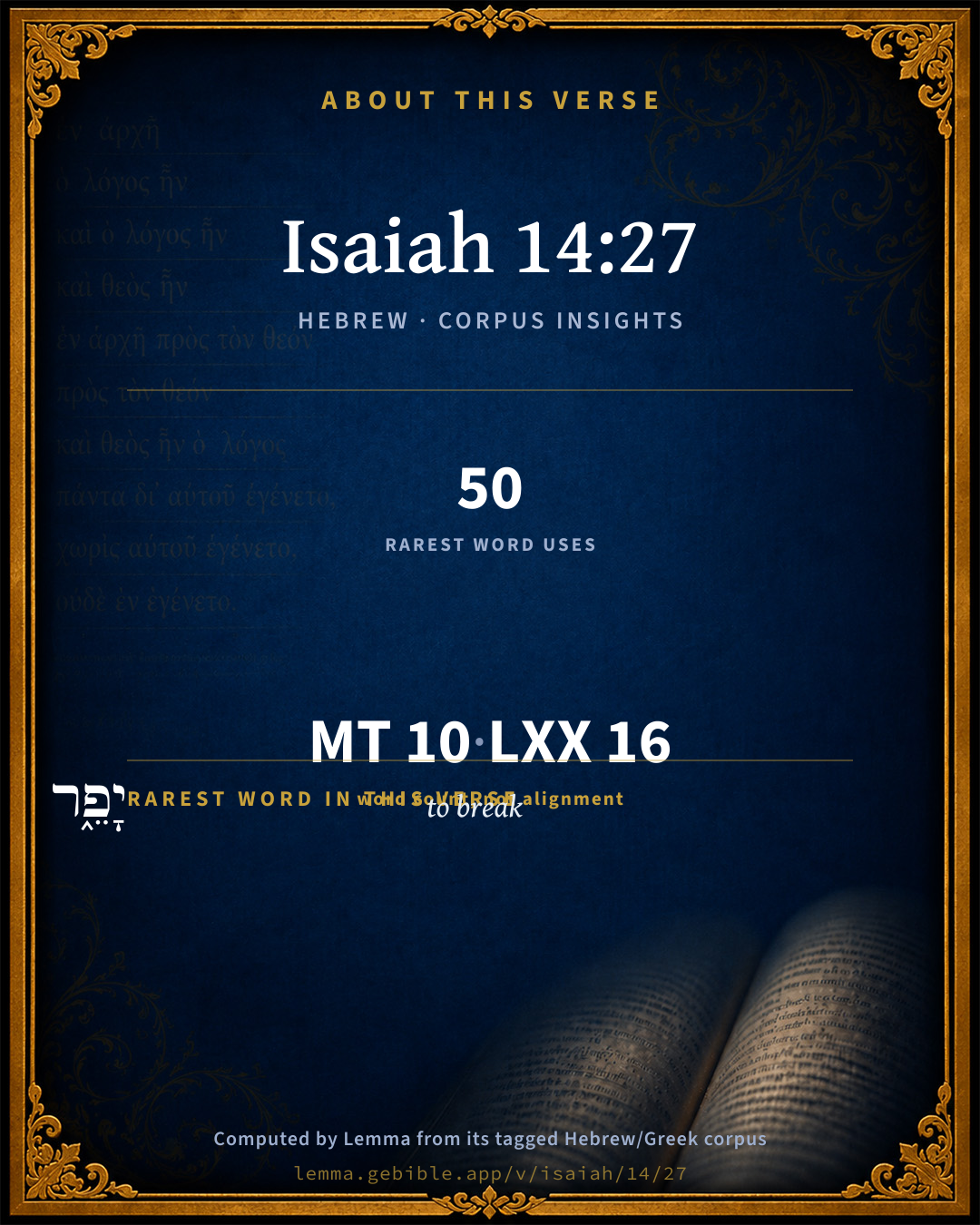
These counts appear in no published source. They are computed here, from the morphology-tagged text and Lemma’s own curated glosses. What Lemma adds →

10
words
9
distinct lemmas
Prophets
section

Shared distinctive vocabulary

יָפֵ֑ר to break H6565 occurs in 46 verses of the Hebrew Bible. Also found in:

Grammatical profile

  • 4 verbs
  • 3 nouns
  • 1 conjunction
  • 2 particles

Verb forms

  • יָעָ֖ץ Qal · Perfect
  • יָפֵ֑ר Hiphil · Imperfect
  • הַנְּטוּיָ֖ה Qal · Participle Passive
  • יְשִׁיבֶֽנָּה Hiphil · Imperfect

Repetition

A word recurs within this verse — often emphatic in Hebrew:

  • וּמִ֣י who H4310 ×2

Hebrew & Septuagint length

In English translation the verse runs 23 words from the Hebrew and 18 from the Septuagint (LXX English) — closely comparable.

A rough comparison of the two English renderings, which tokenize alike — not a word-level alignment.

Word counts can differ between the Hebrew and the Greek without any difference in meaning — e.g. the Hebrew direct-object marker אֵת has no separate Greek word, and Greek often adds the article ὁ.

In the original languages it is 10 Hebrew tokens and 16 Greek tokens — but the two are counted differently (Hebrew bundles its prefixes and suffixes into one token; the Greek is in lemma form), so that isn’t a like-for-like length.

Cross-references

15

Topical passages linked to Isaiah 14:27 in the Treasury of Scripture Knowledge — connected by theme and wording, ordered by reader-vote popularity; previews shown in the World English Bible.

  • Isaiah 43:13 Yes, since the day was I am he; and there is none who can deliver out of my hand: I will work, and who can hinder it?
  • Job 23:13 But he stands alone, and who can oppose him? What his soul desires, even that he does.
  • 2 Chronicles 20:6 and he said, Yahweh, the God of our fathers, aren't you God in heaven? and aren't you ruler over all the kingdoms of the nations? and in your hand is power and might, so that none is able to withstand you.
  • Proverbs 21:30 There is no wisdom nor understanding Nor counsel against Yahweh.
  • Job 9:12 Behold, he snatches away; who can hinder him? Who will ask him, 'What are you doing?'
  • Proverbs 19:21 There are many plans in a man's heart, But Yahweh's counsel will prevail.
  • Romans 8:28 We know that all things work together for good for those who love God, to those who are called according to his purpose.
  • Psalms 33:11 The counsel of Yahweh stands fast forever, The thoughts of his heart to all generations.
  • Romans 8:31 What then shall we say about these things? If God is for us, who can be against us?
  • Isaiah 46:11 calling a ravenous bird from the east, the man of my counsel from a far country; yes, I have spoken, I will also bring it to pass; I have purposed, I will also do it.
  • Jeremiah 4:28 For this shall the earth mourn, and the heavens above be black; because I have spoken it, I have purposed it, and I have not repented, neither will I turn back from it.
  • Isaiah 23:9 Yahweh of hosts has purposed it, to stain the pride of all glory, to bring into contempt all the honorable of the earth.
  • Job 40:8 Will you even annul my judgment? Will you condemn me, that you may be justified?
  • Daniel 4:31–35 While the word was in the king's mouth, there fell a voice from the sky, [saying], O king Nebuchadnezzar, to you it is spoken: The kingdom is departed from you:
  • Isaiah 9:12 the Syrians before, and the Philistines behind; and they shall devour Israel with open mouth. For all this his anger is not turned away, but his hand is stretched out still.

Cross-references courtesy of OpenBible.info (CC BY 4.0).

Hebrew and Greek witnesses Masoretic Hebrew ↔ Greek Septuagint

The same verse in the two great witnesses to the Old Testament, shown verse-for-verse.

These are two independent witnesses, not word-aligned to each other, and the Septuagint is shown in lemma (dictionary) form.

Hebrew Isaiah 14:27 Masoretic · Westminster Leningrad Codex

כִּֽי יְהוָ֧ה צְבָא֛וֹת יָעָ֖ץ וּמִ֣י יָפֵ֑ר וְיָד֥וֹ הַנְּטוּיָ֖ה וּֽמִ֥י יְשִׁיבֶֽנָּה

For Yahweh of Hosts has purposed, and who shall annul it? and his hand is stretched out, and who shall turn it back?

World English Bible · Public Domain

Greek LXX Isaiah 14:27 Septuagint · lemma form

ὅς γάρ ὁ θεός ὁ ἅγιος βουλεύω τίς διασκεδάζω καί ὁ χείρ ὁ ὑψηλός τίς ἀποστρέφω

For what the Holy God has purposed, who shall frustrate? and who shall turn back his uplifted hand?

LXX2012 (modern English Septuagint) · Public Domain

Hebrew: Westminster Leningrad Codex (CC BY 4.0). Greek: Septuagint (public domain); English from LXX2012 (modern English Septuagint) (Public Domain). How the Septuagint differs from the Hebrew →

Targum (Aramaic paraphrase)

1

The Targum is the ancient Jewish Aramaic paraphrase of the Hebrew Scriptures — an interpretive translation, not the Hebrew text itself. Onkelos (literal) and Pseudo-Jonathan (expansive) render the Torah, and Jonathan the Prophets. Coverage is partial: where no permissively-licensed English translation exists for a verse, only the Aramaic is shown. This is verse-level text, not a word-by-word alignment to the Hebrew.

  1. Targum Jonathan Prophets (Joshua–Malachi)
    אֲרֵי יְיָ צְבָאוֹת מְלַךְ וּמַן יַעְדֵי וּגְבוּרְתֵּיהּ מְרַמְמָא וְלֵית דִיתִיבִינֵיהּ:

    For the Lord of hosts has purposed, and who can remove it? yea, His power is exalted, and who can withstand it?

    Targum Jonathan — Aramaic: “Mikraot Gedolot” (public domain). English: “Sefaria Community Translation” (CC0 1.0 (public-domain dedication)); “London "Chaldee Paraphrase," 1871” (public domain). Text via Sefaria.

Commentary

Notes on Isaiah 14:27 from classic Christian and Jewish commentators (each source and its license shown beneath its notes). The classic Christian expositions comment on the surrounding passage and are grouped to its opening verse, so a note may address several verses; the Jewish commentaries on the Tanakh (Rashi and others) are per-verse, so they appear only where the commentator wrote on this verse.

Lemma curates 59 commentaries, every one of them public domain or Creative Commons licensed, each selected and text-cleaned for this edition rather than reprinted as found. About our sources →

Trapp's Complete Commentary

John Trapp

Isa 14:27 For the LORD of hosts hath purposed, and who shall disannul [it]? and his hand [is] stretched out, and who shall turn it back?

Ver. 27. For the Lord of hosts hath purposed, and who shall disannul it?] Emphasin habet interrogatio. An excellent and unanswerable way of arguing from the irresistible will and almighty power of God; the like whereof is used by a certain Persian in Herodotus, in most elegant expressions, as Junius here noteth. {a}

{a} In Calliope.

John Trapp, A Commentary or Exposition upon All the Books of the Old and New Testament (1647–1656) — public domain. Text from a community e-Sword module.

Jamieson, Fausset & Brown

Robert Jamieson, A. R. Fausset & David Brown

(Dan 4:35).

To comfort the Jews, lest they should fear that people; not in order to call the Philistines to repentance, since the prophecy was probably never circulated among them. They had been subdued by Uzziah or Azariah (Ch2 26:6); but in the reign of Ahaz (Ch2 28:18), they took several towns in south Judea. Now Isaiah denounces their final subjugation by Hezekiah.

Jamieson, Fausset & Brown — Commentary Critical and Explanatory on the Whole Bible (1871) — public domain (CC PDM 1.0). Text via the HelloAO Bible API.

Ellicott's Commentary for English Readers

(27) His hand is stretched out.—Literally, and more emphatically, His is the outstretched hand.

A Bible Commentary for English Readers, edited by Charles John Ellicott (1878–1897) — public domain. Text from a community e-Sword module.

John Gill's Exposition

For the Lord of hosts hath purposed,.... What is before declared, the fall of Babylon, and the destruction of the Assyrian, and everything else that comes to pass in this world; there is nothing comes to pass but he has purposed, and everything he has purposed does come to pass:

and who shall disannul it? not the most powerful monarch, or most powerful armies, or the most refined councils of men, or the greatest politicians on earth:

and his hand is stretched out, and who shall turn it back? or aside, from giving the blow it is designed to give; no power on earth is equal to it.

John Gill's Exposition of the Whole Bible (1746–1763) — public domain (CC PDM 1.0). Text via the HelloAO Bible API.

Albert Barnes' Notes on the Bible

For the Lord of hosts - (see the note at Isa 1:9).

Who shall disannul it? - Who has power to defeat his purposes? Difficult as they may be in appearance, and incredible as their fulfillment may seem, yet his purposes are formed in full view of all the circumstances; and there is no power to resist his arm, or to turn him aside from the execution of his designs. By this assurance God designed to comfort his people when they should be in Babylon in a long and dreary captivity (compare Psa 137:1-9.) And by the same consideration his people may be comforted at all times. His plans shall stand. None can disannul them. No arm has power to resist him. None of the schemes formed against him shall ever prosper. Whatever ills, therefore, may befall his people; however thick, and gloomy, and sad their calamities may be; and however dark his dispensations may appear, yet they may bare the assurance that all his plans are wise, and that they all shall stand. No matter how many, or how mighty may be the foes of the church; no matter how strong their cities, or their ramparts; no matter how numerous their armies, or how self-confident may be their leaders, they have no power to resist God. If their plans are in his way they will be thrown down; if revolutions are necessary among human beings to accomplish His purposes, they will be brought about; if cities and armies need to be destroyed in order that “his” plans may succeed, and his church be safe, they will be demolished, just as the army of Sennacherib was laid pale in death, and as Babylon - the haughtiest of cities - was overthrown. Who can stand against God? and who can resist the execution of his will?

Albert Barnes' Notes on the Bible (1834–1885) — public domain. Text from a community e-Sword/MySword module.

The Pulpit Commentary

His hand is stretched out; literally, his is the outstretched hand, which is more emphatic.

The Pulpit Commentary (1880–1919), ed. H.D.M. Spence-Jones & Joseph S. Exell — public domain. Text from a community e-Sword module.

J. A. Alexander on Isaiah

Joseph Addison Alexander

As the preceding verse declares the extent of God’s avenging purpose, so this affirms the certainty of its execution, as a necessary consequence of his almighty power. “For Jehovah of Hosts hath purposed (this), and who shall annul (His purpose)? And His hand (is) the (one) stretched out, and who shall turn it back?” The meaning of the last clause is not simply that His hand is stretched out, but that the hand stretched out is His.

Joseph Addison Alexander, The Prophecies of Isaiah (1846–1847; New York: Scribner, 1870–1878) — public domain. Text from a community e-Sword module.

Ibn Ezra

Rabbi Abraham ibn Ezra

For the Lord of hosts, etc. Since the Lord has decreed, who can annul it.

Ibn Ezra on the Tanakh — English translations: “Sefaria Community Translation” (CC0 1.0 (public-domain dedication)); “Yalkut, Sifsei Chachomim Chumash, Metsudah Publications, 2009” (CC BY 4.0); and “Commentary of Ibn Ezra on Isaiah - trans. by M. Friedlander, 1873” (public domain). Text via Sefaria.

Lesson kit

Teaching starters — assembled from the data on this page, not authored interpretation. Every prompt links to the verse data it draws on. Edit before teaching.

Isaiah, in the Prophets, opens this verse with 10 words (9 distinct Hebrew lemmas). Its most distinctive word is pârar (“to break”). A historical commentator’s framing appears above. Read the whole chapter for the surrounding context.

Discussion questions

  1. How does “to break” (pârar) shape what this verse is saying?
  2. How does Genesis 17:14, which shares the word «to break», read alongside this verse?
  3. What does the repetition of “who” (2× in this one verse) do in this verse?
  4. The translations on this page render this verse differently — a whole-verse word diff, not a word-by-word alignment. What might account for the different wordings?
  5. «יָעָ֖ץ» is a Qal Perfect verb. How does that grammatical form shape the action described?
  6. Compare how Trapp's Complete Commentary and Jamieson, Fausset & Brown read this verse. Where do they agree or differ?

Things to notice

Reading settings

Reading text

Shown beneath each verse's original-language words.

Old Testament
Old Testament edition

Read the OT as the Masoretic Hebrew (MT) or the Greek Septuagint (LXX).

English shown for the Greek Septuagint (in the Hebrew ↔ Greek comparison).

Comparing translations? Open the Compare panel on any verse page to stack up to four side by side.