
Judges 19:8

Hebrew (Westminster Leningrad Codex) Judges 19:8 appears in the Hebrew Old Testament. The text above is from the Westminster Leningrad Codex. Each word links to its Strong’s number, a concise gloss, and parsing drawn from the Open Scriptures Hebrew Bible morphology. Click any word for its full Brown-Driver-Briggs (BDB) entry.
Download image
Cite this verse

Judges 19:8 (World English Bible). Public Domain. Lemma interlinear Bible study tool, https://lemma.gebible.app/v/judges/19/8.

Show BibTeX & RIS
BibTeX
RIS
English Translation
He arose early in the morning on the fifth day to depart; and the young lady's father said, Please strengthen your heart and stay until the day declines; and they ate, both of them.
World English Bible · Public Domain
Download a study sheet

One document with this verse’s original text, its word-by-word gloss line, the meaning frame, cross-references with their text, attributed commentary, and full source and license credits — printable, and it pastes into notes with its structure intact.

This verse Autodidact and up

Study sheet (.html) Plain text (.txt)

A passage Seminary Student

Up to 50 verses in one chapter. A passage sheet keeps up to 6 commentary sources and 12 cross-references per verse, in the order this page ranks them, and says so on the sheet whenever that leaves anything out. Ask for a single verse and you get the Autodidact verse sheet above.

Everything on this page stays free to read, with no account — the sheet is a download of what is already on screen, not access to it.

Want to remove ads? Support Godless Engineer
Compare translations 3

The same verse in 3 English versions, stacked beneath the original-language interlinear above. Click any original word for its lexicon entry.

Each is an independent rendering of the whole verse — the interlinear is not word-aligned to these translations.

Highlighted words mark where these versions differ — a whole-verse word diff, not a word-by-word alignment.

  • World English Bible Public Domain
    He arose early in the morning on the fifth day to depart; and the young lady's father said, Please strengthen your heart and stay until the day declines; and they ate, both of them.
  • King James Version Public Domain
    And he arose early in the morning on the fifth day to depart; and the damsel's father said, Comfort thine heart, I pray thee. And they tarried until afternoon, and they did eat both of them.
  • unfoldingWord Literal Text CC BY-SA 4.0
    And he got up early in the morning on the fifth day to go, but the father of the young woman said, “Please strengthen your heart.” So they lingered until the declining of the day, and the two of them ate.

unfoldingWord Literal Text — © unfoldingWord, licensed CC BY-SA 4.0. Word-aligned USFM3 via Door43 (git.door43.org/unfoldingWord/en_ult).

Versions to compare (up to 4)

3 of 4 selected

Show all 18 translations

Every available English version of this verse, each an independent rendering of the whole verse.

  • World English Bible Public Domain
    He arose early in the morning on the fifth day to depart; and the young lady's father said, Please strengthen your heart and stay until the day declines; and they ate, both of them.
  • Berean Standard Bible Public Domain
    On the fifth day, he got up early in the morning to depart, but the girl’s father said, “Please refresh your heart.” So they waited until late afternoon and the two of them ate.
  • Majority Standard Bible Public Domain
    On the fifth day, he got up early in the morning to depart, but the girl’s father said, “Please refresh your heart.” So they waited until late afternoon and the two of them ate.
  • King James Version Public Domain
    And he arose early in the morning on the fifth day to depart; and the damsel's father said, Comfort thine heart, I pray thee. And they tarried until afternoon, and they did eat both of them.
  • American Standard Version (1901) Public Domain
    And he arose early in the morning on the fifth day to depart; and the damsel's father said, Strengthen thy heart, I pray thee, and tarry ye until the day declineth; and they did eat, both of them.
  • Revised Version (1885) Public Domain
    And he arose early in the morning on the fifth day to depart; and the damsel’s father said, Comfort thine heart, I pray thee, and tarry ye until the day declineth; and they did eat, both of them.
  • Geneva Bible (1599) Public Domain
    And he arose vp earely the fifth day to depart, and the yong womans father saide, Comfort thine heart, I pray thee: and they taryed vntill after midday, and they both did eate.
  • Douay-Rheims (1899) Public Domain
    But when morning was come, the Levite prepared to go on his journey. And his father in law said to him again: I beseech thee to take a little meat, and strengthening thyself, till the day be farther advanced, afterwards thou mayest depart. And they ate together.
  • Young's Literal Translation Public Domain
    And he riseth early in the morning, on the fifth day, to go, and the father of the young woman saith, `Support, I pray thee, thy heart;' and they have tarried till the turning of the day, and they eat, both of them.
  • Literal Standard Version CC BY-SA 4.0
    And he rises early in the morning, on the fifth day, to go, and the father of the young woman says, “Please support your heart”; and they have tarried until the turning of the day, and both of them eat.
  • Unlocked Literal Bible CC BY-SA 4.0
    On the fifth day he woke up early to leave, but the girl's father said, “Strengthen yourself, and wait until the afternoon.” So the two of them had a meal.
  • unfoldingWord Literal Text CC BY-SA 4.0
    And he got up early in the morning on the fifth day to go, but the father of the young woman said, “Please strengthen your heart.” So they lingered until the declining of the day, and the two of them ate.
  • Darby Bible Public Domain
    And on the fifth day he arose early in the morning to depart; and the girl's father said, "Strengthen your heart, and tarry until the day declines." So they ate, both of them.
  • World Messianic Bible Public Domain
    He arose early in the morning on the fifth day to depart; and the young lady’s father said, “Please strengthen your heart and stay until the day declines;” and they both ate.
  • Webster's Bible Public Domain
    And he arose early in the morning on the fifth day to depart: and the damsel's father said, Comfort thy heart, I pray thee. And they tarried until afternoon, and they ate both of them.
  • Free Bible Version CC BY-SA 4.0
    On the fifth day he got up early in the morning to leave. But his father-in-law said, “Eat before you go, then leave later this afternoon.” So they had a meal together.
  • Bible in Basic English Public Domain
    Then early on the morning of the fifth day he got up to go away; but the girl's father said, Keep up your strength; so the two of them had a meal, and the man and his woman and his servant did not go till after the middle of the day.
  • JPS Tanakh (1917) Public Domain
    And he arose early in the morning on the fifth day to depart; and the damsel's father said: 'Stay thy heart, I pray thee, and tarry ye until the day declineth'; and they did eat, both of them.

Literal Standard Version (2020), Covenant Press — licensed CC BY-SA 4.0. Text via the HelloAO Bible API (eBible.org). Unlocked Literal Bible (unfoldingWord) — licensed CC BY-SA 4.0. Text via the HelloAO Bible API (eBible.org). unfoldingWord Literal Text — © unfoldingWord, licensed CC BY-SA 4.0. Word-aligned USFM3 via Door43 (git.door43.org/unfoldingWord/en_ult). Free Bible Version, Dr. Jonathan Gallagher — licensed CC BY-SA 4.0. Text via the HelloAO Bible API (eBible.org).

Word by word

More ways to search: Search by grammar → Find every occurrence → Compare this word →

Practice this passage: Drill this verse → Learn its vocabulary →

וְהִֽתְמַהְמְה֖וּ
mâhahh
H4102
“and · delay”
Conjunction + Verb, Hithpael, Imperative, 2nd Person, Masculine, Plural
Part of Speech
Conjunction + Verb
Stem
Hithpael
Form
Imperative
Person
2nd Person
Gender
Masculine
Number
Plural
Full BDB Definition

Origin: apparently a denominative from H4100

TWOT: 1150

(Hithpalpel) to linger, tarry, wait, delay
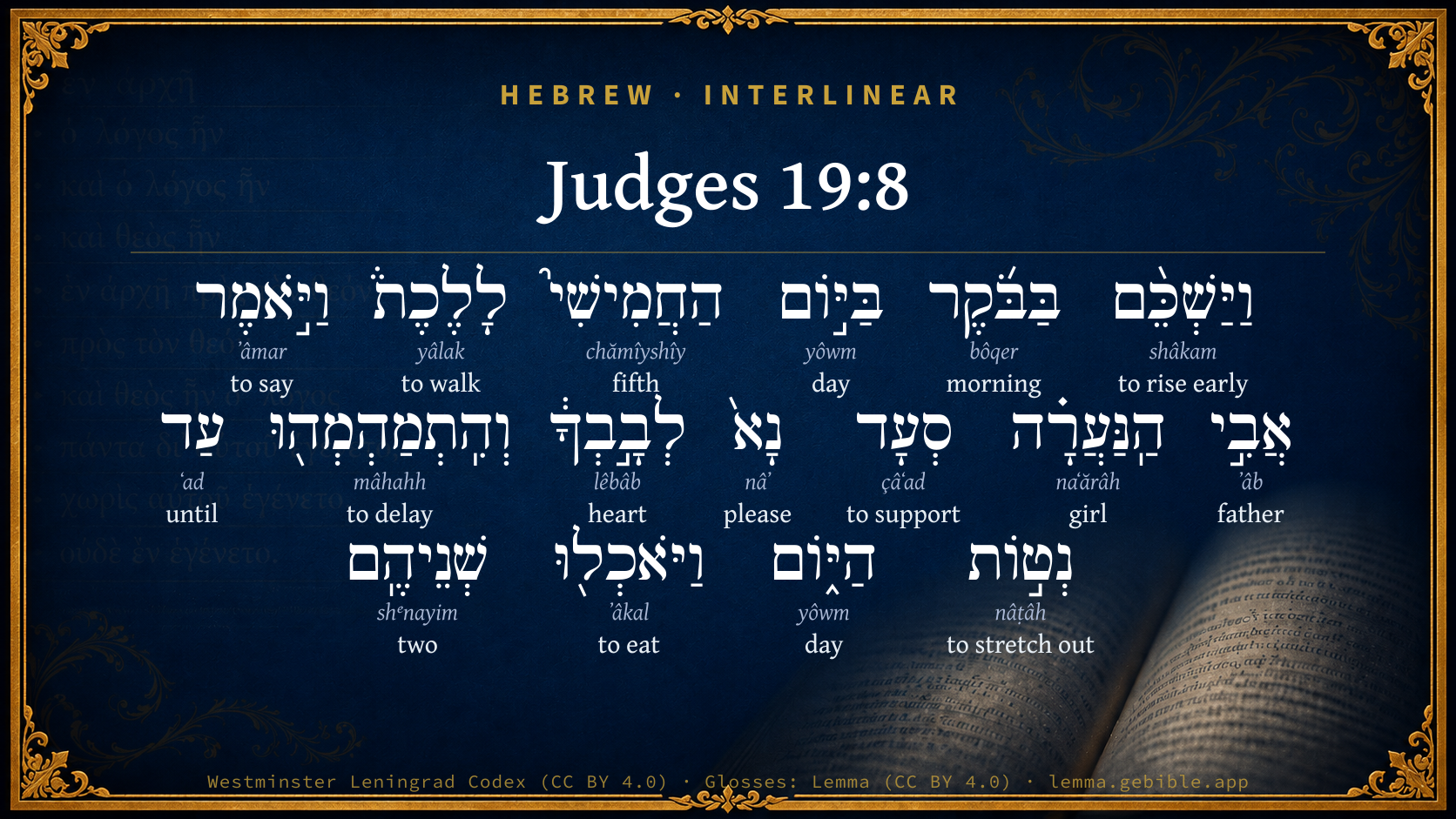
  1. וַיַּשְׁכֵּ֨ם shâkam H7925 “and · to rise early” Conjunction + Verb, Hiphil, Sequential Imperfect, 3rd Person, Masculine, Singular
  2. בַּבֹּ֜קֶר bôqer H1242 “in/at the · morning” Preposition, Determined + Noun, Common, Masculine, Singular, Absolute
  3. בַּיּ֣וֹם yôwm H3117 “in/at the · day” Preposition, Determined + Noun, Common, Masculine, Singular, Absolute
  4. הַחֲמִישִׁי֮ chămîyshîy H2549 “the · fifth” Particle, Definite Article + Adjective, Ordinal number, Masculine, Singular, Absolute
  5. לָלֶכֶת֒ yâlak H3212 “to walk” Preposition + Verb, Qal, Infinitive Construct
  6. וַיֹּ֣אמֶר ʼâmar H559 “and · to say” Conjunction + Verb, Qal, Sequential Imperfect, 3rd Person, Masculine, Singular
  7. אֲבִ֣י ʼâb H1 “father of” Noun, Common, Masculine, Singular, Construct
  8. הַֽנַּעֲרָ֗ה naʻărâh H5291 “the · girl” Particle, Definite Article + Noun, Common, Feminine, Singular, Absolute
  9. סְעָד çâʻad H5582 “support” Verb, Qal, Imperative, 2nd Person, Masculine, Singular
  10. נָא֙ nâʼ H4994 “please” Particle, Exhortation
  11. לְבָ֣בְךָ֔ lêbâb H3824 “heart · your” Noun, Common, Masculine, Singular, Construct + Suffix, Personal, 2nd Person, Masculine, Singular
  12. עַד ʻad H5704 “until” Preposition
  13. נְט֣וֹת nâṭâh H5186 “to stretch out” Verb, Qal, Infinitive Construct
  14. הַיּ֑וֹם yôwm H3117 “the · day” Particle, Definite Article + Noun, Common, Masculine, Singular, Absolute
  15. וַיֹּאכְל֖וּ ʼâkal H398 “and · to eat” Conjunction + Verb, Qal, Sequential Imperfect, 3rd Person, Masculine, Plural
  16. שְׁנֵיהֶֽם shᵉnayim H8147 “two · their” Adjective, Cardinal number, Masculine, Dual, Construct + Suffix, Personal, 3rd Person, Masculine, Plural

About this verse

These counts appear in no published source. They are computed here, from the morphology-tagged text and Lemma’s own curated glosses. What Lemma adds →

17
words
16
distinct lemmas
Historical
section

Notable vocabulary

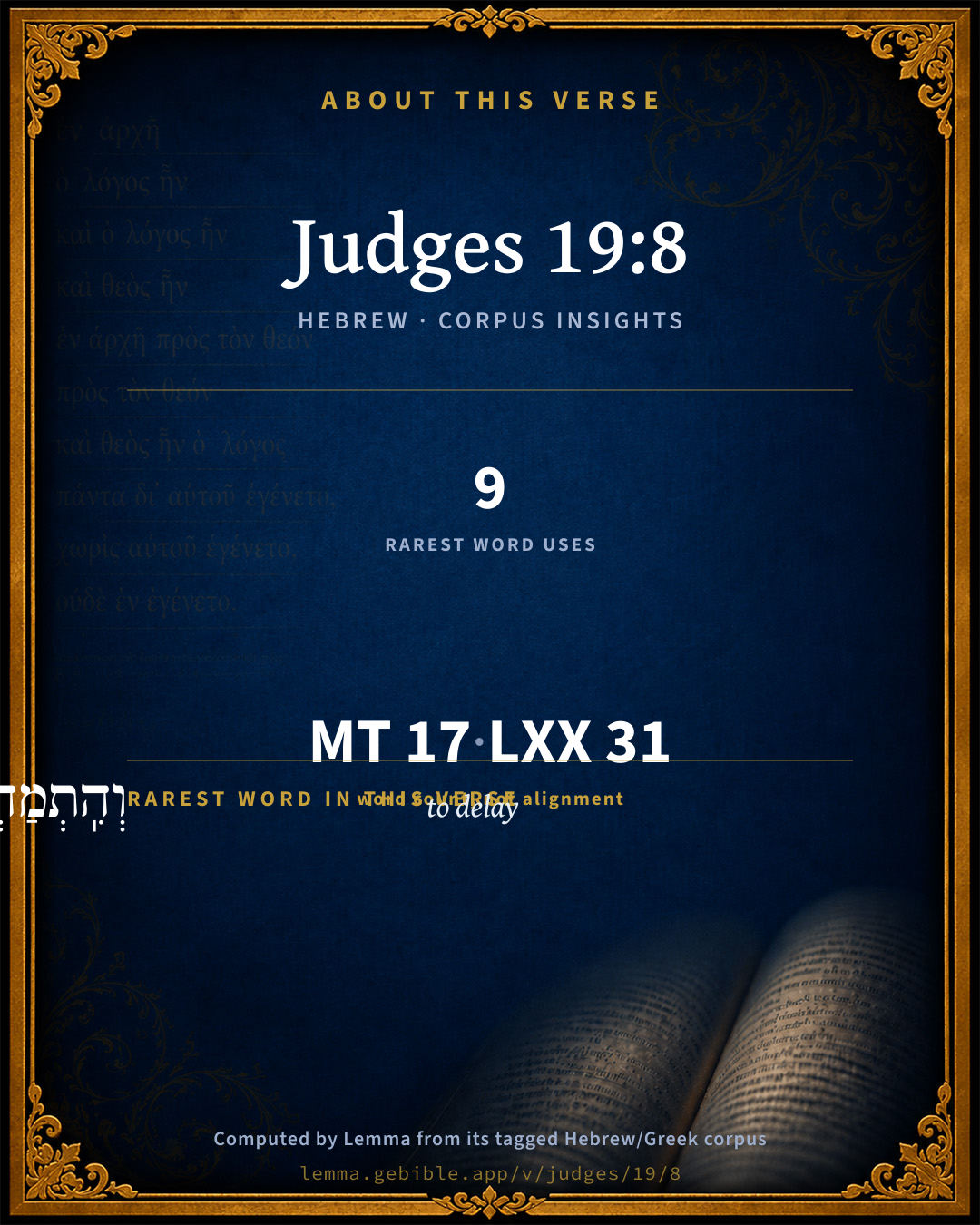
The rarest word here is וְהִֽתְמַהְמְה֖וּ to delay H4102 — appearing just 9 times in the whole Hebrew Bible.

Shared distinctive vocabulary

וְהִֽתְמַהְמְה֖וּ to delay H4102 occurs in 9 verses of the Hebrew Bible. Also found in:

Grammatical profile

  • 7 verbs
  • 6 nouns
  • 2 adjectives
  • 1 preposition
  • 1 particle

Verb forms

  • וַיַּשְׁכֵּ֨ם Hiphil · Sequential Imperfect
  • לָלֶכֶת֒ Qal · Infinitive Construct
  • וַיֹּ֣אמֶר Qal · Sequential Imperfect
  • סְעָד Qal · Imperative
  • וְהִֽתְמַהְמְה֖וּ Hithpael · Imperative
  • נְט֣וֹת Qal · Infinitive Construct
  • וַיֹּאכְל֖וּ Qal · Sequential Imperfect

Repetition

A word recurs within this verse — often emphatic in Hebrew:

  • בַּיּ֣וֹם day H3117 ×2

Hebrew & Septuagint length

In English translation the verse runs 34 words from the Hebrew and 38 from the Septuagint (LXX English) — closely comparable.

A rough comparison of the two English renderings, which tokenize alike — not a word-level alignment.

Word counts can differ between the Hebrew and the Greek without any difference in meaning — e.g. the Hebrew direct-object marker אֵת has no separate Greek word, and Greek often adds the article ὁ.

In the original languages it is 17 Hebrew tokens and 31 Greek tokens — but the two are counted differently (Hebrew bundles its prefixes and suffixes into one token; the Greek is in lemma form), so that isn’t a like-for-like length.

Hebrew and Greek witnesses Masoretic Hebrew ↔ Greek Septuagint

The same verse in the two great witnesses to the Old Testament, shown verse-for-verse.

These are two independent witnesses, not word-aligned to each other, and the Septuagint is shown in lemma (dictionary) form.

Hebrew Judges 19:8 Masoretic · Westminster Leningrad Codex

וַיַּשְׁכֵּ֨ם בַּבֹּ֜קֶר בַּיּ֣וֹם הַחֲמִישִׁי֮ לָלֶכֶת֒ וַיֹּ֣אמֶר אֲבִ֣י הַֽנַּעֲרָ֗ה סְעָד נָא֙ לְבָ֣בְךָ֔ וְהִֽתְמַהְמְה֖וּ עַד נְט֣וֹת הַיּ֑וֹם וַיֹּאכְל֖וּ שְׁנֵיהֶֽם

He arose early in the morning on the fifth day to depart; and the young lady's father said, Please strengthen your heart and stay until the day declines; and they ate, both of them.

World English Bible · Public Domain

Greek LXX Judges 19:8 Septuagint · lemma form

καί ὀρθρίζω ὁ πρωΐ ὁ ἡμέρα ὁ πέμπτος ὁ πορεύομαι καί εἶπον ὁ πατήρ ὁ νεᾶνις στηρίζω δή ὁ καρδία σύ καί στρατεύω ἕως κλίνω ὁ ἡμέρα καί ἐσθίω ὁ δύο

And he rose early in the morning on the fifth day to depart; and the father of the damsel said, Strengthen now your heart, and quit yourself as a soldier till the day decline; and the two ate.

LXX2012 (modern English Septuagint) · Public Domain

On this verse, Ellicott's Commentary for English Readers discusses the Septuagint’s reading. Read the note in Commentary ↓

Hebrew: Westminster Leningrad Codex (CC BY 4.0). Greek: Septuagint (public domain); English from LXX2012 (modern English Septuagint) (Public Domain). How the Septuagint differs from the Hebrew →

Targum (Aramaic paraphrase)

1

The Targum is the ancient Jewish Aramaic paraphrase of the Hebrew Scriptures — an interpretive translation, not the Hebrew text itself. Onkelos (literal) and Pseudo-Jonathan (expansive) render the Torah, and Jonathan the Prophets. Coverage is partial: where no permissively-licensed English translation exists for a verse, only the Aramaic is shown. This is verse-level text, not a word-by-word alignment to the Hebrew.

  1. Targum Jonathan Prophets (Joshua–Malachi)
    וְאַקְדֵים בְּצַפְרָא בְּיוֹמָא חֲמִישָׁאָה לְמֵיזַל וַאֲמַר אֲבוּהָא דְעוּלֶמְתָּא סְעוֹד כְּעַן לִבָּךְ וְאִתְעַכְּבוּ עַד מִתְפְּנֵי יוֹמָא וַאֲכָלוּ תַּרְוֵיהוֹן:

    (no public-domain English translation for this verse)

    Targum Jonathan — Aramaic: “Mikraot Gedolot” (public domain). English: “Sefaria Community Translation” (CC0 1.0 (public-domain dedication)); “London "Chaldee Paraphrase," 1871” (public domain). Text via Sefaria.

Commentary

Notes on Judges 19:8 from classic Christian and Jewish commentators (each source and its license shown beneath its notes). The classic Christian expositions comment on the surrounding passage and are grouped to its opening verse, so a note may address several verses; the Jewish commentaries on the Tanakh (Rashi and others) are per-verse, so they appear only where the commentator wrote on this verse.

Lemma curates 59 commentaries, every one of them public domain or Creative Commons licensed, each selected and text-cleaned for this edition rather than reprinted as found. About our sources →

Trapp's Complete Commentary

John Trapp

Jdg 19:8 And he arose early in the morning on the fifth day to depart: and the damsel’s father said, Comfort thine heart, I pray thee. And they tarried until afternoon, and they did eat both of them.

Ver. 8. And he arose early in the morning.] See Jdg 18:5.

And they tarried until afternoon.] Heb., Till the day declined; whereas else, haply, they might have got home that night, and the following mischiefs have been prevented. Delays are many times very dangerous.

“ Semper nocuit differre paratis. ”

The devil usually courteth and cozeneth {defrauds} those that have a mind to look toward heaven, as this old man did the Levite, with, Be content, I pray thee, &c. What haste? In space cometh grace; and, Hereafter may be time enough. But we must be resolute and peremptory, or worse will come of it, sure enough.

John Trapp, A Commentary or Exposition upon All the Books of the Old and New Testament (1647–1656) — public domain. Text from a community e-Sword module.

Geneva Bible (1599)

Geneva Bible translators

Meaning, that he should refresh himself with meat, as verse 5.

Geneva Bible (1599) marginal notes — public domain. Text via Bolls.life.

Jamieson, Fausset & Brown

Robert Jamieson, A. R. Fausset & David Brown

tarried--with reluctance.

until afternoon--literally, "the decline of the day." People in the East, who take little or nothing to eat in the morning, do not breakfast till from ten to twelve A.M., and this meal the hospitable relative had purposely protracted to so late a period as to afford an argument for urging a further stay.

Jamieson, Fausset & Brown — Commentary Critical and Explanatory on the Whole Bible (1871) — public domain (CC PDM 1.0). Text via the HelloAO Bible API.

Adam Clarke's Commentary

Verse 8. And they tarried until afternoon] Merely that they might avoid the heat of the day, which would have been very inconvenient in travelling.

Adam Clarke's Commentary on the Bible (1810–1826) — public domain. Text from a community e-Sword/MySword module.

Ellicott's Commentary for English Readers

(8) And they tarried until afternoon.—The verb is perhaps an imperative: and linger (as in Isa. (19:9) till the day turns. So the LXX., Chaldee, and Vulg. take it.

A Bible Commentary for English Readers, edited by Charles John Ellicott (1878–1897) — public domain. Text from a community e-Sword module.

The Cambridge Bible for Schools and Colleges

gen. ed. J. J. S. Perowne

8. on the fifth day] See note on Jdg_19:5.

and tarry ye] or wait, to avoid confusion with the different word rendered tarry all night in Jdg_19:6; Jdg_19:9. Some mss. of the LXX read and he enticed him; hence Moore suggests that the text originally ran and he enticed him and he (or they) waited. By the time that the Levite managed to escape it was late in the afternoon.

The Cambridge Bible for Schools and Colleges (gen. ed. J. J. S. Perowne; Cambridge University Press, 1878–1918) — public domain. Text from a community e-Sword module.

John Gill's Exposition

And he rose early in the morning on the fifth day to depart,.... With a full intention to take his leave of his father, and be gone:

and the damsel's father said, comfort thine heart, I pray thee; with a meal's meat, with a breakfast, before he set out on his journey, that he might be heartier and stronger for it:

and they tarried until afternoon; or "until the decline of the day" (m), when the sun had passed the meridian, and was declining, as it immediately does when noon is past:

and they did eat both of them; the man stayed and took a dinner with his father-in-law; and though no mention is made of the concubine, neither in this, nor in the other instances, no doubt she ate with them.

(m) "usque ad declinare diem", Montanus; to the same purpose Pagninus, Tigurine version, Junius & Tremellius, Piscator.

John Gill's Exposition of the Whole Bible (1746–1763) — public domain (CC PDM 1.0). Text via the HelloAO Bible API.

Haydock's Catholic Bible Commentary

Advanced. Hebrew, "and they tarried until the evening." Septuagint, "rest till the day decline." (Haydock) --- He wishes them to wait till the hear of the day be over. (Calmet) --- When he had obtained this request, he made the late hour an excuse for detaining them longer. But unhappily, the Levite was too resolute and desirous of returning home.

George Leo Haydock (1774–1849), Haydock's Catholic Family Bible and Commentary, 1859 edition — public domain. Excludes Psalms (Douay-Rheims chapter numbering differs from Protestant) and Deuterocanonical books (Catholic canon only).

Whedon's Commentary on the Bible

Daniel D. Whedon

8. Until afternoon — Literally, until the declining of the day. “All the painful results grew out of this detention and late setting out, and may help, if every day did not supply lessons enough, to teach us the danger and weakness of allowing our better judgment to be overcome by even the kind importunities of others.” — Kitto.

Daniel D. Whedon (gen. ed.), Commentary on the Old and New Testaments (1874–1909) — public domain. Text from a community e-Sword module.

The Pulpit Commentary

And they tarried. It should rather be rendered in the imperative mood: And tarry ye until the afternoon. So they did eat both of them. The imperative comfort thine heart is in the singular because only the man and the father-in-law are represented throughout as eating and drinking both of them together. The imperative tarry ye is in the plural because it applies to the wife as well as the man.

The Pulpit Commentary (1880–1919), ed. H.D.M. Spence-Jones & Joseph S. Exell — public domain. Text from a community e-Sword module.

Keil & Delitzsch

C. F. Keil & F. Delitzsch

And even in the morning of the fifth day he suffered himself to be induced to remain till the afternoon. התמהמהוּ is an imperative, "Tarry till the day turns," i.e., till mid-day is past.

Keil & Delitzsch — Biblical Commentary on the Old Testament (1861–1891) — public domain (CC PDM 1.0). Text via the HelloAO Bible API. (Old Testament only.)

Lesson kit

Teaching starters — assembled from the data on this page, not authored interpretation. Every prompt links to the verse data it draws on. Edit before teaching.

Judges, in the Historical, opens this verse with 17 words (16 distinct Hebrew lemmas). Its most distinctive word is mâhahh (“to delay”). A historical commentator’s framing appears above. Read the whole chapter for the surrounding context.

Discussion questions

  1. How does “to delay” (mâhahh) shape what this verse is saying?
  2. Genesis 19:16 shares the word «to delay» with this verse. How do the two illuminate each other?
  3. “day” occurs 2× in this one verse. What is the effect of the repetition?
  4. The translations on this page render this verse differently — a whole-verse word diff, not a word-by-word alignment. What might account for the different wordings?
  5. The verb «וַיַּשְׁכֵּ֨ם» is Hiphil Sequential Imperfect. How does its form color the action?
  6. Reading how Trapp's Complete Commentary and Geneva Bible (1599) read this verse, where do the two commentators agree and where do they part?

Things to notice

Reading settings

Reading text

Shown beneath each verse's original-language words.

Old Testament
Old Testament edition

Read the OT as the Masoretic Hebrew (MT) or the Greek Septuagint (LXX).

English shown for the Greek Septuagint (in the Hebrew ↔ Greek comparison).

Comparing translations? Open the Compare panel on any verse page to stack up to four side by side.