
Judges 9:3

Hebrew (Westminster Leningrad Codex) Judges 9:3 appears in the Hebrew Old Testament. The text above is from the Westminster Leningrad Codex. Each word links to its Strong’s number, a concise gloss, and parsing drawn from the Open Scriptures Hebrew Bible morphology. Click any word for its full Brown-Driver-Briggs (BDB) entry.
Download image
Cite this verse

Judges 9:3 (World English Bible). Public Domain. Lemma interlinear Bible study tool, https://lemma.gebible.app/v/judges/9/3.

Show BibTeX & RIS
BibTeX
RIS
English Translation
His mother's brothers spoke of him in the ears of all the men of Shechem all these words: and their hearts inclined to follow Abimelech; for they said, He is our brother.
World English Bible · Public Domain
Download a study sheet

One document with this verse’s original text, its word-by-word gloss line, the meaning frame, cross-references with their text, attributed commentary, and full source and license credits — printable, and it pastes into notes with its structure intact.

This verse Autodidact and up

Study sheet (.html) Plain text (.txt)

A passage Seminary Student

Up to 50 verses in one chapter. A passage sheet keeps up to 6 commentary sources and 12 cross-references per verse, in the order this page ranks them, and says so on the sheet whenever that leaves anything out. Ask for a single verse and you get the Autodidact verse sheet above.

Everything on this page stays free to read, with no account — the sheet is a download of what is already on screen, not access to it.

Want to remove ads? Support Godless Engineer
Compare translations 3

The same verse in 3 English versions, stacked beneath the original-language interlinear above. Click any original word for its lexicon entry.

Each is an independent rendering of the whole verse — the interlinear is not word-aligned to these translations.

Highlighted words mark where these versions differ — a whole-verse word diff, not a word-by-word alignment.

  • World English Bible Public Domain
    His mother's brothers spoke of him in the ears of all the men of Shechem all these words: and their hearts inclined to follow Abimelech; for they said, He is our brother.
  • King James Version Public Domain
    And his mother's brethren spake of him in the ears of all the men of Shechem all these words: and their hearts inclined to follow Abimelech; for they said, He is our brother.
  • unfoldingWord Literal Text CC BY-SA 4.0
    And the brothers of his mother spoke all of these things for him in the ears of all of the lords of Shechem, and their heart turned after Abimelech, for they said, “He our brother.”

unfoldingWord Literal Text — © unfoldingWord, licensed CC BY-SA 4.0. Word-aligned USFM3 via Door43 (git.door43.org/unfoldingWord/en_ult).

Versions to compare (up to 4)

3 of 4 selected

Show all 18 translations

Every available English version of this verse, each an independent rendering of the whole verse.

  • World English Bible Public Domain
    His mother's brothers spoke of him in the ears of all the men of Shechem all these words: and their hearts inclined to follow Abimelech; for they said, He is our brother.
  • Berean Standard Bible Public Domain
    And when his mother’s brothers spoke all these words about him in the presence of all the leaders of Shechem, their hearts were inclined to follow Abimelech, for they said, “He is our brother.”
  • Majority Standard Bible Public Domain
    And when his mother’s brothers spoke all these words about him in the presence of all the leaders of Shechem, their hearts were inclined to follow Abimelech, for they said, “He is our brother.”
  • King James Version Public Domain
    And his mother's brethren spake of him in the ears of all the men of Shechem all these words: and their hearts inclined to follow Abimelech; for they said, He is our brother.
  • American Standard Version (1901) Public Domain
    And his mother's brethren spake of him in the ears of all the men of Shechem all these words: and their hearts inclined to follow Abimelech; for they said, He is our brother.
  • Revised Version (1885) Public Domain
    And his mother’s brethren spake of him in the ears of all the men of Shechem all these words: and their hearts inclined to follow Abimelech; for they said, He is our brother.
  • Geneva Bible (1599) Public Domain
    Then his mothers brethren spake of him in the audience of all the men of Shechem, all these wordes: and their hearts were moued to follow Abimelech: for sayd they, He is our brother.
  • Douay-Rheims (1899) Public Domain
    And his mother's brethren spoke of him to all the men of Sichem, all these words, and they inclined their hearts after Abimelech, saying: He is our brother:
  • Young's Literal Translation Public Domain
    And his mother's brethren speak concerning him, in the ears of all the masters of Shechem, all these words, and their heart inclineth after Abimelech, for they said, `He `is' our brother;'
  • Literal Standard Version CC BY-SA 4.0
    And his mother’s brothers speak concerning him, in the ears of all the masters of Shechem, all these words, and their heart inclines after Abimelech, for they said, “He [is] our brother”;
  • Unlocked Literal Bible CC BY-SA 4.0
    His mother's relatives spoke for him to the leaders of Shechem, and they agreed to follow Abimelech, for they said, “He is our brother.”
  • unfoldingWord Literal Text CC BY-SA 4.0
    And the brothers of his mother spoke all of these things for him in the ears of all of the lords of Shechem, and their heart turned after Abimelech, for they said, “He our brother.”
  • Darby Bible Public Domain
    And his mother's kinsmen spoke all these words on his behalf in the ears of all the men of Shechem; and their hearts inclined to follow Abim'elech, for they said, "He is our brother."
  • World Messianic Bible Public Domain
    His mother’s brothers spoke of him in the ears of all the men of Shechem all these words. Their hearts inclined to follow Abimelech; for they said, “He is our brother.”
  • Webster's Bible Public Domain
    And his mother's brethren spoke of him in the ears of all the men of Shechem all these words: and their hearts inclined to follow Abimelech; for they said, He is our brother.
  • Free Bible Version CC BY-SA 4.0
    His mother's brothers shared his proposal with all the leaders of Shechem, and they decided to follow Abimelech, because they said, “He is our relative.”
  • Bible in Basic English Public Domain
    So his mother's family said all this about him in the ears of all the townsmen of Shechem: and their hearts were turned to Abimelech, for they said, He is our brother.
  • JPS Tanakh (1917) Public Domain
    And his mother's brethren spoke of him in the ears of all the men of Shechem all these words; and their hearts inclined to follow Abimelech; for they said: 'He is our brother.'

Literal Standard Version (2020), Covenant Press — licensed CC BY-SA 4.0. Text via the HelloAO Bible API (eBible.org). Unlocked Literal Bible (unfoldingWord) — licensed CC BY-SA 4.0. Text via the HelloAO Bible API (eBible.org). unfoldingWord Literal Text — © unfoldingWord, licensed CC BY-SA 4.0. Word-aligned USFM3 via Door43 (git.door43.org/unfoldingWord/en_ult). Free Bible Version, Dr. Jonathan Gallagher — licensed CC BY-SA 4.0. Text via the HelloAO Bible API (eBible.org).

Word by word

More ways to search: Search by grammar → Find every occurrence → Compare this word →

Practice this passage: Drill this verse → Learn its vocabulary →

שְׁכֶ֔ם
Shᵉkem
H7927
“Shechem”
Noun, Proper
Part of Speech
Noun
Type
Proper
Full BDB Definition

Origin: the same as H7926

TWOT: 2386b

Shechem = "back" or " shoulder" - son of Hamor, the chieftain of the Hivites at Shechem at the time of Jacob's arrival (noun proper masculine) - a city in Manasseh; located in a valley between Mount Ebal and Mount Gerizim, 34 miles (54 kilometers) north of Jerusalem and 7 miles (noun proper locative)
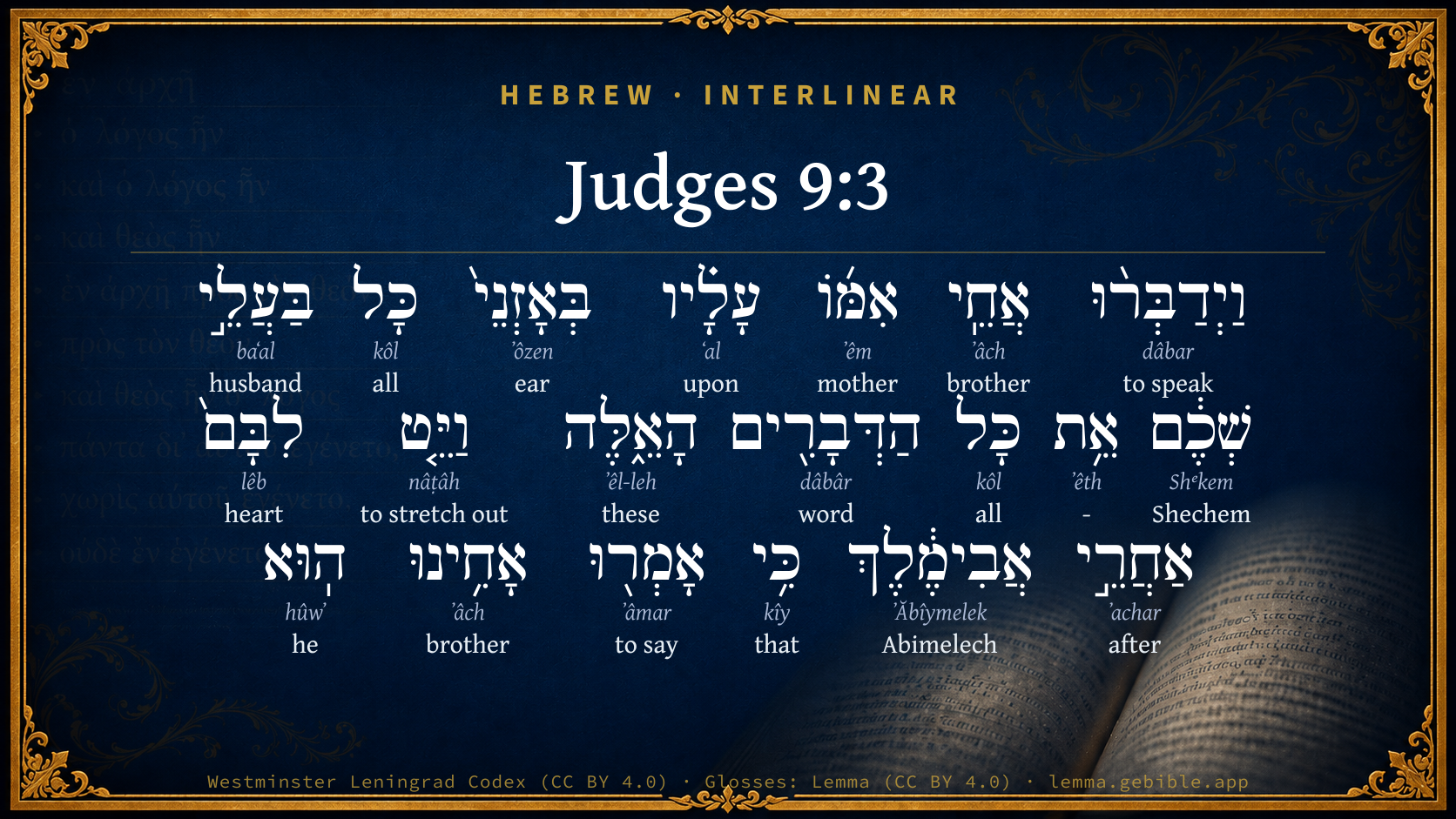
  1. וַיְדַבְּר֨וּ dâbar H1696 “and · to speak” Conjunction + Verb, Piel, Sequential Imperfect, 3rd Person, Masculine, Plural
  2. אֲחֵֽי ʼâch H251 “brothers of” Noun, Common, Masculine, Plural, Construct
  3. אִמּ֜וֹ ʼêm H517 “mother · his” Noun, Common, Feminine, Singular, Construct + Suffix, Personal, 3rd Person, Masculine, Singular
  4. עָלָ֗יו ʻal H5921 “upon · him” Preposition + Suffix, Personal, 3rd Person, Masculine, Singular
  5. בְּאָזְנֵי֙ ʼôzen H241 “in/at · ears of” Preposition + Noun, Common, Feminine, Dual, Construct
  6. כָּל kôl H3605 “all of” Noun, Common, Masculine, Singular, Construct
  7. בַּעֲלֵ֣י baʻal H1167 “husbands of” Noun, Common, Masculine, Plural, Construct
  8. אֵ֥ת ʼêth H853 “-” Particle, Direct Object
  9. כָּל kôl H3605 “all of” Noun, Common, Masculine, Singular, Construct
  10. הַדְּבָרִ֖ים dâbâr H1697 “the · words” Particle, Definite Article + Noun, Common, Masculine, Plural, Absolute
  11. הָאֵ֑לֶּה ʼêl-leh H428 “the · these” Particle, Definite Article + Pronoun, Demonstrative, Common, Plural
  12. וַיֵּ֤ט nâṭâh H5186 “and · to stretch out” Conjunction + Verb, Qal, Sequential Imperfect, 3rd Person, Masculine, Singular
  13. לִבָּם֙ lêb H3820 “heart · their” Noun, Common, Masculine, Singular, Construct + Suffix, Personal, 3rd Person, Masculine, Plural
  14. אַחֲרֵ֣י ʼachar H310 “after” Preposition
  15. אֲבִימֶ֔לֶךְ ʼĂbîymelek H40 “Abimelech” Noun, Proper
  16. כִּ֥י kîy H3588 “that” Conjunction
  17. אָמְר֖וּ ʼâmar H559 “to say” Verb, Qal, Perfect, 3rd Person, Common, Plural
  18. אָחִ֥ינוּ ʼâch H251 “brother · our” Noun, Common, Masculine, Singular, Construct + Suffix, Personal, 1st Person, Common, Plural
  19. הֽוּא hûwʼ H1931 “he” Pronoun, Personal, 3rd Person, Masculine, Singular

About this verse

These counts appear in no published source. They are computed here, from the morphology-tagged text and Lemma’s own curated glosses. What Lemma adds →

20
words
18
distinct lemmas
Historical
section

Grammatical profile

  • 3 verbs
  • 11 nouns
  • 2 pronouns
  • 2 prepositions
  • 1 conjunction
  • 1 particle

Verb forms

  • וַיְדַבְּר֨וּ Piel · Sequential Imperfect
  • וַיֵּ֤ט Qal · Sequential Imperfect
  • אָמְר֖וּ Qal · Perfect

Repetition

Words recur within this verse — often emphatic in Hebrew:

  • אֲחֵֽי brother H251 ×2
  • כָּל all H3605 ×2

Hebrew & Septuagint length

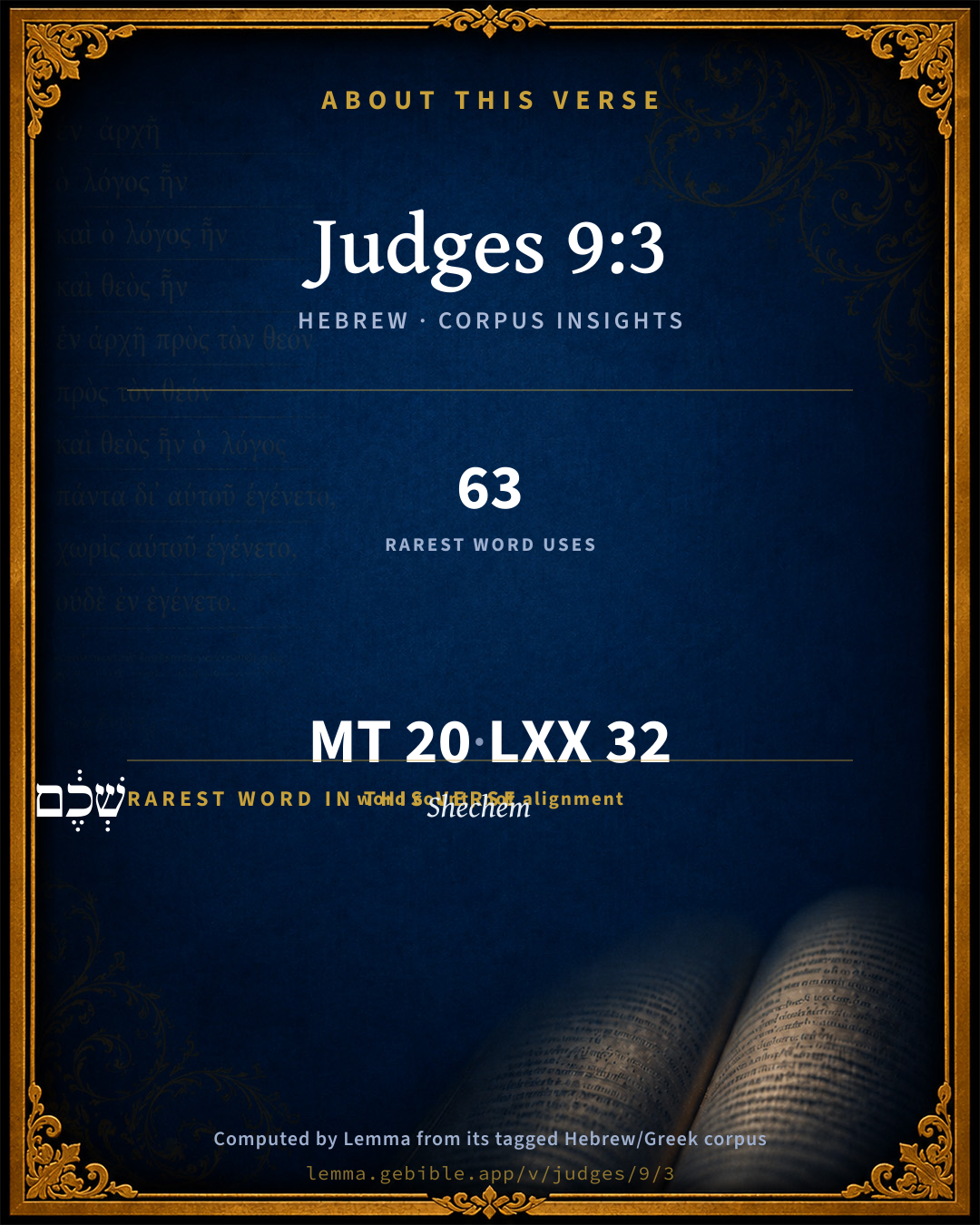
In English translation the verse runs 32 words from the Hebrew and 32 from the Septuagint (LXX English) — the same length.

A rough comparison of the two English renderings, which tokenize alike — not a word-level alignment.

Word counts can differ between the Hebrew and the Greek without any difference in meaning — e.g. the Hebrew direct-object marker אֵת has no separate Greek word, and Greek often adds the article ὁ.

In the original languages it is 20 Hebrew tokens and 32 Greek tokens — but the two are counted differently (Hebrew bundles its prefixes and suffixes into one token; the Greek is in lemma form), so that isn’t a like-for-like length.

Cross-references

3

Topical passages linked to Judges 9:3 in the Treasury of Scripture Knowledge — connected by theme and wording, ordered by reader-vote popularity; previews shown in the World English Bible.

  • Genesis 29:15 Laban said to Jacob, "Because you are my brother, should you therefore serve me for nothing? Tell me, what will your wages be?"
  • Psalms 10:3 For the wicked boasts of his heart's cravings, He blesses the greedy, and condemns Yahweh.
  • Proverbs 1:11–14 If they say, "Come with us, Let's lay in wait for blood; Let's lurk secretly for the innocent without cause;

Cross-references courtesy of OpenBible.info (CC BY 4.0).

Hebrew and Greek witnesses Masoretic Hebrew ↔ Greek Septuagint

The same verse in the two great witnesses to the Old Testament, shown verse-for-verse.

These are two independent witnesses, not word-aligned to each other, and the Septuagint is shown in lemma (dictionary) form.

Hebrew Judges 9:3 Masoretic · Westminster Leningrad Codex

וַיְדַבְּר֨וּ אֲחֵֽי אִמּ֜וֹ עָלָ֗יו בְּאָזְנֵי֙ כָּל בַּעֲלֵ֣י שְׁכֶ֔ם אֵ֥ת כָּל הַדְּבָרִ֖ים הָאֵ֑לֶּה וַיֵּ֤ט לִבָּם֙ אַחֲרֵ֣י אֲבִימֶ֔לֶךְ כִּ֥י אָמְר֖וּ אָחִ֥ינוּ הֽוּא

His mother's brothers spoke of him in the ears of all the men of Shechem all these words: and their hearts inclined to follow Abimelech; for they said, He is our brother.

World English Bible · Public Domain

Greek LXX Judges 9:3 Septuagint · lemma form

καί λαλέω περί αὐτός ὁ ἀδελφός ὁ μήτηρ αὐτός ἐν ὁ οὖς πᾶς ὁ ἀνήρ συχεμ πᾶς ὁ λόγος οὗτος καί κλίνω ὁ καρδία αὐτός ὀπίσω αβιμελεχ ὅτι εἶπον ἀδελφός ἐγώ εἰμί

And his mother's brethren spoke concerning him in the ears of all the men of Sychem all these words; and their heart turned after Abimelech, for they said, He is our brother.

LXX2012 (modern English Septuagint) · Public Domain

Hebrew: Westminster Leningrad Codex (CC BY 4.0). Greek: Septuagint (public domain); English from LXX2012 (modern English Septuagint) (Public Domain). How the Septuagint differs from the Hebrew →

Targum (Aramaic paraphrase)

1

The Targum is the ancient Jewish Aramaic paraphrase of the Hebrew Scriptures — an interpretive translation, not the Hebrew text itself. Onkelos (literal) and Pseudo-Jonathan (expansive) render the Torah, and Jonathan the Prophets. Coverage is partial: where no permissively-licensed English translation exists for a verse, only the Aramaic is shown. This is verse-level text, not a word-by-word alignment to the Hebrew.

  1. Targum Jonathan Prophets (Joshua–Malachi)
    וּמַלִילוּ אֲחֵי אִמֵיהּ עֲלוֹהִי קֳדָם כָּל יַתְבֵי שְׁכֶם יַת כָּל פִּתְגָמַיָא הָאִלֵין וְאִתְפְּנֵי לִבְּהוֹן בָּתַר אֲבִימֶלֶךְ אֲרֵי אֲמַרוּ אֲחוּנָא הוּא:

    (no public-domain English translation for this verse)

    Targum Jonathan — Aramaic: “Mikraot Gedolot” (public domain). English: “Sefaria Community Translation” (CC0 1.0 (public-domain dedication)); “London "Chaldee Paraphrase," 1871” (public domain). Text via Sefaria.

Commentary

Notes on Judges 9:3 from classic Christian and Jewish commentators (each source and its license shown beneath its notes). The classic Christian expositions comment on the surrounding passage and are grouped to its opening verse, so a note may address several verses; the Jewish commentaries on the Tanakh (Rashi and others) are per-verse, so they appear only where the commentator wrote on this verse.

Lemma curates 59 commentaries, every one of them public domain or Creative Commons licensed, each selected and text-cleaned for this edition rather than reprinted as found. About our sources →

Trapp's Complete Commentary

John Trapp

Jdg 9:3 And his mother’s brethren spake of him in the ears of all the men of Shechem all these words: and their hearts inclined to follow Abimelech; for they said, He [is] our brother.

Ver. 3. And his mother’s brethren spake of him.] And perhaps they gained the same commendation that the Duke of Buckingham, speaking to the Londoners for Richard III to be made likewise king, did, viz., that no man could deliver so much bad matter in so good words and quaint phrases.

John Trapp, A Commentary or Exposition upon All the Books of the Old and New Testament (1647–1656) — public domain. Text from a community e-Sword module.

Adam Clarke's Commentary

Verse 3. He is our brother.] We shall be raised to places of trust under him, and our city will be the capital of the kingdom.

Adam Clarke's Commentary on the Bible (1810–1826) — public domain. Text from a community e-Sword/MySword module.

John Gill's Exposition

And his mother's brethren spake of him in the ears of the men of Shechem all these words,.... Got them together in some certain place, and laid before them all that Abimelech had suggested to them, and spake in his favour to them:

and their hearts inclined to follow Abimelech, for they said, he is our brother; being fond of kingly government, as the Israelites generally were, it seemed most agreeable to them to have one king over them, and none more acceptable than one so nearly related to them, who they doubted not, from his alliance to them, would be ready to oblige them on all occasions.

John Gill's Exposition of the Whole Bible (1746–1763) — public domain (CC PDM 1.0). Text via the HelloAO Bible API.

Albert Barnes' Notes on the Bible

The Ephraimite pride revolted from Abi-ezrite rulers, and inclined them to one who was a Shechemite by birth. (Compare the same spirit in the time of David and Rehoboam, 2Sa 20:1; 1Ki 12:16.)

Albert Barnes' Notes on the Bible (1834–1885) — public domain. Text from a community e-Sword/MySword module.

Matthew Poole's English Annotations

His mother’s brethren, i.e. kinsmen, as that word is oft used, as Gen 14:16; 29:12.

He is our brother; they were easily persuaded to believe and follow what served their own interest.

Matthew Poole's English Annotations on the Holy Bible (1683–1685) — public domain. Text from a community e-Sword/MySword module.

The Pulpit Commentary

His mother"s brethren. Presumably the Hivite population of Sheehem.

The Pulpit Commentary (1880–1919), ed. H.D.M. Spence-Jones & Joseph S. Exell — public domain. Text from a community e-Sword module.

John Wesley's Explanatory Notes

Brethren - That is, kinsmen. He is our brother - They were easily persuaded to believe what served their own interest.

John Wesley, Explanatory Notes Upon the Whole Bible (1754–1765) — public domain. Text via the GEBible commentary corpus.

unfoldingWord translationNotes

Door43 World Missions Community

His mother's relatives spoke for him to the leaders

This means that the relatives of the mother of Abimelech spoke to the leaders, suggesting that they make Abimelech their king.

they agreed to follow Abimelech

"they agreed to let Abimelech be their leader"

the house

Here "house" represents a temple. (See: Metonymy)

seventy pieces of silver

This means seventy shekels of silver. A shekel weighs 11 grams. If it is necessary to translate this with modern measurements, you can translate it like this. AT: "almost one kilo of silver" (See: Biblical Money)

seventy

"70" (See: Numbers)

Baal-Berith

This is the name of a false god. See how you translated it in Judges 8:33.

lawless and reckless

"violent and foolish"

translationWords

Shechem

Abimelech

brother

silver

lawful

unfoldingWord translationNotes — © Distant Shores Media and the Door43 World Missions Community, licensed CC BY-SA 4.0. Source: git.door43.org/Door43/en_tn.

Lesson kit

Teaching starters — assembled from the data on this page, not authored interpretation. Every prompt links to the verse data it draws on. Edit before teaching.

Judges, in the Historical, opens this verse with 20 words (18 distinct Hebrew lemmas). Its most distinctive word is Shᵉkem (“Shechem”). A historical commentator’s framing appears above. Read the whole chapter for the surrounding context.

Discussion questions

  1. How does “Shechem” (Shᵉkem) shape what this verse is saying?
  2. Genesis 29:15 shares this passage’s theme. How do the two illuminate each other?
  3. “brother” occurs 2× in this one verse. What is the effect of the repetition?
  4. The translations on this page render this verse differently — a whole-verse word diff, not a word-by-word alignment. What might account for the different wordings?
  5. The verb «וַיְדַבְּר֨וּ» is Piel Sequential Imperfect. How does its form color the action?
  6. Reading how Trapp's Complete Commentary and Adam Clarke's Commentary read this verse, where do the two commentators agree and where do they part?

Things to notice

Reading settings

Reading text

Shown beneath each verse's original-language words.

Old Testament
Old Testament edition

Read the OT as the Masoretic Hebrew (MT) or the Greek Septuagint (LXX).

English shown for the Greek Septuagint (in the Hebrew ↔ Greek comparison).

Comparing translations? Open the Compare panel on any verse page to stack up to four side by side.