
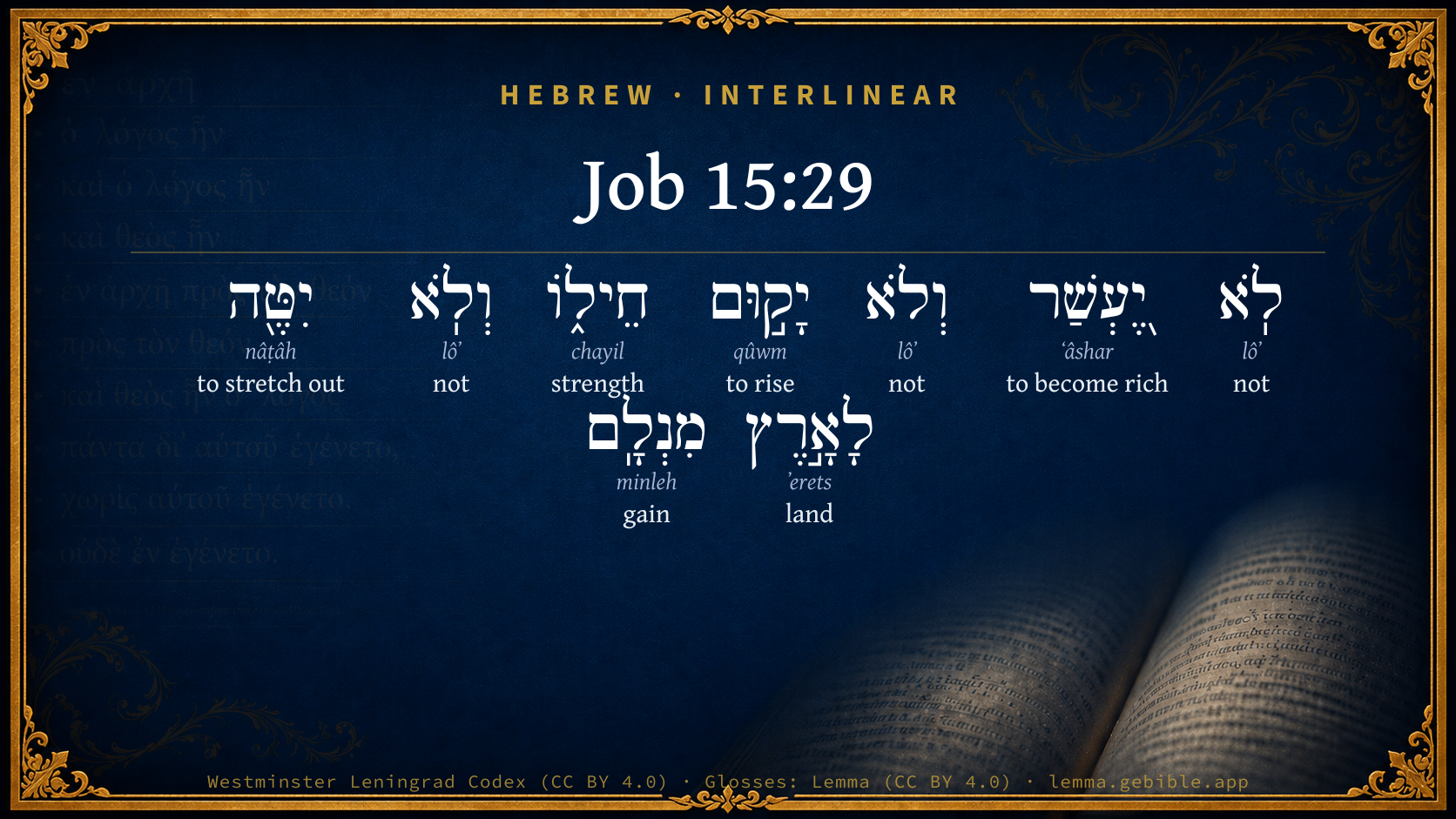
Job 15:29

Hebrew (Westminster Leningrad Codex) Job 15:29 appears in the Hebrew Old Testament. The text above is from the Westminster Leningrad Codex. Each word links to its Strong’s number, a concise gloss, and parsing drawn from the Open Scriptures Hebrew Bible morphology. Click any word for its full Brown-Driver-Briggs (BDB) entry.
Download image
Cite this verse

Job 15:29 (World English Bible). Public Domain. Lemma interlinear Bible study tool, https://lemma.gebible.app/v/job/15/29.

Show BibTeX & RIS
BibTeX
RIS
English Translation
He shall not be rich, neither shall his substance continue, Neither shall their possessions be extended on the earth.
World English Bible · Public Domain
Highlights
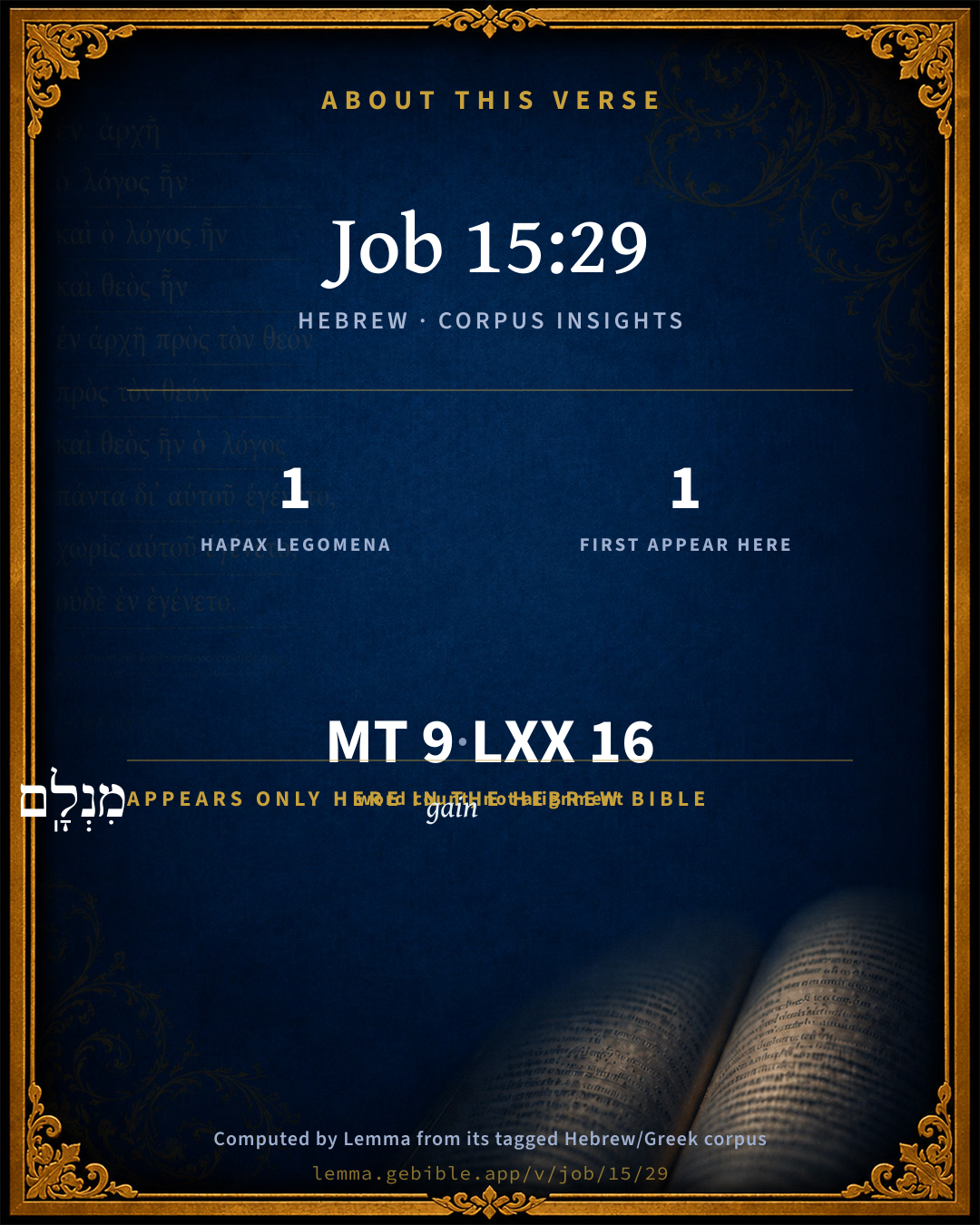
  • 1 hapax legomenon — only here in the Hebrew Bible
  • 1 first appearance in the Hebrew Bible
Full analysis ↓
Download a study sheet

One document with this verse’s original text, its word-by-word gloss line, the meaning frame, cross-references with their text, attributed commentary, and full source and license credits — printable, and it pastes into notes with its structure intact.

This verse Autodidact and up

Study sheet (.html) Plain text (.txt)

A passage Seminary Student

Up to 50 verses in one chapter. A passage sheet keeps up to 6 commentary sources and 12 cross-references per verse, in the order this page ranks them, and says so on the sheet whenever that leaves anything out. Ask for a single verse and you get the Autodidact verse sheet above.

Everything on this page stays free to read, with no account — the sheet is a download of what is already on screen, not access to it.

Want to remove ads? Support Godless Engineer
Compare translations 3

The same verse in 3 English versions, stacked beneath the original-language interlinear above. Click any original word for its lexicon entry.

Each is an independent rendering of the whole verse — the interlinear is not word-aligned to these translations.

Highlighted words mark where these versions differ — a whole-verse word diff, not a word-by-word alignment.

  • World English Bible Public Domain
    He shall not be rich, neither shall his substance continue, Neither shall their possessions be extended on the earth.
  • King James Version Public Domain
    He shall not be rich, neither shall his substance continue, neither shall he prolong the perfection thereof upon the earth.
  • unfoldingWord Literal Text CC BY-SA 4.0
    He will not be rich, and his wealth will not stand, and their possessions will not spread over the land.

unfoldingWord Literal Text — © unfoldingWord, licensed CC BY-SA 4.0. Word-aligned USFM3 via Door43 (git.door43.org/unfoldingWord/en_ult).

Versions to compare (up to 4)

3 of 4 selected

Show all 18 translations

Every available English version of this verse, each an independent rendering of the whole verse.

  • World English Bible Public Domain
    He shall not be rich, neither shall his substance continue, Neither shall their possessions be extended on the earth.
  • Berean Standard Bible Public Domain
    He will no longer be rich; his wealth will not endure. His possessions will not overspread the land.
  • Majority Standard Bible Public Domain
    He will no longer be rich; his wealth will not endure. His possessions will not overspread the land.
  • King James Version Public Domain
    He shall not be rich, neither shall his substance continue, neither shall he prolong the perfection thereof upon the earth.
  • American Standard Version (1901) Public Domain
    He shall not be rich, neither shall his substance continue, Neither shall their possessions be extended on the earth.
  • Revised Version (1885) Public Domain
    He shall not be rich, neither shall his substance continue, neither shall their produce bend to the earth.
  • Geneva Bible (1599) Public Domain
    He shall not be rich, neither shall his substance continue, neither shall he prolong the perfection thereof in the earth.
  • Douay-Rheims (1899) Public Domain
    He shall not be enriched, neither shall his substance continue, neither shall he push his root in the earth.
  • Young's Literal Translation Public Domain
    He is not rich, nor doth his wealth rise, Nor doth he stretch out on earth their continuance.
  • Literal Standard Version CC BY-SA 4.0
    He is not rich, nor does his wealth rise, || Nor does he stretch out their continuance on earth.
  • Unlocked Literal Bible CC BY-SA 4.0
    He will not be rich; his wealth will not last and his possessions will not spread over the land.
  • unfoldingWord Literal Text CC BY-SA 4.0
    He will not be rich, and his wealth will not stand, and their possessions will not spread over the land.
  • Darby Bible Public Domain
    He shall not become rich, neither shall his substance continue, and their possessions shall not extend upon the earth.
  • World Messianic Bible Public Domain
    He will not be rich, neither will his substance continue, neither will their possessions be extended on the earth.
  • Webster's Bible Public Domain
    He shall not be rich, neither shall his substance continue, neither shall he prolong the perfection of it upon the earth.
  • Free Bible Version CC BY-SA 4.0
    They will lose their riches, their wealth will not endure, their possessions will not spread over the earth.
  • Bible in Basic English Public Domain
    He does not get wealth for himself, and is unable to keep what he has got; the heads of his grain are not bent down to the earth.
  • JPS Tanakh (1917) Public Domain
    He shall not be rich, neither shall his substance continue, neither shall their produce bend to the earth.

Literal Standard Version (2020), Covenant Press — licensed CC BY-SA 4.0. Text via the HelloAO Bible API (eBible.org). Unlocked Literal Bible (unfoldingWord) — licensed CC BY-SA 4.0. Text via the HelloAO Bible API (eBible.org). unfoldingWord Literal Text — © unfoldingWord, licensed CC BY-SA 4.0. Word-aligned USFM3 via Door43 (git.door43.org/unfoldingWord/en_ult). Free Bible Version, Dr. Jonathan Gallagher — licensed CC BY-SA 4.0. Text via the HelloAO Bible API (eBible.org).

Word by word

More ways to search: Search by grammar → Find every occurrence → Compare this word →

Practice this passage: Drill this verse → Learn its vocabulary →

About this verse

These counts appear in no published source. They are computed here, from the morphology-tagged text and Lemma’s own curated glosses. What Lemma adds →

9
words
7
distinct lemmas
Wisdom
section

Notable vocabulary

1 hapax legomenon — a word that appears only here in the entire Hebrew Bible:

  • מִנְלָֽם gain H4512

First appearance in Scripture

This word makes its first canonical appearance in the Hebrew Bible here:

  • מִנְלָֽם gain H4512

Shared distinctive vocabulary

יֶ֭עְשַׁר to become rich H6238 occurs in 17 verses of the Hebrew Bible. Also found in:

Grammatical profile

  • 3 verbs
  • 3 nouns
  • 3 particles

Verb forms

  • יֶ֭עְשַׁר Qal · Imperfect
  • יָק֣וּם Qal · Imperfect
  • יִטֶּ֖ה Qal · Imperfect

Repetition

A word recurs within this verse — often emphatic in Hebrew:

Hebrew & Septuagint length

In English translation the verse runs 19 words from the Hebrew and 21 from the Septuagint (LXX English) — closely comparable.

A rough comparison of the two English renderings, which tokenize alike — not a word-level alignment.

Word counts can differ between the Hebrew and the Greek without any difference in meaning — e.g. the Hebrew direct-object marker אֵת has no separate Greek word, and Greek often adds the article ὁ.

In the original languages it is 9 Hebrew tokens and 16 Greek tokens — but the two are counted differently (Hebrew bundles its prefixes and suffixes into one token; the Greek is in lemma form), so that isn’t a like-for-like length.

Cross-references

9

Topical passages linked to Job 15:29 in the Treasury of Scripture Knowledge — connected by theme and wording, ordered by reader-vote popularity; previews shown in the World English Bible.

  • Job 27:16–17 Though he heap up silver as the dust, And prepare clothing as the clay;
  • James 1:11 For the sun arises with the scorching wind, and withers the grass, and the flower in it falls, and the beauty of its appearance perishes. So also will the rich man fade away in his pursuits.
  • Job 20:22–28 In the fullness of his sufficiency, distress shall overtake him: The hand of everyone who is in misery shall come on him.
  • Job 22:15–20 Will you keep the old way Which wicked men have trodden,
  • Psalms 49:16–17 Don't be afraid when a man is made rich, When the glory of his house is increased.
  • Luke 12:19–21 I will tell my soul, "Soul, you have many goods laid up for many years. Take your ease, eat, drink, be merry."'
  • Luke 16:2 He called him, and said to him, 'What is this that I hear about you? Give an accounting of your management, for you can no longer be manager.'
  • Luke 16:19–22 "Now there was a certain rich man, and he was clothed in purple and fine linen, living in luxury every day.
  • James 5:1–3 Come now, you rich, weep and howl for your miseries that are coming on you.

Cross-references courtesy of OpenBible.info (CC BY 4.0).

Hebrew and Greek witnesses Masoretic Hebrew ↔ Greek Septuagint

The same verse in the two great witnesses to the Old Testament, shown verse-for-verse.

These are two independent witnesses, not word-aligned to each other, and the Septuagint is shown in lemma (dictionary) form.

Hebrew Job 15:29 Masoretic · Westminster Leningrad Codex

לֹֽא יֶ֭עְשַׁר וְלֹא יָק֣וּם חֵיל֑וֹ וְלֹֽא יִטֶּ֖ה לָאָ֣רֶץ מִנְלָֽם

He shall not be rich, neither shall his substance continue, Neither shall their possessions be extended on the earth.

World English Bible · Public Domain

Greek LXX Job 15:29 Septuagint · lemma form

οὔτε μή πλουτίζω οὔτε μή μένω αὐτός ὁ ὑποἄρχω οὐ μή βάλλω ἐπί ὁ γῆ σκιά

Neither shall he at all grow rich, nor shall his substance remain: he shall not cast a shadow upon the earth.

LXX2012 (modern English Septuagint) · Public Domain

On this verse, John Gill's Exposition discusses the Septuagint’s reading. Read the note in Commentary ↓

Hebrew: Westminster Leningrad Codex (CC BY 4.0). Greek: Septuagint (public domain); English from LXX2012 (modern English Septuagint) (Public Domain). How the Septuagint differs from the Hebrew →

Commentary

Notes on Job 15:29 from classic Christian and Jewish commentators (each source and its license shown beneath its notes). The classic Christian expositions comment on the surrounding passage and are grouped to its opening verse, so a note may address several verses; the Jewish commentaries on the Tanakh (Rashi and others) are per-verse, so they appear only where the commentator wrote on this verse.

Lemma curates 59 commentaries, every one of them public domain or Creative Commons licensed, each selected and text-cleaned for this edition rather than reprinted as found. About our sources →

Trapp's Complete Commentary

John Trapp

Job 15:29 He shall not be rich, neither shall his substance continue, neither shall he prolong the perfection thereof upon the earth.

Ver. 29. He shall not be rich, neither shall his substance, &c.] If he be rich, it is for a mischief, neither is it likely long to continue with him, for God will blow upon and blast his substance, which is the fort and strength, Isa 10:14. He resolves he will be rich, 1Ti 6:9, and is set upon it. God, to cross him, saith here, He shall not be rich, but I will make a poor fool of him, according to that Jer 17:11, "As the partridge sitteth on eggs and hatcheth them not; so he that getteth riches, and not by right, shall leave them in the midst of his days, and at his end shall be a fool." There is a curse upon unlawful practices, though men be industrious, as in Jehoiakim, Jer 22:19 It is God that giveth power to get wealth, Deu 8:18. Our care can no more add a penny to our estate than it can a cubit to our stature, Mat 6:27.

He shall not prolong the perfection thereof] Vulgate, He shall not send forth his root in the earth. "A man shall not be established by wickedness," saith Solomon: "but the root of the righteous shall continue," Pro 12:3; {See Trapp on "Pro 12:3"}

John Trapp, A Commentary or Exposition upon All the Books of the Old and New Testament (1647–1656) — public domain. Text from a community e-Sword module.

Geneva Bible (1599)

Geneva Bible translators

Meaning, that his sumptuous buildings should never come to perfection.

Geneva Bible (1599) marginal notes — public domain. Text via Bolls.life.

Jamieson, Fausset & Brown

Robert Jamieson, A. R. Fausset & David Brown

Rather, he shall not increase his riches; he has reached his highest point; his prosperity shall not continue.

perfection--rather, "His acquired wealth--what he possesses--shall not be extended," &c.

Jamieson, Fausset & Brown — Commentary Critical and Explanatory on the Whole Bible (1871) — public domain (CC PDM 1.0). Text via the HelloAO Bible API.

Adam Clarke's Commentary

Verse 29. He shall not be rich] The whole of what follows, to the end of the chapter, seems to be directed against Job himself, whom Eliphaz indirectly accuses of having been a tyrant and oppressor. The threatened evils are,

1. He shall not be rich, though he labours greatly to acquire riches.

2. His substance shall not continue - God will blast it, and deprive him of power to preserve it.

3. Neither shall he prolong the perfection thereof - all his works shall perish, for God will blot out his remembrance from under heaven.

Adam Clarke's Commentary on the Bible (1810–1826) — public domain. Text from a community e-Sword/MySword module.

Ellicott's Commentary for English Readers

(29) He shall not be rich.—Now comes the destiny which awaits him in the judgment of the speaker. “Neither shall he prolong the perfection thereof upon the earth.” The word rendered “perfection thereof” occurs nowhere else, so that it is very doubtful what it means. Some render, “Neither shall their produce (that of the wicked) bend (luxuriantly) to the earth;” or, “their possessions or their achievements extend on the earth.”

A Bible Commentary for English Readers, edited by Charles John Ellicott (1878–1897) — public domain. Text from a community e-Sword module.

The Cambridge Bible for Schools and Colleges

gen. ed. J. J. S. Perowne

29. neither shall he prolong the perfection] Perhaps, neither shall their produce bend down to the ground; the figure being that of heavy grain, or branches thickly laden with fruit, bending down to the earth. The word rendered produce or gain is not found again and is of somewhat uncertain meaning.

29–35. The disastrous end of the wicked man.

The Cambridge Bible for Schools and Colleges (gen. ed. J. J. S. Perowne; Cambridge University Press, 1878–1918) — public domain. Text from a community e-Sword module.

John Gill's Exposition

He shall not depart out of darkness,.... Out of the darkness of poverty, calamity, and distress he comes into, and, indeed, he despairs of it himself, as in Job 15:22; and in a spiritual sense he departs not out of the darkness of sin, out of the dark state of unregeneracy; nor will he depart out of the blackness and darkness reserved for him hereafter, when he is once come into it:

the flame shall dry up his branches; alluding either to a violent drought and heat, which dries up pastures, herbs, and trees, and the branches of them; or to a wind, as the Septuagint, a burning wind, in the eastern countries, which consumed all green things; or to a flash of lightning, which shatters, strips, and destroys branches of trees: here it may signify the wrath of God, like a flame of fire consuming the wealth and substance, and families, of wicked men; whose children particularly may be compared to branches, and so respect may be had to Job's children, who were suddenly destroyed by a violent wind, which threw down the house in which they were:

and by the breath of his mouth shall he go away; out of the world, a phrase expressive of death; either because of the breath of his own mouth, as some in Jarchi, because of his blasphemies against God and his people, because of his cursing and swearing his mouth is full of, and the many vain, foolish, and idle words which come out of it, and for which he will be condemned; or rather

"by the breath of the mouth of God,''

as the Targum; either according to his purpose and decree, and by his order, and the word that goes out of his mouth; the wicked man shall be obliged to depart out of the world at once, being struck dead by him, as Ananias and Sapphira were; or by his powerful wrath and vengeance, whose breath is as a stream of brimstone, and with which he will slay the wicked of the earth, and particularly will consume the wicked one, antichrist, even with the spirit of his mouth, and with the brightness of his coming, Isa 11:4.

John Gill's Exposition of the Whole Bible (1746–1763) — public domain (CC PDM 1.0). Text via the HelloAO Bible API.

Albert Barnes' Notes on the Bible

He shall not be rich - That is, he shall not continue rich; or he shall not again become rich. He shall be permanently poor.

Neither shall his substance continue - His property.

Neither shall he prolong the perfection thereof - Noyes renders this, “And his possessions shall not be extended upon the earth.” Wemyss, “Nor shall he be master of his own desires.” Good, “Nor their success spread abroad in the land.” Luther, Und sein Gluck wird sich nicht ausbreiten im Lande - “ And his fortune shall not spread itself abroad in the land.” Vulgate, “Neither shall he send his root in the earth “ - nec mittet in terra radicem suam. The Septuagint, οὐ μὴ βάλῃ ἐπὶ τὴν γῆν σκιὰν ou mē balē epi tēn gōn skian - “and shall not cast a shadow upon the earth.” The word rendered “perfection” (מנלם mı̂nlām) is commonly supposed to be from מנלה mı̂nleh, from נלה nâlâh to finish, to procure, and hence, the noun may be applied to that which is procured - and thus may denote possessions. According to this the correct rendering is, “and he does not extend their possessions abroad in the land;” that is, his possessions do not extend abroad. Gesenius supposes, however, that the word is a corruption for מבלם - “their flocks.” I see no objection, however, to its being regarded as meaning possessions - and then the sense is, that he would fail in that which is so much the object of ambition with every avaricious man - that his possessions should extend through the land; compare the notes at Isa 5:8.

Albert Barnes' Notes on the Bible (1834–1885) — public domain. Text from a community e-Sword/MySword module.

Matthew Poole's English Annotations

He shall not be rich, i. e not abide rich, but shall become poor.

Neither shall his substance continue; what he had gotten shall be taken from him.

The perfection thereof, i.e. the perfection of his substance, or that complete estate and glory which he hath attained, shall not be continued to him and to his posterity. Or, neither shall their perfection (i.e. that prosperity, and wealth, and power wherein they placed their perfection or happiness) spread itself, or be propagated or spread abroad, but shall be diminished and taken away. It is a metaphor from a tree. Compare Job 8:16.

Matthew Poole's English Annotations on the Holy Bible (1683–1685) — public domain. Text from a community e-Sword/MySword module.

Whedon's Commentary on the Bible

Daniel D. Whedon

29. Neither shall he prolong the perfection, etc. — Their substance (riches — Furst) bendeth not to the ground. (Hirtzel, Stickel. etc.) The image is drawn from a tree whose branches bend with their weight of fruit.

Daniel D. Whedon (gen. ed.), Commentary on the Old and New Testaments (1874–1909) — public domain. Text from a community e-Sword module.

The Pulpit Commentary

He shall not be rich; i.e. he shall not increase, or maintain, his riches. Neither shall his substance continue, His riches shall make themselves wings, and take their departure. Neither shall he prolong the perfection thereof upon the earth; rather, neither shall their possessions be extended upon the earth. (So Rosenmuller, Professor Lee, and Renan.) The transition from the singular to the plural is not unusual, when it is a class, and not an individual, that is really spoken of.

The Pulpit Commentary (1880–1919), ed. H.D.M. Spence-Jones & Joseph S. Exell — public domain. Text from a community e-Sword module.

John Wesley's Explanatory Notes

Substance - What he had gotten shall be taken from him.

John Wesley, Explanatory Notes Upon the Whole Bible (1754–1765) — public domain. Text via the GEBible commentary corpus.

unfoldingWord translationNotes

Door43 World Missions Community

He will not be rich; his wealth will not last

These two litotes express that he will be the opposite of rich, that he will be poor. AT: "he will be poor; all his money will disappear" (See: Litotes)

out of darkness

Darkness here represents death. AT: "out of the darkness of death" (See: Metonymy)

a flame will dry up his stalks

Here the flame represents God's judgment and the drying up of his stalks represents either the fact that his possessions disappear, or that he will die. AT: "God will take everything he owns away, like a fire dries out the moist branches of a tree" (See: Metaphor)

the breath of God's mouth

Here God's "breath" represents his judgement. AT: "God's breath" or "God's judgment" (See: Metonymy)

he will go away

This refers to him dying. AT: "he will die" (See: Euphemism)

translationWords

darkness

unfoldingWord translationNotes — © Distant Shores Media and the Door43 World Missions Community, licensed CC BY-SA 4.0. Source: git.door43.org/Door43/en_tn.

Rashi

Rabbi Shlomo Yitzchaki (Rashi)

and his possessions will not remain They will not be preserved for long.

neither will...bend Heb. יטה, [like] ינטה, like (I Sam. 8:3), “and they turned (ויטו) after gain.” They themselves turned (וינטו). It means that they did not bend from heaven to earth. the gratification of their desire Heb. מנלם, the granting of their desire and the fulfillment of their plans. It is like two words, מן להם.

מן means their preparation, like (Dan. 1:5), “And the king prepared (וימן) for them.” Similar to it is (I Sam. 13:21), “a file (הפצירה פים),” in two words. [The analogy is obscure.] (Isa. 33:7), “Behold I will appear to them (אראלם),” which Jonathan renders: I will appear to them. So it appears to me, and Menachem supports me. Another explanation: מִנְלָם is an expression of (Isa. 33:1), “when you finish (כנלתך) dealing treacherously,” in which the “nun” is a radical that sometimes is omitted, an expression of completion. It will not bend to the ground to be freed from a decree of destruction.

Rashi on the Tanakh — English translations: “The Judaica Press complete Tanach with Rashi, translated by A. J. Rosenberg” (CC BY 4.0); “Pentateuch with Rashi's commentary by M. Rosenbaum and A.M. Silbermann, 1929-1934” (public domain); “The Metsudah Tanach series, Lakewood, N.J” (CC BY 4.0); and “The Book of Joshua, Metsudah Publications, 1997” (CC BY 4.0). Text via Sefaria.

Lesson kit

Teaching starters — assembled from the data on this page, not authored interpretation. Every prompt links to the verse data it draws on. Edit before teaching.

Job, in the Wisdom, opens this verse with 9 words (7 distinct Hebrew lemmas). Its most distinctive word is minleh (“gain”). A historical commentator’s framing appears above. Read the whole chapter for the surrounding context.

Discussion questions

  1. What does “gain” (minleh) contribute to the verse as a whole?
  2. This verse holds 1 word here found nowhere else in the Hebrew Bible. What might the rare word draw attention to?
  3. The word “gain” first appears here in Scripture. What is being introduced at this debut?
  4. Genesis 14:23 shares the word «to become rich» with this verse. How do the two illuminate each other?
  5. “not” occurs 3× in this one verse. What is the effect of the repetition?
  6. These translations render this verse differently; the difference is in the English rendering, not the original. What questions does that raise?
  7. The verb «יֶ֭עְשַׁר» is Qal Imperfect. How does its form color the action?
  8. Reading how Trapp's Complete Commentary and Geneva Bible (1599) read this verse, where do the two commentators agree and where do they part?

Things to notice

  • 1 word in this verse appears nowhere else in the Hebrew Bible.
  • 1 word makes its first canonical appearance in Scripture here.
  • This verse counts 9 Hebrew ↔ 16 Greek words.
  • These translations choose different wording for 17 words in this verse.
  • “not” occurs 3× in this single verse.

Reading settings

Reading text

Shown beneath each verse's original-language words.

Old Testament
Old Testament edition

Read the OT as the Masoretic Hebrew (MT) or the Greek Septuagint (LXX).

English shown for the Greek Septuagint (in the Hebrew ↔ Greek comparison).

Comparing translations? Open the Compare panel on any verse page to stack up to four side by side.