Psalms 31:2

Hebrew (Westminster Leningrad Codex) Psalms 31:2 appears in the Hebrew Old Testament. The text above is from the Westminster Leningrad Codex. Each word links to its Strong’s number, a concise gloss, and parsing drawn from the Open Scriptures Hebrew Bible morphology. Click any word for its full Brown-Driver-Briggs (BDB) entry.
Download image
Cite this verse

Psalms 31:2 (World English Bible). Public Domain. Lemma interlinear Bible study tool, https://lemma.gebible.app/v/psalms/31/2.

Show BibTeX & RIS
BibTeX
RIS
English Translation
Bow down your ear to me. Deliver me speedily. Be to me a strong rock, A house of defense to save me.
World English Bible · Public Domain
Download a study sheet

One document with this verse’s original text, its word-by-word gloss line, the meaning frame, cross-references with their text, attributed commentary, and full source and license credits — printable, and it pastes into notes with its structure intact.

This verse Autodidact and up

Study sheet (.html) Plain text (.txt)

A passage Seminary Student

Up to 50 verses in one chapter. A passage sheet keeps up to 6 commentary sources and 12 cross-references per verse, in the order this page ranks them, and says so on the sheet whenever that leaves anything out. Ask for a single verse and you get the Autodidact verse sheet above.

Everything on this page stays free to read, with no account — the sheet is a download of what is already on screen, not access to it.

Want to remove ads? Support Godless Engineer
Compare translations 3

The same verse in 3 English versions, stacked beneath the original-language interlinear above. Click any original word for its lexicon entry.

Each is an independent rendering of the whole verse — the interlinear is not word-aligned to these translations.

Highlighted words mark where these versions differ — a whole-verse word diff, not a word-by-word alignment.

  • World English Bible Public Domain
    Bow down your ear to me. Deliver me speedily. Be to me a strong rock, A house of defense to save me.
  • King James Version Public Domain
    Bow down thine ear to me; deliver me speedily: be thou my strong rock, for an house of defence to save me.
  • unfoldingWord Literal Text CC BY-SA 4.0
    Incline your ear to me; rescue me quickly; be for me a rocky summit of refuge, a dwelling place of strongholds to save me.

unfoldingWord Literal Text — © unfoldingWord, licensed CC BY-SA 4.0. Word-aligned USFM3 via Door43 (git.door43.org/unfoldingWord/en_ult).

Versions to compare (up to 4)

3 of 4 selected

Show all 18 translations

Every available English version of this verse, each an independent rendering of the whole verse.

  • World English Bible Public Domain
    Bow down your ear to me. Deliver me speedily. Be to me a strong rock, A house of defense to save me.
  • Berean Standard Bible Public Domain
    Incline Your ear to me; come quickly to my rescue. Be my rock of refuge, the stronghold of my deliverance.
  • Majority Standard Bible Public Domain
    Incline Your ear to me; come quickly to my rescue. Be my rock of refuge, the stronghold of my deliverance.
  • King James Version Public Domain
    Bow down thine ear to me; deliver me speedily: be thou my strong rock, for an house of defence to save me.
  • American Standard Version (1901) Public Domain
    Bow down thine ear unto me; deliver me speedily: Be thou to me a strong rock, A house of defence to save me.
  • Revised Version (1885) Public Domain
    Bow down thine ear unto me; deliver me speedily: be thou to me a strong rock, an house of defence to save me.
  • Geneva Bible (1599) Public Domain
    Bowe downe thine eare to me: make haste to deliuer mee: be vnto me a stronge rocke, and an house of defence to saue me.
  • Douay-Rheims (1899) Public Domain
    In thee, O Lord, have I hoped, Iet me never be confounded: deliver me in thy justice.
  • Young's Literal Translation Public Domain
    Incline unto me Thine ear hastily, deliver me, Be to me for a strong rock, For a house of bulwarks to save me.
  • Literal Standard Version CC BY-SA 4.0
    Incline Your ear to me quickly, deliver me, || Be to me for a strong rock, || For a house of bulwarks to save me.
  • Unlocked Literal Bible CC BY-SA 4.0
    Listen to me; rescue me quickly; be my rock of refuge, a stronghold to save me.
  • unfoldingWord Literal Text CC BY-SA 4.0
    Incline your ear to me; rescue me quickly; be for me a rocky summit of refuge, a dwelling place of strongholds to save me.
  • Darby Bible Public Domain
    Incline thine ear to me, deliver me speedily; be a strong rock to me, a house of defence to save me.
  • World Messianic Bible Public Domain
    Bow down your ear to me. Deliver me speedily. Be to me a strong rock, a house of defense to save me.
  • Webster's Bible Public Domain
    \\31:1\\To the chief Musician, A Psalm of David. In thee, O LORD, do I put my trust; let me never be ashamed: deliver me in thy righteousness.
  • Free Bible Version CC BY-SA 4.0
    Please listen to me, and be quick to rescue me. Be my rock of protection, my strong fortress of safety.
  • Bible in Basic English Public Domain
    Let your ear be turned to me; take me quickly out of danger; be my strong Rock, my place of strength where I may be safe.
  • JPS Tanakh (1917) Public Domain
    (31-3) Incline Thine ear unto me, deliver me speedily; be Thou to me a rock of refuge, even a fortress of defence, to save me.

Literal Standard Version (2020), Covenant Press — licensed CC BY-SA 4.0. Text via the HelloAO Bible API (eBible.org). Unlocked Literal Bible (unfoldingWord) — licensed CC BY-SA 4.0. Text via the HelloAO Bible API (eBible.org). unfoldingWord Literal Text — © unfoldingWord, licensed CC BY-SA 4.0. Word-aligned USFM3 via Door43 (git.door43.org/unfoldingWord/en_ult). Free Bible Version, Dr. Jonathan Gallagher — licensed CC BY-SA 4.0. Text via the HelloAO Bible API (eBible.org).

Word by word

More ways to search: Search by grammar → Find every occurrence → Compare this word →

Practice this passage: Drill this verse → Learn its vocabulary →

מְהֵרָ֪ה
mᵉhêrâh
H4120
“haste”
Noun, Common, Feminine, Singular, Absolute
Part of Speech
Noun
Type
Common
Gender
Feminine
Number
Singular
State
Absolute
Full BDB Definition

Origin: from H4118

TWOT: 1152d

haste, speed - hastily, speedily (as adverb) - in haste (with preposition)
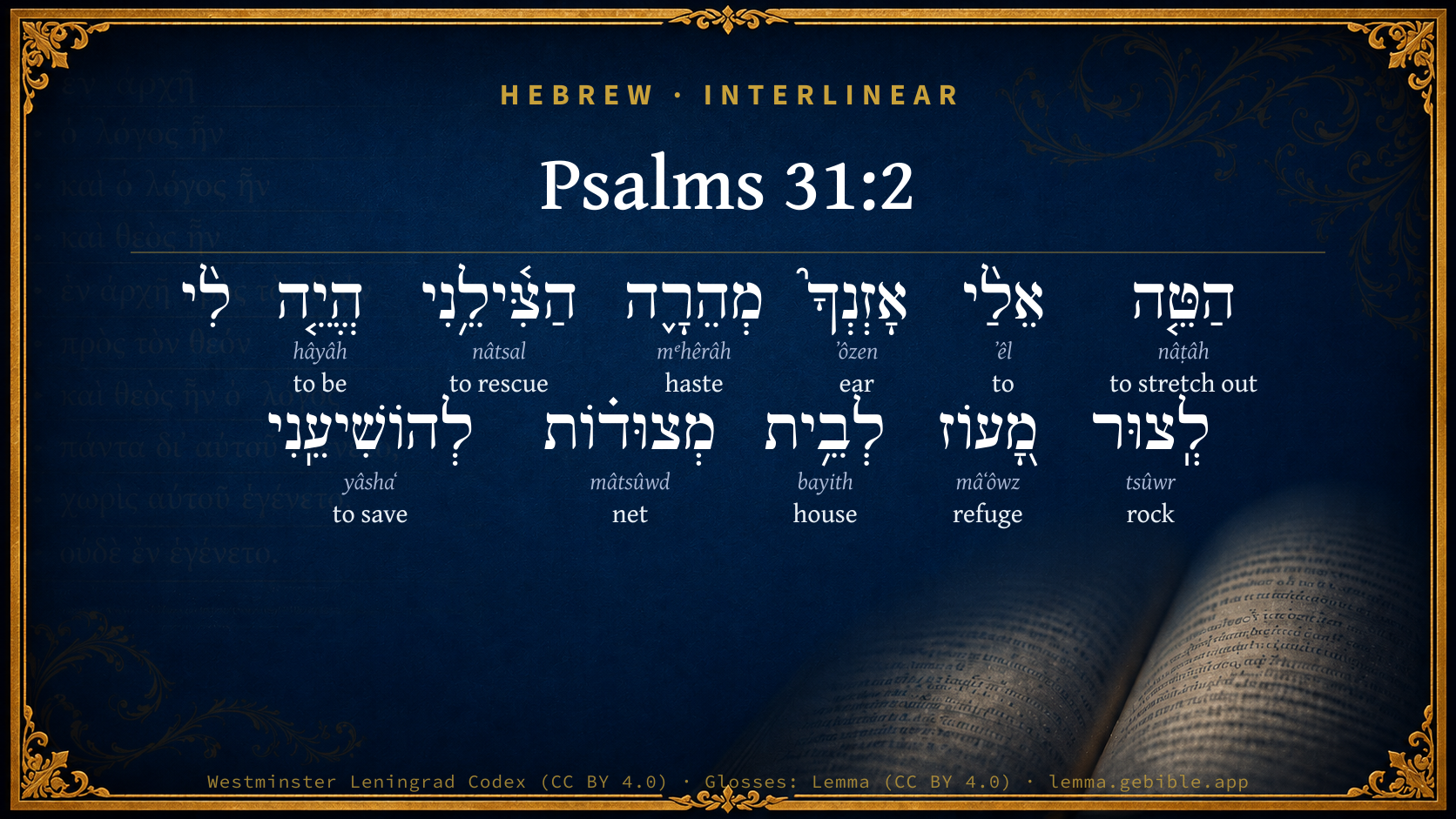
  1. הַטֵּ֤ה nâṭâh H5186 “stretch out” Verb, Hiphil, Imperative, 2nd Person, Masculine, Singular
  2. אֵלַ֨י ʼêl H413 “to · me” Preposition + Suffix, Personal, 1st Person, Common, Singular
  3. אָזְנְךָ֮ ʼôzen H241 “ear · your” Noun, Common, Feminine, Singular, Construct + Suffix, Personal, 2nd Person, Masculine, Singular
  4. הַצִּ֫ילֵ֥נִי nâtsal H5337 “rescue · me” Verb, Hiphil, Imperative, 2nd Person, Masculine, Singular + Suffix, Personal, 1st Person, Common, Singular
  5. הֱיֵ֤ה hâyâh H1961 “be” Verb, Qal, Imperative, 2nd Person, Masculine, Singular
  6. לְֽצוּר tsûwr H6697 “to/for · rock of” Preposition + Noun, Common, Masculine, Singular, Construct
  7. מָ֭עוֹז mâʻôwz H4581 “refuge” Noun, Common, Masculine, Singular, Absolute
  8. לְבֵ֥ית bayith H1004 “to/for · house of” Preposition + Noun, Common, Masculine, Singular, Construct
  9. מְצוּד֗וֹת mâtsûwd H4686 “nets” Noun, Common, Both, Plural, Absolute
  10. לְהוֹשִׁיעֵֽנִי yâshaʻ H3467 “to save · me” Preposition + Verb, Hiphil, Infinitive Construct + Suffix, Personal, 1st Person, Common, Singular

About this verse

These counts appear in no published source. They are computed here, from the morphology-tagged text and Lemma’s own curated glosses. What Lemma adds →

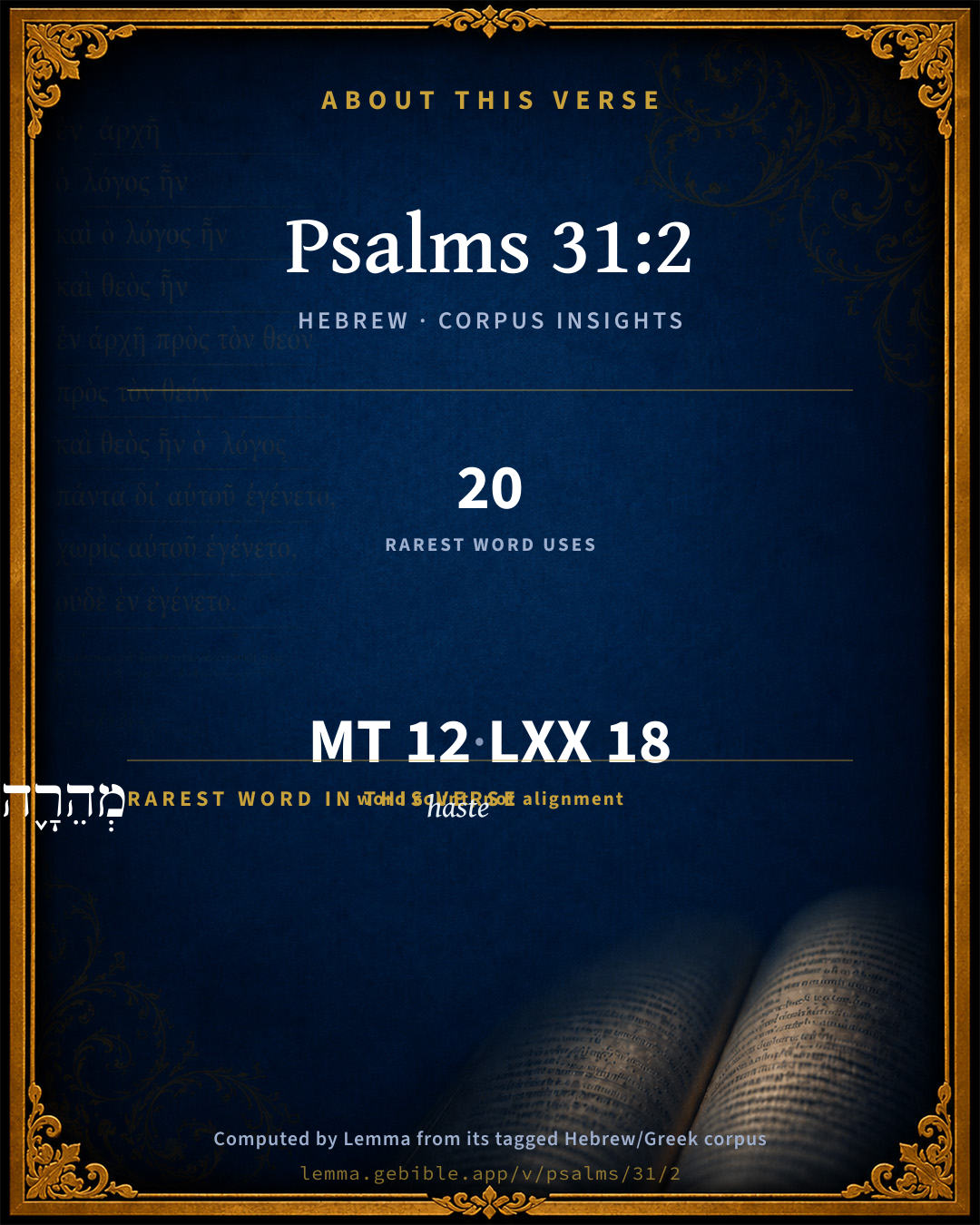
12
words
11
distinct lemmas
Wisdom
section

Notable vocabulary

The rarest word here is מְהֵרָ֪ה haste H4120 — appearing just 20 times in the whole Hebrew Bible.

Shared distinctive vocabulary

מְהֵרָ֪ה haste H4120 occurs in 20 verses of the Hebrew Bible. Also found in:

Grammatical profile

  • 4 verbs
  • 6 nouns
  • 2 prepositions

Verb forms

  • הַטֵּ֤ה Hiphil · Imperative
  • הַצִּ֫ילֵ֥נִי Hiphil · Imperative
  • הֱיֵ֤ה Qal · Imperative
  • לְהוֹשִׁיעֵֽנִי Hiphil · Infinitive Construct

Hebrew & Septuagint length

In English translation the verse runs 22 words from the Hebrew and 27 from the Septuagint (LXX English) — closely comparable.

A rough comparison of the two English renderings, which tokenize alike — not a word-level alignment.

Word counts can differ between the Hebrew and the Greek without any difference in meaning — e.g. the Hebrew direct-object marker אֵת has no separate Greek word, and Greek often adds the article ὁ.

In the original languages it is 12 Hebrew tokens and 18 Greek tokens — but the two are counted differently (Hebrew bundles its prefixes and suffixes into one token; the Greek is in lemma form), so that isn’t a like-for-like length.

Cross-references

22

Topical passages linked to Psalms 31:2 in the Treasury of Scripture Knowledge — connected by theme and wording, ordered by reader-vote popularity; previews shown in the World English Bible.

  • Psalms 71:2–3 Deliver me in your righteousness, and rescue me. Turn your ear to me, and save me.
  • Psalms 86:1 Hear, Yahweh, and answer me, For I am poor and needy.
  • Psalms 102:2 Don't hide your face from me in the day of my distress. Turn your ear to me. Answer me quickly in the day when I call.
  • Deuteronomy 32:31 For their rock is not as our Rock, Even our enemies themselves being judges.
  • Psalms 130:2 Lord, hear my voice. Let your ears be attentive to the voice of my petitions.
  • 1 John 4:15–16 Whoever confesses that Jesus is the Son of God, God remains in him, and he in God.
  • 2 Samuel 22:3 God, my rock, in him will I take refuge; My shield, and the horn of my salvation, my high tower, and my refuge; My savior, you save me from violence.
  • Job 7:21 Why do you not pardon my disobedience, and take away my iniquity? For now shall I lie down in the dust. You will seek me diligently, but I shall not be."
  • Psalms 18:1–2 I love you, Yahweh, my strength.
  • Psalms 40:17 But I am poor and needy; May the Lord think about me. You are my help and my deliverer. Don't delay, my God.
  • Psalms 62:7 With God is my salvation and my honor. The rock of my strength, and my refuge, is in God.
  • Psalms 69:17 Don't hide your face from your servant, For I am in distress. Answer me speedily!
  • Psalms 79:1 God, the nations have come into your inheritance. They have defiled your holy temple. They have laid Jerusalem in heaps.
  • Psalms 90:1 Lord, you have been our dwelling place for all generations.
  • Psalms 91:9 Because you have made Yahweh your refuge, And the Most High your dwelling place,
  • Psalms 94:22 But Yahweh has been my high tower, My God, the rock of my refuge.
  • Psalms 143:7 Hurry to answer me, Yahweh. My spirit fails. Don't hide your face from me, So that I don't become like those who go down into the pit.
  • Proverbs 22:17 Turn your ear, and listen to the words of the wise. Apply your heart to my teaching.
  • Isaiah 33:16 He shall dwell on high; his place of defense shall be the munitions of rocks; his bread shall be given [him]; his waters shall be sure.
  • Luke 18:8 I tell you that he will avenge them quickly. Nevertheless, when the Son of Man comes, will he find faith on the earth?"
  • John 6:56 He who eats my flesh and drinks my blood lives in me, and I in him.
  • 1 John 4:12 No one has seen God at any time. If we love one another, God remains in us, and his love has been perfected in us.

Cross-references courtesy of OpenBible.info (CC BY 4.0).

Hebrew and Greek witnesses Masoretic Hebrew ↔ Greek Septuagint

The same verse in the two great witnesses to the Old Testament, shown verse-for-verse.

You’re reading Greek Psalm 30 (Hebrew Psalm 31). The Septuagint counts the superscription, so verse numbers can differ from the Hebrew — chapter-level alignment, not verse-by-verse. Numbering follows Rahlfs.

These are two independent witnesses, not word-aligned to each other, and the Septuagint is shown in lemma (dictionary) form.

Hebrew Psalms 31:2 Masoretic · Westminster Leningrad Codex

הַטֵּ֤ה אֵלַ֨י אָזְנְךָ֮ מְהֵרָ֪ה הַצִּ֫ילֵ֥נִי הֱיֵ֤ה לִ֨י לְֽצוּר מָ֭עוֹז לְבֵ֥ית מְצוּד֗וֹת לְהוֹשִׁיעֵֽנִי

Bow down your ear to me. Deliver me speedily. Be to me a strong rock, A house of defense to save me.

World English Bible · Public Domain

Greek LXX Greek Psalm 30:2 Septuagint · lemma form

ἐπί σύ κύριος ἐλπίζω μή κατααἰσχύνω εἰς ὁ αἰών ἐν ὁ δικαιοσύνη σύ ῥύομαι ἐγώ καί ἐκαἱρέω ἐγώ

Incline your ear to me; make haste to rescue me: be you to me for a protecting God, and for a house of refuge to save me.

LXX2012 (modern English Septuagint) · Public Domain

On this verse, The Cambridge Bible for Schools and Colleges discusses the Septuagint’s reading. Read the note in Commentary ↓

Hebrew: Westminster Leningrad Codex (CC BY 4.0). Greek: Septuagint (public domain); English from LXX2012 (modern English Septuagint) (Public Domain). How the Septuagint differs from the Hebrew →

Commentary

Notes on Psalms 31:2 from classic Christian and Jewish commentators (each source and its license shown beneath its notes). The classic Christian expositions comment on the surrounding passage and are grouped to its opening verse, so a note may address several verses; the Jewish commentaries on the Tanakh (Rashi and others) are per-verse, so they appear only where the commentator wrote on this verse.

Lemma curates 59 commentaries, every one of them public domain or Creative Commons licensed, each selected and text-cleaned for this edition rather than reprinted as found. About our sources →

Trapp's Complete Commentary

John Trapp

Psa 31:2 Bow down thine ear to me; deliver me speedily: be thou my strong rock, for an house of defence to save me.

Ver. 2. Bow down thine ear to me, deliver me] This repetition of his petition is no vain babbling, as Mat 6:9, but an effect and an evidence of greatest earnestness, as Mat 26:44.

For an house of defence] Where the enemy can as little hurt me as when I was in the hold, 1Sa 22:4.

John Trapp, A Commentary or Exposition upon All the Books of the Old and New Testament (1647–1656) — public domain. Text from a community e-Sword module.

The Biblical Illustrator

Joseph S. Exell

Psa_31:2-8

Be Thou my strong rook,. . . for Thou art my rock,

Be . . . for Thou art

It sounds strange logic, Be . . . for Thou art, and yet it is the logic of prayer, and goes very deep, pointing out both its limits and its encouragements.

If we were to read thus: Be Thou a strong Rock to me, for a house, a fortress, for Thou art my Rock and my Fortress, we should get the whole force of the parallelism. Of course the main idea is that of the Rock, and Fortress is only an exposition of one phase of the meaning of that metaphor.

I. what God is. A rock, a fortress-house. What is the force of that metaphor?

1. Stable being is the first thought in it, for there is nothing that is more absolutely the type of unchangeableness and steadfast continuance. God the Unchangeable rises, like some majestic cliff, round the foot of which rolls for ever the tide of human life, and round which is littered the successive layers of the leaves of many summers.

2. Then besides this stable being, and the consequences of it, is the other thought which is attached to the emblem in Scripture, and that is defence. His place of defence shall be the munitions of rocks. When the floods are out, and all the plain is being dissolved into mud, the dwellers on it fly to the cliffs. Lead me to the rock that is higher than I.

3. But the Rock is a defence in another way. If a hard-pressed fugitive is brought to a stand and can set his back against a rock, he can front his assailants, secure that no unseen foe shall creep up behind and deal a stealthy stab and that he will not be surrounded unawares.

II. our plea with God, from what he is. Be Thou to me a Rock . . . for Thou art a Rock. Is that not illogical? No, for notice that little word to me--be Thou to me what Thou art in Thyself, and hast been to all generations. That makes all the difference. It is not merely Be what Thou art, although that would be much, but it is be it to me, and let me have all which is meant in that great Name. But then, beyond that, let me point out to you how this prayer suggests to us that all true prayer will keep itself within Gods Revelation of what He is.

III. the plea with God drawn from what we have taken him to be to us. Be Thou to me a strong Rock, for Thou art my Rock and my Fortress. What does that mean? It means that the suppliant has, by his own act of faith, taken God for his; that he has appropriated the great Divine revelation, and made it his own. Now a man by faith encloses a bit of the common for his very own. When God says that He so loved the world that He gave His . . . Son, I should say, He loved me, and gave Himself for me. When the great revelation is made that HE is the Rock of Ages, my faith says: My Rock and my Fortress. Having said that, and claimed Him for mine, I can then turn round to Him and say, Be to me what I have taken Thee to be. (A. Maclaren, D. D.)

For Thy names sake lead me and guide me.--

Divine guidance and leading

What a helpless, hopeless thing would a ship be, launched forth upon the deep without a helm, and without a pilot; how it would be drifted about by every current, and tossed to and fro by every wind and wave; how speedily it must be driven amid the shoals, or dashed upon the rocks. No better is man, launched forth on the waves of this troublesome world. Without a Divine helmsman, how must he inevitably be drifted into danger, and betrayed into ruin, if he follows his own wit, and will, and wisdom! The very essence of all Christian life is to walk by faith and not by sight, and the very essence of Divine wisdom in heaven-taught man is to trust in the Lord with all his might, and not to trust in himself, not to trust in his own understanding. How appropriate, then, is this prayer for us all.

I. the petition. Lead me and guide me. It implies--

1. That a man feels that he cannot guide himself.

2. That he believes God does interpose in the affairs of men, and that He condescends to guide and lead all who trust in Him.

3. Expectation that God will direct us. Some pray but never wait for the answer.

4. And there must be leading as well as guiding.

II. the plea. Some plead that they do their best: but they do not. This is the true plea--Thy names sake, Gods gracious character. It is a believers prayer. Gods providence, word, and spirit will make plain to us our way. Let us each adopt this prayer. (Hugh Stowell.)

The Biblical Illustrator, edited by Joseph S. Exell (c. 1880s–1900s) — public domain. Text from a community e-Sword module.

J. A. Alexander on Psalms

Joseph Addison Alexander

3. (Psa 31:2). Incline unto me thine ear; (in) haste deliver me; be to me for a rock of strength for a house of defences to save me. The prayer for speedy deliver- ance implies extreme necessity and danger. For the meaning of the figures, rock of strength and house of defences or fortress, see above, on Psa 18:3 (2), and as to the plural form, on Psa 20:7 (6).—The petition of the first clause seems to imply that God had hitherto appeared to turn a deaf ear to his prayers. It may perhaps have been intended to suggest the additional idea, that his cry was feeble, so that it had hitherto escaped the ear of him to whom it was addressed, and who is now implored to bow down or incline his ear, that the distant sound may reach him.

Joseph Addison Alexander, The Psalms Translated and Explained (1850) — public domain. Text from a community e-Sword module.

MacLaren's Expositions of Holy Scripture

Alexander MacLaren

Psalms

‘BE . . . FOR THOU ART’

Psa 31:2 - Psa 31:3.

It sounds strange logic, ‘Be . . . for Thou art,’ and yet it is the logic of prayer, and goes very deep, pointing out both its limits and its encouragements. The parallelism between these two clauses is even stronger in the original than in our Version, for whilst the two words which designate the ‘Rock’ are not identical, their meaning is identical, and the difference between them is insignificant; one being a rock of any shape or size, the other being a perpendicular cliff or elevated promontory. And in the other clause, ‘for a house of defence to save me,’ the word rendered ‘defence’ is the same as that which is translated in the next clause ‘fortress.’ So that if we were to read thus: ‘Be Thou a strong Rock to me, for a house, a fortress, for Thou art my Rock and my Fortress,’ we should get the whole force of the parallelism. Of course the main idea in that of the ‘Rock,’ and ‘Fortress’ is only an exposition of one phase of the meaning of that metaphor.

I. So let us look first at what God is.

‘A rock, a fortress-house.’ Now, what is the force of that metaphor? Stable being, as it seems to me, is the first thought in it, for there is nothing that is more absolutely the type of unchangeableness and steadfast continuance. The great cliffs rise up, and the river glides at their base-it is a type of mutability, and of the fleeting generations of men, who are as the drops and ripples in its course-it eddies round the foot of the rocks to which the old man looks up, and sees the same dints and streaks and fissures in it that he saw when he was a child. The river runs onwards, the trees that root themselves in the clefts of the rock bear their spring foliage, and drop their leaves like the generations of men, and the Rock is ‘the same yesterday, and to-day, and for ever.’ And God the Unchangeable rises, if I may so say, like some majestic cliff, round the foot of which rolls for ever the tide of human life, and round which are littered the successive layers of the leaves of many summers.

Then besides this stable being, and the consequences of it, is the other thought which is attached to the emblem in a hundred places in Scripture, and that is defence. ‘His place of defence shall be the munitions of rocks.’ When the floods are out, and all the plain is being dissolved into mud, the dwellers on it fly to the cliffs. When the enemy’s banners appear on the horizon, and the open country is being harried and burned, the peasants hurry to the defence of the hills, and, sheltered there, are safe. And so for us this Name assures us that in Him, whatever floods may sweep across the low levels, and whatever foes may storm over the open land and the unwalled villages, there is always the fortress up in the hills, and thither no flood can rise, and there no enemy can come. A defence and a sure abode is his who dwells in God, and thus folds over himself the warm wings that stretch on either side, and shelter him from all assault. ‘Lead me to the Rock that is higher than I.’

But the Rock is a defence in another way. If a hard-pressed fugitive is brought to a stand and can set his back against a rock, he can front his assailants, secure that no unseen foe shall creep up behind and deal a stealthy stab and that he will not be surrounded unawares. ‘The God of Israel shall be your rearward,’ and he who has ‘made the Most High his habitation’ is sheltered from ‘the pestilence that walketh in darkness,’ as well as from ‘the destruction that wasteth at noon-day,’ and will be cleansed from ‘secret faults’ if he keeps up unbroken his union with God, for the ‘faults’ which are not recognised as faults by his partially illuminated conscience are known to God. But the Rock is a defence in yet another way, for it is a sure foundation for our lives. Whoso builds on God need fear no change. When the floods rise, and the winds blow, and the rain storms down, the house that is on the Rock will stand.

And, then, in the Rock there is a spring, and round the spring there is ‘the light of laughing flowers,’ amidst the stern majesty of the cliff. Just as the Law-giver of old smote the rock, and there gushed out the stream that satisfied the thirst of the whole travelling nation, so Paul would have us Christians repeat the miracle by our faith. Of us, too, it may be said, they drank ‘of that Rock that followed them, and that Rock was Christ.’ Stable being, secure defence, a fountain of refreshment and satisfaction: all these blessings lie in that great metaphor.

II. Now, note our plea with God, from what He is.

‘Be Thou to me a Rock . . . for Thou art a Rock.’ Is that not illogical? No, for notice that little word, ‘to me’-be Thou to me what Thou art in Thyself, and hast been to all generations.’ That makes all the difference. It is not merely ‘Be what Thou art,’ although that would be much, but it is ‘be it to me,’ and let me have all which is meant in that great Name.

But then, beyond that, let me point out to you how this prayer suggests to us that all true prayer will keep itself within God’s revelation of what He is. We take His promises, and all the elements which make up His name or manifestation of His character to the world, whether by His acts or by the utterances of this Book, or by the inferences to be drawn from the life of Jesus Christ, the great Revealer, or by what we ourselves have experienced of Him. The ways by which God has revealed Himself to the world define the legitimate subjects, and lay down the firm foundation, of our petitions. In all His acts God reveals Himself, and if I may so say, when we truly pray, we catch these up, and send them back again to heaven, like arrows from a bow. It is only when our desires and prayers foot themselves upon God’s revelation of Himself, and in essence are, in various fashions, the repetition of this prayer of my text: ‘Be . . . for Thou art,’ that we can expect to have them answered. Much else may call itself prayer, but it is often but petulant and self-willed endeavour to force our wishes upon Him, and no answer will come to that. We are to pray about everything; but we are to pray about nothing, except within the lines which are marked out for us by what God has told us, in His words and acts, that He Himself is. Catch these up and fling them back to Him, and for every utterance that He has made of Himself, ‘I am’ so-and-so, let us go to Him and say ‘Be Thou that to me,’ and then we may be sure of an answer.

So then two things follow. If we pray after the pattern of this prayer, ‘Be Thou to me what Thou art,’ then a great many foolish and presumptuous wishes will be stifled in the birth, and, on the other hand, a great many feeble desires will be strengthened and made confident, and we shall be encouraged to expect great things of God. Have you widened your prayers, dear friend!-and I do not mean by that only your outward ones, but the habitual aspiration and expectation of your minds-have you widened these to be as wide as what God has shown us that He is? Have you taken all God’s revelation of Himself, and translated it into petition? And do you expect Him to be to you all that He has ever been to any soul of man upon earth? Oh! how such a prayer as this, if we rightly understand it and feel it, puts to shame the narrowness and the poverty of our prayers, the falterings of our faith, and the absence of expectation in ourselves that we shall receive the fulness of God.

God owns that plea: ‘Be . . . what Thou art.’ He cannot resist that. That is what the Apostle meant when he said, ‘He abideth faithful, He cannot deny Himself.’ He must be true to His character. He can never be other than He always has been. And that is what the Psalmist meant when he goes on, after the words that I have taken for my text, and says, ‘For Thy Name’s sake lead me and guide me,’ What is God’s Name? The collocation of letters by which we designate Him? Certainly not. The Name of God is the sum total of what God has revealed Himself as being. And ‘for the sake of the Name,’ that He may be true to that which He has shown Himself to be, He will always endorse this bill that you draw upon Him when you present Him with His own character, and say ‘Be to me what Thou art.’

III. Lastly, we have here the plea with God drawn from what we have taken Him to be to us.

That is somewhat different from what I have already been dwelling upon. Mark the words: ‘Be Thou to me a strong Rock, for Thou art my Rock and my Fortress.’ What does that mean? It means that the suppliant has, by his own act of faith, taken God for his; that he has appropriated the great divine revelation, and made it his own. Now it seems to me that that appropriation is, if not the point, at least one of the points, in which real faith is distinguished from the sham thing which goes by that name amongst so many people. A man by faith encloses a bit of the common for his very own. When God says that He ‘so loved the world that He gave His . . . Son,’ I should say, ‘He loved me, and gave Himself for me.’ When the great revelation is made that He is the Rock of Ages, my faith says: ‘My Rock and my Fortress.’ Having said that, and claimed Him for mine, I can then turn round to Him and say, ‘Be to me what I have taken Thee to be.’

And that faith is expressed very beautifully and strikingly in one of the Old Testament metaphors, which frequently goes along with this one of the Rock. For instance, in a great chapter in Isaiah we find the original of that phrase ‘the Rock of Ages.’ It runs thus, ‘Trust ye in the Lord for ever, for in the Lord JEHOVAH is the Rock of Ages.’ Now the word for trust there literally means, to flee into a refuge, and so the true idea of faith is ‘to fly for refuge,’ as the Epistle to the Hebrews has it, ‘to the Hope set before us,’-that is {keeping to the metaphor}, to the cleft in the Rock.

That act of trust or flight will make it certain that God will be to us for a house of defence, a fortress to save us. Other rock-shelters may crumble. They may be carried by assault; they may be riven by earthquakes. ‘The mountains shall depart, and the hills shall be removed,’ but this Rock is impregnable, and all who take refuge in it are safe for ever.

And so the upshot of the whole matter is that God will be to us what we have faith to believe that He is, and our faith will be the measure of our possession of the fulness of God. If we can only say in the fulness of our hearts-and keep to the saying: ‘Be Thou to me a Rock, for Thou art my Rock,’ then nothing shall ever hurt us; and ‘dwelling in the secret place of the Most High’ we shall be kept in safety; our ‘abode shall be the munitions of rocks, our bread shall be given us, and our water shall be made sure.’

Alexander MacLaren, Expositions of Holy Scripture (1904–1910) — public domain. Text from a community e-Sword module.

Tyndale Open Study Notes

Tyndale Open Resources

31:2 The psalmist issues an urgent call for the Lord to pay attention to his desperate situation (71:2; 88:2; 102:2).

Tyndale Open Study Notes — © Tyndale Open Resources, licensed CC BY-SA 4.0. Text via the HelloAO Bible API.

Jamieson, Fausset & Brown

Robert Jamieson, A. R. Fausset & David Brown

He seeks help in God's righteous government (Psa 5:8), and begs for an attentive hearing, and speedy and effectual aid. With no other help and no claim of merit, he relies solely on God's regard to His own perfections for a safe guidance and release from the snares of his enemies. On the terms "rock," &c., (compare Psa 17:2; Psa 18:2, Psa 18:50; Psa 20:6; Psa 23:3; Psa 25:21).

Jamieson, Fausset & Brown — Commentary Critical and Explanatory on the Whole Bible (1871) — public domain (CC PDM 1.0). Text via the HelloAO Bible API.

Adam Clarke's Commentary

Verse 2. Bow down thine ear] Listen to my complaint. Put thy ear to my lips, that thou mayest hear all that my feebleness is capable of uttering. We generally put our ear near to the lips of the sick and dying, that we may hear what they say. To this the text appears to allude.

Strong rock] Rocks, rocky places, or caves in the rocks, were often strong places in the land of Judea. To such natural fortifications allusions are repeatedly made by the Hebrew poetic writers.

Adam Clarke's Commentary on the Bible (1810–1826) — public domain. Text from a community e-Sword/MySword module.

John Calvin's Commentaries

2. incline thine ear unto me. These words express with how much ardor David’s soul was stimulated to pray. He affects no splendid or ornate language, as rhetoricians are wont to do; but only describes in suitable figures the vehemence of his desire. In praying that he may be delivered speedily there is shown the greatness of his danger, as if he had said, All will soon be over with my life, unless God make haste to help me. By the words, house of defense, fortress, and rock, he intimates, that, being unable to resist his enemies, his hope rests only on the protection of God.

John Calvin's Commentaries (1540-1563) — public domain. Text from the Calvin Translation Society English edition (1840s-50s) via the Christian Classics Ethereal Library (ccel.org). Calvin's coverage is partial (roughly two-thirds of the Bible); uncommented books and verses are honest gaps, never fabricated. The 19th-century editor's footnotes and remarks are omitted so the notes are faithfully Calvin's own voice.

Ellicott's Commentary for English Readers

(2) My strong rock.—Literally,

“Thou art to me for a rock of a stronghold,

For a house of fortresses to save me.”

A Bible Commentary for English Readers, edited by Charles John Ellicott (1878–1897) — public domain. Text from a community e-Sword module.

The Cambridge Bible for Schools and Colleges

gen. ed. J. J. S. Perowne

2. Bow down] Or, incline, as in Psa_17:6; &c.

2, 3. Be thou &c.] Lit. Become (LXX γενοῦ) to me a stronghold-rock, a fortress-house to save me: for (he goes on to give the ground of his prayer) thou art my cliff and my fortress: i.e. prove Thyself to be what I know Thou art. “It is the logic of every believing prayer.” Delitzsch. For the figures see note on Psa_18:2.

therefore &c.] And for thy name’s sake thou wilt lead me and guide me. A further expression of trust rather than a petition. By gentle and unerring guidance God will shew Himself all that He has declared Himself to be. Cp. the same words in Psa_23:2; Psalms 3, and see notes there.

The Cambridge Bible for Schools and Colleges (gen. ed. J. J. S. Perowne; Cambridge University Press, 1878–1918) — public domain. Text from a community e-Sword module.

John Gill's Exposition

Bow down thine ear to me,.... Which is said after the manner of men, who, when they give attention, and listen to anything, stoop, and incline the ear; and this for God to do, as he sometimes does, is wonderful condescending grace!

deliver me speedily; which shows that he was in great danger, and his case required haste: the Lord does help right early, and is sometimes a present help in time of need, and delivers at once, as soon as the mercy is asked for;

be thou my strong rock: for shelter and security from enemies, as well as to build his everlasting salvation on, and to stand firmly upon, and out of danger;

for an house of defence to save me; both for an house to dwell in, Lord being the dwelling place of his people in all generations, and a strong habitation to which they may continually resort; and for protection and safety, their place of defence in him being the munition of rocks, a strong hold, and a strong tower from the enemy.

John Gill's Exposition of the Whole Bible (1746–1763) — public domain (CC PDM 1.0). Text via the HelloAO Bible API.

Albert Barnes' Notes on the Bible

Bow down thine ear to me - As He does who inclines His ear toward one whom He is willing to hear, or whom He is desirous of hearing. See the notes at Psa 17:6.

Deliver me speedily - Without delay. Or, hasten to deliver me. It is right to pray to be delivered from all evil; equally right to pray to be delivered immediately.

Be thou my strong rock - Margin: “to me for a rock of strength.” See Psa 18:1-2, note; Psa 18:46, note.

For an house of defense to save me - A fortified house; a house made safe and strong. It is equivalent to praying that he might have a secure abode or dwelling-place.

Albert Barnes' Notes on the Bible (1834–1885) — public domain. Text from a community e-Sword/MySword module.

Matthew Poole's English Annotations

Deliver me speedily, because of the greatness and urgency of my danger, which is even ready to swallow me up.

Matthew Poole's English Annotations on the Holy Bible (1683–1685) — public domain. Text from a community e-Sword/MySword module.

The Treasury of David

Charles H. Spurgeon

Ver. 2. Bow down thine ear to me. Condescend to my low estate; listen to me attentively as one who would hear every word. Heaven with its transcendent glories of harmony might well engross the divine ear, but yet the Lord has an hourly regard to the weakest moanings of his poorest people. Deliver me speedily. We must not set times or seasons, yet in submission we may ask for swift as well as sure mercy. God's mercies are often enhanced in value by the timely haste which he uses in their bestowal; if they came late they might be too latebut he rides upon a cherub, and flies upon the wings of the wind when he intends the good of his beloved. Be thou my strong rock. Be my Engedi, my Adullam; my immutable, immovable, impregnable, sublime, resort. For an house of defence to save me, wherein I may dwell in safety, not merely running to thee for temporary shelter, but abiding in thee for eternal salvation. How very simply does the good man pray, and yet with what weight of meaning! he uses no ornamental flourishes, he is too deeply in earnest to be otherwise than plain: it were well if all who engage in public prayer would observe the same rule.

Ver. 1-3: See Psalms on "Ps 31:1" for further information.

Ver. 2. Bow down thy ear. Listen to my complaint. Put thy ear to my lips, that thou mayest hear all that my feebleness is capable of uttering. We generally put our ear near to the lips of the sick and dying that we may hear what they say. To this the text appears to allude. Adam Clarke.

Ver. 2. Deliver me speedily. In praying that he might be delivered speedily there is shown the greatness of his danger, as if he had said, All will soon be over with my life, unless God makes haste to help me. John Calvin.

Ver. 2-3. Be thou my strong rock, etc. What the Lord is engaged to be unto us by covenant, we may pray and expect to find him in effect. "Be thou my strong rock, "saith he, "for thou art my rock." David Dickson.

Ver. 2. (first clause). God's hearing prayer a great condescension.

Ver. 2 (second clause). How far we may be urgent with God as to time.

Ver. 2-3 (last and first clauses). That which we have we may yet seek for.

Psalms 31:3*

Ver. 2-3. Be thou my strong rock, etc. What the Lord is engaged to be unto us by covenant, we may pray and expect to find him in effect. Be thou my strong rock, saith he, for thou art my rock. David Dickson.

Ver. 2-3. (last and first clauses). That which we have we may yet seek for.

Charles H. Spurgeon's The Treasury of David (1869–1885) — public domain. Psalms only. Text from a community e-Sword/MySword module.

Whedon's Commentary on the Bible

Daniel D. Whedon

2. Bow down thine ear—Literally, Stretch forward thine ear, as if to obtain a more accurate hearing. The phrase is anthropomorphic for giving close attention. The anthropomorphisms of belief are idolatrous, forbidden, (Exo_20:4;) but those of the feelings are a necessity arising from the poverty of language.

Deliver me speedily—No time is to be lost. Delay is ruin. See on Psa_31:1.

My strong rock—An impregnable defence. A military term, same as “house of defence;” literally, house of fortresses. 1Sa_24:22

Daniel D. Whedon (gen. ed.), Commentary on the Old and New Testaments (1874–1909) — public domain. Text from a community e-Sword module.

The Pulpit Commentary

Bow down thine ear to me; or, incline thine ear to me, as the same phrase is translated in Psa_71:2. Deliver me speedily. Not doubting of deliverance, he makes his request for speedy deliverance. (comp. Psa_38:22 Psa_40:17 Psa_70:1 Psa_71:12, etc.) Be thou my strong Rock, for a House of defence to save me; rather, as in the Revised Version, Be thou to me a strong Rock, a House of defence, etc. . (comp. Psa_18:2)

The Pulpit Commentary (1880–1919), ed. H.D.M. Spence-Jones & Joseph S. Exell — public domain. Text from a community e-Sword module.

Lesson kit

Teaching starters — assembled from the data on this page, not authored interpretation. Every prompt links to the verse data it draws on. Edit before teaching.

Psalms, in the Wisdom, opens this verse with 12 words (11 distinct Hebrew lemmas). Its most distinctive word is mᵉhêrâh (“haste”). A historical commentator’s framing appears above. Read the whole chapter for the surrounding context.

Discussion questions

  1. The word mᵉhêrâh carries the sense “haste.” How does it shape the verse?
  2. Numbers 16:46 shares the word «haste» with this verse. How do the two illuminate each other?
  3. These translations render this verse differently; the difference is in the English rendering, not the original. What questions does that raise?
  4. The verb «הַטֵּ֤ה» is Hiphil Imperative. How does its form color the action?
  5. Reading how Trapp's Complete Commentary and The Biblical Illustrator read this verse, where do the two commentators agree and where do they part?

Things to notice

Reading settings

Reading text

Shown beneath each verse's original-language words.

Old Testament
Old Testament edition

Read the OT as the Masoretic Hebrew (MT) or the Greek Septuagint (LXX).

English shown for the Greek Septuagint (in the Hebrew ↔ Greek comparison).

Comparing translations? Open the Compare panel on any verse page to stack up to four side by side.