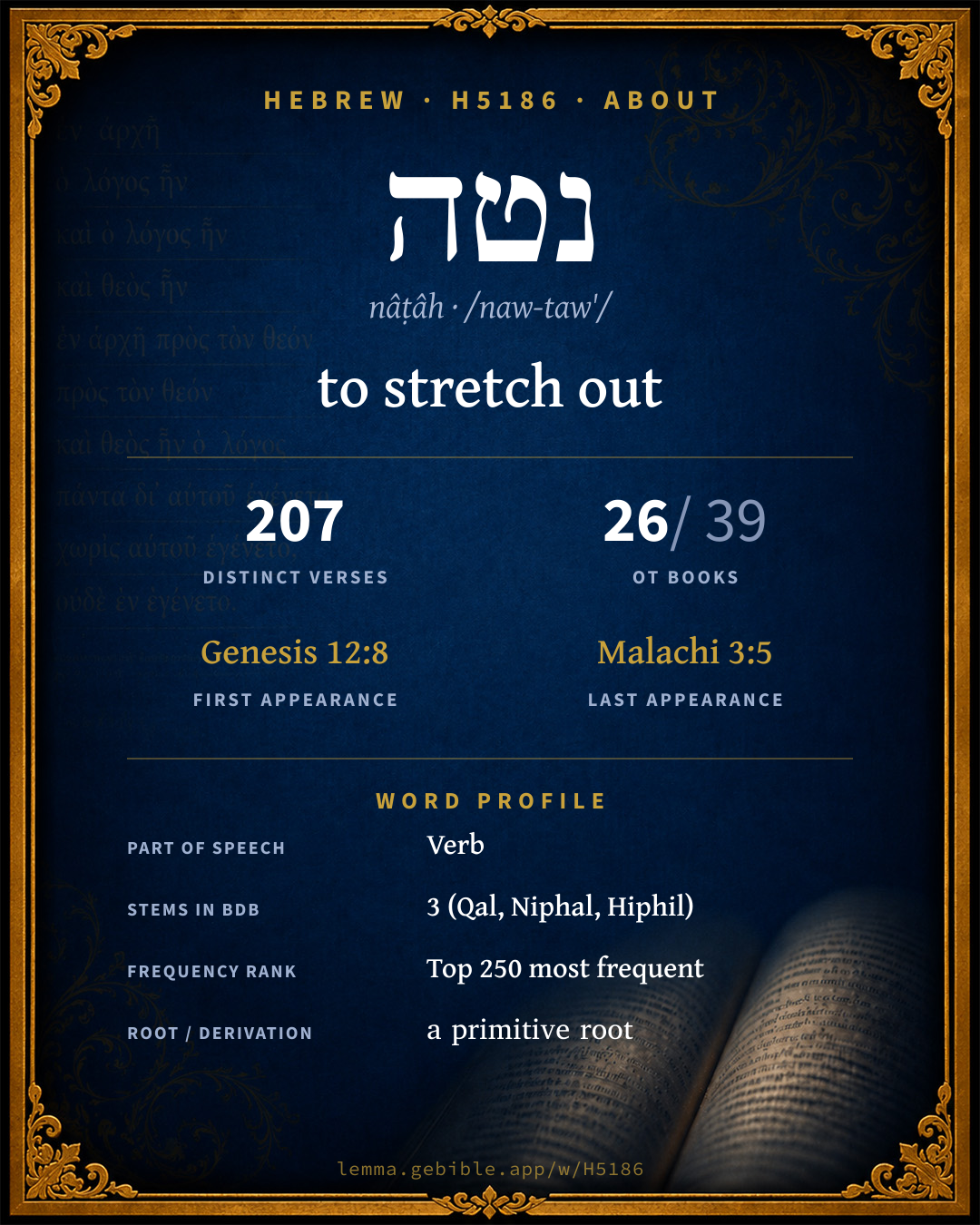
נָטָה
to stretch out
also: extend, spread out, pitch, turn fuller range ↓
Full lexicon entry — Brown-Driver-Briggs (BDB)
From Brown-Driver-Briggs (BDB)
Where this word appears
See every Hiphil verb in the Hebrew Bible →
Grammar key — what these labels mean
Part of speech
- Verb
- An action or state-of-being word.
Stem
- Qal
- The basic, simple active stem — the plain form of the verb (“he wrote”). Here: ‘stretch out’
- Hiphil
- The causative active stem (“he caused / brought about”). Here: ‘rarely stretch out’
- Niphal
- Usually the simple passive or reflexive of the Qal (“he was written”). Here: ‘be stretched out’
Form
- Sequential Imperfect
- An imperfect with prefixed waw — the standard past-narrative form (waw-consecutive imperfect).
- Perfect
- A completed action or state — Hebrew marks aspect (completeness) more than strict tense (“he wrote”).
- Participle Passive
- A verbal adjective expressing action received (“written”).
- Imperative
- A direct command (“write!”).
- Participle Active
- A verbal adjective expressing ongoing or characteristic action (“writing / one who writes”).
- Sequential Perfect
- A perfect with prefixed waw continuing a preceding imperfect or command (waw-consecutive perfect).
- Infinitive Construct
- A bound verbal noun, frequently with prepositions (“to write / in writing”).
- Imperfect
- An incomplete, ongoing, or future action (“he will / would write”).
- Jussive
- A third- or second-person volitional form expressing wish or command (“let him write”).
State
- Absolute
- The independent form of a noun, not bound to a following word.
- Construct
- A noun bound to a following noun in a possessive / “of” relationship (the construct chain).
Person
- 3rd Person
- The one spoken about (“he / she / it / they”).
- 2nd Person
- The one addressed (“you”).
- 1st Person
- The speaker (“I / we”).
Gender
- Masculine
- Grammatically masculine.
- Feminine
- Grammatically feminine.
- Common
- Either gender — not distinguished for this form.
Number
- Singular
- One.
- Plural
- More than one (in Hebrew, generally three or more).
Every verse where H5186 appears in the Book of Psalms — 29 distinct verses. Click any verse to open its interlinear word-by-word view. Verse text shown in the World English Bible for context — . Each verse’s Hebrew form is shown with its reference; the English is not keyword-highlighted, since the data carries no word-level English alignment. Use “Compare translations” on any verse to read it across multiple English versions. This concordance covers the Hebrew Bible; Septuagint (Greek Old Testament) occurrences are not indexed here.
Psalms
- Psalms 17:6 הַֽט Hiphil impv 2ms I have called on you, for you will answer me, God: Turn your ear to me. Hear my speech.
- Psalms 17:11 לִ/נְט֥וֹת prep + Qal inf.cs They have now surrounded us in our steps. They set their eyes to cast us down to the earth.
- Psalms 18:9 וַ/יֵּ֣ט conj + Qal wimpf 3ms He bowed the heavens also, and came down. Thick darkness was under his feet.
- Psalms 21:11 נָט֣וּ Qal pf 3cp For they intended evil against you. They plotted evil against you which cannot succeed.
- Psalms 27:9 תַּט Hiphil juss 2ms Don't hide your face from me. Don't put your servant away in anger. You have been my help. Don't abandon me, Neither forsake me, God of my salvation.
- Psalms 31:2 הַטֵּ֤ה Hiphil impv 2ms Bow down your ear to me. Deliver me speedily. Be to me a strong rock, A house of defense to save me.
- Psalms 40:1 וַ/יֵּ֥ט conj + Qal wimpf 3ms I waited patiently for Yahweh. He turned to me, and heard my cry.
- Psalms 44:18 וַ/תֵּ֥ט conj + Qal wimpf 3fs Our heart has not turned back, Neither have our steps strayed from your path,
- Psalms 45:10 וְ/הַטִּ֣י conj + Hiphil impv 2fs Listen, daughter, consider, and turn your ear. Forget your own people, and also your father's house.
- Psalms 49:4 אַטֶּ֣ה Hiphil impf 1cs I will incline my ear to a proverb. I will open my riddle on the harp.
- Psalms 62:3 נָט֑וּי Qal ptcp.pass ms How long will you assault a man, Would all of you throw him down, Like a leaning wall, like a tottering fence?
- Psalms 71:2 הַטֵּֽה Hiphil impv 2ms Deliver me in your righteousness, and rescue me. Turn your ear to me, and save me.
- Psalms 73:2 נטוי נָטָ֣יוּ Qal ptcp.pass ms cs Qal pf 3cp But as for me, my feet were almost gone. My steps had nearly slipped.
- Psalms 78:1 הַטּ֥וּ Hiphil impv 2mp Hear my law, my people. Turn your ears to the words of my mouth.
- Psalms 86:1 הַטֵּֽה Hiphil impv 2ms Hear, Yahweh, and answer me, For I am poor and needy.
- Psalms 88:2 הַטֵּֽה Hiphil impv 2ms Let my prayer enter into your presence. Turn your ear to my cry.
- Psalms 102:2 הַטֵּֽה Hiphil impv 2ms Don't hide your face from me in the day of my distress. Turn your ear to me. Answer me quickly in the day when I call.
- Psalms 102:11 נָט֑וּי Qal ptcp.pass ms My days are like a long shadow. I have withered like grass.
- Psalms 104:2 נוֹטֶ֥ה Qal ptcp.act ms He covers himself with light as with a garment. He stretches out the heavens like a curtain.
- Psalms 109:23 כִּ/נְטוֹת֥/וֹ prep + Qal inf.cs + sfx pers 3ms I fade away like an evening shadow. I am shaken off like a locust.
- Psalms 116:2 הִטָּ֣ה Hiphil pf 3ms Because he has turned his ear to me, Therefore I will call on him as long as I live.
- Psalms 119:36 הַט Hiphil impv 2ms Turn my heart toward your statutes, Not toward selfish gain.
- Psalms 119:51 נָטִֽיתִי Qal pf 1cs The arrogant mock me excessively, But I don't swerve from your law.
- Psalms 119:112 נָטִ֣יתִי Qal pf 1cs I have set my heart to perform your statutes forever, Even to the end.
- Psalms 119:157 נָטִֽיתִי Qal pf 1cs Many are my persecutors and my adversaries. I haven't swerved from your testimonies.
- Psalms 125:5 וְ/הַ/מַּטִּ֤ים conj + ptcl def.art + Hiphil ptcp.act mp But as for those who turn aside to their crooked ways, Yahweh will lead them away with the workers of iniquity. Peace be on Israel.
- Psalms 136:12 נְטוּיָ֑ה Qal ptcp.pass fs With a strong hand, and with an outstretched arm; For his loving kindness endures forever:
- Psalms 141:4 תַּט Hiphil juss 2ms Don't incline my heart to any evil thing, To practice deeds of wickedness with men who work iniquity. Don't let me eat of their delicacies.
- Psalms 144:5 הַט Hiphil impv 2ms Part your heavens, Yahweh, and come down. Touch the mountains, and they will smoke.
About this entry
At a glance — auto-summarized from this page’s data, not written by a person. Every figure links to its source below. This summary describes the numbers; it doesn’t interpret them.
נטה — transliterated nâṭâh — is a Hebrew verb carrying the sense “to stretch out.” Debuting at Genesis 12:8, it then recurs through the corpus. Spanning 207 verses in 26 books, it ranks among the common words of the Hebrew Bible. The verb spans 3 stems, from Qal to Niphal. From the same root come מטה, מטה and מטה. See the sense tree, 207-verse concordance, and the renderings breakdown below.
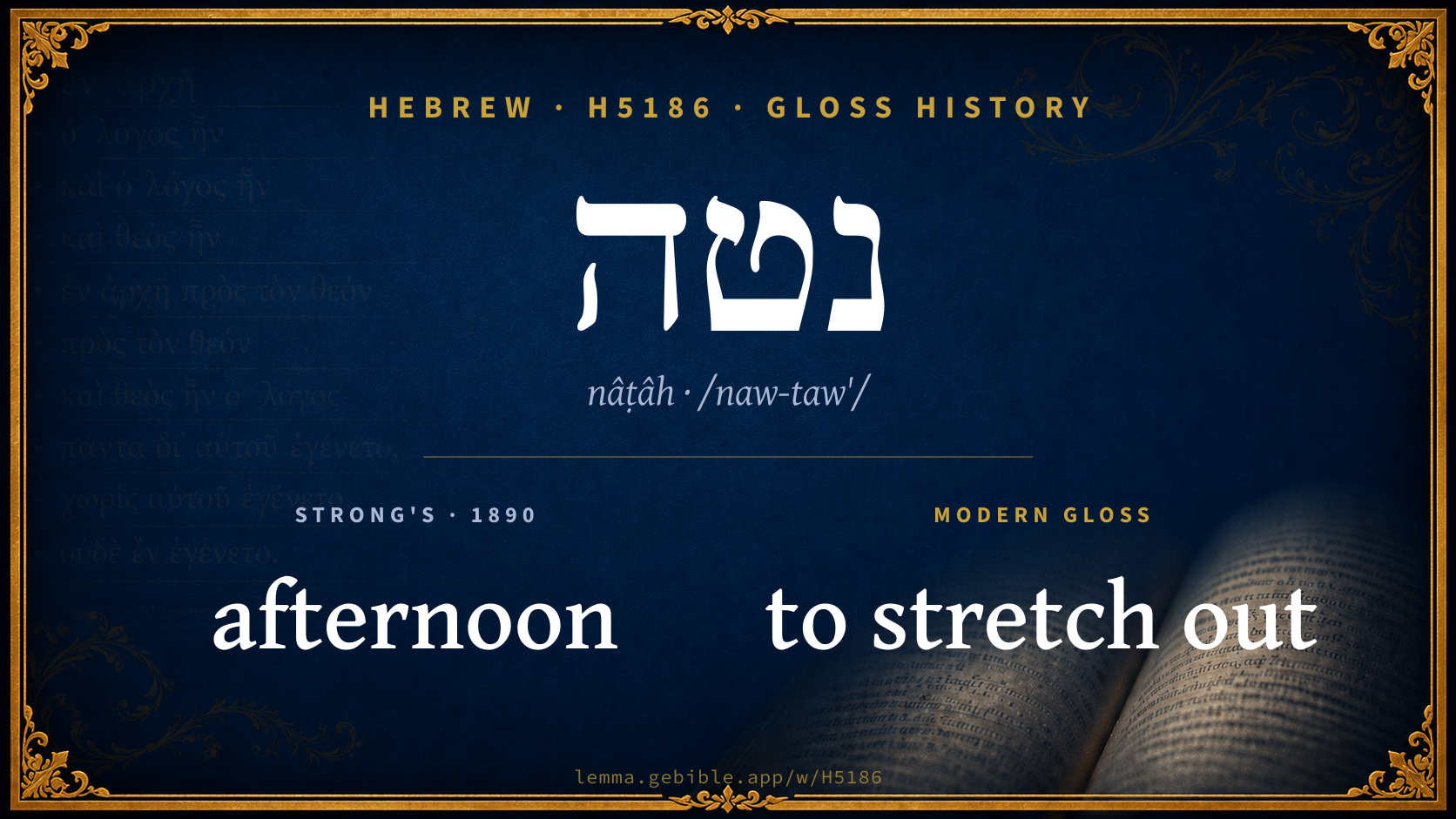
Gloss history
Strong's 1890 vs modern scholarship
About this word
Strong's H5186 catalogs a Hebrew word from the Hebrew Old Testament.
These counts are not copied from any lexicon or concordance. They are computed here, from the morphology-tagged Hebrew Old Testament. What Lemma adds →
- 207
- distinct verses
- The word appears in 207 distinct verses.
- 26 / 39
- OT books
- The word appears in 26 of 39 Old Testament books.
- #220
- by frequency
- Top 250 most frequent Hebrew words (rank 220 of 8,640 Hebrew words by occurrence).
View all 207 occurrences in the concordance →
By section of the Old Testament
By traditional corpus
Conventional, traditional groupings — biblical authorship is debated, so this is a traditional corpus grouping, not an authorship claim. Each share is this word’s portion of its verses in that division of the Hebrew canon. Each figure is a share of the word’s 207 distinct verses.
- Prophets (Nevi'im) 98 verses · 47%
- Writings (Ketuvim) 62 verses · 30%
- Torah (Pentateuch) 47 verses · 23%
How translations render this word
Counts come from each version’s own published word-to-Strong’s tagging or interlinear alignment — an approximate guide to how each version renders this word, not a word-level alignment the data otherwise carries. Because each total is that version’s own tagged count, the per-version totals vary from one another and need not match the appearance or distinct-verse counts above. These counts may also differ from a printed concordance because Lemma counts each distinctly tagged rendering and does not collapse phrase taggings into a single head-word total. This is a fixed set of word-tagged versions (KJV, ASV, BSB, ULT) and does not change with the reading translation you choose elsewhere. Each version’s license is shown beside its name below (and on Sources).
- King James Version: Stretched out 18×, Incline 11×, Inclined 9×
- American Standard Version: Outstretched 15×, Incline 13×, Turn aside 10×
- Berean Standard Bible: Incline 18×, Outstretched 18×, Stretched out 13×
- unfoldingWord Literal Text: Incline 20×, And 14×, Outstretched 14×
King James Version Public Domain
Renders H5186 across 214 tagged occurrences — most commonly:
Plus other, less common renderings. Plus 85 renderings that appear only once — usually multi-word phrases or single function words the recovered tagging swept in, not distinct renderings. Not rendered by a distinct English word in 2 further occurrences.
American Standard Version Public Domain
Renders H5186 across 215 tagged occurrences — most commonly:
Plus other, less common renderings. Plus 84 renderings that appear only once — usually multi-word phrases or single function words the recovered tagging swept in, not distinct renderings.
Berean Standard Bible Public Domain
Renders H5186 across 214 tagged occurrences — most commonly:
Plus other, less common renderings. Plus 94 renderings that appear only once — usually multi-word phrases or single function words the recovered tagging swept in, not distinct renderings.
unfoldingWord Literal Text CC BY-SA 4.0
Renders H5186 across 251 tagged occurrences — most commonly:
Plus other, less common renderings. Plus 97 renderings that appear only once — usually multi-word phrases or single function words the recovered tagging swept in, not distinct renderings.
21 senses and sub-senses in the full BDB
Hebrew verbs can shift meaning by stem (binyan): Qal is the basic action, Niphal is often passive or reflexive, Piel often intensifies or makes it factitive, and Hiphil is typically causative. The senses below are grouped under the stem BDB assigns to each.
What do BDB’s symbols mean?
BDB uses these scholarly abbreviations:
| Symbol | Meaning |
|---|---|
| 𝔊 | the Septuagint (the ancient Greek translation, LXX) |
| 𝔙 | the Vulgate (the Latin translation) |
| 𝔖 | the Syriac version (the Peshitta) |
| 𝔗 | the Targum (the Aramaic translation) |
| ψ | the Psalms |
| √ | root (the underlying root or stem) |
| ‖ | parallel passage (a synonymous or contrasted parallel) |
| † | the dagger: every passage where the word occurs is cited |
The 21 senses and sub-senses the full Brown-Driver-Briggs lexicon distinguishes for this word, in lexicon order (not ranked by frequency), with BDB’s own verbatim wording and sub-sense lettering. Shown in Hebrew script with BDB’s own scholarly abbreviations. The condensed entry is in the Lexicon Entry tab. See also the Forms in the corpus table below.
Qal
- Pf. 3 ms. נ׳ Gn 33:19 +; 3 fs. נָֽטְתָה Nu 22:33; 2 ms. נָטִיתָ Ex 15:12; 3 pl. נָטוּ ψ 21:12 Is 45:12, נָטָ֫יוּ ψ 73:2 Qr, etc.; Impf. יִטֶּה Jb 15:29, juss. יֵט Zp 2:13; וַיֵּט Gn 12:8 +, וַיֶּט־ Gn 26:27 +; 3 fs. תִּטֶּה Jb 31:7, וַתֵּט Nu 22:23 +; 2 ms. juss. תֵּט Pr 4:5, 27; Impf. Is אָט Jb 23:11; 3 mpl. וַיִּטּוּ 1 S 8:3; 1 pl. נִטֶּה Nu 20:17; Imv. נְטֵה Ex 8:1 +; Inf. cstr. נְטוֹת Ju 19:8 + 4 times, נְטֹת Ex 23:2; sf. נְטֹתִי Ex 7:5, נְטוֹתוֹ ψ 109:23; Pt. act. נֹטֶה Je 10:20 + 6 times, נוֹטֶה Ez 25:16 + 3 times; sf. נוֹטֵיהֶם Is 42:5; pass. נָטוּי ψ 62:4 + 2 times, + ψ 73:2 (v. infr.); fs. נְטוּיָה Is 5:25 + 24 times; pl. נְטֻיוֹת Is 3:16 Qr (Kt נטוות):— e.g. Genesis 33:19
- 1.
- a. stretch out, extend, hand, rod, usually c. acc. + עַל of direction Ex 9:22, 23; 10:12, 13, 21, 22 (all E), 7:19; 14:16, 21, 26, 27 (all P), abs. Jos 8:19 (JE), Ex 8:12 (P); c. ב of dart or rod נ׳ בַּכִּידוֹן אֶל־ Jos 8:18(×2) (JE), נ׳ יָֽדְךָ בְּמַטֶּ֔ךָ עַל־ Ex 8:1 (P), cf. v 2 and (עַל om.) v 13 (all P), Jos 8:26 (JE); fig. of hostility to God נ׳ יָדוֹ אֶל־ Jb 15:25; especially of God stretching out his hand over (עַל), often with idea of against, i. e. in judgment, Is 5:25; 23:11 Zp 1:4; 2:13 Ez 6:14 + 7 times Ez, Ex 7:5 (P); c. אֶל־ against Je 51:25, cf. sword Ez 30:25; abs. Ex 15:12 (song); pt. pass. נ׳ גָּרוֹן Is 3:16 outstretched of neck; often זְרוֹע נְטוּיָה arm stretched out (of י׳) to deliver, Dt 4:34 + 14 times (v. זְרוֹעַ); אֶזְרוֹעַ נ׳ Je 32:21; יָד נ׳, to oppose, Je 21:5; עוֹד יָדוֹ נְטוּיָה in judgment, Is 5:25 (‖ לֹא שָׁב אַפּוֹ), so 9:11, 16, 20; 10:4 (all ‖ id.), cf. 14:27; הַיָּד הַנְּטוּיָה עַל־ v 26; נָטִיתִי יָדִי Pr 1:24 (of wisdom’s appeal; ‖ קָרָאתִי). e.g. Exodus 9:22
- b. stretch line and plummet, c. עַל, 2 K 21:13 (subj. י׳; fig. of destruction), cf. Is 34:11 La 2:8; line, of artisan’s measurements (abs.) Is 44:13, and (c. עַל) Jb 38:5. e.g. 2 Kings 21:13
- c. = offer, only שָׁלוֹשׁ אֲנִי נֹטֶה עָלֶיךָ 1 Ch 21:10 three things do I offer unto thee (so read prob. also ‖ 2 S 24:12, v. נטל). e.g. 1 Chronicles 21:10
- 2. Spread out, i. e. pitch, tent Gn 12:8; 26:25; 35:21 (all J), 33:19 (E), Ju 4:11, cf. Je 43:10; fig. of establishing people Je 10:20; of sacred tent Ex 33:7 (JE), 2 S 6:17 = 1 Ch 16:1, 1 Ch 15:1 2 Ch 1:4; obj. heavens (spread out by י׳ as tent) Je 10:12 + 9 times, cf. Jb 26:7; obj. likeness of firmament in Ezek.’s vision Ez 1:22. e.g. Genesis 12:8
- 3. Bend, turn, incline:
- a. intrans., of wady Nu 21:15 (JE; c. לְ); turn aside, of Balaam’s ass 22:23 (מִן־הַדֶּרֶךְ), v 33 (מִפָּנַי), cf. v 33 (לְפָנַי); c. adv. acc. 22:26, so of Isr. 20:17, and (c. מֵעָלָיו) v 21; c. ב into, 21:22; of individ. 2 S 2:19 (לָלֶכֶת עַל), v 21 (עַל), Je 14:8 (c. inf.); cf. Gn 38:1 (עַד), v 16 (אֶל־); fig. of deviating from path of loyalty 1 K 2:28 (c. אַחֲרֵי), cf. Ju 9:3 (of heart), or of righteousness Ex 23:2 [yet on text cf. Bu ZAW xi (1891), 113 Ry ad loc.], 1 S 8:3 (all c. אַחֲרֵי); c. מִן Jb 31:7 ψ 44:19, cf. Pr 4:5 and (c. adv. acc.) v 27; מֵעִם י׳ 1 K 11:9 (of heart), cf. ψ 119:51, 157; incline, of heart, c. לְ 1 S 14:7 (read לְבָֽבְךָ נָטָה לוֹ or נֹטֶה ל׳ Th We Dr Klo Bu HPS Löhr); decline, of shadow on dial 2 K 20:10 (‖ הָלַךְ, opp. אֲחֹרַנִּית שׁוּב), fig. of failing life ψ 102:12; 109:23; of day Ju 19:8 + v 9 (text emend., v. GFM); bend down יִטֶּה לָאָרֶץ Jb 15:29, לִנְטוֹת בָּאָרֶץ ψ 17:11; appar. וַיֵּט בְּכחַ Ju 16:30 and he bowed with all his might (after וַיִּלְפֹּת, וַיִּסָּמֵךְ; al. stretched himself, i. e. gave a thrust, Be GFM, but vb. less often intrans. in this sense); of י׳, וַיֵּט אֵלַי ψ 40:2 and he inclined unto me. e.g. Numbers 21:15
- b. less often trans., bend, bow, וַיֵּט שִׁכְמוֹ לִסְבֹּל Gn 49:15 (Issachar under fig. of ass); קִיר נָטוּי ψ 62:4 (sim. of fate of wicked; ‖ גָּדֵר הַדְּחוּיָה); here belongs also prob. וַאֲנִי כִּמְעַט נָטוּי רַגְלָ֑י ψ 73:2 (Kt) and I was almost prostrated as to my feet (i.e. by stumbling; Qr נָטָיוּ Pf. 3 mpl. but needless, cf. Ol Bae; ‖ כְּאַיִן שֻׁפְּכֻה אֲשֻׁרָֽי׃); נָטִיתִי לִבִּי ψ 119:112 I have inclined my heart (c. inf.); of י׳, שָׁמַיִם וַיֵּרַ֑ד וַיֵּט 2 S 22:10 = ψ 18:10; also fig., hold out, extend unto, of י׳, obj. חֶסֶד Gn 39:21 (J), שָׁלוֹם, etc., Is 66:12 (both c. אֶל־); of men רָעָה ψ 21:12 (עַל). e.g. Genesis 49:15
Niphal
- be stretched out;—Pf. 3 mpl. נִטָּ֫יוּ Nu 24:6 (JE; cf. ii. נַחַל); Impf. 3 ms. יִנָּטֶה עַל־ Zc 1:16 (of measuring line, for building); stretch themselves out, i. e. grow long, 3 mpl. יִנָּטוּ Je 6:4 (of shadows, ‖ פָּנָה הַיּוֹם). e.g. Numbers 24:6
Hiphil
- Pf. הִטָּה Ezr 7:28 ψ 116:2, sf. הִטָּ֫הוּ; 3 fs. sf. הִטַּ֫תּוּ Pr 7:21; 1 s. הִטִּיתִי Pr 5:13; 3 pl. הִטּוּ Am 5:12 + 8 times; 2 mpl. הִטִּיתֶם Je 25:4; 35:15; Impf. יַטֶּה Is 31:3, וַיַּט 2 S 19:15 Ezr 9:9; 2 ms. תַּטֶּה Ex 23:6 + 3 times, juss. תַּט ψ 27:9; 141:4; 1 s. אַטֶּה Je 6:12 ψ 49:5, אָ֑ט Jb 23:11, וְאַט Ho 11:4, but read perhaps וָאַט (cf. Now) as Je 15:6; etc.; Imv. הַטֵּה 2 K 19:16 + 7 times, הַט ψ 17:6 + 5 times ψψ Pr; fs. הַטִּי Gn 24:14 ψ 45:11; mpl. הַטּוּ Jos 24:23 + 3 times; Inf. cstr. לְהַטּוֹת Is 10:8 + 4 times, לְהַטֹּת Ex 23:2; sf. לְהַטּוֹתָהּ Nu 22:23; Pt. מַטֶּה Dt 27:19; mpl. מַטִּים ψ 125:5, cstr. מַטֵּי Mal 3:5;— e.g. Ezra 7:28
- 1. rarely stretch out (as Qal 1), hand Is 31:3 (of י׳ in hostility), c. עַל Je 6:12; 15:6. e.g. Isaiah 31:3
- 2. rarely spread out cloth on (אֶל) rock 2 S 21:10; as Qal 2: tent 16:22 (+ ל pers.), tent-curtains (fig. of growth) Is 54:2. e.g. 2 Samuel 21:10
- 3. usually turn, incline, c. acc., in many senses:
- a. lit. turn ass into (acc.) road Nu 22:23 (JE); take aside 2 S 3:27 (acc. pers. + אֶל־), 6:10 (acc. rei + acc. = to) = 1 Ch 13:13 (אֶל־); incline, turn jar of water Gn 24:14 (J; to give drink); intrans. only יַטּוּ עַל־ Am 2:8 on garments taken in pledge they recline, and הַטּוּ מִנֵּי־אֹרַח Is 30:11 turn aside, out of the path (i. e. do not interfere with us; ‖ סוּרוּ מִנֵּי־דֶרֶךְ). e.g. Numbers 22:23
- b. fig., הַמַּטִּים עֲקַלְקַלּוֹתָם ψ 125:5 those turning aside their crooked (ways), i. e. making their ways crooked; cf. (neg.) Jb 23:11. e.g. Psalms 125:5
- c. turn, = influence, heart 2 S 19:15; turn (away) heart (cause to apostatize) 1 K 11:2, 4 (c. אַחֲרֵי), v 3 (abs.); לֵב subj., c. acc. pers. Is 44:20 cf. Jb 36:18 (acc. pers.); of persuasion, c. acc. pers. Pr 7:21 (‖ תַּדִּיחֶנּוּ). e.g. 2 Samuel 19:15
- d. incline one’s own heart unto (אֶל) God and his commands, Jos 24:23 (E), cf. Pr 2:2 (ל); subj. י׳, 1 K 8:58 ψ 119:36, c. עַל־ Pr 21:1; neg. (c. ל) ψ 141:4. e.g. Joshua 24:23
- e. especially incline the ear, of men (in obedience to God), usually ‖ שָׁמַע: abs. Je 7:24 + 6 times Je (all neg.), so 25:4; 44:5 (+ inf.), Is 55:3; to inspired teacher Pr 4:20 (‖ הִקְשִׁיב), 5:1 (‖ id.) v 13 (all c. ל), 22:17 ψ 45:11; 78:1 (‖ הַאֲזִינָה); to receive revelation ψ 49:5; of God, listening to men, sometimes ‖ שָׁמַע: 2 K 19:16 = Is 37:17, Dn 9:18, c. ל ψ 17:6; also (c. אֶל־) 31:3; 71:2; 102:3, c. לְ 88:3; 116:2, abs. 86:1; once וְאַט אֵלָיו Ho 11:4 and I used to incline etc. (either rare intrans., or obj. om., e.g. אָזְנִי; read perhaps וָאַט (וָאֵט?) and I inclined, after וָאֶהְיֶה). e.g. Jeremiah 7:24
- f. bend down heavens, of י׳ (cf. Qal 3 b), ψ 144:5; = hold out, extend unto (from above, עַל) Ezr 7:28; 9:9 (obj. חֶסֶד). e.g. Psalms 144:5
- g. thrust aside, especially c. acc. מִשְׁפָּט, of perverting or wresting justice: Ex 23:6 (E), 1 S 8:3 Dt 16:19; 24:17; 27:19 La 3:35, cf. Am 2:7; לְהַטּוֹת אָרְחוֹת מִשְׁפָּט Pr 17:23; also c. acc. pers. לְהַטּוֹת מִדִּין דַּלִּים Is 10:2 Am 5:12; Is 29:21 Mal 3:5, יַטּוּ אֶבְיֹנִים מִדָּ֑רֶךְ Jb 24:4, לְהַטּוֹת צַדִּיק בַּמִּשְׁפָּט Pr 18:5; here belongs prob. לְהַטֹּת Ex 23:2 (E; abs.), perhaps ins. מִשְׁפָּט (cf. Bu ZAW xi. (1891), 113 Ryad loc.). e.g. Exodus 23:6
- h. thrust away, of י׳, אַל־תַּט בְּאַף עַבְדֶּ֑ךָ ψ 27:9; cf. עֲוֹנוֹתֵיכֶם הִטּוּ־אֵלֶּה Je 5:25 your iniquities have thrust away (deprived you of) these (harvests). e.g. Psalms 27:9
Senses from the full Brown-Driver-Briggs lexicon (Brown, Driver, Briggs; Oxford 1906 — public domain), digitized via Sefaria, supplemented by the OpenScriptures HebrewLexicon (CC BY 4.0). Full attribution on Sources.
Word origin
vb. stretch out, spread out, extend, incline, bend (NH id., incline, spread tent, etc.; Arabic نطو, نَطَا stretch out);—
— Brown-Driver-Briggs (Oxford 1906, public domain), digitized via Sefaria, supplemented by the OpenScriptures HebrewLexicon (CC BY 4.0). See Sources.
Origin: a primitive root
Jastrow Dictionary
A second Hebrew/Aramaic lexicon for comparison, covering Aramaic and post-biblical (Talmudic, Targumic, Midrashic) usage that the biblical-Hebrew BDB does not. Matched by lemma rather than by Strong’s number, so a lemma may carry more than one Jastrow headword (shown separately below), and the entries cover usage well beyond the Bible.
נְטֵי
- Snh. 26ᵃ דילמא … נַטְיָיה דעתיה וכ׳ perhaps the opinion of the Lord inclines after the majority. Y. B. Bath. II, end, 13ᶜ חד אילן נטה גו וכ׳ a tree the branches of which hung over that Roman’s ground. Ib. זיל קוץ מה דנטה גו דידיה go and cut off what hangs over his ground; a. e.
- to bend. Y. Ber. II, 4ᵇ top לית איפשר דלא יַטֵּי מילה it is not possible that he should not turn the discussion (so as to mention the exodus from Egypt; v. Bab. Ber. 13ᵇ).
A Dictionary of the Targumim, the Talmud Babli and Yerushalmi, and the Midrashic Literature (Marcus Jastrow; London, Luzac, 1903) — Public Domain. Digitized via Sefaria. Digitized via Sefaria. Full attribution on Sources.
Forms in the corpus
The 139 distinct written forms H5186 takes in the Hebrew Bible, most frequent first — each parse links to that stem’s occurrences in the concordance. Hebrew forms include their vowel points and cantillation, so a single lemma takes many written forms.
The 60 most common forms are shown; 79 rarer forms follow in the full concordance.
Same root — word family
Other BDB entries built from the same root as H5186, grouped by Strong’s listed origin. These share a root / origin per the lexicon — not necessarily a shared meaning. Each links to that word’s own entry.
Derived from this word
Proper names from this root
People and places named from this root — a name, not an additional meaning of the word.
Compare all same-root words → Showing 4 of 6 — not the complete family. 1 of the same-root words is a proper name (a person or place). They share a root, not necessarily a meaning.
Septuagint verse parallels
This word appears in 197 verses that also exist in the Greek Old Testament (Septuagint), out of the 207 Hebrew verses it occurs in. You can read those verses in Greek by switching the Old Testament edition to the Septuagint.
Read these verses in the Septuagint
- Genesis 12:8
- Exodus 6:6
- Numbers 20:17
- Deuteronomy 4:34
- Joshua 8:18
- Judges 4:11
- 1 Samuel 8:3
- 2 Samuel 2:19
- 1 Kings 2:28
- 2 Kings 17:36
- 1 Chronicles 13:13
- 2 Chronicles 1:4
This is a verse-level parallel only — the same verses exist in both the Hebrew and Greek Old Testaments. No word-level Hebrew↔Greek correspondence is claimed: the data carries no such alignment, so no Greek word is shown as this Hebrew word’s translation. Coverage is not total — the Septuagint omits the deuterocanon and renumbers the Psalms, so some Hebrew verses have no direct Greek parallel.