
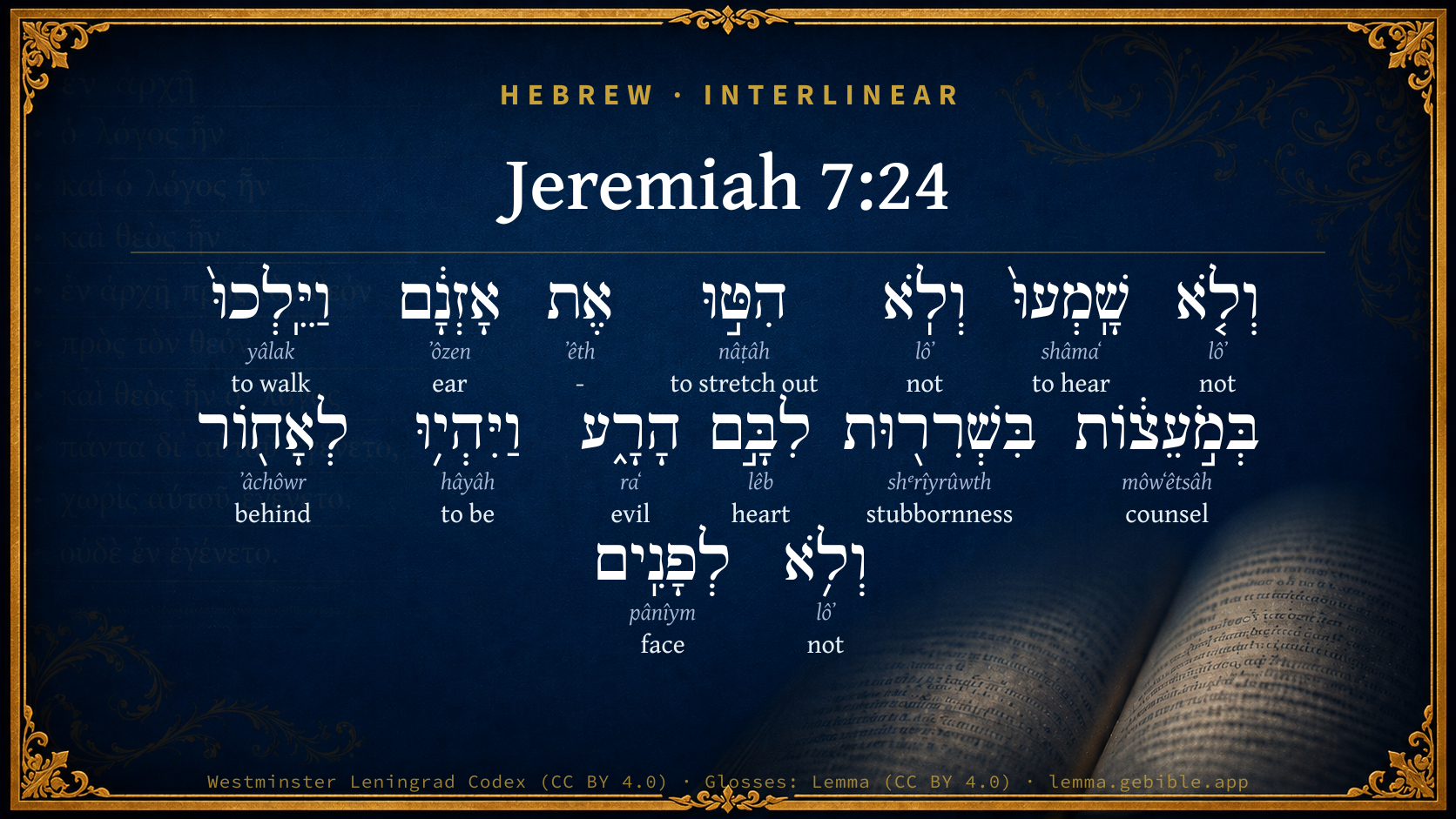
Jeremiah 7:24

Hebrew (Westminster Leningrad Codex) Jeremiah 7:24 appears in the Hebrew Old Testament. The text above is from the Westminster Leningrad Codex. Each word links to its Strong’s number, a concise gloss, and parsing drawn from the Open Scriptures Hebrew Bible morphology. Click any word for its full Brown-Driver-Briggs (BDB) entry.
Download image
Cite this verse

Jeremiah 7:24 (World English Bible). Public Domain. Lemma interlinear Bible study tool, https://lemma.gebible.app/v/jeremiah/7/24.

Show BibTeX & RIS
BibTeX
RIS
English Translation
But they didn't listen nor turn their ear, but walked in [their own] counsels [and] in the stubbornness of their evil heart, and went backward, and not forward.
World English Bible · Public Domain
Download a study sheet

One document with this verse’s original text, its word-by-word gloss line, the meaning frame, cross-references with their text, attributed commentary, and full source and license credits — printable, and it pastes into notes with its structure intact.

This verse Autodidact and up

Study sheet (.html) Plain text (.txt)

A passage Seminary Student

Up to 50 verses in one chapter. A passage sheet keeps up to 6 commentary sources and 12 cross-references per verse, in the order this page ranks them, and says so on the sheet whenever that leaves anything out. Ask for a single verse and you get the Autodidact verse sheet above.

Everything on this page stays free to read, with no account — the sheet is a download of what is already on screen, not access to it.

Want to remove ads? Support Godless Engineer
Compare translations 3

The same verse in 3 English versions, stacked beneath the original-language interlinear above. Click any original word for its lexicon entry.

Each is an independent rendering of the whole verse — the interlinear is not word-aligned to these translations.

Highlighted words mark where these versions differ — a whole-verse word diff, not a word-by-word alignment.

  • World English Bible Public Domain
    But they didn't listen nor turn their ear, but walked in [their own] counsels [and] in the stubbornness of their evil heart, and went backward, and not forward.
  • King James Version Public Domain
    But they hearkened not, nor inclined their ear, but walked in the counsels and in the imagination of their evil heart, and went backward, and not forward.
  • unfoldingWord Literal Text CC BY-SA 4.0
    But they did not listen and they did not incline their ear. And they walked by schemes in the stubbornness of their evil heart, and they went to the back and not to the face.

unfoldingWord Literal Text — © unfoldingWord, licensed CC BY-SA 4.0. Word-aligned USFM3 via Door43 (git.door43.org/unfoldingWord/en_ult).

Versions to compare (up to 4)

3 of 4 selected

Show all 18 translations

Every available English version of this verse, each an independent rendering of the whole verse.

  • World English Bible Public Domain
    But they didn't listen nor turn their ear, but walked in [their own] counsels [and] in the stubbornness of their evil heart, and went backward, and not forward.
  • Berean Standard Bible Public Domain
    Yet they did not listen or incline their ear, but they followed the stubborn inclinations of their own evil hearts. They went backward and not forward.
  • Majority Standard Bible Public Domain
    Yet they did not listen or incline their ear, but they followed the stubborn inclinations of their own evil hearts. They went backward and not forward.
  • King James Version Public Domain
    But they hearkened not, nor inclined their ear, but walked in the counsels and in the imagination of their evil heart, and went backward, and not forward.
  • American Standard Version (1901) Public Domain
    But they hearkened not, nor inclined their ear, but walked in `their own' counsels `and' in the stubbornness of their evil heart, and went backward, and not forward.
  • Revised Version (1885) Public Domain
    But they hearkened not, nor inclined their ear, but walked in their own counsels and in the stubbornness of their evil heart, and went backward and not forward.
  • Geneva Bible (1599) Public Domain
    But they would not obey, nor incline their eare, but went after the counsels and the stubbernesse of their wicked heart, and went backewarde and not forwarde.
  • Douay-Rheims (1899) Public Domain
    But they hearkened not, nor inclined their ear: but walked in their own will, and in the perversity of their wicked heart: and went backward and not forward,
  • Young's Literal Translation Public Domain
    And they have not hearkened, nor inclined their ear, And they walk in the counsels, In the stubbornness, of their evil heart, And are for backward, and not for forward.
  • Literal Standard Version CC BY-SA 4.0
    And they have not listened, nor inclined their ear, || And they walk in the counsels, || [And] in the stubbornness, of their evil hearts, || And are backward and not forward.
  • Unlocked Literal Bible CC BY-SA 4.0
    But they did not listen or pay attention. They lived by their own stubborn plans of their wicked hearts, so they went backwards, not forward.
  • unfoldingWord Literal Text CC BY-SA 4.0
    But they did not listen and they did not incline their ear. And they walked by schemes in the stubbornness of their evil heart, and they went to the back and not to the face.
  • Darby Bible Public Domain
    But they hearkened not, nor inclined their ear, but walked in the counsels, in the stubbornness of their evil heart, and went backward and not forward.
  • World Messianic Bible Public Domain
    But they didn’t listen or turn their ear, but walked in their own counsels and in the stubbornness of their evil heart, and went backward, and not forward.
  • Webster's Bible Public Domain
    But they hearkened not, nor inclined their ear, but walked in the counsels and in the imagination of their evil heart, and went backward, and not forward.
  • Free Bible Version CC BY-SA 4.0
    But they refused to listen or pay attention. Instead they followed the desires of their own stubborn and evil thinking, so they ended up going backward and not forward.
  • Bible in Basic English Public Domain
    But they took no note and did not give ear, but were guided by the thoughts and the pride of their evil hearts, going back and not forward.
  • JPS Tanakh (1917) Public Domain
    But they hearkened not, nor inclined their ear, but walked in their own counsels, even in the stubbornness of their evil heart, and went backward and not forward,

Literal Standard Version (2020), Covenant Press — licensed CC BY-SA 4.0. Text via the HelloAO Bible API (eBible.org). Unlocked Literal Bible (unfoldingWord) — licensed CC BY-SA 4.0. Text via the HelloAO Bible API (eBible.org). unfoldingWord Literal Text — © unfoldingWord, licensed CC BY-SA 4.0. Word-aligned USFM3 via Door43 (git.door43.org/unfoldingWord/en_ult). Free Bible Version, Dr. Jonathan Gallagher — licensed CC BY-SA 4.0. Text via the HelloAO Bible API (eBible.org).

Word by word

More ways to search: Search by grammar → Find every occurrence → Compare this word →

Practice this passage: Drill this verse → Learn its vocabulary →

בְּמֹ֣עֵצ֔וֹת
môwʻêtsâh
H4156
“in/at · counsels”
Preposition + Noun, Common, Feminine, Plural, Absolute
Part of Speech
Preposition + Noun
Type
Common
Gender
Feminine
Number
Plural
State
Absolute
Full BDB Definition

Origin: from H3289

TWOT: 887b

counsel, plan, principal, device
  1. וְלֹ֤א lôʼ H3808 “and · not” Conjunction + Particle, Negative
  2. שָֽׁמְעוּ֙ shâmaʻ H8085 “to hear” Verb, Qal, Perfect, 3rd Person, Common, Plural
  3. וְלֹֽא lôʼ H3808 “and · not” Conjunction + Particle, Negative
  4. הִטּ֣וּ nâṭâh H5186 “to stretch out” Verb, Hiphil, Perfect, 3rd Person, Common, Plural
  5. אֶת ʼêth H853 “-” Particle, Direct Object
  6. אָזְנָ֔ם ʼôzen H241 “ear · their” Noun, Common, Feminine, Singular, Construct + Suffix, Personal, 3rd Person, Masculine, Plural
  7. וַיֵּֽלְכוּ֙ yâlak H3212 “and · to walk” Conjunction + Verb, Qal, Sequential Imperfect, 3rd Person, Masculine, Plural
  8. בִּשְׁרִר֖וּת shᵉrîyrûwth H8307 “in/at · stubbornness of” Preposition + Noun, Common, Feminine, Singular, Construct
  9. לִבָּ֣ם lêb H3820 “heart · their” Noun, Common, Masculine, Singular, Construct + Suffix, Personal, 3rd Person, Masculine, Plural
  10. הָרָ֑ע raʻ H7451 “the · evil” Particle, Definite Article + Adjective, Adjective, Masculine, Singular, Absolute
  11. וַיִּהְי֥וּ hâyâh H1961 “and · to be” Conjunction + Verb, Qal, Sequential Imperfect, 3rd Person, Masculine, Plural
  12. לְאָח֖וֹר ʼâchôwr H268 “to/for · behind” Preposition + Noun, Common, Masculine, Singular, Absolute
  13. וְלֹ֥א lôʼ H3808 “and · not” Conjunction + Particle, Negative
  14. לְפָנִֽים pânîym H6440 “to/for · face(s)” Preposition + Noun, Common, Both, Plural, Absolute

About this verse

These counts appear in no published source. They are computed here, from the morphology-tagged text and Lemma’s own curated glosses. What Lemma adds →

15
words
13
distinct lemmas
Prophets
section

Notable vocabulary

The rarest word here is בְּמֹ֣עֵצ֔וֹת counsel H4156 — appearing just 7 times in the whole Hebrew Bible.

Shared distinctive vocabulary

בְּמֹ֣עֵצ֔וֹת counsel H4156 occurs in 7 verses of the Hebrew Bible. Also found in:

Grammatical profile

  • 4 verbs
  • 6 nouns
  • 1 adjective
  • 4 particles

Verb forms

  • שָֽׁמְעוּ֙ Qal · Perfect
  • הִטּ֣וּ Hiphil · Perfect
  • וַיֵּֽלְכוּ֙ Qal · Sequential Imperfect
  • וַיִּהְי֥וּ Qal · Sequential Imperfect

Repetition

A word recurs within this verse — often emphatic in Hebrew:

  • וְלֹ֤א not H3808 ×3

Cross-references

19

Topical passages linked to Jeremiah 7:24 in the Treasury of Scripture Knowledge — connected by theme and wording, ordered by reader-vote popularity; previews shown in the World English Bible.

  • Psalms 81:11–12 But my people didn't listen to my voice. Israel desired none of me.
  • Deuteronomy 29:19 and it happen, when he hears the words of this curse, that he bless himself in his heart, saying, I shall have peace, though I walk in the stubbornness of my heart, to destroy the moist with the dry.
  • Jeremiah 7:26 yet they didn't listen to me, nor inclined their ear, but made their neck stiff: they did worse than their fathers.
  • Jeremiah 8:5 Why then is this people of Jerusalem slidden back by a perpetual backsliding? they hold fast deceit, they refuse to return.
  • Jeremiah 32:33 They have turned to me the back, and not the face: and though I taught them, rising up early and teaching them, yet they have not listened to receive instruction.
  • Ezekiel 20:13 But the house of Israel rebelled against me in the wilderness: they didn't walk in my statutes, and they rejected my ordinances, which if a man keep, he shall live in them; and my Sabbaths they greatly profaned. Then I said I would pour out my wrath on them in the wilderness, to consume them.
  • Exodus 32:7–8 Yahweh spoke to Moses, "Go, get down; for your people, who you brought up out of the land of Egypt, have corrupted themselves!
  • Nehemiah 9:29 and testified against them, that you might bring them again to your law. Yet they dealt proudly, and didn't listen to your commandments, but sinned against your ordinances, (which if a man do, he shall live in them), and withdrew the shoulder, and hardened their neck, and would not hear.
  • Jeremiah 2:27 who tell a stock, You are my father; and to a stone, You have brought me forth: for they have turned their back to me, and not their face; but in the time of their trouble they will say, Arise, and save us.
  • Jeremiah 3:17 At that time they shall call Jerusalem the throne of Yahweh; and all the nations shall be gathered to it, to the name of Yahweh, to Jerusalem: neither shall they walk any more after the stubbornness of their evil heart.
  • Jeremiah 11:7–8 For I earnestly protested to your fathers in the day that I brought them up out of the land of Egypt, even to this day, rising early and protesting, saying, Obey my voice.
  • Jeremiah 15:6 You have rejected me, says Yahweh, you are gone backward: therefore have I stretched out my hand against you, and destroyed you; I am weary with repenting.
  • Ezekiel 20:8 But they rebelled against me, and would not listen to me; they did not every man cast away the abominations of their eyes, neither did they forsake the idols of Egypt. Then I said I would pour out my wrath on them, to accomplish my anger against them in the midst of the land of Egypt.
  • Ezekiel 20:21 But the children rebelled against me; they didn't walk in my statutes, neither kept my ordinances to do them, which if a man do, he shall live in them; they profaned my Sabbaths. Then I said I would pour out my wrath on them, to accomplish my anger against them in the wilderness.
  • Hosea 4:16 For Israel has behaved extremely stubbornly, like a stubborn heifer. Then how will Yahweh feed them like a lamb in a meadow.
  • Nehemiah 9:16–20 But they and our fathers dealt proudly and hardened their neck, and didn't listen to your commandments,
  • Psalms 106:7–48 Our fathers didn't understand your wonders in Egypt. They didn't remember the multitude of your loving kindnesses, But were rebellious at the sea, even at the Red Sea.
  • Jeremiah 23:17 They say continually to those who despise me, Yahweh has said, You shall have peace; and to everyone who walks in the stubbornness of his own heart they say, No evil shall come on you.
  • Ezekiel 20:16 because they rejected my ordinances, and didn't walk in my statutes, and profaned my Sabbaths: for their heart went after their idols.

Cross-references courtesy of OpenBible.info (CC BY 4.0).

Hebrew and Greek witnesses Masoretic Hebrew ↔ Greek Septuagint

The same verse in the two great witnesses to the Old Testament, shown verse-for-verse.

These are two independent witnesses, not word-aligned to each other, and the Septuagint is shown in lemma (dictionary) form.

Hebrew Jeremiah 7:24 Masoretic · Westminster Leningrad Codex

וְלֹ֤א שָֽׁמְעוּ֙ וְלֹֽא הִטּ֣וּ אֶת אָזְנָ֔ם וַיֵּֽלְכוּ֙ בְּמֹ֣עֵצ֔וֹת בִּשְׁרִר֖וּת לִבָּ֣ם הָרָ֑ע וַיִּהְי֥וּ לְאָח֖וֹר וְלֹ֥א לְפָנִֽים

But they didn't listen nor turn their ear, but walked in [their own] counsels [and] in the stubbornness of their evil heart, and went backward, and not forward.

World English Bible · Public Domain

Greek LXX Structure differs

In the Septuagint, Jeremiah is about an eighth shorter than the Hebrew and arranges its material differently — the Oracles Against the Nations (Hebrew chapters 46–51) appear in the middle of the Greek book, after 25:13. Because the chapter and verse boundaries do not line up, a verse-for-verse comparison with the Hebrew is not shown.

A verse-for-verse comparison isn’t shown here because the chapters and verses don’t line up. Switch to the LXX edition with the MT / LXX toggle above to read the Greek directly.

On this verse, The Cambridge Bible for Schools and Colleges discusses the Septuagint’s reading. Read the note in Commentary ↓

Hebrew: Westminster Leningrad Codex (CC BY 4.0). Greek: Septuagint (public domain); English from a public-domain English Septuagint. How the Septuagint differs from the Hebrew →

Targum (Aramaic paraphrase)

1

The Targum is the ancient Jewish Aramaic paraphrase of the Hebrew Scriptures — an interpretive translation, not the Hebrew text itself. Onkelos (literal) and Pseudo-Jonathan (expansive) render the Torah, and Jonathan the Prophets. Coverage is partial: where no permissively-licensed English translation exists for a verse, only the Aramaic is shown. This is verse-level text, not a word-by-word alignment to the Hebrew.

  1. Targum Jonathan Prophets (Joshua–Malachi)
    וְלָא קַבִּילוּ וְלָא אַרְכִינוּ יַת אוּדְנֵיהוֹן וַאֲזָלוּ בַּעֲצָתְהוֹן בְּהִרְהוּר לִבְּכוֹן בִּישָׁא וְאַחְזָרוּ בְּפוּלְחָנִי קְדַל וְלָא שַׁוִיאוּ דְחַלְתִּי לָקֳבֵיל אַפֵּיהוֹן:

    (no public-domain English translation for this verse)

    Targum Jonathan — Aramaic: “Mikraot Gedolot” (public domain). English: “Sefaria Community Translation” (CC0 1.0 (public-domain dedication)); “London "Chaldee Paraphrase," 1871” (public domain). Text via Sefaria.

Commentary

Notes on Jeremiah 7:24 from classic Christian and Jewish commentators (each source and its license shown beneath its notes). The classic Christian expositions comment on the surrounding passage and are grouped to its opening verse, so a note may address several verses; the Jewish commentaries on the Tanakh (Rashi and others) are per-verse, so they appear only where the commentator wrote on this verse.

Lemma curates 59 commentaries, every one of them public domain or Creative Commons licensed, each selected and text-cleaned for this edition rather than reprinted as found. About our sources →

Trapp's Complete Commentary

John Trapp

Jer 7:24 But they hearkened not, nor inclined their ear, but walked in the counsels [and] in the imagination of their evil heart, and went backward, and not forward.

Ver. 24. But they hearkened not, nor inclined.] So cross grained they were, and thwart from the very first.

In the imagination of their evil hearts.] In sententia animi sui pessimi. {a} Heb., Aspectu cordis - so Deu 19:9.

They went backward, and not forward.] As crab fish do; as vile apostates, in peius proficiunt, grow every day worse than other, being not only averse but adverse to any good, they daily "grow worse and worse, deceiving and being deceived," seipsis indies facti deteriores. Islebius first became an Antinomian, and the father of that sect, and then a Papist, and lastly an atheist and epicure, as Osiander testifieth. While he was an Antinomian only, he many times promised amendment, being convinced of his error, but performed it not. After that he condemned his error, and recanted it in a public auditory, and printed his recantation; yet when Luther was dead, he not only licked up his former vomit, but fell to worse, as aforesaid. {b}

{a} Trem.

{b} Cent. xvi. p. 802.

John Trapp, A Commentary or Exposition upon All the Books of the Old and New Testament (1647–1656) — public domain. Text from a community e-Sword module.

The Biblical Illustrator

Joseph S. Exell

Jer_7:24

Went backward, and not forward.

Backward

I. Illustrations of going backward in regard to religion.

1. From Jewish history. Compare best days of Solomon, when temple was dedicated, with these when jeremiah preached at gate. National mind darkened, conscience enfeebled, heart hardened.

2. Churches. Galatia (Gal_3:1-3; Gal_5:7-8), Ephesus (Rev_2:4), Sardis (Rev_3:1).

3. Individual life.

(1) Brought up in Christian home; back into thoughtlessness, dissipation, infidelity.

(2) Awakened by power of truth, and gained a place in household of faith; go backward and make shipwreck of faith and a good conscience.

(3) Trod noblest heights of Christian service; back to stagnation and ease.

II. Causes of this going backward.

1. Negatively.

(1) God never causes a human being to go backward from what is pure and good and true.

(2) Nor must the charge be laid at the door of men or of Satan.

2. Positively.

(1) The primary cause must be sought in man himself, his inclination to the things which are behind. Spiritual feebleness.

(2) The secondary causes are temptations; the lusts, pleasures, and gains he desires to enjoy.

(3) His weakness in yielding results from neglect of the means of strength, the Word of God, prayer, means of instruction and grace.

III. Consequences of going backward.

1. Displeasure of God.

2. Such as turn back are liable to sink into lowest depths of irreligion.

3. Experience of deepest remorse and reproach of conscience.

Conclusion--

1. Stand fast in the Lord.

2. Despair not, but return. (R. Ann.)

The backslider defenceless

When Christian, in the Pilgrims Progress, thought about going back, he recollected that he had no armour for his back. He had a breastplate, he was covered from head to foot by his shield, but there was nothing to protect his back, and therefore, if he retreated, the adversary could spit him with his javelin in a moment. So he thought that bad as it was to go forward, it would be worse to go backward, and therefore he bravely cut a path for himself straight onward for glory. Look at that fact whenever you are tempted: do not endure the idea of turning tail in the day of battle. May retreat be impossible to you! God makes it Impossible by His grace. (C. H. Spurgeon.)

The Biblical Illustrator, edited by Joseph S. Exell (c. 1880s–1900s) — public domain. Text from a community e-Sword module.

Tyndale Open Study Notes

Tyndale Open Resources

7:24-26 Throughout their history, the Israelites had rejected the messages of the Lord’s prophets (2 Chr 36:15; Mark 12:1-10).

Tyndale Open Study Notes — © Tyndale Open Resources, licensed CC BY-SA 4.0. Text via the HelloAO Bible API.

Jamieson, Fausset & Brown

Robert Jamieson, A. R. Fausset & David Brown

hearkened not--They did not give even a partial hearing to Me (Psa 81:11-12).

imagination--rather, as Margin, "the stubbornness"

backward, &c.-- (Jer 2:27; Jer 32:33; Hos 4:16).

Jamieson, Fausset & Brown — Commentary Critical and Explanatory on the Whole Bible (1871) — public domain (CC PDM 1.0). Text via the HelloAO Bible API.

John Calvin's Commentaries

They hearkened not nor inclined their ear Here the Prophet shews, that the Jews did not then begin to be rebellious against God and his word; for they imitated the impious contumacy of their fathers: and he dwells on this more at large. He now says, “I gave no command about sacrifices, but only this one thing I required of your fathers, to obey me.” They hearkened not, he says. What could have been a juster demand than that they should obey God? How great, then, and how base an indignity it was, to reject his authority? Nay, still more, they inclined not the ear: for by this phrase the Prophet means not only a contempt of his word and indifference, but their obstinacy and willfulness, inasmuch as they had hardened themselves against God. Hypocrites do, indeed, sometimes incline the ear, and wish to know what is said, and in some measure consider it: but the Prophet here sets forth as it were the insane contumacy of the Jews, for they inclined not, no, not even the ear to God speaking to them.

He afterwards adds, that they walked in their tortuous counsels, and also, in the wickedness of their evil heart This comparison aggravates their sin, — the Jews preferred to follow their own humor rather than to obey God and his commands. Had anything been set before them, which might have deceived them and obscured the authority of the law, there would have been some excuse: but when there was nothing to prevent them from obeying the command of God, except that they followed their own foolish imaginations, they were wholly inexcusable. For what excuse could they have made? That they wished to be wiser than God! How great a madness was this, and how diabolical? But the Prophet leaves them nothing but this vain excuse, which doubled their guilt. They thought, no doubt, that their heart was well fitted for the purpose: but he does not here allow them to judge, but distinctly condemns them as they deserved.

We ought to take particular notice of this passage; for the majority of men at this day set up their own fictions against God’s word. The Papists indeed pretend antiquity; they say that they have been taught by their ancestors; and at the same time they plead councils and the ordinances of the fathers: but yet there is not one of them, who is not addicted to his own figments, and who does not take the liberty, nay, an unbridled license, to reject whatever he pleases. Moreover, if the origin of the whole Papal worship be considered, it will appear, that those who first devised so many strange superstitions, were only impelled by audacity and presumption, in order that they might trample under foot the word of God. Hence it is, that all things are become corrupt; for they brought in all the strange figments of their own brains. And we see that the Papists at this day are so perversely fixed in their own errors, that they prefer themselves and their own trumperies to God. And the same is the case also with all heretics. What then is to be done? Obedience, as I have said, is to be held as the basis of all true religion. If, then, on the other hand, we wish to render our worship approved by God, let us learn to cast aside whatever is our own, so that his authority may prevail over all our reasons.

Let us further notice how detestable a sacrilege it is, to follow the wickedness of our heart rather than to obey God, when he shews to us, as by the finger, the way of salvation. Let us also observe, that nothing will then do us good, though we may seem to ourselves to be very wise, and praise ourselves in our folly; for God declares here that our heart is evil whenever we turn aside from his pure word.

He says, that they were behind and not before By this phrase he intimates that the Jews turned the back, that they might not look at him or go forward. For when one promises to be our leader to conduct us in the way, we immediately turn our eyes to him; but when we turn our back, it is a proof of our contempt. And thus God complains of his people, that he was despised by them; for they had not only been deaf to the prophetic teaching and admonitions, but had also turned their faces another way, as a proof of a contumacy still worse, so that they forsook him, and as it were bade him to be gone. This is the import of the last sentence. We shall proceed to-morrow.

John Calvin's Commentaries (1540-1563) — public domain. Text from the Calvin Translation Society English edition (1840s-50s) via the Christian Classics Ethereal Library (ccel.org). Calvin's coverage is partial (roughly two-thirds of the Bible); uncommented books and verses are honest gaps, never fabricated. The 19th-century editor's footnotes and remarks are omitted so the notes are faithfully Calvin's own voice.

Ellicott's Commentary for English Readers

(24) Imagination.—Better, stubbornness, as in Jer_3:17.

Went backward and not forward.—The whole sacrificial system, even at its best, to say nothing of its idolatrous corruptions, was accordingly, from Jeremiah’s point of view, a retrograde movement. The apostasy of the people in the worship of the golden calf involved a like deflection, necessary and inevitable though it might be as a process of education, from the first ideal polity, based upon the covenant made with Abraham, i.e., upon a pure and spiritual theism, the emblems and ordinances of which, though “shadows of good things to come,” were in themselves “weak and beggarly elements” (Heb_10:1; Gal_4:9).

A Bible Commentary for English Readers, edited by Charles John Ellicott (1878–1897) — public domain. Text from a community e-Sword module.

The Cambridge Bible for Schools and Colleges

gen. ed. J. J. S. Perowne

24. in their own counsels] lit. in counsels. The words are best omitted (with LXX).

stubbornness] Cp. Jer_3:17.

The Cambridge Bible for Schools and Colleges (gen. ed. J. J. S. Perowne; Cambridge University Press, 1878–1918) — public domain. Text from a community e-Sword module.

John Gill's Exposition

But they hearkened not, nor inclined their ear,.... Neither to the law that was given them, nor to the promises that were made unto them, this was the case of the Jewish fathers, and also of their posterity, to whom belonged the law, and the promises, and the service of God:

but walked in the counsels and in the imagination of their evil heart; what their evil heart imagined, advised and directed to, that they attended to, walked in, and pursued after. The heart of man is evil; it is desperately wicked, even wickedness itself; and so is every thought and every imagination of the thoughts of it and all its counsels, machinations and contrivances; and therefore the consequence of walking in these, or steering the course of life according to them, must be bad:

and went backward, and not forward; they went backwards from the ways of God, and walked not in them. The Targum is,

"they turned the back in my worship, and did not put my fear before their face;''

or else this may design, not their sin, but their punishment, as Kimchi interprets it; they did not prosper, but suffered adversity; a curse, and not a blessing, attended the works of their hands.

John Gill's Exposition of the Whole Bible (1746–1763) — public domain (CC PDM 1.0). Text via the HelloAO Bible API.

Albert Barnes' Notes on the Bible

Imagination - Better, as in the margin.

And went backward - literally, as in the margin; i. e., they turned their back upon Me to follow their own devices.

Albert Barnes' Notes on the Bible (1834–1885) — public domain. Text from a community e-Sword/MySword module.

Matthew Poole's English Annotations

Nor inclined their ear: it notes something of a higher degree of non-attention than bare not hearkening, viz. their not listening that they might obey what they hear, Jer 7:26; 11:8, noting not only their slightness, but their stiffness.

The imagination, or stubbornness. See Jer 3:17.

Went backward, and not forward, like restive beasts; see Jer 2:27; a sign of their contempt; implying either,

1. They were worse by their admonitions and corrections, and so nothing did thrive with them. Or,

2. From the very first they have gone further and further from me, as Jer 7:25,26.

3. Or else depending upon their outward services, they set not my commands before their eyes, but cast my true worship behind their backs, Mat 23:23.

Matthew Poole's English Annotations on the Holy Bible (1683–1685) — public domain. Text from a community e-Sword/MySword module.

Whedon's Commentary on the Bible

Daniel D. Whedon

24. Went backward — Literally, were backward. That is, they turned the back and not the face.

Daniel D. Whedon (gen. ed.), Commentary on the Old and New Testaments (1874–1909) — public domain. Text from a community e-Sword module.

The Pulpit Commentary

Imagination; rather, stubbornness. (see on Jer_3:17) Went backward, and not forward; rather, turned their back, and not their face (literally, became back wards , and not forwards).

The Pulpit Commentary (1880–1919), ed. H.D.M. Spence-Jones & Joseph S. Exell — public domain. Text from a community e-Sword module.

Keil & Delitzsch

C. F. Keil & F. Delitzsch

But they have not regarded that which was foremost and most cardinal in the law. They hearkened not, sc. to my voice; and instead of walking in the ways commanded, they walked in the counsels of the stubbornness of their evil heart. בּמעצות is stat. absol., and בּשׁררוּת is co-ordinated with it in apposition, instead of being subordinated; cf. Ew. 289, c. The lxx have not seen their way to admit such a co-ordination, and so have omitted the second term; and in this, Movers, Hitz., and Graf have followed them, deleting the word as a mere gloss. As to "the stubbornness of their evil heart," see on Jer 3:17. יהיוּ לאחור, they were backwards, not forwards, i.e., they so walked as to turn to me the back and not the face. היה with ל expresses the direction or aim of a thing. The subject to these clauses is the Israelites from the time of Moses down to that of Jeremiah. This is shown by the continuation of the same idea in Jer 7:25 and Jer 7:26. From the time the fathers were led out of Egypt till the present time, God has with anxious care been sending prophets to exhort and warn them; but they have not hearkened, they have made their neck hard, i.e., were stiffnecked, and did worse than their fathers, i.e., each succeeding generation did more wickedly than that which preceded it. On למן היּום, (the period) from the day...until...cf. the remarks on Hag 2:18. The ל gives to the mention of the time the value of an independent clause, to which that which is said regarding that time is joined by ו consec. יום is adverbial accusative: by the day, i.e., daily, in early morn, i.e., with watchful care sending (on this expression, see at Jer 7:13). יום acquires this sense, not in virtue of its standing for יום יום, but by reason of its connection with the two infinitives absoll.

Keil & Delitzsch — Biblical Commentary on the Old Testament (1861–1891) — public domain (CC PDM 1.0). Text via the HelloAO Bible API. (Old Testament only.)

unfoldingWord translationNotes

Door43 World Missions Community

Connecting Statement:

Yahweh continues giving Jeremiah his message to the people of Judah.

General Information:

The words "you" and "your" in these verses refer to the people of Judah. "They" refers to the ancestors of the people of Judah.

they did not listen or pay attention

These phrases mean about the same thing and are repeated for emphasis. (See: Doublet)

by their own stubborn plans of their wicked hearts

"according to their own plans because they were wicked and stubborn"

they went backwards, not forward

This is a metaphor. Possible meanings are 1) they refused to pay attention to Yahweh, instead of eagerly obeying him. AT: "they went away from me instead of drawing closer to me" or 2) they got worse and worse instead of improving. AT: "they got worse instead of better" (See: Metaphor)

Ever since the day when your ancestors went out from the land of Egypt until this day

This is a generalization that means over this entire period of time, not every day during this period of time. AT: "From the time your ancestors went out from the land of Egypt until now" (See: Hyperbole and Generalization)

I persisted in sending them

"I sent them again and again" or "I repeatedly sent them"

they hardened their necks

This is an idiom that means they were stubborn. AT: "they became stubborn" or "they resisted me" (See: Idiom)

They were more wicked

"Each generation was more wicked"

translationWords

life

stiff-necked

evil

heart

Egypt

send

servant

prophet

hard

unfoldingWord translationNotes — © Distant Shores Media and the Door43 World Missions Community, licensed CC BY-SA 4.0. Source: git.door43.org/Door43/en_tn.

Rashi

Rabbi Shlomo Yitzchaki (Rashi)

in the view Heb. בשררות, in the view of their heart, an expression related to (Num. 24:17) “I see him אשורנו.”

Rashi on the Tanakh — English translations: “The Judaica Press complete Tanach with Rashi, translated by A. J. Rosenberg” (CC BY 4.0); “Pentateuch with Rashi's commentary by M. Rosenbaum and A.M. Silbermann, 1929-1934” (public domain); “The Metsudah Tanach series, Lakewood, N.J” (CC BY 4.0); and “The Book of Joshua, Metsudah Publications, 1997” (CC BY 4.0). Text via Sefaria.

Lesson kit

Teaching starters — assembled from the data on this page, not authored interpretation. Every prompt links to the verse data it draws on. Edit before teaching.

Jeremiah, in the Prophets, opens this verse with 15 words (13 distinct Hebrew lemmas). Its most distinctive word is môwʻêtsâh (“counsel”). A historical commentator’s framing appears above. Read the whole chapter for the surrounding context.

Discussion questions

  1. How does “counsel” (môwʻêtsâh) shape what this verse is saying?
  2. Psalms 5:10 shares the word «counsel» with this verse. How do the two illuminate each other?
  3. “not” occurs 3× in this one verse. What is the effect of the repetition?
  4. These translations render this verse differently. What is at stake in choosing one wording over another?
  5. The verb «שָֽׁמְעוּ֙» is Qal Perfect. How does its form color the action?
  6. Reading how Trapp's Complete Commentary and The Biblical Illustrator read this verse, where do the two commentators agree and where do they part?

Things to notice

Reading settings

Reading text

Shown beneath each verse's original-language words.

Old Testament
Old Testament edition

Read the OT as the Masoretic Hebrew (MT) or the Greek Septuagint (LXX).

English shown for the Greek Septuagint (in the Hebrew ↔ Greek comparison).

Comparing translations? Open the Compare panel on any verse page to stack up to four side by side.