
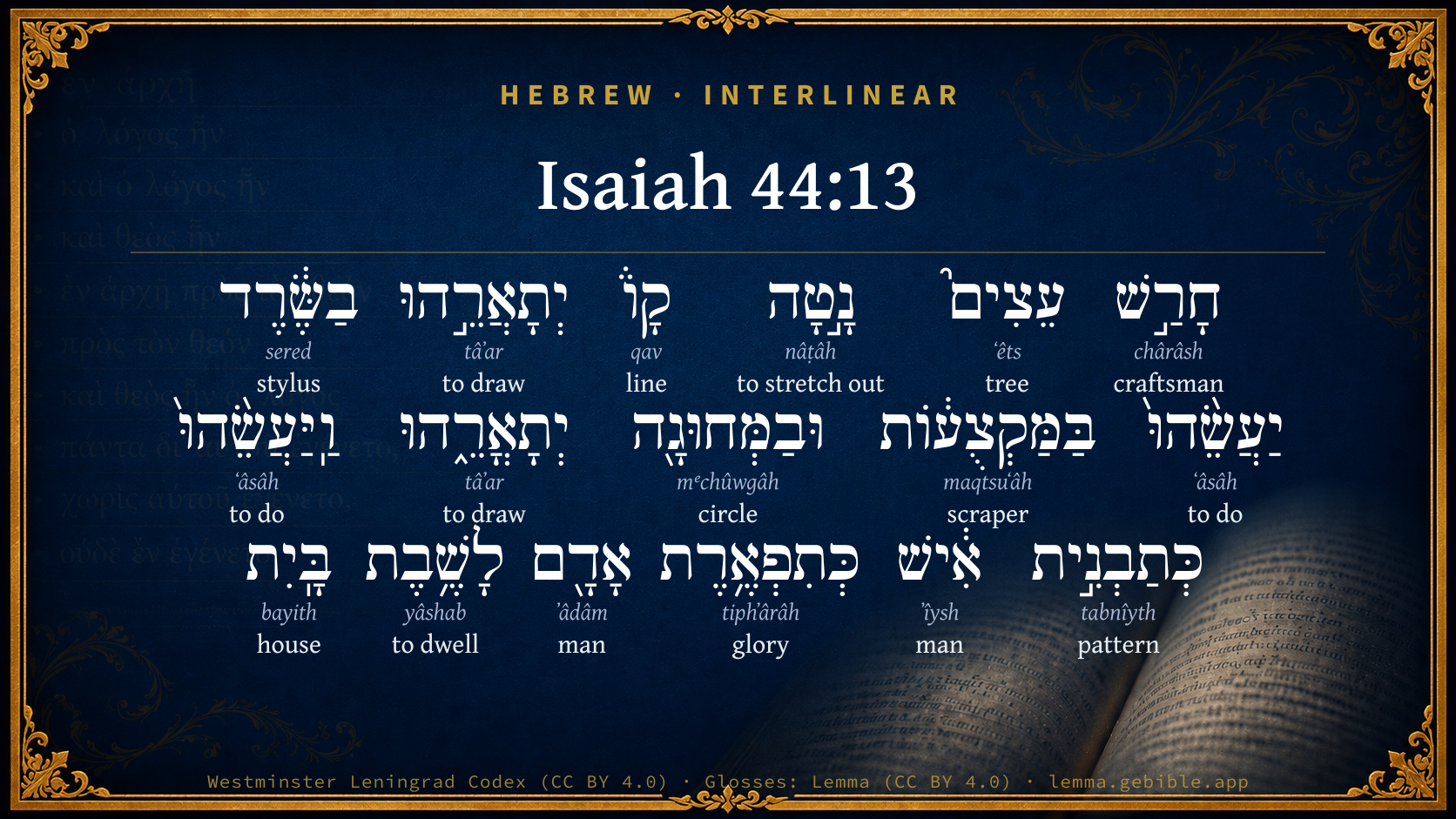
Isaiah 44:13

Hebrew (Westminster Leningrad Codex) Isaiah 44:13 appears in the Hebrew Old Testament. The text above is from the Westminster Leningrad Codex. Each word links to its Strong’s number, a concise gloss, and parsing drawn from the Open Scriptures Hebrew Bible morphology. Click any word for its full Brown-Driver-Briggs (BDB) entry.
Download image
Cite this verse

Isaiah 44:13 (World English Bible). Public Domain. Lemma interlinear Bible study tool, https://lemma.gebible.app/v/isaiah/44/13.

Show BibTeX & RIS
BibTeX
RIS
English Translation
The carpenter stretches out a line; he marks it out with a pencil; he shapes it with planes, and he marks it out with the compasses, and shapes it after the figure of a man, according to the beauty of a man, to dwell in a house.
World English Bible · Public Domain
Highlights
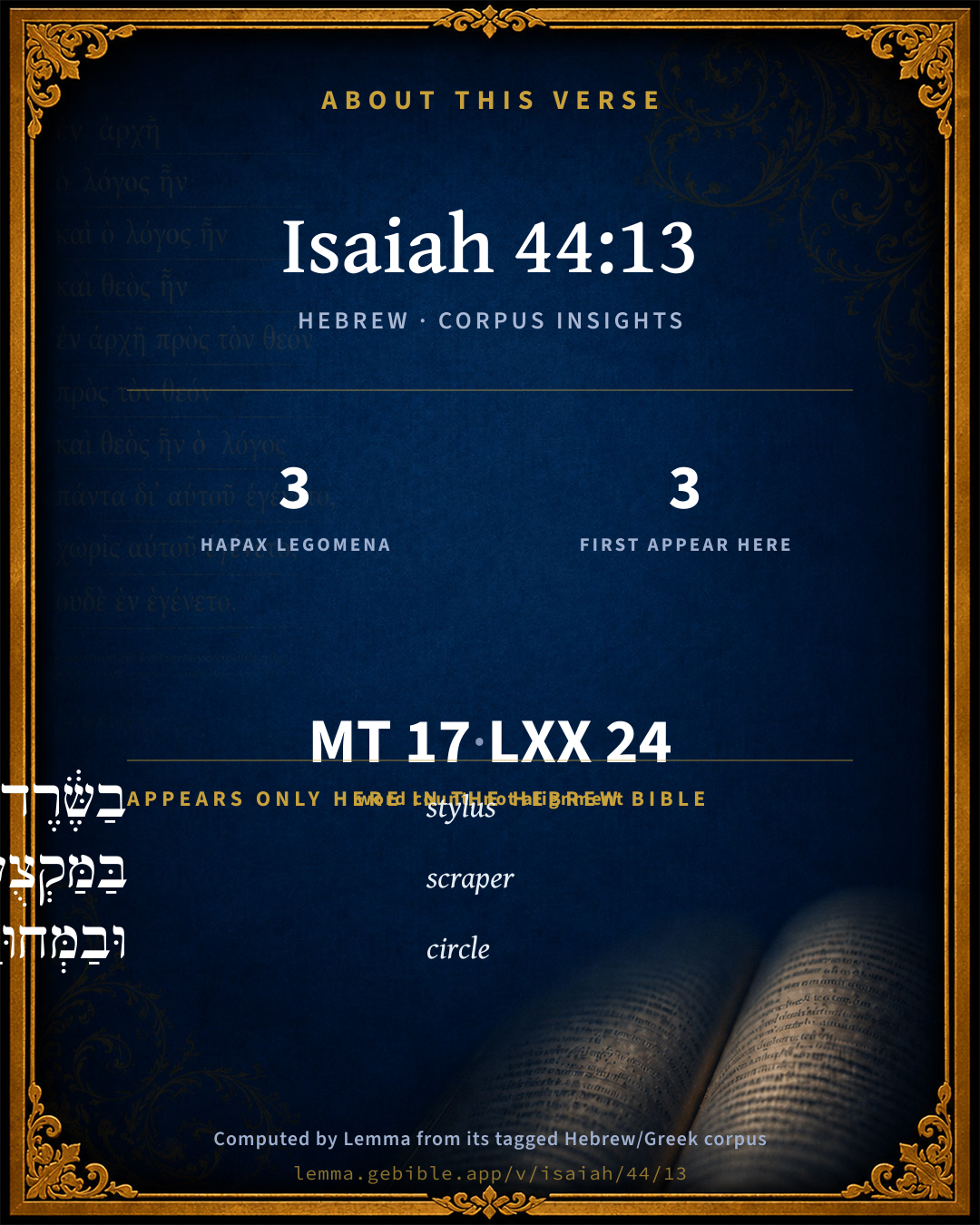
  • 3 hapax legomena — only here in the Hebrew Bible
  • 3 first appearances in the Hebrew Bible
Full analysis ↓
Download a study sheet

One document with this verse’s original text, its word-by-word gloss line, the meaning frame, cross-references with their text, attributed commentary, and full source and license credits — printable, and it pastes into notes with its structure intact.

This verse Autodidact and up

Study sheet (.html) Plain text (.txt)

A passage Seminary Student

Up to 50 verses in one chapter. A passage sheet keeps up to 6 commentary sources and 12 cross-references per verse, in the order this page ranks them, and says so on the sheet whenever that leaves anything out. Ask for a single verse and you get the Autodidact verse sheet above.

Everything on this page stays free to read, with no account — the sheet is a download of what is already on screen, not access to it.

Want to remove ads? Support Godless Engineer
Compare translations 3

The same verse in 3 English versions, stacked beneath the original-language interlinear above. Click any original word for its lexicon entry.

Each is an independent rendering of the whole verse — the interlinear is not word-aligned to these translations.

Highlighted words mark where these versions differ — a whole-verse word diff, not a word-by-word alignment.

  • World English Bible Public Domain
    The carpenter stretches out a line; he marks it out with a pencil; he shapes it with planes, and he marks it out with the compasses, and shapes it after the figure of a man, according to the beauty of a man, to dwell in a house.
  • King James Version Public Domain
    The carpenter stretcheth out his rule; he marketh it out with a line; he fitteth it with planes, and he marketh it out with the compass, and maketh it after the figure of a man, according to the beauty of a man; that it may remain in the house.
  • unfoldingWord Literal Text CC BY-SA 4.0
    The craftsman of wood stretches out a line; he marks it with ochre. He makes it with chisels, and he marks it with a compass. And he makes it like the form of a man, like the beauty of mankind, to dwell a house.

unfoldingWord Literal Text — © unfoldingWord, licensed CC BY-SA 4.0. Word-aligned USFM3 via Door43 (git.door43.org/unfoldingWord/en_ult).

Versions to compare (up to 4)

3 of 4 selected

Show all 18 translations

Every available English version of this verse, each an independent rendering of the whole verse.

  • World English Bible Public Domain
    The carpenter stretches out a line; he marks it out with a pencil; he shapes it with planes, and he marks it out with the compasses, and shapes it after the figure of a man, according to the beauty of a man, to dwell in a house.
  • Berean Standard Bible Public Domain
    The woodworker extends a measuring line; he marks it out with a stylus; he shapes it with chisels and outlines it with a compass. He fashions it in the likeness of man, like man in all his glory, that it may dwell in a shrine.
  • Majority Standard Bible Public Domain
    The woodworker extends a measuring line; he marks it out with a stylus; he shapes it with chisels and outlines it with a compass. He fashions it in the likeness of man, like man in all his glory, that it may dwell in a shrine.
  • King James Version Public Domain
    The carpenter stretcheth out his rule; he marketh it out with a line; he fitteth it with planes, and he marketh it out with the compass, and maketh it after the figure of a man, according to the beauty of a man; that it may remain in the house.
  • American Standard Version (1901) Public Domain
    The carpenter stretcheth out a line; he marketh it out with a pencil; he shapeth it with planes, and he marketh it out with the compasses, and shapeth it after the figure of a man, according to the beauty of a man, to dwell in a house.
  • Revised Version (1885) Public Domain
    The carpenter stretcheth out a line; he marketh it out with a pencil; he shapeth it with planes, and he marketh it out with the compasses, and shapeth it after the figure of a man, according to the beauty of a man, to dwell in the house.
  • Geneva Bible (1599) Public Domain
    The carpenter stretcheth out a line: he facioneth it with a red thread, he planeth it, and he purtreyeth it with the compasse, and maketh it after the figure of a man, and according to the beautie of a man that it may remaine in an house.
  • Douay-Rheims (1899) Public Domain
    The carpenter hath stretched out his rule, he hath formed it with a plane: he hath made it with corners, and hath fashioned it round with the compass: and he hath made the image of a man as it were a beautiful man dwelling in a house.
  • Young's Literal Translation Public Domain
    He hath wrought `with' wood, He hath stretched out a rule, He doth mark it out with a line, He maketh it with carving tools, And with a compass he marketh it out, And maketh it according to the form of a man, According to the beauty of a man, To remain in the house.
  • Literal Standard Version CC BY-SA 4.0
    He has worked [with] wood, || He has stretched out a rule, || He marks it out with a line, || He makes it with carving tools, || And he marks it out with a compass, || And makes it according to the form of a man, || According to the beauty of a man, || To remain in the house.
  • Unlocked Literal Bible CC BY-SA 4.0
    The carpenter measures the wood with a line, and marks it with a stylus. He shapes it with his tools and marks it out with a compass. He shapes it after the figure of a man, like an attractive human, so it may stay in a house.
  • unfoldingWord Literal Text CC BY-SA 4.0
    The craftsman of wood stretches out a line; he marks it with ochre. He makes it with chisels, and he marks it with a compass. And he makes it like the form of a man, like the beauty of mankind, to dwell a house.
  • Darby Bible Public Domain
    The worker in wood stretcheth out a line; he marketh it out with red chalk; he formeth it with sharp tools, and he marketh it out with the compass, and maketh it after the figure of a man, according to the beauty of man: that it may remain in the house.
  • World Messianic Bible Public Domain
    The carpenter stretches out a line. He marks it out with a pencil. He shapes it with planes. He marks it out with compasses, and shapes it like the figure of a man, with the beauty of a man, to reside in a house.
  • Webster's Bible Public Domain
    The carpenter stretcheth out his rule; he marketh it out with a line; he fitteth it with planes, and he marketh it out with the compass, and maketh it after the figure of a man, according to the beauty of a man; that it may remain in the house.
  • Free Bible Version CC BY-SA 4.0
    The woodworker measures out a piece of wood, and draws an image on it. He carves it with a chisel and uses a compass to make an outline. He creates an idol that looks like a person, someone beautiful, to be put in a shrine.
  • Bible in Basic English Public Domain
    The woodworker is measuring out the wood with his line, marking it out with his pencil: after smoothing it with his plane, and making circles on it with his instrument, he gives it the form and glory of a man, so that it may be placed in the house.
  • JPS Tanakh (1917) Public Domain
    The carpenter stretcheth out a line; he marketh it out with a pencil; he fitteth it with planes, and he marketh it out with the compasses, and maketh it after the figure of a man, according to the beauty of a man, to dwell in the house.

Literal Standard Version (2020), Covenant Press — licensed CC BY-SA 4.0. Text via the HelloAO Bible API (eBible.org). Unlocked Literal Bible (unfoldingWord) — licensed CC BY-SA 4.0. Text via the HelloAO Bible API (eBible.org). unfoldingWord Literal Text — © unfoldingWord, licensed CC BY-SA 4.0. Word-aligned USFM3 via Door43 (git.door43.org/unfoldingWord/en_ult). Free Bible Version, Dr. Jonathan Gallagher — licensed CC BY-SA 4.0. Text via the HelloAO Bible API (eBible.org).

Word by word

More ways to search: Search by grammar → Find every occurrence → Compare this word →

Practice this passage: Drill this verse → Learn its vocabulary →

בַשֶּׂ֔רֶד
sered
H8279
“in/at the · stylus”
Preposition, Determined + Noun, Common, Masculine, Singular, Absolute
Part of Speech
Preposition + Noun
Type
Common
Gender
Masculine
Number
Singular
State
Absolute
Full BDB Definition

Origin: from H8277

TWOT: 2286b

stylus, a line, marker - a marking tool for wood
  1. חָרַ֣שׁ chârâsh H2796 “craftsman of” Noun, Common, Masculine, Singular, Construct
  2. עֵצִים֮ ʻêts H6086 “trees” Noun, Common, Masculine, Plural, Absolute
  3. נָ֣טָה nâṭâh H5186 “to stretch out” Verb, Qal, Perfect, 3rd Person, Masculine, Singular
  4. קָו֒ qav H6957 “line” Noun, Common, Masculine, Singular, Absolute
  5. יְתָאֲרֵ֣הוּ tâʼar H8388 “to draw · him” Verb, Piel, Imperfect, 3rd Person, Masculine, Singular + Suffix, Personal, 3rd Person, Masculine, Singular
  6. יַעֲשֵׂ֨הוּ֙ ʻâsâh H6213 “to do · him” Verb, Qal, Imperfect, 3rd Person, Masculine, Singular + Suffix, Personal, 3rd Person, Masculine, Singular
  7. בַּמַּקְצֻע֔וֹת maqtsuʻâh H4741 “in/at the · scrapers” Preposition, Determined + Noun, Common, Feminine, Plural, Absolute
  8. וּבַמְּחוּגָ֖ה mᵉchûwgâh H4230 “and · in/at the · circle” Conjunction + Preposition, Determined + Noun, Common, Feminine, Singular, Absolute
  9. יְתָאֳרֵ֑הוּ tâʼar H8388 “to draw · him” Verb, Piel, Imperfect, 3rd Person, Masculine, Singular + Suffix, Personal, 3rd Person, Masculine, Singular
  10. וַֽיַּעֲשֵׂ֨הוּ֙ ʻâsâh H6213 “and · to do · him” Conjunction + Verb, Qal, Sequential Imperfect, 3rd Person, Masculine, Singular + Suffix, Personal, 3rd Person, Masculine, Singular
  11. כְּתַבְנִ֣ית tabnîyth H8403 “like/as · pattern of” Preposition + Noun, Common, Feminine, Singular, Construct
  12. אִ֔ישׁ ʼîysh H376 “man” Noun, Common, Masculine, Singular, Absolute
  13. כְּתִפְאֶ֥רֶת tiphʼârâh H8597 “like/as · glory of” Preposition + Noun, Common, Feminine, Singular, Construct
  14. אָדָ֖ם ʼâdâm H120 “man” Noun, Common, Masculine, Singular, Absolute
  15. לָשֶׁ֥בֶת yâshab H3427 “to dwell” Preposition + Verb, Qal, Infinitive Construct
  16. בָּֽיִת bayith H1004 “house” Noun, Common, Masculine, Singular, Absolute

About this verse

These counts appear in no published source. They are computed here, from the morphology-tagged text and Lemma’s own curated glosses. What Lemma adds →

17
words
15
distinct lemmas
Prophets
section

Notable vocabulary

3 hapax legomena — words that appear only here in the entire Hebrew Bible:

  • בַשֶּׂ֔רֶד stylus H8279
  • בַּמַּקְצֻע֔וֹת scraper H4741
  • וּבַמְּחוּגָ֖ה circle H4230

First appearance in Scripture

These words make their first canonical appearance in the Hebrew Bible here:

  • בַשֶּׂ֔רֶד stylus H8279
  • בַּמַּקְצֻע֔וֹת scraper H4741
  • וּבַמְּחוּגָ֖ה circle H4230

Shared distinctive vocabulary

יְתָאֲרֵ֣הוּ to draw H8388 occurs in 6 verses of the Hebrew Bible. Also found in:

Grammatical profile

  • 6 verbs
  • 11 nouns

Verb forms

  • נָ֣טָה Qal · Perfect
  • יְתָאֲרֵ֣הוּ Piel · Imperfect
  • יַעֲשֵׂ֨הוּ֙ Qal · Imperfect
  • יְתָאֳרֵ֑הוּ Piel · Imperfect
  • וַֽיַּעֲשֵׂ֨הוּ֙ Qal · Sequential Imperfect
  • לָשֶׁ֥בֶת Qal · Infinitive Construct

Repetition

Words recur within this verse — often emphatic in Hebrew:

  • יְתָאֲרֵ֣הוּ to draw H8388 ×2
  • יַעֲשֵׂ֨הוּ֙ to do H6213 ×2

Hebrew & Septuagint length

In English translation the verse runs 47 words from the Hebrew and 42 from the Septuagint (LXX English) — closely comparable.

A rough comparison of the two English renderings, which tokenize alike — not a word-level alignment.

Word counts can differ between the Hebrew and the Greek without any difference in meaning — e.g. the Hebrew direct-object marker אֵת has no separate Greek word, and Greek often adds the article ὁ.

In the original languages it is 17 Hebrew tokens and 24 Greek tokens — but the two are counted differently (Hebrew bundles its prefixes and suffixes into one token; the Greek is in lemma form), so that isn’t a like-for-like length.

Cross-references

15

Topical passages linked to Isaiah 44:13 in the Treasury of Scripture Knowledge — connected by theme and wording, ordered by reader-vote popularity; previews shown in the World English Bible.

  • Judges 17:4–5 When he restored the money to his mother, his mother took two hundred [pieces] of silver, and gave them to the founder, who made of it an engraved image and a molten image: and it was in the house of Micah.
  • Deuteronomy 4:16–18 Lest you corrupt yourselves, and make yourself an engraved image in the form of any figure, the likeness of male or female,
  • Psalms 115:5–7 They have mouths, but they don't speak; They have eyes, but they don't see;
  • Acts 17:29 Being then the offspring of God, we ought not to think that the Divine Nature is like gold, or silver, or stone, engraved by art and design of man.
  • Romans 1:23 and traded the glory of the incorruptible God for the likeness of an image of corruptible man, and of birds, and four-footed animals, and creeping things.
  • Genesis 31:19 Now Laban had gone to shear his sheep: and Rachel stole the teraphim that were her father's.
  • Genesis 31:30 Now, you want to be gone, because you sore longed after your father's house, but why have you stolen my gods?"
  • Genesis 31:32 With whoever you find your gods, he shall not live. Before our relatives, discern what is yours with me, and take it." For Jacob didn't know that Rachel had stolen them.
  • Genesis 35:2 Then Jacob said to his household, and to all who were with him, "Put away the foreign gods that are among you, purify yourselves, change your garments.
  • Exodus 20:4–5 "You shall not make for yourselves an idol, nor any image of anything that is in the heavens above, or that is in the earth beneath, or that is in the water under the earth:
  • Deuteronomy 4:28 There you shall serve gods, the work of men's hands, wood and stone, which neither see, nor hear, nor eat, nor smell.
  • Deuteronomy 27:15 Cursed be the man who makes an engraved or molten image, an abomination to Yahweh, the work of the hands of the craftsman, and sets it up in secret. All the people shall answer and say, Amen.
  • Judges 18:24 He said, you have taken away my gods which I made, and the priest, and are gone away, and what have I more? and how then say you to me, What ails you?
  • Isaiah 41:7 So the carpenter encourages the goldsmith, [and] he who smoothes with the hammer him who strikes the anvil, saying of the soldering, It is good; and he fastens it with nails, that is should not be moved.
  • Ezekiel 8:12 Then said he to me, Son of man, have you seen what the elders of the house of Israel do in the dark, every man in his chambers of imagery? for they say, Yahweh doesn't see us; Yahweh has forsaken the land.

Cross-references courtesy of OpenBible.info (CC BY 4.0).

Hebrew and Greek witnesses Masoretic Hebrew ↔ Greek Septuagint

The same verse in the two great witnesses to the Old Testament, shown verse-for-verse.

These are two independent witnesses, not word-aligned to each other, and the Septuagint is shown in lemma (dictionary) form.

Hebrew Isaiah 44:13 Masoretic · Westminster Leningrad Codex

חָרַ֣שׁ עֵצִים֮ נָ֣טָה קָו֒ יְתָאֲרֵ֣הוּ בַשֶּׂ֔רֶד יַעֲשֵׂ֨הוּ֙ בַּמַּקְצֻע֔וֹת וּבַמְּחוּגָ֖ה יְתָאֳרֵ֑הוּ וַֽיַּעֲשֵׂ֨הוּ֙ כְּתַבְנִ֣ית אִ֔ישׁ כְּתִפְאֶ֥רֶת אָדָ֖ם לָשֶׁ֥בֶת בָּֽיִת

The carpenter stretches out a line; he marks it out with a pencil; he shapes it with planes, and he marks it out with the compasses, and shapes it after the figure of a man, according to the beauty of a man, to dwell in a house.

World English Bible · Public Domain

Greek LXX Isaiah 44:13 Septuagint · lemma form

τέκτων ξύλον ἵστημι αὐτός ἐν μέτρον καί ἐν κόλλη ῥυθμίζω αὐτός ποιέω αὐτός ὡς μορφή ἀνήρ καί ὡς ὡραιότης ἄνθρωπος ἵστημι αὐτός ἐν οἶκος

The artificer having chosen a piece of wood, marks it out with a rule, and fits it with glue, and makes it as the form of a man, and as the beauty of a man, to set it up in the house.

LXX2012 (modern English Septuagint) · Public Domain

On this verse, Albert Barnes' Notes on the Bible discusses the Septuagint’s reading. Read the note in Commentary ↓

Hebrew: Westminster Leningrad Codex (CC BY 4.0). Greek: Septuagint (public domain); English from LXX2012 (modern English Septuagint) (Public Domain). How the Septuagint differs from the Hebrew →

Targum (Aramaic paraphrase)

1

The Targum is the ancient Jewish Aramaic paraphrase of the Hebrew Scriptures — an interpretive translation, not the Hebrew text itself. Onkelos (literal) and Pseudo-Jonathan (expansive) render the Torah, and Jonathan the Prophets. Coverage is partial: where no permissively-licensed English translation exists for a verse, only the Aramaic is shown. This is verse-level text, not a word-by-word alignment to the Hebrew.

  1. Targum Jonathan Prophets (Joshua–Malachi)
    נַגָר אָעִין נָפֵיץ בְּחוּטָא מְסַר לֵיהּ בְּמַשְׁקוּלְתָּא מְגַזֵי לֵיהּ בְּאִזְמֵילַיָא וּבִנְצוּרִין מְאַחֵיד לֵיהּ וְעָבֵיד לֵיהּ כִּדְמוּת גְבַר כְּתוּשְׁבְּחַת אִתְּתָא לְמִיתַּב בְּבֵיתָא:

    The carpenter stretcheth out the line, he applieth the plummet to it; he carveth it with a knife, and he dove-taileth it together, and he maketh it after the likeness of a man, according to the beauty of a woman, that it may remain in the house.

    Targum Jonathan — Aramaic: “Mikraot Gedolot” (public domain). English: “Sefaria Community Translation” (CC0 1.0 (public-domain dedication)); “London "Chaldee Paraphrase," 1871” (public domain). Text via Sefaria.

Commentary

Notes on Isaiah 44:13 from classic Christian and Jewish commentators (each source and its license shown beneath its notes). The classic Christian expositions comment on the surrounding passage and are grouped to its opening verse, so a note may address several verses; the Jewish commentaries on the Tanakh (Rashi and others) are per-verse, so they appear only where the commentator wrote on this verse.

Lemma curates 59 commentaries, every one of them public domain or Creative Commons licensed, each selected and text-cleaned for this edition rather than reprinted as found. About our sources →

Trapp's Complete Commentary

John Trapp

Isa 44:13 The carpenter stretcheth out [his] rule; he marketh it out with a line; he fitteth it with planes, and he marketh it out with the compass, and maketh it after the figure of a man, according to the beauty of a man; that it may remain in the house.

Ver. 13. The carpenter stretcheth out his rule.] As did the carpenter of Cockram, who yet made but an ill-shaped rood, and was forced to sue for his money. {a} Mrs Catismore suffered in King Henry VIII’s days for saying that images were but carpenters’ chips; and yet they are no better. That is a remarkable saying of Seneca, Ridiculum est genu posito, &c. It is a ridiculous thing to worship images, and yet to slight the man that made them.

And maketh it after the figure of a man.] God made man after his own image; and man, to be even with God, will needs make him after his image. {b}

{a} Acts and Mon., fol. 1340.

{b} Quasi ad hostimentum.

John Trapp, A Commentary or Exposition upon All the Books of the Old and New Testament (1647–1656) — public domain. Text from a community e-Sword module.

Geneva Bible (1599)

Geneva Bible translators

To place it in some Temple.

Geneva Bible (1599) marginal notes — public domain. Text via Bolls.life.

Jamieson, Fausset & Brown

Robert Jamieson, A. R. Fausset & David Brown

After the smith's work in preparing the instruments comes the carpenter's work in forming the idol.

rule--rather, "line" [BARNES].

with a line--rather, a "pencil," [HORSLEY]. Literally, "red ochre," which he uses to mark on the wood the outline of the figure [LOWTH]. Or best, the stylus or graver, with which the incision of the outline is made [GESENIUS].

planes--rather, "chisels" or "carving tools," for a plane would not answer for carving.

compass--from a Hebrew root, "to make a circle"; by it, symmetry of form is secured.

according to . . . beauty of a man--irony. The highest idea the heathen could form of a god was one of a form like their own. JEROME says, "The more handsome the statue the more august the god was thought." The incarnation of the Son of God condescends to this anthropomorphic feeling so natural to man, but in such a way as to raise man's thoughts up to the infinite God who "is a spirit."

that it may remain in . . . house--the only thing it was good for; it could not hear nor save (compare Wisdom 13:15).

Jamieson, Fausset & Brown — Commentary Critical and Explanatory on the Whole Bible (1871) — public domain (CC PDM 1.0). Text via the HelloAO Bible API.

Ellicott's Commentary for English Readers

(13) The carpenter.—The wooden idol comes next. First there is the rough measurement with the “rule;” then the artificer draws the outline of the figure in red chalk. “Plane” and “compasses” come in to make the form more definite. The human figure is complete; then there is the artist’s final touch to add the element of beauty; and so it is ready for the “house,” or temple.

A Bible Commentary for English Readers, edited by Charles John Ellicott (1878–1897) — public domain. Text from a community e-Sword module.

The Cambridge Bible for Schools and Colleges

gen. ed. J. J. S. Perowne

13. The carpenter] lit., “the workman in wood.”

stretcheth out a line, (R.V.)] to mark off the dimensions of the future image on the block of wood. For line in the next clause read pencil (as R.V.); the word, like that for “planes” (which may mean “chisels” or any cutting implement), occurs only here.

fitteth] R.V. “shapeth”; lit. maketh.

that it may remain in the house] to dwell in a house; either a great temple, or a private shrine.

The Cambridge Bible for Schools and Colleges (gen. ed. J. J. S. Perowne; Cambridge University Press, 1878–1918) — public domain. Text from a community e-Sword module.

John Gill's Exposition

The carpenter stretcheth out his rule,.... Or, the worker of trees (e); that works in wood, or makes images of wood; having cut down a tree, he stretches out his rule or line upon it, and takes the dimensions of it, and measures the length and the breadth of it, as much as is for his purpose to make a god of: and then

he maketh it out with a line; coloured with ochre, or chalk, which leaves a mark, by which he knows where to cut it, and fashion it to his mind:

and he fitteth it with planes; first with the rougher planes, which take off the knotty and more rugged parts; and then with a smoother plane, makes it even, and polishes it:

and he marketh it out with a compass; where its head and body, and legs and arms, and other parts must be:

and maketh it after the figure of a man; with all the parts and proportion of a man:

according to the beauty of a man; with the face and countenance of a man; with all the lineaments and just symmetry of a man; in the most comely and beautiful manner he is capable of, that it may be the more striking and pleasing to the worshippers of it. Jarchi's note is,

"this is a woman, who is the glory of her husband;''

and so the Targum,

"according to the praise of a woman;''

there being female deities, as Juno, Venus, Diana, and others:

that it may remain in the house (f); either in the temple built for it, whither its rotaries repair to the worship of it; or in the dwelling house, being one of the Lares or Penates, household gods: it may be, this is said by way of scorn and contempt; this god being made, is set up in the house, from whence it cannot stir nor move, to the help of any of its worshippers.

(e) "faber lignorum", Montanus; "artifex lignarius", V. L. Pagninus; "faber lignarius", Vitringa. (f) The note of Ben Melech is, "as it is the glory of a woman to abide in the house, and not go out of doors, so a graven image abides in the house.''

John Gill's Exposition of the Whole Bible (1746–1763) — public domain (CC PDM 1.0). Text via the HelloAO Bible API.

Albert Barnes' Notes on the Bible

The carpenter - The axe is made Isa 44:12, and the carpenter now proceeds to the construction of the god.

Stretcheth out his rule - For the purpose of laying out his work, or measuring it. The word rendered here ‘rule,’ however (קו qâv), means properly “a line”; and should be so rendered here. The carpenter stretches out a line, but not a rule.

He marketh it out with a line - He marks out the shape; the length, and breadth, and thickness of the body, in the rough and unhewn piece of wood. He has an idea in his mind of the proper shape of a god, and he goes to work to make one of that form. The expression ‘to mark out with a line,’ is, however, not congruous. The word which is used here, and which is rendered ‘line’ (שׂרד s'ered) occurs nowhere else in the Bible. Lowth and Kimchi render it, ‘Red ochre.’ According to this the reference is to the chalk, red clay, or crayon, which a carpenter uses on a line to mark out his work. But according to Gesenius, the word means an awl, or a stylus, or engraver; with which the artist sketches the outlines of the figure to be sculptured. A carpenter always uses such an instrument in laying out and marking his work.

He fitteth it with planes - Or rather with chisels, or carving-tools, with which wooden images were carved. Planes are rather adapted to a smooth surface; carving is performed with chisels. The word is derived from קצע qâtsa‛, ‘to cut off.’ The Chaldee renders it, אזמל 'azemēl - ‘A knife.’ The Septuagint renders this, ‘Framed it by rule, and glued the parts together.’

Marketh it out with the compass - From חוּג chûg, “to make a circle,” to revolve, as compasses do. By a compass he accurately designates the parts, and marks out the symmetry of the form.

According to the beauty of a man - Perhaps there may be a little sarcasm here in the thought that a god should be made in the shape of a man. It was true, however, that the statues of the gods among the ancients were made after the most perfect conceptions of the human form. The statuary of the Greeks was of this description, and the images of Apollo, of Venus, and of Jupiter, have been celebrated everywhere as the most perfect representations of the bureau form.

That it may remain in the house - To dwell in a temple. Such statues were usually made to decorate a temple; or rather perhaps temples were reared to be dwelling places of the gods. It may be implied here, that the idol was of no use but to remain in a house. It could not hear, or save. It was like a useless piece of furniture, and had none of the attributes of God.

Albert Barnes' Notes on the Bible (1834–1885) — public domain. Text from a community e-Sword/MySword module.

Haydock's Catholic Bible Commentary

Man. To be styled afterwards a god. (Calmet) --- Maluit esse deum. (Horace i. ser. 8.)

George Leo Haydock (1774–1849), Haydock's Catholic Family Bible and Commentary, 1859 edition — public domain. Excludes Psalms (Douay-Rheims chapter numbering differs from Protestant) and Deuterocanonical books (Catholic canon only).

Matthew Poole's English Annotations

He here speaks, either,

1. Of the same image, which is supposed to be made of wood, and then covered with some metal; or,

2. Of another sort of images made of wood, as the former might be made of iron. It is not material which way you understand it.

He marketh it with a line; he measureth and marketh that portion of wood by his rule and line of which the idol is to be made.

According to the beauty of a man; in the same comely shape and proportions which are in a living man, whom he designs to represent as exactly as is possible.

That it may remain, or sit, or dwell; which implies either,

1. That it cannot stir out of its place; or,

2. That when the image is made, it is set up and fixed in its appointed place.

In the house; either in the temple appointed for it; or in the dwelling-house of him that made it; that he and his family might more frequently give worship to it, and might receive protection from it, as idolaters vainly imagined.

Matthew Poole's English Annotations on the Holy Bible (1683–1685) — public domain. Text from a community e-Sword/MySword module.

The Pulpit Commentary

The carpenter, etc. When the smith has done his part in the formation of tools, the carpenter is called into action. His proceedings are traced "extragressively." (Delitzsch). First, he is regarded as in possession of his block of wood. On this he proceeds to stretch out his rule, to obtain the idol"s length and breadth. Then he marks out on the block a rough outline with red chalk (sered). After this he pares away the superfluous wood with planes, or chisels, and marks out the limbs more accurately with the compass, planning and measuring until he has brought the rough block into the figure of a man, and impressed on it something of the beauty of a man, so that it may seem worthy of remaining in the place where it is set up, whether temple or private house. But there is something necessarily anterior to all this. To obtain his block, the carpenter must first cut down a tree, or have one cut down for him (ver. 14); to obtain a tree, he (or some one for him) must have planted it; for the tree to have grown to a fitting size, the rain must have watered it. So the very existence of these wooden idols depends ultimately on.whether it has rained or noti.e., whether God has given his rain or withheld it.

The Pulpit Commentary (1880–1919), ed. H.D.M. Spence-Jones & Joseph S. Exell — public domain. Text from a community e-Sword module.

John Wesley's Explanatory Notes

According to - In the same comely shape and proportions which are in a living man. House - In the dwelling-house of him that made it.

John Wesley, Explanatory Notes Upon the Whole Bible (1754–1765) — public domain. Text via the GEBible commentary corpus.

J. A. Alexander on Isaiah

Joseph Addison Alexander

“He has carved wood, he has stretched a line, he will mark it with the awl (or graver), he will form it with the chisels, and with the compass (or circle) he will mark it, and then, make it (or now he has made it) like the structure (i.e., after the model) of a man, like the beauty of mankind, to dwell in a house.” In this verse, as in that before it, the alternation of the preterit and future introduces us into the very midst of the process, and describes it as already begun but not yet finished. This distinctive feature of the passage is destroyed by making all the verbs indiscriminately present. The future at the opening of the second clause may either denote simply that the act described is subsequent to that just mentioned, or it may represent what was just now future as already done, thereby rendering the view of a progressive operation still more vivid. The two markings or delineations mentioned are commonly supposed to have respect to the general dimensions of the figure and then to its precise form and proportions. The meaning of the last words of the verse seems to be that the idol, being like a man in form, is, like a man, to dwell in a house.

Joseph Addison Alexander, The Prophecies of Isaiah (1846–1847; New York: Scribner, 1870–1878) — public domain. Text from a community e-Sword module.

unfoldingWord translationNotes

Door43 World Missions Community

with a line

A string was used to outline the shape of the idol in the wood.

stylus

This is a sharp tool to scratch the wood so the craftsman can see where to cut.

a compass

This is a tool with two points that spread out used to help mark the wood to make the idol.

unfoldingWord translationNotes — © Distant Shores Media and the Door43 World Missions Community, licensed CC BY-SA 4.0. Source: git.door43.org/Door43/en_tn.

Rashi

Rabbi Shlomo Yitzchaki (Rashi)

The carpenter And if he comes to make it of wood, and he is a carpenter, the following is his method.

stretched out a line as is the custom of the carpenters, and according to the line, יְתָאֲרֵהוּ בַשֶּׂרֶד, he straightens it with a saw, which they call doloire in French. he beautifies it Heb. יְתָאֲרֵהוּ, he beautifies it.

he fixes it with planes Heb. מַקְצֻעוֹת. He smoothes it with a plane and a blade. Jonathan renders מַקְצֻעוֹת as אִיזְמֵלַיָּא, knives or blades.

and with a compass he rounds it Heb. יְתָאֳרֵהוּ, an expression similar to (Josh. 15:9): “And the border circled (וְתָאַר).” If he comes to make circular drawings, he draws around it with a compass, compas in French.

like the beauty of a man That is a woman, who is the beauty of her husband.

Rashi on the Tanakh — English translations: “The Judaica Press complete Tanach with Rashi, translated by A. J. Rosenberg” (CC BY 4.0); “Pentateuch with Rashi's commentary by M. Rosenbaum and A.M. Silbermann, 1929-1934” (public domain); “The Metsudah Tanach series, Lakewood, N.J” (CC BY 4.0); and “The Book of Joshua, Metsudah Publications, 1997” (CC BY 4.0). Text via Sefaria.

Ibn Ezra

Rabbi Abraham ibn Ezra

The carpenter, etc. After having mentioned the mason and smith, he speaks of the carpenter.

The carpenter stretches out his rule, etc. This is just the mode of proceeding of those workmen.

יתארהו He forms it or he draws the outlines; comp. ותאר הגבול and the border was drawn (Jos. 15:9).

שרד A kind of drug used for dying. The word is hap. leg. יעשהו He finisheth it.

מקצעות Rulers. This is the opinion of R. Jonah.

מחוגה Compass. Comp. חוג circle (40:22). It is an instrument used for drawing a circle.

According to the beauty of a man, that is, the female, according to the opinion of some; but I think that it is in reality only a repetition of the preceding idea.

לשבת בית That it may remain in the house. That it be like a man, who dwells in his house.

Ibn Ezra on the Tanakh — English translations: “Sefaria Community Translation” (CC0 1.0 (public-domain dedication)); “Yalkut, Sifsei Chachomim Chumash, Metsudah Publications, 2009” (CC BY 4.0); and “Commentary of Ibn Ezra on Isaiah - trans. by M. Friedlander, 1873” (public domain). Text via Sefaria.

Lesson kit

Teaching starters — assembled from the data on this page, not authored interpretation. Every prompt links to the verse data it draws on. Edit before teaching.

Isaiah, in the Prophets, opens this verse with 17 words (15 distinct Hebrew lemmas). Its most distinctive word is sered (“stylus”). A historical commentator’s framing appears above. Read the whole chapter for the surrounding context.

Discussion questions

  1. How does “stylus” (sered) shape what this verse is saying?
  2. 3 words here appear nowhere else in the Hebrew Bible. Why might the author reach for such rare wording?
  3. 3 words make their first appearance in Scripture here. What does this debut establish?
  4. How does Joshua 15:9, which shares the word «to draw», read alongside this verse?
  5. What does the repetition of “to draw” (2× in this one verse) do in this verse?
  6. These translations render this verse differently. What is at stake in choosing one wording over another?
  7. «נָ֣טָה» is a Qal Perfect verb. How does that grammatical form shape the action described?
  8. Compare how Trapp's Complete Commentary and Geneva Bible (1599) read this verse. Where do they agree or differ?

Things to notice

  • 3 words in this verse appear nowhere else in the Hebrew Bible.
  • 3 words make their first canonical appearance in Scripture here.
  • This verse counts 17 Hebrew ↔ 24 Greek words.
  • These translations choose different wording for 27 words in this verse.
  • “to draw” occurs 2× in this single verse.

Reading settings

Reading text

Shown beneath each verse's original-language words.

Old Testament
Old Testament edition

Read the OT as the Masoretic Hebrew (MT) or the Greek Septuagint (LXX).

English shown for the Greek Septuagint (in the Hebrew ↔ Greek comparison).

Comparing translations? Open the Compare panel on any verse page to stack up to four side by side.