Job 31:7

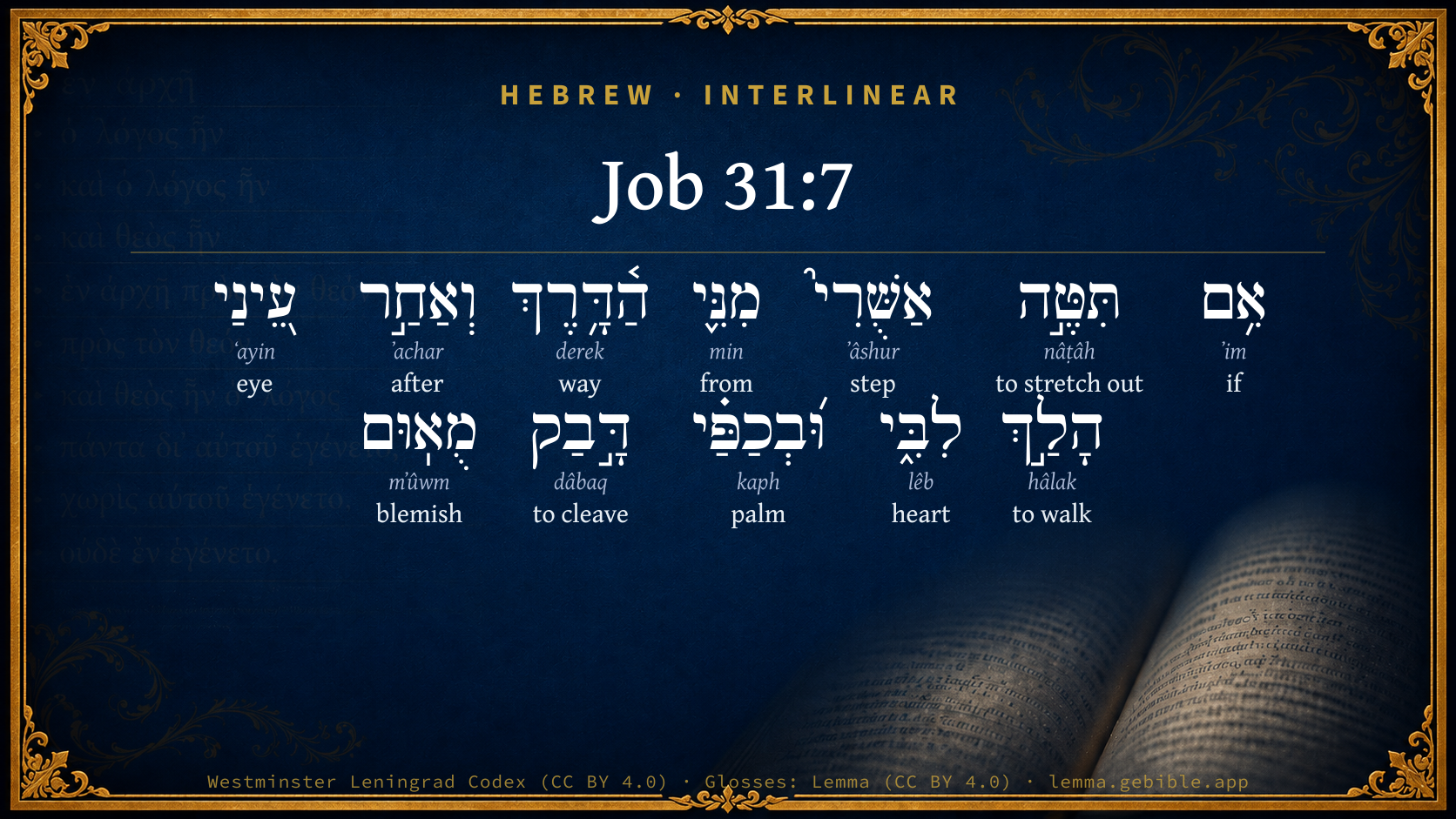
Hebrew (Westminster Leningrad Codex) Job 31:7 appears in the Hebrew Old Testament. The text above is from the Westminster Leningrad Codex. Each word links to its Strong’s number, a concise gloss, and parsing drawn from the Open Scriptures Hebrew Bible morphology. Click any word for its full Brown-Driver-Briggs (BDB) entry.
Download image
Cite this verse

Job 31:7 (World English Bible). Public Domain. Lemma interlinear Bible study tool, https://lemma.gebible.app/v/job/31/7.

Show BibTeX & RIS
BibTeX
RIS
English Translation
If my step has turned out of the way, If my heart walked after my eyes, If any defilement has stuck to my hands,
World English Bible · Public Domain
Download a study sheet

One document with this verse’s original text, its word-by-word gloss line, the meaning frame, cross-references with their text, attributed commentary, and full source and license credits — printable, and it pastes into notes with its structure intact.

This verse Autodidact and up

Study sheet (.html) Plain text (.txt)

A passage Seminary Student

Up to 50 verses in one chapter. A passage sheet keeps up to 6 commentary sources and 12 cross-references per verse, in the order this page ranks them, and says so on the sheet whenever that leaves anything out. Ask for a single verse and you get the Autodidact verse sheet above.

Everything on this page stays free to read, with no account — the sheet is a download of what is already on screen, not access to it.

Want to remove ads? Support Godless Engineer
Compare translations 3

The same verse in 3 English versions, stacked beneath the original-language interlinear above. Click any original word for its lexicon entry.

Each is an independent rendering of the whole verse — the interlinear is not word-aligned to these translations.

Highlighted words mark where these versions differ — a whole-verse word diff, not a word-by-word alignment.

  • World English Bible Public Domain
    If my step has turned out of the way, If my heart walked after my eyes, If any defilement has stuck to my hands,
  • King James Version Public Domain
    If my step hath turned out of the way, and mine heart walked after mine eyes, and if any blot hath cleaved to mine hands;
  • unfoldingWord Literal Text CC BY-SA 4.0
    if my step has turned aside from the way, or my heart has gone after my eyes, or a spot has stuck to my hands,

unfoldingWord Literal Text — © unfoldingWord, licensed CC BY-SA 4.0. Word-aligned USFM3 via Door43 (git.door43.org/unfoldingWord/en_ult).

Versions to compare (up to 4)

3 of 4 selected

Show all 18 translations

Every available English version of this verse, each an independent rendering of the whole verse.

  • World English Bible Public Domain
    If my step has turned out of the way, If my heart walked after my eyes, If any defilement has stuck to my hands,
  • Berean Standard Bible Public Domain
    If my steps have turned from the path, if my heart has followed my eyes, or if impurity has stuck to my hands,
  • Majority Standard Bible Public Domain
    If my steps have turned from the path, if my heart has followed my eyes, or if impurity has stuck to my hands,
  • King James Version Public Domain
    If my step hath turned out of the way, and mine heart walked after mine eyes, and if any blot hath cleaved to mine hands;
  • American Standard Version (1901) Public Domain
    If my step hath turned out of the way, And my heart walked after mine eyes, And if any spot hath cleaved to my hands:
  • Revised Version (1885) Public Domain
    If my step hath turned out of the way, and mine heart walked after mine eyes, and if any spot hath cleaved to mine hands:
  • Geneva Bible (1599) Public Domain
    If my steppe hath turned out of the way, or mine heart hath walked after mine eye, or if any blot hath cleaued to mine handes,
  • Douay-Rheims (1899) Public Domain
    If my step hath turned out of the way, and if my heart hath followed my eyes, and if a spot hath cleaved to my hands:
  • Young's Literal Translation Public Domain
    If my step doth turn aside from the way, And after mine eyes hath my heart gone, And to my hands cleaved hath blemish,
  • Literal Standard Version CC BY-SA 4.0
    If my step turns aside from the way, || And my heart has gone after my eyes, || And blemish has cleaved to my hands,
  • Unlocked Literal Bible CC BY-SA 4.0
    If my step has turned aside from the way, if my heart has gone after my eyes, if any spot has stuck to my hands,
  • unfoldingWord Literal Text CC BY-SA 4.0
    if my step has turned aside from the way, or my heart has gone after my eyes, or a spot has stuck to my hands,
  • Darby Bible Public Domain
    If my step have turned out of the way, and my heart followed mine eyes, and if any blot cleaveth to my hands;
  • World Messianic Bible Public Domain
    if my step has turned out of the way, if my heart walked after my eyes, if any defilement has stuck to my hands,
  • Webster's Bible Public Domain
    If my step hath turned out of the way, and my heart walked after my eyes, and if any blot hath cleaved to my hands;
  • Free Bible Version CC BY-SA 4.0
    If I have wandered from God's way, if I have let what I see become my desires, if there's any stain of sin on my hands,
  • Bible in Basic English Public Domain
    If my steps have been turned out of the way, or if my heart went after my eyes, or if the property of another is in my hands;
  • JPS Tanakh (1917) Public Domain
    If my step hath turned out of the way, and my heart walked after mine eyes, and if any spot hath cleaved to my hands;

Literal Standard Version (2020), Covenant Press — licensed CC BY-SA 4.0. Text via the HelloAO Bible API (eBible.org). Unlocked Literal Bible (unfoldingWord) — licensed CC BY-SA 4.0. Text via the HelloAO Bible API (eBible.org). unfoldingWord Literal Text — © unfoldingWord, licensed CC BY-SA 4.0. Word-aligned USFM3 via Door43 (git.door43.org/unfoldingWord/en_ult). Free Bible Version, Dr. Jonathan Gallagher — licensed CC BY-SA 4.0. Text via the HelloAO Bible API (eBible.org).

Word by word

More ways to search: Search by grammar → Find every occurrence → Compare this word →

Practice this passage: Drill this verse → Learn its vocabulary →

אַשֻּׁרִי֮
ʼâshur
H838
“step · my”
Noun, Common, Feminine, Singular, Construct + Suffix, Personal, 1st Person, Common, Singular
Part of Speech
Noun
Type
Common
Gender
Feminine
Number
Singular
State
Construct
Full BDB Definition

Origin: from H833 in the sense of going

TWOT: 183d

step, going
  1. אִ֥ם ʼim H518 “if” Conjunction
  2. תִּטֶּ֣ה nâṭâh H5186 “to stretch out” Verb, Qal, Imperfect, 3rd Person, Feminine, Singular
  3. מִנִּ֪י min H4480 “from” Preposition
  4. הַ֫דָּ֥רֶךְ derek H1870 “the · way” Particle, Definite Article + Noun, Common, Both, Singular, Absolute
  5. וְאַחַ֣ר ʼachar H310 “and · after” Conjunction + Preposition
  6. עֵ֭ינַי ʻayin H5869 “eyes · my” Noun, Common, Both, Dual, Construct + Suffix, Personal, 1st Person, Common, Singular
  7. הָלַ֣ךְ hâlak H1980 “to walk” Verb, Qal, Perfect, 3rd Person, Masculine, Singular
  8. לִבִּ֑י lêb H3820 “heart · my” Noun, Common, Masculine, Singular, Construct + Suffix, Personal, 1st Person, Common, Singular
  9. וּ֝בְכַפַּ֗י kaph H3709 “and · in/at · palms · my” Conjunction + Preposition + Noun, Common, Feminine, Dual, Construct + Suffix, Personal, 1st Person, Common, Singular
  10. דָּ֣בַק dâbaq H1692 “to cleave” Verb, Qal, Perfect, 3rd Person, Masculine, Singular
  11. מֻאֽוּם mʼûwm H3971 “blemish” Noun, Common, Masculine, Singular, Absolute

About this verse

These counts appear in no published source. They are computed here, from the morphology-tagged text and Lemma’s own curated glosses. What Lemma adds →

12
words
12
distinct lemmas
Wisdom
section

Notable vocabulary

The rarest word here is אַשֻּׁרִי֮ step H838 — appearing just 9 times in the whole Hebrew Bible.

Shared distinctive vocabulary

אַשֻּׁרִי֮ step H838 occurs in 9 verses of the Hebrew Bible. Also found in:

Grammatical profile

  • 3 verbs
  • 6 nouns
  • 2 prepositions
  • 1 conjunction

Verb forms

  • תִּטֶּ֣ה Qal · Imperfect
  • הָלַ֣ךְ Qal · Perfect
  • דָּ֣בַק Qal · Perfect

Hebrew & Septuagint length

In English translation the verse runs 24 words from the Hebrew and 28 from the Septuagint (LXX English) — closely comparable.

A rough comparison of the two English renderings, which tokenize alike — not a word-level alignment.

Word counts can differ between the Hebrew and the Greek without any difference in meaning — e.g. the Hebrew direct-object marker אֵת has no separate Greek word, and Greek often adds the article ὁ.

Cross-references

11

Topical passages linked to Job 31:7 in the Treasury of Scripture Knowledge — connected by theme and wording, ordered by reader-vote popularity; previews shown in the World English Bible.

  • Numbers 15:39 and it shall be to you for a fringe, that you may look on it, and remember all the commandments of Yahweh, and do them; and that you not follow after your own heart and your own eyes, after which you use to play the prostitute;
  • Ecclesiastes 11:9 Rejoice, young man, in your youth, And let your heart cheer you in the days of your youth, And walk in the ways of your heart, And in the sight of your eyes; But know that for all these things God will bring you into judgment.
  • Matthew 5:29 If your right eye causes you to stumble, pluck it out and throw it away from you. For it is more profitable for you that one of your members should perish, than for your whole body to be cast into Gehenna.
  • Job 23:11 My foot has held fast to his steps. His way have I kept, and not turned aside.
  • Psalms 44:20–21 If we have forgotten the name of our God, Or spread forth our hands to a strange god;
  • Psalms 101:3 I will set no vile thing before my eyes. I hate the deeds of faithless men. They will not cling to me.
  • Isaiah 33:15 He who walks righteously, and speaks blamelessly; he who despises the gain of oppressions, who shakes his hands from taking a bribe, who stops his ears from hearing of blood, and shuts his eyes from looking on evil:
  • Ezekiel 6:9 Those of you that escape shall remember me among the nations where they shall be carried captive, how that I have been broken with their lewd heart, which has departed from me, and with they eyes, which play the prostitute after their idols: and they shall loathe themselves in their own sight for the evils which they have committed in all their abominations.
  • Ezekiel 14:3 Son of man, these men have taken their idols into their heart, and put the stumbling block of their iniquity before their face: should I be inquired of at all by them?
  • Ezekiel 14:7 For everyone of the house of Israel, or of the strangers who sojourn in Israel, who separates himself from me, and takes his idols into his heart, and puts the stumbling block of his iniquity before his face, and comes to the prophet to inquire for himself of me; I Yahweh will answer him by myself:
  • Job 9:30 If I wash myself with snow, And cleanse my hands with lye,

Cross-references courtesy of OpenBible.info (CC BY 4.0).

Hebrew and Greek witnesses Masoretic Hebrew ↔ Greek Septuagint

The same verse in the two great witnesses to the Old Testament, shown verse-for-verse.

These are two independent witnesses, not word-aligned to each other, and the Septuagint is shown in lemma (dictionary) form.

Hebrew Job 31:7 Masoretic · Westminster Leningrad Codex

אִ֥ם תִּטֶּ֣ה אַשֻּׁרִי֮ מִנִּ֪י הַ֫דָּ֥רֶךְ וְאַחַ֣ר עֵ֭ינַי הָלַ֣ךְ לִבִּ֑י וּ֝בְכַפַּ֗י דָּ֣בַק מֻאֽוּם

If my step has turned out of the way, If my heart walked after my eyes, If any defilement has stuck to my hands,

World English Bible · Public Domain

Greek LXX Job 31:7 Septuagint · lemma form

εἰ ἐκκλίνω ὁ πούς ἐγώ ἐκ ὁ ὁδός εἰ δέ καί ὁ ὀφθαλμός ἐπιἀκολουθέω ὁ καρδία ἐγώ εἰ δέ καί ὁ χείρ ἐγώ ἅπτομαι δῶρον

if my foot has turned aside out of the way, or if my heart has followed my eye, and if too I have touched gifts with my hands;

LXX2012 (modern English Septuagint) · Public Domain

Hebrew: Westminster Leningrad Codex (CC BY 4.0). Greek: Septuagint (public domain); English from LXX2012 (modern English Septuagint) (Public Domain). How the Septuagint differs from the Hebrew →

Commentary

Notes on Job 31:7 from classic Christian and Jewish commentators (each source and its license shown beneath its notes). The classic Christian expositions comment on the surrounding passage and are grouped to its opening verse, so a note may address several verses; the Jewish commentaries on the Tanakh (Rashi and others) are per-verse, so they appear only where the commentator wrote on this verse.

Lemma curates 59 commentaries, every one of them public domain or Creative Commons licensed, each selected and text-cleaned for this edition rather than reprinted as found. About our sources →

Trapp's Complete Commentary

John Trapp

Job 31:7 If my step hath turned out of the way, and mine heart walked after mine eyes, and if any blot hath cleaved to mine hands;

Ver. 7. If my step hath turned out of the way] sc. Of justice and equity, in trading and trafficking to get the mammon of unrighteousness. No; the sun might sooner be turned out of his course (as it was once said of Fabricius) than Job out of the track of truth and honesty; he had laid laws upon his feet, his eyes, and his hands too; binding them all to the good behaviour: witness the next words.

And mine heart walked after mine eyes] As it doth too often, to coveting other men’s goods; which St John calleth the lust of the eyes, 1Jn 2:16. Alexander the Great called the Persian maids Dolores oculorum, the griefs of the eyes. The wedge of gold and Babylonish garment proved to be so to covetous Achan, Jos 7:21, and Naboth’s vineyard to that no good Ahab, 1Ki 21:2. He was even sick of it, and could not be cured but by a salad out of it. Hence the law flatly forbiddeth men to go after the sight of their eyes and the lust of their hearts; for these are seldom sundered, Num 15:39 Ecc 11:9. Unruly eyes, like Jacob’s sheep, too firmly fixed on unlawful objects, make the affections bring forth spotted fruit. Job would, therefore, set a guard upon them, lest they should prove brokers of wickedness to the heart; as that hang by Hiram, the Adullamite, was to Judah, Gen 38:20. There is an easy passage for evil through the eyes into the heart, saith Quintilian, Oculus et cor sunt proxenetae peccati (Hebr. Proverb).

And if any blot hath cleaved to my hands] If I have been fingering that which was not fit for me to meddle with; viz. evil gotten goods, whether by bribery, usury, deceit, or the like; the very touching whereof will blot aud benumb the hands, as Pliny writeth of the fish torpedo; and as scholars know that Demosthenes, a great lawyer, by poising Harpalus’s goblet, was tempted and swayed to favour his cause, to the great danger of his country, and his own indelible infamy.

John Trapp, A Commentary or Exposition upon All the Books of the Old and New Testament (1647–1656) — public domain. Text from a community e-Sword module.

Joseph Benson's Commentary

Job 31:7-8. If my step hath turned out of the way — If I have knowingly and willingly swerved from the way of truth and justice, which God hath prescribed to me; and my heart walked after mine eyes — A strong and beautiful expression, signifying, if my eyes have seduced my heart. If I have let my heart loose to desire forbidden objects, which my eyes have seen. Commonly sin enters by the eye into the heart: thus David, letting his heart walk after his eyes, was led into the sin, first, of adultery, and then, of murder. How careful then ought we to be, how deeply should this be fixed in our minds, not to let our heart walk after our eyes. It is a maxim which deserves to be written, we will not say in letters of gold, but, what is of more importance, on the table of every heart! And if any blot hath cleaved to my hands — Any unjust gain. If I have had or have in my hands, or possession, any goods, gotten from others by fraud or violence, which would be a great scandal and a blot to my reputation: Then let me sow, and let another eat — Let strangers enjoy the fruit of my labours. Yea, let my offspring be rooted out — Or, rather, my increase; all my plants, and fruits, and improvements, as the word צאצאי, tzeetzaai, properly signifies. Indeed, Job had not now any children to be rooted out.

Joseph Benson's Commentary on the Old and New Testaments (1811–1818) — public domain. Text from a community e-Sword module.

Geneva Bible (1599)

Geneva Bible translators

That is, hath accomplished the lust of mine eyes.

Geneva Bible (1599) marginal notes — public domain. Text via Bolls.life.

Jamieson, Fausset & Brown

Robert Jamieson, A. R. Fausset & David Brown

Connected with Job 31:6.

the way--of God (Job 23:11; Jer 5:5). A godly life.

heart . . . after . . . eyes--if my heart coveted, what my eyes beheld (Ecc 11:9; Jos 7:21).

hands-- (Psa 24:4).

Jamieson, Fausset & Brown — Commentary Critical and Explanatory on the Whole Bible (1871) — public domain (CC PDM 1.0). Text via the HelloAO Bible API.

Adam Clarke's Commentary

Verse 7. If my step hath turned out of the way] I am willing to be sifted to the uttermost-for every step of my foot, for every thought of my heart, for every look of mine eye, and for every act of my hands.

Adam Clarke's Commentary on the Bible (1810–1826) — public domain. Text from a community e-Sword/MySword module.

Ellicott's Commentary for English Readers

(7) If my step hath turned out of the way—The form of the expression is very emphatic: the narrow way of strict integrity and righteousness. (Compare the expression applied to the first believers, Act_9:2—men of the way.)

A Bible Commentary for English Readers, edited by Charles John Ellicott (1878–1897) — public domain. Text from a community e-Sword module.

The Cambridge Bible for Schools and Colleges

gen. ed. J. J. S. Perowne

7. out of the way] i. e. the way of rectitude, set before him by God, ch. Job_23:11. This going out of the way is amplified in the next words, if mine heart walked after mine eyes, i. e. if my mind consented and yielded to the lust of the eye. By such yielding he would have fallen into deeds that would have left a “blot” or stain upon his hands; comp. Psa_24:4.

The Cambridge Bible for Schools and Colleges (gen. ed. J. J. S. Perowne; Cambridge University Press, 1878–1918) — public domain. Text from a community e-Sword module.

John Gill's Exposition

Then let me sow, and another eat,.... If what he had before said was not true; but he had turned out of the way of righteousness, and walked after the sight of his eyes, and the mammon of unrighteousness cleaved to his hands; then he wishes might sow his fields, and another enjoy the increase of them, which is one of God's judgments threatened unto the wicked and disobedient, Lev 26:16;

let my offspring be rooted out; but Job had no offspring or children at this time to be rooted out or destroyed; they were all destroyed already; some think therefore that this imprecation was made by him in the time of his prosperity, though here repeated as it was then, he made a covenant with his eyes; but then this might have been improved against him and retorted on him, that so it was according to his wish; and therefore he must have been guilty of the sin he would have purged himself from; others suppose that he refers to the future, and to the offspring he hoped to have hereafter; and when he should have them, wishes they may be rooted out, if he had done what he denies he had; but it does not appear that Job had any hope at all of being restored to his former state of prosperity, and of being possessed of a family and substance again, but the reverse. Gussetius (a) will have it, that he means his grandchildren; those indeed are sometimes called a man's children, and may propriety be said to be his offspring, they springing frown him; and it is possible, that, as his sons were settled from him, they were married and had children; but this is not certain, or, if they had any, that these were not destroyed with them; wherefore it is best to take the word (b) in its first and literal sense, for what springs out of the earth, herbs, plants, and trees, as in Isa 42:5; so Ben Gersom and Bar Tzemach, and which best agrees with the phrase of being "rooted out", and with what goes before; that as he had wished that which was sown in his fields might be eaten up by another, so what was planted and grew up in his gardens, orchards, vineyards, and olive yards, and the like, might be quite rooted out and destroyed; if he was not the man he declared himself to be, or had wronged any of their goods and property, then this would have been a just retaliation of him.

(a) Comment. Ebr. p. 338. (b) "germina mea", Beza, Montanus, Mercerus, Drusius, Michaelis, Schultens.

John Gill's Exposition of the Whole Bible (1746–1763) — public domain (CC PDM 1.0). Text via the HelloAO Bible API.

Albert Barnes' Notes on the Bible

If my step hath turned out of the way - The path in which I ought to walk - the path of virtue.

And mine heart walked after mine eyes - That is, if I have coveted what my eyes have beheld; or if I have been determined by the appearance of things rather than by what is right, I consent to bear the appropriate punishment.

And if any blot hath cleaved to mine hands - To have clean hands is emblematic of innocence; Job 17:9; Psa 24:4; compare Mat 27:24. The word blot here means stain, blemish: Dan 1:4. The idea is, that his hands were pure, and that he had not been guilty of any act of fraud or violence in depriving others of their property.

Albert Barnes' Notes on the Bible (1834–1885) — public domain. Text from a community e-Sword/MySword module.

Haydock's Catholic Bible Commentary

Eyes. Sixtus V read, "If my eye hath followed my heart." (Calmet) --- Job kept the utmost restraint both upon his eyes and heart, that no evil impressions from exterior objects might cause his ruin, Numbers xv. 39. (Haydock) --- Hands, from presents, (Calmet) or injustice, particularly that of impurity. (Haydock)

George Leo Haydock (1774–1849), Haydock's Catholic Family Bible and Commentary, 1859 edition — public domain. Excludes Psalms (Douay-Rheims chapter numbering differs from Protestant) and Deuterocanonical books (Catholic canon only).

Matthew Poole's English Annotations

If I have wittingly, and willingly, and customarily (as you accuse me) swerved from the way of truth and justice which God hath prescribed to me; for otherwise no man here is so just, but he sometimes takes a wrong step, Ecc 7:20. If I have let my heart loose to covet and seek after forbidden things, which mine eyes have seen; which may design either,

1. The lust of uncleanness; but of that he had spoken Job 31:1, and reneweth the discourse Job 31:9. Or rather,

2. The lust of covetousness, which is called the lust of the eyes, 1Jo 2:16, partly because it is oft caused by sight, as Jos 7:21, and partly because ofttimes all the satisfaction it gives is to please the sight, Ecc 5:11. And this sin is most legible in the following punishment, Job 31:8, where his loss answers to this evil gain. The phrase notes the common method and progress of sin, which is to enter by the eye to the heart, Gen 3:6; Num 15:39; Ecc 2:10; 11:9.

Any blot, or blemish, to wit, any unjust gain. If I have in my hands or possession any goods gotten from others by fraud or violence, which would be a great scandal and a blot to my reputation.

Matthew Poole's English Annotations on the Holy Bible (1683–1685) — public domain. Text from a community e-Sword/MySword module.

Whedon's Commentary on the Bible

Daniel D. Whedon

7. The way — Used figuratively for the law of God.

Mine heart — לב here, as in many other places, denotes the will or active reason, rather than the mere feeling. It is what Socrates calls the reversal, or turning upside down, or wrong end foremost, of human nature, indicating a dire catastrophe; the reason following the sense, and submitting to the sense instead of controlling it. (Tayler Lewis.)

Mine eyes — As in Job_31:1. Blot — See the gloss of Elihu upon Job’s self-righteousness, Job_33:9.

Daniel D. Whedon (gen. ed.), Commentary on the Old and New Testaments (1874–1909) — public domain. Text from a community e-Sword module.

The Pulpit Commentary

If my step hath turned out of the way. If; i.e., I have at any time knowingly and voluntarily departed from the way of thy commandments, as made known to me either by godly men or by thy law written in my heart, then let the consequences follow that are mentioned in the next verse. Or if mine heart hath walked after mine eyes, and if consequently any blot hath cleaved to mine hands; i.e. if I have been guilty of any plain act of sin. It is to be remembered that Job has the testimony of God himself to the fact that he was "a perfect and an upright man, one that feared God, and eschewed evil. (Job_2:3)

The Pulpit Commentary (1880–1919), ed. H.D.M. Spence-Jones & Joseph S. Exell — public domain. Text from a community e-Sword module.

John Wesley's Explanatory Notes

Heart - If I have let my heart loose to covet forbidden things, which mine eyes have seen: commonly sin enters by the eye into the heart. A blot - Any unjust gain.

John Wesley, Explanatory Notes Upon the Whole Bible (1754–1765) — public domain. Text via the GEBible commentary corpus.

unfoldingWord translationNotes

Door43 World Missions Community

General Information:

Job continues describing situations in which he would deserve God's punishment, but he knows they are not true. (See: Hypothetical Situations)

If my step has turned aside from the way

Here "my step" is a metaphor for Job's behavior, and "turned out of the right way" is a metaphor for changing from living right. AT: "If I have changed from living right" or "If I have stopped doing what is right" (See: Metaphor)

if my heart has gone after my eyes

Here "my heart" and "my eyes" are metonyms for what Job desires and sees. The heart going after the eyes is a metaphor for desiring to do what he sees. It is implied that this refers to sinful things that Job sees. AT: "if I have have wanted to do any sinful things that I see" (See: Metonymy and Metaphor)

if any spot has stuck to my hands

This is a metaphor for being guilty. AT: "if I am guilty of any sin at all" (See: Metaphor)

then let me sow, and let another eat, and let my crops be uprooted

Job is saying that if he really has sinned, then this bad thing should happen to him. He would do the hard work of sowing his fields, but he would not be able to eat any of it.

let my crops be uprooted

This can be stated in active form. AT: "let someone else come and take the harvest from my field" (See: Active or Passive)

translationWords

heart

hand

plant

harvest

unfoldingWord translationNotes — © Distant Shores Media and the Door43 World Missions Community, licensed CC BY-SA 4.0. Source: git.door43.org/Door43/en_tn.

Rashi

Rabbi Shlomo Yitzchaki (Rashi)

wrong Heb. מאום, that is a blemish, a shameful thing. This “alef” is written but not read, in the Great Masorah, and it is of the form of (Exod. 5:7), “You shall not continue (תאספון).” If I did this, I would deserve that this curse come upon me.

Rashi on the Tanakh — English translations: “The Judaica Press complete Tanach with Rashi, translated by A. J. Rosenberg” (CC BY 4.0); “Pentateuch with Rashi's commentary by M. Rosenbaum and A.M. Silbermann, 1929-1934” (public domain); “The Metsudah Tanach series, Lakewood, N.J” (CC BY 4.0); and “The Book of Joshua, Metsudah Publications, 1997” (CC BY 4.0). Text via Sefaria.

Lesson kit

Teaching starters — assembled from the data on this page, not authored interpretation. Every prompt links to the verse data it draws on. Edit before teaching.

Job, in the Wisdom, opens this verse with 12 words (12 distinct Hebrew lemmas). Its most distinctive word is ʼâshur (“step”). A historical commentator’s framing appears above. Read the whole chapter for the surrounding context.

Discussion questions

  1. The word ʼâshur carries the sense “step.” How does it shape the verse?
  2. Job 23:11 shares the word «step» with this verse. How do the two illuminate each other?
  3. The translations on this page render this verse differently — a whole-verse word diff, not a word-by-word alignment. What might account for the different wordings?
  4. The verb «תִּטֶּ֣ה» is Qal Imperfect. How does its form color the action?
  5. Reading how Trapp's Complete Commentary and Joseph Benson's Commentary read this verse, where do the two commentators agree and where do they part?

Things to notice

Reading settings

Reading text

Shown beneath each verse's original-language words.

Old Testament
Old Testament edition

Read the OT as the Masoretic Hebrew (MT) or the Greek Septuagint (LXX).

English shown for the Greek Septuagint (in the Hebrew ↔ Greek comparison).

Comparing translations? Open the Compare panel on any verse page to stack up to four side by side.