
Psalms 109:23

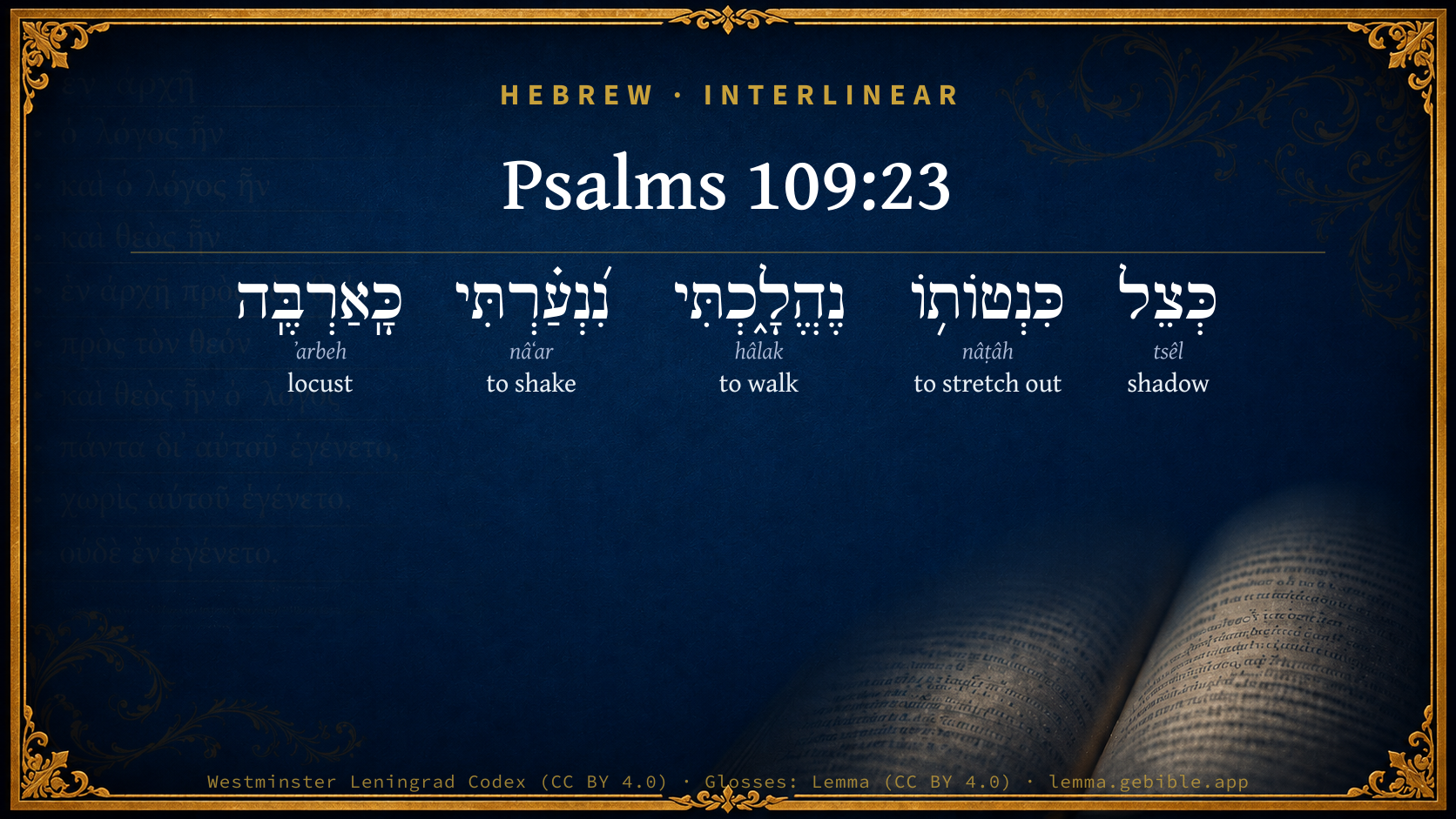
Hebrew (Westminster Leningrad Codex) Psalms 109:23 appears in the Hebrew Old Testament. The text above is from the Westminster Leningrad Codex. Each word links to its Strong’s number, a concise gloss, and parsing drawn from the Open Scriptures Hebrew Bible morphology. Click any word for its full Brown-Driver-Briggs (BDB) entry.
Download image
Cite this verse

Psalms 109:23 (World English Bible). Public Domain. Lemma interlinear Bible study tool, https://lemma.gebible.app/v/psalms/109/23.

Show BibTeX & RIS
BibTeX
RIS
English Translation
I fade away like an evening shadow. I am shaken off like a locust.
World English Bible · Public Domain
Download a study sheet

One document with this verse’s original text, its word-by-word gloss line, the meaning frame, cross-references with their text, attributed commentary, and full source and license credits — printable, and it pastes into notes with its structure intact.

This verse Autodidact and up

Study sheet (.html) Plain text (.txt)

A passage Seminary Student

Up to 50 verses in one chapter. A passage sheet keeps up to 6 commentary sources and 12 cross-references per verse, in the order this page ranks them, and says so on the sheet whenever that leaves anything out. Ask for a single verse and you get the Autodidact verse sheet above.

Everything on this page stays free to read, with no account — the sheet is a download of what is already on screen, not access to it.

Want to remove ads? Support Godless Engineer
Compare translations 3

The same verse in 3 English versions, stacked beneath the original-language interlinear above. Click any original word for its lexicon entry.

Each is an independent rendering of the whole verse — the interlinear is not word-aligned to these translations.

Highlighted words mark where these versions differ — a whole-verse word diff, not a word-by-word alignment.

  • World English Bible Public Domain
    I fade away like an evening shadow. I am shaken off like a locust.
  • King James Version Public Domain
    I am gone like the shadow when it declineth: I am tossed up and down as the locust.
  • unfoldingWord Literal Text CC BY-SA 4.0
    Like a shadow when it lengthens I am made to go; I am shaken off like a locust.

unfoldingWord Literal Text — © unfoldingWord, licensed CC BY-SA 4.0. Word-aligned USFM3 via Door43 (git.door43.org/unfoldingWord/en_ult).

Versions to compare (up to 4)

3 of 4 selected

Show all 18 translations

Every available English version of this verse, each an independent rendering of the whole verse.

  • World English Bible Public Domain
    I fade away like an evening shadow. I am shaken off like a locust.
  • Berean Standard Bible Public Domain
    I am fading away like a lengthening shadow; I am shaken off like a locust.
  • Majority Standard Bible Public Domain
    I am fading away like a lengthening shadow; I am shaken off like a locust.
  • King James Version Public Domain
    I am gone like the shadow when it declineth: I am tossed up and down as the locust.
  • American Standard Version (1901) Public Domain
    I am gone like the shadow when it declineth: I am tossed up and down as the locust.
  • Revised Version (1885) Public Domain
    I am gone like the shadow when it declineth: I am tossed up and down as the locust.
  • Geneva Bible (1599) Public Domain
    I depart like the shadowe that declineth, and am shaken off as the grashopper.
  • Douay-Rheims (1899) Public Domain
    I am taken away like the shadow when it declineth: and I am shaken off as locusts.
  • Young's Literal Translation Public Domain
    As a shadow when it is stretched out I have gone, I have been driven away as a locust.
  • Literal Standard Version CC BY-SA 4.0
    I have gone as a shadow when it is stretched out, || I have been driven away as a locust.
  • Unlocked Literal Bible CC BY-SA 4.0
    I am fading away like the shadow of the evening; I am shaken off like a locust.
  • unfoldingWord Literal Text CC BY-SA 4.0
    Like a shadow when it lengthens I am made to go; I am shaken off like a locust.
  • Darby Bible Public Domain
    I am gone like a shadow when it lengtheneth; I am tossed about like the locust;
  • World Messianic Bible Public Domain
    I fade away like an evening shadow. I am shaken off like a locust.
  • Webster's Bible Public Domain
    I am gone like the shadow when it declineth: I am tossed up and down as the locust.
  • Free Bible Version CC BY-SA 4.0
    I am fading away like an evening shadow; I am like a locust that is shaken off.
  • Bible in Basic English Public Domain
    I am gone like the shade when it is stretched out: I am forced out of my place like a locust.
  • JPS Tanakh (1917) Public Domain
    I am gone like the shadow when it lengtheneth; I am shaken off as the locust.

Literal Standard Version (2020), Covenant Press — licensed CC BY-SA 4.0. Text via the HelloAO Bible API (eBible.org). Unlocked Literal Bible (unfoldingWord) — licensed CC BY-SA 4.0. Text via the HelloAO Bible API (eBible.org). unfoldingWord Literal Text — © unfoldingWord, licensed CC BY-SA 4.0. Word-aligned USFM3 via Door43 (git.door43.org/unfoldingWord/en_ult). Free Bible Version, Dr. Jonathan Gallagher — licensed CC BY-SA 4.0. Text via the HelloAO Bible API (eBible.org).

Word by word

More ways to search: Search by grammar → Find every occurrence → Compare this word →

Practice this passage: Drill this verse → Learn its vocabulary →

About this verse

These counts appear in no published source. They are computed here, from the morphology-tagged text and Lemma’s own curated glosses. What Lemma adds →

5
words
5
distinct lemmas
Wisdom
section

Notable vocabulary

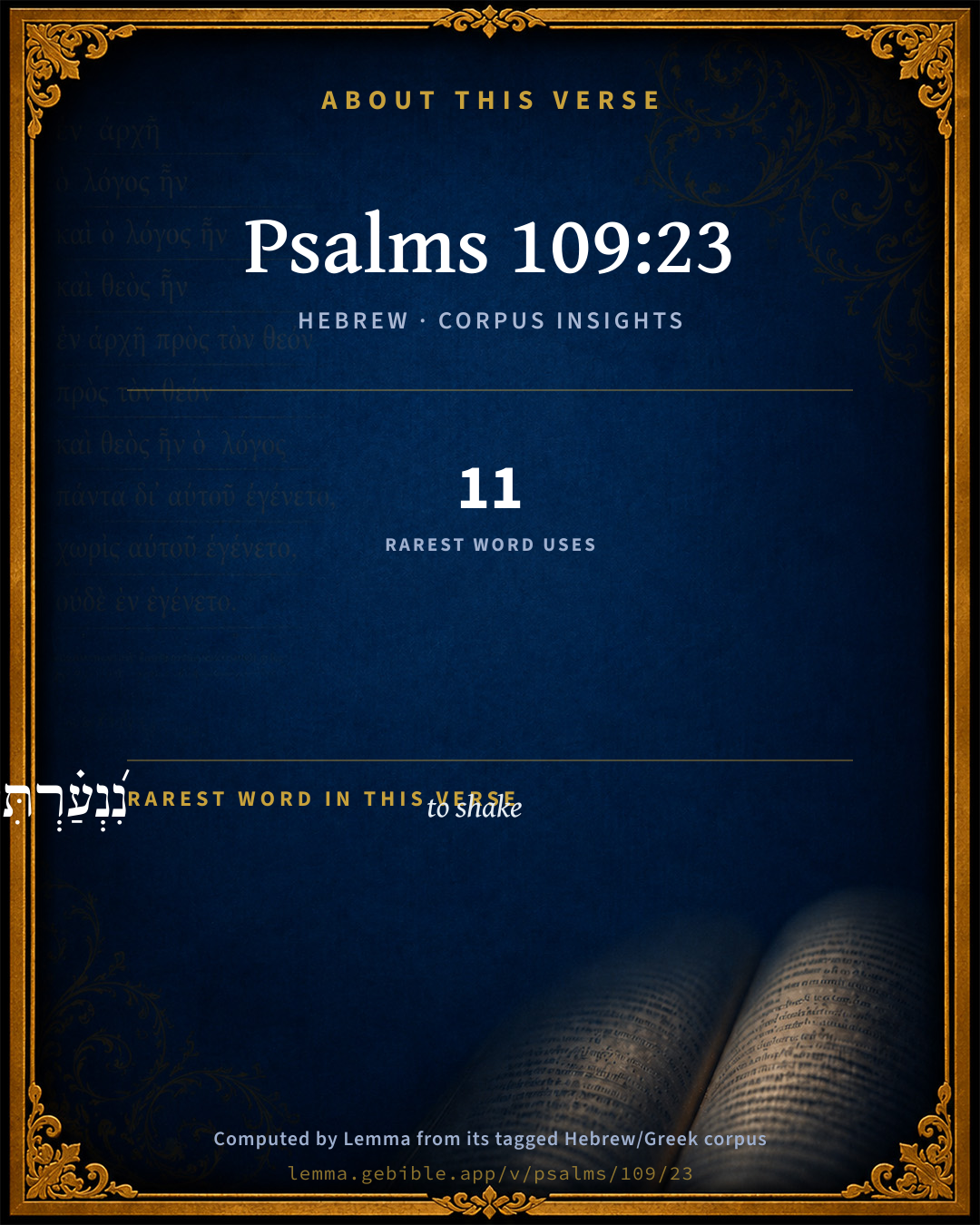
The rarest word here is נִ֝נְעַ֗רְתִּי to shake H5287 — appearing just 11 times in the whole Hebrew Bible.

Shared distinctive vocabulary

נִ֝נְעַ֗רְתִּי to shake H5287 occurs in 9 verses of the Hebrew Bible. Also found in:

Grammatical profile

  • 3 verbs
  • 2 nouns

Verb forms

  • כִּנְטוֹת֥וֹ Qal · Infinitive Construct
  • נֶהֱלָ֑כְתִּי Niphal · Perfect
  • נִ֝נְעַ֗רְתִּי Niphal · Perfect

Hebrew & Septuagint length

In English translation the verse runs 14 words from the Hebrew and 18 from the Septuagint (LXX English) — closely comparable.

A rough comparison of the two English renderings, which tokenize alike — not a word-level alignment.

Word counts can differ between the Hebrew and the Greek without any difference in meaning — e.g. the Hebrew direct-object marker אֵת has no separate Greek word, and Greek often adds the article ὁ.

Cross-references

9

Topical passages linked to Psalms 109:23 in the Treasury of Scripture Knowledge — connected by theme and wording, ordered by reader-vote popularity; previews shown in the World English Bible.

  • Exodus 10:19 Yahweh turned an exceeding strong west wind, which took up the locusts, and drove them into the Red Sea. There remained not one locust in all the borders of Egypt.
  • 1 Chronicles 29:15 For we are strangers before you, and foreigners, as all our fathers were: our days on the earth are as a shadow, and there is no abiding.
  • Job 14:2 He comes forth like a flower, and is cut down. He also flees like a shadow, and doesn't continue.
  • Psalms 102:10–11 Because of your indignation and your wrath, For you have taken me up, and thrown me away.
  • Exodus 10:13 Moses stretched forth his rod over the land of Egypt, and Yahweh brought an east wind on the land all that day, and all the night; and when it was morning, the east wind brought the locusts.
  • Psalms 144:4 Man is like a breath. His days are like a shadow that passes away.
  • Ecclesiastes 6:12 For who knows what is good for man in life, all the days of his vain life which he spends like a shadow? For who can tell a man what will be after him under the sun?
  • Ecclesiastes 8:13 But it shall not be well with the wicked, neither shall he lengthen days like a shadow; because he doesn't fear God.
  • James 4:14 Whereas you don't know what your life will be like tomorrow. For what is your life? For you are a vapor, that appears for a little time, and then vanishes away.

Cross-references courtesy of OpenBible.info (CC BY 4.0).

Hebrew and Greek witnesses Masoretic Hebrew ↔ Greek Septuagint

The same verse in the two great witnesses to the Old Testament, shown verse-for-verse.

You’re reading Greek Psalm 108 (Hebrew Psalm 109). The Septuagint counts the superscription, so verse numbers can differ from the Hebrew — chapter-level alignment, not verse-by-verse. Numbering follows Rahlfs.

These are two independent witnesses, not word-aligned to each other, and the Septuagint is shown in lemma (dictionary) form.

Hebrew Psalms 109:23 Masoretic · Westminster Leningrad Codex

כְּצֵל כִּנְטוֹת֥וֹ נֶהֱלָ֑כְתִּי נִ֝נְעַ֗רְתִּי כָּֽאַרְבֶּֽה

I fade away like an evening shadow. I am shaken off like a locust.

World English Bible · Public Domain

Greek LXX Greek Psalm 108:23 Septuagint · lemma form

ὡσεί σκιά ἐν ὁ ἐκκλίνω αὐτός ἀντι ἀνααἱρέω ἐκτινάσσω ὡσεί ἀκρίς

I am removed as a shadow in its going down: I am tossed up and down like locusts.

LXX2012 (modern English Septuagint) · Public Domain

On this verse, Ellicott's Commentary for English Readers discusses the Septuagint’s reading. Read the note in Commentary ↓

Hebrew: Westminster Leningrad Codex (CC BY 4.0). Greek: Septuagint (public domain); English from LXX2012 (modern English Septuagint) (Public Domain). How the Septuagint differs from the Hebrew →

Commentary

Notes on Psalms 109:23 from classic Christian and Jewish commentators (each source and its license shown beneath its notes). The classic Christian expositions comment on the surrounding passage and are grouped to its opening verse, so a note may address several verses; the Jewish commentaries on the Tanakh (Rashi and others) are per-verse, so they appear only where the commentator wrote on this verse.

Lemma curates 59 commentaries, every one of them public domain or Creative Commons licensed, each selected and text-cleaned for this edition rather than reprinted as found. About our sources →

Trapp's Complete Commentary

John Trapp

Psa 109:23 I am gone like the shadow when it declineth: I am tossed up and down as the locust.

Ver. 23. I am gone like the shadow] Abii, perii, evanui, I vanish, as the long shadows do so soon as the sun setteth.

As the locust] Leapeth from hedge to hedge, so do I from place to place, being tossed from post to pillar, αστατουμεν, 1Co 4:11

John Trapp, A Commentary or Exposition upon All the Books of the Old and New Testament (1647–1656) — public domain. Text from a community e-Sword module.

Joseph Benson's Commentary

Psa 109:23. I am gone, &c. — Hebrew, נהלכתי, neehlacheti, I am made to go, either, 1st, From place to place; which was David’s case when he was persecuted by Saul and by Absalom, and Christ’s case upon earth when he had no certain place where to lay his head. Or, 2d, Into the grave, as this phrase frequently signifies; like the shadow when it declineth — Toward the evening, when, the sun setting, it vanisheth instantly and irrecoverably. I am tossed up and down as a locust — Which of itself is unstable, continually leaping and moving from place to place, and is easily driven away with every wind. So am I exposed to perpetual and successive changes within myself, and to a thousand violences and mischiefs from other persons and things.

Joseph Benson's Commentary on the Old and New Testaments (1811–1818) — public domain. Text from a community e-Sword module.

J. A. Alexander on Psalms

Joseph Addison Alexander

23. (Psa 109:23) Like a shadow at its turning I am gone; I am driven away like the locust. The first comparison is the same with that in Psa 102:12. Our idiom enables us to imitate the phrase I am gone, a passive which in Hebrew occurs only here. The other verb is rare, but its meaning is suffi-ciently determined by usage. The allusion here is to the violence with which a cloud of locusts in the east is scattered by the wind. Compare Exo 10:19, Joe 2:20, Nah 3:17.

Joseph Addison Alexander, The Psalms Translated and Explained (1850) — public domain. Text from a community e-Sword module.

Tyndale Open Study Notes

Tyndale Open Resources

109:23 A shadow at dusk suggests a transitory, empty existence (102:11; 144:4); a single locust could easily be brushed off one’s clothing.

Tyndale Open Study Notes — © Tyndale Open Resources, licensed CC BY-SA 4.0. Text via the HelloAO Bible API.

Geneva Bible (1599)

Geneva Bible translators

Meaning, that he hath no stay nor assurance in this world.

Geneva Bible (1599) marginal notes — public domain. Text via Bolls.life.

Adam Clarke's Commentary

Verse 23. I am gone like the shadow] "I have walked like the declining shadow,"-I have passed my meridian of health and life; and as the sun is going below the horizon, so am I about to go under the earth.

I am tossed up and down as the locust.] When swarms of locusts take wing, and infest the countries in the east, if the wind happen to blow briskly, the swarms are agitated and driven upon each other, so as to appear to be heaved to and fro, or tossed up and down. Dr. Shaw, who has seen this, says it gives a lively idea of the comparisons of the psalmist.

Adam Clarke's Commentary on the Bible (1810–1826) — public domain. Text from a community e-Sword/MySword module.

John Calvin's Commentaries

23 I walk about as a shadow. These are two very appropriate similitudes: to the first of them I formerly adverted in Psalm 102:12; namely, that the afflicted person, and he who is almost lifeless, is very fitly compared to the shadow of the evening. At sunrise, or when he is shining in noon-day brightness, the constant shifting of the shadow is not so perceptible; but, towards sunset, the shadow flits before us during every moment that passes. By the other similitude, the transitory nature of all sublunary things is pointed out. For as the locusts are constantly skipping from one place to another, so David complains of his life being ever rendered uneasy by incessant persecution, so that no space was allowed him for repose; and this is similar to what he says in Psalm 11:1, that he was compelled to flee like a sparrow, for which the fowler lays snares in all directions. In short, he mourns over his forlorn situation, that he could find no place of safety, and that, even among men, he could get no habitation. And, as in this psalm, he presents us with a picture of the whole Church, we need not be surprised if God try us, and arouse us from our lethargy, by an innumerable variety of events. Accordingly, Paul, 1 Corinthians 4:11, speaking of himself and others, says, that they have no certain dwelling-place; a description which is more or less applicable to all the children of God.

John Calvin's Commentaries (1540-1563) — public domain. Text from the Calvin Translation Society English edition (1840s-50s) via the Christian Classics Ethereal Library (ccel.org). Calvin's coverage is partial (roughly two-thirds of the Bible); uncommented books and verses are honest gaps, never fabricated. The 19th-century editor's footnotes and remarks are omitted so the notes are faithfully Calvin's own voice.

Ellicott's Commentary for English Readers

(23) Shadow when it declineth.—Literally, a lengthened shade. (Comp. Psa_102:11, and see Note. Son_2:17.) When the day declines the shadow lengthens, it becomes longer and longer, till it vanishes in the universal darkness. Thus does the life of the suffering generation pass away.

Tossed up and down.—Better, tossed or shaken out, as from the lap. So LXX. and Vulg. (See Neh_5:13, where the same verb is three times used.) The grasshopper was an emblem of timidity (Job_39:20).

A Bible Commentary for English Readers, edited by Charles John Ellicott (1878–1897) — public domain. Text from a community e-Sword module.

The Cambridge Bible for Schools and Colleges

gen. ed. J. J. S. Perowne

23. Like a shadow when it declines or is stretched out towards evening (Psa_102:11), and is about to disappear altogether, so am I made to depart: the form of the verb implies compulsion from without.

I am tossed up and down] Or, driven away. The point of comparison is the helplessness of the locust swept along by the wind (Exo_10:19; Joe_2:20).

The Cambridge Bible for Schools and Colleges (gen. ed. J. J. S. Perowne; Cambridge University Press, 1878–1918) — public domain. Text from a community e-Sword module.

John Gill's Exposition

My knees are weak through fasting,..... Either voluntary or forced, through want of food or refreshment; this was verified in Christ, when he kneeled and prayed, and his sweat was as it were great drops of blood falling to the ground; see Psa 69:10.

And my flesh faileth of fatness; or "for want of oil" (k); the radical moisture of his flesh being dried up like a potsherd, Psa 22:15.

(k) , Sept. "propter oleum", V. L. "propter defectum olei", Eth. Arab.

John Gill's Exposition of the Whole Bible (1746–1763) — public domain (CC PDM 1.0). Text via the HelloAO Bible API.

Albert Barnes' Notes on the Bible

I am gone like the shadow when it declineth - See the notes at Psa 102:11.

I am tossed up and down as the locust - Agitated, moved, driven about, as a cloud of locusts is by the wind. The meaning of the whole is, that he was frail and weak, and needed strength from on high.

Albert Barnes' Notes on the Bible (1834–1885) — public domain. Text from a community e-Sword/MySword module.

Matthew Poole's English Annotations

I am gone, Heb. I am made to go; either,

1. From place to place; which was David’s case, when he was persecuted by Saul and by Absalom; and Christ’s case upon earth, where he had no certain place

where to lay his head: Mat 8:20. Or,

2. Into the grave, as this phrase is used, 1Ch 17:11; Psa 58:8, and oft elsewhere. Declineth; towards the evening, when, the sun setting, it vanisheth instantly, and irrecoverably, until the sun rise again, which it never will do to me in this world, when once I am gone out of it.

As the locust; which of itself is unstable, continually skipping from place to place, and is easily driven away with every wind; so am I exposed to perpetual and successive changes within myself, and to a thousand violences and mischiefs from other persons and things.

Matthew Poole's English Annotations on the Holy Bible (1683–1685) — public domain. Text from a community e-Sword/MySword module.

The Treasury of David

Charles H. Spurgeon

Ver. 23. I am gone like the shadow when it declineth. I am a mere shadow, a shadow at the vanishing point, when it stretches far, but is almost lost in the universal gloom of evening which settles over all, and so obliterates the shadows cast by the setting sun. Lord, there is next to nothing left of me, wilt thou not come in before I am quite gone?

I am tossed up and down as the locust, which is the sport of the winds, and must go up or down as the breeze carries it. The psalmist felt as powerless in his distress as a poor insect, which a child may toss up and down at its pleasure. He entreats the divine pity, because he had been brought to this forlorn and feeble condition by the long persecution which his tender heart had endured. Slander and malice are apt to produce nervous disorders and to lead on to pining diseases. Those who use these poisoned arrows are not always aware of the consequences; they scatter fire brands and death and say it is sport.

Ver. 23. I am gone like the shadow when it declineth. Bishop Horsley renders, "I am just gone, like the shadow stretched to its utmost length"; and remarks: "The state of the shadows of terrestrial objects at sunset, lengthening every instant, and growing faint as they lengthen; and in the instant that they shoot to an immeasurable length disappearing."

Ver. 23. I am tossed up and down as the locust. Although the locusts have sufficient strength of flight to remain on the wing for a considerable period, and to pass over great distances, they have little or no command over the direction of their flight, always travel with the wind, in the same way as the quail. So entirely are they at the mercy of the wind, that if a sudden gust arises the locusts are tossed about in the most helpless manner; and if they should happen to come across one of the circular air currents that are so frequently found in the countries which they inhabit, they are whirled round and round without the least power of extricating themselves. J.G. Wood.

Ver. 23. I am tossed up and down as the locust. This reference is to the flying locust. I have had frequent opportunities to notice how these squadrons are tossed up and down, and whirled round and round by the ever varying currents of the mountain winds. W.M. Thomson.

Psalms 109:24*

Charles H. Spurgeon's The Treasury of David (1869–1885) — public domain. Psalms only. Text from a community e-Sword/MySword module.

Whedon's Commentary on the Bible

Daniel D. Whedon

23. Gone like the shadow—Like a disappearing evening shadow, till its form and outline are lost in the darkness.

I am tossed up and down—I am shaken out. I have been violently cast out of home and country. So Exo_14:27, “The Lord shook off [margin] the Egyptians” Neh_5:13, “So God shake out every man from his house.”

As the locust—An allusion to their being tossed up and down by violent winds. Thus Morier: “On looking up we perceived an immense cloud, here and there semi-transparent, in other parts quite black, that spread itself all over the sky, and at intervals shadowed the sun. This we soon found to be locusts, whole swarms of them falling about us; but their passage was but momentary, for a fresh wind from the southwest, which had brought them to us, so completely drove them forward that not a vestige of them was seen two hours after.”

Daniel D. Whedon (gen. ed.), Commentary on the Old and New Testaments (1874–1909) — public domain. Text from a community e-Sword module.

The Pulpit Commentary

I am gone like the shadow when it declineth; rather, lille a shodow. (comp. Psa_102:11) When shadows "decline," they are just about to cease and disappear. I am tossed up and down as the locust; or, "I am carried away swept off, i.e. , or just ready to be swept off, from the face of the earth. (see Exo_10:19 Joe_2:20 Nah_3:17)

The Pulpit Commentary (1880–1919), ed. H.D.M. Spence-Jones & Joseph S. Exell — public domain. Text from a community e-Sword module.

John Wesley's Explanatory Notes

When - Towards the evening, when the sun is setting. The locust - Which is easily driven away with every wind.

John Wesley, Explanatory Notes Upon the Whole Bible (1754–1765) — public domain. Text via the GEBible commentary corpus.

Rashi

Rabbi Shlomo Yitzchaki (Rashi)

Like a shadow when it lengthens at eventide.

I was stirred up an expression of stirring and mixing and astonishment, like a locust, which wanders to and fro and is stirred up. [This] I found:

Rashi on the Tanakh — English translations: “The Judaica Press complete Tanach with Rashi, translated by A. J. Rosenberg” (CC BY 4.0); “Pentateuch with Rashi's commentary by M. Rosenbaum and A.M. Silbermann, 1929-1934” (public domain); “The Metsudah Tanach series, Lakewood, N.J” (CC BY 4.0); and “The Book of Joshua, Metsudah Publications, 1997” (CC BY 4.0). Text via Sefaria.

Lesson kit

Teaching starters — assembled from the data on this page, not authored interpretation. Every prompt links to the verse data it draws on. Edit before teaching.

Psalms, in the Wisdom, opens this verse with 5 words (5 distinct Hebrew lemmas). Its most distinctive word is nâʻar (“to shake”). A historical commentator’s framing appears above. Read the whole chapter for the surrounding context.

Discussion questions

  1. What does “to shake” (nâʻar) contribute to the verse as a whole?
  2. How does Exodus 14:27, which shares the word «to shake», read alongside this verse?
  3. These translations render this verse differently. What is at stake in choosing one wording over another?
  4. «כִּנְטוֹת֥וֹ» is a Qal Infinitive Construct verb. How does that grammatical form shape the action described?
  5. Compare how Trapp's Complete Commentary and Joseph Benson's Commentary read this verse. Where do they agree or differ?

Things to notice

Reading settings

Reading text

Shown beneath each verse's original-language words.

Old Testament
Old Testament edition

Read the OT as the Masoretic Hebrew (MT) or the Greek Septuagint (LXX).

English shown for the Greek Septuagint (in the Hebrew ↔ Greek comparison).

Comparing translations? Open the Compare panel on any verse page to stack up to four side by side.