
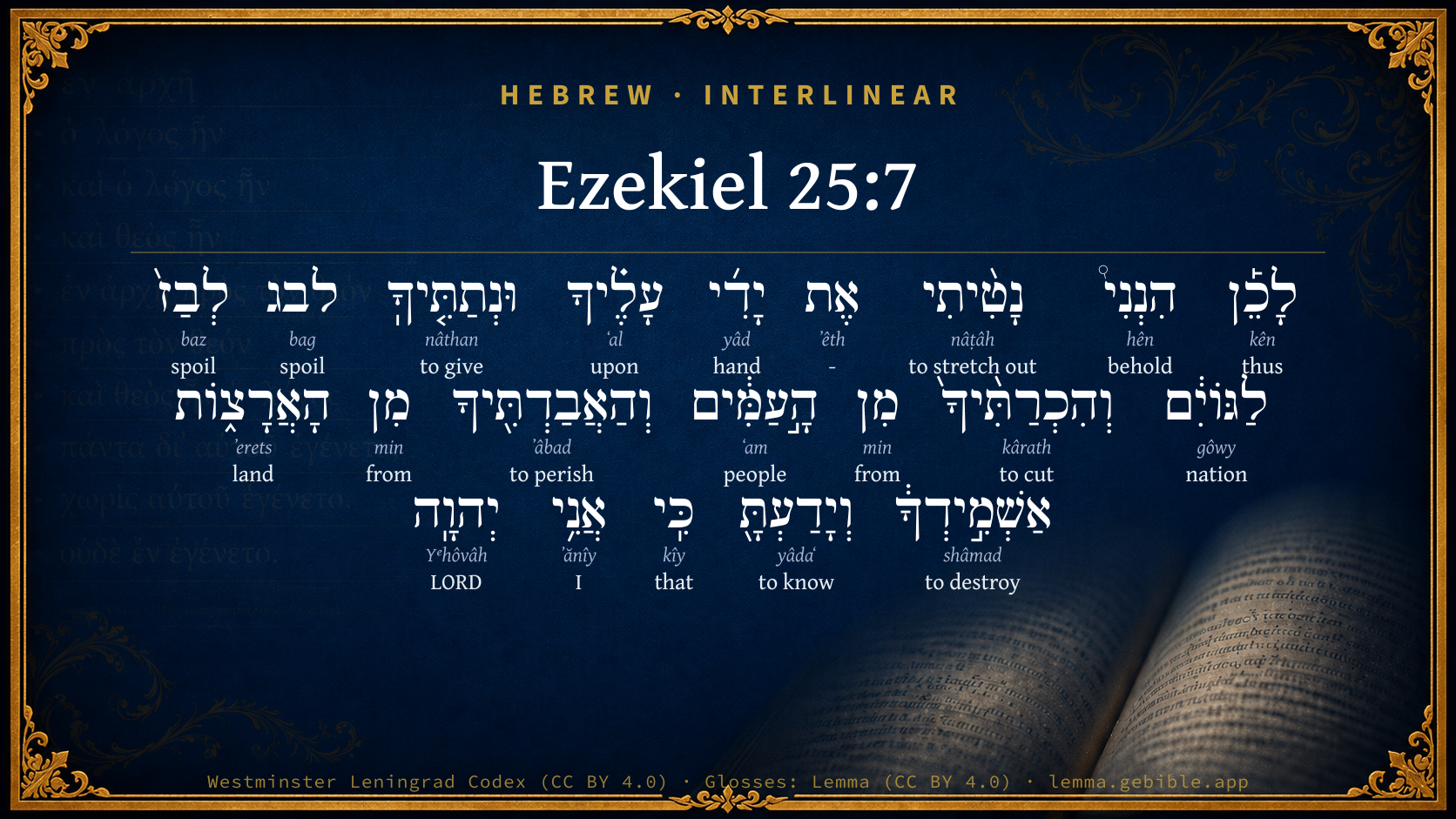
Ezekiel 25:7

Hebrew (Westminster Leningrad Codex) Ezekiel 25:7 appears in the Hebrew Old Testament. The text above is from the Westminster Leningrad Codex. Each word links to its Strong’s number, a concise gloss, and parsing drawn from the Open Scriptures Hebrew Bible morphology. Click any word for its full Brown-Driver-Briggs (BDB) entry.
Download image
Cite this verse

Ezekiel 25:7 (World English Bible). Public Domain. Lemma interlinear Bible study tool, https://lemma.gebible.app/v/ezekiel/25/7.

Show BibTeX & RIS
BibTeX
RIS
English Translation
therefore, behold, I have stretched out my hand on you, and will deliver you for a spoil to the nations; and I will cut you off from the peoples, and I will cause you to perish out of the countries: I will destroy you; and you shall know that I am Yahweh.
World English Bible · Public Domain
Highlights
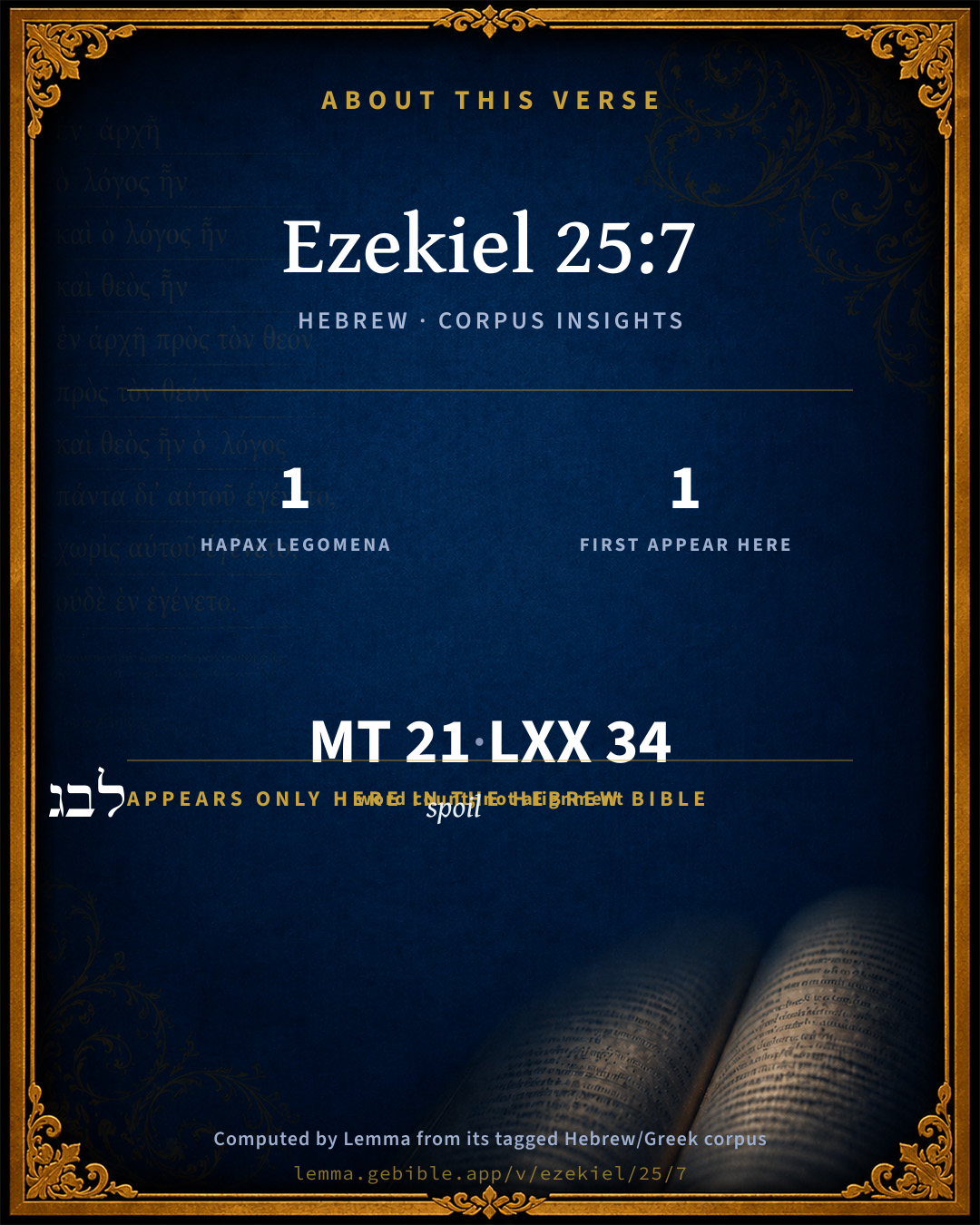
  • 1 hapax legomenon — only here in the Hebrew Bible
  • 1 first appearance in the Hebrew Bible
Full analysis ↓
Download a study sheet

One document with this verse’s original text, its word-by-word gloss line, the meaning frame, cross-references with their text, attributed commentary, and full source and license credits — printable, and it pastes into notes with its structure intact.

This verse Autodidact and up

Study sheet (.html) Plain text (.txt)

A passage Seminary Student

Up to 50 verses in one chapter. A passage sheet keeps up to 6 commentary sources and 12 cross-references per verse, in the order this page ranks them, and says so on the sheet whenever that leaves anything out. Ask for a single verse and you get the Autodidact verse sheet above.

Everything on this page stays free to read, with no account — the sheet is a download of what is already on screen, not access to it.

Want to remove ads? Support Godless Engineer
Compare translations 3

The same verse in 3 English versions, stacked beneath the original-language interlinear above. Click any original word for its lexicon entry.

Each is an independent rendering of the whole verse — the interlinear is not word-aligned to these translations.

Highlighted words mark where these versions differ — a whole-verse word diff, not a word-by-word alignment.

  • World English Bible Public Domain
    therefore, behold, I have stretched out my hand on you, and will deliver you for a spoil to the nations; and I will cut you off from the peoples, and I will cause you to perish out of the countries: I will destroy you; and you shall know that I am Yahweh.
  • King James Version Public Domain
    Behold, therefore I will stretch out mine hand upon thee, and will deliver thee for a spoil to the heathen; and I will cut thee off from the people, and I will cause thee to perish out of the countries: I will destroy thee; and thou shalt know that I am the LORD.
  • unfoldingWord Literal Text CC BY-SA 4.0
    Therefore, behold! I will strike you with my hand and give you as plunder to the nations. I will cut you off from the peoples and make you perish from among the countries! I will destroy you, and you will know that I am Yahweh.’

unfoldingWord Literal Text — © unfoldingWord, licensed CC BY-SA 4.0. Word-aligned USFM3 via Door43 (git.door43.org/unfoldingWord/en_ult).

Versions to compare (up to 4)

3 of 4 selected

Show all 18 translations

Every available English version of this verse, each an independent rendering of the whole verse.

  • World English Bible Public Domain
    therefore, behold, I have stretched out my hand on you, and will deliver you for a spoil to the nations; and I will cut you off from the peoples, and I will cause you to perish out of the countries: I will destroy you; and you shall know that I am Yahweh.
  • Berean Standard Bible Public Domain
    therefore I will indeed stretch out My hand against you and give you as plunder to the nations. I will cut you off from the peoples and exterminate you from the countries. I will destroy you, and you will know that I am the LORD.’
  • Majority Standard Bible Public Domain
    therefore I will indeed stretch out My hand against you and give you as plunder to the nations. I will cut you off from the peoples and exterminate you from the countries. I will destroy you, and you will know that I am the LORD.’
  • King James Version Public Domain
    Behold, therefore I will stretch out mine hand upon thee, and will deliver thee for a spoil to the heathen; and I will cut thee off from the people, and I will cause thee to perish out of the countries: I will destroy thee; and thou shalt know that I am the LORD.
  • American Standard Version (1901) Public Domain
    therefore, behold, I have stretched out my hand upon thee, and will deliver thee for a spoil to the nations; and I will cut thee off from the peoples, and I will cause thee to perish out of the countries: I will destroy thee; and thou shalt know that I am Jehovah.
  • Revised Version (1885) Public Domain
    therefore behold, I have stretched out mine hand upon thee, and will deliver thee for a spoil to the nations; and I will cut thee off from the peoples, and I will cause thee to perish out of the countries: I will destroy thee; and thou shalt know that I am the LORD.
  • Geneva Bible (1599) Public Domain
    Beholde, therefore I will stretche out mine hand vpon thee, and will deliuer thee to be spoyled of the heathen, and I will roote thee out from the people, and I will cause thee to be destroyed out of the countreys, and I will destroy thee, and thou shalt know that I am the Lord.
  • Douay-Rheims (1899) Public Domain
    Therefore behold I: will stretch forth my hand upon thee, and will deliver thee to be the spoil of nations, and will cut thee off from among the people, and destroy thee out of the lands, and break thee in pieces: and thou shalt know that I am the Lord.
  • Young's Literal Translation Public Domain
    Therefore, lo, I -- I have stretched out My hand against thee, And have given thee for a portion to nations, And I have cut thee off from the peoples, And caused thee to perish from the lands; I destroy thee, and thou hast known that I `am' Jehovah.
  • Literal Standard Version CC BY-SA 4.0
    Therefore, behold, I have stretched out My hand against you, || And have given you for a portion to nations, || And I have cut you off from the peoples, || And caused you to perish from the lands; I destroy you, and you have known that I [am] YHWH.
  • Unlocked Literal Bible CC BY-SA 4.0
    Therefore, behold! I will strike you with my hand and give you as plunder to the nations. I will cut you off from the peoples and make you perish from among the countries! I will destroy you, and you will know that I am Yahweh.'
  • unfoldingWord Literal Text CC BY-SA 4.0
    Therefore, behold! I will strike you with my hand and give you as plunder to the nations. I will cut you off from the peoples and make you perish from among the countries! I will destroy you, and you will know that I am Yahweh.’
  • Darby Bible Public Domain
    therefore behold, I will stretch out my hand upon thee, and will give thee for a spoil to the nations; and I will cut thee off from the peoples, and I will cause thee to perish out of the countries: I will destroy thee, and thou shalt know that I [am] Jehovah.
  • World Messianic Bible Public Domain
    therefore, behold, I have stretched out my hand on you, and will deliver you for a plunder to the nations. I will cut you off from the peoples, and I will cause you to perish out of the countries. I will destroy you. Then you will know that I am the LORD.”
  • Webster's Bible Public Domain
    Behold, therefore I will stretch out my hand upon thee, and will deliver thee for a spoil to the heathen; and I will cut thee off from the people, and I will cause thee to perish out of the countries: I will destroy thee; and thou shalt know that I am the LORD.
  • Free Bible Version CC BY-SA 4.0
    this is why I will reach out and attack you, and hand you over to be looted by other nations. I will wipe you out so completely that you will no longer exist as a nation. I will destroy you, and then you will know that I am the Lord.
  • Bible in Basic English Public Domain
    For this cause my hand has been stretched out against you, and I will give up your goods to be taken by the nations; I will have you cut off from the peoples and will put an end to you among the countries: I will give you up to destruction; and you will be certain that I am the Lord.
  • JPS Tanakh (1917) Public Domain
    therefore, behold, I stretch out My hand upon thee, and will deliver thee for a spoil to the nations; and I will cut thee off from the peoples, and I will cause thee to perish out of the countries; I will destroy thee, and thou shalt know that I am the LORD.

Literal Standard Version (2020), Covenant Press — licensed CC BY-SA 4.0. Text via the HelloAO Bible API (eBible.org). Unlocked Literal Bible (unfoldingWord) — licensed CC BY-SA 4.0. Text via the HelloAO Bible API (eBible.org). unfoldingWord Literal Text — © unfoldingWord, licensed CC BY-SA 4.0. Word-aligned USFM3 via Door43 (git.door43.org/unfoldingWord/en_ult). Free Bible Version, Dr. Jonathan Gallagher — licensed CC BY-SA 4.0. Text via the HelloAO Bible API (eBible.org).

Word by word

More ways to search: Search by grammar → Find every occurrence → Compare this word →

Practice this passage: Drill this verse → Learn its vocabulary →

לבג
bag
H897
“to/for · spoil”
Preposition + Noun, Common, Masculine, Singular, Absolute
Part of Speech
Preposition + Noun
Type
Common
Gender
Masculine
Number
Singular
State
Absolute
Full BDB Definition

Origin: a Persian word

TWOT: 225a

spoil, booty
  1. לָכֵ֡ן kên H3651 “to/for · thus” Preposition + Adverb
  2. הִנְנִי֩ hên H2005 “behold · me” Particle, Demonstrative + Suffix, Personal, 1st Person, Common, Singular
  3. נָטִ֨יתִי nâṭâh H5186 “to stretch out” Verb, Qal, Perfect, 1st Person, Common, Singular
  4. אֶת ʼêth H853 “-” Particle, Direct Object
  5. יָדִ֜י yâd H3027 “hand · my” Noun, Common, Both, Singular, Construct + Suffix, Personal, 1st Person, Common, Singular
  6. עָלֶ֗יךָ ʻal H5921 “upon · you” Preposition + Suffix, Personal, 2nd Person, Masculine, Singular
  7. וּנְתַתִּ֤יךָֽ nâthan H5414 “and · to give · you” Conjunction + Verb, Qal, Perfect, 1st Person, Common, Singular + Suffix, Personal, 2nd Person, Masculine, Singular
  8. לְבַז֙ baz H957 “to/for · spoil” Preposition + Noun, Common, Masculine, Singular, Absolute
  9. לַגּוֹיִ֔ם gôwy H1471 “to/for the · nations” Preposition, Determined + Noun, Common, Masculine, Plural, Absolute
  10. וְהִכְרַתִּ֨יךָ֙ kârath H3772 “and · to cut · you” Conjunction + Verb, Hiphil, Sequential Perfect, 1st Person, Common, Singular + Suffix, Personal, 2nd Person, Masculine, Singular
  11. מִן min H4480 “from” Preposition
  12. הָ֣עַמִּ֔ים ʻam H5971 “the · peoples” Particle, Definite Article + Noun, Common, Masculine, Plural, Absolute
  13. וְהַאֲבַדְתִּ֖יךָ ʼâbad H6 “and · to perish · you” Conjunction + Verb, Hiphil, Sequential Perfect, 1st Person, Common, Singular + Suffix, Personal, 2nd Person, Masculine, Singular
  14. מִן min H4480 “from” Preposition
  15. הָאֲרָצ֑וֹת ʼerets H776 “the · lands” Particle, Definite Article + Noun, Common, Both, Plural, Absolute
  16. אַשְׁמִ֣ידְךָ֔ shâmad H8045 “to destroy · you” Verb, Hiphil, Imperfect, 1st Person, Common, Singular + Suffix, Personal, 2nd Person, Masculine, Singular
  17. וְיָדַעְתָּ֖ yâdaʻ H3045 “and · to know” Conjunction + Verb, Qal, Sequential Perfect, 2nd Person, Masculine, Singular
  18. כִּֽי kîy H3588 “that” Conjunction
  19. אֲנִ֥י ʼănîy H589 “I” Pronoun, Personal, 1st Person, Common, Singular
  20. יְהוָֽה Yᵉhôvâh H3068 “LORD” Noun, Proper

About this verse

These counts appear in no published source. They are computed here, from the morphology-tagged text and Lemma’s own curated glosses. What Lemma adds →

21
words
20
distinct lemmas
Prophets
section

Notable vocabulary

1 hapax legomenon — a word that appears only here in the entire Hebrew Bible:

First appearance in Scripture

This word makes its first canonical appearance in the Hebrew Bible here:

Shared distinctive vocabulary

לְבַז֙ spoil H957 occurs in 25 verses of the Hebrew Bible. Also found in:

Grammatical profile

  • 6 verbs
  • 7 nouns
  • 1 pronoun
  • 3 prepositions
  • 1 conjunction
  • 1 adverb
  • 2 particles

Verb forms

  • נָטִ֨יתִי Qal · Perfect
  • וּנְתַתִּ֤יךָֽ Qal · Perfect
  • וְהִכְרַתִּ֨יךָ֙ Hiphil · Sequential Perfect
  • וְהַאֲבַדְתִּ֖יךָ Hiphil · Sequential Perfect
  • אַשְׁמִ֣ידְךָ֔ Hiphil · Imperfect
  • וְיָדַעְתָּ֖ Qal · Sequential Perfect

Repetition

A word recurs within this verse — often emphatic in Hebrew:

Hebrew & Septuagint length

In English translation the verse runs 52 words from the Hebrew and 50 from the Septuagint (LXX English) — closely comparable.

A rough comparison of the two English renderings, which tokenize alike — not a word-level alignment.

Word counts can differ between the Hebrew and the Greek without any difference in meaning — e.g. the Hebrew direct-object marker אֵת has no separate Greek word, and Greek often adds the article ὁ.

In the original languages it is 21 Hebrew tokens and 34 Greek tokens — but the two are counted differently (Hebrew bundles its prefixes and suffixes into one token; the Greek is in lemma form), so that isn’t a like-for-like length.

Cross-references

8

Topical passages linked to Ezekiel 25:7 in the Treasury of Scripture Knowledge — connected by theme and wording, ordered by reader-vote popularity; previews shown in the World English Bible.

  • Zephaniah 1:4 I will stretch out my hand against Judah, and against all the inhabitants of Jerusalem. I will cut off the remnant of Baal from this place: the name of the idolatrous and pagan priests,
  • Ezekiel 6:14 I will stretch out my hand on them, and make the land desolate and waste, from the wilderness toward Diblah, throughout all their habitations: and they shall know that I am Yahweh.
  • Ezekiel 25:13 therefore thus says the Lord Yahweh, I will stretch out my hand on Edom, and will cut off man and animal from it; and I will make it desolate from Teman; even to Dedan shall they fall by the sword.
  • Ezekiel 25:16 therefore thus says the Lord Yahweh, Behold, I will stretch out my hand on the Philistines, and I will cut off the Cherethites, and destroy the remnant of the sea coast.
  • Jeremiah 49:2 Therefore, behold, the days come, says Yahweh, that I will cause an alarm of war to be heard against Rabbah of the children of Ammon; and it shall become a desolate heap, and her daughters shall be burned with fire: then shall Israel possess those who did possess him, says Yahweh.
  • Ezekiel 14:9 If the prophet be deceived and speak a word, I, Yahweh, have deceived that prophet, and I will stretch out my hand on him, and will destroy him from the midst of my people Israel.
  • Ezekiel 35:3 and tell it, Thus says the Lord Yahweh: Behold, I am against you, Mount Seir, and I will stretch out my hand against you, and I will make you a desolation and an astonishment.
  • Amos 1:14–15 But I will kindle a fire in the wall of Rabbah, And it will devour its palaces, With shouting in the day of battle, With a tempest in the day of the whirlwind;

Cross-references courtesy of OpenBible.info (CC BY 4.0).

Hebrew and Greek witnesses Masoretic Hebrew ↔ Greek Septuagint

The same verse in the two great witnesses to the Old Testament, shown verse-for-verse.

These are two independent witnesses, not word-aligned to each other, and the Septuagint is shown in lemma (dictionary) form.

Hebrew Ezekiel 25:7 Masoretic · Westminster Leningrad Codex

לָכֵ֡ן הִנְנִי֩ נָטִ֨יתִי אֶת יָדִ֜י עָלֶ֗יךָ וּנְתַתִּ֤יךָֽ לבג לְבַז֙ לַגּוֹיִ֔ם וְהִכְרַתִּ֨יךָ֙ מִן הָ֣עַמִּ֔ים וְהַאֲבַדְתִּ֖יךָ מִן הָאֲרָצ֑וֹת אַשְׁמִ֣ידְךָ֔ וְיָדַעְתָּ֖ כִּֽי אֲנִ֥י יְהוָֽה

therefore, behold, I have stretched out my hand on you, and will deliver you for a spoil to the nations; and I will cut you off from the peoples, and I will cause you to perish out of the countries: I will destroy you; and you shall know that I am Yahweh.

World English Bible · Public Domain

Greek LXX Ezekiel 25:7 Septuagint · lemma form

διά οὗτος ἐκτείνω ὁ χείρ ἐγώ ἐπί σύ καί δίδωμι σύ εἰς διαρπαγή ἐν ὁ ἔθνος καί ἐκὀλεθρεύω σύ ἐκ ὁ λαός καί ἀποὀλλύω σύ ἐκ ὁ χώρα ἀπώλεια καί ἐπιγιγνώσκω διότι ἐγώ κύριος

therefore I will stretch out my hand against you, and I will make you a spoil to the nations; and I will utterly destroy you from among the peoples, and I will completely cut you off from out of the countries: and you shall know that I am the Lord.

LXX2012 (modern English Septuagint) · Public Domain

Hebrew: Westminster Leningrad Codex (CC BY 4.0). Greek: Septuagint (public domain); English from LXX2012 (modern English Septuagint) (Public Domain). How the Septuagint differs from the Hebrew →

Targum (Aramaic paraphrase)

1

The Targum is the ancient Jewish Aramaic paraphrase of the Hebrew Scriptures — an interpretive translation, not the Hebrew text itself. Onkelos (literal) and Pseudo-Jonathan (expansive) render the Torah, and Jonathan the Prophets. Coverage is partial: where no permissively-licensed English translation exists for a verse, only the Aramaic is shown. This is verse-level text, not a word-by-word alignment to the Hebrew.

  1. Targum Jonathan Prophets (Joshua–Malachi)
    בְּכֵן הָא אֲנָא מְרִים יַת מְחַת גְבוּרְתִּי עֲלָךְ וְאֶתְּנִנָךְ לְבִיז לְעַמְמַיָא וְאֱשֵׁיצִינָךְ מִבֵּינֵי עַמְמַיָא וְאַבְּדִנָךְ מִן מְדִינָתָא אַצְדִנָךְ וְתֵידַע אֲרֵי אֲנָא יְיָ:

    (no public-domain English translation for this verse)

    Targum Jonathan — Aramaic: “Mikraot Gedolot” (public domain). English: “Sefaria Community Translation” (CC0 1.0 (public-domain dedication)); “London "Chaldee Paraphrase," 1871” (public domain). Text via Sefaria.

Commentary

Notes on Ezekiel 25:7 from classic Christian and Jewish commentators (each source and its license shown beneath its notes). The classic Christian expositions comment on the surrounding passage and are grouped to its opening verse, so a note may address several verses; the Jewish commentaries on the Tanakh (Rashi and others) are per-verse, so they appear only where the commentator wrote on this verse.

Lemma curates 59 commentaries, every one of them public domain or Creative Commons licensed, each selected and text-cleaned for this edition rather than reprinted as found. About our sources →

Trapp's Complete Commentary

John Trapp

Eze 25:7 Behold, therefore I will stretch out mine hand upon thee, and will deliver thee for a spoil to the heathen; and I will cut thee off from the people, and I will cause thee to perish out of the countries: I will destroy thee; and thou shalt know that I [am] the LORD.

Ver. 7. Behold, therefore I will stretch out my hand upon thee.] God loveth to retaliate.

I will cause thee to perish out of the country.] So little a distance is there again, saith Seneca, between a great city and no city.

“ Ludit in humanis divina potentia rebus:

Et certam praesens vix habet hora fidem. ”

John Trapp, A Commentary or Exposition upon All the Books of the Old and New Testament (1647–1656) — public domain. Text from a community e-Sword module.

Jamieson, Fausset & Brown

Robert Jamieson, A. R. Fausset & David Brown

a spoil--so the Hebrew Margin, or Keri, for the text or Chetib, "meat" (so Eze 26:5; Eze 34:28). Their goods were to be a "spoil to the foe"; their state was to be "cut off," so as to be no more a "people"; and they were as individuals, for the most part, to be "destroyed."

Jamieson, Fausset & Brown — Commentary Critical and Explanatory on the Whole Bible (1871) — public domain (CC PDM 1.0). Text via the HelloAO Bible API.

Adam Clarke's Commentary

Verse 7. I will cause thee to perish] Except in history, the name of the Ammonites does not now exist.

Adam Clarke's Commentary on the Bible (1810–1826) — public domain. Text from a community e-Sword/MySword module.

Ellicott's Commentary for English Readers

(7) For a spoil.—This is the sense of the margin of the Hebrew; its text is represented by our margin, meat or food. The word in the text occurs only here, but a compound of it is found in Dan_1:5; Dan_11:26. The figure seems to be the same as that which speaks of devouring the people.

Shalt know that I am the Lord.—This frequent close of the denunciatory prophecies against Israel in the former chapters is here also used at the close of each message in this chapter, and of many of the other prophecies against foreign nations. It refers not to a penitent recognition of the Lord, but to an experience of His wrath so plain that they can no longer refuse to acknowledge His power (see Eze_25:14).

A Bible Commentary for English Readers, edited by Charles John Ellicott (1878–1897) — public domain. Text from a community e-Sword module.

The Cambridge Bible for Schools and Colleges

gen. ed. J. J. S. Perowne

7. a spoil to the heathen] the nations (the reading baz to be adopted), cf. Eze_26:5, Eze_7:21, Eze_23:46. For people peoples.

know that I am the Lord] The statement is hardly to the effect that the Ammonites shall be converted to the worship of the true God. They shall recognise that there is one Most high, ruling in the kingdom of men (Dan_4:17), and that it is he who is shaping their history; possibly also that this God is Jehovah, God of Israel. The prophet does not pursue the destinies of the nations beyond this recognition, nor state what it implies. It is to be observed, however, that Israel restored, though occupying only the land west of the Jordan, enjoys profound peace on all sides. The nations that swell the army of Gog (ch. 38) are not Israel’s historical neighbours, but peoples from the uttermost parts of the earth.

The Cambridge Bible for Schools and Colleges (gen. ed. J. J. S. Perowne; Cambridge University Press, 1878–1918) — public domain. Text from a community e-Sword module.

John Gill's Exposition

Behold, therefore, I will stretch out mine hand upon thee,.... In just retaliation for clapping their hands against his people; and which hand of the Lord they would find to be a heavy one, and which they would not be able either to resist or bear. The Targum is,

"I will lift up the stroke of my power upon thee:''

and will deliver thee for a spoil to the Heathen; to the Chaldeans first, and then to the Arabians, to be spoiled and plundered by them of their wealth and substance: some render it, "for meat" (s) unto them; to be devoured and consumed by them:

and I will cut thee off from the people, and I will cause thee to perish out of the countries; so as to be no more a people and a country; or be reckoned among the people and countries; or have any alliance with them, or help from them:

I will destroy thee, and thou shalt know that I am the Lord; who has said and done all this; See Gill on Eze 25:5.

(s) "in cibum", Montanus, Gussetius. This is the Cetib or textual writing; but the Keri or marginal reading is "in direptionem", Pagninus, Cocceius; "in praedam", Junius & Tremeilius, Piscator. Both come to much one and the same sense, as Ben Melech observes, for food was of the spoil; and one word answers to another by "athbash", which is a certain form of placing the alphabet; See Gill on

John Gill's Exposition of the Whole Bible (1746–1763) — public domain (CC PDM 1.0). Text via the HelloAO Bible API.

Haydock's Catholic Bible Commentary

Lord, and that it was not through impotence that my people became a prey. Ammon and Moab returned after some time, ver. 10., and chap. xvi. 53., and Jeremias xlix. 6.

George Leo Haydock (1774–1849), Haydock's Catholic Family Bible and Commentary, 1859 edition — public domain. Excludes Psalms (Douay-Rheims chapter numbering differs from Protestant) and Deuterocanonical books (Catholic canon only).

Matthew Poole's English Annotations

Thou stretchedst out thy hand in joy,

I will stretch out mine in wrath; thou, against my people, I, against thee.

For a spoil; for a prey, or for meat, so the word will bear. The greedy, covetous soldier shall make thy wealth his prey; the hungry enemy shall eat thee up.

The heathen; Babylonians, and their confederates.

I will cut thee off; explained by that follows; Ammon, thou shalt no more be accounted among the nations, but cease from being a people. I will destroy thee; so shalt thou be destroyed.

Thou shalt know: see Eze 25:5.

Matthew Poole's English Annotations on the Holy Bible (1683–1685) — public domain. Text from a community e-Sword/MySword module.

Whedon's Commentary on the Bible

Daniel D. Whedon

7. Heathen — R.V., “nations.”

People — R.V., “peoples.”

Thou shalt know — The aim of Jehovah in the destruction of the capital of Ammon was the same as in the destruction of Jerusalem (Eze_22:22; Eze_24:13).

Daniel D. Whedon (gen. ed.), Commentary on the Old and New Testaments (1874–1909) — public domain. Text from a community e-Sword module.

The Pulpit Commentary

A spoil to the heathen. The noun for "spoil" is not found elsewhere, but probably means "food." The Hebrew Keri, i.e. its marginal reading, gives the same word as that rendered "spoil" in Eze_27:5. The meaning is substantially the same whichever word we choose. Ezekiel, it will be noticed, says nothing about the return of the Ammonites, but contemplates, as in Eze_21:32, entire destruction. The moaning of Rabbah ("great" or "populous the mother-city of Ammon, gives greater force to the prophecy of desolation.

The Pulpit Commentary (1880–1919), ed. H.D.M. Spence-Jones & Joseph S. Exell — public domain. Text from a community e-Sword module.

John Wesley's Explanatory Notes

Know - Thus God will bring those that were strangers to him into an acquaintance with him, and it will be a blessed effect of their calamities. How much better is it, to be poor and know God, than to be rich, and ignorant of him?

John Wesley, Explanatory Notes Upon the Whole Bible (1754–1765) — public domain. Text via the GEBible commentary corpus.

Lesson kit

Teaching starters — assembled from the data on this page, not authored interpretation. Every prompt links to the verse data it draws on. Edit before teaching.

Ezekiel, in the Prophets, opens this verse with 21 words (20 distinct Hebrew lemmas). Its most distinctive word is bag (“spoil”). A historical commentator’s framing appears above. Read the whole chapter for the surrounding context.

Discussion questions

  1. The word bag carries the sense “spoil.” How does it shape the verse?
  2. 1 word here appears nowhere else in the Hebrew Bible. Why might the author reach for such rare wording?
  3. This is the first place “spoil” appears in Scripture (first appears here). What does its debut here establish?
  4. How does Numbers 14:3, which shares the word «spoil», read alongside this verse?
  5. What does the repetition of “from” (2× in this one verse) do in this verse?
  6. These translations render this verse differently. What is at stake in choosing one wording over another?
  7. «נָטִ֨יתִי» is a Qal Perfect verb. How does that grammatical form shape the action described?
  8. Compare how Trapp's Complete Commentary and Jamieson, Fausset & Brown read this verse. Where do they agree or differ?

Things to notice

  • 1 word in this verse appears nowhere else in the Hebrew Bible.
  • 1 word makes its first canonical appearance in Scripture here.
  • This verse counts 21 Hebrew ↔ 34 Greek words.
  • These translations choose different wording for 22 words in this verse.
  • “from” occurs 2× in this single verse.

Reading settings

Reading text

Shown beneath each verse's original-language words.

Old Testament
Old Testament edition

Read the OT as the Masoretic Hebrew (MT) or the Greek Septuagint (LXX).

English shown for the Greek Septuagint (in the Hebrew ↔ Greek comparison).

Comparing translations? Open the Compare panel on any verse page to stack up to four side by side.