
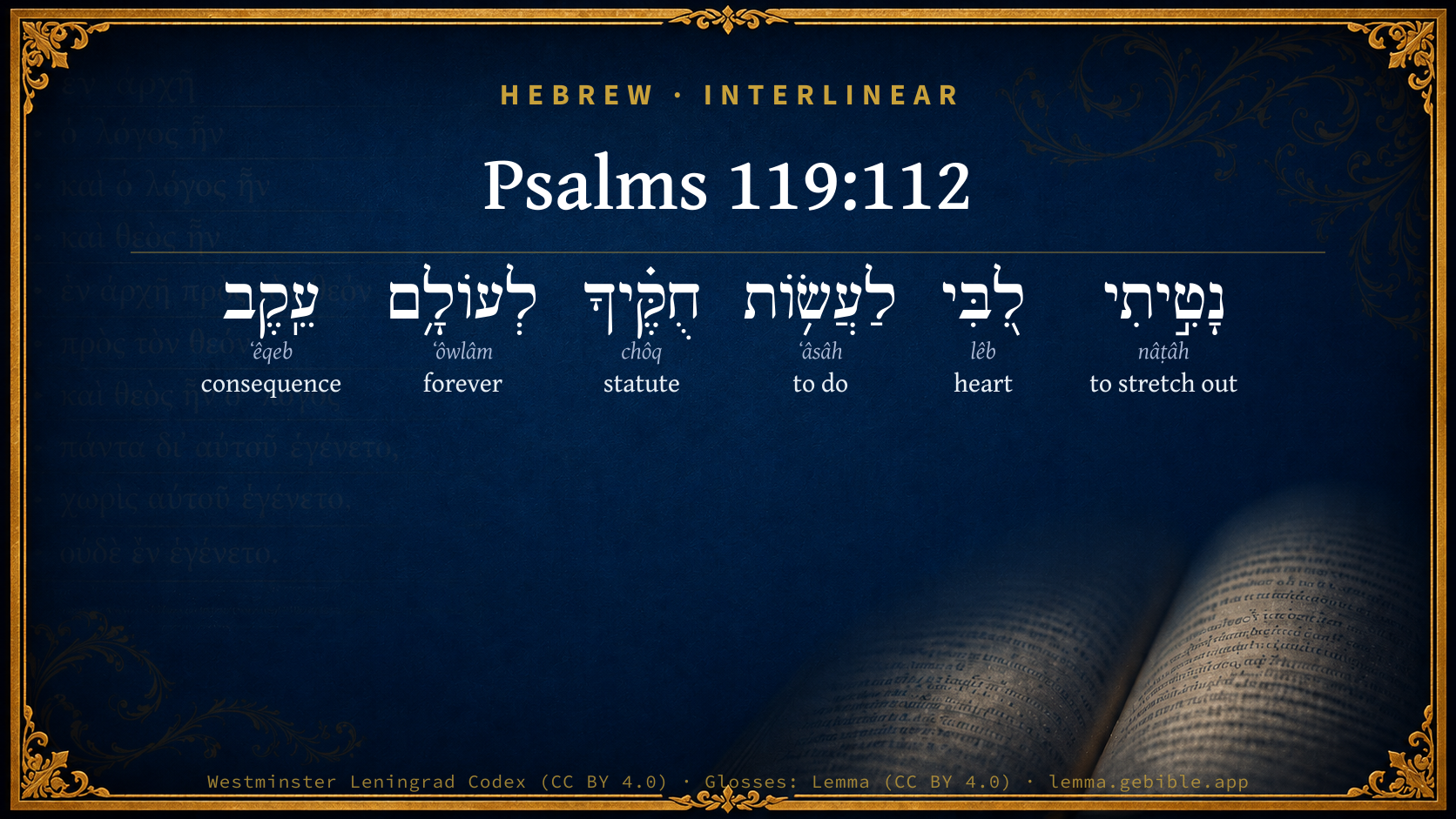
Psalms 119:112

Hebrew (Westminster Leningrad Codex) Psalms 119:112 appears in the Hebrew Old Testament. The text above is from the Westminster Leningrad Codex. Each word links to its Strong’s number, a concise gloss, and parsing drawn from the Open Scriptures Hebrew Bible morphology. Click any word for its full Brown-Driver-Briggs (BDB) entry.
Download image
Cite this verse

Psalms 119:112 (World English Bible). Public Domain. Lemma interlinear Bible study tool, https://lemma.gebible.app/v/psalms/119/112.

Show BibTeX & RIS
BibTeX
RIS
English Translation
I have set my heart to perform your statutes forever, Even to the end.
World English Bible · Public Domain
Download a study sheet

One document with this verse’s original text, its word-by-word gloss line, the meaning frame, cross-references with their text, attributed commentary, and full source and license credits — printable, and it pastes into notes with its structure intact.

This verse Autodidact and up

Study sheet (.html) Plain text (.txt)

A passage Seminary Student

Up to 50 verses in one chapter. A passage sheet keeps up to 6 commentary sources and 12 cross-references per verse, in the order this page ranks them, and says so on the sheet whenever that leaves anything out. Ask for a single verse and you get the Autodidact verse sheet above.

Everything on this page stays free to read, with no account — the sheet is a download of what is already on screen, not access to it.

Want to remove ads? Support Godless Engineer
Compare translations 3

The same verse in 3 English versions, stacked beneath the original-language interlinear above. Click any original word for its lexicon entry.

Each is an independent rendering of the whole verse — the interlinear is not word-aligned to these translations.

Highlighted words mark where these versions differ — a whole-verse word diff, not a word-by-word alignment.

  • World English Bible Public Domain
    I have set my heart to perform your statutes forever, Even to the end.
  • King James Version Public Domain
    I have inclined mine heart to perform thy statutes alway, even unto the end.
  • unfoldingWord Literal Text CC BY-SA 4.0
    I have inclined my heart to do your statutes to forever, the end. SAMEKH

unfoldingWord Literal Text — © unfoldingWord, licensed CC BY-SA 4.0. Word-aligned USFM3 via Door43 (git.door43.org/unfoldingWord/en_ult).

Versions to compare (up to 4)

3 of 4 selected

Show all 17 translations

Every available English version of this verse, each an independent rendering of the whole verse.

  • World English Bible Public Domain
    I have set my heart to perform your statutes forever, Even to the end.
  • Berean Standard Bible Public Domain
    I have inclined my heart to perform Your statutes, even to the very end.
  • Majority Standard Bible Public Domain
    I have inclined my heart to perform Your statutes, even to the very end.
  • King James Version Public Domain
    I have inclined mine heart to perform thy statutes alway, even unto the end.
  • American Standard Version (1901) Public Domain
    I have inclined my heart to perform thy statutes For ever, even unto the end.
  • Revised Version (1885) Public Domain
    I have inclined mine heart to perform thy statutes, for ever, even unto the end.
  • Geneva Bible (1599) Public Domain
    I haue applied mine heart to fulfill thy statutes alway, euen vnto the ende.
  • Young's Literal Translation Public Domain
    I have inclined my heart To do Thy statutes, to the age -- `to' the end!
  • Literal Standard Version CC BY-SA 4.0
    I have inclined my heart || To do Your statutes, for all time—[to] the end!
  • Unlocked Literal Bible CC BY-SA 4.0
    My heart is set on obeying your statutes forever to the very end.
  • unfoldingWord Literal Text CC BY-SA 4.0
    I have inclined my heart to do your statutes to forever, the end. SAMEKH
  • Darby Bible Public Domain
    I have inclined my heart to perform thy statutes for ever, unto the end.
  • World Messianic Bible Public Domain
    I have set my heart to perform your statutes forever, even to the end. SAMEKH
  • Webster's Bible Public Domain
    I have inclined my heart to perform thy statutes always, even to the end.
  • Free Bible Version CC BY-SA 4.0
    I have made up my mind to follow your instructions to the very end. Samekh
  • Bible in Basic English Public Domain
    My heart is ever ready to keep your rules, even to the end.
  • JPS Tanakh (1917) Public Domain
    I have inclined my heart to perform Thy statutes, for ever, at every step.

Literal Standard Version (2020), Covenant Press — licensed CC BY-SA 4.0. Text via the HelloAO Bible API (eBible.org). Unlocked Literal Bible (unfoldingWord) — licensed CC BY-SA 4.0. Text via the HelloAO Bible API (eBible.org). unfoldingWord Literal Text — © unfoldingWord, licensed CC BY-SA 4.0. Word-aligned USFM3 via Door43 (git.door43.org/unfoldingWord/en_ult). Free Bible Version, Dr. Jonathan Gallagher — licensed CC BY-SA 4.0. Text via the HelloAO Bible API (eBible.org).

Word by word

More ways to search: Search by grammar → Find every occurrence → Compare this word →

Practice this passage: Drill this verse → Learn its vocabulary →

About this verse

These counts appear in no published source. They are computed here, from the morphology-tagged text and Lemma’s own curated glosses. What Lemma adds →

6
words
6
distinct lemmas
Wisdom
section

Notable vocabulary

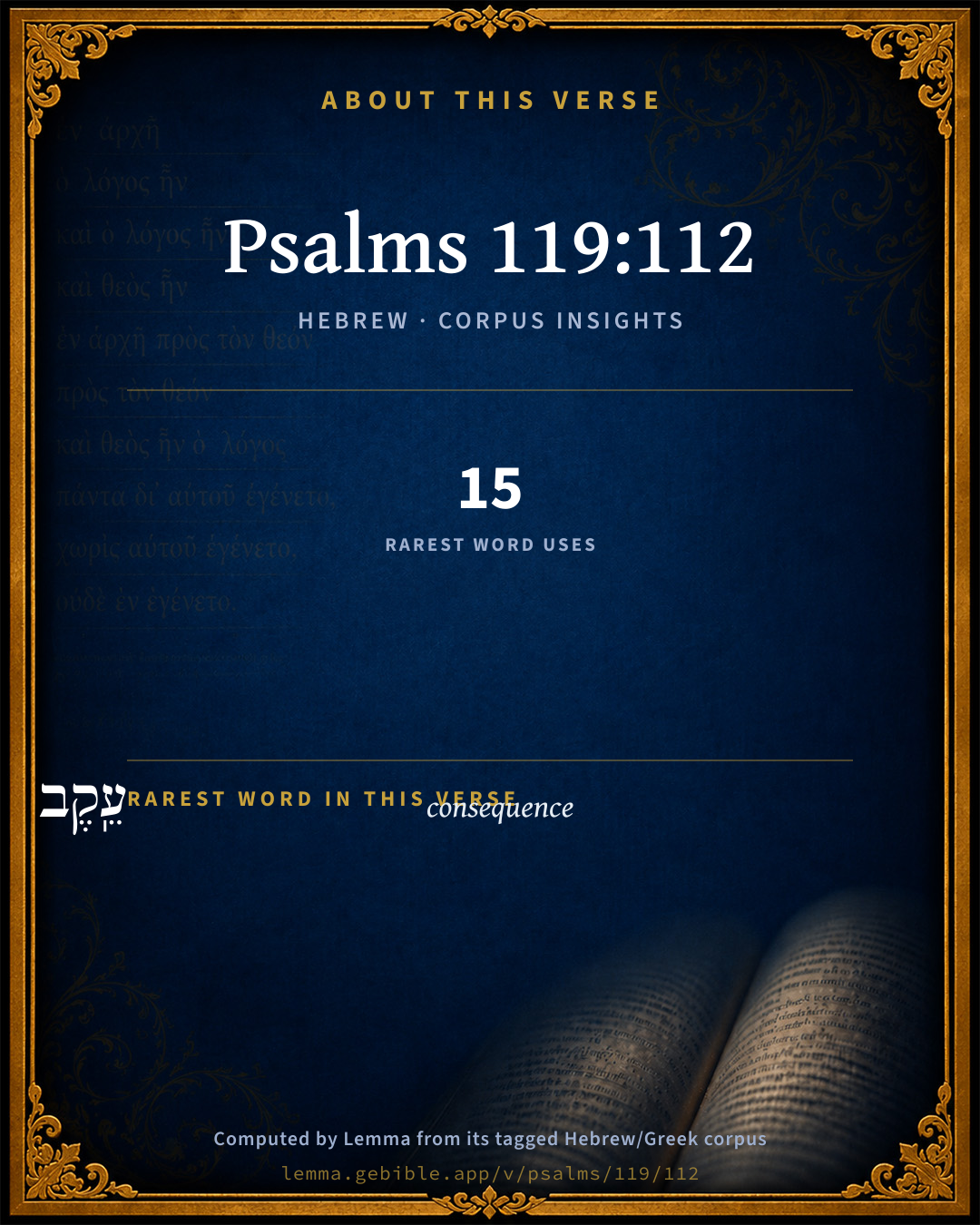
The rarest word here is עֵֽקֶב consequence H6118 — appearing just 15 times in the whole Hebrew Bible.

Shared distinctive vocabulary

עֵֽקֶב consequence H6118 occurs in 15 verses of the Hebrew Bible. Also found in:

Grammatical profile

  • 2 verbs
  • 4 nouns

Verb forms

  • נָטִ֣יתִי Qal · Perfect
  • לַעֲשׂ֥וֹת Qal · Infinitive Construct

Hebrew & Septuagint length

In English translation the verse runs 14 words from the Hebrew and 16 from the Septuagint (LXX English) — closely comparable.

A rough comparison of the two English renderings, which tokenize alike — not a word-level alignment.

Word counts can differ between the Hebrew and the Greek without any difference in meaning — e.g. the Hebrew direct-object marker אֵת has no separate Greek word, and Greek often adds the article ὁ.

Cross-references

10

Topical passages linked to Psalms 119:112 in the Treasury of Scripture Knowledge — connected by theme and wording, ordered by reader-vote popularity; previews shown in the World English Bible.

  • Psalms 119:33 Teach me, Yahweh, the way of your statutes. I will keep them to the end.
  • Joshua 24:23 Now therefore put away, [said he], the foreign gods which are among you, and incline your heart to Yahweh, the God of Israel.
  • 1 Kings 8:58 that he may incline our hearts to him, to walk in all his ways, and to keep his commandments, and his statutes, and his ordinances, which he commanded our fathers.
  • Psalms 119:36 Turn my heart toward your statutes, Not toward selfish gain.
  • Psalms 141:4 Don't incline my heart to any evil thing, To practice deeds of wickedness with men who work iniquity. Don't let me eat of their delicacies.
  • Psalms 119:44 So I will obey your law continually, Forever and ever.
  • Philippians 2:13 For it is God who works in you both to will and to work, for his good pleasure.
  • 1 Peter 1:13 Therefore, prepare your minds for action, be sober and set your hope fully on the grace that will be brought to you at the revelation of Jesus Christ--
  • 2 Chronicles 19:3 Nevertheless there are good things found in you, in that you have put away the Asheroth out of the land, and have set your heart to seek God.
  • Revelation 2:10 Don't be afraid of the things which you are about to suffer. Behold, the devil is about to throw some of you into prison, that you may be tested; and you will have oppression for ten days. Be faithful to death, and I will give you the crown of life.

Cross-references courtesy of OpenBible.info (CC BY 4.0).

Hebrew and Greek witnesses Masoretic Hebrew ↔ Greek Septuagint

The same verse in the two great witnesses to the Old Testament, shown verse-for-verse.

You’re reading Greek Psalm 118 (Hebrew Psalm 119). The Septuagint counts the superscription, so verse numbers can differ from the Hebrew — chapter-level alignment, not verse-by-verse. Numbering follows Rahlfs.

These are two independent witnesses, not word-aligned to each other, and the Septuagint is shown in lemma (dictionary) form.

Hebrew Psalms 119:112 Masoretic · Westminster Leningrad Codex

נָטִ֣יתִי לִ֭בִּי לַעֲשׂ֥וֹת חֻקֶּ֗יךָ לְעוֹלָ֥ם עֵֽקֶב

I have set my heart to perform your statutes forever, Even to the end.

World English Bible · Public Domain

Greek LXX Greek Psalm 118:112 Septuagint · lemma form

κλίνω ὁ καρδία ἐγώ ὁ ποιέω ὁ δικαίωμα σύ εἰς ὁ αἰών διά ἀντάμειψις

I have inclined my heart to perform your ordinances for ever, in return for your mercies.

LXX2012 (modern English Septuagint) · Public Domain

On this verse, The Cambridge Bible for Schools and Colleges discusses the Septuagint’s reading. Read the note in Commentary ↓

Hebrew: Westminster Leningrad Codex (CC BY 4.0). Greek: Septuagint (public domain); English from LXX2012 (modern English Septuagint) (Public Domain). How the Septuagint differs from the Hebrew →

Commentary

Notes on Psalms 119:112 from classic Christian and Jewish commentators (each source and its license shown beneath its notes). The classic Christian expositions comment on the surrounding passage and are grouped to its opening verse, so a note may address several verses; the Jewish commentaries on the Tanakh (Rashi and others) are per-verse, so they appear only where the commentator wrote on this verse.

Lemma curates 59 commentaries, every one of them public domain or Creative Commons licensed, each selected and text-cleaned for this edition rather than reprinted as found. About our sources →

Trapp's Complete Commentary

John Trapp

Psa 119:112 I have inclined mine heart to perform thy statutes alway, [even unto] the end.

Ver. 112. I have inclined mine heart to perform thy statutes] This is the fruit of my Christian contentation and spiritual joy, "I have inclined my heart." Indeed, thou, Lord, hast done it, for thou art the only heart maker and heart mender; but thou countest and callest it my doing, for mine encouragement in thy service. Certum est nos facere quod facimus, sed Deus facit ut faciamus, saith Austin.

Alway even to the end] For else I shall lose the things that I have wrought, and not receive a full reward, 2Jn 1:8.

John Trapp, A Commentary or Exposition upon All the Books of the Old and New Testament (1647–1656) — public domain. Text from a community e-Sword module.

The Biblical Illustrator

Joseph S. Exell

Psa_119:112

I have inclined mine heart to perform Thy statutes alway, even unto the end.

The means of giving the heart a right inclination

The necessity of labouring for ourselves, and our entire dependence on the grace of God, are not incompatible; and so we find that the psalmist, while in one place, speaking by the Spirit, he makes this prayer to God, Incline my heart unto Thy testimonies, makes this declaration in another place, speaking by the same Spirit, I have inclined, etc.

I. Using those means by which the grace of God is communicated to us. If succour is at hand to aid the infirmities of our nature, and we seek it not, then our helplessness is our own fault.

II. Presenting to it such considerations as are likely to work effectually upon it. Communing with our own heart, as the psalmist speaks; reasoning with it, and pressing on its attention such truths as are fitted to influence it.

1. The nature of the Divine commands. They are holy, just, and good.

2. The claims which God has upon our obedience.

III. The forming of Godly resolutions. The recollection of any specific engagement which we have made with an earthly friend will, if our hearts are at all right with him, prompt us with an earnest desire to fulfil the service to which we have pledged ourselves; and the like effect, we may assuredly expect, will result from the remembrance of our vows to God, if they have been seriously and sincerely made.

IV. Holding intercourse with those who are thus disposed. The effects of fellowship on the human mind are great indeed, nor is it possible to keep ourselves out of the reach of its influence. We are so formed, that sympathy is the natural result of intercourse, and we insensibly acquire a similarity of tastes and habits with those with whom we often associate (Pro_27:17). If any man, therefore, wishes to have his heart inclined to Gods statutes, he will avoid, as much as may be, communication with those who disregard them. He will choose as his daily companions, his familiar associates, his bosom friends, those who will be likely to turn his thoughts to God, and by their example, their conversation, and by their imperceptible influence on the mind, may incline his heart to keep His statutes. (G. Bellett.)

The Biblical Illustrator, edited by Joseph S. Exell (c. 1880s–1900s) — public domain. Text from a community e-Sword module.

J. A. Alexander on Psalms

Joseph Addison Alexander

112. (Psa 119:112) I incline my heart to do thy statutes to eternity, (even to) the end. The preterite form of the first verb represents the effort as already made, but still continued. For the meaning of the last word, see above, on Psa 119:33. This stanza, like the eighth, has a different initial word in every verse.

Joseph Addison Alexander, The Psalms Translated and Explained (1850) — public domain. Text from a community e-Sword module.

Adam Clarke's Commentary

Verse 112. I have inclined mine heart] I used the power God gave me, and turned to his testimonies with all mine heart. When we work with God, we can do all things.

ANALYSIS OF LETTER Nun. - Fourteenth Division

In this division the psalmist points out farther excellencies of God's word, in the use of it. 1. God's word was a lamp to his feet to guide him through every dark place. 2. It was a light to his path, ever showing him generally the way in which he should walk.

1. He therefore resolves to keep it, and binds himself to fulfil his resolution. As the lamp was going before, and the light was shining, it was necessary that he should walk while the light shone. He therefore, 1. Binds himself by an oath or vow: "I have sworn." 2. He will be faithful to his oath: "I will perform it." 3. Not merely to admire, but to keep God's word. 4. Not its promises merely, but its righteous judgments.

2. And this he will do in all circumstances, even in extreme affliction. Then he requests two things from the Lord. 1. That he would "accept the freewill-offerings of his mouth." All his praises, thanksgivings, and vows. 2. That he would "teach him his judgments," that he might perform what he had vowed.

3. He shows the difficulties he was in: 1. "My soul is continually in my hand." I am in continual danger. He had got the sword of the Spirit, and his life depended on the use he made of it: if the soldier, whose life depends on his drawn sword, does not use it well, his enemy kills him. 2. Hence he says, "I do not forget thy law." I am making - a proper use of my sword. 3. And that I have need of it is evident for "the wicked have laid a snare for me." 4. This did not intimidate him: he did not leave the path of duty for fear of a snare being in that path: "I erred not from thy precepts." I did not go about to seek a safer way.

4. He keeps his resolution, and vows still. 1. He preferred God's testimonies even to the land of Canaan, to riches and crowns: "I have taken them for my heritage." 2. He delighted in them: "They are the rejoicing of my heart."

5. In this work he was determined to continue: 1. "I have inclined my heart." The counsel of the soul is like a balance; and the mind, which hath the commanding power over the affections, inclines the balance to that which it judges best. 2. It was to perform it, that he thus inclined his heart. 3. And this, not for a time, or on some particular occasion, but always, and unto the end. Then the end of life would be the beginning of glory.

Adam Clarke's Commentary on the Bible (1810–1826) — public domain. Text from a community e-Sword/MySword module.

John Calvin's Commentaries

112. I have inclined my heart to perform thy statutes. In this verse he describes the right observance of the law, which consists in Our cheerfully and heartily preparing ourselves for doing what the law commands. Slavish and constrained obedience differs little from rebellion. The prophet, therefore, in order briefly to define what it is to serve God, asserts, that he applied not only his hands, eyes, or feet, to the keeping of the law, but that he began with the affection of the heart. Instead of the verb incline, the verb extend might with propriety be employed; but I am inclined to rest in the more generally received interpretation, which is, that he devoted himself with sincere affection of heart to the observance of the law. This inclination of the heart is oppose to the wandering lusts which rise up against God, and drag us any where rather than incline us to a virtuous life. The attempt of the Papists to defend from this passage their doctrine of free will is mere trifling. They infer from the words of the prophet, that it is in the power of man to bend his own heart in whatever way he pleases. But the answer is easy. The prophet does not here boast of what he had done by his own strength, for he now repeats the very same word which he had employed before, when he said, Incline my heart to these testimonies. If that prayer was not feigned, he doubtless acknowledged by it that it was the peculiar work of the Holy Spirit to incline and frame our hearts to God. But it is no new thing for that to be ascribed to us which God works in us: Paul’s statement to this effect is very plain,

“It is God who worketh in you, both to will and to do of his good pleasures” (Philippians 2:13.)

When the prophet says of himself that he inclined his heart, he does not separate his own endeavor from the grace of the Holy Spirit, by whose inspiration he has previously declared that the whole was done. At the same time, he distinguishes the constancy of his pious affection from the transient favor of others. Thus, that he might not fail in the midst of his course, or even go backward, he affirms that he had resolved to continue in the same course during the whole of his life. The word עקב, ekeb, to the end, in my opinion, is added to the word לעולם, leolam, for ever, by way of exposition; and to show us that he struggled manfully against all obstacles and difficulties, that they might not break his constancy; for no man perseveres in the service of God without arduous exertions. Some take the word as denoting a reward; but this seems too foreign to the design of the passage.

John Calvin's Commentaries (1540-1563) — public domain. Text from the Calvin Translation Society English edition (1840s-50s) via the Christian Classics Ethereal Library (ccel.org). Calvin's coverage is partial (roughly two-thirds of the Bible); uncommented books and verses are honest gaps, never fabricated. The 19th-century editor's footnotes and remarks are omitted so the notes are faithfully Calvin's own voice.

The Cambridge Bible for Schools and Colleges

gen. ed. J. J. S. Perowne

112. alway, even unto the end] R.V. for ever, even unto the end, rendering ‘çqeb as in Psa_119:33. Cp. Psa_119:44 for the sense. But the meaning may be eternal (lit. for ever) is the reward. Cp. Psa_19:11. So the LXX, διʼ ἀντάμειψιν, for the sake of recompence, Jer. propter aeternam retributionem.

The Cambridge Bible for Schools and Colleges (gen. ed. J. J. S. Perowne; Cambridge University Press, 1878–1918) — public domain. Text from a community e-Sword module.

John Gill's Exposition

Uphold me according unto thy word,.... In thy ways, that my footsteps slip not; in thine arms, and with the right hand of thy righteousness, from fainting and sinking under difficulties and discouragements, in trying circumstances; and from slipping and sliding out of the way of God; and from a total and final filling away, according to thy word of promise, that, as are the days of thy people, their strength shall be; and that thou wilt never leave them nor forsake them. The Targum is,

"uphold me in thy word;''

or by thy word, either essential or written;

that I may live; meaning not corporeally, though none so live but whom the Lord upholds in life; but, spiritually, live by faith on Christ the Saviour, live comfortably on the word of promise, and live honourably, agreeably to the word of God, in all holy conversation and godliness;

and let me not be ashamed of my hope: as men are, when they are disappointed or having and enjoying what they have been hoping and waiting for; but the grace of hope makes not ashamed, nor shall those who have it ever have any reason to be ashamed of it; since it is a good hope through grace; is an anchor of the soul, sure and steadfast; is upon a good foundation, Christ, and by which men are saved; and so may rejoice, in full hope of the glory of God they shall certainly enjoy.

John Gill's Exposition of the Whole Bible (1746–1763) — public domain (CC PDM 1.0). Text via the HelloAO Bible API.

Albert Barnes' Notes on the Bible

I have inclined mine heart - The Hebrew word means properly “to stretch out”; “to extend” - as the hand. Exo 8:6, Exo 8:17. Then it means to incline, to bow, to depress. Here the idea is, that he had “given” that “direction” to the inclinations of his heart; he had resolved or purposed. He refers to an act of choice on his part, meaning that he had preferred this course, or that he had made this a solemn intention. Though every right inclination of the human heart is to be traced to the divine agency, yet it is also true that man is active in religion - or that his own mind resolves, chooses, and prefers - and that true religion is the actual choice or preference of all who serve God aright. See the notes at Psa 119:59.

To perform thy statutes alway - Margin, as in Hebrew, “to do.” He meant to do the will of God. He intended to do this constantly; even forever. No man can be a truly pious man who has any disposition, or any purpose, “ever” to turn away from the service of God.

Even unto the end - See Psa 119:33. To the end of life; to the end of all things.

Albert Barnes' Notes on the Bible (1834–1885) — public domain. Text from a community e-Sword/MySword module.

Matthew Poole's English Annotations

As I prayed to thee to incline mine heart to them, above Psa 119:36, so I did not neglect my duty, but cheerfully complied with the motions of thy Spirit, and yielded up my mind and heart to the study and practice of them.

Matthew Poole's English Annotations on the Holy Bible (1683–1685) — public domain. Text from a community e-Sword/MySword module.

The Treasury of David

Charles H. Spurgeon

Ver. 112. I have inclined mine heart to perform thy statutes alway, even unto the end. He was not half inclined to virtue, but heartily inclined to it. His whole heart was bent on practical, persevering godliness. He was resolved to keep the statutes of the Lord with all his heart, throughout all his time, without erring or ending. He made it his end to keep the law unto the end, and that without end. He had by prayer, and meditation, and resolution made his whole being lean towards God's commands; or as we should say in other words the grace of God had inclined him to incline his heart in a sanctified direction. Many are inclined to preach, but the Psalmist was inclined to practise; many are inclined to perform ceremonies, but he was inclined to perform statutes; many are inclined to obey occasionally, but David would obey alway; and, alas, many are inclined for temporary religion, but this godly man was bound for eternity, he would perform the statutes of his Lord and King even unto the end. Lord, send us such a heavenly inclination of heart as this: then shall we show chat thou hast quickened and taught us. To this end create in us a clean heart, and daily renew a right spirit within us, for only so shall we incline in the right direction.

Ver. 112. I have inclined my heart to perform thy statutes alway, etc. In the former verse he showed his faith, and his joy which came thereof; now he showeth that here in this joy he will keep the commandments; whereby he showeth that this was a true joy, because it wrought a care to do good. For if we believe the promises truly, then we also love the commandments, otherwise faith is vain; a care to live a godly life nourisheth faith in God's promises. Here is the cause then why many regard not the word and sacraments; or if they do a little, it is to no purpose, because they labour not to keep the commandments. For unless they have care to do this, the word of God to them cannot be profitable, nor the sacraments sacred. Richard Greenham.

Ver. 112. I have inclined my heart to perform, etc. Observe. In Ps 119:36 he prayed to God, saying, "Incline my heart unto thy testimonies." And here he speaks about himself, saying, "I have inclined mine heart to perform thy statutes alway even unto the end." What need, then, was there to ask from God that which he in another place glories to have done himself? I answer: These things are not contrary the one to the other. God inclines, and the godly man inclines. Man inclines by striving; God inclines by effecting. Neither is that which the man attempts, nor that which he by striving achieves goodwards, from the man, but from God, who gives, "both to will and to do of His good pleasure:" Php 2:13. Wolfgang Musculus.

Ver. 112. The sinful heart of itself will run any way; upon earthly things, upon evil things, or upon impertinent and unseasonable things; but it will not come to or keep upon that which it should mind; therefore it must be taken as by strong hand, and set upon spiritual things, set on musing and meditation of heavenly things. A carnal heart is like the loadstone, it cleaves to nothing but steel or iron, and both of them easily unite: but the heart must be of another property, and act in a higher way. And a good heart, though it thinks too much earthward, and runs often wrong, yet it will set itself in its thinking on right objects, and make itself and them to meet and unite. David tells us how he did; he inclined his heart to God's commandments, both to keep them and to meditate on them. He took and bent his heart, as a thing bending too much to other things; set his mind on musing on it. He found his heart and the law of God too far asunder, and so would continue, unless he brought them together and made them one. If he had not brought his heart to the word, he had never meditated: the object cannot apply itself to the mind, but the mind must bring itself to the object. No holy duties will come to us, we must come to them. Nathanael Ranew, in "Solitude Improved by Divine Meditation, " 1670.

Ver. 112. I have inclined mine heart to perform, etc. In this work he was determined to continue.

1. "I have inclined my heart." The counsel of the soul is like a balance; and the mind, which hath the commanding power over the affections, inclines the balance to that which it judges best.

2. It was to perform it that he thus inclined his heart.

3. And this not for a time, or some particular occasion, but always, and unto the end. Then the end of life would be the beginning of glory. Adam Clarke.

Ver. 112. I have inclined my heart. The prophet, in order briefly to define what it is to serve God, asserts that he applied not only his hands, eyes, or feet, to the keeping of the law, but that he began with the affection of the heart. John Calvin.

Ver. 112. Unto the end. Our life on earth is a race; in vain begins he to run swiftly, that fainteth, and gives over before he come to the end. And this was signified (saith Gregory) when in the law the tail of the beast was sacrificed with the rest: perseverance crowneth all. It is good we have begun to do well; let us also strive to persevere to the end. William Cowper.

Ver. 112-113. When David had an inclination in his heart to God's statutes, the immediate effect of it was to "hate vain thoughts." We read, "I have inclined mine heart to perform thy statutes"; and it follows, "I hate vain thoughts." The vanity of his heart was a burden to him. A new creature is as careful against wickedness in the head or heart, as in the life. A godly man would be purer in the sight of God than in the view of man. He knows none but God can see the wanderings of his heart or the thoughts of his head, yet he is as careful that sins should not rise up as that they should not break out. Stephen Charnock.

Ver. 112. Heart leanings. Personality, pressure, inclination, performance, constancy, perpetuity.

Verse 112. The godly man's obedience.

1. Its reality

(a) "To perform"; not words or feelings merely; but deeds.

(b) "Thy statutes"; not human inventions, nor self

conceits, nor conventional maxims.

2. Its cordiality: "inclined my heart."

(a) Heart inclination is requisite for pleasing a

heart searching God.

(b) And to make obedience easy and even delightful.

(c) "I have, "he says; was it therefore his doing? Yes. Was

it his work alone No. See Ps 119:36.

(d) The proofs. (1) Universality: "statutes, "the whole of

them. (2) Uniformity: "alway."

3. Its constancy: "even unto the end."

(a) Though a man should be cautious when planning for the

future, yet this life long purpose is right, wise, and

safe.

(b) Nor can he purpose less, if holy fervency fill the

heart.

(c) It is no more than what God and consistency demand. J.F.

Psalms 119:113*

Charles H. Spurgeon's The Treasury of David (1869–1885) — public domain. Psalms only. Text from a community e-Sword/MySword module.

The Pulpit Commentary

I have inclined mine heart to perform thy statutes always (comp. vers. 34, 44, etc.). Even unto the end. The end of life is probably meant, as in ver. 33.

Our power over our own hearts.

"I have inclined my heart." "The sinful heart will run any way: upon earthly things, upon evil things, or upon impertinent and unseasonable things; but it will not come to or keep upon that which it should mind; therefore it must be taken as by a strong hand, and set upon spiritual things, set on musing and meditation of heavenly things. The psalmist took and bent his heart, as a thing bending too much to other things; set his mind on musing on it. He found his heart and the Law of God too far asunder, and so would continue, unless he brought them together and made them one. If he had not brought his heart to the Word, he had never meditated; the object cannot apply itself to the mind, but the mind must bring itself to the object. No holy duties will come to us; we must come to them" (Nathanael Ranew, 1670).

I WE RECOGNIZE OUR POWER OVER OUR OWN LIVES. We say that a man may make of his life what he pleases. He can set before him standards and rules of conduct, and compel his actions to conform to them. His power is indeed within limitations, so that he cannot always do the things that he would. There are limitations arising from

(1) natural character, feebleness of will, etc.;

(2) imperfect mental and moral training;

(3) hindering circumstances;

(4) resistance of other wills.

And yet every man knows that the dominion given to man in this world includes, and indeed reaches, its higher forms in the dominion of his own conduct and relationships.

II WE NEED TO RECOGNIZE OUR POWER OVER OUR OWN HEARTS. Because a vague sentiment easily grows on us that our hearts are the sphere only of the Divine operations, and we can do nothing with them, but must leave them wholly to the indwelling Spirit. This, however, is exaggerating and misrepresenting a most vital and precious truth. What we cannot do in the inclining and shaping of our hearts or affections should bring to view how much there is that we can do. We can put ourselves in the way of nourishing all good affections and emotions. We can keep out of the way of things that would unworthily bias or occupy our hearts. And we may keep ever fresh in our convictions that the power which we have to incline our own hearts is power on which God"s power rests, and through which his power works. R.T.

The Pulpit Commentary (1880–1919), ed. H.D.M. Spence-Jones & Joseph S. Exell — public domain. Text from a community e-Sword module.

Rashi

Rabbi Shlomo Yitzchaki (Rashi)

forever on their paths On their paths and their roads.

Rashi on the Tanakh — English translations: “The Judaica Press complete Tanach with Rashi, translated by A. J. Rosenberg” (CC BY 4.0); “Pentateuch with Rashi's commentary by M. Rosenbaum and A.M. Silbermann, 1929-1934” (public domain); “The Metsudah Tanach series, Lakewood, N.J” (CC BY 4.0); and “The Book of Joshua, Metsudah Publications, 1997” (CC BY 4.0). Text via Sefaria.

Lesson kit

Teaching starters — assembled from the data on this page, not authored interpretation. Every prompt links to the verse data it draws on. Edit before teaching.

Psalms, in the Wisdom, opens this verse with 6 words (6 distinct Hebrew lemmas). Its most distinctive word is ʻêqeb (“consequence”). A historical commentator’s framing appears above. Read the whole chapter for the surrounding context.

Discussion questions

  1. How does “consequence” (ʻêqeb) shape what this verse is saying?
  2. How does Genesis 22:18, which shares the word «consequence», read alongside this verse?
  3. These translations render this verse differently. What is at stake in choosing one wording over another?
  4. «נָטִ֣יתִי» is a Qal Perfect verb. How does that grammatical form shape the action described?
  5. Compare how Trapp's Complete Commentary and The Biblical Illustrator read this verse. Where do they agree or differ?

Things to notice

Reading settings

Reading text

Shown beneath each verse's original-language words.

Old Testament
Old Testament edition

Read the OT as the Masoretic Hebrew (MT) or the Greek Septuagint (LXX).

English shown for the Greek Septuagint (in the Hebrew ↔ Greek comparison).

Comparing translations? Open the Compare panel on any verse page to stack up to four side by side.