
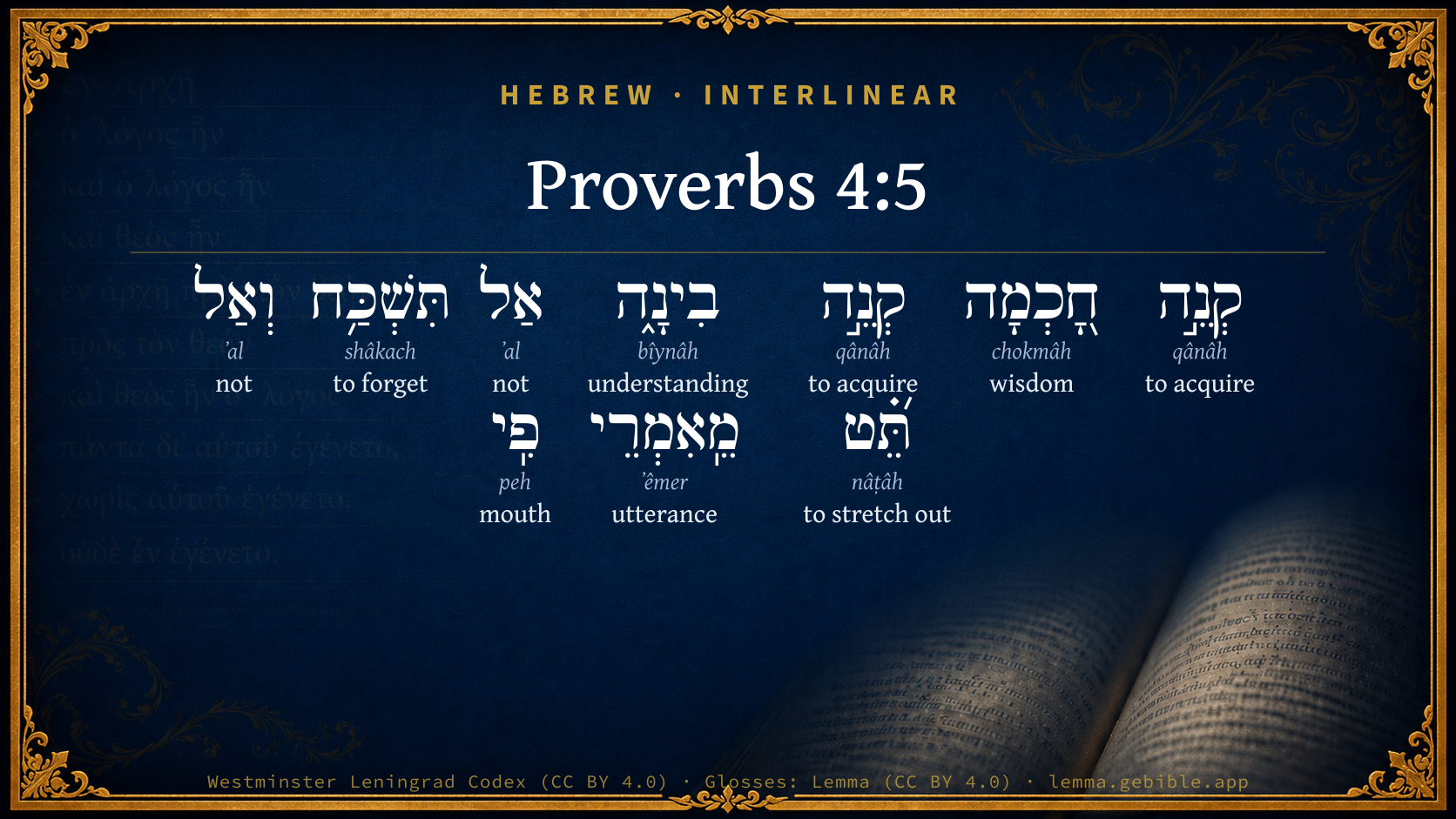
Proverbs 4:5

Hebrew (Westminster Leningrad Codex) Proverbs 4:5 appears in the Hebrew Old Testament. The text above is from the Westminster Leningrad Codex. Each word links to its Strong’s number, a concise gloss, and parsing drawn from the Open Scriptures Hebrew Bible morphology. Click any word for its full Brown-Driver-Briggs (BDB) entry.
Download image
Cite this verse

Proverbs 4:5 (World English Bible). Public Domain. Lemma interlinear Bible study tool, https://lemma.gebible.app/v/proverbs/4/5.

Show BibTeX & RIS
BibTeX
RIS
English Translation
Get wisdom. Get understanding. Don't forget, neither swerve from the words of my mouth.
World English Bible · Public Domain
Download a study sheet

One document with this verse’s original text, its word-by-word gloss line, the meaning frame, cross-references with their text, attributed commentary, and full source and license credits — printable, and it pastes into notes with its structure intact.

This verse Autodidact and up

Study sheet (.html) Plain text (.txt)

A passage Seminary Student

Up to 50 verses in one chapter. A passage sheet keeps up to 6 commentary sources and 12 cross-references per verse, in the order this page ranks them, and says so on the sheet whenever that leaves anything out. Ask for a single verse and you get the Autodidact verse sheet above.

Everything on this page stays free to read, with no account — the sheet is a download of what is already on screen, not access to it.

Want to remove ads? Support Godless Engineer
Compare translations 3

The same verse in 3 English versions, stacked beneath the original-language interlinear above. Click any original word for its lexicon entry.

Each is an independent rendering of the whole verse — the interlinear is not word-aligned to these translations.

Highlighted words mark where these versions differ — a whole-verse word diff, not a word-by-word alignment.

  • World English Bible Public Domain
    Get wisdom. Get understanding. Don't forget, neither swerve from the words of my mouth.
  • King James Version Public Domain
    Get wisdom, get understanding: forget it not; neither decline from the words of my mouth.
  • unfoldingWord Literal Text CC BY-SA 4.0
    Acquire wisdom, acquire understanding; do not forget and do not veer from the sayings of my mouth.

unfoldingWord Literal Text — © unfoldingWord, licensed CC BY-SA 4.0. Word-aligned USFM3 via Door43 (git.door43.org/unfoldingWord/en_ult).

Versions to compare (up to 4)

3 of 4 selected

Show all 18 translations

Every available English version of this verse, each an independent rendering of the whole verse.

  • World English Bible Public Domain
    Get wisdom. Get understanding. Don't forget, neither swerve from the words of my mouth.
  • Berean Standard Bible Public Domain
    Get wisdom, get understanding; do not forget my words or turn from them.
  • Majority Standard Bible Public Domain
    Get wisdom, get understanding; do not forget my words or turn from them.
  • King James Version Public Domain
    Get wisdom, get understanding: forget it not; neither decline from the words of my mouth.
  • American Standard Version (1901) Public Domain
    Get wisdom, get understanding; Forget not, neither decline from the words of my mouth;
  • Revised Version (1885) Public Domain
    Get wisdom, get understanding; forget it not, neither decline from the words of my mouth:
  • Geneva Bible (1599) Public Domain
    Get wisedom: get vnderstading: forget not, neither decline from the woordes of my mouth.
  • Douay-Rheims (1899) Public Domain
    Get wisdom, get prudence: forget not, neither decline from the words of my mouth.
  • Young's Literal Translation Public Domain
    Get wisdom, get understanding, Do not forget, nor turn away From the sayings of my mouth.
  • Literal Standard Version CC BY-SA 4.0
    Get wisdom, get understanding, || Do not forget, nor turn away || From the sayings of my mouth.
  • Unlocked Literal Bible CC BY-SA 4.0
    Acquire wisdom and understanding; do not forget and do not reject the words of my mouth;
  • unfoldingWord Literal Text CC BY-SA 4.0
    Acquire wisdom, acquire understanding; do not forget and do not veer from the sayings of my mouth.
  • Darby Bible Public Domain
    Get wisdom, get intelligence: forget [it] not; neither decline from the words of my mouth.
  • World Messianic Bible Public Domain
    Get wisdom. Get understanding. Don’t forget, and don’t deviate from the words of my mouth.
  • Webster's Bible Public Domain
    Get wisdom, get understanding: forget it not; neither decline from the words of my mouth.
  • Free Bible Version CC BY-SA 4.0
    Get wisdom, find out what makes sense. Don't forget my words or reject them.
  • Bible in Basic English Public Domain
    Get wisdom, get true knowledge; keep it in memory, do not be turned away from the words of my mouth.
  • JPS Tanakh (1917) Public Domain
    Get wisdom, get understanding; forget not, neither decline from the words of my mouth;

Literal Standard Version (2020), Covenant Press — licensed CC BY-SA 4.0. Text via the HelloAO Bible API (eBible.org). Unlocked Literal Bible (unfoldingWord) — licensed CC BY-SA 4.0. Text via the HelloAO Bible API (eBible.org). unfoldingWord Literal Text — © unfoldingWord, licensed CC BY-SA 4.0. Word-aligned USFM3 via Door43 (git.door43.org/unfoldingWord/en_ult). Free Bible Version, Dr. Jonathan Gallagher — licensed CC BY-SA 4.0. Text via the HelloAO Bible API (eBible.org).

Word by word

More ways to search: Search by grammar → Find every occurrence → Compare this word →

Practice this passage: Drill this verse → Learn its vocabulary →

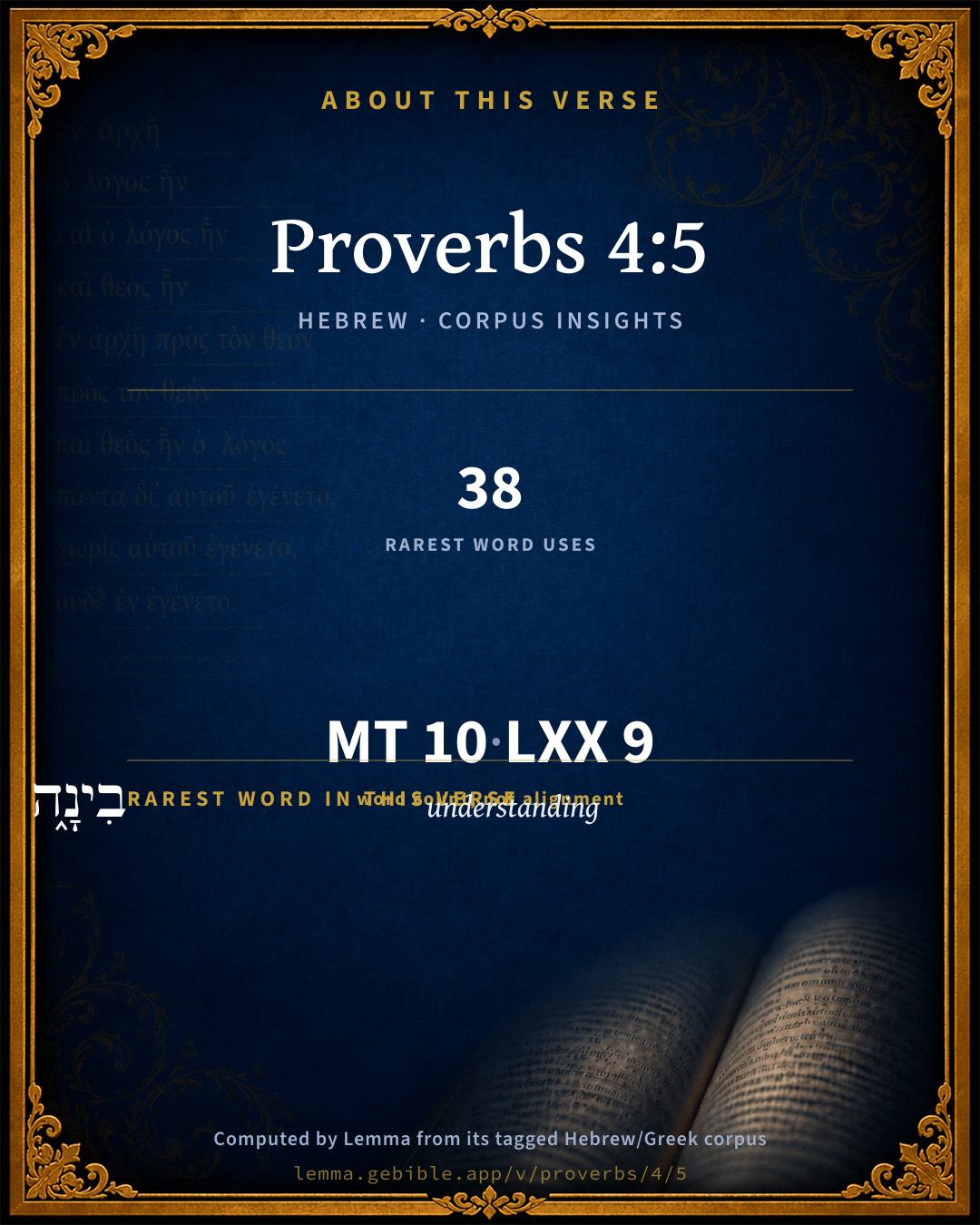
About this verse

These counts appear in no published source. They are computed here, from the morphology-tagged text and Lemma’s own curated glosses. What Lemma adds →

10
words
8
distinct lemmas
Wisdom
section

Shared distinctive vocabulary

בִינָ֑ה understanding H998 occurs in 38 verses of the Hebrew Bible. Also found in:

Grammatical profile

  • 4 verbs
  • 4 nouns
  • 2 particles

Verb forms

  • קְנֵ֣ה Qal · Imperative
  • קְנֵ֣ה Qal · Imperative
  • תִּשְׁכַּ֥ח Qal · Jussive
  • תֵּ֝֗ט Qal · Jussive

Repetition

Words recur within this verse — often emphatic in Hebrew:

  • קְנֵ֣ה to acquire H7069 ×2
  • אַל not H408 ×2

Hebrew & Septuagint length

In English translation the verse runs 14 words from the Hebrew and 9 from the Septuagint (LXX English) — the Septuagint runs noticeably shorter here. See the side-by-side →

A rough comparison of the two English renderings, which tokenize alike — not a word-level alignment.

Word counts can differ between the Hebrew and the Greek without any difference in meaning — e.g. the Hebrew direct-object marker אֵת has no separate Greek word, and Greek often adds the article ὁ.

In the original languages it is 10 Hebrew tokens and 9 Greek tokens — but the two are counted differently (Hebrew bundles its prefixes and suffixes into one token; the Greek is in lemma form), so that isn’t a like-for-like length.

Cross-references

15

Topical passages linked to Proverbs 4:5 in the Treasury of Scripture Knowledge — connected by theme and wording, ordered by reader-vote popularity; previews shown in the World English Bible.

  • James 1:5 But if any of you lacks wisdom, let him ask of God, who gives to all liberally and without reproach; and it will be given to him.
  • Proverbs 3:13–18 Happy is the man who finds wisdom, The man who gets understanding.
  • 2 Chronicles 34:2 He did that which was right in the eyes of Yahweh, and walked in the ways of David his father, and didn't turn aside to the right hand or to the left.
  • Proverbs 1:22–23 "How long, you simple ones, will you love simplicity? How long will mockers delight themselves in mockery, And fools hate knowledge?
  • Psalms 44:18 Our heart has not turned back, Neither have our steps strayed from your path,
  • Job 23:11 My foot has held fast to his steps. His way have I kept, and not turned aside.
  • Proverbs 8:5 You simple, understand prudence. You fools, be of an understanding heart.
  • Proverbs 17:16 Why is there money in the hand of a fool to buy wisdom, Seeing he has no understanding?
  • Proverbs 19:8 He who gets wisdom loves his own soul. He who keeps understanding shall find good.
  • Psalms 119:51 The arrogant mock me excessively, But I don't swerve from your law.
  • Psalms 119:157 Many are my persecutors and my adversaries. I haven't swerved from your testimonies.
  • Proverbs 2:2–4 So as to turn your ear to wisdom, And apply your heart to understanding;
  • Proverbs 16:16 How much better it is to get wisdom than gold! Yes, to get understanding is to be chosen rather than silver.
  • Proverbs 18:1 An unfriendly man pursues selfishness, And defies all sound judgment.
  • Proverbs 23:23 Buy the truth, and don't sell it: Get wisdom, discipline, and understanding.

Cross-references courtesy of OpenBible.info (CC BY 4.0).

Hebrew and Greek witnesses Masoretic Hebrew ↔ Greek Septuagint

The same verse in the two great witnesses to the Old Testament, shown verse-for-verse.

Here the Septuagint runs noticeably shorter than the Hebrew — LXX2012 (modern English Septuagint) 9 words vs World English Bible 14. A rough length comparison of the two English translations, not a word-level alignment — read both below.

These are two independent witnesses, not word-aligned to each other, and the Septuagint is shown in lemma (dictionary) form.

Hebrew Proverbs 4:5 Masoretic · Westminster Leningrad Codex

קְנֵ֣ה חָ֭כְמָה קְנֵ֣ה בִינָ֑ה אַל תִּשְׁכַּ֥ח וְאַל תֵּ֝֗ט מֵֽאִמְרֵי פִֽי

Get wisdom. Get understanding. Don't forget, neither swerve from the words of my mouth.

World English Bible · Public Domain

Greek LXX Proverbs 4:5 Septuagint · lemma form

φυλάσσω ἐντολή μή ἐπιλανθάνω μηδέ παραὁράω ῥῆσις ἐγώ στόμα

and do not neglect the speech of my mouth.

LXX2012 (modern English Septuagint) · Public Domain

Hebrew: Westminster Leningrad Codex (CC BY 4.0). Greek: Septuagint (public domain); English from LXX2012 (modern English Septuagint) (Public Domain). How the Septuagint differs from the Hebrew →

Commentary

Notes on Proverbs 4:5 from classic Christian and Jewish commentators (each source and its license shown beneath its notes). The classic Christian expositions comment on the surrounding passage and are grouped to its opening verse, so a note may address several verses; the Jewish commentaries on the Tanakh (Rashi and others) are per-verse, so they appear only where the commentator wrote on this verse.

Lemma curates 59 commentaries, every one of them public domain or Creative Commons licensed, each selected and text-cleaned for this edition rather than reprinted as found. About our sources →

Trapp's Complete Commentary

John Trapp

Pro 4:5 Get wisdom, get understanding: forget [it] not; neither decline from the words of my mouth.

Ver. 5. Get wisdom, get understanding.] Compara sapientiam, compara intelligentiam - so Chrysostom. Comparate saeculares, comparate vobis biblia, animae pharmaca. Get you Bibles by all means, whatever they cost you. You may better want bread, light, &c., than the knowledge of the Scriptures. Augustine makes mention of some that neglected the means of knowledge, because knowledge puffeth up; and so would be ignorant, that they might be humble, and want knowledge, that they might want pride. This was to do as that foolish philosopher that plucked out his eyes to avoid the danger of uncleanness; or as the silly friar, to whom Sir Thomas Moore wrote thus, -

“ Tu bene cavisti ne te ulla occidere possit

Litera: Nam nota est litera nulla tibi. ”

But men must get knowledge, and lest it puff them up, swelling them beyond measure, they must get humility laid on as a weight to keep them down.

Forget it not.] For so much a man learns as he remembers. The promise also of salvation is limited to the condition of "keeping in memory what we have received." {1Co 15:2}

John Trapp, A Commentary or Exposition upon All the Books of the Old and New Testament (1647–1656) — public domain. Text from a community e-Sword module.

Whedon's Commentary on the Bible

Daniel D. Whedon

VARIOUS PATERNAL INSTRUCTIONS, Pro_4:5-27.

5. Get wisdom — Or, buy wisdom. The repetition of the verb makes it more vehement. It is thought to be the imitation of a merchant offering his wares.

Decline — Turn away from.

Daniel D. Whedon (gen. ed.), Commentary on the Old and New Testaments (1874–1909) — public domain. Text from a community e-Sword module.

The Preacher's Complete Homiletical Commentary

Joseph S. Exell (gen. ed.)

CRITICAL NOTES.—

Pro_4:8. Exalt or “esteem.”

Pro_4:9. Last clause, or “she shall compass thee with a crown of glory.”

Pro_4:10. As is all other instances (see Notes on Chap. Pro_3:2), Miller translates the promise: “And they shall grow greater to thee through years of life.”

MAIN HOMILETICS OF THE PARAGRAPH.—Pro_4:5-13

THE ONE THING NEEDFUL

I. Human nature has many needs.

1. There are the needs of the body, which begin upon our entrance into life, and never cease until the day of our death. These are common to all men, and keep every man in an attitude of getting all through his life. It is the demand of these needs—the effort to get what will supply them—that is the motive-power which keeps the world of men in motion.

2. Men’s needs are multiplied in proportion to the greatness of their sphere and their intellectual activity. The needs of a judge upon the bench are more than those of a crossing-sweeper. Both have some wants in common, but the intellectual and social position of the former has multiplied his needs far beyond those of the latter. The needs of a master in a house of business, or of a mistress in a family, are more than those of their servants. They have more claims to meet—more responsible positions to fill. But the aim of each individual man, woman, or child is to supply their natural or acquired—their real or their supposed—wants, whether material, or intellectual, or spiritual.

II. There is one need above all other needs—one thing to be gotten before all other gettings—viz: Wisdom, taking the word to mean godliness. The husbandman finds that the field that has been given him to till needs many things before it will yield him a golden harvest. But there is one thing, among others, that is indispensable, viz: the sunlight. He will plough, and harrow, and sow in vain if this want is not supplied. So all a man’s gettings will fail to bring him a harvest of soul-satisfaction if this primal element be wanting.

III. The blessings which will follow the getting of godliness. They have already been enumerated in chap. Pro_3:21-26. See homiletics on that paragraph. On Pro_4:9 see homiletics on chap. Pro_1:9.

OUTLINES AND SUGGESTIVE COMMENTS

Pro_4:5. We cannot do it directly, but there immediately follow the rules to be observed, “forget not,” etc. It is astonishing how much is made of attention. It is the only voluntary thing, not muscular.—Miller.

For so much a man learns as he remembers. The promise also of salvation is limited to “keeping in memory what we have received” (1Co_15:2).

1. Because of the excellency of it. Things of high birth are excellent. This wisdom is from above (Jas_3:17). Things rare are precious. True wisdom is not found in many.

2. Because of the pleasure of it (chap. Pro_3:17). No content in the world like that wisdom gives.

3. Because of the profit of it. Every trade will tell you that wisdom thrives, and folly beggars men. So in spiritual things.

4. Because of the necessity of it, which is the strongest argument. Without it die, nay be damned.—Francis Taylor.

Pro_4:6. Jerome wrote to a friend, “Beg now for me, who am grey-headed, of the Lord, that I may have Wisdom for my companion, of which it is written, “Love her and she shall keep thee.”

Forsake her not, and thou will love her, for love is bred by continuing together; love her and thou will not forsake her, for love liketh not of parting. The manner of speech seemeth to intimate a union of marriage, and indeed Wisdom is a fit spouse for man’s noble soul.—Jermin.

We turn an eye to Wisdom, and she turns an eye to us. We watch and she watches. In our ungodly state we cannot think of Wisdom that she does not turn and step back to us by common grace. And, if we think so long, and strive so earnestly as that she comes up to us and is full in sight, then each new fondness fascinates her and brings her close. Each wise thing that we do makes us wiser.—Miller.

It is worse with him that leaves good, than with him that never did it (2Pe_2:21). One goes blindfold to hell and hath less pains there; another, seeing, hath more.—Francis Taylor.

Pro_4:7. Make religion thy business, other things do by the bye. As Cæsar, swimming through the waters to escape his enemies, carried his books in his hand above them, but lost his robe.—Trapp.

It can have no place if it has not the first place. If it be anything it will be everything.—Bridges.

The mistake of the principal thing is that which maketh the principal disorder in man’s heart.… But as that is light which showeth the light unto us, so that is the principal thing which showeth the principal thing unto us, even wisdom alone.—Jermin.

I. What we are to acquire. Both divine and human learning, which differ as means do from the end. Were there no divine learning, human learning would lose great part of its value: limited to the present life, it must terminate on the confines of the grave. And had we no human learning, now that the days of inspiration have passed, we should not be able to attain that which is divine. II. How we are to acquire it. We must be taught by those who were in the world before us. Weeds and thistles only will be the spontaneous produce if the ground is not broken up and good seed sown. III. Why we are to acquire it. The pleasures of wisdom exceed all others—in kind, degree, and duration.—Bishop Horne.

The world’s maxim, on the contrary, is—money is the principal thing; therefore get money; and with all thy getting, get more.—Fausset.

Amidst all thy other acquisitions acquire this, without which all others will be useless and even hurtful.—Menochius.

“With,” rather “by means of” (see “Critical Notes”). We are to turn all our gettings into the channel of more grace. We are to use all our properties for growing wiser. We are to grind up all our corn into the bread of spiritual nourishment.—Miller.

Venture all for wisdom rather than miss it.

1. What we lose is transitory, what we get is durable. A fee-simple is better than a leaf.

2. What we lose is hollow and empty, what we get is full and substantial. A sound timber tree is better than one hollow within, though the latter make a bigger show.

3. What we lose is vain, what we get is profitable. A piece of gold is better than a counter.

4. What we lose is often matter of danger, what we get is matter of safety and security.—Francis Taylor.

Pro_4:8. On this recommendation of religion it is the more necessary to fix our attention because it is often refused to it by men of the world. Their notions of honour are apt to run in a very different channel.… A distinction must be made between fame and honour. The former is a loud and noisy applause; the latter a more silent and internal homage. Fame floats on the breath of the multitude; honour rests on the judgment of the thinking. Fame may give praise while it withholds esteem; true honour implies esteem mingled with respect. The one regards particular distinguished talents; the other looks up to the whole character. It follows, therefore, that in order to discern where man’s true honour lies, we must look at the whole of what forms a man. A mind superior to fear, to selfish interest, and corruption; governed by this principle of uniform rectitude, the same in prosperity as in adversity, such is the mind which forms the distinction and eminence of men. And such a character is formed solely by the influence of true religion. II. The honour which man acquires by religion and virtue is independent and complete. It is independent of anything foreign or external. Wherever fortune is concerned it is the rank which commands our deference. Where some shining quality attracts admiration, it is only to a part of the character that we pay homage. But with goodness, it is the whole man whom we respect. III. This honour is divine and immortal. It is honour not only in the sight of man, but of God, whose judgment is the standard of truth and right. It enters with man into a future state; and continues to brighten through eternal ages.—Blair.

Not only “get,” “keep,” and “love” her, but also “exalt her.” We are apt to think less of those things which we have, however precious, after the novelty has worn off. Beware of this feeling in religion. Religion richly repays in kind all that we can do to “embrace” her. She exalts them who exalt her (Psa_30:1), and gives them fresh reason for exalting her (Psa_37:34).—Fausset.

Pro_4:9. She is the diadem which bindeth up the shattered thoughts of man’s understanding: she it is which covereth and succoureth the broken cracks of man’s invention: she it is which delivereth the authority of sovereignty to the head, and maketh the head to be the head, in bearing rule and commanding the inferior affections and lusts of the heart and other members.—Jermin.

Crowns were anciently given to many sorts of persons as tokens of general favour and esteem.

1. To wise men and learned; to those who excelled in the arts and sciences. Godly-wise men deserve them much better.

2. To men famous for justice and other moral virtues; to good lawmakers and judges. Godly-wise men excel in theological virtues, which are far more excellent.

3. To conquerors. A wise man is a conqueror over his passions and affections, which make other men, and great ones too, very slaves.

4. To bridegrooms when they were married. A wise man is married to Wisdom, the fairest bride in the world.

5. To kings on their coronation day. So shall godly men be crowned when they die. They know how to rule their own souls here, and to direct others, and to get an eternal crown in Heaven. A beggar being once asked what he was, answered: “I am a king!” “Where is thy kingdom?” “It is in my soul. I can so rule my external and internal senses that all the faculties of my soul are subject to me.” And who doubts that this kingdom is better than all the kingdoms of the world?—Francis Taylor.

Pro_4:11. He may boldly call to be heard who himself doth what he teacheth. Christ placeth doing before teaching (Mat_8:19), for good doing leading the way, though teaching doth not follow, yet good works can, as clear as the light, teach those that look upon us. Paul saith, “We have received grace and apostleship to the obedience of faith; one would have thought he should have said rather to the government and direction of faith, but he saith, obedience, because examples do direct and govern better than words.—Jermin.

The two branches which constitute the sum of parental tuition—instruction and direction—teaching truth and guiding to duty. The one part relates to knowledge, the other to practice. In all rightly conducted education, the two should never be disjoined. To teach duty without truth is to teach action without motive—virtue without its principle. To teach truth without duty is to teach motive without the practice to which it should lead. They are both partial, and, if kept asunder, both worthless.—Wardlaw.

Pro_4:12. Having a good mixture of zeal and knowledge; so that thy zeal doth quicken thy knowledge, and thy knowledge guide thy zeal.—Trapp.

The way of wisdom is indeed narrow, but in a narrow way there may be large steps; for though our feet may be straightened from going aside, yet they are not straightened from going on apace.—Jermin.

As “goest” refers to the ordinary course, so “runnest” refers to extraordinary undertakings, wherein the believer has to put forth more than common energy.—Fausset.

The word straightened seems to express the case of one in difficulty and perplexity—contradictory impulses and obstacles pressing and hindering him on every side, perpetually producing embarrassment and apprehension—hedging up the way, and hemming us in, and destroying the freedom and comfort of advancement. Such is the case of a man who walks according to a worldly and carnal policy. He is ever at a loss. As circumstances are ever shifting, he is ever shifting his principles and plans to suit them. But the “wisdom from above” inspires a simplicity and a unity of principle by which a vast amount of this painful and agitating perplexity is taken away.—Wardlaw.

Pro_4:13. Often a ship’s crew at sea are obliged suddenly to betake themselves to their boats, and abandon the sinking ship. Such a case was recently reported of an American whale-ship in the South Seas. The huge leviathan of the deep, wounded by the art of man, ran out the distance of a mile by way of getting a run-race, and thence came on with incredible velocity against the devoted ship. She began to fill.… the word was given. All hands went to work, and soon all the seaworthy boats were loaded to the gunwale with the prime necessaries of life. The deck was now nearly level with the water, and the boats shoved off for safety. After they had pulled a hundred yards away, two resolute men leaped from one of the boats into the sea, and made towards the ship. They disappear down a hatchway. In a minute they emerge again, bearing something in their hands. As they leap into the water the ship goes down; the men are separated from each other and their burden in the whirlpool that gathers over the sinking hull. They do not seem to consult their own safety. They remain in that dangerous eddy until they grasp again the object which they had carried over the ship’s side. Holding it fast, they are seen at length bearing away to their comrades in the boat. What do these strong swimmers carry, for they seem to value it more than life? It is the compass! It had been left behind, and was remembered almost too late. Now they have taken fast hold of it, and will not let it go. Whatever they lose, they will at all hazards keep it, for “it is their life.” When shall we see souls, shipwrecked on the sea of time, take and keep such hold of the truth as it is in Jesus?—Arnot.

Fasten and do not let slack. One rough grapple is not enough. Wisdom insidiously glides away if we give time to the arch deceiver. We are like a child trying to wake: he grasps the apple that one gives, but slackens as drowsiness creeps back.—Miller.

I. Because many thieves lie in the way to rob us of what wisdom teaches.

1. The devil steals away the seed of the word (Mat_13:9).

2. Wicked men also, by seducing us. Sometimes by persecuting us to make us forsake the truth (Mat_13:21).

3. The world with its cares and profits seeks to take this treasure from us (Mat_13:22). The flesh presents many pleasures to us which drown our wits.

II. Because we may lose wisdom ourselves by negligence.—F. Taylor.

The Preacher's Complete Homiletical Commentary (gen. ed. Joseph S. Exell; Funk & Wagnalls, c. 1892) — public domain (pre-1929). A full-Bible homiletical/sermon-outline anthology covering 65 of 66 books (2 John is absent from the source module). Text from a community e-Sword module.

Keil & Delitzsch

C. F. Keil & F. Delitzsch

The exhortation of the father now specializes itself:

5 Get wisdom, get understanding;

Forget not and turn not from the words of my mouth.

6 Forsake her not, so shall she preserve thee;

Love her, so shall she keep thee.

Wisdom and understanding are (5a) thought of as objects of merchandise (cf. Pro 23:23; Pro 3:14), like the one pearl of great price, Mat 13:46, and the words of fatherly instruction (5b), accordingly, as offering this precious possession, or helping to the acquisition of it. One cannot indeed say correctly אל־תשׁכח מאמרי־פי, but אל־תשׁכח משּׁמר אמרי־פי (Psa 102:5); and in this sense אל־תּשׁכּח goes before, or also the accus. object, which in אל־תשכח the author has in his mind, may, since he continues with אל־תּט, now not any longer find expression as such. That the אמרי־פי are the means of acquiring wisdom is shown in Pro 4:6, where this continues to be the primary idea. The verse, consisting of only four words, ought to be divided by Mugrash;

(Note: According to correct readings in codd. and older editions, ותשמרךּ has also indeed Rebia Mugrash, and אהבה, Mercha (with Zinnorith); vid., Torath Emeth, p. 47, 6; Accentuationssystem, xviii. 1, 2; and regarding the Zinnorith, see Liber Psalmorum Hebraicus by S. Baer, p. xii.)

the Vav (ו) in both halves of the verse introduces the apodosis imperativi (cf. e.g., Pro 3:9., and the apodosis prohibitivi, Pro 3:21.). The actual representation of wisdom, Pro 4:5, becomes in Pro 4:6 personal.

Keil & Delitzsch — Biblical Commentary on the Old Testament (1861–1891) — public domain (CC PDM 1.0). Text via the HelloAO Bible API. (Old Testament only.)

Tyndale Open Study Notes

Tyndale Open Resources

4:5 In the Old Testament, to forget means more than not to remember; it is failure to obey.

Tyndale Open Study Notes — © Tyndale Open Resources, licensed CC BY-SA 4.0. Text via the HelloAO Bible API.

Jamieson, Fausset & Brown

Robert Jamieson, A. R. Fausset & David Brown

Get--as a possession not to be given up.

neither decline--that is, from obeying my word.

Jamieson, Fausset & Brown — Commentary Critical and Explanatory on the Whole Bible (1871) — public domain (CC PDM 1.0). Text via the HelloAO Bible API.

Adam Clarke's Commentary

Verse 5. Get wisdom] True religion is essential to thy happiness; never forget its teachings, nor go aside from the path it prescribes.

Adam Clarke's Commentary on the Bible (1810–1826) — public domain. Text from a community e-Sword/MySword module.

Ellicott's Commentary for English Readers

(5) Get wisdom, get understanding.—Like the pearl of great price (Mat_13:46).

A Bible Commentary for English Readers, edited by Charles John Ellicott (1878–1897) — public domain. Text from a community e-Sword module.

John Gill's Exposition

Get wisdom, get understanding,.... Not only moral and political wisdom and understanding, but that which is spiritual and evangelical; Christ, and the knowledge of him; he being the only happy man that has an interest in him, and is possessed of him by faith, which is the meaning of getting him; See Gill on Pro 3:13; by which it appears, that what Solomon had before delivered, and afterwards repeats and urges, was the same his father David, that wise, great, and good man, taught him; and which he mentions, the more to recommend the getting of wisdom and understanding to others;

forget it not; when gotten, keep it in remembrance; be continually meditating on Wisdom, or Christ, his glories and excellencies; the fulness of grace and truth in him; the blessings of goodness which come by him; the great use and profit of having and enjoying him;

neither decline from the words of my mouth; the above instructions, and all others he gave unto him.

John Gill's Exposition of the Whole Bible (1746–1763) — public domain (CC PDM 1.0). Text via the HelloAO Bible API.

Matthew Poole's English Annotations

From the belief and practice of my word.

Matthew Poole's English Annotations on the Holy Bible (1683–1685) — public domain. Text from a community e-Sword/MySword module.

The Pulpit Commentary

After the general exhortation given above, the father"s instruction becomes more specific, and deals with the acquirement of wisdom. This subject seems to be continued in ver. 13, where the second and concluding branch of the instruction begins, which consists mainly of warning, as the first part does with exhortation. We are thus furnished with an example how to teach. In our teaching it is not sufficient simply to point out what is to be done, but we must show what is to be avoided. Get wisdom, get understanding. The father urges the acquirement of wisdom in the same way and with the same importunity as the trader or merchant presses his goods upon buyers. Wisdom and understanding are put forward as objects of merchandise; for the verb kanah, from which the imperative kneh, signifies not only "to acquire for one"s self," or "to possess," but especially "to buy." The verb occurs again in the same sense in ver. 7, "Get k"neh, i.e. buy wisdom;" and in Pro_23:23, "Buy (k"neh) the truth, and sell it not; also wisdom, and instruction, and understanding". (cf. Pro_15:22 Pro_16:16 Pro_19:9, where we also meet with the same verb) The reiteration of the word "get," as Umbreit remarks, is "an imitation of the exclamation of a merchant who is offering his wares." The importunity of the father measures the value he sets upon wisdom as an inestimable treasure, a pearl of great price. (see Pro_3:14) Forget it not, etc.; rather, forget not, neither turn from the words of my mouth, so Zockler, Delitzsch, Hodg., and others; Vulgate, ne obliviscaris, neque declines a verbis oris mei. There is no need to supply "it" after the verb al-tish"-kakh, "forget not," as Holden states, and as appears in the Authorized Version, since shakakh is found with min (mi), "of" or "from," in Psa_12:4, "I forgot to eat (shakakh"ti meakol)," and the same construction may obtain here. The two verbs, "forget" and "decline from," are not so very wide in meaning, since the former, shakakh, is to "leave" something from forgetfulness, and the latter, natah, rendered here "decline from," is "to turn away" from something. The words of my mouth represent as it were the means by which wisdom may be purchased.

The Pulpit Commentary (1880–1919), ed. H.D.M. Spence-Jones & Joseph S. Exell — public domain. Text from a community e-Sword module.

unfoldingWord translationNotes

Door43 World Missions Community

General Information:

The father continues to teach his children what his father taught him.

Acquire wisdom

"Work hard to gain for yourself wisdom" or "Get wisdom"

do not forget

"remember"

do not reject

"accept"

the words of my mouth

Here the word "mouth" represents the person who speaks. AT: "what I am saying" (See: Synecdoche)

do not abandon wisdom and she will watch over you; love her and she will keep you safe

The writer speaks of wisdom as if it were a woman who protects the person who is faithful to her. (See: Personification and Metaphor)

do not abandon wisdom

This can be stated in positive form. AT: "hold tightly to wisdom" or "be faithful to wisdom"

love her

"love wisdom"

translationWords

wise

reject

word

watch

love

unfoldingWord translationNotes — © Distant Shores Media and the Door43 World Missions Community, licensed CC BY-SA 4.0. Source: git.door43.org/Door43/en_tn.

Lesson kit

Teaching starters — assembled from the data on this page, not authored interpretation. Every prompt links to the verse data it draws on. Edit before teaching.

Proverbs, in the Wisdom, opens this verse with 10 words (8 distinct Hebrew lemmas). Its most distinctive word is bîynâh (“understanding”). The Greek Septuagint runs shorter here. A historical commentator’s framing appears above. Read the whole chapter for the surrounding context.

Discussion questions

  1. What does “understanding” (bîynâh) contribute to the verse as a whole?
  2. Deuteronomy 4:6 shares the word «understanding» with this verse. How do the two illuminate each other?
  3. “to acquire” occurs 2× in this one verse. What is the effect of the repetition?
  4. Compared with the Hebrew, the Septuagint runs shorter here. What questions does that raise?
  5. These translations render this verse differently; the difference is in the English rendering, not the original. What questions does that raise?
  6. The verb «קְנֵ֣ה» is Qal Imperative. How does its form color the action?
  7. Reading how Trapp's Complete Commentary and Whedon's Commentary on the Bible read this verse, where do the two commentators agree and where do they part?

Things to notice

Reading settings

Reading text

Shown beneath each verse's original-language words.

Old Testament
Old Testament edition

Read the OT as the Masoretic Hebrew (MT) or the Greek Septuagint (LXX).

English shown for the Greek Septuagint (in the Hebrew ↔ Greek comparison).

Comparing translations? Open the Compare panel on any verse page to stack up to four side by side.