
Isaiah 34:11

Hebrew (Westminster Leningrad Codex) Isaiah 34:11 appears in the Hebrew Old Testament. The text above is from the Westminster Leningrad Codex. Each word links to its Strong’s number, a concise gloss, and parsing drawn from the Open Scriptures Hebrew Bible morphology. Click any word for its full Brown-Driver-Briggs (BDB) entry.
Download image
Cite this verse

Isaiah 34:11 (World English Bible). Public Domain. Lemma interlinear Bible study tool, https://lemma.gebible.app/v/isaiah/34/11.

Show BibTeX & RIS
BibTeX
RIS
English Translation
But the pelican and the porcupine shall possess it; and the owl and the raven shall dwell therein: and he will stretch over it the line of confusion, and the plummet of emptiness.
World English Bible · Public Domain
Download a study sheet

One document with this verse’s original text, its word-by-word gloss line, the meaning frame, cross-references with their text, attributed commentary, and full source and license credits — printable, and it pastes into notes with its structure intact.

This verse Autodidact and up

Study sheet (.html) Plain text (.txt)

A passage Seminary Student

Up to 50 verses in one chapter. A passage sheet keeps up to 6 commentary sources and 12 cross-references per verse, in the order this page ranks them, and says so on the sheet whenever that leaves anything out. Ask for a single verse and you get the Autodidact verse sheet above.

Everything on this page stays free to read, with no account — the sheet is a download of what is already on screen, not access to it.

Want to remove ads? Support Godless Engineer
Compare translations 3

The same verse in 3 English versions, stacked beneath the original-language interlinear above. Click any original word for its lexicon entry.

Each is an independent rendering of the whole verse — the interlinear is not word-aligned to these translations.

Highlighted words mark where these versions differ — a whole-verse word diff, not a word-by-word alignment.

  • World English Bible Public Domain
    But the pelican and the porcupine shall possess it; and the owl and the raven shall dwell therein: and he will stretch over it the line of confusion, and the plummet of emptiness.
  • King James Version Public Domain
    But the cormorant and the bittern shall possess it; the owl also and the raven shall dwell in it: and he shall stretch out upon it the line of confusion, and the stones of emptiness.
  • unfoldingWord Literal Text CC BY-SA 4.0
    And the pelican and the desert owl will possess it, and the screech owl and the raven will dwell in it. And he will stretch over it the line of formlessness and the stones of emptiness.

unfoldingWord Literal Text — © unfoldingWord, licensed CC BY-SA 4.0. Word-aligned USFM3 via Door43 (git.door43.org/unfoldingWord/en_ult).

Versions to compare (up to 4)

3 of 4 selected

Show all 18 translations

Every available English version of this verse, each an independent rendering of the whole verse.

  • World English Bible Public Domain
    But the pelican and the porcupine shall possess it; and the owl and the raven shall dwell therein: and he will stretch over it the line of confusion, and the plummet of emptiness.
  • Berean Standard Bible Public Domain
    The desert owl and screech owl will possess it, and the great owl and raven will dwell in it. The LORD will stretch out over Edom a measuring line of chaos and a plumb line of destruction.
  • Majority Standard Bible Public Domain
    The desert owl and screech owl will possess it, and the great owl and raven will dwell in it. The LORD will stretch out over Edom a measuring line of chaos and a plumb line of destruction.
  • King James Version Public Domain
    But the cormorant and the bittern shall possess it; the owl also and the raven shall dwell in it: and he shall stretch out upon it the line of confusion, and the stones of emptiness.
  • American Standard Version (1901) Public Domain
    But the pelican and the porcupine shall possess it; and the owl and the raven shall dwell therein: and he will stretch over it the line of confusion, and the plummet of emptiness.
  • Revised Version (1885) Public Domain
    But the pelican and the porcupine shall possess it; and the owl and the raven shall dwell therein: and he shall stretch over it the line of confusion, and the plummet of emptiness.
  • Geneva Bible (1599) Public Domain
    But the pelicane and the hedgehog shall possesse it, and the great owle, and the rauen shall dwel in it, and he shall stretch out vpon it the line of vanitie, and the stones of emptinesse.
  • Douay-Rheims (1899) Public Domain
    The bittern and ericius shall possess it: and the ibis and the raven shall dwell in it: and a line shall be stretched out upon it, to bring it to nothing, and a plummet, unto desolation.
  • Young's Literal Translation Public Domain
    And possess her do pelican and hedge-hog, And owl and raven dwell in her, And He hath stretched out over her A line of vacancy, and stones of emptiness.
  • Literal Standard Version CC BY-SA 4.0
    And pelican and hedgehog possess her, || And owl and raven dwell in her, || And He has stretched out over her || A line of vacancy, and stones of emptiness.
  • Unlocked Literal Bible CC BY-SA 4.0
    But wild birds and animals will live there; the owl and the raven will make their nest in it. He will stretch over it the measuring line of ruin and the plumbline of destruction.
  • unfoldingWord Literal Text CC BY-SA 4.0
    And the pelican and the desert owl will possess it, and the screech owl and the raven will dwell in it. And he will stretch over it the line of formlessness and the stones of emptiness.
  • Darby Bible Public Domain
    And the pelican and the bittern shall possess it, and the great owl and the raven shall dwell in it. And he shall stretch out upon it the line of waste, and the plummets of emptiness.
  • World Messianic Bible Public Domain
    But the pelican and the porcupine will possess it. The owl and the raven will dwell in it. He will stretch the line of confusion over it, and the plumb line of emptiness.
  • Webster's Bible Public Domain
    But the cormorant and the bittern shall possess it; the owl also and the raven shall dwell in it: and he shall stretch out upon it the line of confusion, and the stones of emptiness.
  • Free Bible Version CC BY-SA 4.0
    The desert owl and screech owl will take it over, and the eagle owl and raven will live there. The Lord will stretch out over Edom a measuring line of destruction and a plumb line of desolation.
  • Bible in Basic English Public Domain
    But the birds of the waste land will have their place there; it will be a heritage for the bittern and the raven: and it will be measured out with line and weight as a waste land.
  • JPS Tanakh (1917) Public Domain
    But the pelican and the bittern shall possess it, and the owl and the raven shall dwell therein; and He shall stretch over it the line of confusion, and the plummet of emptiness.

Literal Standard Version (2020), Covenant Press — licensed CC BY-SA 4.0. Text via the HelloAO Bible API (eBible.org). Unlocked Literal Bible (unfoldingWord) — licensed CC BY-SA 4.0. Text via the HelloAO Bible API (eBible.org). unfoldingWord Literal Text — © unfoldingWord, licensed CC BY-SA 4.0. Word-aligned USFM3 via Door43 (git.door43.org/unfoldingWord/en_ult). Free Bible Version, Dr. Jonathan Gallagher — licensed CC BY-SA 4.0. Text via the HelloAO Bible API (eBible.org).

Word by word

More ways to search: Search by grammar → Find every occurrence → Compare this word →

Practice this passage: Drill this verse → Learn its vocabulary →

וְקִפּ֔וֹד
qippôwd
H7090
“and · porcupine”
Conjunction + Noun, Common, Masculine, Singular, Absolute
Part of Speech
Conjunction + Noun
Type
Common
Gender
Masculine
Number
Singular
State
Absolute
Full BDB Definition

Origin: from H7088

TWOT: 2049a

porcupine, hedgehog - a shrinking animal
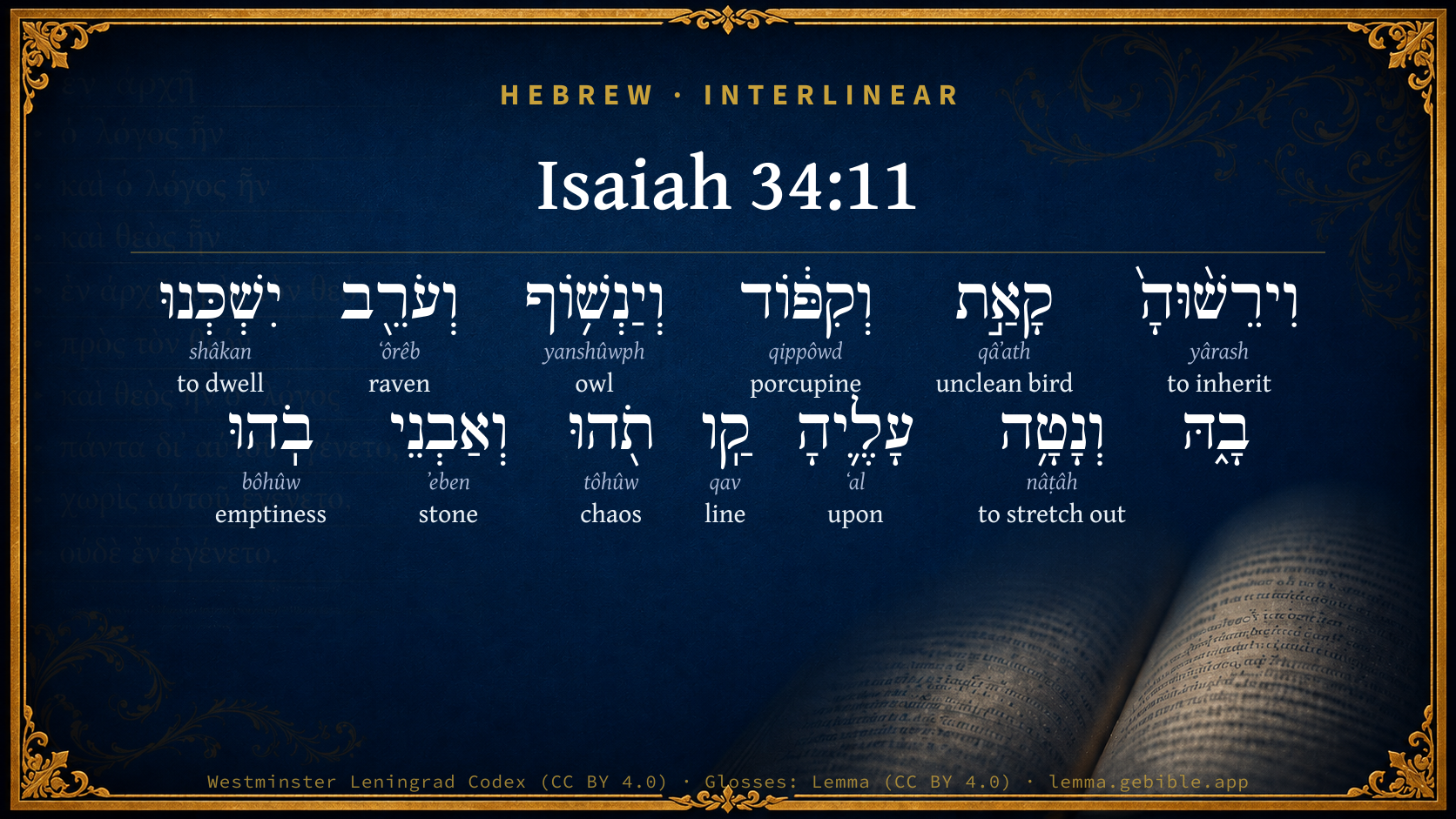
  1. וִירֵשׁ֨וּהָ֙ yârash H3423 “and · to inherit · her” Conjunction + Verb, Qal, Sequential Perfect, 3rd Person, Common, Plural + Suffix, Personal, 3rd Person, Feminine, Singular
  2. קָאַ֣ת qâʼath H6893 “unclean bird” Noun, Common, Feminine, Singular, Absolute
  3. וְיַנְשׁ֥וֹף yanshûwph H3244 “and · owl” Conjunction + Noun, Common, Masculine, Singular, Absolute
  4. וְעֹרֵ֖ב ʻôrêb H6158 “and · raven” Conjunction + Noun, Common, Masculine, Singular, Absolute
  5. יִשְׁכְּנוּ shâkan H7931 “to dwell” Verb, Qal, Imperfect, 3rd Person, Masculine, Plural
  6. וְנָטָ֥ה nâṭâh H5186 “and · to stretch out” Conjunction + Verb, Qal, Sequential Perfect, 3rd Person, Masculine, Singular
  7. עָלֶ֛יהָ ʻal H5921 “upon · her” Preposition + Suffix, Personal, 3rd Person, Feminine, Singular
  8. קַֽו qav H6957 “line of” Noun, Common, Masculine, Singular, Construct
  9. תֹ֖הוּ tôhûw H8414 “chaos” Noun, Common, Masculine, Singular, Absolute
  10. וְאַבְנֵי ʼeben H68 “and · stones of” Conjunction + Noun, Common, Feminine, Plural, Construct
  11. בֹֽהוּ bôhûw H922 “emptiness” Noun, Common, Masculine, Singular, Absolute

About this verse

These counts appear in no published source. They are computed here, from the morphology-tagged text and Lemma’s own curated glosses. What Lemma adds →

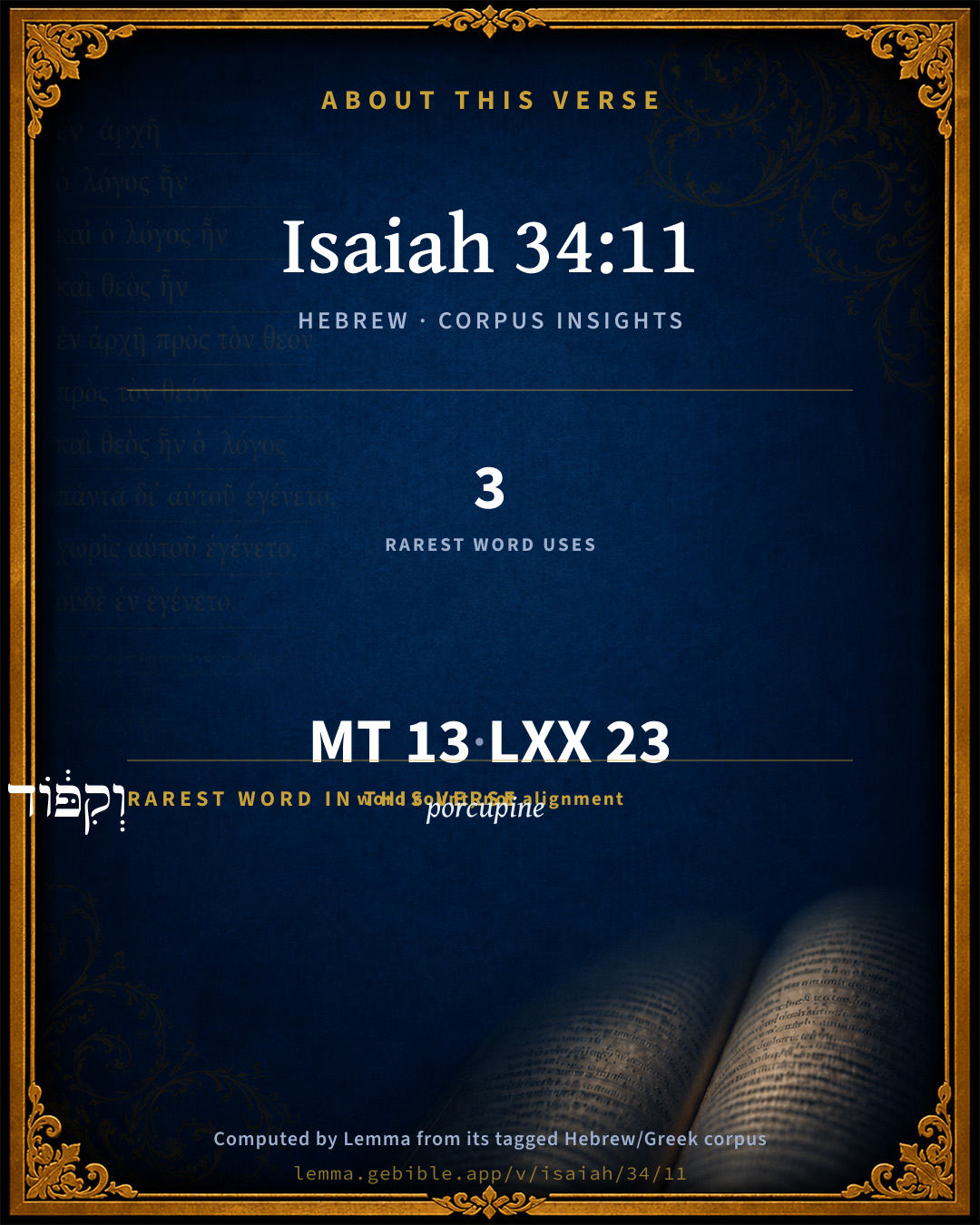
13
words
12
distinct lemmas
Prophets
section

Notable vocabulary

The rarest word here is וְקִפּ֔וֹד porcupine H7090 — appearing just 3 times in the whole Hebrew Bible.

Shared distinctive vocabulary

וְקִפּ֔וֹד porcupine H7090 occurs in 3 verses of the Hebrew Bible. Also found in:

Grammatical profile

  • 3 verbs
  • 8 nouns
  • 2 prepositions

Verb forms

  • וִירֵשׁ֨וּהָ֙ Qal · Sequential Perfect
  • יִשְׁכְּנוּ Qal · Imperfect
  • וְנָטָ֥ה Qal · Sequential Perfect

Hebrew & Septuagint length

In English translation the verse runs 33 words from the Hebrew and 33 from the Septuagint (LXX English) — the same length.

A rough comparison of the two English renderings, which tokenize alike — not a word-level alignment.

Word counts can differ between the Hebrew and the Greek without any difference in meaning — e.g. the Hebrew direct-object marker אֵת has no separate Greek word, and Greek often adds the article ὁ.

In the original languages it is 13 Hebrew tokens and 23 Greek tokens — but the two are counted differently (Hebrew bundles its prefixes and suffixes into one token; the Greek is in lemma form), so that isn’t a like-for-like length.

Cross-references

10

Topical passages linked to Isaiah 34:11 in the Treasury of Scripture Knowledge — connected by theme and wording, ordered by reader-vote popularity; previews shown in the World English Bible.

  • 2 Kings 21:13 I will stretch over Jerusalem the line of Samaria, and the plummet of the house of Ahab; and I will wipe Jerusalem as a man wipes a dish, wiping it and turning it upside down.
  • Lamentations 2:8 Yahweh has purposed to destroy the wall of the daughter of Zion; He has stretched out the line, he has not withdrawn his hand from destroying; He has made the rampart and wall to lament; they languish together.
  • Zephaniah 2:14 Herds will lie down in the midst of her, all the animals of the nations. Both the pelican and the porcupine will lodge in its capitals. Their calls will echo through the windows. Desolation will be in the thresholds, for he has laid bare the cedar beams.
  • Revelation 18:2 He cried with a mighty voice, saying, "Fallen, fallen is Babylon the great, and she has become a habitation of demons, a prison of every unclean spirit, and a prison of every unclean and hateful bird!
  • 2 Samuel 8:2 He struck Moab, and measured them with the line, making them to lie down on the ground; and he measured two lines to put to death, and one full line to keep alive. The Moabites became servants to David, and brought tribute.
  • Isaiah 14:23 I will also make it a possession for the porcupine, and pools of water: and I will sweep it with the broom of destruction, says Yahweh of Hosts.
  • Isaiah 13:20–22 It shall never be inhabited, neither shall it be lived in from generation to generation: neither shall the Arabian pitch tent there; neither shall shepherds make their flocks to lie down there.
  • Isaiah 24:10 The waste city is broken down; every house is shut up, that no man may come in.
  • Malachi 1:3–4 but Esau I hated, and made his mountains a desolation, and gave his heritage to the jackals of the wilderness."
  • Revelation 18:21–23 A mighty angel took up a stone like a great millstone and cast it into the sea, saying, "Thus with violence will Babylon, the great city, be thrown down, and will be found no more at all.

Cross-references courtesy of OpenBible.info (CC BY 4.0).

Hebrew and Greek witnesses Masoretic Hebrew ↔ Greek Septuagint

The same verse in the two great witnesses to the Old Testament, shown verse-for-verse.

These are two independent witnesses, not word-aligned to each other, and the Septuagint is shown in lemma (dictionary) form.

Hebrew Isaiah 34:11 Masoretic · Westminster Leningrad Codex

וִירֵשׁ֨וּהָ֙ קָאַ֣ת וְקִפּ֔וֹד וְיַנְשׁ֥וֹף וְעֹרֵ֖ב יִשְׁכְּנוּ בָ֑הּ וְנָטָ֥ה עָלֶ֛יהָ קַֽו תֹ֖הוּ וְאַבְנֵי בֹֽהוּ

But the pelican and the porcupine shall possess it; and the owl and the raven shall dwell therein: and he will stretch over it the line of confusion, and the plummet of emptiness.

World English Bible · Public Domain

Greek LXX Isaiah 34:11 Septuagint · lemma form

καί καταοἰκέω ἐν αὐτός ὄρνεον καί ἐχῖνος καί ἴβις καί κόραξ καί ἐπιβάλλω ἐπί αὐτός σπαρτίον γεωμετρία ἔρημος καί ὀνοκένταυρος οἰκέω ἐν αὐτός

and for a long time birds and hedgehogs, and ibises and ravens shall dwell in it: and the measuring line of desolation shall be cast over it, and satyrs shall dwell in it.

LXX2012 (modern English Septuagint) · Public Domain

Hebrew: Westminster Leningrad Codex (CC BY 4.0). Greek: Septuagint (public domain); English from LXX2012 (modern English Septuagint) (Public Domain). How the Septuagint differs from the Hebrew →

Targum (Aramaic paraphrase)

1

The Targum is the ancient Jewish Aramaic paraphrase of the Hebrew Scriptures — an interpretive translation, not the Hebrew text itself. Onkelos (literal) and Pseudo-Jonathan (expansive) render the Torah, and Jonathan the Prophets. Coverage is partial: where no permissively-licensed English translation exists for a verse, only the Aramaic is shown. This is verse-level text, not a word-by-word alignment to the Hebrew.

  1. Targum Jonathan Prophets (Joshua–Malachi)
    וְיַחְסְנוּנָהּ קָתִין וְקִפּוֹדִין וְקִפוֹפִין וְעוֹרְבִין יִשְׁרָן בָּה וְיִתְנְגִיד עֲלָהּ חוּט דְחוּרְבָּנָא וּמִשְׁקַלְתָּא דְצַדְיוּתָא:

    The pelican and the porcupine shall inherit her, and the owls and the ravens shall dwell in her: and the line of devastation shall be extended over her, and the plummet of desolation.

    Targum Jonathan — Aramaic: “Mikraot Gedolot” (public domain). English: “Sefaria Community Translation” (CC0 1.0 (public-domain dedication)); “London "Chaldee Paraphrase," 1871” (public domain). Text via Sefaria.

Commentary

Notes on Isaiah 34:11 from classic Christian and Jewish commentators (each source and its license shown beneath its notes). The classic Christian expositions comment on the surrounding passage and are grouped to its opening verse, so a note may address several verses; the Jewish commentaries on the Tanakh (Rashi and others) are per-verse, so they appear only where the commentator wrote on this verse.

Lemma curates 59 commentaries, every one of them public domain or Creative Commons licensed, each selected and text-cleaned for this edition rather than reprinted as found. About our sources →

Trapp's Complete Commentary

John Trapp

Isa 34:11 But the cormorant and the bittern shall possess it; the owl also and the raven shall dwell in it: and he shall stretch out upon it the line of confusion, and the stones of emptiness.

Ver. 11. The cormorant and the bittern shall possess it.] God cannot satisfy himself in saying what he will do to the Edomites, because they had dealt by revenge, and had taken vengeance with a despiteful heart to destroy the Church, for the old satanical hatred. {as Eze 25:15} He will turn in those animalis faeda, fera et terribilia, to dwell in their land; whereby is noted extreme devastation, which is here in many exquisite words (more propemodum poetico) described.

And he shall stretch out upon it.] So that men shall in vain think of rebuilding and repeopling it.

John Trapp, A Commentary or Exposition upon All the Books of the Old and New Testament (1647–1656) — public domain. Text from a community e-Sword module.

Keil & Delitzsch

C. F. Keil & F. Delitzsch

The land of Edom, in this geographical and also emblematical sense, would become a wilderness; the kingdom of Edom would be for ever destroyed. "And pelican and hedgehog take possession of it, and eared-owl and raven dwell there; and he stretches over it the measure of Tohu and the level of Bohu. Its nobles - there is no longer a monarchy which they elected; and all its princes come to nought." The description of the ruin, which commences in Isa 34:11 with a list of animals that frequent marshy and solitary regions, is similar to the one in Isa 13:20-22; Isa 14:23 (compare Zep 2:14, which is founded upon this). Isaiah's was the original of all such pictures of ruin which we meet with in the later prophets. The qippōd is the hedgehog, although we find it here in the company of birds (from qâphad, to draw one's self together, to roll up; see Isa 14:23). קאת is written here with a double kametz, as well as in Zep 2:14, according to codd. and Kimchi, W.B. (Targ. qâth, elsewhere qâq; Saad. and Abulwalid, qûq: see at Psa 102:7). According to well-established tradition, it is the long-necked pelican, which lives upon fish (the name is derived either from קוא, to vomit, or, as the construct is קאת, from a word קאה, formed in imitation of the animal's cry). Yanshūph is rendered by the Targum qı̄ppōphı̄n (Syr. kafûfo), i.e., eared-owls, which are frequently mentioned in the Talmud as birds of ill omen (Rashi, or Berachoth 57b, chouette). As the parallel to qâv, we have אבני (stones) here instead of משׁקלת, the level, in Isa 28:17. It is used in the same sense, however - namely, to signify the weight used in the plumb or level, which is suspended by a line. The level and the measure are commonly employed for the purpose of building up; but here Jehovah is represented as using these fore the purpose of pulling down (a figure met with even before the time of Isaiah: vid., Amo 7:7-9, cf., Kg2 21:13; Lam 2:8), inasmuch as He carries out this negative reverse of building with the same rigorous exactness as that with which a builder carries out his well-considered plan, and throws Edom back into a state of desolation and desert, resembling the disordered and shapeless chaos of creation (compare Jer 4:23, where tōhū vâbhōhū represents, as it does here, the state into which a land is reduced by fire). תהוּ has no dagesh lene; and this is one of the three passages in which the opening mute is without a dagesh, although the word not only follows, but is closely connected with, one which has a soft consonant as its final letter (the others are Psa 68:18 and Eze 23:42). Thus the primeval kingdom with its early monarchy, which is long preceded that of Israel, is brought to an end (Gen 36:31). חריה stands at the head as a kind of protasis. Edom was an elective monarchy; the hereditary nobility electing the new king. But this would be done no more. The electoral princes of Edom would come to nothing. Not a trace would be left of all that had built up the glory of Edom.

Keil & Delitzsch — Biblical Commentary on the Old Testament (1861–1891) — public domain (CC PDM 1.0). Text via the HelloAO Bible API. (Old Testament only.)

Tyndale Open Study Notes

Tyndale Open Resources

34:11-14 Wild animals, night birds, and hostile plants with thorns and nettles created an eerie environment.

34:11 The identification of some of these birds is uncertain, but they inhabited wild and deserted places and many were considered unclean (Deut 14:11-18).

Tyndale Open Study Notes — © Tyndale Open Resources, licensed CC BY-SA 4.0. Text via the HelloAO Bible API.

Geneva Bible (1599)

Geneva Bible translators

In vain shall any man go about to build it again.

Read Isa. 13:21 and Zeph. 2:14.

Geneva Bible (1599) marginal notes — public domain. Text via Bolls.life.

Jamieson, Fausset & Brown

Robert Jamieson, A. R. Fausset & David Brown

cormorant--The Hebrew is rendered, in Psa 102:6, "pelican," which is a seafowl, and cannot be meant here: some waterfowl (katta, according to BURCKHARDT) that tenants desert places is intended.

bittern--rather, "the hedgehog," or "porcupine" [GESENIUS] (Isa 14:23).

owl--from its being enumerated among water birds in Lev 11:17; Deu 14:16. MAURER thinks rather the heron or crane is meant; from a Hebrew root, "to blow," as it utters a sound like the blowing of a horn (Rev 18:2).

confusion--devastation.

line . . . stones--metaphor from an architect with line and plummet-stone (see on Isa 18:2; Isa 28:17); God will render to it the exact measure of justice without mercy (Jam 2:13; Kg2 21:13; Lam 2:8; Amo 7:7-8).

emptiness--desolation. Edom is now a waste of "stones."

Jamieson, Fausset & Brown — Commentary Critical and Explanatory on the Whole Bible (1871) — public domain (CC PDM 1.0). Text via the HelloAO Bible API.

Adam Clarke's Commentary

Verse 11. The cormorant] קאת kaath, the pelican, from the root קיא ki, to vomit, because it is said she swallows shell-fish, and when the heat of her stomach has killed the fish, she vomits the shells, takes out the dead fish, and eats them.

The bittern] קפד kippod, the hedge-hog, or porcupine.

The owl] ינשוף yanshoph, the bittern, from נשף nashaph, to blow, because of the blowing noise it makes, almost like the lowing of an ox. My old MS. Bible renders the words thus: - The foule in face like an asse, and the yrchoun, and the snyte (snipe.)

The line of confusion, and the stones of emptiness - "The plummet of emptiness over her scorched plains."] The word חריה choreyha, joined to the 12th verse, embarrasses it, and makes it inexplicable. At least I do not know that any one has yet made out the construction, or given any tolerable explication of it. I join it to the 11th verse, and supply a letter or two, which seem to have been lost. Fifteen MSS. five ancient, and two editions, read חוריה choreyha; the first printed edition of 1486, I think nearer to the truth, חור חריה chor choreyha. I read בחרריה becharereyha, or על חרריה al chorereyha; see Jer 17:6. A MS. has חדיה chodiah, and the Syriac reads חדוה chaduah, gaudium, joining it to the two preceding words; which he likewise reads differently, but without improving the sense. However, his authority is clear for dividing the verses as they are here divided. I read שם shem, as a noun. They shall boast, יקראו yikreu; see Pr 20:6.

Adam Clarke's Commentary on the Bible (1810–1826) — public domain. Text from a community e-Sword/MySword module.

Ellicott's Commentary for English Readers

(11) But the cormorant and the bittern shall possess it . . .—The picture of a wild, desolate region, haunted by birds and beasts that shun the abode of men, is a favourite one with Isaiah (comp. Isa_13:20-22; Isa_14:23), and is reproduced by Zephaniah (Zep_2:14). Naturalists agree in translating, The pelicans and hedgehogs; the owl, and the raven.

The line of confusion, and the stones of emptiness . . .—The “line” and the “stones” are those of the builder’s plumb-line, used, as in 2Ki_21:13; Amo_7:7-9; Lam_2:8, for the work, not of building up, but for the destroying as with a scientific completeness. “Confusion” and “emptiness,” are the tohu v’bohu, “without form and void” of the primeval chaos (Gen_1:1).

A Bible Commentary for English Readers, edited by Charles John Ellicott (1878–1897) — public domain. Text from a community e-Sword module.

The Cambridge Bible for Schools and Colleges

gen. ed. J. J. S. Perowne

11. the cormorant and the bittern] Zep_2:14. R.V. has “the pelican (Lev_11:18; Psa_102:6) and the porcupine”; for the latter see on ch. Isa_14:23.

the line of confusion, and the stones (R.V. plummet) of emptiness] See on ch. Isa_28:17. These implements of the builder were naturally employed where a partial destruction (of houses, &c.) was contemplated; but the image is also extended to the case of complete demolition; 2Ki_21:13; Lam_2:8. “Confusion” and “emptiness” stand for the words tôhû and bôhû, used of the primeval chaos in Gen_1:2 (cf. Jer_4:23).

The Cambridge Bible for Schools and Colleges (gen. ed. J. J. S. Perowne; Cambridge University Press, 1878–1918) — public domain. Text from a community e-Sword module.

John Gill's Exposition

But the cormorant and the bittern shall possess it,.... The word for "cormorant" is rendered a "pelican", in Psa 102:6 they were both unclean fowls according to the law, of which see Lev 11:17 and See Gill on Isa 14:23,

the owl also and the raven shall dwell in it; which were likewise unclean creatures; and these, with the former, and other creatures after mentioned, delight to dwell in desolate and ruinous places; and so Babylon or Rome being destroyed, will become a cage of every unclean and hateful bird, Rev 18:2,

and he shall stretch out upon it the line of confusion and the stones of emptiness; "he", that is, God, as Kimchi interprets it; the allusion is to builders, that make use of the line and plummet, as to build, so to pull down, that they may know what is to be pulled down, and how far they are to go; see Kg2 21:13 and hereby it is signified, that as the destruction should be entire, nothing should be left but confusion and emptiness; and all should become "tohu" and "bohu", which are the words used here; and are the same that are used to express the confused chaos, the unformed and empty earth, Gen 1:2 so likewise that it should be by line and level, by rule and measure; or according to the rules of justice and equity.

John Gill's Exposition of the Whole Bible (1746–1763) — public domain (CC PDM 1.0). Text via the HelloAO Bible API.

Albert Barnes' Notes on the Bible

But the cormorant - This and the following verses contain a description of the desolations of Edom in language remarkably similar to that employed in the account of the destruction of Babylon Isa 13:20-22; Isa 14:23. The word here translated ‘cormorant’ (קאת qâ'ath), occurs in this place and in Zep 2:14, where it is rendered ‘cormorant,’ and in Lev 11:18; Deu 14:17; Psa 102:6, where it is rendered ‘pelican.’ Bochart supposes it is the ardea stellaris, or bitourn, which frequents watery places in deserts, and makes a horrible noise. The pelican is a sea-fowl, and cannot be intended here. The cormorant or water raven is a large fowl of the pelican kind, which occupies the cliffs by the sea, feeds on fish, and which is extremely voracious, and which is the emblem of a glutton. It is not certain what fowl is intended here, but the word properly denotes a water-fowl, and evidently refers to some bird that inhabits desolate places.

And the bittern shall possess it - For a description of the bittern, see the note at Isa 14:23.

The owl also and the raven - Well known birds that occupy deserts, and old ruins of houses or towns. The image here is that of desolation and ruin; and the sense is, that the land would be reduced to a waste that would not be inhabited by man, but would be given up to wild animals. How well this agrees with Edom, may be seen in the Travels of Burckhardt, Seetsen, and others. In regard to the fact that the cormorant (קאת qâ'ath) should be found there, it may be proper to introduce a remark of Burckhardt, who seems to have had no reference to this prophecy. ‘The bird katta,’ says he, ‘is met with in immense numbers. They fly in such large flocks that the boys often kill two or three of them at a time, merely by throwing a stick among them.’ So also in regard to the fact that the owl and the raven shall dwell there, the following statements are made by travelers: Captain Mangles relates thatwhile he and his fellow-travelers were examining the ruins and contemplating the sublime scenery of Petra, ‘the screaming of the eagles, hawks, and owls, which were soaring above their heads in considerable numbers, seemingly annoyed at anyone approaching their lonely habitation, added much to the singularity of the scene.’ So says Burckhardt: ‘The fields of Tafyle (situated in the immediate vicinity of Edom) are frequented by an immense number of crows.’

And he shall stretch out upon it - This is an illusion to the fact that an architect uses a line, which is employed to lay out his work (see the note at Isa 28:17).

The line of confusion - A similar expression occurs in 2Ki 21:13 : ‘I will stretch over Jerusalem the line of Samaria, and the plummet of the house of Ahab;’ that is, I will apply the same measure and rule of destruction to Jerusalem that has been applied to Samaria. So Edom would be marked out for desolation. It was the work which God had laid out, and which he intended to perform.

And the stones of emptiness - Probably the plummet which the architect commonly employed with his line (see the note at Isa 28:17). It is a fact, however, that Edom is at present an extended waste of stones and barren rocks. ‘We had before us an immense expanse of dreary country, entirely covered with black flints, with here and there some hilly chain rising from the plain.’ (Burckhardt’s Travels in Syria, p. 445.)

Albert Barnes' Notes on the Bible (1834–1885) — public domain. Text from a community e-Sword/MySword module.

Haydock's Catholic Bible Commentary

Line. Intimating entire destruction, Lamentations ii. 8., and 4 Kings xi. 13. (Calmet) --- Yet God will not punish more than people deserve. (Menochius)

George Leo Haydock (1774–1849), Haydock's Catholic Family Bible and Commentary, 1859 edition — public domain. Excludes Psalms (Douay-Rheims chapter numbering differs from Protestant) and Deuterocanonical books (Catholic canon only).

Matthew Poole's English Annotations

The cormorant and the bittern shall possess it, the owl also and the raven shall dwell in it; the inhabitants shall be wholly cut off, and it shall be entirely possessed by those creatures which delight in deserts and waste places. See the same or like expressions in the like case, Isa 13:21,22; 14:23.

He shall stretch out upon it the line of confusion, and the stones of emptiness; he shall use the line, or the stone or plummet joined to it, not to build them, but to mark them out to desolation and destruction, as workmen commonly use them to mark what they are to pull down.

Matthew Poole's English Annotations on the Holy Bible (1683–1685) — public domain. Text from a community e-Sword/MySword module.

Whedon's Commentary on the Bible

Daniel D. Whedon

11, 12. The picture of a solitary, foul, and marshy land, and of disgusting animals and birds, taking complete possession thereof, is a favourite one with Isaiah, (see Isa_13:20-22; Isa_14:23,) and others copy him. See Zep_2:14. The cormorant is possibly the pelican, though it be a sea fowl; the bittern is, in the opinion of most, the crane, or heron, though some read hedgehog. And this is the condition of the punished Edom.

The line of confusion — And he, or one, stretches a line upon it — an architectural idea denoting exact measurement of justice upon Edom. Stones of emptiness, may mean waste stones, desert stones, stones of dark flint, with which the whole desert land there is strewed. These were picked up and used as, or for, a plummet, with the measuring line. So desolate is every thing there that one visiting the region, either in mockery or in mournful seeming, calls out, Where are the once great nobles, or dukes, (Gen_36:40,) that ruled here? But no answer. Only the same sad question is mockingly echoed back.

Daniel D. Whedon (gen. ed.), Commentary on the Old and New Testaments (1874–1909) — public domain. Text from a community e-Sword module.

The Pulpit Commentary

The cormorant and the bittern shall possess it. Compare the prophecy against Babylon in Isa_14:23. The Hebrew word translated "cormorant," is now generally regarded as designating the "pelican," while the one rendered "bittern" is thought by some to mean "hedgehog" or "porcupine." Animals that delight in solitude are certainly meant, but the particular species is, more or less, matter of conjecture. He shall stretch out upon it; rather, and one shall stretch out upon it. The verb is used impersonally. The line of confusion, and the stones of emptiness; rather, the line of desolation, and the plummet of emptiness. (2Ki_21:13 Lam_2:8 Amo_7:7, Amo_7:8) The destruction of cities was effected by rule and measure, probably because different portions of the task were assigned to different sets of laborers, and, if the work was to be completely done, it required to be done systematically. Here, the measuring-tape and the plumb-line are to be these of tohu and vohu, or of the eternal chaos out of which God, by his word, produced order. (Gen_1:2)

The Pulpit Commentary (1880–1919), ed. H.D.M. Spence-Jones & Joseph S. Exell — public domain. Text from a community e-Sword module.

John Wesley's Explanatory Notes

Dwell - It shall be entirely possessed by those creatures which delight in deserts and waste places. Stretch - He shall use the line, or the stone or plummet joined to it, not to build them, but to mark them out to destruction, as workmen commonly use them to mark what they are to pull down.

John Wesley, Explanatory Notes Upon the Whole Bible (1754–1765) — public domain. Text via the GEBible commentary corpus.

J. A. Alexander on Isaiah

Joseph Addison Alexander

“Then shall possess it (as a heritage) the pelican and porcupine, the crane and crow shall dwell in it. And he (or one) shall stretch upon it the line of confusion and the stones of emptiness.” Having declared that man should no longer pass through it, he now explains who shall be its inhabitants. These animals should not only occupy the land, but occupy it as the successors and to the exclusion of mankind. The essential idea is that of wild and solitary animals. (Compare Isa 13:21-22; Isa 14:23; Rev 18:2). Here again a remarkable coincidence is furnished by the statements of travelers with respect to the number of wild birds in Edom. Mangles, while at Petra, describes the screaming of the eagles, hawks, and owls, seemingly annoyed at any one approaching their lonely habitation. Burckhardt speaks of Tafyle as frequented by an immense number of crows and of the birds called katta, which fly in such large flocks that the boys often kill two or three at a time merely by throwing a stick among them. The apparent inconsistency between this clause and the description of the country in the verse before it only shows that neither can be strictly taken, but that both are metaphorical predictions of entire desolation. In the next clause the same idea is expressed by an entire change of figure. The line meant is a measuring line, mentioned elsewhere not only in connection with building (Zec 1:16), but also with destroying (2Ki 21:13). The stones are stones used for weights (Deu 25:13; Pro 16:11), and here for plumb-line or plummet. The same figure is employed by Amos (Amo 7:7-9) to denote a moral test or standard, but in this case as a symbol of destruction. The plummet is here mentioned as a parallel to line, both together expressing the idea of exact and careful measurement. The sense of the whole metaphor may then be either that God has laid this work out for Himself and will perform it, or that in destroying Edom He will act with equity and justice, or that even in destroying He will proceed deliberately and by rule.

Joseph Addison Alexander, The Prophecies of Isaiah (1846–1847; New York: Scribner, 1870–1878) — public domain. Text from a community e-Sword module.

unfoldingWord translationNotes

Door43 World Missions Community

will live there

"will live in the land of Edom"

owl

See how you translated this in Isaiah 13:21.

raven

This is a large black bird. It is difficult to identify some of the precise kinds of birds mentioned in this passage. However, they were all birds that preferred to live in places where there were no people, so they symbolize deserted places.

in it

"there." This refers to Edom.

He will stretch over it the measuring line of ruin and the plumbline of destruction

This speaks of Yahweh as if he were a careful builder as he causes destruction in Edom. AT: "Yahweh will measure that land carefully; he will measure it to to decide where to cause ruin and destruction" (See: Metaphor)

measuring line ... plumbline

These are builders' tools. See how you translated similar words in Isaiah 28:17.

Her nobles ... her princes

"The nobles of Edom ... the princes of Edom"

all her princes will be nothing

This exaggerates the princes losing their royal status by saying that they will become nothing. AT: "all her princes will no longer rule" (See: Hyperbole and Generalization)

translationWords

kingdom

prince

unfoldingWord translationNotes — © Distant Shores Media and the Door43 World Missions Community, licensed CC BY-SA 4.0. Source: git.door43.org/Door43/en_tn.

Rashi

Rabbi Shlomo Yitzchaki (Rashi)

owl (קִפֹּד) a bird that flies at night (chouette in French), an owl.

a line of waste A judgment of desolation.

and weights of destruction Weights of the judgment of destruction. (אַבְנֵי, lit., stones.) Comp. (Deut. 25:15) “a whole weight (אֶבֶן).”

Rashi on the Tanakh — English translations: “The Judaica Press complete Tanach with Rashi, translated by A. J. Rosenberg” (CC BY 4.0); “Pentateuch with Rashi's commentary by M. Rosenbaum and A.M. Silbermann, 1929-1934” (public domain); “The Metsudah Tanach series, Lakewood, N.J” (CC BY 4.0); and “The Book of Joshua, Metsudah Publications, 1997” (CC BY 4.0). Text via Sefaria.

Ibn Ezra

Rabbi Abraham ibn Ezra

קפוד Hedgehog. Well known; the root of this word is met with in קפדתי I have rolled together (38:12).

And he shall stretch upon it, etc. Lime and stones are materials used by the builder.

תהו, בהו Emptiness, confusion. These words are similar in meaning to שממה desolation.

Ibn Ezra on the Tanakh — English translations: “Sefaria Community Translation” (CC0 1.0 (public-domain dedication)); “Yalkut, Sifsei Chachomim Chumash, Metsudah Publications, 2009” (CC BY 4.0); and “Commentary of Ibn Ezra on Isaiah - trans. by M. Friedlander, 1873” (public domain). Text via Sefaria.

Lesson kit

Teaching starters — assembled from the data on this page, not authored interpretation. Every prompt links to the verse data it draws on. Edit before teaching.

Isaiah, in the Prophets, opens this verse with 13 words (12 distinct Hebrew lemmas). Its most distinctive word is qippôwd (“porcupine”). A historical commentator’s framing appears above. Read the whole chapter for the surrounding context.

Discussion questions

  1. The word qippôwd carries the sense “porcupine.” How does it shape the verse?
  2. Isaiah 14:23 shares the word «porcupine» with this verse. How do the two illuminate each other?
  3. These translations render this verse differently; the difference is in the English rendering, not the original. What questions does that raise?
  4. The verb «וִירֵשׁ֨וּהָ֙» is Qal Sequential Perfect. How does its form color the action?
  5. Reading how Trapp's Complete Commentary and Keil & Delitzsch read this verse, where do the two commentators agree and where do they part?

Things to notice

Reading settings

Reading text

Shown beneath each verse's original-language words.

Old Testament
Old Testament edition

Read the OT as the Masoretic Hebrew (MT) or the Greek Septuagint (LXX).

English shown for the Greek Septuagint (in the Hebrew ↔ Greek comparison).

Comparing translations? Open the Compare panel on any verse page to stack up to four side by side.