
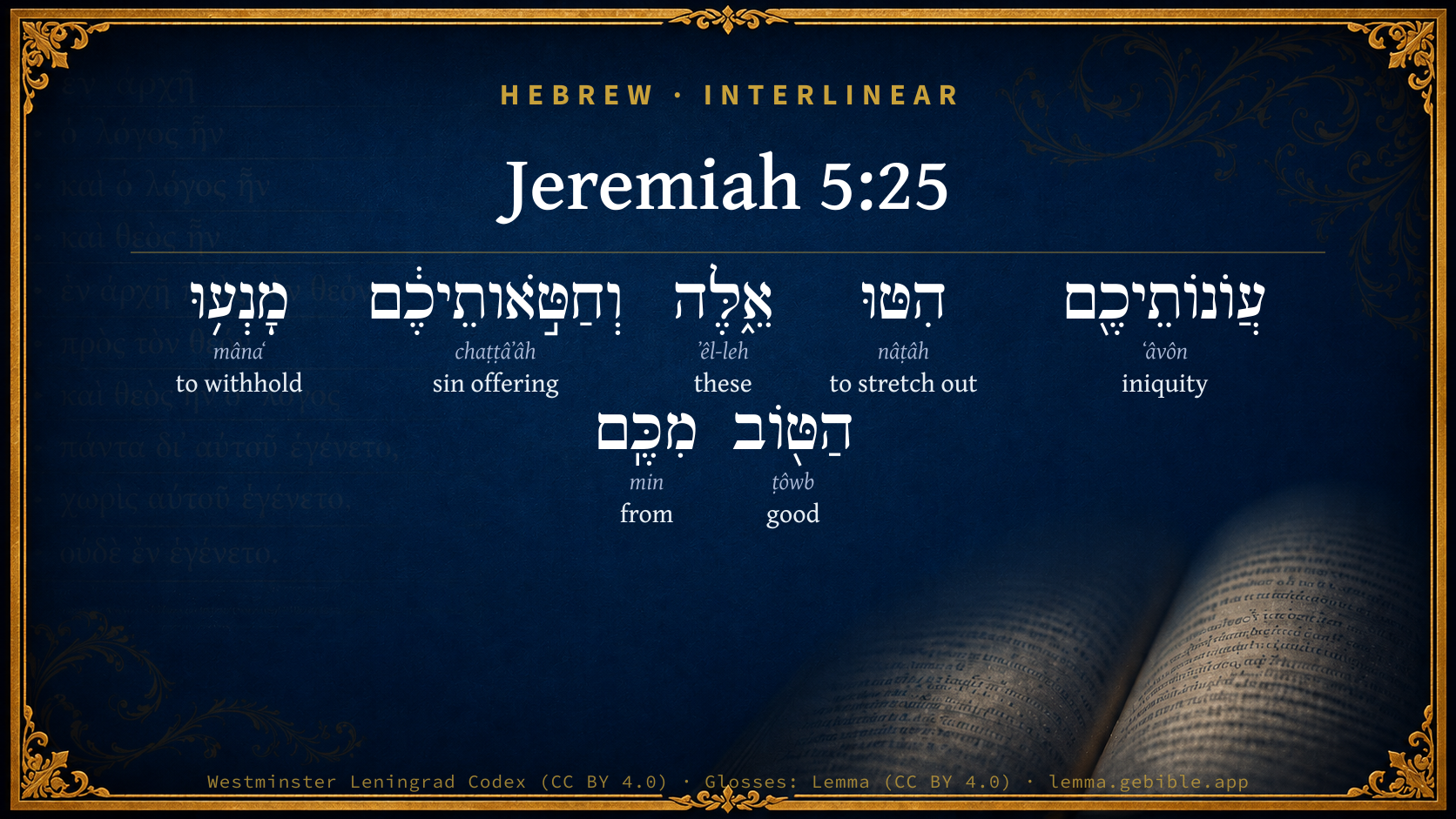
Jeremiah 5:25

Hebrew (Westminster Leningrad Codex) Jeremiah 5:25 appears in the Hebrew Old Testament. The text above is from the Westminster Leningrad Codex. Each word links to its Strong’s number, a concise gloss, and parsing drawn from the Open Scriptures Hebrew Bible morphology. Click any word for its full Brown-Driver-Briggs (BDB) entry.
Download image
Cite this verse

Jeremiah 5:25 (World English Bible). Public Domain. Lemma interlinear Bible study tool, https://lemma.gebible.app/v/jeremiah/5/25.

Show BibTeX & RIS
BibTeX
RIS
English Translation
Your iniquities have turned away these things, and your sins have withheld good from you.
World English Bible · Public Domain
Download a study sheet

One document with this verse’s original text, its word-by-word gloss line, the meaning frame, cross-references with their text, attributed commentary, and full source and license credits — printable, and it pastes into notes with its structure intact.

This verse Autodidact and up

Study sheet (.html) Plain text (.txt)

A passage Seminary Student

Up to 50 verses in one chapter. A passage sheet keeps up to 6 commentary sources and 12 cross-references per verse, in the order this page ranks them, and says so on the sheet whenever that leaves anything out. Ask for a single verse and you get the Autodidact verse sheet above.

Everything on this page stays free to read, with no account — the sheet is a download of what is already on screen, not access to it.

Want to remove ads? Support Godless Engineer
Compare translations 3

The same verse in 3 English versions, stacked beneath the original-language interlinear above. Click any original word for its lexicon entry.

Each is an independent rendering of the whole verse — the interlinear is not word-aligned to these translations.

Highlighted words mark where these versions differ — a whole-verse word diff, not a word-by-word alignment.

  • World English Bible Public Domain
    Your iniquities have turned away these things, and your sins have withheld good from you.
  • King James Version Public Domain
    Your iniquities have turned away these things, and your sins have withholden good things from you.
  • unfoldingWord Literal Text CC BY-SA 4.0
    Your iniquities turned have away these, and your sins have kept back from you the good. ts\*

unfoldingWord Literal Text — © unfoldingWord, licensed CC BY-SA 4.0. Word-aligned USFM3 via Door43 (git.door43.org/unfoldingWord/en_ult).

Versions to compare (up to 4)

3 of 4 selected

Show all 18 translations

Every available English version of this verse, each an independent rendering of the whole verse.

  • World English Bible Public Domain
    Your iniquities have turned away these things, and your sins have withheld good from you.
  • Berean Standard Bible Public Domain
    Your iniquities have diverted these from you; your sins have deprived you of My bounty.
  • Majority Standard Bible Public Domain
    Your iniquities have diverted these from you; your sins have deprived you of My bounty.
  • King James Version Public Domain
    Your iniquities have turned away these things, and your sins have withholden good things from you.
  • American Standard Version (1901) Public Domain
    Your iniquities have turned away these things, and your sins have withholden good from you.
  • Revised Version (1885) Public Domain
    Your iniquities have turned away these things, and your sins have withholden good from you.
  • Geneva Bible (1599) Public Domain
    Yet your iniquities haue turned away these things, and your sinnes haue hindred good things from you.
  • Douay-Rheims (1899) Public Domain
    Your iniquities have turned these things away, and your sins have withholden good things from you.
  • Young's Literal Translation Public Domain
    Your iniquities have turned these away, And your sins have kept the good from you.
  • Literal Standard Version CC BY-SA 4.0
    Your iniquities have turned these away, || And your sins have kept the good from you.
  • Unlocked Literal Bible CC BY-SA 4.0
    Your iniquities kept these things from happening. Your sins have stopped good from coming to you.
  • unfoldingWord Literal Text CC BY-SA 4.0
    Your iniquities turned have away these, and your sins have kept back from you the good. ts\*
  • Darby Bible Public Domain
    Your iniquities have turned away these things, and your sins have withholden from you what is good.
  • World Messianic Bible Public Domain
    “Your iniquities have turned away these things, and your sins have withheld good from you.
  • Webster's Bible Public Domain
    Your iniquities have turned away these things, and your sins have withheld good things from you.
  • Free Bible Version CC BY-SA 4.0
    Your wrong actions have taken these benefits from you; your sins have deprived you of my blessings.
  • Bible in Basic English Public Domain
    Through your evil-doing these things have been turned away, and your sins have kept back good from you.
  • JPS Tanakh (1917) Public Domain
    Your iniquities have turned away these things, and your sins have withholden good from you.

Literal Standard Version (2020), Covenant Press — licensed CC BY-SA 4.0. Text via the HelloAO Bible API (eBible.org). Unlocked Literal Bible (unfoldingWord) — licensed CC BY-SA 4.0. Text via the HelloAO Bible API (eBible.org). unfoldingWord Literal Text — © unfoldingWord, licensed CC BY-SA 4.0. Word-aligned USFM3 via Door43 (git.door43.org/unfoldingWord/en_ult). Free Bible Version, Dr. Jonathan Gallagher — licensed CC BY-SA 4.0. Text via the HelloAO Bible API (eBible.org).

Word by word

More ways to search: Search by grammar → Find every occurrence → Compare this word →

Practice this passage: Drill this verse → Learn its vocabulary →

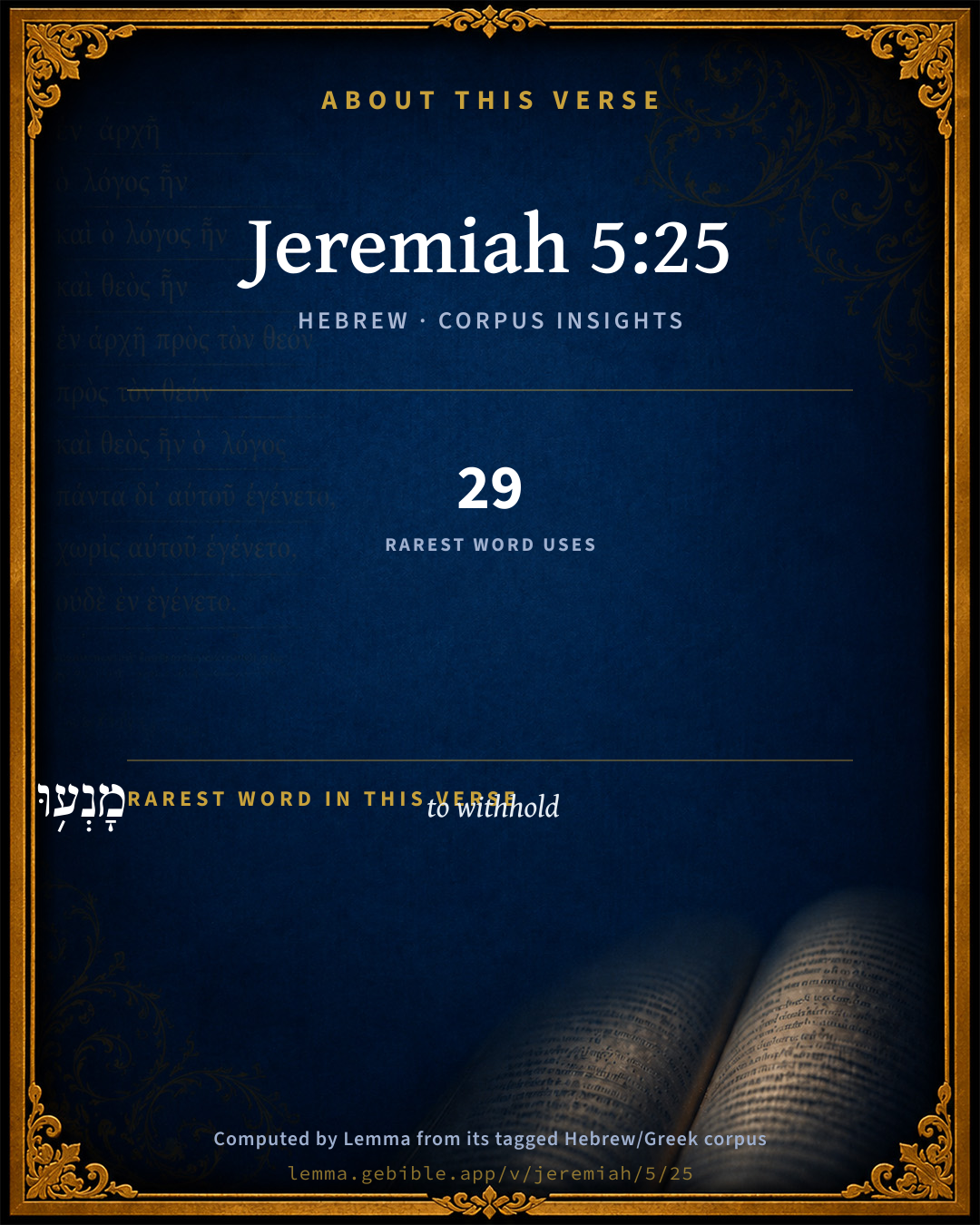
About this verse

These counts appear in no published source. They are computed here, from the morphology-tagged text and Lemma’s own curated glosses. What Lemma adds →

7
words
7
distinct lemmas
Prophets
section

Shared distinctive vocabulary

מָנְע֥וּ to withhold H4513 occurs in 29 verses of the Hebrew Bible. Also found in:

Grammatical profile

  • 2 verbs
  • 2 nouns
  • 1 adjective
  • 1 pronoun
  • 1 preposition

Verb forms

  • הִטּוּ Hiphil · Perfect
  • מָנְע֥וּ Qal · Perfect

Cross-references

8

Topical passages linked to Jeremiah 5:25 in the Treasury of Scripture Knowledge — connected by theme and wording, ordered by reader-vote popularity; previews shown in the World English Bible.

  • Isaiah 59:2 but your iniquities have separated between you and your God, and your sins have hidden his face from you, so that he will not hear.
  • Psalms 107:34 And a fruitful land into a salt waste, For the wickedness of those who dwell in it.
  • Psalms 107:17 Fools are afflicted because of their disobedience, And because of their iniquities.
  • Deuteronomy 28:23–24 Your sky that is over your head shall be brass, and the earth that is under you shall be iron.
  • Jeremiah 2:17–19 Haven't you procured this to yourself, in that you have forsaken Yahweh your God, when he led you by the way?
  • Jeremiah 3:3 Therefore the showers have been withheld, and there has been no latter rain; yet you have a prostitute's forehead, you refused to be ashamed.
  • Lamentations 3:39 Why does a living man complain, a man for the punishment of his sins?
  • Lamentations 4:22 The punishment of your iniquity is accomplished, daughter of Zion; he will no more carry you away into captivity: He will visit your iniquity, daughter of Edom; he will uncover your sins.

Cross-references courtesy of OpenBible.info (CC BY 4.0).

Hebrew and Greek witnesses Masoretic Hebrew ↔ Greek Septuagint

The same verse in the two great witnesses to the Old Testament, shown verse-for-verse.

These are two independent witnesses, not word-aligned to each other, and the Septuagint is shown in lemma (dictionary) form.

Hebrew Jeremiah 5:25 Masoretic · Westminster Leningrad Codex

עֲוֺנוֹתֵיכֶ֖ם הִטּוּ אֵ֑לֶּה וְחַטֹּ֣אותֵיכֶ֔ם מָנְע֥וּ הַטּ֖וֹב מִכֶּֽם

Your iniquities have turned away these things, and your sins have withheld good from you.

World English Bible · Public Domain

Greek LXX Structure differs

In the Septuagint, Jeremiah is about an eighth shorter than the Hebrew and arranges its material differently — the Oracles Against the Nations (Hebrew chapters 46–51) appear in the middle of the Greek book, after 25:13. Because the chapter and verse boundaries do not line up, a verse-for-verse comparison with the Hebrew is not shown.

A verse-for-verse comparison isn’t shown here because the chapters and verses don’t line up. Switch to the LXX edition with the MT / LXX toggle above to read the Greek directly.

Hebrew: Westminster Leningrad Codex (CC BY 4.0). Greek: Septuagint (public domain); English from a public-domain English Septuagint. How the Septuagint differs from the Hebrew →

Targum (Aramaic paraphrase)

1

The Targum is the ancient Jewish Aramaic paraphrase of the Hebrew Scriptures — an interpretive translation, not the Hebrew text itself. Onkelos (literal) and Pseudo-Jonathan (expansive) render the Torah, and Jonathan the Prophets. Coverage is partial: where no permissively-licensed English translation exists for a verse, only the Aramaic is shown. This is verse-level text, not a word-by-word alignment to the Hebrew.

  1. Targum Jonathan Prophets (Joshua–Malachi)
    חוֹבֵיכוֹן גְרָמוּ אִלֵין לְכוֹן וַחֲטָאֵיכוֹן מְנָעוּ טוּבָא מִנְכוֹן:

    (no public-domain English translation for this verse)

    Targum Jonathan — Aramaic: “Mikraot Gedolot” (public domain). English: “Sefaria Community Translation” (CC0 1.0 (public-domain dedication)); “London "Chaldee Paraphrase," 1871” (public domain). Text via Sefaria.

Commentary

Notes on Jeremiah 5:25 from classic Christian and Jewish commentators (each source and its license shown beneath its notes). The classic Christian expositions comment on the surrounding passage and are grouped to its opening verse, so a note may address several verses; the Jewish commentaries on the Tanakh (Rashi and others) are per-verse, so they appear only where the commentator wrote on this verse.

Lemma curates 59 commentaries, every one of them public domain or Creative Commons licensed, each selected and text-cleaned for this edition rather than reprinted as found. About our sources →

Matthew Henry's Commentary

Here, I. The prophet shows them what mischief their sins had done them: They have turned away these things (Jer 5:25), the former and the latter rain, which they used to have in due season (Jer 5:24), but which had of late been withheld (Jer 3:3), by reason of which the appointed weeks of harvest had sometimes disappointed them. "It is your sin that has withholden good from you, when God was ready to bestow it upon you." Note, It is sin that stops the current of God's favour to us, and deprives us of the blessings we used to receive. It is that which makes the heavens as brass and the earth as iron.

II. He shows them how great their sins were, how heinous and provoking. When they had forsaken the worship of the true God, even moral honesty was lost among them: Among my people are found wicked men (Jer 5:26), some of the worst of men, and so much the worse they were for being found among God's people. 1. They were spiteful and malicious. Such are properly wicked men, men that delight in doing mischief. They were found (that is, caught) in the very act of their wickedness. As hunters or fowlers lay snares for their game, so did they lie in wait to catch men, and made a sport of it, and took as much pleasure in it as if they had been entrapping beasts or birds. They contrives ways of doing mischief to good people (whom they hated for their goodness), especially to those that faithfully reproved them (Isa 29:21), or to those that stood in the way of their preferment or whom they supposed to have affronted them or done them a diskindness, or to those whose estates they coveted; so Jezebel ensnared Naboth for his vineyard. Nay, they did mischief for mischief's sake. 2. They were false and treacherous (Jer 5:27): "As a cage, or coop, is full of birds, and of food for them to fatten them for the table, so are their houses full of deceit, of wealth obtained by fraudulent practices or of arts and methods of defrauding. All the business of their families is done with deceit; whoever deals with them, they will cheat him if they can, which is easily done by those who make no conscience of what they say and do. Herein they overpass the deed of the wicked, Jer 5:28. Those that act by deceit, with a colour of law and justice, do more mischief perhaps than those wicked men (Jer 5:26) that carry all before them by open force and violence; or they are worse than the heathen themselves, yea, the worst of them. And (would you think it?) they prosper in these wicked courses and therefore their hearts are hardened in them. They are greedy of the world, because they find it flows in upon them, and they stick not at any wickedness in pursuit of it, because they find that it is so far from hindering their prosperity that it furthers it: They have become great in the world; they have waxen rich, and thrive upon it. They have wherewithal to make provision for the flesh to fulfill all the lusts of it, to which they are very indulgent, so that they have waxen fat with living at ease and bathing themselves in all the delights of sense. They are sleek and smooth: The shine; they look fair and gay; every body admires them. And they pass by matters of evil (so some read the following words); they escape the evils which one would expect their sins should bring upon them; they are not in trouble as other men, much less as we might expect bad men," Psa 73:5, etc. 3. When they had grown great, and had got power in their hands, they did not do that good with it which they ought to have done: They judge not the cause, the cause of the fatherless, and the right of the needy. The fatherless are often needy, always need assistance and advice, and advantage is taken of their helpless condition to do them an injury. Who should succour them then but the great and rich? What have men wealth for but to do good with it? But these would take no cognizance of any such distressed cases: they had not so much sense of justice, or compassion for the injured; or, if they did concern themselves in the cause, it was not to do right, but to protect those that did wrong. And yet they prosper still; God layeth not folly to them. Certainly then the things of this world are not the best things, for often-times the worst men have the most of them; yet we are not to think that, because they prosper, God allows of their practices. No; though sentence against their evil works be not executed speedily, it will be executed. 4. There was a general corruption of all orders and degrees of men among them (Jer 5:30, Jer 5:31); A wonderful and horrible thing is committed in the land. The degeneracy of such a people, so privileged and advanced, was a wonderful thing, and to be viewed with amazement. How could they ever break through so many obligations? It was a horrible thing, a thing to be detested and the consequences of it dreaded. To frighten ourselves from sin, let us call it a horrible thing. What was the matter? In short, this: (1.) The leaders misled the people: The prophets prophesy falsely, counterfeit a commission from heaven when they are factors for hell. Religion is never more dangerously attacked than under colour and pretence of divine revelation. But why did not the priests, who had power in their hands for that purpose, restrain these false prophets? Alas! instead of doing that they made use of them as the tools of their ambition and tyranny: The priests bear rule by their means; they supported themselves in their grandeur and wealth, their laziness and luxury, their impositions and oppressions, by the help of the false prophets and their interest in the people. Thus they were in a combination against every thing that was good, and strengthened one another's hands in evil. (2.) The people were well enough pleased to be so misled: "They are my people," says God, "and should have stood up for me, and borne their testimony against the wickedness of their priests and prophets; but they love to have it so." If the priests and prophets will let them alone in their sins, they will give them no disturbance in theirs. They love to be ridden with a loose rein, and like those rulers very well that will not restrain their lusts and those teachers that will not reprove them.

III. He shows them how fatal the consequences of this would certainly be. Let them consider,

1. What the reckoning would be for their wickedness (Jer 5:29): Shall not I visit for these things? as before, Jer 5:9. Sometimes mercy rejoices against judgment: How shall I give thee up, Ephraim? Here, judgment is reasoning against mercy: Shall I not visit? We are sure that Infinite Wisdom knows how to accommodate the matter between them. The manner of expression is very emphatic, and denotes, (1.) The certainty and necessity of God's judgments: Shall not my soul be avenged? Yes, without doubt, vengeance will come, it must come, if the sinner repent not. (2.) The justice and equity of God's judgments; he appeals to the sinner's own conscience, Do not those deserve to be punished that have been guilty of such abominations? Shall he not be avenged on such a nation, such a wicked provoking nation as this?

2. What the direct tendency of their wickedness was: What will you do in the end thereof? That is, (1.) "What a pitch of wickedness will you come to at last! What will you do? What will you not do that is base and wicked. What will this grow to? You will certainly grow worse and worse, till you have filled up the measure of your iniquity." (2.) "What a pit of destruction will you come to at last! When things are brought to such a pass as this, nothing can be expected from you but a deluge of sin, so nothing can be expected from God but a deluge of wrath; and what will you do when that shall come?" Note, Those that walk in bad ways would do well to consider the tendency of them both to greater sin and utter ruin. An end will come; the end of a wicked life will come, when it will be all called over again, and without doubt will be bitterness in the latter end.

Matthew Henry's Commentary on the Whole Bible (1708–1710) — public domain (CC PDM 1.0). Text via the HelloAO Bible API.

Trapp's Complete Commentary

John Trapp

Jer 5:25 Your iniquities have turned away these [things], and your sins have withholden good [things] from you.

Ver. 25. Your iniquities have turned.] See on Isa 59:2; Isa 1:2.

John Trapp, A Commentary or Exposition upon All the Books of the Old and New Testament (1647–1656) — public domain. Text from a community e-Sword module.

Joseph Benson's Commentary

Jer 5:25-29. Your iniquities have turned away these things — See note on Jer 3:3. For among my people are found wicked men — I need not search for such among the heathen nations, for they are easily found among them that are called by my name. They lay wait, &c. — They use all the arts of fraud and cunning, that they may overreach others, and make a prey of them and their substance. They set a trap, they catch men — Such a trap did Jezebel lay for Naboth, 1Ki 21:9-10. Such a one was that conspiracy of more than forty men against Paul, Act 23:13-15. As a cage is full of birds, &c. — As in the foregoing words they were compared to a hunter, or a fowler, who takes beasts or birds in snares; so here, carrying on the same similitude, he describes their houses as cages full of birds, that is, of goods gotten by robbery and fraudful arts. They are waxen fat, they shine — Or, so fat that they shine. By living at ease, and bathing themselves in all the delights of sense, they look so fair and gay that every body admires them. Yea, they overpass the deeds of the wicked — “They exceed the common instances of injustice and oppression, and make no conscience of enriching themselves with the spoils of the fatherless, and those who have most need of their charity and kindness.” — Lowth. Waterland renders the clause, “Yea, they have exceeded all expression of wickedness; or, have been wicked beyond expression.” Shall I not visit, &c. — See note on Jer 5:9.

Joseph Benson's Commentary on the Old and New Testaments (1811–1818) — public domain. Text from a community e-Sword module.

Geneva Bible (1599)

Geneva Bible translators

If there be any stay, that we receive not God’s blessings in abundance, we must consider that it is for our own iniquities, Isa. 59:1, 2.

Geneva Bible (1599) marginal notes — public domain. Text via Bolls.life.

Jamieson, Fausset & Brown

Robert Jamieson, A. R. Fausset & David Brown

National guilt had caused the suspension of these national mercies mentioned in Jer 5:24 (compare Jer 3:3).

Jamieson, Fausset & Brown — Commentary Critical and Explanatory on the Whole Bible (1871) — public domain (CC PDM 1.0). Text via the HelloAO Bible API.

Adam Clarke's Commentary

Verse 25. Your iniquities have turned away these things] When these appointed weeks of harvest do not come, should we not examine and see whether this be not in God's judgments? Have not our iniquities turned away these good things from us?

Adam Clarke's Commentary on the Bible (1810–1826) — public domain. Text from a community e-Sword/MySword module.

John Calvin's Commentaries

Inasmuch as hypocrites, according to what has been said before, often reply to God, and bring this and that objection, the Prophet here checks what they might have alleged; for he says that God’s beneficence had been restrained by them, and that it was indeed their fault that it did not flow to them. For they might have thus objected, “Thou indeed preachest well respecting God’s paternal bounty, because he supplies us with food; but the heat at one time burns our corn, the unseasonable rains at another time destroy our provisions: in a word, there is nothing certain, but all things are in a state of disorder.” That he might therefore obviate this objection, he says, that it was on account of their wickedness and depravity, that God did not so regulate every part of the year as to allow them to see with their eyes his continued bounty.

This passage is worthy of special notice: for God’s paternal favor does not so continually shine forth in our daily sustenance, but that many clouds intercept our view. Hence it is, that ungodly men think that the years are now barren and then fruitful through mere chance. We indeed see nothing so regulated in every respect in the world, that the goodness of God can be seen without clouds and obstructions: but we do not consider whence this confusion proceeds, even because we obstruct God’s access to us, so that his beneficence does not reach us. We throw heaven and earth into confusion by our sins. For were we in right order as to our obedience to God, doubtless all the elements would be conformable, and we should thus observe in the world an angelic harmony. But as our lusts tumultuate against God; nay, as we stir up war daily, and provoke him by our pride, perverseness, and obstinacy, it must needs be, that all things, above and below, should be in disorder, that the heavens should at one time appear cloudy, and that continuous rains should at another time destroy the produce of the earth, and that nothing should be unmixed and unstained in the world. This confusion then, in all the elements, is to be ascribed to our sins: and this is what is meant by the Prophet. Though indeed the reproof was then addressed to the Jews, we may yet gather hence a lesson of general instruction.

These two things are then both true, — that God is not without a testimony as to his beneficence, for he gives rain, he gives suitable seasons, he renders the earth fruitful, so as to supply us with food, — and also, that heaven and earth are often in great disorder, that many things happen unseasonably, as though God had no care for us, because we provoke him by our sins, and thus confound and subvert the order of nature. These two things then ought to be viewed as connected together: for in the ordinary course of nature we may see the inconceivable bounty of God towards mankind; but as to accidental evils, the cause ought to be considered, even this — because we do not allow God to govern the world in a regular and consistent order, but as far as we can we disturb and confound his providence. We hence see how suitably the Prophet has added this truth — that the iniquities of the people had turned away the beneficence of God. It afterwards follows —

John Calvin's Commentaries (1540-1563) — public domain. Text from the Calvin Translation Society English edition (1840s-50s) via the Christian Classics Ethereal Library (ccel.org). Calvin's coverage is partial (roughly two-thirds of the Bible); uncommented books and verses are honest gaps, never fabricated. The 19th-century editor's footnotes and remarks are omitted so the notes are faithfully Calvin's own voice.

Ellicott's Commentary for English Readers

(25) These things.—i.e., the rain and the harvest which, from the prophet’s point of view, had been withheld in consequence of the sins of the people.

A Bible Commentary for English Readers, edited by Charles John Ellicott (1878–1897) — public domain. Text from a community e-Sword module.

The Cambridge Bible for Schools and Colleges

gen. ed. J. J. S. Perowne

25. these things] the blessings mentioned. For the thought cp. Amo_4:6 ff.

The Cambridge Bible for Schools and Colleges (gen. ed. J. J. S. Perowne; Cambridge University Press, 1878–1918) — public domain. Text from a community e-Sword module.

John Gill's Exposition

Your iniquities have turned away these things,.... Whereas of late years rain was withheld from them in common, and they had not the former and latter rain in its season, nor the appointed weeks of the harvest, and so their land was barren, and famine ensued. This was to be ascribed, not to the want of goodness and faithfulness in God, but to their own iniquities; these mercies were kept back from them in order to humble them, and bring them to a sense of their sins, and an acknowledgment of them:

and your sins have withholden good things from you; as rain from heaven, and fruitful seasons, and had also brought many evil things upon them; for more is understood than is expressed.

John Gill's Exposition of the Whole Bible (1746–1763) — public domain (CC PDM 1.0). Text via the HelloAO Bible API.

Haydock's Catholic Bible Commentary

Away. The rain comes unseasonably.

George Leo Haydock (1774–1849), Haydock's Catholic Family Bible and Commentary, 1859 edition — public domain. Excludes Psalms (Douay-Rheims chapter numbering differs from Protestant) and Deuterocanonical books (Catholic canon only).

Matthew Poole's English Annotations

Your iniquities have turned away these things: q.d. Do not say your ground is parched up with drought, or your fruits are corrupted and rotted by too much or unseasonable rain; we have nothing now in so due a course as we were wont to have it. Would you know the reason of it? You have inverted the ordinances and order of nature, have put heaven and earth out of their regular courses, by your iniquities.

Your sins have withholden good things from you; that either you have been cut short of these good things, or denied a blessing upon them: by this God would not have profane men think that unusual seasons either for better or worse do come by chance, but as he sees convenient, either for the encouragement of the obedient, or punishing the obstinate.

Matthew Poole's English Annotations on the Holy Bible (1683–1685) — public domain. Text from a community e-Sword/MySword module.

The Pulpit Commentary

Have turned away these things. "These things" are the benefits mentioned in the preceding verse. (comp. Jer_3:3 Jer_12:4) Thus the judgment is not entirely future; a foretaste of it has already been given. (comp. 1Ki 17 Am 4)

The Pulpit Commentary (1880–1919), ed. H.D.M. Spence-Jones & Joseph S. Exell — public domain. Text from a community e-Sword module.

Rashi

Rabbi Shlomo Yitzchaki (Rashi)

have brought about these Have brought about these laws. Have cast aside these laws from you, so they don’t guard you and you will be consumed from hunger.

Rashi on the Tanakh — English translations: “The Judaica Press complete Tanach with Rashi, translated by A. J. Rosenberg” (CC BY 4.0); “Pentateuch with Rashi's commentary by M. Rosenbaum and A.M. Silbermann, 1929-1934” (public domain); “The Metsudah Tanach series, Lakewood, N.J” (CC BY 4.0); and “The Book of Joshua, Metsudah Publications, 1997” (CC BY 4.0). Text via Sefaria.

Lesson kit

Teaching starters — assembled from the data on this page, not authored interpretation. Every prompt links to the verse data it draws on. Edit before teaching.

Jeremiah, in the Prophets, opens this verse with 7 words (7 distinct Hebrew lemmas). Its most distinctive word is mânaʻ (“to withhold”). A historical commentator’s framing appears above. Read the whole chapter for the surrounding context.

Discussion questions

  1. The word mânaʻ carries the sense “to withhold.” How does it shape the verse?
  2. How does Genesis 30:2, which shares the word «to withhold», read alongside this verse?
  3. The translations on this page render this verse differently — a whole-verse word diff, not a word-by-word alignment. What might account for the different wordings?
  4. «הִטּוּ» is a Hiphil Perfect verb. How does that grammatical form shape the action described?
  5. Compare how Matthew Henry's Commentary and Trapp's Complete Commentary read this verse. Where do they agree or differ?

Things to notice

Reading settings

Reading text

Shown beneath each verse's original-language words.

Old Testament
Old Testament edition

Read the OT as the Masoretic Hebrew (MT) or the Greek Septuagint (LXX).

English shown for the Greek Septuagint (in the Hebrew ↔ Greek comparison).

Comparing translations? Open the Compare panel on any verse page to stack up to four side by side.