
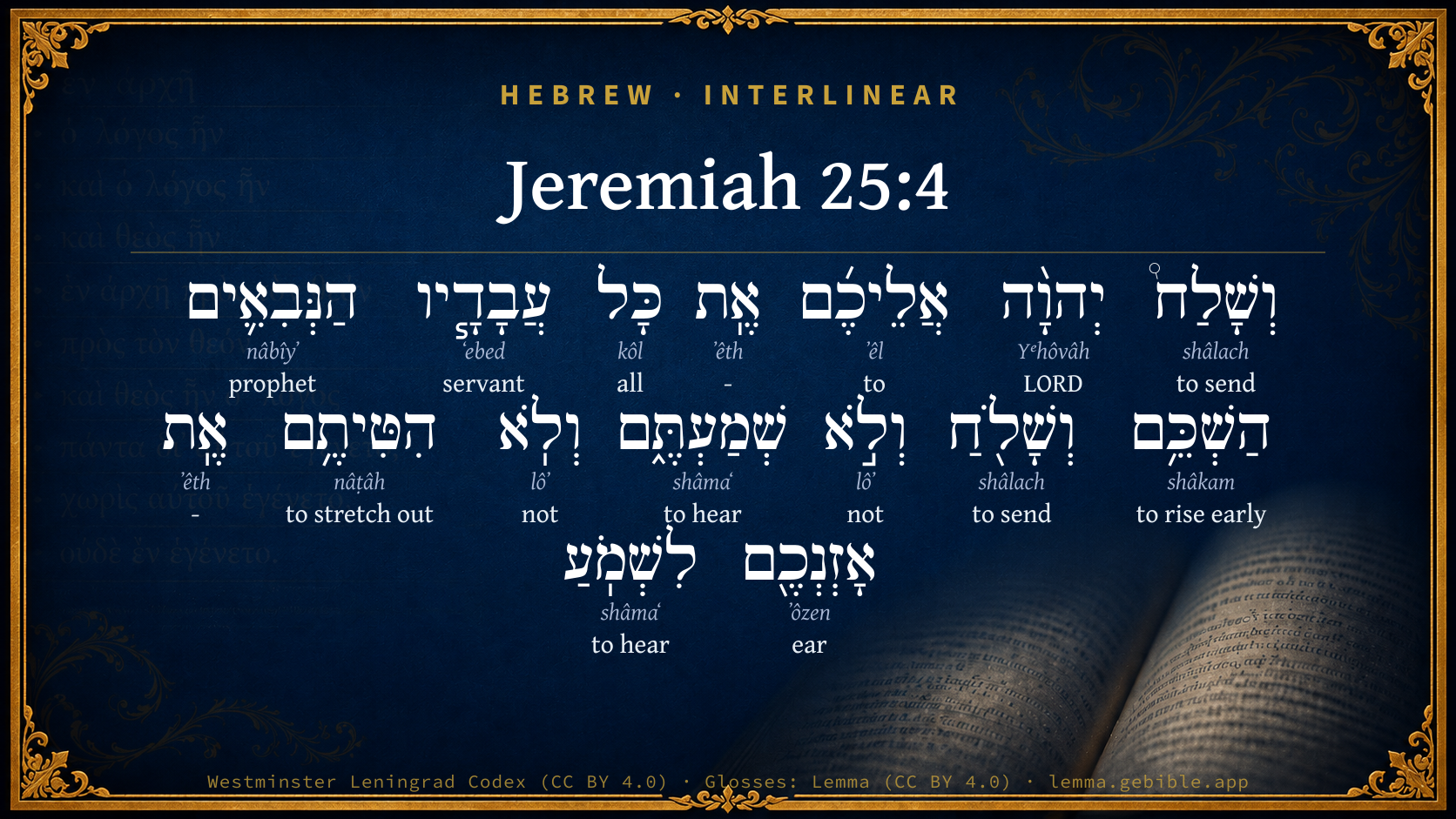
Jeremiah 25:4

Hebrew (Westminster Leningrad Codex) Jeremiah 25:4 appears in the Hebrew Old Testament. The text above is from the Westminster Leningrad Codex. Each word links to its Strong’s number, a concise gloss, and parsing drawn from the Open Scriptures Hebrew Bible morphology. Click any word for its full Brown-Driver-Briggs (BDB) entry.
Download image
Cite this verse

Jeremiah 25:4 (World English Bible). Public Domain. Lemma interlinear Bible study tool, https://lemma.gebible.app/v/jeremiah/25/4.

Show BibTeX & RIS
BibTeX
RIS
English Translation
Yahweh has sent to you all his servants the prophets, rising up early and sending them, (but you have not listened, nor inclined your ear to hear),
World English Bible · Public Domain
Download a study sheet

One document with this verse’s original text, its word-by-word gloss line, the meaning frame, cross-references with their text, attributed commentary, and full source and license credits — printable, and it pastes into notes with its structure intact.

This verse Autodidact and up

Study sheet (.html) Plain text (.txt)

A passage Seminary Student

Up to 50 verses in one chapter. A passage sheet keeps up to 6 commentary sources and 12 cross-references per verse, in the order this page ranks them, and says so on the sheet whenever that leaves anything out. Ask for a single verse and you get the Autodidact verse sheet above.

Everything on this page stays free to read, with no account — the sheet is a download of what is already on screen, not access to it.

Want to remove ads? Support Godless Engineer
Compare translations 3

The same verse in 3 English versions, stacked beneath the original-language interlinear above. Click any original word for its lexicon entry.

Each is an independent rendering of the whole verse — the interlinear is not word-aligned to these translations.

Highlighted words mark where these versions differ — a whole-verse word diff, not a word-by-word alignment.

  • World English Bible Public Domain
    Yahweh has sent to you all his servants the prophets, rising up early and sending them, (but you have not listened, nor inclined your ear to hear),
  • King James Version Public Domain
    And the LORD hath sent unto you all his servants the prophets, rising early and sending them; but ye have not hearkened, nor inclined your ear to hear.
  • unfoldingWord Literal Text CC BY-SA 4.0
    And Yahweh has sent to you all of his servants the prophets, rising early and sending, but you have not listened, and you have not extended your ear to hear,

unfoldingWord Literal Text — © unfoldingWord, licensed CC BY-SA 4.0. Word-aligned USFM3 via Door43 (git.door43.org/unfoldingWord/en_ult).

Versions to compare (up to 4)

3 of 4 selected

Show all 18 translations

Every available English version of this verse, each an independent rendering of the whole verse.

  • World English Bible Public Domain
    Yahweh has sent to you all his servants the prophets, rising up early and sending them, (but you have not listened, nor inclined your ear to hear),
  • Berean Standard Bible Public Domain
    And the LORD has sent all His servants the prophets to you again and again, but you have not listened or inclined your ear to hear.
  • Majority Standard Bible Public Domain
    And the LORD has sent all His servants the prophets to you again and again, but you have not listened or inclined your ear to hear.
  • King James Version Public Domain
    And the LORD hath sent unto you all his servants the prophets, rising early and sending them; but ye have not hearkened, nor inclined your ear to hear.
  • American Standard Version (1901) Public Domain
    And Jehovah hath sent unto you all his servants the prophets, rising up early and sending them, (but ye have not hearkened, nor inclined your ear to hear,)
  • Revised Version (1885) Public Domain
    And the LORD hath sent unto you all his servants the prophets, rising up early and sending them; but ye have not hearkened, nor inclined your ear to hear;
  • Geneva Bible (1599) Public Domain
    And the Lord hath sent vnto you all his seruantes the Prophets, rising early and sending them, but yee would not heare, nor encline your eares to obey.
  • Douay-Rheims (1899) Public Domain
    And the Lord hath sent to you all his servants the prophets, rising early, and sending, and you have not hearkened, nor inclined your ears to hear.
  • Young's Literal Translation Public Domain
    And Jehovah hath sent unto you all His servants, the prophets, rising early and sending, and ye have not hearkened, nor inclined your ear to hear, saying:
  • Literal Standard Version CC BY-SA 4.0
    and YHWH has sent all His servants to you, the prophets, rising early and sending, and you have not listened, nor inclined your ear to hear, saying,
  • Unlocked Literal Bible CC BY-SA 4.0
    Yahweh sent out all his servants the prophets to you again and again, but you have not listened or paid any attention.
  • unfoldingWord Literal Text CC BY-SA 4.0
    And Yahweh has sent to you all of his servants the prophets, rising early and sending, but you have not listened, and you have not extended your ear to hear,
  • Darby Bible Public Domain
    And Jehovah hath sent unto you all his servants the prophets, rising early and sending; but ye have not hearkened, nor inclined your ear to hear,
  • World Messianic Bible Public Domain
    The LORD has sent to you all his servants the prophets, rising up early and sending them (but you have not listened or inclined your ear to hear),
  • Webster's Bible Public Domain
    And the LORD hath sent to you all his servants the prophets, rising early and sending them; but ye have not hearkened, nor inclined your ear to hear.
  • Free Bible Version CC BY-SA 4.0
    Even though the Lord has sent all his servants the prophets to you time and again, you don't bother to listen or pay any attention.
  • Bible in Basic English Public Domain
    And the Lord has sent to you all his servants the prophets, getting up early and sending them; but you have not given attention and your ear has not been open to give hearing;
  • JPS Tanakh (1917) Public Domain
    And the LORD hath sent unto you all His servants the prophets, sending them betimes and often — but ye have not hearkened, nor inclined your ear to hear —

Literal Standard Version (2020), Covenant Press — licensed CC BY-SA 4.0. Text via the HelloAO Bible API (eBible.org). Unlocked Literal Bible (unfoldingWord) — licensed CC BY-SA 4.0. Text via the HelloAO Bible API (eBible.org). unfoldingWord Literal Text — © unfoldingWord, licensed CC BY-SA 4.0. Word-aligned USFM3 via Door43 (git.door43.org/unfoldingWord/en_ult). Free Bible Version, Dr. Jonathan Gallagher — licensed CC BY-SA 4.0. Text via the HelloAO Bible API (eBible.org).

Word by word

More ways to search: Search by grammar → Find every occurrence → Compare this word →

Practice this passage: Drill this verse → Learn its vocabulary →

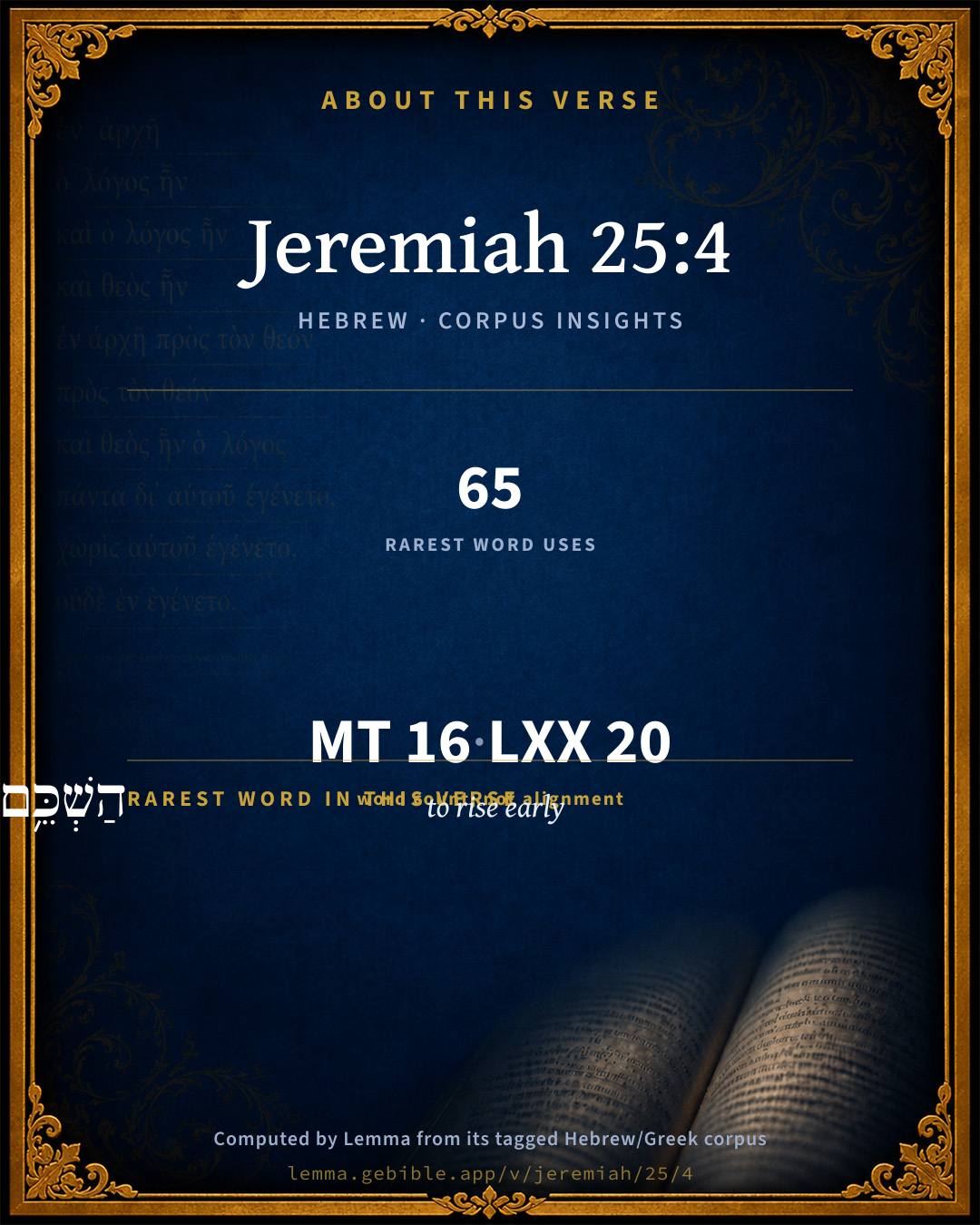
הַשְׁכֵּ֥ם
shâkam
H7925
“to rise early”
Verb, Hiphil, Infinitive Absolute
Part of Speech
Verb
Stem
Hiphil
Form
Infinitive Absolute
Full BDB Definition

Origin: a primitive root

TWOT: 2386

to rise or start early - (Hiphil) - to rise early, make an early start - early (as adverb)
  1. וְשָׁלַח֩ shâlach H7971 “and · to send” Conjunction + Verb, Qal, Perfect, 3rd Person, Masculine, Singular
  2. יְהוָ֨ה Yᵉhôvâh H3068 “LORD” Noun, Proper
  3. אֲלֵיכֶ֜ם ʼêl H413 “to · you” Preposition + Suffix, Personal, 2nd Person, Masculine, Plural
  4. אֶֽת ʼêth H853 “-” Particle, Direct Object
  5. כָּל kôl H3605 “all of” Noun, Common, Masculine, Singular, Construct
  6. עֲבָדָ֧יו ʻebed H5650 “servants · his” Noun, Common, Masculine, Plural, Construct + Suffix, Personal, 3rd Person, Masculine, Singular
  7. הַנְּבִאִ֛ים nâbîyʼ H5030 “the · prophets” Particle, Definite Article + Noun, Common, Masculine, Plural, Absolute
  8. וְשָׁלֹ֖חַ shâlach H7971 “and · to send” Conjunction + Verb, Qal, Infinitive Absolute
  9. וְלֹ֣א lôʼ H3808 “and · not” Conjunction + Particle, Negative
  10. שְׁמַעְתֶּ֑ם shâmaʻ H8085 “to hear” Verb, Qal, Perfect, 2nd Person, Masculine, Plural
  11. וְלֹֽא lôʼ H3808 “and · not” Conjunction + Particle, Negative
  12. הִטִּיתֶ֥ם nâṭâh H5186 “to stretch out” Verb, Hiphil, Perfect, 2nd Person, Masculine, Plural
  13. אֶֽת ʼêth H853 “-” Particle, Direct Object
  14. אָזְנְכֶ֖ם ʼôzen H241 “ear · your” Noun, Common, Feminine, Singular, Construct + Suffix, Personal, 2nd Person, Masculine, Plural
  15. לִשְׁמֹֽעַ shâmaʻ H8085 “to hear” Preposition + Verb, Qal, Infinitive Construct

About this verse

These counts appear in no published source. They are computed here, from the morphology-tagged text and Lemma’s own curated glosses. What Lemma adds →

16
words
12
distinct lemmas
Prophets
section

Grammatical profile

  • 6 verbs
  • 5 nouns
  • 1 preposition
  • 4 particles

Verb forms

  • וְשָׁלַח֩ Qal · Perfect
  • הַשְׁכֵּ֥ם Hiphil · Infinitive Absolute
  • וְשָׁלֹ֖חַ Qal · Infinitive Absolute
  • שְׁמַעְתֶּ֑ם Qal · Perfect
  • הִטִּיתֶ֥ם Hiphil · Perfect
  • לִשְׁמֹֽעַ Qal · Infinitive Construct

Repetition

Words recur within this verse — often emphatic in Hebrew:

  • וְשָׁלַח֩ to send H7971 ×2
  • שְׁמַעְתֶּ֑ם to hear H8085 ×2
  • וְלֹ֣א not H3808 ×2

Hebrew & Septuagint length

In the original languages it is 16 Hebrew tokens and 20 Greek tokens — but the two are counted differently (Hebrew bundles its prefixes and suffixes into one token; the Greek is in lemma form), so that isn’t a like-for-like length.

Cross-references

20

Topical passages linked to Jeremiah 25:4 in the Treasury of Scripture Knowledge — connected by theme and wording, ordered by reader-vote popularity; previews shown in the World English Bible.

  • Jeremiah 25:3 From the thirteenth year of Josiah the son of Amon, king of Judah, even to this day, these twenty-three years, the word of Yahweh has come to me, and I have spoken to you, rising up early and speaking; but you have not listened.
  • Jeremiah 26:5 to listen to the words of my servants the prophets, whom I send to you, even rising up early and sending them, but you have not listened;
  • 2 Chronicles 36:15–16 Yahweh, the God of their fathers, sent to them by his messengers, rising up early and sending, because he had compassion on his people, and on his dwelling-place:
  • Jeremiah 7:24–26 But they didn't listen nor turn their ear, but walked in [their own] counsels [and] in the stubbornness of their evil heart, and went backward, and not forward.
  • Jeremiah 11:7–10 For I earnestly protested to your fathers in the day that I brought them up out of the land of Egypt, even to this day, rising early and protesting, saying, Obey my voice.
  • Jeremiah 13:10–11 This evil people, who refuse to hear my words, who walk in the stubbornness of their heart, and are gone after other gods to serve them, and to worship them, shall even be as this belt, which is profitable for nothing.
  • Jeremiah 16:12 and you have done evil more than your fathers; for, behold, you walk every one after the stubbornness of his evil heart, so that you don't listen to me:
  • Jeremiah 17:23 But they didn't listen, neither turn their ear, but made their neck stiff, that they might not hear, and might not receive instruction.
  • Jeremiah 18:12 But they say, It is in vain; for we will walk after our own devices, and we will do everyone after the stubbornness of his evil heart.
  • Jeremiah 19:15 Thus says Yahweh of Hosts, the God of Israel, Behold, I will bring on this city and on all its towns all the evil that I have pronounced against it; because they have made their neck stiff, that they may not hear my words.
  • Jeremiah 22:21 I spoke to you in your prosperity; but you said, I will not hear. This has been your manner from your youth, that you didn't obey my voice.
  • Jeremiah 29:19 because they have not listened to my words, says Yahweh, with which I sent to them my servants the prophets, rising up early and sending them; but you would not hear, says Yahweh.
  • Jeremiah 32:33 They have turned to me the back, and not the face: and though I taught them, rising up early and teaching them, yet they have not listened to receive instruction.
  • Jeremiah 35:14–15 The words of Jonadab the son of Rechab, that he commanded his sons, not to drink wine, are performed; and to this day they drink none, for they obey their father's commandment: but I have spoken to you, rising up early and speaking; and you have not listened to me.
  • Jeremiah 36:31 I will punish him and his seed and his servants for their iniquity; and I will bring on them, and on the inhabitants of Jerusalem, and on the men of Judah, all the evil that I have pronounced against them, but they didn't listen.
  • Jeremiah 44:4–5 However I sent to you all my servants the prophets, rising up early and sending them, saying, Oh, don't do this abominable thing that I hate.
  • Zechariah 7:11–12 But they refused to listen, and turned their backs, and stopped their ears, that they might not hear.
  • Acts 7:51–52 "You stiff-necked and uncircumcised in heart and ears, you always resist the Holy Spirit! As your fathers did, so you do.
  • Hebrews 12:25 See that you don't refuse him who speaks. For if they didn't escape when they refused him who warned on the Earth, how much more will we not escape who turn away from him who warns from heaven,
  • Jeremiah 25:7 Yet you have not listened to me, says Yahweh; that you may provoke me to anger with the work of your hands to your own hurt.

Cross-references courtesy of OpenBible.info (CC BY 4.0).

Hebrew and Greek witnesses Masoretic Hebrew ↔ Greek Septuagint

The same verse in the two great witnesses to the Old Testament, shown verse-for-verse.

These are two independent witnesses, not word-aligned to each other, and the Septuagint is shown in lemma (dictionary) form.

Hebrew Jeremiah 25:4 Masoretic · Westminster Leningrad Codex

וְשָׁלַח֩ יְהוָ֨ה אֲלֵיכֶ֜ם אֶֽת כָּל עֲבָדָ֧יו הַנְּבִאִ֛ים הַשְׁכֵּ֥ם וְשָׁלֹ֖חַ וְלֹ֣א שְׁמַעְתֶּ֑ם וְלֹֽא הִטִּיתֶ֥ם אֶֽת אָזְנְכֶ֖ם לִשְׁמֹֽעַ

Yahweh has sent to you all his servants the prophets, rising up early and sending them, (but you have not listened, nor inclined your ear to hear),

World English Bible · Public Domain

Greek LXX Structure differs

In the Septuagint, Jeremiah is about an eighth shorter than the Hebrew and arranges its material differently — the Oracles Against the Nations (Hebrew chapters 46–51) appear in the middle of the Greek book, after 25:13. Because the chapter and verse boundaries do not line up, a verse-for-verse comparison with the Hebrew is not shown.

A verse-for-verse comparison isn’t shown here because the chapters and verses don’t line up. Switch to the LXX edition with the MT / LXX toggle above to read the Greek directly.

On this verse, The Cambridge Bible for Schools and Colleges discusses the Septuagint’s reading. Read the note in Commentary ↓

Hebrew: Westminster Leningrad Codex (CC BY 4.0). Greek: Septuagint (public domain); English from a public-domain English Septuagint. How the Septuagint differs from the Hebrew →

Targum (Aramaic paraphrase)

1

The Targum is the ancient Jewish Aramaic paraphrase of the Hebrew Scriptures — an interpretive translation, not the Hebrew text itself. Onkelos (literal) and Pseudo-Jonathan (expansive) render the Torah, and Jonathan the Prophets. Coverage is partial: where no permissively-licensed English translation exists for a verse, only the Aramaic is shown. This is verse-level text, not a word-by-word alignment to the Hebrew.

  1. Targum Jonathan Prophets (Joshua–Malachi)
    וּשְׁלַח יְיָ לְוַתְכוֹן יַת כָּל עַבְדוֹהִי נְבִיַיָא מַקְדֵם וּמַשְׁלַח וְלָא קַבֵּילְתּוּן וְלָא אַרְכֵינְתּוּן יַת אוּדְנְכוֹן לְקַבְּלָא:

    (no public-domain English translation for this verse)

    Targum Jonathan — Aramaic: “Mikraot Gedolot” (public domain). English: “Sefaria Community Translation” (CC0 1.0 (public-domain dedication)); “London "Chaldee Paraphrase," 1871” (public domain). Text via Sefaria.

Commentary

Notes on Jeremiah 25:4 from classic Christian and Jewish commentators (each source and its license shown beneath its notes). The classic Christian expositions comment on the surrounding passage and are grouped to its opening verse, so a note may address several verses; the Jewish commentaries on the Tanakh (Rashi and others) are per-verse, so they appear only where the commentator wrote on this verse.

Lemma curates 59 commentaries, every one of them public domain or Creative Commons licensed, each selected and text-cleaned for this edition rather than reprinted as found. About our sources →

Trapp's Complete Commentary

John Trapp

Jer 25:4 And the LORD hath sent unto you all his servants the prophets, rising early and sending [them]; but ye have not hearkened, nor inclined your ear to hear.

Ver. 4. But ye have not hearkened.] See Jer 7:24; Jer 7:26.

John Trapp, A Commentary or Exposition upon All the Books of the Old and New Testament (1647–1656) — public domain. Text from a community e-Sword module.

Joseph Benson's Commentary

Jer 25:4-7. And the Lord hath sent unto you all his servants, &c. — Nor am I the only prophet whom the Lord hath sent you, and whom you have neglected and despised. God hath sent you many more, and you have despised as many as he hath sent. This contempt of the Lord’s messengers is made the proximate cause of God’s wrath coming upon this people, till there was no remedy, 2Ch 36:16. They said, Turn ye again now, &c. — The substance, both of their and my sermons, hath been to persuade you to abandon those sinful courses, wherein you have lived, and which you might have amended, by virtue of that grace which God did not deny you. We have not differed in our doctrine, to the practice of which you have also been encouraged, both by them and me, with an assurance from God, that, if you obeyed it, you should enjoy this good land which the Lord promised, and gave to you and your fathers, and which you have now possessed for many ages. And go not after other gods — Though the Jews were guilty of many other sins, yet their most heinous sin was idolatry, as it was a direct renouncing of God’s authority, who had, by so many miracles of mercy, set them apart for himself and his own service, and had bestowed so many signal privileges and blessings upon them. And provoke me not with the works of your hands — By worshipping, as gods, the images which your own hands have made, or with any works which are contrary to my law. And I will do you no hurt — You shall yet enjoy your own land and prosper. Yet ye have not hearkened unto me — Ye heard me, and other the Lord’s prophets, thus speaking to you, but you have not obeyed; that ye might provoke me, &c. — As if you had disobeyed with a design to incense me against you; to your own hurt — For the sinful actions of men do not affect or injure me, but are to the hurt of those who do them.

Joseph Benson's Commentary on the Old and New Testaments (1811–1818) — public domain. Text from a community e-Sword module.

Whedon's Commentary on the Bible

Daniel D. Whedon

THE JUDGMENT ON JUDAH, Jer_25:4-11.

4. The Lord… sent, etc. — Thus demonstrating his love and long-suffering.

Daniel D. Whedon (gen. ed.), Commentary on the Old and New Testaments (1874–1909) — public domain. Text from a community e-Sword module.

Tyndale Open Study Notes

Tyndale Open Resources

25:4 For many generations, God had sent prophets to the people, but they had not paid attention to the Lord’s warnings.

Tyndale Open Study Notes — © Tyndale Open Resources, licensed CC BY-SA 4.0. Text via the HelloAO Bible API.

Jamieson, Fausset & Brown

Robert Jamieson, A. R. Fausset & David Brown

rising early--(See on Jer 7:13). "The prophets" refer to Urijah, Zephaniah, Habakkuk, &c. It aggravates their sin, that God sent not merely one but many messengers, and those messengers, prophets; and, that during all those years specified, Jeremiah and his fellow prophets spared no effort, late and early.

Jamieson, Fausset & Brown — Commentary Critical and Explanatory on the Whole Bible (1871) — public domain (CC PDM 1.0). Text via the HelloAO Bible API.

John Calvin's Commentaries

He then adds, I have spoken, and ye heard not He complains here that his work had been useless, and at the same time shews that the whole fault was in the people. He confirms the same thing in other words, Jehovah has sent to you all his servants the prophets, rising. up early, etc He enhances their sin, — that they had not only rejected one Prophet but even many; for God had not employed Jeremiah alone to teach them, but had joined others with him, so that they were less excusable. We hence see that their sin is in this verse exaggerated; for the Jews had not only despised God in the person of one man, but had also rejected all his servants. He might, indeed, have simply said, that God had sent his servants, but he adds the word prophets, in order that their ingratitude might appear more evident. It was, indeed, very wicked to neglect God’s servants; but as prophecy was an invaluable treasure, and a singular pledge and symbol of God’s favor, it was a double crime when they thus despised the prophets, whose very name ought to have been held sacred by them.

He afterwards applies to God what he had said of himself, rising up early It is certain that God does not rise up, as he sleeps not in the night; but the language is much more expressive and forcible, when God himself is said to rise up early. And it, was not without reason that the Prophet spoke so emphatically; for though the Jews were sufficiently convicted of ingratitude for having disregarded God’s servants, it was yet a monstrous impiety to shew no regard for God. But when the unbelieving are proved guilty, they ever fix their eyes on men, “He! it is with a mortal that I have to do; far be it from me ever to rise up against God; but why is this so much blamed, since I do not immediately perish? since I am not suddenly cast down at the nod of man? what! am I not free to inquire, and to discuss, and to examine every part of what is said? why do the prophets so imperiously treat us, that it is not lawful to doubt any of their words?” Thus, then, did the ungodly speak. But God on the other hand answered them and said, that he was despised, as also Christ said,

“He who hears you hears me, and he who despises you despises me.” (Luke 10:16)

So also the Prophet sets forth God himself as rising up early, exhorting the people and manifesting every care for their wellbeing. This, then, is the design of the metaphor, when he says, that God had sent to them and rose up early; he rose up early while sending his servants.

Now as God fulminates against all despisers of his doctrine, so from these words we may gather no small consolation; for we certainly conclude that God watches over our safety whenever sound and faithful teachers go forth: it is the same as though he himself descended from heaven, rose up early, and was intent in securing our salvation. This we learn from the very words of the Prophet, when he says, that God rose up early. But as this testimony of God’s favor and paternal care towards us is delightful, so to the same extent dreadful is the vengeance that awaits those who neglect this favor, who sleep when God is watching, who hear not when he is speaking, who continue in their sloth and torpor when God of his own accord meets them, and kindly and gently invites them to himself.

John Calvin's Commentaries (1540-1563) — public domain. Text from the Calvin Translation Society English edition (1840s-50s) via the Christian Classics Ethereal Library (ccel.org). Calvin's coverage is partial (roughly two-thirds of the Bible); uncommented books and verses are honest gaps, never fabricated. The 19th-century editor's footnotes and remarks are omitted so the notes are faithfully Calvin's own voice.

The Cambridge Bible for Schools and Colleges

gen. ed. J. J. S. Perowne

4. The editor or copyist failed to perceive that it is the prophet, not Jehovah, who is speaking in Jer_25:3. Moreover, the grammar in the Hebrew is suspicious, and this v. is an insertion suggested by such passages as Jer_7:25, Jer_11:7. By omitting it, and (with LXX) all after “unto me” in Jer_25:7, we get a smooth and consistent text, the words being those of Jeremiah, not Jehovah, throughout.

The Cambridge Bible for Schools and Colleges (gen. ed. J. J. S. Perowne; Cambridge University Press, 1878–1918) — public domain. Text from a community e-Sword module.

John Gill's Exposition

And the Lord hath sent unto you all his servants the prophets,.... Not only him, but many others, Micah, Nahum, Zephaniah, and others:

rising early and sending them; not only the prophet, but the Lord himself is said to rise early, and send his prophets to them; which denotes his great care and concern for this people for their good; see Jer 7:25;

but ye have not hearkened, nor inclined your ear to hear; which is an aggravation of their sin; that whereas they had one prophet after another sent to them, and sent by the Lord himself; he rising early, and sending them; and they rising early, being sent to do their message; and yet were not hearkened and attended to.

John Gill's Exposition of the Whole Bible (1746–1763) — public domain (CC PDM 1.0). Text via the HelloAO Bible API.

Haydock's Catholic Bible Commentary

All. We know of Joel, Habacuc, Sophonias, and Holda. (Calmet)

George Leo Haydock (1774–1849), Haydock's Catholic Family Bible and Commentary, 1859 edition — public domain. Excludes Psalms (Douay-Rheims chapter numbering differs from Protestant) and Deuterocanonical books (Catholic canon only).

Matthew Poole's English Annotations

Nor am I the only prophet whom the Lord hath sent you, and whom you have neglected and despised; God hath sent you many more, and you have despised as many as he hath sent, though the Lord hath made it his business to send you one after another from time to time. This contempt of the Lord’s messengers is made the proximate cause of God’s wrath coming upon this people, till there was no remedy, 2Ch 36:16.

Matthew Poole's English Annotations on the Holy Bible (1683–1685) — public domain. Text from a community e-Sword/MySword module.

The Pulpit Commentary

Vers. 4, 5. (Comp. Jer_7:25 Jer_11:7 Jer_35:15) They said; literally, saying. The prophet mentally resumes the statement of ver. 4. He hath sent his servants the prophets." Turn ye; rather, return ye, conversion being the return of the sinner to his natural home.

The Pulpit Commentary (1880–1919), ed. H.D.M. Spence-Jones & Joseph S. Exell — public domain. Text from a community e-Sword module.

Lesson kit

Teaching starters — assembled from the data on this page, not authored interpretation. Every prompt links to the verse data it draws on. Edit before teaching.

Jeremiah, in the Prophets, opens this verse with 16 words (12 distinct Hebrew lemmas). Its most distinctive word is shâkam (“to rise early”). A historical commentator’s framing appears above. Read the whole chapter for the surrounding context.

Discussion questions

  1. How does “to rise early” (shâkam) shape what this verse is saying?
  2. Jeremiah 25:3 shares this passage’s theme. How do the two illuminate each other?
  3. “to send” occurs 2× in this one verse. What is the effect of the repetition?
  4. The translations on this page render this verse differently — a whole-verse word diff, not a word-by-word alignment. What might account for the different wordings?
  5. The verb «וְשָׁלַח֩» is Qal Perfect. How does its form color the action?
  6. Reading how Trapp's Complete Commentary and Joseph Benson's Commentary read this verse, where do the two commentators agree and where do they part?

Things to notice

Reading settings

Reading text

Shown beneath each verse's original-language words.

Old Testament
Old Testament edition

Read the OT as the Masoretic Hebrew (MT) or the Greek Septuagint (LXX).

English shown for the Greek Septuagint (in the Hebrew ↔ Greek comparison).

Comparing translations? Open the Compare panel on any verse page to stack up to four side by side.