2 Samuel 19:15

Hebrew (Westminster Leningrad Codex) 2 Samuel 19:15 appears in the Hebrew Old Testament. The text above is from the Westminster Leningrad Codex. Each word links to its Strong’s number, a concise gloss, and parsing drawn from the Open Scriptures Hebrew Bible morphology. Click any word for its full Brown-Driver-Briggs (BDB) entry.
Download image
Cite this verse

2 Samuel 19:15 (World English Bible). Public Domain. Lemma interlinear Bible study tool, https://lemma.gebible.app/v/2-samuel/19/15.

Show BibTeX & RIS
BibTeX
RIS
English Translation
So the king returned, and came to the Jordan. Judah came to Gilgal, to go to meet the king, to bring the king over the Jordan.
World English Bible · Public Domain
Download a study sheet

One document with this verse’s original text, its word-by-word gloss line, the meaning frame, cross-references with their text, attributed commentary, and full source and license credits — printable, and it pastes into notes with its structure intact.

This verse Autodidact and up

Study sheet (.html) Plain text (.txt)

A passage Seminary Student

Up to 50 verses in one chapter. A passage sheet keeps up to 6 commentary sources and 12 cross-references per verse, in the order this page ranks them, and says so on the sheet whenever that leaves anything out. Ask for a single verse and you get the Autodidact verse sheet above.

Everything on this page stays free to read, with no account — the sheet is a download of what is already on screen, not access to it.

Want to remove ads? Support Godless Engineer
Compare translations 3

The same verse in 3 English versions, stacked beneath the original-language interlinear above. Click any original word for its lexicon entry.

Each is an independent rendering of the whole verse — the interlinear is not word-aligned to these translations.

Highlighted words mark where these versions differ — a whole-verse word diff, not a word-by-word alignment.

  • World English Bible Public Domain
    So the king returned, and came to the Jordan. Judah came to Gilgal, to go to meet the king, to bring the king over the Jordan.
  • King James Version Public Domain
    So the king returned, and came to Jordan. And Judah came to Gilgal, to go to meet the king, to conduct the king over Jordan.
  • unfoldingWord Literal Text CC BY-SA 4.0
    And the king returned, and he came to the Jordan. And Judah came to Gilgal to go to meet the king to bring the king across the Jordan.

unfoldingWord Literal Text — © unfoldingWord, licensed CC BY-SA 4.0. Word-aligned USFM3 via Door43 (git.door43.org/unfoldingWord/en_ult).

Versions to compare (up to 4)

3 of 4 selected

Show all 18 translations

Every available English version of this verse, each an independent rendering of the whole verse.

  • World English Bible Public Domain
    So the king returned, and came to the Jordan. Judah came to Gilgal, to go to meet the king, to bring the king over the Jordan.
  • Berean Standard Bible Public Domain
    So the king returned, and when he arrived at the Jordan, the men of Judah came to Gilgal to meet him and escort him across the Jordan.
  • Majority Standard Bible Public Domain
    So the king returned, and when he arrived at the Jordan, the men of Judah came to Gilgal to meet him and escort him across the Jordan.
  • King James Version Public Domain
    So the king returned, and came to Jordan. And Judah came to Gilgal, to go to meet the king, to conduct the king over Jordan.
  • American Standard Version (1901) Public Domain
    So the king returned, and came to the Jordan. And Judah came to Gilgal, to go to meet the king, to bring the king over the Jordan.
  • Revised Version (1885) Public Domain
    So the king returned, and came to Jordan. And Judah came to Gilgal, to go to meet the king, to bring the king over Jordan.
  • Geneva Bible (1599) Public Domain
    So the King returned, and came to Iorden. And Iudah came to Gilgal, for to goe to meete the King, and to conduct him ouer Iorde.
  • Douay-Rheims (1899) Public Domain
    And the king returned and came as far as the Jordan, and all Juda came as far as Galgal to meet the king, and to bring him over the Jordan.
  • Young's Literal Translation Public Domain
    And the king turneth back, and cometh in unto the Jordan, and Judah hath come to Gilgal, to go to meet the king, to bring the king over the Jordan,
  • Literal Standard Version CC BY-SA 4.0
    And the king turns back, and comes to the Jordan, and Judah has come to Gilgal, to go to meet the king, to bring the king over the Jordan,
  • Unlocked Literal Bible CC BY-SA 4.0
    So the king returned and came to the Jordan. Now the men of Judah came to Gilgal to go to meet the king and then to bring the king across the Jordan.
  • unfoldingWord Literal Text CC BY-SA 4.0
    And the king returned, and he came to the Jordan. And Judah came to Gilgal to go to meet the king to bring the king across the Jordan.
  • Darby Bible Public Domain
    And the king returned and came as far as the Jordan. And Judah came to Gilgal, to go to meet the king, to conduct the king over the Jordan.
  • World Messianic Bible Public Domain
    So the king returned, and came to the Jordan. Judah came to Gilgal, to go to meet the king, to bring the king over the Jordan.
  • Webster's Bible Public Domain
    So the king returned, and came to Jordan. And Judah came to Gilgal, to go to meet the king, to conduct the king over Jordan.
  • Free Bible Version CC BY-SA 4.0
    The king began his journey back, and when he arrived at the Jordan, the men of Judah met him at Gilgal to help him cross the river.
  • Bible in Basic English Public Domain
    So the king came back, and came as far as Jordan. And Judah came to Gilgal, meeting the king there, to take him back with them over Jordan.
  • JPS Tanakh (1917) Public Domain
    (19-16) So the king returned, and came to the Jordan. And Judah came to Gilgal, to go to meet the king, to bring the king over the Jordan.

Literal Standard Version (2020), Covenant Press — licensed CC BY-SA 4.0. Text via the HelloAO Bible API (eBible.org). Unlocked Literal Bible (unfoldingWord) — licensed CC BY-SA 4.0. Text via the HelloAO Bible API (eBible.org). unfoldingWord Literal Text — © unfoldingWord, licensed CC BY-SA 4.0. Word-aligned USFM3 via Door43 (git.door43.org/unfoldingWord/en_ult). Free Bible Version, Dr. Jonathan Gallagher — licensed CC BY-SA 4.0. Text via the HelloAO Bible API (eBible.org).

Word by word

More ways to search: Search by grammar → Find every occurrence → Compare this word →

Practice this passage: Drill this verse → Learn its vocabulary →

הַגִּלְגָּ֗לָה
Gilgâl
H1537
“the · Gilgal · toward”
Particle, Definite Article + Noun, Proper + Suffix, Demonstrative
Part of Speech
Particle + Noun
Type
Proper
Full BDB Definition

Origin: the same as H1536

TWOT: None

Gilgal = "a wheel, rolling" - the first site of an Israelite camp west of the Jordan, east of Jericho, here Samuel was judge, and Saul was made king; later used for illicit worship - dwelling place of prophets in northern Israel about four miles - a region conquered by Joshua, site unsure
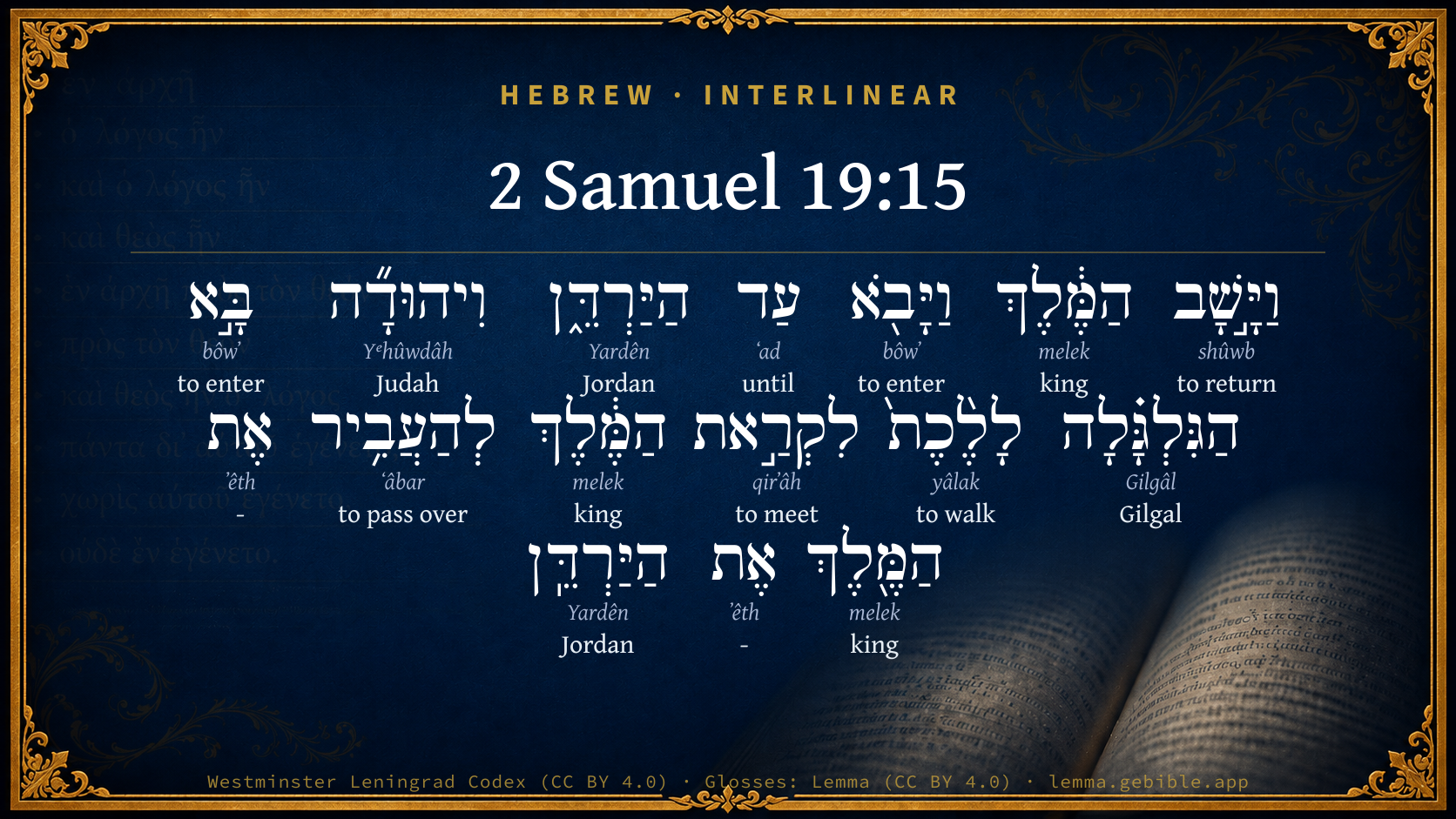
  1. וַיָּ֣שָׁב shûwb H7725 “and · to return” Conjunction + Verb, Qal, Sequential Imperfect, 3rd Person, Masculine, Singular
  2. הַמֶּ֔לֶךְ melek H4428 “the · king” Particle, Definite Article + Noun, Common, Masculine, Singular, Absolute
  3. וַיָּבֹ֖א bôwʼ H935 “and · to enter” Conjunction + Verb, Qal, Sequential Imperfect, 3rd Person, Masculine, Singular
  4. עַד ʻad H5704 “until” Preposition
  5. הַיַּרְדֵּ֑ן Yardên H3383 “the · Jordan” Particle, Definite Article + Noun, Proper
  6. וִיהוּדָ֞ה Yᵉhûwdâh H3063 “and · Judah” Conjunction + Noun, Proper
  7. בָּ֣א bôwʼ H935 “to enter” Verb, Qal, Perfect, 3rd Person, Masculine, Singular
  8. לָלֶ֨כֶת֙ yâlak H3212 “to walk” Preposition + Verb, Qal, Infinitive Construct
  9. לִקְרַ֣את qirʼâh H7125 “to meet” Preposition + Verb, Qal, Infinitive Construct
  10. הַמֶּ֔לֶךְ melek H4428 “the · king” Particle, Definite Article + Noun, Common, Masculine, Singular, Absolute
  11. לְהַעֲבִ֥יר ʻâbar H5674 “to pass over” Preposition + Verb, Hiphil, Infinitive Construct
  12. אֶת ʼêth H853 “-” Particle, Direct Object
  13. הַמֶּ֖לֶךְ melek H4428 “the · king” Particle, Definite Article + Noun, Common, Masculine, Singular, Absolute
  14. אֶת ʼêth H853 “-” Particle, Direct Object
  15. הַיַּרְדֵּֽן Yardên H3383 “the · Jordan” Particle, Definite Article + Noun, Proper

About this verse

These counts appear in no published source. They are computed here, from the morphology-tagged text and Lemma’s own curated glosses. What Lemma adds →

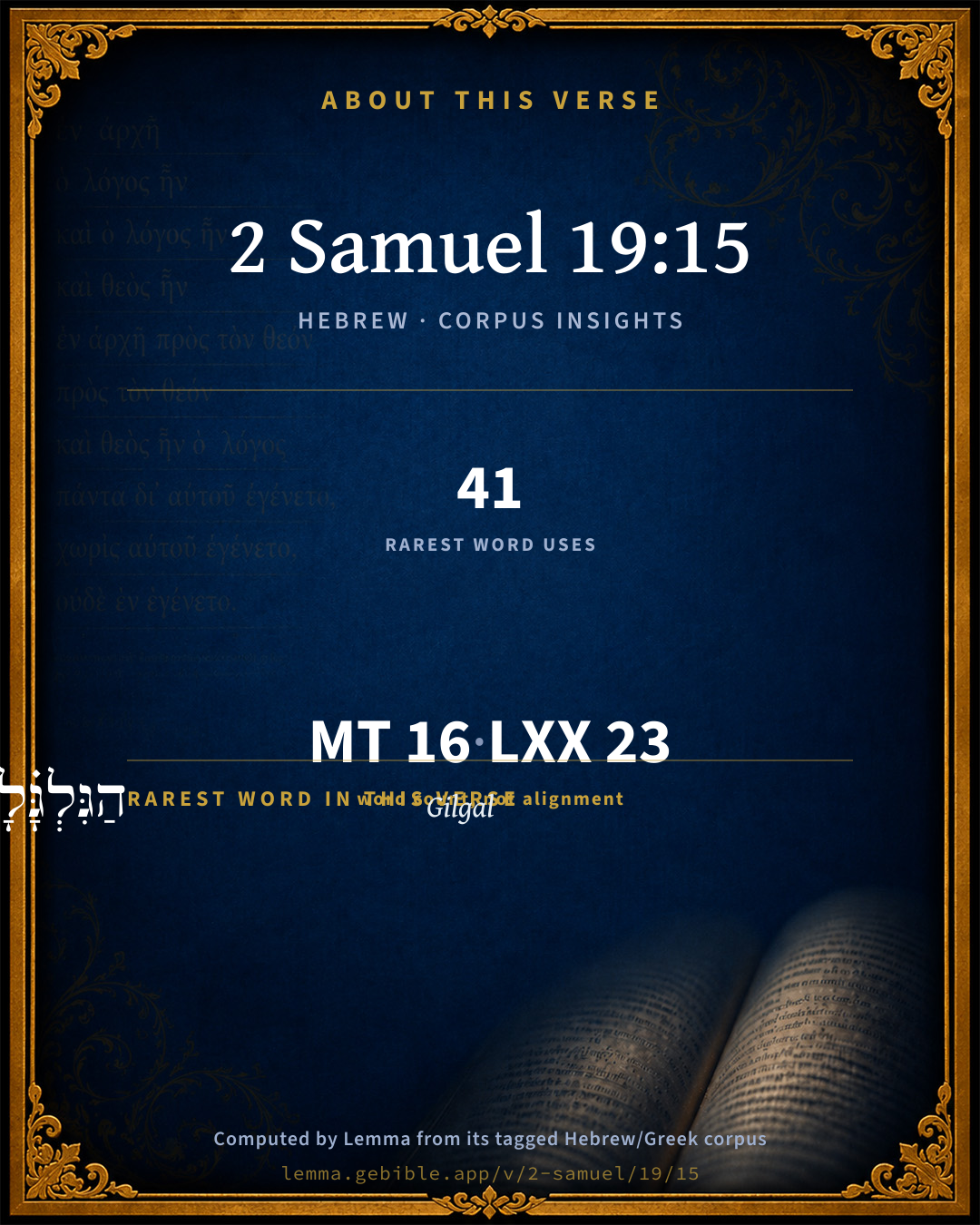
16
words
11
distinct lemmas
Historical
section

Shared distinctive vocabulary

הַגִּלְגָּ֗לָה Gilgal H1537 occurs in 39 verses of the Hebrew Bible. Also found in:

Grammatical profile

  • 6 verbs
  • 7 nouns
  • 1 preposition
  • 2 particles

Verb forms

  • וַיָּ֣שָׁב Qal · Sequential Imperfect
  • וַיָּבֹ֖א Qal · Sequential Imperfect
  • בָּ֣א Qal · Perfect
  • לָלֶ֨כֶת֙ Qal · Infinitive Construct
  • לִקְרַ֣את Qal · Infinitive Construct
  • לְהַעֲבִ֥יר Hiphil · Infinitive Construct

Repetition

Words recur within this verse — often emphatic in Hebrew:

  • הַמֶּ֔לֶךְ king H4428 ×3
  • וַיָּבֹ֖א to enter H935 ×2
  • הַיַּרְדֵּ֑ן Jordan H3383 ×2

Hebrew & Septuagint length

In English translation the verse runs 26 words from the Hebrew and 33 from the Septuagint (LXX English) — closely comparable.

A rough comparison of the two English renderings, which tokenize alike — not a word-level alignment.

Word counts can differ between the Hebrew and the Greek without any difference in meaning — e.g. the Hebrew direct-object marker אֵת has no separate Greek word, and Greek often adds the article ὁ.

In the original languages it is 16 Hebrew tokens and 23 Greek tokens — but the two are counted differently (Hebrew bundles its prefixes and suffixes into one token; the Greek is in lemma form), so that isn’t a like-for-like length.

Cross-references

2

Topical passages linked to 2 Samuel 19:15 in the Treasury of Scripture Knowledge — connected by theme and wording, ordered by reader-vote popularity; previews shown in the World English Bible.

  • Joshua 5:9 Yahweh said to Joshua, This day have I rolled away the reproach of Egypt from off you. Therefore the name of that place was called Gilgal, to this day.
  • 1 Samuel 11:14–15 Then said Samuel to the people, Come, and let us go to Gilgal, and renew the kingdom there.

Cross-references courtesy of OpenBible.info (CC BY 4.0).

Hebrew and Greek witnesses Masoretic Hebrew ↔ Greek Septuagint

The same verse in the two great witnesses to the Old Testament, shown verse-for-verse.

These are two independent witnesses, not word-aligned to each other, and the Septuagint is shown in lemma (dictionary) form.

Hebrew 2 Samuel 19:15 Masoretic · Westminster Leningrad Codex

וַיָּ֣שָׁב הַמֶּ֔לֶךְ וַיָּבֹ֖א עַד הַיַּרְדֵּ֑ן וִיהוּדָ֞ה בָּ֣א הַגִּלְגָּ֗לָה לָלֶ֨כֶת֙ לִקְרַ֣את הַמֶּ֔לֶךְ לְהַעֲבִ֥יר אֶת הַמֶּ֖לֶךְ אֶת הַיַּרְדֵּֽן

So the king returned, and came to the Jordan. Judah came to Gilgal, to go to meet the king, to bring the king over the Jordan.

World English Bible · Public Domain

Greek LXX 2 Samuel 19:15 Septuagint · lemma form

καί κλίνω ὁ καρδία πᾶς ἀνήρ ιουδα ὡς ἀνήρ εἷς καί ἀποστέλλω πρός ὁ βασιλεύς λέγω ἐπιστρέφω σύ καί πᾶς ὁ δοῦλος σύ

And the king returned, and came as far as Jordan. And the men of Juda came to Galgala on their way to meet the king, to cause the king to pass over Jordan.

LXX2012 (modern English Septuagint) · Public Domain

Hebrew: Westminster Leningrad Codex (CC BY 4.0). Greek: Septuagint (public domain); English from LXX2012 (modern English Septuagint) (Public Domain). How the Septuagint differs from the Hebrew →

Targum (Aramaic paraphrase)

1

The Targum is the ancient Jewish Aramaic paraphrase of the Hebrew Scriptures — an interpretive translation, not the Hebrew text itself. Onkelos (literal) and Pseudo-Jonathan (expansive) render the Torah, and Jonathan the Prophets. Coverage is partial: where no permissively-licensed English translation exists for a verse, only the Aramaic is shown. This is verse-level text, not a word-by-word alignment to the Hebrew.

  1. Targum Jonathan Prophets (Joshua–Malachi)
    וְאִתְפְּנֵי לִבָּא דְכָל אֱנַשׁ יְהוּדָה כְּגַבְרָא חָד וּשְׁלָחוּ לְמַלְכָּא תּוּב אַתְּ וְכָל עַבְדָיִךְ:

    (no public-domain English translation for this verse)

    Targum Jonathan — Aramaic: “Mikraot Gedolot” (public domain). English: “Sefaria Community Translation” (CC0 1.0 (public-domain dedication)); “London "Chaldee Paraphrase," 1871” (public domain). Text via Sefaria.

Commentary

Notes on 2 Samuel 19:15 from classic Christian and Jewish commentators (each source and its license shown beneath its notes). The classic Christian expositions comment on the surrounding passage and are grouped to its opening verse, so a note may address several verses; the Jewish commentaries on the Tanakh (Rashi and others) are per-verse, so they appear only where the commentator wrote on this verse.

Lemma curates 59 commentaries, every one of them public domain or Creative Commons licensed, each selected and text-cleaned for this edition rather than reprinted as found. About our sources →

Trapp's Complete Commentary

John Trapp

2Sa 19:15 So the king returned, and came to Jordan. And Judah came to Gilgal, to go to meet the king, to conduct the king over Jordan.

Ver. 15. And Judah came to Gilgal.] The rendezvous was there. But why were not the rest of the tribes acquainted therewith? Had not they first shown their forwardness to reduce David? and did not this neglect of them breed ill blood, and cause a quarrel? {2Sa 19:40-41} It is easier to stir strife than to stint it. Tostatus blameth David as overpartial to his own tribe.

John Trapp, A Commentary or Exposition upon All the Books of the Old and New Testament (1647–1656) — public domain. Text from a community e-Sword module.

Keil & Delitzsch

C. F. Keil & F. Delitzsch

Return of the king; and occurrences at the crossing of the Jordan. - Sa2 19:15-23. Pardon of Shimei. - Sa2 19:15, Sa2 19:16. When David reached the Jordan on his return, and Judah had come to Gilgal "to meet him, to conduct the king over the Jordan," i.e., to form an escort at the crossing, Shimei the Benjaminite hastened down from Bahurim (see Sa2 16:5.) with the men of Judah to meet David.

Keil & Delitzsch — Biblical Commentary on the Old Testament (1861–1891) — public domain (CC PDM 1.0). Text via the HelloAO Bible API. (Old Testament only.)

Tyndale Open Study Notes

Tyndale Open Resources

19:15-23 On his return to Jerusalem, David showed mercy to Shimei, the pro-Saul northerner who had cursed David when he fled from Jerusalem (see 16:5-14), but Shimei’s action did not go unpunished (1 Kgs 2:8, 36-46).

19:15 Gilgal was an important city in the days of Samuel and Saul (see study note on 19:40; 1 Sam 7:16; 11:15).

Tyndale Open Study Notes — © Tyndale Open Resources, licensed CC BY-SA 4.0. Text via the HelloAO Bible API.

Jamieson, Fausset & Brown

Robert Jamieson, A. R. Fausset & David Brown

Judah came to Gilgal--the most convenient place where preparations could be made for bringing the king and court over the Jordan.

Jamieson, Fausset & Brown — Commentary Critical and Explanatory on the Whole Bible (1871) — public domain (CC PDM 1.0). Text via the HelloAO Bible API.

Ellicott's Commentary for English Readers

(15) Judah came to Gilgal.—The two parties met at the Jordan, David coming from Mahanaim to the eastern side of the ford, near Jericho, and the representatives of the tribe of Judah to Gilgal on the opposite bank.

A Bible Commentary for English Readers, edited by Charles John Ellicott (1878–1897) — public domain. Text from a community e-Sword module.

The Cambridge Bible for Schools and Colleges

gen. ed. J. J. S. Perowne

15. to Gilgal] Gilgal, between Jericho and the Jordan, was the rendezvous for the representatives of Judah—probably the elders—who were sent to escort the king back to Jerusalem.

The Cambridge Bible for Schools and Colleges (gen. ed. J. J. S. Perowne; Cambridge University Press, 1878–1918) — public domain. Text from a community e-Sword module.

John Gill's Exposition

So the king returned, and came to Jordan,.... From Mahanaim thither, which according to Bunting (i) was twenty eight miles:

and Judah came to Gilgal; that is, the elders, or principal men of the tribe of Judah, came thither; which place, according to the same writer (k), was twelve miles from Jerusalem, and four from Jordan; and was the first place the Israelites came to when they passed that river in Joshua's time; but it seems to be rather more; See Gill on Jos 2:1 and See Gill on Jos 4:19,

to go to meet the king, to conduct the king over Jordan; but then they must proceed further on, for Gilgal seems to be live or six miles on this side Jordan.

(i) Travels, &c. p. 142. (k) Travels, &c. p. 142, 143.

John Gill's Exposition of the Whole Bible (1746–1763) — public domain (CC PDM 1.0). Text via the HelloAO Bible API.

Haydock's Catholic Bible Commentary

Galgal, and thence proceeded across the Jordan, (Calmet) an hour and a half’s walk. (Menochius)

George Leo Haydock (1774–1849), Haydock's Catholic Family Bible and Commentary, 1859 edition — public domain. Excludes Psalms (Douay-Rheims chapter numbering differs from Protestant) and Deuterocanonical books (Catholic canon only).

Matthew Poole's English Annotations

To attend upon the king in his passage over Jordan, and to furnish him with conveniences for his passage and journey. See below, 2Sa 19:41,42.

Matthew Poole's English Annotations on the Holy Bible (1683–1685) — public domain. Text from a community e-Sword/MySword module.

The Pulpit Commentary

Gilgal. As Gilgal lay upon the west bank of the Jordan, (Jos_5:9) near Jericho and the fords, it was a convenient place for the elders of Judah to await there the king. During the crossing, two interesting events happened the meeting of Shimei and David, and the leave taking of Barzillai the Gileadite. Shortly afterwards came the apology of Mephibosheth but it is uncertain whether he was among those who had come to Gilgal to welcome the king.

David"s return to Jerusalem.

David returned, and came to the Jordan" (the eastern bank; while Judah came to Gilgal, joined by Shimei and Ziba; and a ferry boat was passing to and fro to carry over the king"s household, ver. 18); crossed over (to the western bank, conducted by Judah and half the people of Israel, vers. 39, 40); came to Gilgal, where all the men of Israel met him, and a new contention arose, ver. 41; (2Sa_21:1) and finally (conducted by the men of Judah) to Jerusalem. (2Sa_21:3) The return of David, like his flight, is described minutely and graphically. As he had been called to the throne by the voice of the people, (2Sa_5:1-3) so he desired to return to it, not by force, but by their free consent; and would take no active measures for his restoration until he should receive some intimation thereof. "Our Lord Jesus will rule only in those that invite him to the throne in their hearts, and not till he is invited. He first bows the heart, and makes it willing.in the day of his power, then rules in the midst of his enemies" (Psa_110:2, Psa_110:3) (Matthew Henry). David"s restoration was distinguished by:

1. The returning allegiance of the rebellious. (Vers. 9, 10.) "All the tribes of Israel (except Judah). Popular revolutions are usually followed by speedy reactions. Convinced of their error, ingratitude, and injustice by their defeat, remembering the great services which David had rendered on their behalf, and considering the present condition of affairs, "all the people" manifest a disposition to "bring the king back;" and this gratifying intelligence is reported to him while waiting at Mahanaim.

1. The decisive action of the dilatory. (Vers. 11-15.) "The men of Judah," who, since the rebellion arose in their territory, feared the king"s

2. displeasure, or proudly held aloof in continued disaffection under Amasa. But whoa assured of his regard, reminded of their kinship, and urged to activity, they are at once "drawn" unto him "as one man;" send the message, "Return," etc.; and come to conduct him across the Jordan. Judah is again to the front. David"s appeal was conciliatory, and seems wise and just (though some think otherwise), however disastrous its ultimate effect.

3. The humble submission of the guilty. (Vers. 16-23.) Shimei, with a thousand men of Benjamin, and Ziba," etc. "They went eagerly prosperously, Hebrew, tzalach over the Jordan in the presence of the king" (ver. 17); and "Shimei fell down before the king in his crossing over (abar) the Jordan" (while the transit was going on). "With a self-control rare in Western no less than Eastern history, every step in his progress was marked by forgiveness" (Maclear).

1. The joyful welcome of the suspected. (Vers. 24-30.) The innocent Mephibosheth, the grandson of Saul, now vindicated and restored to "all that he most cared for the king"s favour, his old place at the king"s table, and the formal recognition of his ownership" of the inheritance.

2. The friendly greeting of the faithful. (Vers. 31-39). Barzillai, an aged and "very great man," representative of the trans-Jordanic inhabitants; testifying his devotion to the king in prosperity, whom he had aided in adversity, and receiving his grateful benediction. How different is it with David now from what it had been at his former crossing (2Sa_17:22) "This passage of the Jordan was the most memorable one since the days of Joshua.

3. The zealous emulation of the tribes. (Vers. 40-43.) Their strife for preeminence; "Ephraim envying Judah, and Judah vexing Ephraim", (Isa_11:13) leading to a fresh revolt, which, however, is speedily overcome. David"s troubles, so incessant, so varied, so great, "from his youth" (ver. 7), are not yet ended; but they are all ordered by the hand of God for his good. "Sanctified affliction is spiritual promotion.

4. The complete establishment of the kingdom. (2Sa_20:3, 2Sa_20:22-26) He sees again the habitation of the Lord, (2Sa_15:25) and rules over a peaceful and united nation. His return is like the commencement of a new reign (ver. 22). "The remainder of David"s life a period probably of about ten years flowed on, so far as we can gather, in a bright calm, and an undisturbed course of improvements" (Ewald). D.

The Pulpit Commentary (1880–1919), ed. H.D.M. Spence-Jones & Joseph S. Exell — public domain. Text from a community e-Sword module.

Lesson kit

Teaching starters — assembled from the data on this page, not authored interpretation. Every prompt links to the verse data it draws on. Edit before teaching.

2 Samuel, in the Historical, opens this verse with 16 words (11 distinct Hebrew lemmas). Its most distinctive word is Gilgâl (“Gilgal”). A historical commentator’s framing appears above. Read the whole chapter for the surrounding context.

Discussion questions

  1. What does “Gilgal” (Gilgâl) contribute to the verse as a whole?
  2. How does Deuteronomy 11:30, which shares the word «Gilgal», read alongside this verse?
  3. What does the repetition of “king” (3× in this one verse) do in this verse?
  4. The translations on this page render this verse differently — a whole-verse word diff, not a word-by-word alignment. What might account for the different wordings?
  5. «וַיָּ֣שָׁב» is a Qal Sequential Imperfect verb. How does that grammatical form shape the action described?
  6. Compare how Trapp's Complete Commentary and Keil & Delitzsch read this verse. Where do they agree or differ?

Things to notice

Reading settings

Reading text

Shown beneath each verse's original-language words.

Old Testament
Old Testament edition

Read the OT as the Masoretic Hebrew (MT) or the Greek Septuagint (LXX).

English shown for the Greek Septuagint (in the Hebrew ↔ Greek comparison).

Comparing translations? Open the Compare panel on any verse page to stack up to four side by side.