Psalms 102:2

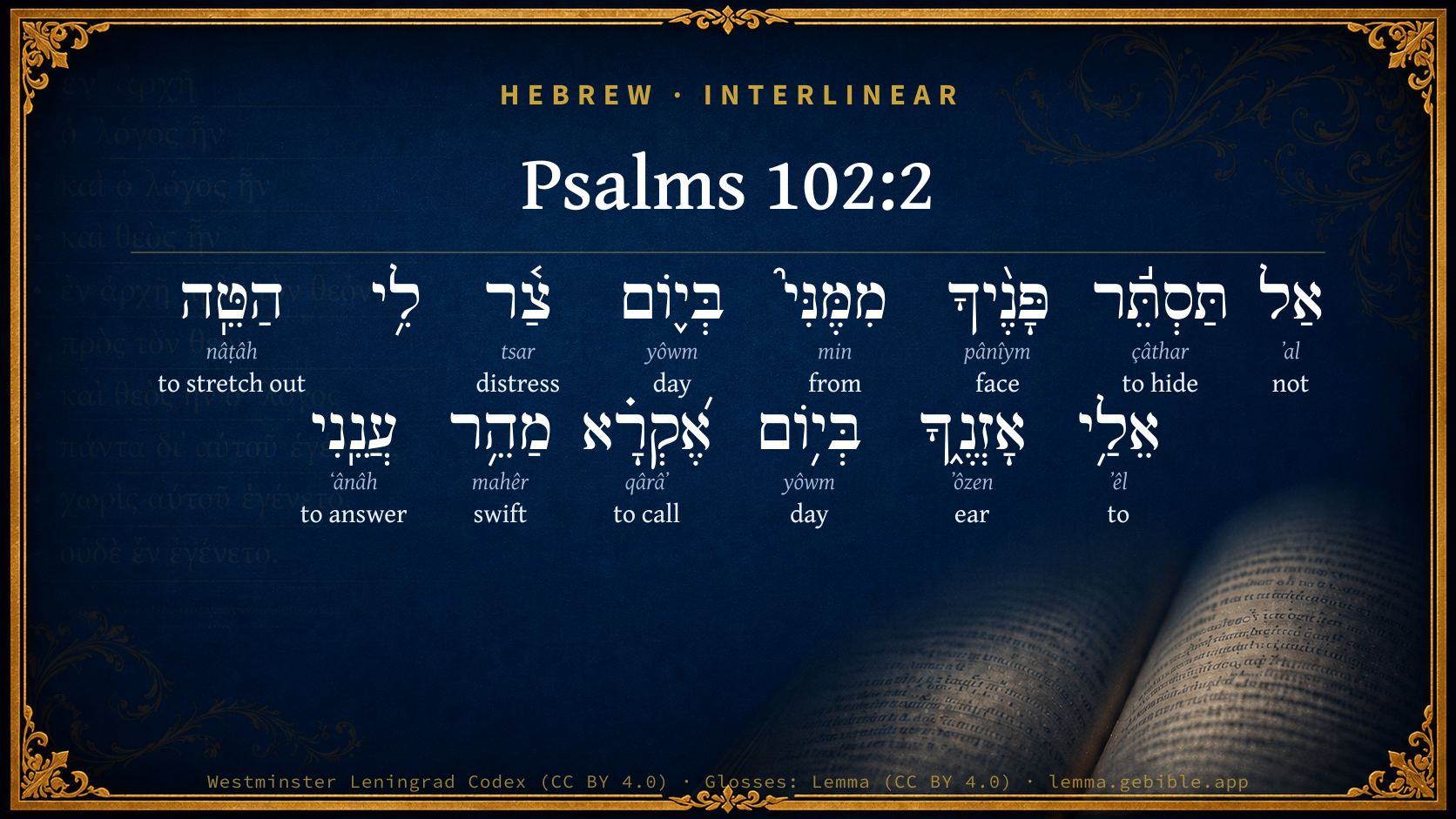
Hebrew (Westminster Leningrad Codex) Psalms 102:2 appears in the Hebrew Old Testament. The text above is from the Westminster Leningrad Codex. Each word links to its Strong’s number, a concise gloss, and parsing drawn from the Open Scriptures Hebrew Bible morphology. Click any word for its full Brown-Driver-Briggs (BDB) entry.
Download image
Cite this verse

Psalms 102:2 (World English Bible). Public Domain. Lemma interlinear Bible study tool, https://lemma.gebible.app/v/psalms/102/2.

Show BibTeX & RIS
BibTeX
RIS
English Translation
Don't hide your face from me in the day of my distress. Turn your ear to me. Answer me quickly in the day when I call.
World English Bible · Public Domain
Download a study sheet

One document with this verse’s original text, its word-by-word gloss line, the meaning frame, cross-references with their text, attributed commentary, and full source and license credits — printable, and it pastes into notes with its structure intact.

This verse Autodidact and up

Study sheet (.html) Plain text (.txt)

A passage Seminary Student

Up to 50 verses in one chapter. A passage sheet keeps up to 6 commentary sources and 12 cross-references per verse, in the order this page ranks them, and says so on the sheet whenever that leaves anything out. Ask for a single verse and you get the Autodidact verse sheet above.

Everything on this page stays free to read, with no account — the sheet is a download of what is already on screen, not access to it.

Want to remove ads? Support Godless Engineer
Compare translations 3

The same verse in 3 English versions, stacked beneath the original-language interlinear above. Click any original word for its lexicon entry.

Each is an independent rendering of the whole verse — the interlinear is not word-aligned to these translations.

Highlighted words mark where these versions differ — a whole-verse word diff, not a word-by-word alignment.

  • World English Bible Public Domain
    Don't hide your face from me in the day of my distress. Turn your ear to me. Answer me quickly in the day when I call.
  • King James Version Public Domain
    Hide not thy face from me in the day when I am in trouble; incline thine ear unto me: in the day when I call answer me speedily.
  • unfoldingWord Literal Text CC BY-SA 4.0
    Do not hide your face from me on the day it distresses me. Incline your ear to me. On the day I call out, hurry, answer me.

unfoldingWord Literal Text — © unfoldingWord, licensed CC BY-SA 4.0. Word-aligned USFM3 via Door43 (git.door43.org/unfoldingWord/en_ult).

Versions to compare (up to 4)

3 of 4 selected

Show all 18 translations

Every available English version of this verse, each an independent rendering of the whole verse.

  • World English Bible Public Domain
    Don't hide your face from me in the day of my distress. Turn your ear to me. Answer me quickly in the day when I call.
  • Berean Standard Bible Public Domain
    Do not hide Your face from me in my day of distress. Incline Your ear to me; answer me quickly when I call.
  • Majority Standard Bible Public Domain
    Do not hide Your face from me in my day of distress. Incline Your ear to me; answer me quickly when I call.
  • King James Version Public Domain
    Hide not thy face from me in the day when I am in trouble; incline thine ear unto me: in the day when I call answer me speedily.
  • American Standard Version (1901) Public Domain
    Hide not thy face from me in the day of my distress: Incline thine ear unto me; In the day when I call answer me speedily.
  • Revised Version (1885) Public Domain
    Hide not thy face from me in the day of my distress: incline thine ear unto me; in the day when I call answer me speedily.
  • Geneva Bible (1599) Public Domain
    Hide not thy face from me in the time of my trouble: incline thine eares vnto me: when I call, make haste to heare me.
  • Douay-Rheims (1899) Public Domain
    Hear, O Lord, my prayer: and let my cry come to thee.
  • Young's Literal Translation Public Domain
    Hide not Thou Thy face from me, In a day of mine adversity, Incline unto me Thine ear, In the day I call, haste, answer me.
  • Literal Standard Version CC BY-SA 4.0
    Do not hide Your face from me, || In a day of my adversity, || Incline Your ear to me, || In the day I call, hurry, answer me.
  • Unlocked Literal Bible CC BY-SA 4.0
    Do not hide your face from me in my time of trouble. Listen to me. When I call out to you, answer me quickly.
  • unfoldingWord Literal Text CC BY-SA 4.0
    Do not hide your face from me on the day it distresses me. Incline your ear to me. On the day I call out, hurry, answer me.
  • Darby Bible Public Domain
    Hide not thy face from me: in the day of my trouble, incline thine ear unto me; in the day I call, answer me speedily.
  • World Messianic Bible Public Domain
    Don’t hide your face from me in the day of my distress. Turn your ear to me. Answer me quickly in the day when I call.
  • Webster's Bible Public Domain
    \\102:1\\A Prayer of the afflicted, when he is overwhelmed, and poureth out his complaint before the LORD. Hear my prayer, O LORD, and let my cry come to thee.
  • Free Bible Version CC BY-SA 4.0
    Don't hide your face from me in my time of trouble! Turn and listen to me, and answer me quickly when I call.
  • Bible in Basic English Public Domain
    Let not your face be veiled from me in the day of my trouble; give ear to me, and let my cry be answered quickly.
  • JPS Tanakh (1917) Public Domain
    (102-3) Hide not Thy face from me in the day of my distress; incline Thine ear unto me; in the day when I call answer me speedily.

Literal Standard Version (2020), Covenant Press — licensed CC BY-SA 4.0. Text via the HelloAO Bible API (eBible.org). Unlocked Literal Bible (unfoldingWord) — licensed CC BY-SA 4.0. Text via the HelloAO Bible API (eBible.org). unfoldingWord Literal Text — © unfoldingWord, licensed CC BY-SA 4.0. Word-aligned USFM3 via Door43 (git.door43.org/unfoldingWord/en_ult). Free Bible Version, Dr. Jonathan Gallagher — licensed CC BY-SA 4.0. Text via the HelloAO Bible API (eBible.org).

Word by word

More ways to search: Search by grammar → Find every occurrence → Compare this word →

Practice this passage: Drill this verse → Learn its vocabulary →

מַהֵ֥ר
mahêr
H4118
“swift”
Verb, Piel, Imperative, 2nd Person, Masculine, Singular
Part of Speech
Verb
Stem
Piel
Form
Imperative
Person
2nd Person
Gender
Masculine
Number
Singular
Full BDB Definition

Origin: from H4116

TWOT: 1152a , 1152b

hurrying, speedy, swift, hastening (adjective) - quickly, speedily (adverb)
  1. אַל ʼal H408 “not” Particle, Negative
  2. תַּסְתֵּ֬ר çâthar H5641 “to hide” Verb, Hiphil, Jussive, 2nd Person, Masculine, Singular
  3. פָּנֶ֨יךָ pânîym H6440 “face(s) · your” Noun, Common, Both, Plural, Construct + Suffix, Personal, 2nd Person, Masculine, Singular
  4. מִמֶּנִּי֮ min H4480 “from · me” Preposition + Suffix, Personal, 1st Person, Common, Singular
  5. בְּי֪וֹם yôwm H3117 “in/at · day of” Preposition + Noun, Common, Masculine, Singular, Construct
  6. צַ֫ר tsar H6862 “distress” Verb, Qal, Perfect, 3rd Person, Masculine, Singular
  7. הַטֵּֽה nâṭâh H5186 “stretch out” Verb, Hiphil, Imperative, 2nd Person, Masculine, Singular
  8. אֵלַ֥י ʼêl H413 “to · me” Preposition + Suffix, Personal, 1st Person, Common, Singular
  9. אָזְנֶ֑ךָ ʼôzen H241 “ear · your” Noun, Common, Feminine, Singular, Construct + Suffix, Personal, 2nd Person, Masculine, Singular
  10. בְּי֥וֹם yôwm H3117 “in/at · day of” Preposition + Noun, Common, Masculine, Singular, Construct
  11. אֶ֝קְרָ֗א qârâʼ H7121 “to call” Verb, Qal, Imperfect, 1st Person, Common, Singular
  12. עֲנֵֽנִי ʻânâh H6030 “answer · me” Verb, Qal, Imperative, 2nd Person, Masculine, Singular + Suffix, Personal, 1st Person, Common, Singular

About this verse

These counts appear in no published source. They are computed here, from the morphology-tagged text and Lemma’s own curated glosses. What Lemma adds →

14
words
12
distinct lemmas
Wisdom
section

Notable vocabulary

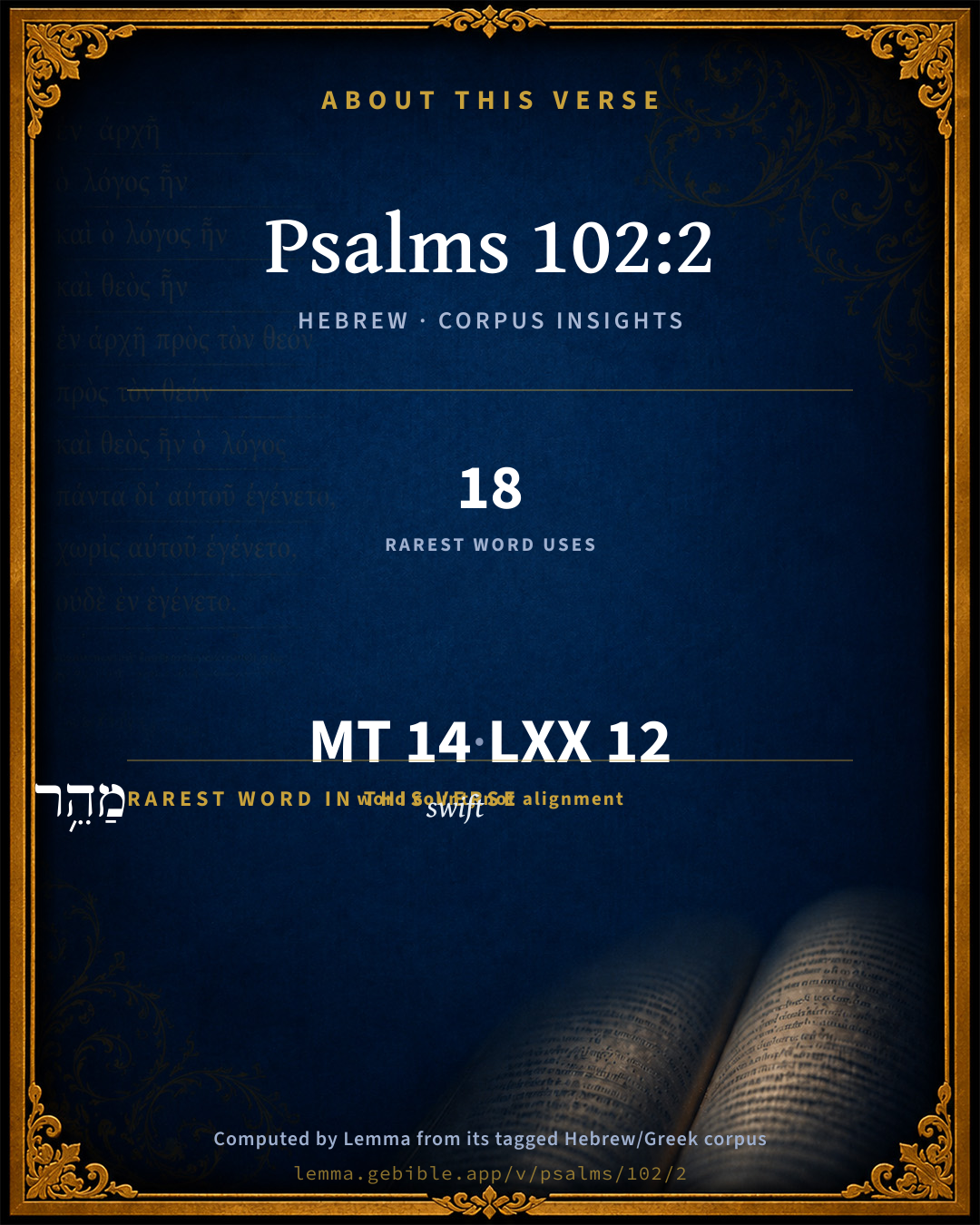
The rarest word here is מַהֵ֥ר swift H4118 — appearing just 18 times in the whole Hebrew Bible.

Shared distinctive vocabulary

מַהֵ֥ר swift H4118 occurs in 17 verses of the Hebrew Bible. Also found in:

Grammatical profile

  • 6 verbs
  • 4 nouns
  • 3 prepositions
  • 1 particle

Verb forms

  • תַּסְתֵּ֬ר Hiphil · Jussive
  • צַ֫ר Qal · Perfect
  • הַטֵּֽה Hiphil · Imperative
  • אֶ֝קְרָ֗א Qal · Imperfect
  • מַהֵ֥ר Piel · Imperative
  • עֲנֵֽנִי Qal · Imperative

Repetition

A word recurs within this verse — often emphatic in Hebrew:

  • בְּי֪וֹם day H3117 ×2

Hebrew & Septuagint length

In English translation the verse runs 26 words from the Hebrew and 31 from the Septuagint (LXX English) — closely comparable.

A rough comparison of the two English renderings, which tokenize alike — not a word-level alignment.

Word counts can differ between the Hebrew and the Greek without any difference in meaning — e.g. the Hebrew direct-object marker אֵת has no separate Greek word, and Greek often adds the article ὁ.

In the original languages it is 14 Hebrew tokens and 12 Greek tokens — but the two are counted differently (Hebrew bundles its prefixes and suffixes into one token; the Greek is in lemma form), so that isn’t a like-for-like length.

Cross-references

18

Topical passages linked to Psalms 102:2 in the Treasury of Scripture Knowledge — connected by theme and wording, ordered by reader-vote popularity; previews shown in the World English Bible.

  • Psalms 69:17 Don't hide your face from your servant, For I am in distress. Answer me speedily!
  • Psalms 27:9 Don't hide your face from me. Don't put your servant away in anger. You have been my help. Don't abandon me, Neither forsake me, God of my salvation.
  • Psalms 70:1 Hurry, God, to deliver me. Come quickly to help me, Yahweh.
  • Isaiah 8:17 I will wait for Yahweh, who hides his face from the house of Jacob, and I will look for him.
  • Psalms 71:2 Deliver me in your righteousness, and rescue me. Turn your ear to me, and save me.
  • Psalms 88:2–18 Let my prayer enter into your presence. Turn your ear to my cry.
  • Psalms 104:29 You hide your face: they are troubled; You take away their breath: they die, and return to the dust.
  • Psalms 143:7 Hurry to answer me, Yahweh. My spirit fails. Don't hide your face from me, So that I don't become like those who go down into the pit.
  • Acts 12:5–25 Peter therefore was kept in the prison, but constant prayer was made by the assembly to God for him.
  • 1 Corinthians 10:13 No temptation has taken you except what is common to man. God is faithful, who will not allow you to be tempted above what you are able, but will with the temptation also make the way of escape, that you may be able to endure it.
  • Psalms 22:19 But don't be far off, Yahweh. You are my help: hurry to help me.
  • Psalms 31:2 Bow down your ear to me. Deliver me speedily. Be to me a strong rock, A house of defense to save me.
  • Psalms 40:13 Be pleased, Yahweh, to deliver me. Hurry to help me, Yahweh.
  • Isaiah 43:2 When you pass through the waters, I will be with you; and through the rivers, they shall not overflow you: when you walk through the fire, you shall not be burned, neither shall the flame kindle on you.
  • Job 7:21 Why do you not pardon my disobedience, and take away my iniquity? For now shall I lie down in the dust. You will seek me diligently, but I shall not be."
  • Job 34:29 When he gives quietness, who then can condemn? When he hides his face, who then can see him? Alike whether to a nation, or to a man:
  • Isaiah 65:24 It shall happen that, before they call, I will answer; and while they are yet speaking, I will hear.
  • Psalms 13:1 How long, Yahweh? Will you forget me forever? How long will you hide your face from me?

Cross-references courtesy of OpenBible.info (CC BY 4.0).

Hebrew and Greek witnesses Masoretic Hebrew ↔ Greek Septuagint

The same verse in the two great witnesses to the Old Testament, shown verse-for-verse.

You’re reading Greek Psalm 101 (Hebrew Psalm 102). The Septuagint counts the superscription, so verse numbers can differ from the Hebrew — chapter-level alignment, not verse-by-verse. Numbering follows Rahlfs.

These are two independent witnesses, not word-aligned to each other, and the Septuagint is shown in lemma (dictionary) form.

Hebrew Psalms 102:2 Masoretic · Westminster Leningrad Codex

אַל תַּסְתֵּ֬ר פָּנֶ֨יךָ מִמֶּנִּי֮ בְּי֪וֹם צַ֫ר לִ֥י הַטֵּֽה אֵלַ֥י אָזְנֶ֑ךָ בְּי֥וֹם אֶ֝קְרָ֗א מַהֵ֥ר עֲנֵֽנִי

Don't hide your face from me in the day of my distress. Turn your ear to me. Answer me quickly in the day when I call.

World English Bible · Public Domain

Greek LXX Greek Psalm 101:2 Septuagint · lemma form

εἰςἀκούω κύριος ὁ προσευχή ἐγώ καί ὁ κραυγή ἐγώ πρός σύ ἔρχομαι

Turn not away your face from me: in the day when I am afflicted, incline your ear to me: in the day when I shall call upon you, speedily hear me.

LXX2012 (modern English Septuagint) · Public Domain

On this verse, Albert Barnes' Notes on the Bible discusses the Septuagint’s reading. Read the note in Commentary ↓

Hebrew: Westminster Leningrad Codex (CC BY 4.0). Greek: Septuagint (public domain); English from LXX2012 (modern English Septuagint) (Public Domain). How the Septuagint differs from the Hebrew →

Commentary

Notes on Psalms 102:2 from classic Christian and Jewish commentators (each source and its license shown beneath its notes). The classic Christian expositions comment on the surrounding passage and are grouped to its opening verse, so a note may address several verses; the Jewish commentaries on the Tanakh (Rashi and others) are per-verse, so they appear only where the commentator wrote on this verse.

Lemma curates 59 commentaries, every one of them public domain or Creative Commons licensed, each selected and text-cleaned for this edition rather than reprinted as found. About our sources →

Trapp's Complete Commentary

John Trapp

Psa 102:2 Hide not thy face from me in the day [when] I am in trouble; incline thine ear unto me: in the day [when] I call answer me speedily.

Ver. 2. Hide not thy face from me] For this would be worse than all the rest. See Jer 16:13, "I will cast you out of this land, and I will show you no favour." This last was a cutting speech, and far worse than their captivity; and yet,

Non exul curae dicitur esse Deo.

Answer me speedily] Festina, responde. In our earnest prayers we may press for expedition in general, not tying God to any particular time, as those Bethulians did in the Book of Judith.

John Trapp, A Commentary or Exposition upon All the Books of the Old and New Testament (1647–1656) — public domain. Text from a community e-Sword module.

J. A. Alexander on Psalms

Joseph Addison Alexander

3. (Psa 102:2) Hide not thy face from me; in the day (there is) distress to me, incline to me thine ear; in the day I call, make haste (and) answer me. Compare Psa 10:1; Psa 13:1; Psa 17:6; Psa 18:6; Psa 27:9; Psa 31:2; Psa 56:9; Psa 66:13; Psa 71:2. We find here accumulated nearly all the phrases used by David to express the same ideas elsewhere. This is not unnatural if we suppose him to have been preparing a form of complaint and supplication for the use of his successors in their worst distresses.

Joseph Addison Alexander, The Psalms Translated and Explained (1850) — public domain. Text from a community e-Sword module.

John Calvin's Commentaries

2 Hide not thy face from me in the day of my affliction The prayer, that God would not hide his face, is far from being superfluous. As the people had been languishing in captivity for the space of nearly seventy years, it might seem that God had for ever turned away his favor from them. But they are, notwithstanding, commanded, in their extreme affliction, to have recourse to prayer as their only remedy. They affirm that they cry in the day of their affliction, not as hypocrites are accustomed to do, who utter their complaints in a tumultuous manner, but because they feel that they are then called upon by God to cry to him.

Make haste, answer me Having elsewhere spoken more fully of these forms of expression, it may suffice, at present, briefly to observe, that when God permits us to lay open before him our infirmities without reserve, and patiently bears with our foolishness, he deals in a way of great tenderness towards us. To pour out our complaints before him after the manner of little children would certainly be to treat his Majesty with very little reverence, were it not that he has been pleased to allow us such freedom. I purposely make use of this illustration, that the weak, who are afraid to draw near to God, may understand that they are invited to him with such gentleness as that nothing may hinder them from familiarly and confidently approaching him.

John Calvin's Commentaries (1540-1563) — public domain. Text from the Calvin Translation Society English edition (1840s-50s) via the Christian Classics Ethereal Library (ccel.org). Calvin's coverage is partial (roughly two-thirds of the Bible); uncommented books and verses are honest gaps, never fabricated. The 19th-century editor's footnotes and remarks are omitted so the notes are faithfully Calvin's own voice.

Ellicott's Commentary for English Readers

(2) This verse may be better arranged, Hide not . . . in the day of my trouble. Incline . . . in the day when I call. Answer me speedily.

A Bible Commentary for English Readers, edited by Charles John Ellicott (1878–1897) — public domain. Text from a community e-Sword module.

John Gill's Exposition

Hide not thy face from me in the day when I am in trouble,.... Thy Shechinah, as the Targum: when God hides his face at any time from his people, it is a trouble to them, and very grievous; but especially when they are in any other trouble besides; it is very afflicting, indeed, when to their outward trouble this is added, which was Job's case, Job 23:1, incline thine ear unto me; condescend, in great grace and goodness, to stoop and bow thine ear, and listen to the voice of my supplication: in the day when I call, answer me speedily; good men are always for speedy answers of prayer; they would have them the day, the hour, the moment they are calling upon God: sometimes answers are returned as soon, Isa 65:24, the case of the psalmist was very distressing, and, as he thought at least, required haste, and therefore requests a speedy answer.

, the case of the psalmist was very distressing, and, as he thought at least, required haste, and therefore requests a speedy answer.

Psalms 102:3

psa 102:3

psa 102:3

psa 102:3For my days are consumed like smoke,.... Which suddenly rises up, is easily dissipated, and quickly disappears; so sudden, short, and transient, are the days of man's life; see Jam 4:14 or "in smoke" (c), as the Syriac version; his days were spent in great obscurity, in the darkness of affliction, temptation, and desertion; and in so much vexation, trouble, and uneasiness, as if he had lived in smoke all his time: and

my bones are burnt as an hearth; on which fire is continually made for the preparation of food, and other uses: or as a "trivet", or "gridiron": so the Targum: or as a frying pan; so the Arabic version: the meaning is, that, through trouble and grief, his bones, the strongest parts of his body, the props and supports of it, were so weakened and enfeebled, the strength of them so exhausted, that they were as if they had been parched and burnt up, as the hearth by fire; see Pro 17:22.

(c) "in fumo", Montanus.

John Gill's Exposition of the Whole Bible (1746–1763) — public domain (CC PDM 1.0). Text via the HelloAO Bible API.

Albert Barnes' Notes on the Bible

Hide not thy face from me - The Septuagint and the Latin Vulgate render this, “Do not turn away thy face from me.” The sense is essentially the same. The prayer is, that God would not refuse to look graciously upon him; that he would turn his attention to him; that he would regard his supplications. See the notes at Psa 10:1; compare Psa 13:1; Psa 27:9; Job 13:24; Job 34:29; Deu 31:17.

In the day when I am in trouble - When sorrows come upon me; when I need thy gracious help. Literally, “When there is distress to me.”

Incline thine ear unto me - See Psa 5:1, note; Psa 17:6, note; compare Psa 17:1; Psa 55:1; Psa 86:6; Psa 39:12.

In the day when I call, answer me speedily - Grant at once my requests; give me immediate evidence that my prayer is heard. The psalmist believed in an immediate answer to prayer. He often had evidence that his prayer was answered at once; his mind became calm; he had comfort and peace; he obtained the blessing which he earnestly sought. No one can doubt that prayer may be answered at once; no one who prays can fail to find such answers in his own case, in his peace, his calmness, his joy. In multitudes of cases blessings are granted in such a way that there can be no doubt that they have come in answer to prayer. Compare the notes at Dan 9:20-23.

Albert Barnes' Notes on the Bible (1834–1885) — public domain. Text from a community e-Sword/MySword module.

The Treasury of David

Charles H. Spurgeon

Ver. 2. Hide not thy face from me in the day when I am in trouble. Do not seem as if thou didst not see me, or wouldst not own me. Smile now at any rate. Reserve thy frowns for other times when I can bear them better, if, indeed, I can ever bear them; but now in my heavy distress, favour me with looks of compassion.

Incline thine ear unto me. Bow thy greatness to my weakness. If because of sin thy face is turned away, at least let me have a side view of thee, lend me thine ear if I may not see thine eye. Turn thyself to me again if, my sin has turned thee away, give to thine ear an inclination to my prayers.

In the day when I call answer me speedily. Because the case is urgent, and my soul little able to wait. We may ask to have answers to prayer as soon as possible, but we may not complain of the Lord if he should think it more wise to delay. We have permission to request and to use importunity, but no right to dictate or to be petulant. If it be important that the deliverance should arrive at once, we are quite right in making an early time a point of our entreaty, for God is as willing to grant us a favour now as to-morrow, and he is not slack concerning his promise. It is a proverb concerning favours from human hands, that "he gives twice who gives quickly, "because a gift is enhanced in value by arriving in a time of urgent necessity; and we may be sure that our heavenly Patron will grant us the best gifts in the best manner, granting us grace to help in time of need. When answers come upon the heels of our prayers they are all the more striking, more consoling, and more encouraging.

In these two verses the psalmist has gathered up a variety of expressions all to the same effect; in them all he entreats an audience and answer of the Lord, and the whole may be regarded as a sort of preface to the prayer which follows.

Ver. 2. Incline thine ear unto me. The great exhaustion of the affiicted one is hinted at: so worn out is he, that he is hardly able to cry any more, but with a faint voice only feebly mutters, like a weak sick man, whose voice if we would catch, we must incline the ear. Martin Geier.

Ver. 2.

1. Prayer in trouble is most needed.

2. Prayer in trouble is most heeded.

3. Prayer in trouble is most speeded: "Answer me speedily."

Or,

1. Prayer in trouble: "In the day, "etc.

2. The prayer of trouble: "Hide not thy face; "not remove the trial, but be with me in it. A fiery furnace is a paradise when God is with us there. G. R.

Ver. 2 (first elause). He deprecates the loss of the divine countenance when under trouble.

1. That would intensify it a thousandfold.

2. That would deprive him of strength to bear the trouble.

3. That would prevent his acting so as to glorify God in the trouble.

4. That might injure the result of the trouble.

Ver. 2 (last clause).

1. We often need to be answered speedily.

2. God can so answer.

3. God has so answered.

4. God has promised so to answer.

Psalms 102:3*

Charles H. Spurgeon's The Treasury of David (1869–1885) — public domain. Psalms only. Text from a community e-Sword/MySword module.

The Pulpit Commentary

Hide not thy face from me. (so in Psa_27:9 Psa_69:17 Psa_143:7) As the "light of God"s countenance" is the greatest of all goods, (Psa_4:6) so its withdrawal is the worst of evils. In the day when I am in trouble; literally, in the day of my trouble, or of my straits. Incline thine ear unto me. (comp. Psa_17:6 Psa_71:2 Psa_88:2, etc.) In the day when I call, answer me speedily. Compare the vesicles of our Prayer book, "O God, make speed to save us; O Lord, make haste to help us."

The Pulpit Commentary (1880–1919), ed. H.D.M. Spence-Jones & Joseph S. Exell — public domain. Text from a community e-Sword module.

Lesson kit

Teaching starters — assembled from the data on this page, not authored interpretation. Every prompt links to the verse data it draws on. Edit before teaching.

Psalms, in the Wisdom, opens this verse with 14 words (12 distinct Hebrew lemmas). Its most distinctive word is mahêr (“swift”). A historical commentator’s framing appears above. Read the whole chapter for the surrounding context.

Discussion questions

  1. The word mahêr carries the sense “swift.” How does it shape the verse?
  2. How does Exodus 32:8, which shares the word «swift», read alongside this verse?
  3. What does the repetition of “day” (2× in this one verse) do in this verse?
  4. These translations render this verse differently; the difference is in the English rendering, not the original. What questions does that raise?
  5. «תַּסְתֵּ֬ר» is a Hiphil Jussive verb. How does that grammatical form shape the action described?
  6. Compare how Trapp's Complete Commentary and J. A. Alexander on Psalms read this verse. Where do they agree or differ?

Things to notice

Reading settings

Reading text

Shown beneath each verse's original-language words.

Old Testament
Old Testament edition

Read the OT as the Masoretic Hebrew (MT) or the Greek Septuagint (LXX).

English shown for the Greek Septuagint (in the Hebrew ↔ Greek comparison).

Comparing translations? Open the Compare panel on any verse page to stack up to four side by side.