

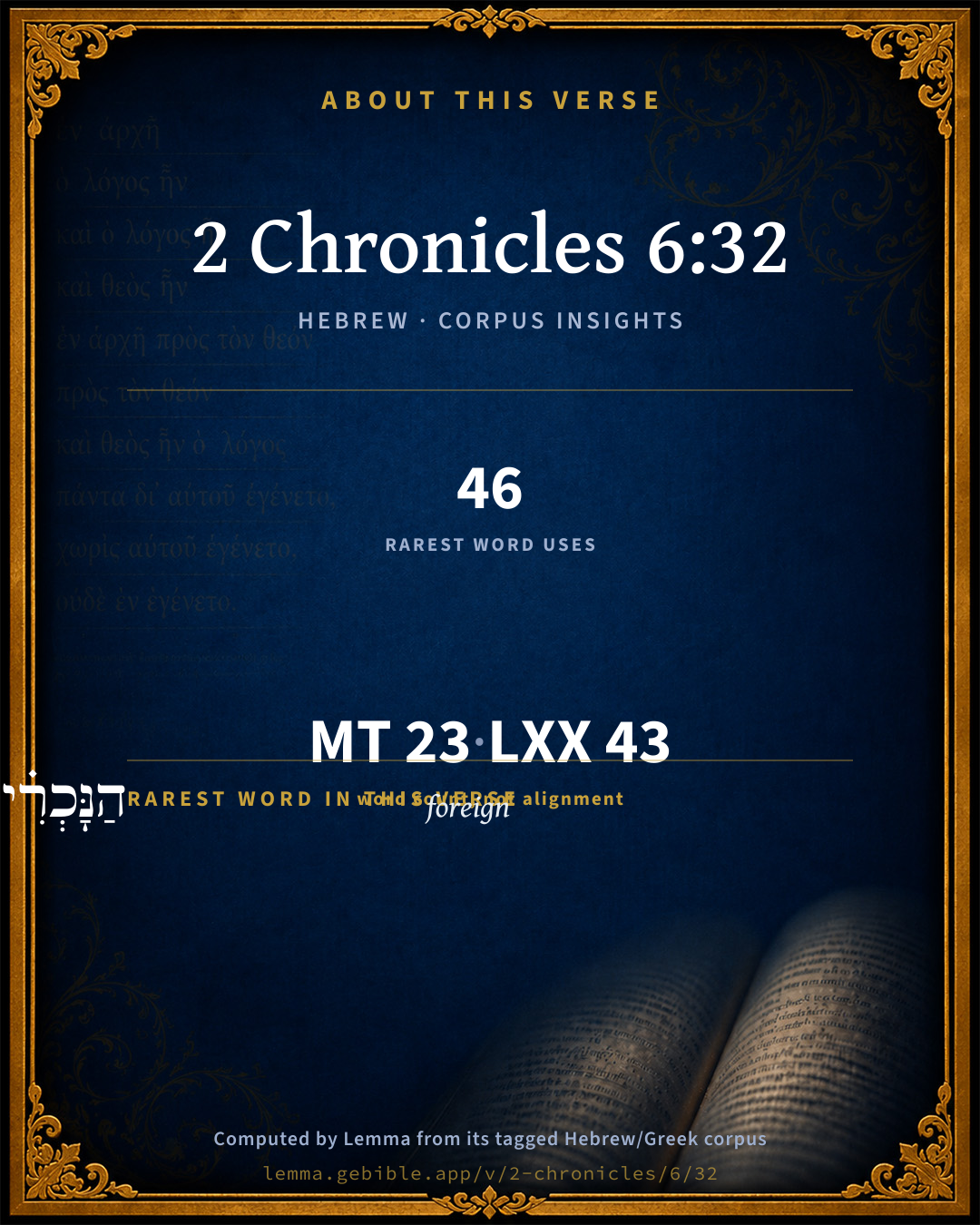
2 Chronicles 6:32

Hebrew (Westminster Leningrad Codex) 2 Chronicles 6:32 appears in the Hebrew Old Testament. The text above is from the Westminster Leningrad Codex. Each word links to its Strong’s number, a concise gloss, and parsing drawn from the Open Scriptures Hebrew Bible morphology. Click any word for its full Brown-Driver-Briggs (BDB) entry.
Download image
Cite this verse

2 Chronicles 6:32 (World English Bible). Public Domain. Lemma interlinear Bible study tool, https://lemma.gebible.app/v/2-chronicles/6/32.

Show BibTeX & RIS
BibTeX
RIS
English Translation
Moreover concerning the foreigner, who is not of your people Israel, when he shall come from a far country for your great name's sake, and your mighty hand, and your outstretched arm; when they shall come and pray toward this house:
World English Bible · Public Domain
Download a study sheet

One document with this verse’s original text, its word-by-word gloss line, the meaning frame, cross-references with their text, attributed commentary, and full source and license credits — printable, and it pastes into notes with its structure intact.

This verse Autodidact and up

Study sheet (.html) Plain text (.txt)

A passage Seminary Student

Up to 50 verses in one chapter. A passage sheet keeps up to 6 commentary sources and 12 cross-references per verse, in the order this page ranks them, and says so on the sheet whenever that leaves anything out. Ask for a single verse and you get the Autodidact verse sheet above.

Everything on this page stays free to read, with no account — the sheet is a download of what is already on screen, not access to it.

Want to remove ads? Support Godless Engineer
Compare translations 3

The same verse in 3 English versions, stacked beneath the original-language interlinear above. Click any original word for its lexicon entry.

Each is an independent rendering of the whole verse — the interlinear is not word-aligned to these translations.

Highlighted words mark where these versions differ — a whole-verse word diff, not a word-by-word alignment.

  • World English Bible Public Domain
    Moreover concerning the foreigner, who is not of your people Israel, when he shall come from a far country for your great name's sake, and your mighty hand, and your outstretched arm; when they shall come and pray toward this house:
  • King James Version Public Domain
    Moreover concerning the stranger, which is not of thy people Israel, but is come from a far country for thy great name's sake, and thy mighty hand, and thy stretched out arm; if they come and pray in this house;
  • unfoldingWord Literal Text CC BY-SA 4.0
    And also to the foreigner who is not from your people Israel, and he comes from a distant land because of your great name, and your strong hand, and your outstretched arm, and they come and pray toward this house,

unfoldingWord Literal Text — © unfoldingWord, licensed CC BY-SA 4.0. Word-aligned USFM3 via Door43 (git.door43.org/unfoldingWord/en_ult).

Versions to compare (up to 4)

3 of 4 selected

Show all 18 translations

Every available English version of this verse, each an independent rendering of the whole verse.

  • World English Bible Public Domain
    Moreover concerning the foreigner, who is not of your people Israel, when he shall come from a far country for your great name's sake, and your mighty hand, and your outstretched arm; when they shall come and pray toward this house:
  • Berean Standard Bible Public Domain
    And as for the foreigner who is not of Your people Israel but has come from a distant land because of Your great name and Your mighty hand and outstretched arm—when he comes and prays toward this temple,
  • Majority Standard Bible Public Domain
    And as for the foreigner who is not of Your people Israel but has come from a distant land because of Your great name and Your mighty hand and outstretched arm—when he comes and prays toward this temple,
  • King James Version Public Domain
    Moreover concerning the stranger, which is not of thy people Israel, but is come from a far country for thy great name's sake, and thy mighty hand, and thy stretched out arm; if they come and pray in this house;
  • American Standard Version (1901) Public Domain
    Moreover concerning the foreigner, that is not of thy people Israel, when he shall come from a far country for thy great name's sake, and thy mighty hand, and thine outstretched arm; when they shall come and pray toward this house:
  • Revised Version (1885) Public Domain
    Moreover concerning the stranger, that is not of thy people Israel, when he shall come from a far country for thy great name’s sake, and thy mighty hand, and thy stretched out arm; when they shall come and pay toward this house:
  • Geneva Bible (1599) Public Domain
    Moreouer, as touching ye stranger which is not of thy people Israel, who shall come out of a farre countrey for thy great Names sake, and thy mighty hande, and thy stretched out arme: when they shall come and pray in this house,
  • Douay-Rheims (1899) Public Domain
    If the stranger also, who is not of thy people Israel, come from a far country, for the sake of thy great name, and thy strong hand, and thy stretched out arm, and adore in this place:
  • Young's Literal Translation Public Domain
    `And also, unto the stranger who is not of Thy people Israel, and he hath come from a land afar off for the sake of Thy great name, and Thy strong hand, and Thy stretched-out arm, and they have come in and prayed towards this house:
  • Literal Standard Version CC BY-SA 4.0
    And also, to the stranger who is not of Your people Israel, and he has come from a far-off land for the sake of Your great Name, and Your strong hand, and Your outstretched arm, and they have come in and prayed toward this house—
  • Unlocked Literal Bible CC BY-SA 4.0
    As for the foreigner who does not belong to your people Israel, but who—because of your great name, your mighty hand, and your outstretched arm—comes and prays toward this house,
  • unfoldingWord Literal Text CC BY-SA 4.0
    And also to the foreigner who is not from your people Israel, and he comes from a distant land because of your great name, and your strong hand, and your outstretched arm, and they come and pray toward this house,
  • Darby Bible Public Domain
    And as to the stranger also, who is not of thy people Israel, but cometh out of a far country for thy great name's sake, and thy mighty hand and thy stretched-out arm; when they shall come and pray toward this house,
  • World Messianic Bible Public Domain
    “Moreover, concerning the foreigner, who is not of your people Israel, when he comes from a far country for your great name’s sake and your mighty hand and your outstretched arm, when they come and pray toward this house,
  • Webster's Bible Public Domain
    Moreover concerning the stranger, who is not of thy people Israel, but hath come from a distant country for thy great name's sake, and thy mighty hand, and thy out-stretched arm; if they come and pray in this house;
  • Free Bible Version CC BY-SA 4.0
    As for the foreigners who do not belong to your people Israel but who come from a distant land, having heard of your great nature and power and ability to help, when they come and pray toward this Temple,
  • Bible in Basic English Public Domain
    And as for the man from a strange land, who is not of your people Israel but comes from a far country because of the glory of your name and your strong hand and your outstretched arm; when he comes to make his prayer, turning to this house:
  • JPS Tanakh (1917) Public Domain
    Moreover concerning the stranger, that is not of Thy people Israel, when be shall come out of a far country for Thy great name's sake, and Thy mighty hand, and Thine outstretched arm; when they shall come and pray toward this house;

Literal Standard Version (2020), Covenant Press — licensed CC BY-SA 4.0. Text via the HelloAO Bible API (eBible.org). Unlocked Literal Bible (unfoldingWord) — licensed CC BY-SA 4.0. Text via the HelloAO Bible API (eBible.org). unfoldingWord Literal Text — © unfoldingWord, licensed CC BY-SA 4.0. Word-aligned USFM3 via Door43 (git.door43.org/unfoldingWord/en_ult). Free Bible Version, Dr. Jonathan Gallagher — licensed CC BY-SA 4.0. Text via the HelloAO Bible API (eBible.org).

Word by word

More ways to search: Search by grammar → Find every occurrence → Compare this word →

Practice this passage: Drill this verse → Learn its vocabulary →

הַנָּכְרִ֗י
nokrîy
H5237
“the · foreign”
Particle, Definite Article + Adjective, Adjective, Masculine, Singular, Absolute
Part of Speech
Particle + Adjective
Type
Adjective
Gender
Masculine
Number
Singular
State
Absolute
Full BDB Definition

Origin: from H5235 (second form)

TWOT: 1368c

foreign, alien - foreign - foreigner (substantive) - foreign woman, harlot - unknown, unfamiliar (figuratively)
  1. וְגַ֣ם gam H1571 “and · also” Conjunction + Particle, Accusative
  2. אֶל ʼêl H413 “to” Preposition
  3. אֲ֠שֶׁר ʼăsher H834 “which” Particle, Relative
  4. לֹ֥א lôʼ H3808 “not” Particle, Negative
  5. מֵעַמְּךָ֣ ʻam H5971 “from · people · your” Preposition + Noun, Common, Masculine, Singular, Construct + Suffix, Personal, 2nd Person, Masculine, Singular
  6. יִשְׂרָאֵל֮ Yisrâʼêl H3478 “Israel” Noun, Proper
  7. הוּא֒ hûwʼ H1931 “he” Pronoun, Personal, 3rd Person, Masculine, Singular
  8. וּבָ֣א bôwʼ H935 “and · to enter” Conjunction + Verb, Qal, Sequential Perfect, 3rd Person, Masculine, Singular
  9. מֵאֶ֣רֶץ ʼerets H776 “from · land” Preposition + Noun, Common, Both, Singular, Absolute
  10. רְחוֹקָ֗ה râchôwq H7350 “far” Adjective, Adjective, Feminine, Singular, Absolute
  11. לְמַ֨עַן maʻan H4616 “for the sake of” Preposition
  12. שִׁמְךָ֤ shêm H8034 “name · your” Noun, Common, Masculine, Singular, Construct + Suffix, Personal, 2nd Person, Masculine, Singular
  13. הַגָּדוֹל֙ gâdôwl H1419 “the · great” Particle, Definite Article + Adjective, Adjective, Masculine, Singular, Absolute
  14. וְיָדְךָ֣ yâd H3027 “and · hand · your” Conjunction + Noun, Common, Both, Singular, Construct + Suffix, Personal, 2nd Person, Masculine, Singular
  15. הַחֲזָקָ֔ה châzâq H2389 “the · strong” Particle, Definite Article + Adjective, Adjective, Feminine, Singular, Absolute
  16. וּֽזְרֽוֹעֲךָ֖ zᵉrôwaʻ H2220 “and · arm · your” Conjunction + Noun, Common, Both, Singular, Construct + Suffix, Personal, 2nd Person, Masculine, Singular
  17. הַנְּטוּיָ֑ה nâṭâh H5186 “the · stretched out” Particle, Definite Article + Verb, Qal, Participle Passive, Feminine, Singular, Absolute
  18. וּבָ֥אוּ bôwʼ H935 “and · to enter” Conjunction + Verb, Qal, Sequential Perfect, 3rd Person, Common, Plural
  19. וְהִֽתְפַּלְל֖וּ pâlal H6419 “and · to pray” Conjunction + Verb, Hithpael, Sequential Perfect, 3rd Person, Common, Plural
  20. אֶל ʼêl H413 “to” Preposition
  21. הַבַּ֥יִת bayith H1004 “the · house” Particle, Definite Article + Noun, Common, Masculine, Singular, Absolute
  22. הַזֶּֽה zeh H2088 “the · this” Particle, Definite Article + Pronoun, Demonstrative, Masculine, Singular

About this verse

These counts appear in no published source. They are computed here, from the morphology-tagged text and Lemma’s own curated glosses. What Lemma adds →

23
words
21
distinct lemmas
Historical
section

Shared distinctive vocabulary

הַנָּכְרִ֗י foreign H5237 occurs in 45 verses of the Hebrew Bible. Also found in:

Grammatical profile

  • 4 verbs
  • 7 nouns
  • 4 adjectives
  • 2 pronouns
  • 3 prepositions
  • 3 particles

Verb forms

  • וּבָ֣א Qal · Sequential Perfect
  • הַנְּטוּיָ֑ה Qal · Participle Passive
  • וּבָ֥אוּ Qal · Sequential Perfect
  • וְהִֽתְפַּלְל֖וּ Hithpael · Sequential Perfect

Repetition

Words recur within this verse — often emphatic in Hebrew:

  • וּבָ֣א to enter H935 ×2
  • אֶל to H413 ×2

Hebrew & Septuagint length

In English translation the verse runs 41 words from the Hebrew and 43 from the Septuagint (LXX English) — closely comparable.

A rough comparison of the two English renderings, which tokenize alike — not a word-level alignment.

Word counts can differ between the Hebrew and the Greek without any difference in meaning — e.g. the Hebrew direct-object marker אֵת has no separate Greek word, and Greek often adds the article ὁ.

In the original languages it is 23 Hebrew tokens and 43 Greek tokens — but the two are counted differently (Hebrew bundles its prefixes and suffixes into one token; the Greek is in lemma form), so that isn’t a like-for-like length.

Cross-references

28

Topical passages linked to 2 Chronicles 6:32 in the Treasury of Scripture Knowledge — connected by theme and wording, ordered by reader-vote popularity; previews shown in the World English Bible.

  • Isaiah 56:3–7 Neither let the foreigner, who has joined himself to Yahweh, speak, saying, Yahweh will surely separate me from his people; neither let the eunuch say, Behold, I am a dry tree.
  • 1 Kings 8:41–43 Moreover concerning the foreigner, who is not of your people Israel, when he shall come out of a far country for your name's sake
  • Matthew 8:10–11 When Jesus heard it, he marveled, and said to those who followed, "Most assuredly I tell you, I haven't found so great a faith, not even in Israel.
  • Zechariah 14:16–17 It will happen that everyone who is left of all the nations that came against Jerusalem will go up from year to year to worship the King, Yahweh of Hosts, and to keep the feast of tents.
  • John 12:20 Now there were certain Greeks among those that went up to worship at the feast.
  • Acts 10:1–4 Now there was a certain man in Caesarea, Cornelius by name, a centurion of what was called the Italian Regiment,
  • Ephesians 2:12–13 that you were at that time separate from Christ, alienated from the commonwealth of Israel, and strangers from the covenants of the promise, having no hope and without God in the world.
  • Exodus 3:19–20 I know that the king of Egypt won't give you permission to go, no, not by a mighty hand.
  • Exodus 12:48–49 When a stranger shall live as a foreigner with you, and will keep the Passover to Yahweh, let all his males be circumcised, and then let him come near and keep it; and he shall be as one who is born in the land: but no uncircumcised person shall eat of it.
  • Joshua 9:9 They said to him, From a very far country your servants are come because of the name of Yahweh your God: for we have heard the fame of him, and all that he did in Egypt,
  • Isaiah 60:1–10 Arise, shine; for your light is come, and the glory of Yahweh is risen on you.
  • Isaiah 66:20 They shall bring all your brothers out of all the nations for an offering to Yahweh, on horses, and in chariots, and in litters, and on mules, and on dromedaries, to my holy mountain Jerusalem, says Yahweh, as the children of Israel bring their offering in a clean vessel into the house of Yahweh.
  • Zechariah 8:22 Yes, many peoples and strong nations will come to seek Yahweh of Hosts in Jerusalem, and to entreat the favor of Yahweh."
  • Matthew 2:1 Now when Jesus was born in Bethlehem of Judea in the days of Herod the king, behold, wise men from the east came to Jerusalem, saying,
  • John 10:16 I have other sheep, which are not of this fold. I must bring them also, and they will hear my voice. They will become one flock with one shepherd.
  • Acts 2:10 Phrygia, Pamphylia, Egypt, the parts of Libya around Cyrene, visitors from Rome, both Jews and proselytes,
  • Acts 8:27–39 He arose and went; and behold, there was a man of Ethiopia, a eunuch of great authority under Candace, queen of the Ethiopians, who was over all her treasure, who had come to Jerusalem to worship.
  • Exodus 13:14 It shall be, when your son asks you in time to come, saying, 'What is this?' that you shall tell him, 'By strength of hand Yahweh brought us out from Egypt, from the house of bondage;
  • Exodus 18:8–12 Moses told his father-in-law all that Yahweh had done to Pharaoh and to the Egyptians for Israel's sake, all the hardships that had come on them on the way, and how Yahweh delivered them.
  • Joshua 2:9 and she said to the men, I know that Yahweh has given you the land, and that the fear of you is fallen on us, and that all the inhabitants of the land melt away before you.
  • Ruth 1:16 Ruth said, "Don't entreat me to leave you, and to return from following after you, for where you go, I will go; and where you lodge, I will lodge; your people shall be my people, and your God my God;
  • Ruth 2:11–12 Boaz answered her, It has fully been shown me, all that you have done to your mother-in-law since the death of your husband; and how you have left your father and your mother, and the land of your birth, and have come to a people that you didn't know before.
  • 1 Kings 10:1–2 When the queen of Sheba heard of the fame of Solomon concerning the name of Yahweh, she came to prove him with hard questions.
  • 2 Kings 5:3 She said to her mistress, Would that my lord were with the prophet who is in Samaria! then would he recover him of his leprosy.
  • 2 Kings 5:8 It was so, when Elisha the man of God heard that the king of Israel had torn his clothes, that he sent to the king, saying, Why have you torn your clothes? let him come now to me, and he shall know that there is a prophet in Israel.
  • 2 Kings 5:15 He returned to the man of God, he and all his company, and came, and stood before him; and he said, See now, I know that there is no God in all the earth, but in Israel: now therefore, please take a present from your servant.
  • Psalms 89:13 You have a mighty arm. Your hand is strong, and your right hand is exalted.
  • Matthew 12:42 The queen of the south will rise up in the judgment with this generation, and will condemn it, for she came from the ends of the earth to hear the wisdom of Solomon; and behold, someone greater than Solomon is here.

Cross-references courtesy of OpenBible.info (CC BY 4.0).

Hebrew and Greek witnesses Masoretic Hebrew ↔ Greek Septuagint

The same verse in the two great witnesses to the Old Testament, shown verse-for-verse.

These are two independent witnesses, not word-aligned to each other, and the Septuagint is shown in lemma (dictionary) form.

Hebrew 2 Chronicles 6:32 Masoretic · Westminster Leningrad Codex

וְגַ֣ם אֶל הַנָּכְרִ֗י אֲ֠שֶׁר לֹ֥א מֵעַמְּךָ֣ יִשְׂרָאֵל֮ הוּא֒ וּבָ֣א מֵאֶ֣רֶץ רְחוֹקָ֗ה לְמַ֨עַן שִׁמְךָ֤ הַגָּדוֹל֙ וְיָדְךָ֣ הַחֲזָקָ֔ה וּֽזְרֽוֹעֲךָ֖ הַנְּטוּיָ֑ה וּבָ֥אוּ וְהִֽתְפַּלְל֖וּ אֶל הַבַּ֥יִת הַזֶּֽה

Moreover concerning the foreigner, who is not of your people Israel, when he shall come from a far country for your great name's sake, and your mighty hand, and your outstretched arm; when they shall come and pray toward this house:

World English Bible · Public Domain

Greek LXX 2 Chronicles 6:32 Septuagint · lemma form

καί πᾶς ἀλλότριος ὅς οὐ ἐκ ὁ λαός σύ ἰσραήλ εἰμί αὐτός καί ἔρχομαι ἐκ γῆ μακρόθεν διά ὁ ὄνομα σύ ὁ μέγας καί ὁ χείρ σύ ὁ κραταιός καί ὁ βραχίων σύ ὁ ὑψηλός καί ἔρχομαι καί προςεὔχομαι εἰς ὁ τόπος οὗτος

And every stranger who is not himself of your people Israel, and who shall have come from a distant land because of your great name, and your mighty hand, and your high arm; when they shall come and worship toward this place; —

LXX2012 (modern English Septuagint) · Public Domain

Hebrew: Westminster Leningrad Codex (CC BY 4.0). Greek: Septuagint (public domain); English from LXX2012 (modern English Septuagint) (Public Domain). How the Septuagint differs from the Hebrew →

Commentary

Notes on 2 Chronicles 6:32 from classic Christian and Jewish commentators (each source and its license shown beneath its notes). The classic Christian expositions comment on the surrounding passage and are grouped to its opening verse, so a note may address several verses; the Jewish commentaries on the Tanakh (Rashi and others) are per-verse, so they appear only where the commentator wrote on this verse.

Lemma curates 59 commentaries, every one of them public domain or Creative Commons licensed, each selected and text-cleaned for this edition rather than reprinted as found. About our sources →

Tyndale Open Study Notes

Tyndale Open Resources

6:32-33 Petition 5: Solomon expressed concern for those from other nations who voluntarily joined the society of the covenant when they saw God’s blessings on those who obeyed it (Deut 4:6-8). These foreigners, no less than native Israelites, were the object of Solomon’s prayer for mercy before God.

Tyndale Open Study Notes — © Tyndale Open Resources, licensed CC BY-SA 4.0. Text via the HelloAO Bible API.

Geneva Bible (1599)

Geneva Bible translators

He showeth that before God there is no deception of person, but all people that feareth him and worketh righteousness, are accepted, Acts 10:35.

Geneva Bible (1599) marginal notes — public domain. Text via Bolls.life.

Ellicott's Commentary for English Readers

(32) Moreover concerning the stranger.—In this verse, 1Ki_8:41-42, are run together, probably by an error of transcription.

But is come.—And shall come.

For thy great name’s sake.—Kings, “for thy name sake (for they will hear of thy great name and thy mighty hand and thy stretched-out arm), and shall come and pray towards this house.” So nearly the Syriac and Arabic here.

A Bible Commentary for English Readers, edited by Charles John Ellicott (1878–1897) — public domain. Text from a community e-Sword module.

The Cambridge Bible for Schools and Colleges

gen. ed. J. J. S. Perowne

32. but is come] R.V. when he shall come.

if they come] R.V. when they shall come.

in this house] R.V. toward this house; cp. 2Ch_6:29.

The Cambridge Bible for Schools and Colleges (gen. ed. J. J. S. Perowne; Cambridge University Press, 1878–1918) — public domain. Text from a community e-Sword module.

The Pulpit Commentary

Vers. 32, 33. The stranger come from a far country for thy great Name"s sake. These two verses, with every clause in them, must be felt most refreshing by every reader; but they ought also to be particularly observed, as both corrective of a common but strictly erroneous impression as to exclusiveness and a genius of bigotry inhering in the setting apart of the Jewish race for a certain purpose in the Divine government and counsel, and also as revealing very significantly that that setting apart was nothing but a method and means to an end, as comprehensive and universal as the world itself The analogies, in fact, in the world"s history are linked, in one unbroken chain, to what sometimes seems to a mere reader of the Bible pages as an artificial and somewhat arbitrary decree or arrangement, (see amid many significant parallels, Exo_22:21; Num_15:13-17; Deu_10:19 Deu_31:12) Not of thy people Israel (Joh_10:16 Joh_12:20-26; Act_8:27) For thy great Name"s sake. The insertion of the adjective "great" here (lwOdG) is not Pentateuchal, but is found in Jos_7:9; in our parallel, Psa_76:1 Psa_99:3; Eze_36:23; Jer_10:6 Jer_44:26. All people of the earth. Not only are many of the psalms utterly in harmony with the spirit of this verse, but also the light of it is reflected brilliantly in such passages as Act_17:22-31. This house is called by thy Name; literally, thy Name is called upon (or perhaps, into) this house, meaning that God himself is invoked there, or present there in order that he may be constantly invoked.

The Pulpit Commentary (1880–1919), ed. H.D.M. Spence-Jones & Joseph S. Exell — public domain. Text from a community e-Sword module.

unfoldingWord translationNotes

Door43 World Missions Community

Connecting Statement:

King Solomon continues praying.

who—because of your great name, your mighty hand, and your outstretched arm—comes

It is implied that the foreigners come because they hear about God's greatness. AT: "who hears about your great name, your mighty hand, and your outstretched arm—if he comes" (See: Assumed Knowledge and Implicit Information)

your great name

Here God's name represents his reputation. AT: "your great reputation" or "your greatness" (See: Metonymy)

your mighty hand, and your outstretched arm

These two phrases mean basically the same thing and refer to God's power. (See: Doublet and Metonymy)

prays toward this house

Praying toward Yahweh's temple shows that one is praying to Yahweh. (See: Symbolic Action)

may know your name

Here God's name represents his reputation. AT: "may know your reputation" or "may know your greatness" (See: Metonymy)

as do your own people Israel

"as your own people Israel know your name and fear you"

this house I have built is called by your name

The phrase "is called by your name" shows that God possesses and owns the house. This can be stated in active form. AT: "you own this house that I have built" (See: Active or Passive)

this house I have built

Solomon speaks of commanding the people to build the temple and telling them how to do it as if he himself had built it. See how you translated a similar phrase in 2 Chronicles 6:18. AT: "this house that your people have built under my leadership" or "this house that I and your people have built" (See: Synecdoche)

translationWords

alien

might

earth

fear

unfoldingWord translationNotes — © Distant Shores Media and the Door43 World Missions Community, licensed CC BY-SA 4.0. Source: git.door43.org/Door43/en_tn.

Lesson kit

Teaching starters — assembled from the data on this page, not authored interpretation. Every prompt links to the verse data it draws on. Edit before teaching.

2 Chronicles, in the Historical, opens this verse with 23 words (21 distinct Hebrew lemmas). Its most distinctive word is nokrîy (“foreign”). A historical commentator’s framing appears above. Read the whole chapter for the surrounding context.

Discussion questions

  1. How does “foreign” (nokrîy) shape what this verse is saying?
  2. How does Genesis 31:15, which shares the word «foreign», read alongside this verse?
  3. What does the repetition of “to enter” (2× in this one verse) do in this verse?
  4. These translations render this verse differently; the difference is in the English rendering, not the original. What questions does that raise?
  5. «וּבָ֣א» is a Qal Sequential Perfect verb. How does that grammatical form shape the action described?
  6. Compare how Tyndale Open Study Notes and Geneva Bible (1599) read this verse. Where do they agree or differ?

Things to notice

Reading settings

Reading text

Shown beneath each verse's original-language words.

Old Testament
Old Testament edition

Read the OT as the Masoretic Hebrew (MT) or the Greek Septuagint (LXX).

English shown for the Greek Septuagint (in the Hebrew ↔ Greek comparison).

Comparing translations? Open the Compare panel on any verse page to stack up to four side by side.