Joshua 8:26

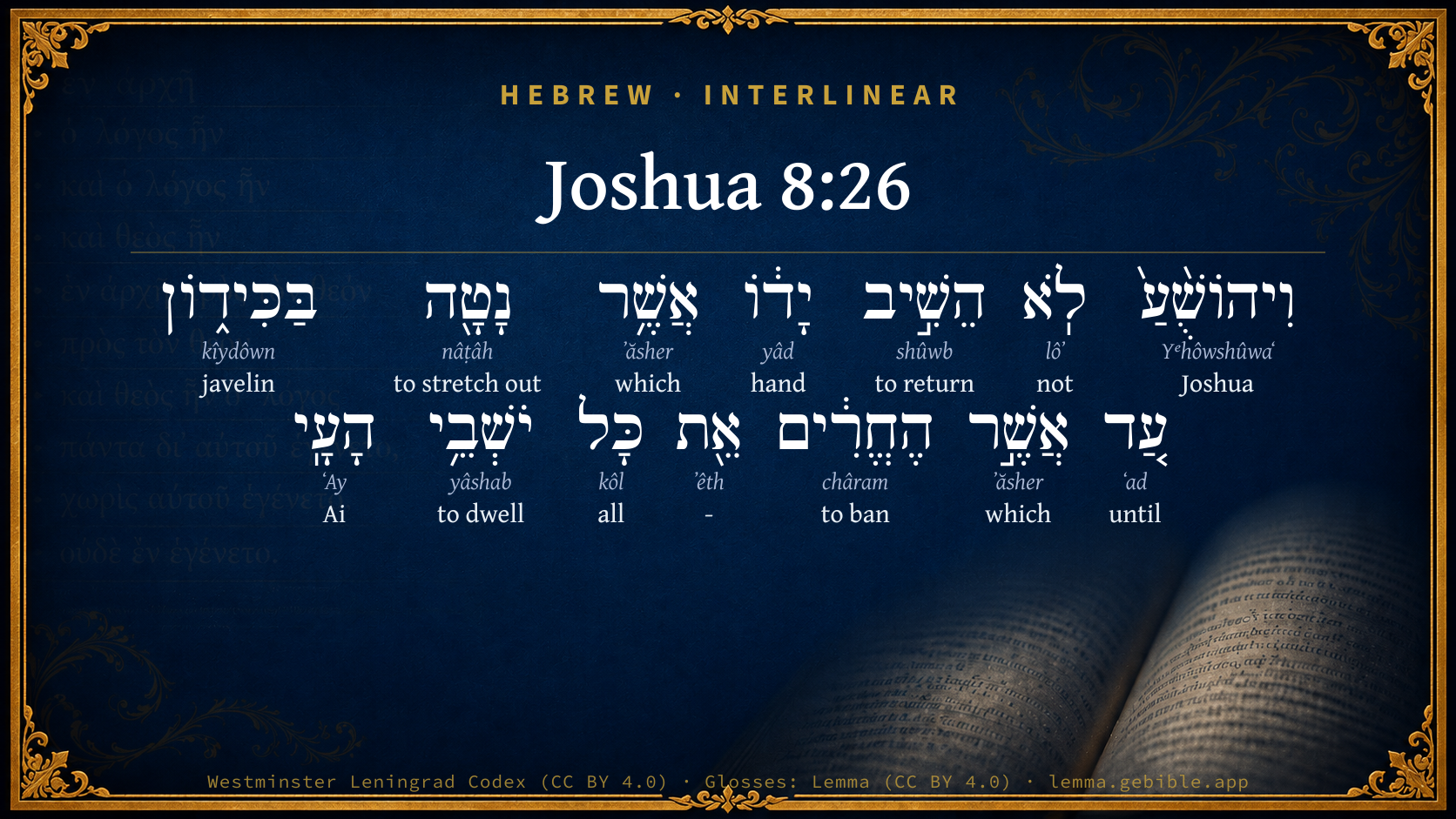
Hebrew (Westminster Leningrad Codex) Joshua 8:26 appears in the Hebrew Old Testament. The text above is from the Westminster Leningrad Codex. Each word links to its Strong’s number, a concise gloss, and parsing drawn from the Open Scriptures Hebrew Bible morphology. Click any word for its full Brown-Driver-Briggs (BDB) entry.
Download image
Cite this verse

Joshua 8:26 (World English Bible). Public Domain. Lemma interlinear Bible study tool, https://lemma.gebible.app/v/joshua/8/26.

Show BibTeX & RIS
BibTeX
RIS
English Translation
For Joshua didn't draw back his hand, with which he stretched out the javelin, until he had utterly destroyed all the inhabitants of Ai.
World English Bible · Public Domain
Download a study sheet

One document with this verse’s original text, its word-by-word gloss line, the meaning frame, cross-references with their text, attributed commentary, and full source and license credits — printable, and it pastes into notes with its structure intact.

This verse Autodidact and up

Study sheet (.html) Plain text (.txt)

A passage Seminary Student

Up to 50 verses in one chapter. A passage sheet keeps up to 6 commentary sources and 12 cross-references per verse, in the order this page ranks them, and says so on the sheet whenever that leaves anything out. Ask for a single verse and you get the Autodidact verse sheet above.

Everything on this page stays free to read, with no account — the sheet is a download of what is already on screen, not access to it.

Want to remove ads? Support Godless Engineer
Compare translations 3

The same verse in 3 English versions, stacked beneath the original-language interlinear above. Click any original word for its lexicon entry.

Each is an independent rendering of the whole verse — the interlinear is not word-aligned to these translations.

Highlighted words mark where these versions differ — a whole-verse word diff, not a word-by-word alignment.

  • World English Bible Public Domain
    For Joshua didn't draw back his hand, with which he stretched out the javelin, until he had utterly destroyed all the inhabitants of Ai.
  • King James Version Public Domain
    For Joshua drew not his hand back, wherewith he stretched out the spear, until he had utterly destroyed all the inhabitants of Ai.
  • unfoldingWord Literal Text CC BY-SA 4.0
    And Joshua did not turn back his hand that he had stretched out with the curved sword, until when he had devoted all of the dwellers of Ai.

unfoldingWord Literal Text — © unfoldingWord, licensed CC BY-SA 4.0. Word-aligned USFM3 via Door43 (git.door43.org/unfoldingWord/en_ult).

Versions to compare (up to 4)

3 of 4 selected

Show all 18 translations

Every available English version of this verse, each an independent rendering of the whole verse.

  • World English Bible Public Domain
    For Joshua didn't draw back his hand, with which he stretched out the javelin, until he had utterly destroyed all the inhabitants of Ai.
  • Berean Standard Bible Public Domain
    Joshua did not draw back the hand that held his battle lance until he had devoted to destruction all who lived in Ai.
  • Majority Standard Bible Public Domain
    Joshua did not draw back the hand that held his battle lance until he had devoted to destruction all who lived in Ai.
  • King James Version Public Domain
    For Joshua drew not his hand back, wherewith he stretched out the spear, until he had utterly destroyed all the inhabitants of Ai.
  • American Standard Version (1901) Public Domain
    For Joshua drew not back his hand, wherewith he stretched out the javelin, until he had utterly destroyed all the inhabitants of Ai.
  • Revised Version (1885) Public Domain
    For Joshua drew not back his hand wherewith he stretched out the javelin, until he had utterly destroyed all the inhabitants of Ai.
  • Geneva Bible (1599) Public Domain
    For Ioshua drewe not his hande backe againe which he had stretched out with the speare, vntill hee had vtterly destroyed all the inhabitants of Ai.
  • Douay-Rheims (1899) Public Domain
    But Josue drew not back his hand, which he had stretched out on high, holding the shield, till all the inhabitants of Hai were slain.
  • Young's Literal Translation Public Domain
    And Joshua hath not brought back his hand which he stretched out with the javelin till that he hath devoted all the inhabitants of Ai;
  • Literal Standard Version CC BY-SA 4.0
    And Joshua has not brought back his hand which he stretched out with the javelin until he has devoted all the inhabitants of Ai;
  • Unlocked Literal Bible CC BY-SA 4.0
    Joshua did not draw back his hand with which he had reached out while holding his spear, until he had completely destroyed all the people of Ai.
  • unfoldingWord Literal Text CC BY-SA 4.0
    And Joshua did not turn back his hand that he had stretched out with the curved sword, until when he had devoted all of the dwellers of Ai.
  • Darby Bible Public Domain
    And Joshua did not draw back his hand, which he had stretched out with the javelin, until they had utterly destroyed all the inhabitants of Ai.
  • World Messianic Bible Public Domain
    For Joshua didn’t draw back his hand, with which he stretched out the javelin, until he had utterly destroyed all the inhabitants of Ai.
  • Webster's Bible Public Domain
    For Joshua drew not his hand back with which he stretched out the spear, until he had utterly destroyed all the inhabitants of Ai.
  • Free Bible Version CC BY-SA 4.0
    For Joshua had continued to hold up his spear until all the people of Ai had been destroyed.
  • Bible in Basic English Public Domain
    For Joshua did not take back his hand with the outstretched spear till the destruction of the people of Ai was complete.
  • JPS Tanakh (1917) Public Domain
    For Joshua drew not back his hand, wherewith he stretched out the javelin, until he had utterly destroyed all the inhabitants of Ai.

Literal Standard Version (2020), Covenant Press — licensed CC BY-SA 4.0. Text via the HelloAO Bible API (eBible.org). Unlocked Literal Bible (unfoldingWord) — licensed CC BY-SA 4.0. Text via the HelloAO Bible API (eBible.org). unfoldingWord Literal Text — © unfoldingWord, licensed CC BY-SA 4.0. Word-aligned USFM3 via Door43 (git.door43.org/unfoldingWord/en_ult). Free Bible Version, Dr. Jonathan Gallagher — licensed CC BY-SA 4.0. Text via the HelloAO Bible API (eBible.org).

Word by word

More ways to search: Search by grammar → Find every occurrence → Compare this word →

Practice this passage: Drill this verse → Learn its vocabulary →

בַּכִּיד֑וֹן
kîydôwn
H3591
“in/at the · javelin”
Preposition, Determined + Noun, Common, Masculine, Singular, Absolute
Part of Speech
Preposition + Noun
Type
Common
Gender
Masculine
Number
Singular
State
Absolute
Full BDB Definition

Origin: from the same as H3589

TWOT: 977b

javelin, short sword, dart - gorget, a piece of armour for the throat (1Sam Job 17:6 )
  1. וִיהוֹשֻׁ֨עַ֙ Yᵉhôwshûwaʻ H3091 “and · Joshua” Conjunction + Noun, Proper
  2. לֹֽא lôʼ H3808 “not” Particle, Negative
  3. הֵשִׁ֣יב shûwb H7725 “to return” Verb, Hiphil, Perfect, 3rd Person, Masculine, Singular
  4. יָד֔וֹ yâd H3027 “hand · his” Noun, Common, Both, Singular, Construct + Suffix, Personal, 3rd Person, Masculine, Singular
  5. אֲשֶׁ֥ר ʼăsher H834 “which” Particle, Relative
  6. נָטָ֖ה nâṭâh H5186 “to stretch out” Verb, Qal, Perfect, 3rd Person, Masculine, Singular
  7. עַ֚ד ʻad H5704 “until” Preposition
  8. אֲשֶׁ֣ר ʼăsher H834 “which” Particle, Relative
  9. הֶחֱרִ֔ים châram H2763 “to ban” Verb, Hiphil, Perfect, 3rd Person, Masculine, Singular
  10. אֵ֖ת ʼêth H853 “-” Particle, Direct Object
  11. כָּל kôl H3605 “all of” Noun, Common, Masculine, Singular, Construct
  12. יֹשְׁבֵ֥י yâshab H3427 “dwelling” Verb, Qal, Participle Active, Masculine, Plural, Construct
  13. הָעָֽי ʻAy H5857 “the · Ai” Particle, Definite Article + Noun, Proper

About this verse

These counts appear in no published source. They are computed here, from the morphology-tagged text and Lemma’s own curated glosses. What Lemma adds →

14
words
13
distinct lemmas
Historical
section

Notable vocabulary

The rarest word here is בַּכִּיד֑וֹן javelin H3591 — appearing just 9 times in the whole Hebrew Bible.

Shared distinctive vocabulary

בַּכִּיד֑וֹן javelin H3591 occurs in 8 verses of the Hebrew Bible. Also found in:

Grammatical profile

  • 4 verbs
  • 5 nouns
  • 1 preposition
  • 4 particles

Verb forms

  • הֵשִׁ֣יב Hiphil · Perfect
  • נָטָ֖ה Qal · Perfect
  • הֶחֱרִ֔ים Hiphil · Perfect
  • יֹשְׁבֵ֥י Qal · Participle Active

Repetition

A word recurs within this verse — often emphatic in Hebrew:

  • אֲשֶׁ֥ר which H834 ×2

Cross-references

2

Topical passages linked to Joshua 8:26 in the Treasury of Scripture Knowledge — connected by theme and wording, ordered by reader-vote popularity; previews shown in the World English Bible.

  • Exodus 17:11–12 It happened, when Moses held up his hand, that Israel prevailed; and when he let down his hand, Amalek prevailed.
  • Joshua 8:18 Yahweh said to Joshua, Stretch out the javelin that is in your hand toward Ai; for I will give it into your hand. Joshua stretched out the javelin that was in his hand toward the city.

Cross-references courtesy of OpenBible.info (CC BY 4.0).

Hebrew and Greek witnesses Masoretic Hebrew ↔ Greek Septuagint

The same verse in the two great witnesses to the Old Testament, shown verse-for-verse.

These are two independent witnesses, not word-aligned to each other, and the Septuagint is shown in lemma (dictionary) form.

Hebrew Joshua 8:26 Masoretic · Westminster Leningrad Codex

וִיהוֹשֻׁ֨עַ֙ לֹֽא הֵשִׁ֣יב יָד֔וֹ אֲשֶׁ֥ר נָטָ֖ה בַּכִּיד֑וֹן עַ֚ד אֲשֶׁ֣ר הֶחֱרִ֔ים אֵ֖ת כָּל יֹשְׁבֵ֥י הָעָֽי

For Joshua didn't draw back his hand, with which he stretched out the javelin, until he had utterly destroyed all the inhabitants of Ai.

World English Bible · Public Domain

Hebrew: Westminster Leningrad Codex (CC BY 4.0). Greek: Septuagint (public domain); English from a public-domain English Septuagint. How the Septuagint differs from the Hebrew →

Targum (Aramaic paraphrase)

1

The Targum is the ancient Jewish Aramaic paraphrase of the Hebrew Scriptures — an interpretive translation, not the Hebrew text itself. Onkelos (literal) and Pseudo-Jonathan (expansive) render the Torah, and Jonathan the Prophets. Coverage is partial: where no permissively-licensed English translation exists for a verse, only the Aramaic is shown. This is verse-level text, not a word-by-word alignment to the Hebrew.

  1. Targum Jonathan Prophets (Joshua–Malachi)
    וִיהוֹשֻׁעַ לָא אָתֵיב יְדֵיהּ דַאֲרִים בְּרוּמְחָא עַד דְגַמַר יַת כָּל יַתְבֵי עָי:

    (no public-domain English translation for this verse)

    Targum Jonathan — Aramaic: “Mikraot Gedolot” (public domain). English: “Sefaria Community Translation” (CC0 1.0 (public-domain dedication)); “London "Chaldee Paraphrase," 1871” (public domain). Text via Sefaria.

Commentary

Notes on Joshua 8:26 from classic Christian and Jewish commentators (each source and its license shown beneath its notes). The classic Christian expositions comment on the surrounding passage and are grouped to its opening verse, so a note may address several verses; the Jewish commentaries on the Tanakh (Rashi and others) are per-verse, so they appear only where the commentator wrote on this verse.

Lemma curates 59 commentaries, every one of them public domain or Creative Commons licensed, each selected and text-cleaned for this edition rather than reprinted as found. About our sources →

Trapp's Complete Commentary

John Trapp

Jos 8:26 For Joshua drew not his hand back, wherewith he stretched out the spear, until he had utterly destroyed all the inhabitants of Ai.

Ver. 26. For Joshua drew not his hand back.] "The arms of his hands being made strong by the hands of the mighty God of Jacob," {Gen 49:24} of whom it is said that "his hand is stretched out still." {Isa 9:12}

John Trapp, A Commentary or Exposition upon All the Books of the Old and New Testament (1647–1656) — public domain. Text from a community e-Sword module.

Joseph Benson's Commentary

Jos 8:26. Joshua drew not his hand back — That is, he continued the battle, and ceased not to fight, spear in hand, till he had utterly routed them. Or, as some think, it means that he kept his hand and spear in the same posture, both stretched out, and lifted up, as a sign to encourage and direct his army to go on with their work till the enemy were destroyed.

Joseph Benson's Commentary on the Old and New Testaments (1811–1818) — public domain. Text from a community e-Sword module.

Jamieson, Fausset & Brown

Robert Jamieson, A. R. Fausset & David Brown

Joshua drew not his hand back--Perhaps, from the long continuance of the posture, it might have been a means appointed by God, to animate the people, and kept up in the same devout spirit as Moses had shown, in lifting up his hands, until the work of slaughter had been completed--the ban executed. (See on Exo 17:10).

Jamieson, Fausset & Brown — Commentary Critical and Explanatory on the Whole Bible (1871) — public domain (CC PDM 1.0). Text via the HelloAO Bible API.

Adam Clarke's Commentary

Verse 26. Joshua drew not his hand back] He was not only the general, but the standard-bearer or ensign of his own army, and continued in this employment during the whole of the battle. See on Jos 8:18. Some commentators understand this and Jos 8:18 figuratively, as if they implied that Joshua continued in prayer to God for the success of his troops; nor did he cease till the armies of Ai were annihilated, and the city taken and destroyed. The Hebrew word כידון kidon, which we render spear, is rendered by the Vulgate clypeum, buckler; and it must be owned that it seems to have this signification in several passages of Scripture: (see 1Sa 17:6; 1Sa 17:45; Job 39:23:) but it is clear enough also that it means a spear, or some kind of offensive armour, in other places: see Job 41:29; Jer 6:23. I cannot therefore think that it has any metaphorical meaning, such as that attributed to the holding up of Moses's hands, Ex 17:10-12, which is generally allowed to have a spiritual meaning, though it might be understood as the act of Joshua is here; and to this meaning an indirect glance is given in the note on the above place. But however the place in Exodus may be understood, that before us does not appear to have any metaphorical or equivocal meaning; Joshua continued to hold up or stretch out his spear, and did not slack from the pursuit till the forces of Ai were utterly discomfited.

Adam Clarke's Commentary on the Bible (1810–1826) — public domain. Text from a community e-Sword/MySword module.

John Calvin's Commentaries

26. For Joshua drew not his hand back, etc As by raising the spear he gave sign and pledge of hope as it were from heaven, he did not cease to keep the minds of his followers fixed upon it until they were masters of the city. By thus persevering he sufficiently proved how far removed he was from ambition; how free from doing anything in the way of vain ostentation. For it was just as if he had resigned the office of leader, and transferred the whole praise of the victory to God. How intrepid a warrior he was is plain from other passages. He might now, too, have willingly discharged his military functions, and thus done what was far better fitted to promote his reputation and glory. But as if his hand had been fastened to the spear, he exhorts the soldiers to look to God alone, to whom he resigns the success of the battle. By thus standing aloof he profited more than if he had in all directions, and by his own hand, struck down heaps of the enemy: at the same time his remaining at ease was more praiseworthy than any degree of agility could have been.

John Calvin's Commentaries (1540-1563) — public domain. Text from the Calvin Translation Society English edition (1840s-50s) via the Christian Classics Ethereal Library (ccel.org). Calvin's coverage is partial (roughly two-thirds of the Bible); uncommented books and verses are honest gaps, never fabricated. The 19th-century editor's footnotes and remarks are omitted so the notes are faithfully Calvin's own voice.

John Gill's Exposition

For Joshua drew not his hand back wherewith he stretched out his spear,.... But continued it, and that stretched out:

until he had utterly destroyed all the inhabitants of Ai; just as the hand of Moses was held up, and kept held up until Amalek was discomfited by Joshua, Exo 17:12.

John Gill's Exposition of the Whole Bible (1746–1763) — public domain (CC PDM 1.0). Text via the HelloAO Bible API.

Haydock's Catholic Bible Commentary

CHAPTER VIII.

George Leo Haydock (1774–1849), Haydock's Catholic Family Bible and Commentary, 1859 edition — public domain. Excludes Psalms (Douay-Rheims chapter numbering differs from Protestant) and Deuterocanonical books (Catholic canon only).

Matthew Poole's English Annotations

Either,

1. He ceased not to fight with that hand. Or,

2. He kept his hand and spear in the same posture, both stretched out and lifted up, as a sign both to encourage them, and to direct them to go on in the work. See Poole "Jos 8:18".

Matthew Poole's English Annotations on the Holy Bible (1683–1685) — public domain. Text from a community e-Sword/MySword module.

The Pulpit Commentary

Utterly destroyed. Hebrew, (see note on Jos_6:17)

The Pulpit Commentary (1880–1919), ed. H.D.M. Spence-Jones & Joseph S. Exell — public domain. Text from a community e-Sword module.

John Wesley's Explanatory Notes

Drew not his hand back - He kept his hand and spear in the same posture, both stretched out and lifted up, as a sign both to encourage them, and to direct them to go on in the work.

John Wesley, Explanatory Notes Upon the Whole Bible (1754–1765) — public domain. Text via the GEBible commentary corpus.

Lesson kit

Teaching starters — assembled from the data on this page, not authored interpretation. Every prompt links to the verse data it draws on. Edit before teaching.

Joshua, in the Historical, opens this verse with 14 words (13 distinct Hebrew lemmas). Its most distinctive word is kîydôwn (“javelin”). A historical commentator’s framing appears above. Read the whole chapter for the surrounding context.

Discussion questions

  1. How does “javelin” (kîydôwn) shape what this verse is saying?
  2. Joshua 8:18 shares the word «javelin» with this verse. How do the two illuminate each other?
  3. “which” occurs 2× in this one verse. What is the effect of the repetition?
  4. These translations render this verse differently; the difference is in the English rendering, not the original. What questions does that raise?
  5. The verb «הֵשִׁ֣יב» is Hiphil Perfect. How does its form color the action?
  6. Reading how Trapp's Complete Commentary and Joseph Benson's Commentary read this verse, where do the two commentators agree and where do they part?

Things to notice

Reading settings

Reading text

Shown beneath each verse's original-language words.

Old Testament
Old Testament edition

Read the OT as the Masoretic Hebrew (MT) or the Greek Septuagint (LXX).

English shown for the Greek Septuagint (in the Hebrew ↔ Greek comparison).

Comparing translations? Open the Compare panel on any verse page to stack up to four side by side.