
Jeremiah 32:17

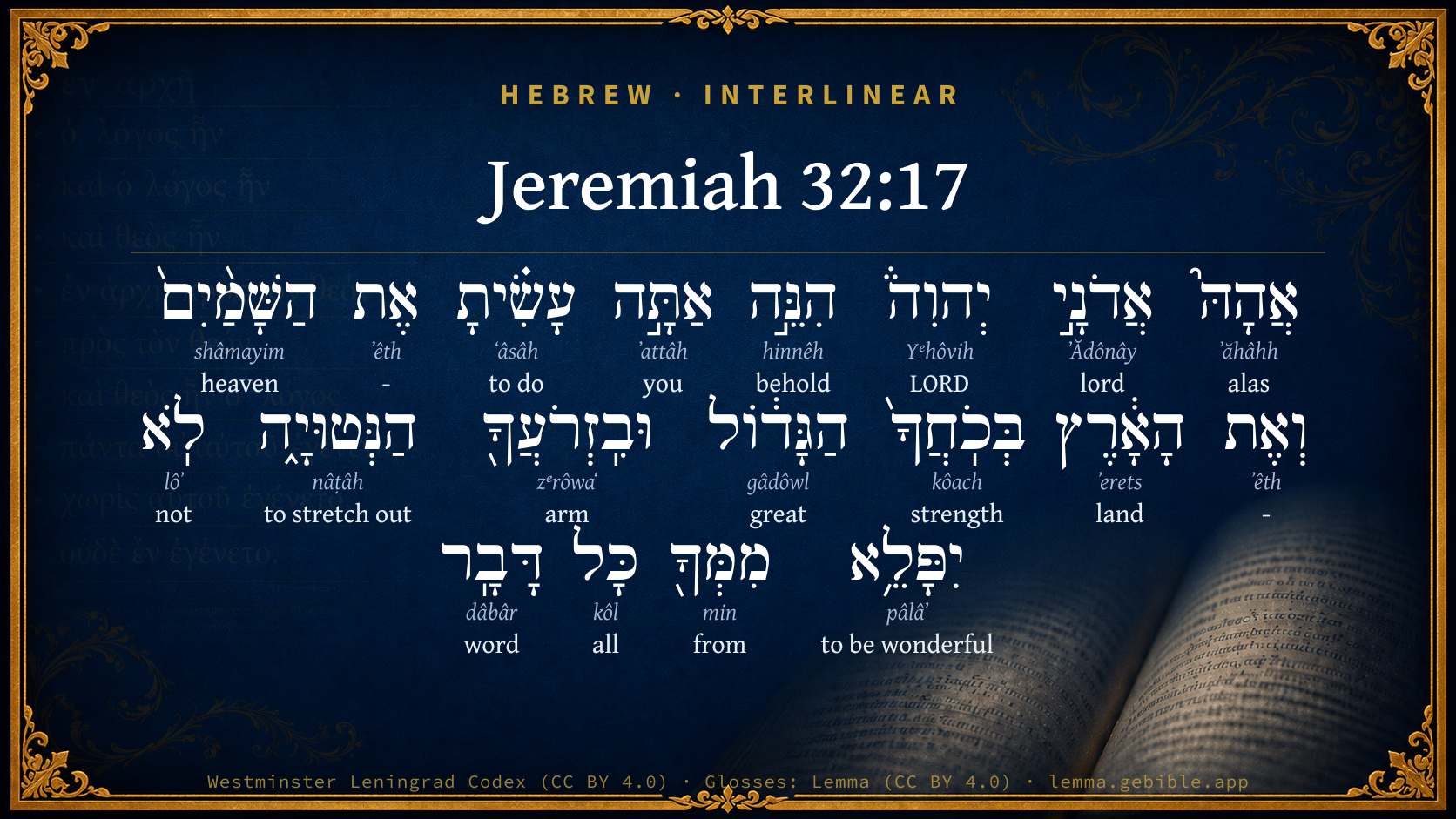
Hebrew (Westminster Leningrad Codex) Jeremiah 32:17 appears in the Hebrew Old Testament. The text above is from the Westminster Leningrad Codex. Each word links to its Strong’s number, a concise gloss, and parsing drawn from the Open Scriptures Hebrew Bible morphology. Click any word for its full Brown-Driver-Briggs (BDB) entry.
Download image
Cite this verse

Jeremiah 32:17 (World English Bible). Public Domain. Lemma interlinear Bible study tool, https://lemma.gebible.app/v/jeremiah/32/17.

Show BibTeX & RIS
BibTeX
RIS
English Translation
Ah Lord Yahweh! behold, you have made the heavens and the earth by your great power and by your outstretched arm; there is nothing too hard for you,
World English Bible · Public Domain
Download a study sheet

One document with this verse’s original text, its word-by-word gloss line, the meaning frame, cross-references with their text, attributed commentary, and full source and license credits — printable, and it pastes into notes with its structure intact.

This verse Autodidact and up

Study sheet (.html) Plain text (.txt)

A passage Seminary Student

Up to 50 verses in one chapter. A passage sheet keeps up to 6 commentary sources and 12 cross-references per verse, in the order this page ranks them, and says so on the sheet whenever that leaves anything out. Ask for a single verse and you get the Autodidact verse sheet above.

Everything on this page stays free to read, with no account — the sheet is a download of what is already on screen, not access to it.

Want to remove ads? Support Godless Engineer
Compare translations 3

The same verse in 3 English versions, stacked beneath the original-language interlinear above. Click any original word for its lexicon entry.

Each is an independent rendering of the whole verse — the interlinear is not word-aligned to these translations.

Highlighted words mark where these versions differ — a whole-verse word diff, not a word-by-word alignment.

  • World English Bible Public Domain
    Ah Lord Yahweh! behold, you have made the heavens and the earth by your great power and by your outstretched arm; there is nothing too hard for you,
  • King James Version Public Domain
    Ah Lord GOD! behold, thou hast made the heaven and the earth by thy great power and stretched out arm, and there is nothing too hard for thee:
  • unfoldingWord Literal Text CC BY-SA 4.0
    “Woe, Lord Yahweh! Look! You alone have made the heavens and the earth by your great strength and with your raised arm. Nothing you say is too difficult for you to do.

unfoldingWord Literal Text — © unfoldingWord, licensed CC BY-SA 4.0. Word-aligned USFM3 via Door43 (git.door43.org/unfoldingWord/en_ult).

Versions to compare (up to 4)

3 of 4 selected

Show all 18 translations

Every available English version of this verse, each an independent rendering of the whole verse.

  • World English Bible Public Domain
    Ah Lord Yahweh! behold, you have made the heavens and the earth by your great power and by your outstretched arm; there is nothing too hard for you,
  • Berean Standard Bible Public Domain
    “Oh, Lord GOD! You have made the heavens and the earth by Your great power and outstretched arm. Nothing is too difficult for You!
  • Majority Standard Bible Public Domain
    “Oh, Lord GOD! You have made the heavens and the earth by Your great power and outstretched arm. Nothing is too difficult for You!
  • King James Version Public Domain
    Ah Lord GOD! behold, thou hast made the heaven and the earth by thy great power and stretched out arm, and there is nothing too hard for thee:
  • American Standard Version (1901) Public Domain
    Ah Lord Jehovah! behold, thou hast made the heavens and the earth by thy great power and by thine outstretched arm; there is nothing too hard for thee,
  • Revised Version (1885) Public Domain
    Ah Lord GOD! behold, thou hast made the heaven and the earth by thy great power and by thy stretched out arm; there is nothing too hard for thee:
  • Geneva Bible (1599) Public Domain
    Ah Lord God, beholde, thou hast made the heauen and the earth by thy great power, and by thy stretched out arme, and there is nothing hard vnto thee.
  • Douay-Rheims (1899) Public Domain
    Alas, alas, alas, 0 Lord God, behold thou hast made heaven and earth by thy great power, and thy stretched out arm: no word shall be hard to thee:
  • Young's Literal Translation Public Domain
    `Ah, Lord Jehovah, lo, Thou hast made the heavens and the earth by Thy great power, and by Thy stretched-out arm; there is nothing too wonderful for Thee:
  • Literal Standard Version CC BY-SA 4.0
    “Aah! Lord YHWH, behold, You have made the heavens and the earth by Your great power, and by Your outstretched arm; there is nothing too wonderful for You:
  • Unlocked Literal Bible CC BY-SA 4.0
    “Woe, Lord Yahweh! Look! You alone have made the heavens and the earth by your great strength and with your raised arm. Nothing you say is too difficult for you to do.
  • unfoldingWord Literal Text CC BY-SA 4.0
    “Woe, Lord Yahweh! Look! You alone have made the heavens and the earth by your great strength and with your raised arm. Nothing you say is too difficult for you to do.
  • Darby Bible Public Domain
    Alas, Lord Jehovah! Behold, thou hast made the heavens and the earth by thy great power and stretched-out arm; there is nothing too hard for thee:
  • World Messianic Bible Public Domain
    “Ah Lord GOD! Behold, you have made the heavens and the earth by your great power and by your outstretched arm. There is nothing too hard for you.
  • Webster's Bible Public Domain
    Ah Lord GOD! behold, thou hast made the heaven and the earth by thy great power and out-stretched arm, and there is nothing too hard for thee:
  • Free Bible Version CC BY-SA 4.0
    “Ah, Lord God! You created the heavens and the earth by your great strength and power. Nothing is too hard for you!
  • Bible in Basic English Public Domain
    Ah Lord God! see, you have made the heaven and the earth by your great power and by your outstretched arm, and there is nothing you are not able to do:
  • JPS Tanakh (1917) Public Domain
    'Ah Lord GOD! behold, Thou hast made the heaven and the earth by Thy great power and by Thy outstretched arm; there is nothing too hard for Thee;

Literal Standard Version (2020), Covenant Press — licensed CC BY-SA 4.0. Text via the HelloAO Bible API (eBible.org). Unlocked Literal Bible (unfoldingWord) — licensed CC BY-SA 4.0. Text via the HelloAO Bible API (eBible.org). unfoldingWord Literal Text — © unfoldingWord, licensed CC BY-SA 4.0. Word-aligned USFM3 via Door43 (git.door43.org/unfoldingWord/en_ult). Free Bible Version, Dr. Jonathan Gallagher — licensed CC BY-SA 4.0. Text via the HelloAO Bible API (eBible.org).

Word by word

More ways to search: Search by grammar → Find every occurrence → Compare this word →

Practice this passage: Drill this verse → Learn its vocabulary →

אֲהָהּ֮
ʼăhâhh
H162
“alas”
Particle, Interjection
Part of Speech
Particle
Type
Interjection
Full BDB Definition

Origin: apparently a primitive word expressing pain exclamatorily, Oh!

TWOT: 30

alas!, oh!, ah!
  1. אֲדֹנָ֣י ʼĂdônây H136 “Lord · my” Noun, Common, Masculine, Plural, Construct + Suffix, Personal, 1st Person, Common, Singular
  2. יְהוִה֒ Yᵉhôvih H3069 “LORD” Noun, Proper
  3. הִנֵּ֣ה hinnêh H2009 “behold” Particle, Demonstrative
  4. אַתָּ֣ה ʼattâh H859 “you” Pronoun, Personal, 2nd Person, Masculine, Singular
  5. עָשִׂ֗יתָ ʻâsâh H6213 “to do” Verb, Qal, Perfect, 2nd Person, Masculine, Singular
  6. אֶת ʼêth H853 “-” Particle, Direct Object
  7. הַשָּׁמַ֨יִם֙ shâmayim H8064 “the · heaven(s)” Particle, Definite Article + Noun, Common, Masculine, Plural, Absolute
  8. וְאֶת ʼêth H853 “and · -” Conjunction + Particle, Direct Object
  9. הָאָ֔רֶץ ʼerets H776 “the · land” Particle, Definite Article + Noun, Common, Both, Singular, Absolute
  10. בְּכֹֽחֲךָ֙ kôach H3581 “in/at · strength · your” Preposition + Noun, Common, Masculine, Singular, Construct + Suffix, Personal, 2nd Person, Masculine, Singular
  11. הַגָּד֔וֹל gâdôwl H1419 “the · great” Particle, Definite Article + Adjective, Adjective, Masculine, Singular, Absolute
  12. וּבִֽזְרֹעֲךָ֖ zᵉrôwaʻ H2220 “and · in/at · arm · your” Conjunction + Preposition + Noun, Common, Both, Singular, Construct + Suffix, Personal, 2nd Person, Masculine, Singular
  13. הַנְּטוּיָ֑ה nâṭâh H5186 “the · stretched out” Particle, Definite Article + Verb, Qal, Participle Passive, Feminine, Singular, Absolute
  14. לֹֽא lôʼ H3808 “not” Particle, Negative
  15. יִפָּלֵ֥א pâlâʼ H6381 “to be wonderful” Verb, Niphal, Imperfect, 3rd Person, Masculine, Singular
  16. מִמְּךָ֖ min H4480 “from · you” Preposition + Suffix, Personal, 2nd Person, Masculine, Singular
  17. כָּל kôl H3605 “all of” Noun, Common, Masculine, Singular, Construct
  18. דָּבָֽר dâbâr H1697 “word” Noun, Common, Masculine, Singular, Absolute

About this verse

These counts appear in no published source. They are computed here, from the morphology-tagged text and Lemma’s own curated glosses. What Lemma adds →

19
words
18
distinct lemmas
Prophets
section

Notable vocabulary

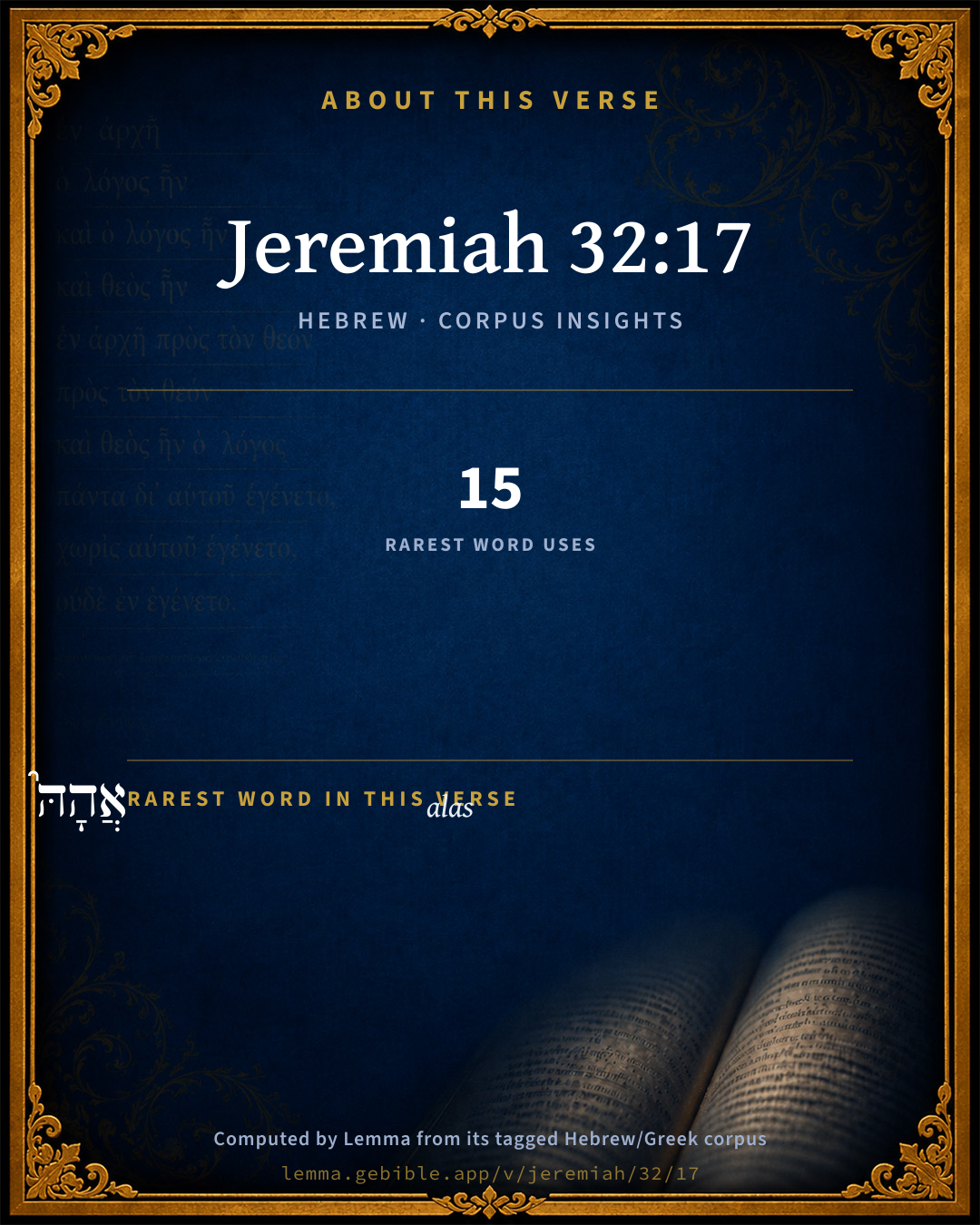
The rarest word here is אֲהָהּ֮ alas H162 — appearing just 15 times in the whole Hebrew Bible.

Shared distinctive vocabulary

אֲהָהּ֮ alas H162 occurs in 15 verses of the Hebrew Bible. Also found in:

Grammatical profile

  • 3 verbs
  • 8 nouns
  • 1 adjective
  • 1 pronoun
  • 1 preposition
  • 5 particles

Verb forms

  • עָשִׂ֗יתָ Qal · Perfect
  • הַנְּטוּיָ֑ה Qal · Participle Passive
  • יִפָּלֵ֥א Niphal · Imperfect

Cross-references

40

Topical passages linked to Jeremiah 32:17 in the Treasury of Scripture Knowledge — connected by theme and wording, ordered by reader-vote popularity; previews shown in the World English Bible.

  • Luke 1:37 For everything spoken by God is possible."
  • Jeremiah 32:27 Behold, I am Yahweh, the God of all flesh: is there anything too hard for me?
  • Genesis 18:14 Is anything too hard for Yahweh? At the set time I will return to you, when the season comes round, and Sarah will have a son."
  • Job 42:2 "I know that you can do all things, And that no purpose of yours can be restrained.
  • Matthew 19:26 Looking at them, Jesus said, "With men this is impossible, but with God all things are possible."
  • Exodus 20:11 for in six days Yahweh made heaven and earth, the sea, and all that is in them, and rested the seventh day; therefore Yahweh blessed the Sabbath day, and made it holy.
  • Genesis 1:1–31 In the beginning God created the heavens and the earth.
  • Jeremiah 27:5 I have made the earth, the men and the animals that are on the surface of the earth, by my great power and by my outstretched arm; and I give it to whom it seems right to me.
  • John 1:1–3 In the beginning was the Word, and the Word was with God, and the Word was God.
  • Luke 18:27 But he said, "The things which are impossible with men are possible with God."
  • Jeremiah 10:11–12 Thus shall you say to them, The gods that have not made the heavens and the earth, these shall perish from the earth, and from under the heavens.
  • 2 Kings 19:15 Hezekiah prayed before Yahweh, and said, Yahweh, the God of Israel, who sit [above] the cherubim, you are the God, even you alone, of all the kingdoms of the earth; you have made heaven and earth.
  • Psalms 102:25 Of old, you laid the foundation of the earth. The heavens are the work of your hands.
  • Isaiah 45:12 I have made the earth, and created man on it: I, even my hands, have stretched out the heavens; and all their host have I commanded.
  • Revelation 4:11 "Worthy are you, our Lord and God, the Holy One, to receive the glory, the honor, and the power, for you created all things, and because of your desire they existed, and were created!"
  • Hebrews 1:10–12 And, "You, Lord, in the beginning, laid the foundation of the earth. The heavens are the works of your hands.
  • Isaiah 40:26–28 Lift up your eyes on high, and see who has created these, who brings out their host by number; he calls them all by name; by the greatness of his might, and because he is strong in power, not one is lacking.
  • Isaiah 46:9–10 Remember the former things of old: for I am God, and there is none else; [I am] God, and there is none like me;
  • Hebrews 1:2–3 has at the end of these days spoken to us by his Son, whom he appointed heir of all things, through whom also he made the worlds.
  • Psalms 146:5–6 Happy is he who has the God of Jacob for his help, Whose hope is in Yahweh, his God:
  • Nehemiah 9:6 You are Yahweh, even you alone; you have made heaven, the heaven of heavens, with all their host, the earth and all things that are thereon, the seas and all that is in them, and you preserve them all; and the host of heaven worships you.
  • Jeremiah 51:15 He has made the earth by his power, he has established the world by his wisdom, and by his understanding has he stretched out the heavens:
  • Psalms 136:5–9 To him who by understanding made the heavens; For his loving kindness endures forever:
  • Isaiah 42:5 Thus says God Yahweh, he who created the heavens, and stretched them forth; he who spread abroad the earth and that which comes out of it; he who gives breath to the people on it, and spirit to those who walk therein:
  • Colossians 1:15–16 who is the image of the invisible God, the firstborn of all creation.
  • Isaiah 48:12–13 Listen to me, O Jacob, and Israel my called: I am he; I am the first, I also am the last.
  • Jeremiah 1:6 Then said I, Ah, Lord Yahweh! behold, I don't know how to speak; for I am a child.
  • Jeremiah 51:19 The portion of Jacob is not like these; for he is the former of all things; and [Israel] is the tribe of his inheritance: Yahweh of Hosts is his name.
  • Daniel 2:22 he reveals the deep and secret things; he knows what is in the darkness, and the light dwells with him.
  • Jeremiah 14:13 Then said I, Ah, Lord Yahweh! behold, the prophets tell them, You shall not see the sword, neither shall you have famine; but I will give you assured peace in this place.
  • Zechariah 12:1 An oracle. The word of Yahweh concerning Israel. Yahweh, who stretches out the heavens, and lays the foundation of the earth, and forms the spirit of man within him says:
  • Acts 7:49–50 'heaven is my throne, And the earth a footstool for my feet. What kind of house will you build me?' says the Lord; 'Or what is the place of my rest?
  • Isaiah 44:24 Thus says Yahweh, your Redeemer, and he who formed you from the womb: I am Yahweh, who makes all things; who stretches forth the heavens alone; who spreads abroad the earth (who is with me?);
  • Acts 14:15 "Men, why are you doing these things? We also are men of like passions with you, and bring you good news, that you should turn from these vain things to the living God, who made the sky and the earth and the sea, and all that is in them;
  • Acts 17:24 The God who made the world and all things in it, he, being Lord of heaven and earth, doesn't dwell in temples made with hands,
  • Ezekiel 9:8 It happened, while they were smiting, and I was left, that I fell on my face, and cried, and said, Ah Lord Yahweh! will you destroy all the residue of Israel in your pouring out of your wrath on Jerusalem?
  • Ezekiel 11:13 It happened, when I prophesied, that Pelatiah the son of Benaiah died. Then fell I down on my face, and cried with a loud voice, and said, Ah Lord Yahweh! will you make a full end of the remnant of Israel?
  • Acts 15:18 All his works are known to God from eternity.'
  • Ephesians 3:9–11 and to make all men see what is the administration of the mystery which for ages has been hidden in God, who created all things through Jesus Christ;
  • Jeremiah 4:10 Then said I, Ah, Lord Yahweh! surely you have greatly deceived this people and Jerusalem, saying, You shall have peace; whereas the sword reaches to the life.

Cross-references courtesy of OpenBible.info (CC BY 4.0).

Hebrew and Greek witnesses Masoretic Hebrew ↔ Greek Septuagint

The same verse in the two great witnesses to the Old Testament, shown verse-for-verse.

These are two independent witnesses, not word-aligned to each other, and the Septuagint is shown in lemma (dictionary) form.

Hebrew Jeremiah 32:17 Masoretic · Westminster Leningrad Codex

אֲהָהּ֮ אֲדֹנָ֣י יְהוִה֒ הִנֵּ֣ה אַתָּ֣ה עָשִׂ֗יתָ אֶת הַשָּׁמַ֨יִם֙ וְאֶת הָאָ֔רֶץ בְּכֹֽחֲךָ֙ הַגָּד֔וֹל וּבִֽזְרֹעֲךָ֖ הַנְּטוּיָ֑ה לֹֽא יִפָּלֵ֥א מִמְּךָ֖ כָּל דָּבָֽר

Ah Lord Yahweh! behold, you have made the heavens and the earth by your great power and by your outstretched arm; there is nothing too hard for you,

World English Bible · Public Domain

Greek LXX Structure differs

In the Septuagint, Jeremiah is about an eighth shorter than the Hebrew and arranges its material differently — the Oracles Against the Nations (Hebrew chapters 46–51) appear in the middle of the Greek book, after 25:13. Because the chapter and verse boundaries do not line up, a verse-for-verse comparison with the Hebrew is not shown.

A verse-for-verse comparison isn’t shown here because the chapters and verses don’t line up. Switch to the LXX edition with the MT / LXX toggle above to read the Greek directly.

On this verse, Haydock's Catholic Bible Commentary discusses the Septuagint’s reading. Read the note in Commentary ↓

Hebrew: Westminster Leningrad Codex (CC BY 4.0). Greek: Septuagint (public domain); English from a public-domain English Septuagint. How the Septuagint differs from the Hebrew →

Targum (Aramaic paraphrase)

1

The Targum is the ancient Jewish Aramaic paraphrase of the Hebrew Scriptures — an interpretive translation, not the Hebrew text itself. Onkelos (literal) and Pseudo-Jonathan (expansive) render the Torah, and Jonathan the Prophets. Coverage is partial: where no permissively-licensed English translation exists for a verse, only the Aramaic is shown. This is verse-level text, not a word-by-word alignment to the Hebrew.

  1. Targum Jonathan Prophets (Joshua–Malachi)
    קַבֵּיל בָּעוּתִי יְיָ אֱלֹהִים הָא אַתְּ עֲבַדְתָּא יַת שְׁמַיָא וְיַת אַרְעָא בְחֵילָךְ רַבָּא וּבִדְרָעָךְ מְרַמְמָא לָא יִתְכַּסֵי מִן קָדָמָךְ כָּל פִּתְגָם:

    (no public-domain English translation for this verse)

    Targum Jonathan — Aramaic: “Mikraot Gedolot” (public domain). English: “Sefaria Community Translation” (CC0 1.0 (public-domain dedication)); “London "Chaldee Paraphrase," 1871” (public domain). Text via Sefaria.

Commentary

Notes on Jeremiah 32:17 from classic Christian and Jewish commentators (each source and its license shown beneath its notes). The classic Christian expositions comment on the surrounding passage and are grouped to its opening verse, so a note may address several verses; the Jewish commentaries on the Tanakh (Rashi and others) are per-verse, so they appear only where the commentator wrote on this verse.

Lemma curates 59 commentaries, every one of them public domain or Creative Commons licensed, each selected and text-cleaned for this edition rather than reprinted as found. About our sources →

Trapp's Complete Commentary

John Trapp

Jer 32:17 Ah Lord GOD! behold, thou hast made the heaven and the earth by thy great power and stretched out arm, [and] there is nothing too hard for thee:

Ver. 17. Ah Lord God!] This interjection in the beginning of his prayer showeth that his heart was greatly grieved and perplexed. Nevertheless he reineth in his passions, and runneth not out into a brawl instead of a prayer, as Jonah did. {Jon 4:1} {See Trapp on "Jon 4:1"}

Thou hast made the heaven and earth by thy great power.] God’s might and mercy are the good soul’s Joachin and Boaz, whereon it ever resteth. These two doth Jeremiah in this prayer of his chiefly plead and flee to.

And there is nothing too hard for thee.] Heb., Nothing is hidden from thee, or wonderful with thee. But for my part I am at a great stand, neither know I how to bring both ends together.

John Trapp, A Commentary or Exposition upon All the Books of the Old and New Testament (1647–1656) — public domain. Text from a community e-Sword module.

The Biblical Illustrator

Joseph S. Exell

Jer_32:17

Thou hast made the heaven and the earth.

Creation-an argument for faith

I would to God we had in the religion of these modern times a more potent infusion of this heroic faith in God. When Edward Irving preached that memorable sermon concerning the missionary, who he thought was bound to go forth without purse or scrip, and trusting in his God alone, to preach the Word, a howl went up to heaven against the man as a fanatic. They said he was visionary, unpractical, mad, and all because he dared to preach a sermon full of faith in God. If once again we could, like the world, be hanged upon nothing but the simple power and providence of God, I am sure we should find it a blessed and a safe way of living, glorious to God, and honourable to ourselves.

I. To stimulate the evangelist. And who is the evangelist? Every man and woman who has tasted that the Lord is gracious. Here is your encouragement: the work is Gods, and your success is in the hand of Him who made the heaven and the earth.

1. Remember that the world was created from nothing. He spake and it was done; He commanded, and it stood fast. The case of the sinner is a parallel one. You say there is nothing in the sinner. Ay, then, there is room here for a re-creating work; for the Eternal God to come, and with His outstretched arm to create a new heart and a right spirit, and put His grace where there was none before.

2. But you have none to help you or go forth in your work with you. When God made the world--and the same God is with thee--He worked alone.

3. But you reply, My sorrow lieth not so much in that I am alone, as in the melancholy fact that I am very conscious of my own weakness, and of my want of adaptation for my peculiar work. I am not sufficient for these things; but rather I feel like Jonah, that I would flee into Tarshish, that I might escape from the burden of the Lord against this Nineveh. Ay, but cast thy thoughts back again upon creation. The Eternal needed no instruments in creation. He sayeth not by mans strength, nor by human learning, and eloquence, and talent. It is His strength, and not the strength or weakness of the instruments to which we must look.

4. Dost thou still complain, and say--Alas! it is little I can say! When I speak, I can but utter a few plain words--true and earnest, but not mighty. I have no power to plead with souls with the tears and the seraphic zeal of a Whitfield. I can only tell the tale of mercy simply, and leave it there. Well, and did not God create all things by His naked word? At this day, is not the Gospel in itself the rod of Jehovahs strength? Is it not the power of God unto salvation to every one that believeth?

5. Another pleads, You are not aware of the darkness of the district in which I labour. I toil among a benighted, unintelligent, ignorant people. I cannot expect to see fruit there, toil as I may. Ah! brother, and while you talk so you never will see any fruit, for God giveth not great things to unbelieving men. But for the encouragement of thy faith, let me remind thee that it is the God that made the heavens and the earth on whom thou hast to lean.

6. Ay, saith one, but the men among whom I labour are so confused in their notions, they put darkness for light and light for darkness; their moral sense is blunted; if I try to teach them, their ears are dull of hearing and their hearts are given to slumber. Besides, they are full of vain janglings and oppose themselves to the truth; I endure much contradiction of sinners, and they will not receive the truth in the love of it. Did not the Holy Spirit brood with shadowing wings over the earth when it was chaos? Did He not bring out order from confusion?

7. Ah, say you, they are all so dead, so dead! Ay, and remember how the waters brought forth life abundantly; and how the earth brought forth the creeping thing, and the cattle after its kind; and how, at last, man was made out of the very dust of the earth.

8. See how fair and glorious this earth is now! Well might the morning stars sing together, and the sons of God shout for joy! And dost thou think that God cannot make as fair a heart in man, and make it bud and blossom, and teem with hallowed life?

II. To encourage the inquirer. Many really desirous to be saved are full of doubts, and difficulties, and questionings.

1. Your mind is so dark. I cannot see Christ, says one; I feel benighted; it is all darkness, thick as night with me. Yes, but then there is the question, Can God roll this night away? And the answer comes, He who said, Let there be light, and there was light, can certainly repeat the miracle.

2. Another of your doubts will arise from the fact that you feel so weak. You cannot do what you would. You would leave sin, but still fall into it; would lay hold on Christ, but cannot. Then comes the question, Can God do it? And we answer, He who made the heavens and the earth without a helper, can certainly Bare thee when thou canst not help thyself.

3. Ay, sayest thou again, but I am in such an awful state of mind; there is such a confusion within me; I cannot tell what is the matter with me; I know not what I am; I cannot understand myself. Was not the world just so of old, and did not all the beauty of all lands rise out of this dire confusion?

4. There is more hope in thy case than there was in the creation of the world, for in the creation there was nothing done beforehand. The plan was drawn, no doubt, but no material was provided; no stores laid in to effect the purpose. But in thy case the work is done already, beforehand. On the bloody tree Christ has carried sin; in the grave He has vanquished death; in resurrection He has rent for ever the bends of the grave; in ascension He has opened heaven to all believers; and in His intercession He is pleading still for them that trust Him.

5. Yet again, God has done something more in thee than there was done before He made the world. Emptiness did not cry, O God! create me. Darkness could not pray, O Lord give me light. Confusion could not cry, O God! ordain me into order. But see what He has done for you. He has taught you to cry, Create in me a clean heart, O God, and renew a right spirit within me.

6. It was in Gods power to make the world or not, just as He pleased. No promise bound Him; no covenant made it imperative upon Him that His arm should be outstretched. Sinner, the Lord is not bound to save thee except from His own promise, and that promise is, He that calleth upon the name of the Lord shall be saved. He cannot withhold saving thee if thou callest upon Him.

7. It is certain that there is more room in your case for God to glorify Himself than there was in the making of the world. In making the world He glorified His wisdom and He magnified His power, but He could not show His mercy.

III. To comfort believers. You are greatly troubled, are you? It is a common lot with us all And you have nothing on earth to trust to now, and are going to be cast on your God alone? Happy trouble that drives thee to thy Father! Blessed storm that wrecks thee on the Rock of Ages! Glorious billow that washes thee upon this heavenly shore! And now thou hast nothing but thy God to trust to, what art thou going to do? To fret? Oh, do not thus dishonour thy Lord! Show the world that thy God is worth ton thousand worlds to thee. (C. H. Spurgeon.)

The power of God

I. Look at the power of God in what He has made. A little child can take a grain of wheat, and drop it into the earth; by the aid of the earth, the air, the sun, the rain, and the dew, it grows and fills the carol wheat. By a lithe grinding at the mill, the coarse and fine parts are separated, and you have flour. By a little adding of water, and by baking, you have bread. You eat the bread, and it becomes flesh, and blood, and bone. But suppose you had to do all this. Could you make the grain of wheat? Could you make it grow when made? Could you make it turn into blood, and bone, and flesh? What power of God is seen in every grain of wheat! You can bring two drops of water together, and you might, by great digging, and much hard work, turn the channel of the small brook, and make the brook run in a different place; but could you make a basin of waters, ton thousand miles across its top, and so deep, that no man can measure it even with the longest rope? Could you make such basins again and again, till all the oceans on the earth were made? Could you dig great channels, some of them many miles wide, and fill them all with waters, and thus make all those great rivers which pour their waters on towards the great ocean, and which will thus run as long as the world lasts? No, you cannot. No man can. But God can do all this! Men can shoot a bird on the wing; they can subdue the horse and the elephant; they can spear the fish, and crush the insect with the foot. But who has power to make the smallest insect that creeps or flies, or the most tiny fish that swims? God can do all this. Suppose you could see a chain held in the hand of God, which holds every weed and flower, every insect and creature that lives, every mind that thinks, whether in this or in any other world, would you not feel that the hand of God was strong, to hold all up, every moment, from the morning of creation to the end of all things? He fainteth not, neither is He weary. There is nothing too hard for the Lord. Men are born and die; trees grow up and fall away; nations grow and perish; but all the works of God continue as they were from the beginning, because from age to age God remains the same, almighty in power, unaltered, undiminished, untired, unceasing! What a being God is!

II. Look at the power of god as he governs the world. God made the body, and the spirit in the body, and knows just how to reach and guide the spirit. Herod and Pilate may lay their plans just as will please themselves; and the wicked in hell may curse and swear day and night for ever, if they wish; but God knows how to make all this wickedness turn, so as to bring honour to His own name.

1. He can make great joy to come from great sorrows.

2. The power of God can keep His people when in danger.

3. The power of God is seen in turning the plans of Satan, the greatest sinner, against himself.

III. Having proved that god has almighty power i infer some things.

1. I infer that He can aid us to carry the, Bible to all people.

2. That the power of God gives us faith in His government.

3. That the power of God is terrible to wicked people. What an eye God has! No darkness can hide from it: no cave shut it out!

4. That the power of God should make His people feel happy. (John Todd, D. D.)

The Creators regard and provision for man

I see a mother that, as the twilight falls and the baby sleeps, and because it sleeps out of her arms, goes about gathering from the floor its playthings, and carries them to the closet, and carries away the vestments that have been cast down, and stirring the fire, sweeping up the hearth, winding the clock, and gathering up dispersed books, she hums to herself low melodies as she moves about the room, until the whole place is once again neat and clean, and in order. Why is it that the room is so precious to her? Is it because there is such beautiful paper on the walls? because there is so goodly a carpet on the floor? because the furniture in the room is so pleasing to the eye? All these are nothing in her estimation except as servants of that little creature of hers--the baby in the cradle. She says, All these things serve my heart while I rock my child. The whole round globe is but a cradle, and our God rocks it, and regards all things, even the world itself, as so many instruments for the promotion of our welfare. When He makes the tempest, the pestilence, or the storm, when He causes ages in their revolutions to change the world, it is all to serve His own heart through His children--men when we are walking through this world, we are not walking through long files of laws that have no design; we are walking through a world that has natural laws, which we must both know and observe; yet these must have their master, and Christ is He. And all of these are made to be our servants because we are Gods children. (Christian Age.)

The Biblical Illustrator, edited by Joseph S. Exell (c. 1880s–1900s) — public domain. Text from a community e-Sword module.

Tyndale Open Study Notes

Tyndale Open Resources

32:17 As the all-powerful Creator of all things, the Sovereign Lord could do what he had promised for his people.

Tyndale Open Study Notes — © Tyndale Open Resources, licensed CC BY-SA 4.0. Text via the HelloAO Bible API.

Geneva Bible (1599)

Geneva Bible translators

Or, hid.

Geneva Bible (1599) marginal notes — public domain. Text via Bolls.life.

Jamieson, Fausset & Brown

Robert Jamieson, A. R. Fausset & David Brown

hast made . . . heaven--Jeremiah extols God's creative power, as a ground of humility on his part as man: It is not my part to call Thee, the mighty God, to account for Thy ways (compare Jer 12:1).

too hard--In Jer 32:27 God's reply exactly accords with Jeremiah's prayer (Gen 18:14; Zac 8:6; Luk 1:37).

Jamieson, Fausset & Brown — Commentary Critical and Explanatory on the Whole Bible (1871) — public domain (CC PDM 1.0). Text via the HelloAO Bible API.

John Calvin's Commentaries

Ah, Lord Jehovah! he says; behold, thou hast made heaven and earth. Were any one not to attend to the circumstances of the passage, he might think that the Prophet is here rambling, and does not connect his sentences, so that his prayer seems incoherent. But as I have already said, that as the Prophet knew that men take too much liberty when they speak of God’s works, he bridled himself in due time, before he came to his subject. He then made this sort of introduction, “O Lord, it does not behove me to contend with thee, nor is it right in me to require thee to give me a reason for thy doings, for thou hast made heaven and earth by thy great power and extended arm.” There is here then an implied contrast between God and mortal man; “For who am I to dare to summon thee to a contest! for thy power is justly to be dreaded by us; when we raise up our eyes to heaven, when we look on the earth, there is nothing which ought not to fill us with admiration of thy power, for its immensity appears above and below.” We hence see that the Prophet extols in high terms the power of God, in order that he might keep himself in a meek and humble state of mind, and not dare to clamor against God, nor presumptuously rush forward to pronounce a judgment on his works. Behold, he says; he sets before his eyes the wonderful workmanship of the world, in which the immeasurable power of God shines forth most conspicuously.

He then adds, Nor is there any thing hid from thee This clause admits of two meanings; for פלא, pala, means wonderful, and also hidden. Now the greater part of interpreters give this explanation, — that nothing is hid from God, because all things are before his eyes, for his knowledge penetrates to the deepest depths. It may then be a commendation of God’s knowledge, as an eulogy on his power has previously been given; and this meaning is not unsuitable.

I do not, however, reject the other meaning, given by Jerome, that there is nothing difficult to God, or wonderful, because all things are subject to his will. Thus the Prophet might say, continuing the same thought, that the power of God, which shines forth to our view in the heavens and in the earth, may at the same time be observed in the permanent government of the world; for he who has created the heavens and the earth can do all things, so that nothing is wonderful to him, that is, nothing is difficult for his power as soon as he has decreed this or that. The main object of the Prophet is, however, still the same.

John Calvin's Commentaries (1540-1563) — public domain. Text from the Calvin Translation Society English edition (1840s-50s) via the Christian Classics Ethereal Library (ccel.org). Calvin's coverage is partial (roughly two-thirds of the Bible); uncommented books and verses are honest gaps, never fabricated. The 19th-century editor's footnotes and remarks are omitted so the notes are faithfully Calvin's own voice.

Ellicott's Commentary for English Readers

(17) There is nothing too hard for thee.—The thought of the omnipotence of God was here, as always, the ground of prayer. The occurrence of the self-same phrase in Gen_18:14 shows that it had been, even from patriarchal times, one of the axioms of the faith of Israel. We note its repetition in Jer_32:27.

A Bible Commentary for English Readers, edited by Charles John Ellicott (1878–1897) — public domain. Text from a community e-Sword module.

The Cambridge Bible for Schools and Colleges

gen. ed. J. J. S. Perowne

17. thy stretched out arm] Here, as in Jer_27:5, referring to creation. Elsewhere the expression has to do with Jehovah’s acts of deliverance (e.g. Jer_32:21; Exo_6:6; Deu_4:34). Cp. the similar phrase used of punishment in Jer_21:5.

hard] lit. as mg. wonderful. Cp. Gen_18:14.

The Cambridge Bible for Schools and Colleges (gen. ed. J. J. S. Perowne; Cambridge University Press, 1878–1918) — public domain. Text from a community e-Sword module.

John Gill's Exposition

Thou showest lovingkindness unto thousands,.... Not to thousands of persons only, but to a thousand generations, even such that love, fear, and serve him; see Exo 20:6; this is very properly added, for the further strengthening of faith; for though the omnipotence of God assures us that there is nothing but what he can do, yet it gives us no certain encouragement he will do this, or that, or the other, in a favourable and gracious manner; but this his loving kindness, experienced by a multitude of persons in all ages, gives reason to hope for:

and recompensest the iniquities of the fathers into the bosom of their children after them; it is added in the decalogue, from whence these words are taken, "of them that hate me", Exo 20:5; and here the Targum adds,

"when they go on to sin after them;''

when they imitate their fathers in their wickedness, and commit the same sins they have done, and continue in them; wherefore, having tilled up the measure of their fathers' sins, they receive a just and full recompence of them into their bosom; which denotes both the certainty of it and the fulness of it: the prophet formed in his mind just notions and ideas of the divine Being, as being not only gracious and merciful, but holy, just, and righteous; and it may be he strikes at the Jews, who might complain of God, as they sometimes did, for being punished for their fathers' sins, as if they themselves were innocent and guiltless:

the Great, the Mighty God, the Lord of hosts is his name: "great" in all the perfections of his nature, and greatly to be praised, loved, and feared; "mighty" to do whatsoever he pleases; and who, agreeably to his name, has all the hosts and armies of heaven and earth at his command; and what is it that he cannot do?

John Gill's Exposition of the Whole Bible (1746–1763) — public domain (CC PDM 1.0). Text via the HelloAO Bible API.

Albert Barnes' Notes on the Bible

(27). Too hard - literally, too wonderful.

Albert Barnes' Notes on the Bible (1834–1885) — public domain. Text from a community e-Sword/MySword module.

Haydock's Catholic Bible Commentary

Alas. Hebrew ahah, ah! only once. Septuagint, "O, thou Being, Lord God." (Haydock) --- Hard. Hebrew also, "hidden, wonderful," &c. (Calmet) --- "When the gods perform, nothing appears incredible." (Pindar, Pyt. x.) See ver. 27., and Luke i. 37. (Haydock)

George Leo Haydock (1774–1849), Haydock's Catholic Family Bible and Commentary, 1859 edition — public domain. Excludes Psalms (Douay-Rheims chapter numbering differs from Protestant) and Deuterocanonical books (Catholic canon only).

Matthew Poole's English Annotations

He beginneth his prayer with a recognition of God’s omnipotency, and the infiniteness of his power, which was showed in his first making the heaven and the earth, as we read, Gen 1:1; Psa 146:6. God himself used this instance to confirm his people’s faith in his ability to do what he pleased, Jer 27:5. It is observable, that the servants of God in holy writ used in their prayers to give God such names as might help to confirm their faith as to what they asked. Nothing can further be necessary to confirm our faith that we shall have what we ask, than for us to be persuaded that the person is able to do it, and also willing. The prophet beginneth with a declaration of his faith in God as to the first, then goes on to the second.

Matthew Poole's English Annotations on the Holy Bible (1683–1685) — public domain. Text from a community e-Sword/MySword module.

Whedon's Commentary on the Bible

Daniel D. Whedon

17. Too hard — Literally, too wonderful.

Daniel D. Whedon (gen. ed.), Commentary on the Old and New Testaments (1874–1909) — public domain. Text from a community e-Sword module.

The Pulpit Commentary

Ah, Lord God! rather, Alas! O Lord Jehovah. (as Jer_1:6) Too hard for thee. It is the word usually rendered "wonderful," but rather indicating that thing or person lies outside the common order. (comp. Gen_18:14)

The Pulpit Commentary (1880–1919), ed. H.D.M. Spence-Jones & Joseph S. Exell — public domain. Text from a community e-Sword module.

Rashi

Rabbi Shlomo Yitzchaki (Rashi)

nothing is hidden from You Nothing is hidden; hence You know that we are destined to be exiled, so why did You tell me to buy a field?

Rashi on the Tanakh — English translations: “The Judaica Press complete Tanach with Rashi, translated by A. J. Rosenberg” (CC BY 4.0); “Pentateuch with Rashi's commentary by M. Rosenbaum and A.M. Silbermann, 1929-1934” (public domain); “The Metsudah Tanach series, Lakewood, N.J” (CC BY 4.0); and “The Book of Joshua, Metsudah Publications, 1997” (CC BY 4.0). Text via Sefaria.

Lesson kit

Teaching starters — assembled from the data on this page, not authored interpretation. Every prompt links to the verse data it draws on. Edit before teaching.

Jeremiah, in the Prophets, opens this verse with 19 words (18 distinct Hebrew lemmas). Its most distinctive word is ʼăhâhh (“alas”). A historical commentator’s framing appears above. Read the whole chapter for the surrounding context.

Discussion questions

  1. The word ʼăhâhh carries the sense “alas.” How does it shape the verse?
  2. Joshua 7:7 shares the word «alas» with this verse. How do the two illuminate each other?
  3. These translations render this verse differently. What is at stake in choosing one wording over another?
  4. The verb «עָשִׂ֗יתָ» is Qal Perfect. How does its form color the action?
  5. Reading how Trapp's Complete Commentary and The Biblical Illustrator read this verse, where do the two commentators agree and where do they part?

Things to notice

Reading settings

Reading text

Shown beneath each verse's original-language words.

Old Testament
Old Testament edition

Read the OT as the Masoretic Hebrew (MT) or the Greek Septuagint (LXX).

English shown for the Greek Septuagint (in the Hebrew ↔ Greek comparison).

Comparing translations? Open the Compare panel on any verse page to stack up to four side by side.