
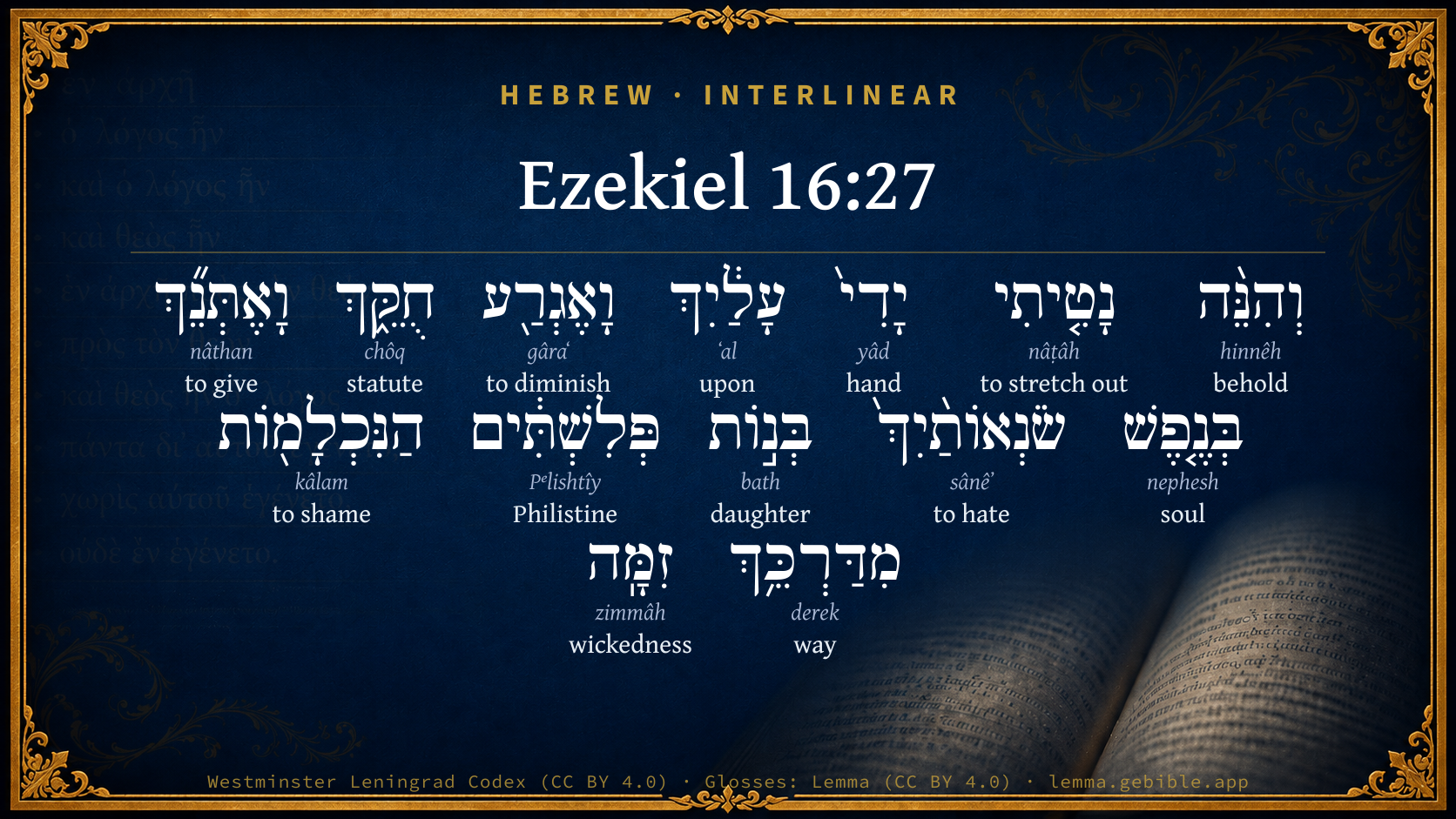
Ezekiel 16:27

Hebrew (Westminster Leningrad Codex) Ezekiel 16:27 appears in the Hebrew Old Testament. The text above is from the Westminster Leningrad Codex. Each word links to its Strong’s number, a concise gloss, and parsing drawn from the Open Scriptures Hebrew Bible morphology. Click any word for its full Brown-Driver-Briggs (BDB) entry.
Download image
Cite this verse

Ezekiel 16:27 (World English Bible). Public Domain. Lemma interlinear Bible study tool, https://lemma.gebible.app/v/ezekiel/16/27.

Show BibTeX & RIS
BibTeX
RIS
English Translation
See therefore, I have stretched out my hand over you, and have diminished your ordinary [food], and delivered you to the will of those who hate you, the daughters of the Philistines, who are ashamed of your lewd way.
World English Bible · Public Domain
Download a study sheet

One document with this verse’s original text, its word-by-word gloss line, the meaning frame, cross-references with their text, attributed commentary, and full source and license credits — printable, and it pastes into notes with its structure intact.

This verse Autodidact and up

Study sheet (.html) Plain text (.txt)

A passage Seminary Student

Up to 50 verses in one chapter. A passage sheet keeps up to 6 commentary sources and 12 cross-references per verse, in the order this page ranks them, and says so on the sheet whenever that leaves anything out. Ask for a single verse and you get the Autodidact verse sheet above.

Everything on this page stays free to read, with no account — the sheet is a download of what is already on screen, not access to it.

Want to remove ads? Support Godless Engineer
Compare translations 3

The same verse in 3 English versions, stacked beneath the original-language interlinear above. Click any original word for its lexicon entry.

Each is an independent rendering of the whole verse — the interlinear is not word-aligned to these translations.

Highlighted words mark where these versions differ — a whole-verse word diff, not a word-by-word alignment.

  • World English Bible Public Domain
    See therefore, I have stretched out my hand over you, and have diminished your ordinary [food], and delivered you to the will of those who hate you, the daughters of the Philistines, who are ashamed of your lewd way.
  • King James Version Public Domain
    Behold, therefore I have stretched out my hand over thee, and have diminished thine ordinary food, and delivered thee unto the will of them that hate thee, the daughters of the Philistines, which are ashamed of thy lewd way.
  • unfoldingWord Literal Text CC BY-SA 4.0
    See! I will strike you with my hand and cut off your food. I will hand your life over to your enemies, the daughters of the Philistines, who were ashamed of your obscene behavior.

unfoldingWord Literal Text — © unfoldingWord, licensed CC BY-SA 4.0. Word-aligned USFM3 via Door43 (git.door43.org/unfoldingWord/en_ult).

Versions to compare (up to 4)

3 of 4 selected

Show all 18 translations

Every available English version of this verse, each an independent rendering of the whole verse.

  • World English Bible Public Domain
    See therefore, I have stretched out my hand over you, and have diminished your ordinary [food], and delivered you to the will of those who hate you, the daughters of the Philistines, who are ashamed of your lewd way.
  • Berean Standard Bible Public Domain
    Therefore I stretched out My hand against you and reduced your portion. I gave you over to the desire of those who hate you, the daughters of the Philistines, who were ashamed of your lewd conduct.
  • Majority Standard Bible Public Domain
    Therefore I stretched out My hand against you and reduced your portion. I gave you over to the desire of those who hate you, the daughters of the Philistines, who were ashamed of your lewd conduct.
  • King James Version Public Domain
    Behold, therefore I have stretched out my hand over thee, and have diminished thine ordinary food, and delivered thee unto the will of them that hate thee, the daughters of the Philistines, which are ashamed of thy lewd way.
  • American Standard Version (1901) Public Domain
    Behold therefore, I have stretched out my hand over thee, and have diminished thine ordinary `food', and delivered thee unto the will of them that hate thee, the daughters of the Philistines, that are ashamed of thy lewd way.
  • Revised Version (1885) Public Domain
    Behold therefore, I have stretched out my hand over thee, and have diminished thine ordinary food, and delivered thee unto the will of them that hate thee, the daughters of the Philistines, which are ashamed of thy lewd way.
  • Geneva Bible (1599) Public Domain
    Beholde, therefore I did stretche out mine hand ouer thee, and will diminish thine ordinarie, and deliuer thee vnto the will of them that hate thee, euen to the daughters of the Philistims, which are ashamed of thy wicked way.
  • Douay-Rheims (1899) Public Domain
    Behold, I will stretch out my hand upon thee, and will take away thy justification: and I will deliver thee up to the will of the daughters of the Philistines that hate thee, that are ashamed of thy wicked way.
  • Young's Literal Translation Public Domain
    And lo, I have stretched out My hand against thee, And I diminish thy portion, And give thee to the desire of those hating thee, The daughters of the Philistines, Who are ashamed of thy wicked way.
  • Literal Standard Version CC BY-SA 4.0
    And behold, I have stretched out My hand against you, || And I diminish your portion, || And give you to the desire of those hating you, || The daughters of the Philistines, || Who are ashamed of your wicked way.
  • Unlocked Literal Bible CC BY-SA 4.0
    See! I will strike you with my hand and cut off your food. I will hand your life over to your enemies, the daughters of the Philistines, who were ashamed of your obscene behavior.
  • unfoldingWord Literal Text CC BY-SA 4.0
    See! I will strike you with my hand and cut off your food. I will hand your life over to your enemies, the daughters of the Philistines, who were ashamed of your obscene behavior.
  • Darby Bible Public Domain
    And behold, I stretched out my hand over thee, and diminished thine appointed portion; and I gave thee over unto the will of them that hate thee, the daughters of the Philistines, who were confounded at thy lewd way.
  • World Messianic Bible Public Domain
    See therefore, I have stretched out my hand over you, and have diminished your portion, and delivered you to the will of those who hate you, the daughters of the Philistines, who are ashamed of your lewd way.
  • Webster's Bible Public Domain
    Behold, therefore I have stretched out my hand over thee, and have diminished thy ordinary food, and delivered thee to the will of them that hate thee, the daughters of the Philistines, who are ashamed of thy lewd way.
  • Free Bible Version CC BY-SA 4.0
    So I acted to reduce my blessings to you. I let your enemies the Philistines do what they wanted to you. Even they were embarrassed at your immorality.
  • Bible in Basic English Public Domain
    Now, then, my hand is stretched out against you, cutting down your fixed amount, and I have given you up to the desire of your haters, the daughters of the Philistines who are shamed by your loose ways.
  • JPS Tanakh (1917) Public Domain
    Behold, therefore I have stretched out My hand over thee, and have diminished thine allowance, and delivered thee unto the will of them that hate thee, the daughters of the Philistines, that are ashamed of thy lewd way.

Literal Standard Version (2020), Covenant Press — licensed CC BY-SA 4.0. Text via the HelloAO Bible API (eBible.org). Unlocked Literal Bible (unfoldingWord) — licensed CC BY-SA 4.0. Text via the HelloAO Bible API (eBible.org). unfoldingWord Literal Text — © unfoldingWord, licensed CC BY-SA 4.0. Word-aligned USFM3 via Door43 (git.door43.org/unfoldingWord/en_ult). Free Bible Version, Dr. Jonathan Gallagher — licensed CC BY-SA 4.0. Text via the HelloAO Bible API (eBible.org).

Word by word

More ways to search: Search by grammar → Find every occurrence → Compare this word →

Practice this passage: Drill this verse → Learn its vocabulary →

וָאֶגְרַ֖ע
gâraʻ
H1639
“and · to diminish”
Conjunction + Verb, Qal, Sequential Imperfect, 1st Person, Common, Singular
Part of Speech
Conjunction + Verb
Stem
Qal
Form
Sequential Imperfect
Person
1st Person
Gender
Common
Number
Singular
Full BDB Definition

Origin: a primitive root

TWOT: 384

to diminish, restrain, withdraw, abate, keep back, do away, take from, clip - (Qal) - to diminish - to restrain - to withdraw - (Niphal) - to be withdrawn - to be restrained - (Piel) to withdraw, draw up
  1. וְהִנֵּ֨ה hinnêh H2009 “and · behold” Conjunction + Particle, Demonstrative
  2. נָטִ֤יתִי nâṭâh H5186 “to stretch out” Verb, Qal, Perfect, 1st Person, Common, Singular
  3. יָדִי֙ yâd H3027 “hand · my” Noun, Common, Both, Singular, Construct + Suffix, Personal, 1st Person, Common, Singular
  4. עָלַ֔יִךְ ʻal H5921 “upon · you” Preposition + Suffix, Personal, 2nd Person, Feminine, Singular
  5. חֻקֵּ֑ךְ chôq H2706 “statute · your” Noun, Common, Masculine, Singular, Construct + Suffix, Personal, 2nd Person, Feminine, Singular
  6. וָאֶתְּנֵ֞ךְ nâthan H5414 “and · to give · you” Conjunction + Verb, Qal, Sequential Imperfect, 1st Person, Common, Singular + Suffix, Personal, 2nd Person, Feminine, Singular
  7. בְּנֶ֤פֶשׁ nephesh H5315 “in/at · soul of” Preposition + Noun, Common, Both, Singular, Construct
  8. שֹׂנְאוֹתַ֨יִךְ֙ sânêʼ H8130 “hating · you” Verb, Qal, Participle Active, Feminine, Plural, Construct + Suffix, Personal, 2nd Person, Feminine, Singular
  9. בְּנ֣וֹת bath H1323 “daughters of” Noun, Common, Feminine, Plural, Construct
  10. פְּלִשְׁתִּ֔ים Pᵉlishtîy H6430 “Philistines” Noun, Gentilic, Masculine, Plural, Absolute
  11. הַנִּכְלָמ֖וֹת kâlam H3637 “the · shamed” Particle, Definite Article + Verb, Niphal, Participle Passive, Feminine, Plural, Absolute
  12. מִדַּרְכֵּ֥ךְ derek H1870 “from · way · your” Preposition + Noun, Common, Both, Singular, Construct + Suffix, Personal, 2nd Person, Feminine, Singular
  13. זִמָּֽה zimmâh H2154 “wickedness” Noun, Common, Feminine, Singular, Absolute

About this verse

These counts appear in no published source. They are computed here, from the morphology-tagged text and Lemma’s own curated glosses. What Lemma adds →

14
words
14
distinct lemmas
Prophets
section

Notable vocabulary

The rarest word here is וָאֶגְרַ֖ע to diminish H1639 — appearing just 22 times in the whole Hebrew Bible.

Shared distinctive vocabulary

וָאֶגְרַ֖ע to diminish H1639 occurs in 21 verses of the Hebrew Bible. Also found in:

Grammatical profile

  • 5 verbs
  • 7 nouns
  • 1 preposition
  • 1 particle

Verb forms

  • נָטִ֤יתִי Qal · Perfect
  • וָאֶגְרַ֖ע Qal · Sequential Imperfect
  • וָאֶתְּנֵ֞ךְ Qal · Sequential Imperfect
  • שֹׂנְאוֹתַ֨יִךְ֙ Qal · Participle Active
  • הַנִּכְלָמ֖וֹת Niphal · Participle Passive

Hebrew & Septuagint length

In English translation the verse runs 39 words from the Hebrew and 44 from the Septuagint (LXX English) — closely comparable.

A rough comparison of the two English renderings, which tokenize alike — not a word-level alignment.

Word counts can differ between the Hebrew and the Greek without any difference in meaning — e.g. the Hebrew direct-object marker אֵת has no separate Greek word, and Greek often adds the article ὁ.

Cross-references

20

Topical passages linked to Ezekiel 16:27 in the Treasury of Scripture Knowledge — connected by theme and wording, ordered by reader-vote popularity; previews shown in the World English Bible.

  • Isaiah 9:12 the Syrians before, and the Philistines behind; and they shall devour Israel with open mouth. For all this his anger is not turned away, but his hand is stretched out still.
  • Ezekiel 16:57 before your wickedness was uncovered, as at the time of the reproach of the daughters of Syria, and of all who are round about her, the daughters of the Philistines, who do despite to you round about.
  • Ezekiel 16:37 therefore see, I will gather all your lovers, with whom you have taken pleasure, and all those who you have loved, with all those who you have hated; I will even gather them against you on every side, and will uncover your nakedness to them, that they may see all your nakedness.
  • Deuteronomy 28:48–57 therefore shall you serve your enemies whom Yahweh shall send against you, in hunger, and in thirst, and in nakedness, and in want of all things: and he shall put a yoke of iron on your neck, until he have destroyed you.
  • 2 Kings 24:2 Yahweh sent against him bands of the Chaldeans, and bands of the Syrians, and bands of the Moabites, and bands of the children of Ammon, and sent them against Judah to destroy it, according to the word of Yahweh, which he spoke by his servants the prophets.
  • 2 Chronicles 28:18–19 The Philistines also had invaded the cities of the lowland, and of the South of Judah, and had taken Beth-shemesh, and Aijalon, and Gederoth, and Soco with the towns of it, and Timnah with the towns of it, Gimzo also and the towns of it: and they lived there.
  • Psalms 106:41 He gave them into the hand of the nations. Those who hated them ruled over them.
  • Isaiah 3:1 For, behold, the Lord, Yahweh of Hosts, takes away from Jerusalem and from Judah supply and support, The whole supply of bread, And the whole supply of water;
  • Isaiah 5:25 Therefore Yahweh's anger burns against his people, And he has stretched out his hand against them, and has struck them. The mountains tremble, And their dead bodies are as refuse in the midst of the streets. For all this, his anger is not turned away, But his hand is still stretched out.
  • Isaiah 9:17 Therefore the Lord will not rejoice over their young men, neither will he have compassion on their fatherless and widows; for everyone is profane and an evil-doer, and every mouth speaks folly. For all this his anger is not turned away, but his hand is stretched out still.
  • Jeremiah 34:21 Zedekiah king of Judah and his princes will I give into the hand of their enemies, and into the hand of those who seek their life, and into the hand of the king of Babylon's army, who have gone away from you.
  • Ezekiel 5:6–7 She has rebelled against my ordinances in doing wickedness more than the nations, and against my statutes more than the countries that are round about her; for they have rejected my ordinances, and as for my statutes, they have not walked in them.
  • Ezekiel 14:9 If the prophet be deceived and speak a word, I, Yahweh, have deceived that prophet, and I will stretch out my hand on him, and will destroy him from the midst of my people Israel.
  • Ezekiel 16:47 Yet have you not walked in their ways, nor done after their abominations; but, as [if that were] a very little [thing], you were more corrupt than they in all your ways.
  • Ezekiel 23:22 Therefore, Oholibah, thus says the Lord Yahweh: Behold, I will raise up your lovers against you, from whom your soul is alienated, and I will bring them against you on every side:
  • Ezekiel 23:25 I will set my jealousy against you, and they shall deal with you in fury; they shall take away your nose and your ears; and your residue shall fall by the sword: they shall take your sons and your daughters; and your residue shall be devoured by the fire.
  • Ezekiel 23:28–29 For thus says the Lord Yahweh: Behold, I will deliver you into the hand of them whom you hate, into the hand of them from whom your soul is alienated;
  • Ezekiel 23:46–47 For thus says the Lord Yahweh: I will bring up a company against them, and will give them to be tossed back and forth and robbed.
  • Hosea 2:9–12 Therefore I will take back my grain in its time, And my new wine in its season, And will pluck away my wool and my flax which should have covered her nakedness.
  • Revelation 17:16 The ten horns which you saw, and the beast, these will hate the prostitute, and will make her desolate, and will make her naked, and will eat her flesh, and will burn her utterly with fire.

Cross-references courtesy of OpenBible.info (CC BY 4.0).

Hebrew and Greek witnesses Masoretic Hebrew ↔ Greek Septuagint

The same verse in the two great witnesses to the Old Testament, shown verse-for-verse.

These are two independent witnesses, not word-aligned to each other, and the Septuagint is shown in lemma (dictionary) form.

Hebrew Ezekiel 16:27 Masoretic · Westminster Leningrad Codex

וְהִנֵּ֨ה נָטִ֤יתִי יָדִי֙ עָלַ֔יִךְ וָאֶגְרַ֖ע חֻקֵּ֑ךְ וָאֶתְּנֵ֞ךְ בְּנֶ֤פֶשׁ שֹׂנְאוֹתַ֨יִךְ֙ בְּנ֣וֹת פְּלִשְׁתִּ֔ים הַנִּכְלָמ֖וֹת מִדַּרְכֵּ֥ךְ זִמָּֽה

See therefore, I have stretched out my hand over you, and have diminished your ordinary [food], and delivered you to the will of those who hate you, the daughters of the Philistines, who are ashamed of your lewd way.

World English Bible · Public Domain

Greek LXX Ezekiel 16:27 Septuagint · lemma form

ἐάν δέ κτείνω ὁ χείρ ἐγώ ἐπί σύ καί ἐκαἴρω ὁ νόμιμος σύ καί παραδίδωμι σύ εἰς ψυχή μισέω σύ θυγάτηρ ἀλλόφυλος ὁ ἐκκλίνω σύ ἐκ ὁ ὁδός σύ ὅς ἀσεβέω

And if I stretch out my hand against you, then will I abolish your statutes, and deliver you up to the wills of them that hate you, even to the daughters of the Philistines that turned you aside from the way wherein you sinned.

LXX2012 (modern English Septuagint) · Public Domain

Hebrew: Westminster Leningrad Codex (CC BY 4.0). Greek: Septuagint (public domain); English from LXX2012 (modern English Septuagint) (Public Domain). How the Septuagint differs from the Hebrew →

Targum (Aramaic paraphrase)

1

The Targum is the ancient Jewish Aramaic paraphrase of the Hebrew Scriptures — an interpretive translation, not the Hebrew text itself. Onkelos (literal) and Pseudo-Jonathan (expansive) render the Torah, and Jonathan the Prophets. Coverage is partial: where no permissively-licensed English translation exists for a verse, only the Aramaic is shown. This is verse-level text, not a word-by-word alignment to the Hebrew.

  1. Targum Jonathan Prophets (Joshua–Malachi)
    וְהָא אֲרֵימִית יַת מְחַת גְבוּרְתִּי עֲלָךְ וּמְנָעֵית טוּבִיךְ וְאֶמְסְרִינִיךְ בְּיַד בַּעֲלֵי דְבָבִיךְ כַּפְרָנֵי פְּלִשְׁתָּאֵי דְאִלוּ שַׁלְחֵית לְוַתְהוֹן נְבִיַי אִתְכְּנָעוּ וְאַתְּ לָא תַּבְתְּ מֵאוֹרְחִיךְ דְעֵיצַת חֶטְאִין:

    (no public-domain English translation for this verse)

    Targum Jonathan — Aramaic: “Mikraot Gedolot” (public domain). English: “Sefaria Community Translation” (CC0 1.0 (public-domain dedication)); “London "Chaldee Paraphrase," 1871” (public domain). Text via Sefaria.

Commentary

Notes on Ezekiel 16:27 from classic Christian and Jewish commentators (each source and its license shown beneath its notes). The classic Christian expositions comment on the surrounding passage and are grouped to its opening verse, so a note may address several verses; the Jewish commentaries on the Tanakh (Rashi and others) are per-verse, so they appear only where the commentator wrote on this verse.

Lemma curates 59 commentaries, every one of them public domain or Creative Commons licensed, each selected and text-cleaned for this edition rather than reprinted as found. About our sources →

Trapp's Complete Commentary

John Trapp

Eze 16:27 Behold, therefore I have stretched out my hand over thee, and have diminished thine ordinary [food], and delivered thee unto the will of them that hate thee, the daughters of the Philistines, which are ashamed of thy lewd way.

Ver. 27. I have stretched out my hand over thee.] To cut thee short. {as Hos 2:9}

And have diminished thine ordinary food.] Diminui demensum tuum. What should a father do but snatch away the meat from his child that marreth it? or a husband, but hold his wanton wife to straiter allowance?

The daughters of the Philistines, which are ashamed of thy lewd way.] It must needs be most lewd that Philistines were ashamed of. Zimmah signifieth wickedness with a witness. Jerome interpreteth it an execrable and villanous filthiness. So is Popish idolatry in the eyes of modern Jews; and the hellish blasphemies darted out against God and Christ so ordinarily and openly by pseudo Christians, abominable to the Turks, who do punish them for it with great severity.

John Trapp, A Commentary or Exposition upon All the Books of the Old and New Testament (1647–1656) — public domain. Text from a community e-Sword module.

The Biblical Illustrator

Joseph S. Exell

Eze_16:27

I have stretched out My hand over thee, and have diminished thine ordinary food, and delivered thee unto the will of them that hate thee.

The tyranny of Satan

To be delivered unto the will of them that hate us--this seems given as amongst the most oppressive of calamities--the judgment which God, after having long striven with the unrighteousness of a nation, selects from the stores of His retributive appointments. Suppose one person knew another to be his rancorous enemy, bent on doing him every kind of injury, and causing him every kind of pain; it may be that this enemy had left the kingdom and gone to foreign parts, so that it did not seem likely that he would again cross the path of the object of his bitter dislike. But the individual himself may be called to quit his home, and navigate distant seas; and he himself, falling amongst pirates, may find that, though life is spared, liberty is gone, and that he is to be sold as a slave on reaching the land. Who can tell the anguish of his soul? The endearing recollections of his native shores crowd thickly upon him; and he thinks that not only shall he never again meet the friends of his youth, but that he shall drag out the remainder of his days in subjection to some tyrant whose delight will be to torment. Yet perhaps not so! It is a galling thing that he--a freeborn man--should stand in the slave market, exposed for sale like a mere beast of burden; but it may be that, through this degradation, he shall recover all that he has lost. He therefore waits with trembling eagerness to know who his purchaser shall be. On a sudden his eye rests on his ancient enemy; he cannot be mistaken. He knows that form; it will not allow him to doubt. Oh! that he might hide himself! But in vain! His foe has purchased him; he has paid down the demanded price. Tell me! did the man till this moment feel himself utterly wretched? Now, the case would be much the same with a community or nation as with the individual. If a nation must yield to a foreign power, it would desire that it might not be to a power by which it had always been held in dislike, and with which it had often been at war. The galling thing would be, not merely that we were subdued, but that we were subdued by those to whom we knew ourselves to be objects of inveterate hatred, and who cherished against us deep-rooted antipathy. Now, whilst these may be thoroughly accurate illustrations of our text, they are not those which cause the passage to be surveyed under its most instructive aspects. The text, when separated from its local and temporary application, may justly be considered as describing the state to which the human race was reduced when, by the first rebellion against God, it severed the links which had heretofore associated the Creator and the creature. We all admit that through the apostasy of Adam, Satan acquired a dominion over the globe which he never could have held had our first parents remained firm in their allegiance, He became, in the language of St. Paul, The God of this world. If it were to be said of the Jews that God delivered them unto the will of them that hated them, it is easy to be said of man in general that God surrendered him to the hands of the devil. Though never let it be for a moment forgotten that whilst He thus allowed judgment to fall on sin, and caused the disobedient to eat of the fruit of their own ways, He was providing for the emancipation of our race--arranging that His blessed Son should be manifested for the express purpose of destroying the works of the devil. And you are yet to be told the worst feature in this our natural condition. Not only are we slaves, but they that hate us are they that rule over us. There can be nothing darker, if we may judge from the scattered touches of Scripture, than the character of apostate angels. Fallen from the very summit of created glory, their debasement seems to bear proportion with their original eminence; and they move to and fro burning with the fiercest animosity against God, and eager for nothing but to drag down others to share their sufferings and their shame. It may have been that it was hatred to man which first moved Satan to attempt his destruction. That haughty spirit, chafed by his defeat, and furious at his own exile from happiness, could not endure to look on the purities and felicities of Paradise. Man was innocent, and that made him hateful; man was happy, and he was therefore instinctively detested. And if we may speak of man as an object of hatred to Satan whilst he held fast his allegiance, what may we suppose him now--now that, seduced into apostasy, he hath been rescued by the interference of God manifest in the flesh? Was the lofty angel to be passed by and this inferior being taken note of? And was it to be the result of Satans machinations against the inmates of Paradise that a richer than that rich garden was to open to them all its loveliness, and a deeper than the happiness they then enjoyed be placed within reach as their everlasting portion? This surely were sufficient to account for a hatred the most intense and inveterate on the part of the devil toward man! Again, Satan must hate man, so that whosoever is the servant of this chief of fallen angels is accurately in the condition described in our text; and every one of you is that servant, on whom there has not passed the great moral change of conversion. Oh! that we could bring all that imagery which was furnished by the slave market, or the horrors of an invasion, and force those who are yet indifferent to religion to recognise in it a delineation of themselves! He who really feels that the devil is both his master and his enemy is not far from embracing Christ as his Redeemer and his friend. But it in no degree alters the fact of your being ruled by one who hates you that you are blind to your condition, and not even conscious of being ruled at all: it does but make that condition all the worse. Why, suppose that when the inveterate enemy has entered the slave market, and possessed himself of the wretched being who actually quails before his look;--suppose he should speak soothingly to his victim, easing his chains as he leads him away, promising him abundance and enjoyment, and all because he knows a generous friend of the poor captive is waiting on the road, and will be attracted by a cry of disquietude or a shriek of distress;--suppose this, and you suppose precisely the policy of Satan, who, if he can only prevent a man from feeling that uneasiness which would prompt an appeal to the Saviour, is quite content to defer the season for giving swing to all his malice and wreaking all his vengeance. But that season will come. It is little, it is nothing to say that imagination is utterly incompetent to the giving to such season its due measure of horror. We pretend not to lift the veil which shrouds from human gaze the future, with its direful retribution. But we may venture to say that in the brief description of our text is condensed whatever tongue can express, or thought compass, of the wretchedness which must be the portion of the lost. We do not attempt to carry the description further; we have adventured thus far only in hopes that the terrors of the future may scare some of those who, if they were this instant to die, must have these terrors for their own. Why shrink ye from our picture of the man sold to be a slave--a slave to his bitter enemy, who has long sought opportunity of indulging all the vengeance of a fierce and implacable nature? Wherefore are ye moved by this imagined wretchedness? Wherefore is the cheek pale, and wherefore the blood cold, as you fancy that you hear the clanking chain and the stifled cry, and behold the oppressor grinding down the captive? Wherefore is it? Because there is a consciousness which you cannot repress, of being in the power of one who hates you. This is supreme misery in itself, and such a finishing stroke to all others as leaves nothing for imagination to add. It is, indeed, to one who hates you that you are making yourselves slaves in following the course which the God of this world prescribes to the children of disobedience. That the devil hates you witness what he has already done to make mankind wretched. Witness a devastated earth; witness every grave; witness every tear. He was a murderer from the beginning; and to his foul machinations we owe all our woe. Oh! shall it then be that you will so live that, when you come to die, there will remain nothing but that you go down to the prison house of woe, to experience all the terribleness of the saying--a saying from which the most hardened amongst you instinctivley recoils when it is exhibited as brought to pass on earth;--the saying that when God has a vast vengeance to inflict, and a vast retribution to exact, He appoints for the guilty--what:--that they be delivered unto the evil of them that hate them? (H. Melvill, B. D.)

The Biblical Illustrator, edited by Joseph S. Exell (c. 1880s–1900s) — public domain. Text from a community e-Sword module.

Joseph Benson's Commentary

Eze 16:27-29. Behold, therefore — Open thine eyes, thou secure and foolish adulteress, see what has been done against thee, and consider it is for thy lewdness. I have stretched out my hand over thee — I have chastised and punished thee already in some measure. And have diminished thine ordinary food — Have taken away some of thy opulence, and abridged thee of many necessaries and conveniences. And delivered thee unto the will of them that hate thee — Have excited them to make war against thee, have given them victory over thee, and delivered thee into their power. The daughters of the Philistines — This and what follows was effected in the reign of King Ahaz, 2Ch 28:16; 2Ch 28:18. The daughters of the Philistines are here put for the Philistines, as the daughters of Samaria, Sodom, and Syria stand for the people of those places, to carry on the allegory and comparison between them and Jerusalem, being all of them described as so many lewd women, prostituting themselves to idols, Eze 16:41. By the same metaphor Samaria and Sodom are called sisters to Jerusalem, Eze 16:46. Which are ashamed of thy lewd way — Who have not had the wickedness to imitate thy evil deeds; for they have not forsaken the religion of their country as you Jews have done, nor have been so fond of foreign idolatries. Thou hast played the whore also with the Assyrians — The Jews courted the alliance of their two potent neighbours, the Egyptians and Assyrians, as it served their present turn; and, to ingratiate themselves with them, served their idols, Jer 2:18; Jer 2:36. This is particularly recorded of Ahaz, 2Ch 28:23. Thou hast multiplied thy fornication in Canaan unto Chaldea — The sense is, thou hast defiled thyself with all the idolatries of the heathen, beginning with those that were practised by the former inhabitants of Canaan, and, by degrees, learning new kinds of idolatry, derived from distant countries, such as Chaldea was reckoned. It is said unto Chaldea, to signify that they learned and practised the idolatries of Chaldea before they were carried captives thither.

Joseph Benson's Commentary on the Old and New Testaments (1811–1818) — public domain. Text from a community e-Sword module.

Geneva Bible (1599)

Geneva Bible translators

Or, cities.

Geneva Bible (1599) marginal notes — public domain. Text via Bolls.life.

Jamieson, Fausset & Brown

Robert Jamieson, A. R. Fausset & David Brown

The consequent judgments, which, however, proved of no avail in reforming the people (Isa 9:13; Jer 5:3).

delivered thee unto . . . Philistines-- (Kg2 16:6; Ch2 28:18-19).

ashamed of thy lewd way--The Philistines were less wanton in idolatry, in that they did not, like Israel, adopt the idols of every foreign country but were content with their own (Eze 16:57; Jer 2:11).

Jamieson, Fausset & Brown — Commentary Critical and Explanatory on the Whole Bible (1871) — public domain (CC PDM 1.0). Text via the HelloAO Bible API.

Adam Clarke's Commentary

Verse 27. Have diminished thine ordinary] חקך chukkech means here the household provision made for a wife-food, clothing, and money.

Adam Clarke's Commentary on the Bible (1810–1826) — public domain. Text from a community e-Sword/MySword module.

John Calvin's Commentaries

Here God reproves the hardness of the Jews because admonition did not render them wise. The common proverb aptly says, “fools grow wise only by the rod;” and when their obstinacy is such that the rod does no good, their faults are indeed desperate. Hence God complains, when he had chastised the Jews, that even this did not profit them, for they were so perverse that they did not apply their minds to reflect upon their sins. For God’s blows ought to rouse us up, so that our faults previously hidden ought to be brought to light and knowledge; but when we champ the bit, and are not affected by the blows, then our abandoned disposition is made manifest. Now the Prophet condemns this obstinacy in the Jews: I have extended, says he, my hand over thee. He now enumerates two kinds of chastisement, first, when God deprived the Jews of the abundance of the possessions by which they were enriched; and then because he had subjected them to the lust of their enemies. Those who translate justification as Jerome does, depart from the sense of the Prophet: חק, chek, signifies, indeed, a statute and edict, and he explains it of the law. But how will this agree with the Prophet’s retaining the simile already used? for he compares God to a husband. God now pronounces that he had taken away their appointed portion, when he saw himself a laughingstock through his impure wife; that is, what he had intended for both food and clothing: for husbands spend a fixed sum on their wives in food, clothing, and ornament. And God previously recounted, among other things, that what he had conferred upon the Jews they had spent in superstitions. Hence, for this reason, he now says, I have taken away their allotted portion, that is, what I had assigned to them. This was one part of the chastisement: for he compares the fruitfulness of the land and other advantages to the portion which the husband assigns to the wife.

Now the other chastisement follows — their being harassed by their enemies; for not only did the Jews find themselves encompassed by the Philistines, but they were delivered up and bound to slavery, as Moses says, (Deuteronomy 32:30,) How, then, could one vanquish ten, and ten chase a thousand, unless we had been shut up in his hand? He shows, therefore, that our enemies are never our superiors unless God enslaves us to them. But those who do not calmly subject themselves to God’s command, but are refractory, are delivered into the enemy’s hand, that their contumacy may be subdued by severe tyranny. Now we understand what the Prophet means by this verse: he enlarges upon the people’s wickedness in not turning to God, though they felt by clear experience that they were under a curse. They ought to examine their lives, to groan before God, to acknowledge their fault, and to beg for pardon: since no feeling was awakened, the Prophet gathers that their obstinacy was desperate. This passage is worthy of our notice, that we may be attentive to God’s chastisements. Whenever God even raises his finger and threatens us, let us know that he is anxious for our safety: hence in our turn let us rouse ourselves and implore his pity, and especially let us repent of our sins by which we see his anger to have been enflamed. (Jeremiah 2:30.) But if we remain slothful, we see that no excuse for us remains, since God elsewhere complains that he is trifled with, when he has chastised his children in vain. Here, נפש, nepish, the soul is used for lust or desire, as I have explained it. It follows —

John Calvin's Commentaries (1540-1563) — public domain. Text from the Calvin Translation Society English edition (1840s-50s) via the Christian Classics Ethereal Library (ccel.org). Calvin's coverage is partial (roughly two-thirds of the Bible); uncommented books and verses are honest gaps, never fabricated. The 19th-century editor's footnotes and remarks are omitted so the notes are faithfully Calvin's own voice.

Ellicott's Commentary for English Readers

(27) Diminished thine ordinary food.—This cutting short of the power and prosperity of Israel was a discipline of correction designed to bring her to a consciousness of her sin.

The daughters of the Philistines, i.e., their cities, according to the figurative language of the chapter, and indeed the common figurative language of Scripture. Philistia was but a small power in the south-west corner of Palestine, yet from the time of the Judges down through the whole period of the monarchy, they were the persistent foes of Israel. During the time immediately before Samuel, they held nearly the entire land in subjection, and although subdued by David, they became troublesome again in the times of the later kings (see 2Ch_26:7; 2Ch_28:18), and are often spoken of not only by the earlier prophets, Isaiah and Amos, but also by Jeremiah (Jer_25:20; Jer_47:1; Jer_47:4), Ezekiel (Eze_25:15-16), and Zechariah Zec_9:6).

Ashamed of thy lewd way.—The Philistines, true to their own false gods, despised the Israelites for their unfaithfulness to Jehovah. It is the old but ever new story of the heathen repelled from the truth by the unworthiness of its professed followers.

A Bible Commentary for English Readers, edited by Charles John Ellicott (1878–1897) — public domain. Text from a community e-Sword module.

The Cambridge Bible for Schools and Colleges

gen. ed. J. J. S. Perowne

27. I have stretched] I stretched … and diminished … them that hated … were ashamed. The reference appears to be to the distant times of the Philistine supremacy in the last days of the Judges.

thine ordinary food] Or, allotted portion, Exo_21:10. The measure is one to which an offended husband might have recourse. Hos_2:9, “therefore will I take back my corn in the time thereof, and my wine in the season thereof.”

daughters of the Philistines] i.e. the cities or small Philistine lordships. The clause might explain the phrase “diminished thy portion”—her territory was seized by her enemies.

which are ashamed] were ashamed. Cf. Amo_3:9, “Publish ye in the palaces of Ashdod and say, Assemble ye on the mountains of Samaria, and behold what oppressions are in the midst thereof.” Whether the prophet speaks of Egyptian idolatry in the early times of Israel’s life from historical sources may be uncertain. Such idolatry at this period seems nowhere else spoken of; comp. the list Jdg_10:6. Possibly as he charges the people with idolatry in Egypt (ch. Eze_20:7; Eze_23:3; Eze_23:8; Eze_23:19; Eze_23:21) they may not have shaken themselves clear of it even in the period of the Judges. The connexion of the country with Egypt was at all times very close.

The Cambridge Bible for Schools and Colleges (gen. ed. J. J. S. Perowne; Cambridge University Press, 1878–1918) — public domain. Text from a community e-Sword module.

John Gill's Exposition

Thou hast played the whore also with the Assyrians,.... By entering into alliances with them, and worshipping their idols; which was done in the times of Ahaz, who sent to Tiglathpileser king of Assyria for help, and to Damascus for the fashion of the altar there, and built one according to it, Kg2 7:10;

because thou wast unsatiable; not content with the alliance and idolatries of the Egyptians:

yea, thou hast played the harlot with them; with the Assyrians:

and yet couldest not be satisfied; with their idols, and the worship of them, but sought out for new gods, and new modes of worship; like a lewd woman, who having prostituted herself to one, and to another, yet remains insatiable, and seeks out for other lovers.

John Gill's Exposition of the Whole Bible (1746–1763) — public domain (CC PDM 1.0). Text via the HelloAO Bible API.

Albert Barnes' Notes on the Bible

Have diminished thine ordinary food - As a husband lessens the things which minister to the luxury of an unfaithful wife, so did the Lord cut Israel short in consequence of her unfaithfulness.

Daughters - The small cities. The Philistines have left a permanent record of their supremacy in the name of the holy land - Palestine. It was a special shame to be subjected to so small a power as that of Philistia (see Isa 14:29); but the very Philistines were ashamed of Judah’s unfaithfulness, and were themselves truer to their false gods than Judah was to Yahweh.

Albert Barnes' Notes on the Bible (1834–1885) — public domain. Text from a community e-Sword/MySword module.

Haydock's Catholic Bible Commentary

Justification; law, &c. Hebrew, "thy right," or allowance, Exodus xxi. 10. --- Hate thee. To be abandoned to the will of a rival, is most dreadful for a woman. The Jews were subjected to the nations which they had despised, as they are still to Christians. Even other less favoured idolaters were astonished (Calmet) at their apostacy. (Haydock)

George Leo Haydock (1774–1849), Haydock's Catholic Family Bible and Commentary, 1859 edition — public domain. Excludes Psalms (Douay-Rheims chapter numbering differs from Protestant) and Deuterocanonical books (Catholic canon only).

Matthew Poole's English Annotations

Behold; open thine eyes, thou secure and foolish adulteress, see what hath been done against thee, and consider it is for thy lewdness.

I have stretched out my hand; I have chastised and punished already in some measure.

Over thee; it may be read, against thee. In like phrase Isa 5:25; 9:12,17,21; 10:4, expresseth the punishing of this people.

Diminished thine ordinary food; abated of that plentiful allowance a kind Husband made, and an unfaithful wife abused: it refers to scarcity and penury, with which God did punish idolatrous Israel, and this more than once.

Delivered thee; stirred up first such to fight against them, and then gave victory to their arms, yet they might use the conquered as they pleased; sent them into captivity into an enemy’s land, where they that hated them ruled over them, and no doubt such would satisfy their own lusts on these captives.

The daughters of the Philistines: either it is a Hebraism, the daughters of the Philistines for the whole nation, or else some particular cities and principalities of the Philistines, which quarrelled with and prevailed against the Jews, when God had been so provoked by the sins of the Jews. Idolaters, but in this honester than the Jews; they were constant to their own god, and did not, as the Jews, lewdly go a whoring with every idol they saw.

Which are ashamed of thy lewd way; will therefore reprove, and teach thee some modesty and chastity.

Matthew Poole's English Annotations on the Holy Bible (1683–1685) — public domain. Text from a community e-Sword/MySword module.

Whedon's Commentary on the Bible

Daniel D. Whedon

27. I have stretched… have diminished thine ordinary food… hate thee — Literally, I stretched… diminished their allotted food… hated thee. “That is, her fixed or allotted support was lessened, just as an insulted husband would take something from the wife’s stipend.” — Orelli. “The reference seems to be to the distant times of Philistine supremacy in the last days of the judges.” — Davidson.

The daughters of the Philistines, which are ashamed of thy lewd way — Even the Philistines are ashamed of this harlot (Amo_3:9). Even the cities of Philistia do not encourage such a mixed religious cult as this “holy city” of Jerusalem, and this is seen to explain why so much of Israelitish territory is controlled by Philistia.

Daniel D. Whedon (gen. ed.), Commentary on the Old and New Testaments (1874–1909) — public domain. Text from a community e-Sword module.

The Pulpit Commentary

Have diminished thine ordinary food. The husband was bound to provide his wife with food and raiment. (Exo_21:10) Here his first discipline for the unfaithful wife is to place her on a short allowance. Jehovah, to interpret the parable, had placed Israel under the discipline of famine and other visitations that involved a loss of wealth and Hos_2:9, 10 supplies a striking parallel. The daughters of the Philistines. So in ver. 57. The phrase, like "the daughter of Zion," indicates the Philistine cities. These had been, from the days of Samuel to those of Ahaz, (2Ch_28:18) among the most persistent enemies of Judah. (comp. Amo_1:6 Amo_3:9; Joe_3:4; Isa_9:12 Isa_14:29) In the words, were ashamed of thy lewd way, the prophet points, as his master had done, (Jer_2:10) to the fact that other nations had at leastbeen faithful to their inherited religion, while Judah had forsaken hers.

The Pulpit Commentary (1880–1919), ed. H.D.M. Spence-Jones & Joseph S. Exell — public domain. Text from a community e-Sword module.

unfoldingWord translationNotes

Door43 World Missions Community

General Information:

Yahweh continues to speak about Jerusalem as if the city were his unfaithful wife. The city represents the people who live there. (See: Metaphor and Metonymy)

See!

The word "see" here alerts us to pay attention to the surprising information that follows.

I will strike you with my hand

Here "hand" represents power. AT: "I will use my power to strike you" (See: Metonymy)

cut off your food

Yahweh speaks of stopping the supply of food as if it were cutting off the food. AT: "stop your food supply" (See: Metaphor)

I will hand your life over

Here "life" represents the person. AT: "I will hand you over" (See: Synecdoche)

the daughters of the Philistines

Here Yahweh speaks of the cities of Philistia as if they were the daughters of the Philistines. The cities represent the people who live there. AT: "the Philistine people" (See: Metaphor and Metonymy)

translationWords

hand

cut off

life

adversary

Philistines

shame

prostitute

Assyria

Chaldea

unfoldingWord translationNotes — © Distant Shores Media and the Door43 World Missions Community, licensed CC BY-SA 4.0. Source: git.door43.org/Door43/en_tn.

Rashi

Rabbi Shlomo Yitzchaki (Rashi)

your ration Your food, in the days that the judges judged.

and I delivered you to the will of those who hate you in the days of Samson.

who were embarrassed by your lewd way Jonathan [paraphrases]: For had I sent My prophets to them, they would have humbled themselves, and they would not have gone in the way of your lewdness.

Rashi on the Tanakh — English translations: “The Judaica Press complete Tanach with Rashi, translated by A. J. Rosenberg” (CC BY 4.0); “Pentateuch with Rashi's commentary by M. Rosenbaum and A.M. Silbermann, 1929-1934” (public domain); “The Metsudah Tanach series, Lakewood, N.J” (CC BY 4.0); and “The Book of Joshua, Metsudah Publications, 1997” (CC BY 4.0). Text via Sefaria.

Lesson kit

Teaching starters — assembled from the data on this page, not authored interpretation. Every prompt links to the verse data it draws on. Edit before teaching.

Ezekiel, in the Prophets, opens this verse with 14 words (14 distinct Hebrew lemmas). Its most distinctive word is gâraʻ (“to diminish”). A historical commentator’s framing appears above. Read the whole chapter for the surrounding context.

Discussion questions

  1. The word gâraʻ carries the sense “to diminish.” How does it shape the verse?
  2. How does Exodus 5:8, which shares the word «to diminish», read alongside this verse?
  3. These translations render this verse differently. What is at stake in choosing one wording over another?
  4. «נָטִ֤יתִי» is a Qal Perfect verb. How does that grammatical form shape the action described?
  5. Compare how Trapp's Complete Commentary and The Biblical Illustrator read this verse. Where do they agree or differ?

Things to notice

Reading settings

Reading text

Shown beneath each verse's original-language words.

Old Testament
Old Testament edition

Read the OT as the Masoretic Hebrew (MT) or the Greek Septuagint (LXX).

English shown for the Greek Septuagint (in the Hebrew ↔ Greek comparison).

Comparing translations? Open the Compare panel on any verse page to stack up to four side by side.