
Deuteronomy 16:19

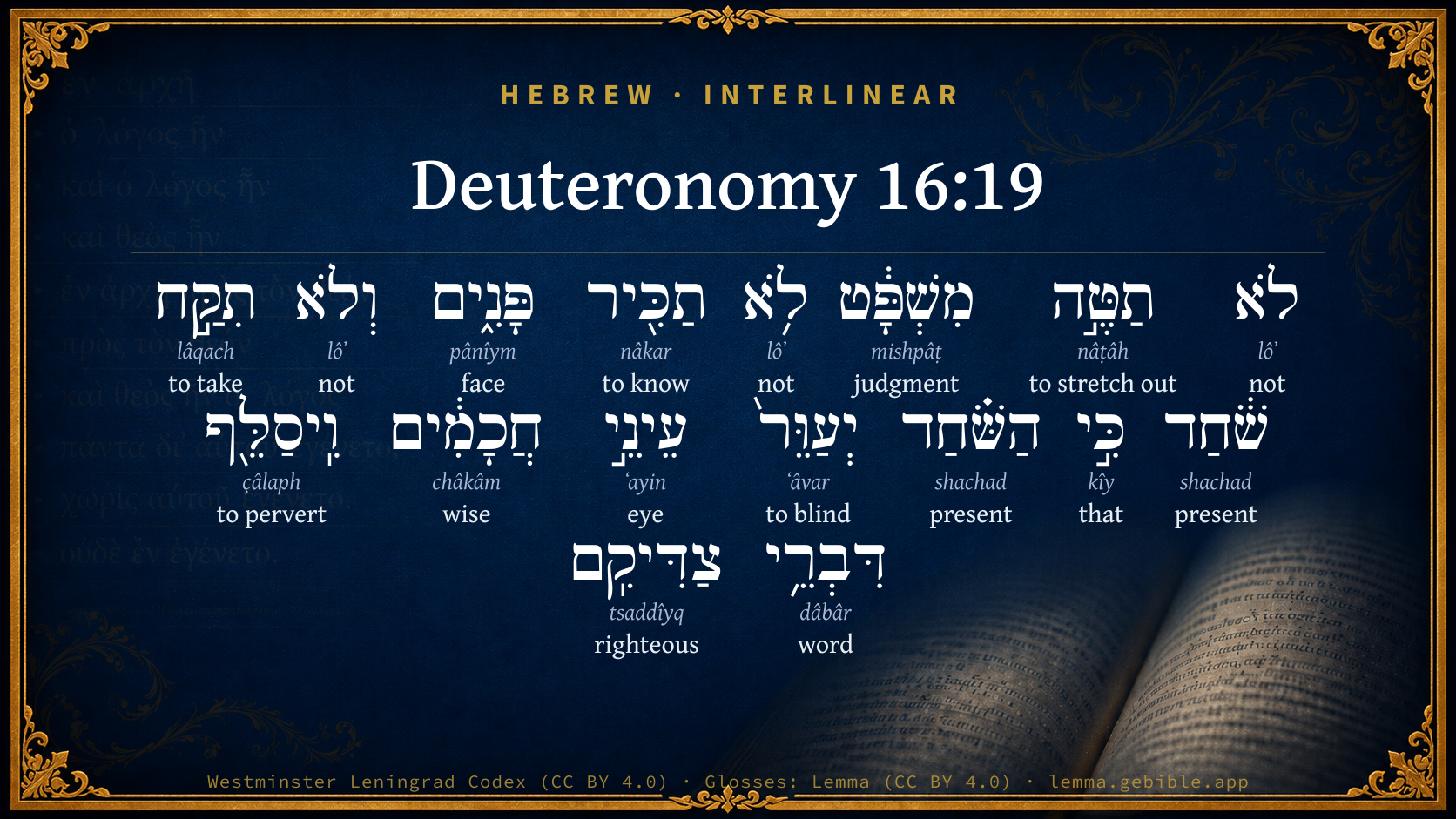
Hebrew (Westminster Leningrad Codex) Deuteronomy 16:19 appears in the Hebrew Old Testament. The text above is from the Westminster Leningrad Codex. Each word links to its Strong’s number, a concise gloss, and parsing drawn from the Open Scriptures Hebrew Bible morphology. Click any word for its full Brown-Driver-Briggs (BDB) entry.
Download image
Cite this verse

Deuteronomy 16:19 (World English Bible). Public Domain. Lemma interlinear Bible study tool, https://lemma.gebible.app/v/deuteronomy/16/19.

Show BibTeX & RIS
BibTeX
RIS
English Translation
You shall not wrest justice: you shall not respect persons; neither shall you take a bribe; for a bribe does blind the eyes of the wise, and pervert the words of the righteous.
World English Bible · Public Domain
Download a study sheet

One document with this verse’s original text, its word-by-word gloss line, the meaning frame, cross-references with their text, attributed commentary, and full source and license credits — printable, and it pastes into notes with its structure intact.

This verse Autodidact and up

Study sheet (.html) Plain text (.txt)

A passage Seminary Student

Up to 50 verses in one chapter. A passage sheet keeps up to 6 commentary sources and 12 cross-references per verse, in the order this page ranks them, and says so on the sheet whenever that leaves anything out. Ask for a single verse and you get the Autodidact verse sheet above.

Everything on this page stays free to read, with no account — the sheet is a download of what is already on screen, not access to it.

Want to remove ads? Support Godless Engineer
Compare translations 3

The same verse in 3 English versions, stacked beneath the original-language interlinear above. Click any original word for its lexicon entry.

Each is an independent rendering of the whole verse — the interlinear is not word-aligned to these translations.

Highlighted words mark where these versions differ — a whole-verse word diff, not a word-by-word alignment.

  • World English Bible Public Domain
    You shall not wrest justice: you shall not respect persons; neither shall you take a bribe; for a bribe does blind the eyes of the wise, and pervert the words of the righteous.
  • King James Version Public Domain
    Thou shalt not wrest judgment; thou shalt not respect persons, neither take a gift: for a gift doth blind the eyes of the wise, and pervert the words of the righteous.
  • unfoldingWord Literal Text CC BY-SA 4.0
    You shall not twist a judgment; you shall not recognize a face and you shall not take a bribe, for a bribe blinds the eyes of the wise and perverts the words of the righteous.

unfoldingWord Literal Text — © unfoldingWord, licensed CC BY-SA 4.0. Word-aligned USFM3 via Door43 (git.door43.org/unfoldingWord/en_ult).

Versions to compare (up to 4)

3 of 4 selected

Show all 18 translations

Every available English version of this verse, each an independent rendering of the whole verse.

  • World English Bible Public Domain
    You shall not wrest justice: you shall not respect persons; neither shall you take a bribe; for a bribe does blind the eyes of the wise, and pervert the words of the righteous.
  • Berean Standard Bible Public Domain
    Do not deny justice or show partiality. Do not accept a bribe, for a bribe blinds the eyes of the wise and twists the words of the righteous.
  • Majority Standard Bible Public Domain
    Do not deny justice or show partiality. Do not accept a bribe, for a bribe blinds the eyes of the wise and twists the words of the righteous.
  • King James Version Public Domain
    Thou shalt not wrest judgment; thou shalt not respect persons, neither take a gift: for a gift doth blind the eyes of the wise, and pervert the words of the righteous.
  • American Standard Version (1901) Public Domain
    Thou shalt not wrest justice: thou shalt not respect persons; neither shalt thou take a bribe; for a bribe doth blind the eyes of the wise, and pervert the words of the righteous.
  • Revised Version (1885) Public Domain
    Thou shalt not wrest judgment; thou shalt not respect persons: neither shalt thou take a gift; for a gift doth blind the eyes of the wise, and pervert the words of the righteous.
  • Geneva Bible (1599) Public Domain
    Wrest not thou ye Law, nor respect any person, neither take rewarde: for the reward blindeth ye eyes of the wise, and peruerteth ye worde of ye iust.
  • Douay-Rheims (1899) Public Domain
    And not go aside to either part. Thou shalt not accept person nor gifts: for gifts blind the eyes of the wise, and change the words of the just.
  • Young's Literal Translation Public Domain
    Thou dost not turn aside judgment; thou dost not discern faces, nor take a bribe, for the bribe blindeth the eyes of the wise, and perverteth the words of the righteous.
  • Literal Standard Version CC BY-SA 4.0
    You do not turn aside judgment; you do not discern faces, nor take a bribe, for the bribe blinds the eyes of the wise and perverts the words of the righteous.
  • Unlocked Literal Bible CC BY-SA 4.0
    You must not take justice away by force; you must not show partiality nor take a bribe, for a bribe blinds the eyes of the wise and perverts the words of the righteous.
  • unfoldingWord Literal Text CC BY-SA 4.0
    You shall not twist a judgment; you shall not recognize a face and you shall not take a bribe, for a bribe blinds the eyes of the wise and perverts the words of the righteous.
  • Darby Bible Public Domain
    Thou shalt not wrest judgment; thou shalt not respect persons, neither take a bribe; for the bribe blindeth the eyes of the wise, and perverteth the words of the righteous.
  • World Messianic Bible Public Domain
    You shall not pervert justice. You shall not show partiality. You shall not take a bribe, for a bribe blinds the eyes of the wise and perverts the words of the righteous.
  • Webster's Bible Public Domain
    Thou shalt not wrest judgment; thou shalt not respect persons, neither take a gift; for a gift doth blind the eyes of the wise, and pervert the words of the righteous.
  • Free Bible Version CC BY-SA 4.0
    Don't pervert justice or show favoritism. Don't take a bribe, for a bribe blinds the wise and twists the words of the truthful.
  • Bible in Basic English Public Domain
    You are not to be moved in your judging by a man's position, you are not to take rewards; for rewards make the eyes of the wise man blind, and the decisions of the upright false.
  • JPS Tanakh (1917) Public Domain
    Thou shalt not wrest judgment; thou shalt not respect persons; neither shalt thou take a gift; for a gift doth blind the eyes of the wise, and pervert the words of the righteous.

Literal Standard Version (2020), Covenant Press — licensed CC BY-SA 4.0. Text via the HelloAO Bible API (eBible.org). Unlocked Literal Bible (unfoldingWord) — licensed CC BY-SA 4.0. Text via the HelloAO Bible API (eBible.org). unfoldingWord Literal Text — © unfoldingWord, licensed CC BY-SA 4.0. Word-aligned USFM3 via Door43 (git.door43.org/unfoldingWord/en_ult). Free Bible Version, Dr. Jonathan Gallagher — licensed CC BY-SA 4.0. Text via the HelloAO Bible API (eBible.org).

Word by word

More ways to search: Search by grammar → Find every occurrence → Compare this word →

Practice this passage: Drill this verse → Learn its vocabulary →

יְעַוֵּר֙
ʻâvar
H5786
“to blind”
Verb, Piel, Imperfect, 3rd Person, Masculine, Singular
Part of Speech
Verb
Stem
Piel
Form
Imperfect
Person
3rd Person
Gender
Masculine
Number
Singular
Full BDB Definition

Origin: a primitive root [rather denominatively from H5785 through the idea of a film over the eyes]

TWOT: 1586

(Piel) to blind, make blind, put out the eyes of
  1. לֹא lôʼ H3808 “not” Particle, Negative
  2. תַטֶּ֣ה nâṭâh H5186 “to stretch out” Verb, Hiphil, Imperfect, 2nd Person, Masculine, Singular
  3. מִשְׁפָּ֔ט mishpâṭ H4941 “judgment” Noun, Common, Masculine, Singular, Absolute
  4. לֹ֥א lôʼ H3808 “not” Particle, Negative
  5. תַכִּ֖יר nâkar H5234 “to know” Verb, Hiphil, Imperfect, 2nd Person, Masculine, Singular
  6. פָּנִ֑ים pânîym H6440 “face(s)” Noun, Common, Both, Plural, Absolute
  7. וְלֹא lôʼ H3808 “and · not” Conjunction + Particle, Negative
  8. תִקַּ֣ח lâqach H3947 “to take” Verb, Qal, Imperfect, 2nd Person, Masculine, Singular
  9. שֹׁ֔חַד shachad H7810 “present” Noun, Common, Masculine, Singular, Absolute
  10. כִּ֣י kîy H3588 “that” Conjunction
  11. הַשֹּׁ֗חַד shachad H7810 “the · present” Particle, Definite Article + Noun, Common, Masculine, Singular, Absolute
  12. עֵינֵ֣י ʻayin H5869 “eyes of” Noun, Common, Both, Dual, Construct
  13. חֲכָמִ֔ים châkâm H2450 “wise” Adjective, Adjective, Masculine, Plural, Absolute
  14. וִֽיסַלֵּ֖ף çâlaph H5557 “and · to pervert” Conjunction + Verb, Piel, Imperfect, 3rd Person, Masculine, Singular
  15. דִּבְרֵ֥י dâbâr H1697 “words of” Noun, Common, Masculine, Plural, Construct
  16. צַדִּיקִֽם tsaddîyq H6662 “righteous” Adjective, Adjective, Masculine, Plural, Absolute

About this verse

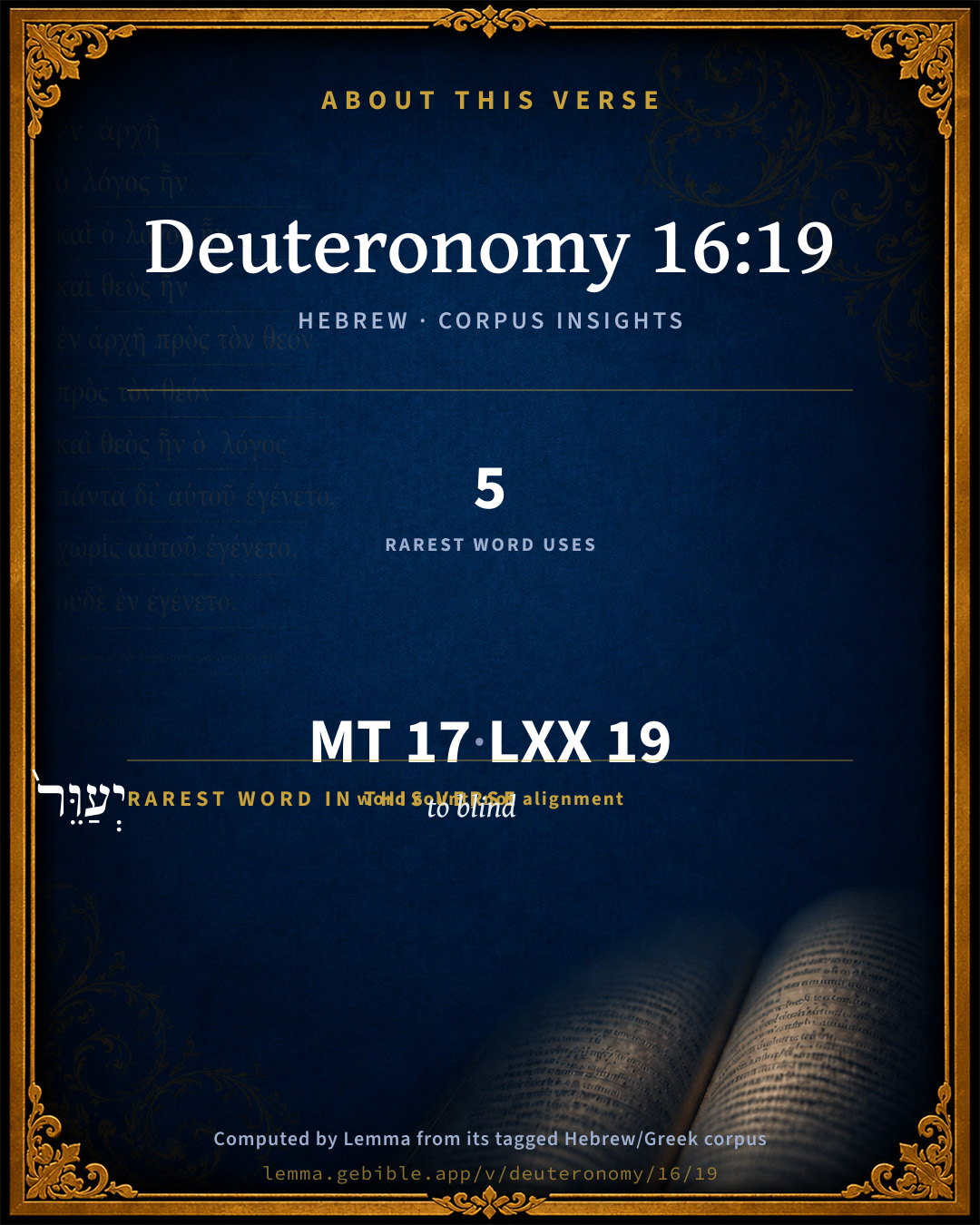
These counts appear in no published source. They are computed here, from the morphology-tagged text and Lemma’s own curated glosses. What Lemma adds →

17
words
14
distinct lemmas
Pentateuch
section

Notable vocabulary

The rarest word here is יְעַוֵּר֙ to blind H5786 — appearing just 5 times in the whole Hebrew Bible.

Shared distinctive vocabulary

יְעַוֵּר֙ to blind H5786 occurs in 5 verses of the Hebrew Bible. Also found in:

Grammatical profile

  • 5 verbs
  • 6 nouns
  • 2 adjectives
  • 1 conjunction
  • 3 particles

Verb forms

  • תַטֶּ֣ה Hiphil · Imperfect
  • תַכִּ֖יר Hiphil · Imperfect
  • תִקַּ֣ח Qal · Imperfect
  • יְעַוֵּר֙ Piel · Imperfect
  • וִֽיסַלֵּ֖ף Piel · Imperfect

Repetition

Words recur within this verse — often emphatic in Hebrew:

  • שֹׁ֔חַד present H7810 ×2
  • לֹא not H3808 ×3

Hebrew & Septuagint length

In English translation the verse runs 33 words from the Hebrew and 27 from the Septuagint (LXX English) — closely comparable.

A rough comparison of the two English renderings, which tokenize alike — not a word-level alignment.

Word counts can differ between the Hebrew and the Greek without any difference in meaning — e.g. the Hebrew direct-object marker אֵת has no separate Greek word, and Greek often adds the article ὁ.

In the original languages it is 17 Hebrew tokens and 19 Greek tokens — but the two are counted differently (Hebrew bundles its prefixes and suffixes into one token; the Greek is in lemma form), so that isn’t a like-for-like length.

Cross-references

25

Topical passages linked to Deuteronomy 16:19 in the Treasury of Scripture Knowledge — connected by theme and wording, ordered by reader-vote popularity; previews shown in the World English Bible.

  • Leviticus 19:15 "'You shall do no injustice in judgment: you shall not be partial to the poor, nor show favoritism to the great; but in righteousness shall you judge your neighbor.
  • Exodus 23:2 You shall not follow a crowd to do evil; neither shall you testify in court to side with a multitude to pervert justice;
  • Proverbs 17:23 A wicked man receives a bribe in secret, To pervert the ways of justice.
  • Deuteronomy 10:17 For Yahweh your God, he is God of gods, and Lord of lords, the great God, the mighty, and the awesome, who doesn't regard persons, nor takes reward.
  • Deuteronomy 24:17 You shall not wrest the justice [due] to the foreigner, [or] to the fatherless, nor take the widow's clothing to pledge;
  • Habakkuk 1:4 Therefore the law is paralyzed, and justice never goes forth; for the wicked surround the righteous; therefore justice goes forth perverted.
  • Deuteronomy 27:19 Cursed be he who wrests the justice [due] to the foreigner, fatherless, and widow. All the people shall say, Amen.
  • Proverbs 24:23 These also are sayings of the wise. To show partiality in judgment is not good.
  • Ecclesiastes 7:7 Surely extortion makes the wise man foolish; and a bribe destroys the understanding.
  • Isaiah 1:17 Learn to do well. Seek justice, Relieve the oppressed, Judge the fatherless, Plead for the widow."
  • Exodus 23:6–8 "You shall not deny justice to your poor people in their lawsuits.
  • Deuteronomy 1:16–17 I charged your judges at that time, saying, Hear [the causes] between your brothers, and judge righteously between a man and his brother, and the foreigner who is living with him.
  • 1 Samuel 8:3 His sons didn't walk in his ways, but turned aside after lucre, and took bribes, and perverted justice.
  • Micah 7:3 Their hands are on that which is evil to do it diligently. The ruler and judge ask for a bribe; And the powerful man dictates the evil desire of his soul. Thus they conspire together.
  • Acts 10:34 Peter opened his mouth and said, "Truly I perceive that God doesn't show favoritism;
  • Acts 16:37 But Paul said to them, "They have beaten us publicly, without a trial, men who are Romans, and have cast us into prison! Do they now release us secretly? No, most assuredly, but let them come themselves and bring us out!"
  • 1 Samuel 12:3 Here I am: witness against me before Yahweh, and before his anointed: whose ox have I taken? or whose donkey have I taken? or whom have I defrauded? whom have I oppressed? or of whose hand have I taken a ransom to blind my eyes therewith? and I will restore it you.
  • Job 31:21–22 If I have lifted up my hand against the fatherless, Because I saw my help in the gate:
  • Proverbs 24:28 Don't be a witness against your neighbor without cause. Don't deceive with your lips.
  • Isaiah 1:23 Your princes are rebellious, and companions of thieves. Everyone loves bribes, and follows after rewards. They don't judge the fatherless, Neither does the cause of the widow come to them.
  • Isaiah 33:15 He who walks righteously, and speaks blamelessly; he who despises the gain of oppressions, who shakes his hands from taking a bribe, who stops his ears from hearing of blood, and shuts his eyes from looking on evil:
  • Jeremiah 5:28 They are grew fat, they shine: yes, they overpass in deeds of wickedness; they don't plead the cause, the cause of the fatherless, that they may prosper; and the right of the needy they don't judge.
  • Ezekiel 22:12 In you have they taken bribes to shed blood; you have taken interest and increase, and you have greedily gained of your neighbors by oppression, and have forgotten me, says the Lord Yahweh.
  • Acts 23:3 Then Paul said to him, "God will strike you, you whitewashed wall! Do you sit to judge me according to the law, and command me to be struck contrary to the law?"
  • Zephaniah 3:3–5 Her princes in the midst of her are roaring lions. Her judges are evening wolves. They leave nothing until the next day.

Cross-references courtesy of OpenBible.info (CC BY 4.0).

Hebrew and Greek witnesses Masoretic Hebrew ↔ Greek Septuagint

The same verse in the two great witnesses to the Old Testament, shown verse-for-verse.

These are two independent witnesses, not word-aligned to each other, and the Septuagint is shown in lemma (dictionary) form.

Hebrew Deuteronomy 16:19 Masoretic · Westminster Leningrad Codex

לֹא תַטֶּ֣ה מִשְׁפָּ֔ט לֹ֥א תַכִּ֖יר פָּנִ֑ים וְלֹא תִקַּ֣ח שֹׁ֔חַד כִּ֣י הַשֹּׁ֗חַד יְעַוֵּר֙ עֵינֵ֣י חֲכָמִ֔ים וִֽיסַלֵּ֖ף דִּבְרֵ֥י צַדִּיקִֽם

You shall not wrest justice: you shall not respect persons; neither shall you take a bribe; for a bribe does blind the eyes of the wise, and pervert the words of the righteous.

World English Bible · Public Domain

Greek LXX Deuteronomy 16:19 Septuagint · lemma form

οὐ ἐκκλίνω κρίσις οὐ ἐπιγιγνώσκω πρόσωπον οὐδέ λαμβάνω δῶρον ὁ γάρ δῶρον ἐκτυφλόω ὀφθαλμός σοφός καί ἐκαἴρω λόγος δίκαιος

they shall not wrest judgment, nor favor persons, nor receive a gift; for gifts blind the eyes of the wise, and pervert the words of the righteous.

LXX2012 (modern English Septuagint) · Public Domain

Hebrew: Westminster Leningrad Codex (CC BY 4.0). Greek: Septuagint (public domain); English from LXX2012 (modern English Septuagint) (Public Domain). How the Septuagint differs from the Hebrew →

Targum (Aramaic paraphrase)

2

The Targum is the ancient Jewish Aramaic paraphrase of the Hebrew Scriptures — an interpretive translation, not the Hebrew text itself. Onkelos (literal) and Pseudo-Jonathan (expansive) render the Torah, and Jonathan the Prophets. Coverage is partial: where no permissively-licensed English translation exists for a verse, only the Aramaic is shown. This is verse-level text, not a word-by-word alignment to the Hebrew.

  1. Targum Onkelos Torah (Genesis–Deuteronomy)
    לָא תַצְלֵי דִין לָא תִשְׁתְּמוֹדַע אַפִּין וְלָא תְקַבֵּל שֹׁחֲדָא אֲרֵי שֹׁחֲדָא מְעַוֵּר עֵינֵי חַכִּימִין וּמְקַלְקַל פִּתְגָמִין תְּרִיצִין

    (no public-domain English translation for this verse)

    Targum Onkelos — Aramaic: “Onkelos Genesis” (public domain); “Onkelos Exodus” (public domain); “Onkelos Leviticus” (public domain); “Onkelos Numbers” (public domain); “Onkelos Deuteronomy” (public domain). English: “Sefaria Community Translation” (CC0 1.0 (public-domain dedication)); “J.W. Etheridge. The Targums of Onkelos and Jonathan Ben Uzziel on the Pentateuch. London: Longmans, Green, 1862” (public domain). Text via Sefaria.

  2. Targum Pseudo-Jonathan Torah (Genesis–Deuteronomy)
    לָא תֵיצְלוּן דִּינָא וְלָא תִסְבּוּן אַפִּין וְלָא תְקַבְּלוּן שׁוֹחֲדָא אֲרוּם שׁוֹחֲדָא מְסַמֵּי עֵינֵי חַכִּימַיָא דְנַסְבִין לֵיהּ דְּגָרִים לְהוֹן טִפְּשׁוּתָא וּמְעַרְבֵּב מִילִין זַכָּאִין בְּפוּם דַּיָּינַיָא בְּשַׁעַת דִּינֵיהוֹן

    You shall not set judgment aside, nor respect persons, nor take a gift, because a gift blindeth the eyes of the wise who take it; for it perverteth them to foolishness, and confuseth equitable words in the mouth of the judges in the hour of their decision

    Targum Pseudo-Jonathan — Aramaic: “Targum Jonathan on Genesis” (public domain); “Targum Jonathan on Exodus” (public domain); “Targum Jonathan on Leviticus” (public domain); “Targum Jonathan on Numbers” (public domain); “Targum Jonathan on Deuteronomy” (public domain). English: “The Targum of Jonathan ben Uzziel, trans. J. W. Etheridge, London, 1862” (public domain). Text via Sefaria.

Commentary

Notes on Deuteronomy 16:19 from classic Christian and Jewish commentators (each source and its license shown beneath its notes). The classic Christian expositions comment on the surrounding passage and are grouped to its opening verse, so a note may address several verses; the Jewish commentaries on the Tanakh (Rashi and others) are per-verse, so they appear only where the commentator wrote on this verse.

Lemma curates 59 commentaries, every one of them public domain or Creative Commons licensed, each selected and text-cleaned for this edition rather than reprinted as found. About our sources →

Trapp's Complete Commentary

John Trapp

Deu 16:19 Thou shalt not wrest judgment; thou shalt not respect persons, neither take a gift: for a gift doth blind the eyes of the wise, and pervert the words of the righteous.

Ver. 19. Neither take a gift.] Rain is good, and ground is good; yet, ex eorum coniunctione fit luturn, by the mixture of those two is made dirt: so giving is kind, and taking is courteous; yet the mixing of them makes the smooth paths of justice foul and uneven.

John Trapp, A Commentary or Exposition upon All the Books of the Old and New Testament (1647–1656) — public domain. Text from a community e-Sword module.

The Biblical Illustrator

Joseph S. Exell

Deu_16:19

Thou shalt not respect persons, neither take a gift.

Equality before the law

I. Some facts and tendencies in legal administration.

1. The sentence pronounced against a poor man is often very heavy, and that against a rich man very light. In New Jersey a poor man was sentenced to five years of hard labour in prison for stealing a ham; in the same court a rich banker, who had ruined two banks and stolen the money of hundreds of people, received the same sentence.

2. After conviction rich convicts receive favours. In the case just cited the poor man and the rich man went to the same prison. But the poor man was put at hard labour; the rich man was made clerk in the prison library.

3. Rich men have an unfair advantage over poor men when brought to trial. The big fee that hires the eloquent pleader buys out the law.

4. Even judges are sometimes corrupt.

5. Juries are accused of taking bribes.

II. The perils of these forms of injustice.

1. They threaten the property and lives of the poor.

2. They weaken the spirit of obedience (Num_22:23).

3. They develop the communistic spirit of destruction.

4. We are all unsafe when one poor wretch is unsafe only because he lacks money or friends.

III. The remedies for existing evils.

1. More and better teaching, in home, school, and church, on Gods law of equality.

2. Wiser conversation on such matters when citizens meet together. It is dangerous and unpatriotic to treat the miscarriage of justice as a jest.

3. A sound public opinion should be cultivated by press, pulpit, and platform.

4. Our social power may be used to condemn a triumph over the law.

5. Seek to associate in all minds the idea of obedience to God with that of just judgment. (Homiletic Monthly.)

An upright judge

Judge Sewall, of Massachusetts, went into a hatters shop in order to purchase a pair of shoe brushes. The master of the shop presented him with a couple. What is your price? said the judge. If they will answer your purpose, replied the other, you may have them and welcome. The judge, upon hearing this, laid them down, and bowing, was leaving the shop; upon which the hatter said to him, Pray, sir, your honour has forgotten the principal object of your visit. By no means, answered the judge; if you please to set a price, I am ready to purchase; but ever since it has fallen to my lot to occupy a seat on the bench, I have studiously avoided receiving to the value of a single copper, lest at some future period of my life it might have some kind of influence in determining my judgment.

The acceptance of bribes discouraged

In the Soudan, he said, he had £6000 a year, as Governor, but he brought nothing out of the country when he returned to England. He spent his income in adding to the insufficient salaries of the officials, to keep them from accepting bribes, and thus to secure justice for the people at large. (Memoir of General Gordon.)

The Biblical Illustrator, edited by Joseph S. Exell (c. 1880s–1900s) — public domain. Text from a community e-Sword module.

Joseph Benson's Commentary

Deu 16:19-20. Thou shalt not wrest judgment — Not give a forced and unjust sentence. Thou shalt not respect persons — Not give sentence according to the quality of the person, his riches or poverty, friendship or enmity, but according to the justice of the cause. A gift doth blind the eyes of the wise — Biases his mind, that he cannot discern between right and wrong. And pervert the words of the righteous — That is, the sentence of those judges who are inclined and used to do righteous things, and have the reputation of being righteous men; it makes them give a wrong judgment. That which is altogether just — Hebrew, righteousness, righteousness, doubling the expression to give it emphasis; that is, nothing but righteousness in all causes and times, and to all persons equally.

Joseph Benson's Commentary on the Old and New Testaments (1811–1818) — public domain. Text from a community e-Sword module.

Tyndale Open Study Notes

Tyndale Open Resources

16:19 show partiality: See study note on 1:16-17.

Tyndale Open Study Notes — © Tyndale Open Resources, licensed CC BY-SA 4.0. Text via the HelloAO Bible API.

Ellicott's Commentary for English Readers

(19) See Exo_23:6; Exo_23:8.

A Bible Commentary for English Readers, edited by Charles John Ellicott (1878–1897) — public domain. Text from a community e-Sword module.

The Cambridge Bible for Schools and Colleges

gen. ed. J. J. S. Perowne

19. Thou] The whole people are responsible for the impartial discharge of justice: characteristic of D.

shalt not wrest judgement] E, Exo_23:6 : the judgement of thy poor in his cause.

thou shalt not respect persons] See on Deu_1:17.

neither shalt thou take a gift, etc.] So E, Exo_23:8, except that for the eyes of the wise it has the open-eyed or them that have sight.

a gift] Heb. shoḥad, of a present in order to influence justice, a bribe (Deu_10:17), a prevalent temptation of judges in the East, where he is regarded as still a just judge who takes gifts only from the party in the right, as it were a fee for his judgement or an inducement to hasten it. Here, however, the acceptance of any gift by a judge is forbidden. In the Code of Ḫammurabi the 5th law, expelling from office the judge who alters his decision, implies that he does this for some unjust reason such as a bribe. On bribery among the settled Arabs see Doughty Ar. Des. i. 607.

words] Statements or pleas, equivalent to cause or case.

The Cambridge Bible for Schools and Colleges (gen. ed. J. J. S. Perowne; Cambridge University Press, 1878–1918) — public domain. Text from a community e-Sword module.

John Gill's Exposition

That which is altogether just shalt thou follow,.... Or "justice", "justice" (a), strict justice, and nothing else:

that thou mayest live and inherit the land which the Lord thy God giveth thee; that is, continue in the possession of it.

(a)

John Gill's Exposition of the Whole Bible (1746–1763) — public domain (CC PDM 1.0). Text via the HelloAO Bible API.

Haydock's Catholic Bible Commentary

Just. Avarice is like a cloud, (Calmet) which darkens the understanding. Oppression troubleth the wise, and (Hebrew) "a present destroyeth the heart." A timid or interested judge is unfit for his office. Sir Thomas More was very careful not to receive presents, while he was high chancellor of England. (Haydock) --- If even the just are in danger of being perverted by presents, what must we think of others? (Du Hamel)

George Leo Haydock (1774–1849), Haydock's Catholic Family Bible and Commentary, 1859 edition — public domain. Excludes Psalms (Douay-Rheims chapter numbering differs from Protestant) and Deuterocanonical books (Catholic canon only).

Matthew Poole's English Annotations

Not wrest judgment, i.e. not give a perverse, forced, and unjust sentence. See Poole "Exo 23:8".

Not respect persons, i.e. not give sentence according to the quality of the person, his riches or poverty, friendship or enmity, but according to the justice of the cause.

A gift doth blind the eyes of the wise; corrupts and biasseth his mind, that as he will not, so ofttimes he cannot, discern between right and wrong.

The words of the righteous; either,

1. The words, i.e. the sentence, of those judges who are inclined and used to do righteous things, and have the repute of righteous men, it makes them give wrong judgment. Or,

2. The words, i.e. the matters, or causes, (as word oft signifies,) of righteous persons, or of them whose cause is just.

Matthew Poole's English Annotations on the Holy Bible (1683–1685) — public domain. Text from a community e-Sword/MySword module.

The Pulpit Commentary

Cf. Exo_23:6, 8 Respect persons (cf. Deu_1:17) Pervert the words margin, matters of the righteous; rather, the case or the cause of the righteous.

The Pulpit Commentary (1880–1919), ed. H.D.M. Spence-Jones & Joseph S. Exell — public domain. Text from a community e-Sword module.

John Wesley's Explanatory Notes

Wrest judgment - Not give an unjust sentence. A gift doth blind the eyes - Biasseth his mind, that he cannot discern between right and wrong. The words - That is the sentence, of those Judges who are used to do righteous things, it makes them give wrong judgment.

John Wesley, Explanatory Notes Upon the Whole Bible (1754–1765) — public domain. Text via the GEBible commentary corpus.

Rashi

Rabbi Shlomo Yitzchaki (Rashi)

לא תטה משפט means what it literally implies: THOU SHALT NOT PERVERT JUDGMENT.

ולא תכיר פנים AND THOU SHALT NOT RESPECT PERSONS — not even if it be only during the pleadings of the parties. This is an admonition addressed to the judge that he should not be lenient to one and harsh to the other, e.g. letting one stand and the other sit; because as soon as he (the party treated harshly) observes that the judge shows more respect to his fellow his ability to plead is hampered (i.e. he loses self-confidence and cannot present his case with assurance) (cf. Shevuot 30a).

ולא תקח שחד NEITHER TAKE BRIBERY — even if you mean to give a just judgment in favor of the giver (Sifrei Devarim 144:10; cf. Rashi on Exodus 23:8).

כי השחד יעור FOR BRIBERY DOES BLIND — As soon as he (the judge) has accepted a bribe from him (from one of the parties) it is impossible for him not to incline his heart to him trying to find something in his favor (Ketuvot 105b).

דברי צדיקם means, the words which have been described by the term “righteous” viz., the judgments of truth uttered on Sinai (cf. Rashi on Exodus 22:8 and Note thereon).

Rashi on the Tanakh — English translations: “The Judaica Press complete Tanach with Rashi, translated by A. J. Rosenberg” (CC BY 4.0); “Pentateuch with Rashi's commentary by M. Rosenbaum and A.M. Silbermann, 1929-1934” (public domain); “The Metsudah Tanach series, Lakewood, N.J” (CC BY 4.0); and “The Book of Joshua, Metsudah Publications, 1997” (CC BY 4.0). Text via Sefaria.

Lesson kit

Teaching starters — assembled from the data on this page, not authored interpretation. Every prompt links to the verse data it draws on. Edit before teaching.

Deuteronomy, in the Pentateuch, opens this verse with 17 words (14 distinct Hebrew lemmas). Its most distinctive word is ʻâvar (“to blind”). A historical commentator’s framing appears above. Read the whole chapter for the surrounding context.

Discussion questions

  1. The word ʻâvar carries the sense “to blind.” How does it shape the verse?
  2. Exodus 23:8 shares the word «to blind» with this verse. How do the two illuminate each other?
  3. “present” occurs 2× in this one verse. What is the effect of the repetition?
  4. The translations on this page render this verse differently — a whole-verse word diff, not a word-by-word alignment. What might account for the different wordings?
  5. The verb «תַטֶּ֣ה» is Hiphil Imperfect. How does its form color the action?
  6. Reading how Trapp's Complete Commentary and The Biblical Illustrator read this verse, where do the two commentators agree and where do they part?

Things to notice

Reading settings

Reading text

Shown beneath each verse's original-language words.

Old Testament
Old Testament edition

Read the OT as the Masoretic Hebrew (MT) or the Greek Septuagint (LXX).

English shown for the Greek Septuagint (in the Hebrew ↔ Greek comparison).

Comparing translations? Open the Compare panel on any verse page to stack up to four side by side.