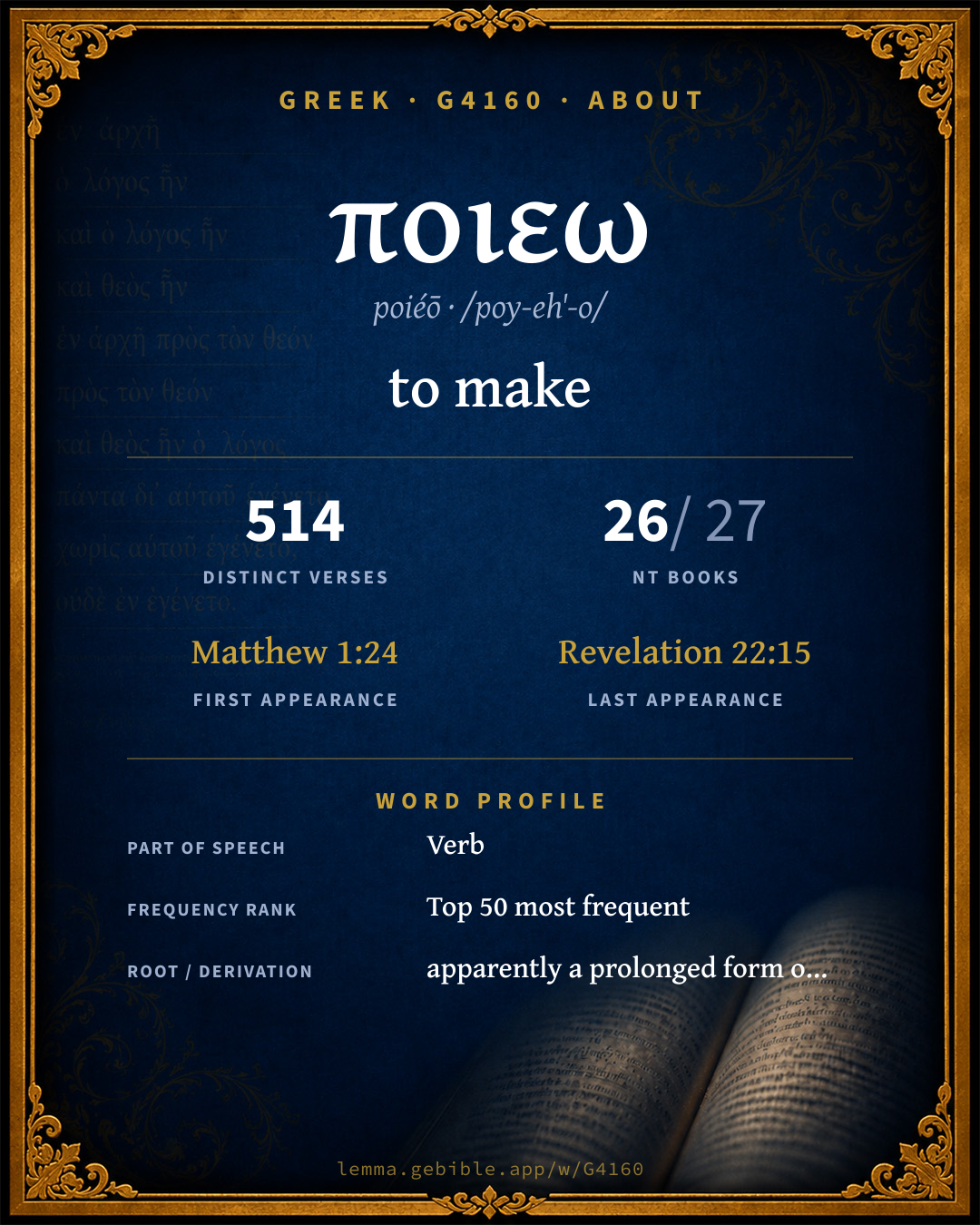
ποιέω
to make
‘to make’ is one of 15 main senses fuller range ↓
Full lexicon entry — Thayer's Greek Lexicon
From Thayer's Greek Lexicon
Where this word appears
See every Aorist-tense verb in the Greek New Testament →
Grammar key — what these labels mean
Part of speech
- Verb
- An action or state-of-being word.
Tense
- Aorist
- Action viewed as a simple whole, without regard to duration — often past (perfective aspect).
- Present
- Ongoing or general action in present time (imperfective aspect).
- Future
- Action expected in future time.
- Imperfect
- Continuous or repeated action in past time (“was writing”).
- Perfect
- A completed past action with continuing present results.
- Pluperfect
- A past action completed before another past point (“had written”).
Voice
- Active
- The subject performs the action.
- Middle
- The subject acts on or for itself, or with special interest in the action.
- Middle deponent
- Middle in form but active in meaning.
- Passive
- The subject receives the action.
Mood
- Indicative
- States a fact or asks a factual question (the mood of reality).
- Infinitive
- A verbal noun (“to write”), unmarked for person or number.
- Participle
- A verbal adjective (“writing,” “having written”).
- Subjunctive
- Expresses probability, purpose, or possibility (the mood of contingency).
- Imperative
- Expresses a command or request.
- Optative
- Expresses a wish or a remote possibility.
Case
- Nominative
- The case of the subject (and the predicate nominative).
- Accusative
- The case of the direct object and of extent.
- Dative
- The case of the indirect object, means, or location — “to / for / with / in.”
- Genitive
- The case of source, possession, or “of” — answers “whose / from what.”
Person
- 3rd person
- The one spoken about (“he / she / it / they”).
- 1st person
- The speaker (“I / we”).
- 2nd person
- The one addressed (“you”).
Gender
- Masculine
- Grammatically masculine.
- Neuter
- Grammatically neuter.
- Feminine
- Grammatically feminine.
Number
- Singular
- One.
- Plural
- More than one.
Grammatical forms 82 distinct
- Verb, Aorist, Active, Indicative, 3rd person, Singular 74 times (13%)
- Verb, Aorist, Active, Infinitive 47 times (8%)
- Verb, Present, Active, Indicative, 3rd person, Singular 29 times (5%)
- Verb, Present, Active, Participle, Nominative, Singular, Masculine 28 times (5%)
- Verb, Present, Active, Infinitive 24 times (4%)
- Verb, Present, Active, Indicative, 1st person, Singular 22 times (4%)
- Verb, Aorist, Active, Participle, Nominative, Singular, Masculine 21 times (4%)
- Verb, Present, Active, Indicative, 2nd person, Plural 18 times (3%)
+74 more forms (306 occurrences)
Parsed forms decoded from the imported morphology (Robinson–Tischendorf, public domain), counted across 569 parsed occurrences — not distinct verses.
Page 1 of 3 — showing verses 1–200 of 514 distinct verses where G4160 appears, across 26 books. Click any verse to open its interlinear word-by-word view. Verse text shown in the World English Bible for context — . Each verse’s Greek form is shown with its reference; the English is not keyword-highlighted, since the data carries no word-level English alignment. Use “Compare translations” on any verse to read it across multiple English versions. This concordance covers the Greek New Testament; Septuagint (Greek Old Testament) occurrences of this word are not indexed here.
Matthew 71 verses
- Matthew 1:24 ἐποίησεν aor act ind 3sg Joseph arose from his sleep, and did as the angel of the Lord commanded him, and took his wife to himself;
- Matthew 3:3 ποιεῖτε pres act impv 2pl For this is he who was spoken of by Isaiah the prophet, saying, "The voice of one crying in the wilderness, Make ready the way of the Lord, Make his paths straight."
- Matthew 3:8 ποιήσατε aor act impv 2pl Therefore bring forth fruit worthy of repentance!
- Matthew 3:10 ποιοῦν pres act ptcp nom sg neut "Even now the axe lies at the root of the trees. Therefore, every tree that doesn't bring forth good fruit is cut down, and cast into the fire.
- Matthew 4:19 ποιήσω fut act ind 1sg He said to them, "Come after me, and I will make you fishers for men."
- Matthew 5:19 ποιήσῃ aor act subj 3sg Whoever, therefore, shall break one of these least commandments, and teach others to do so, shall be called least in the Kingdom of Heaven; but whoever shall do and teach them shall be called great in the Kingdom of Heaven.
- Matthew 5:32 ποιεῖ pres act ind 3sg but I tell you that whoever puts away his wife, except for the cause of sexual immorality, makes her an adulteress; and whoever marries her when she is put away commits adultery.
- Matthew 5:36 ποιῆσαι aor act inf Neither shall you swear by your head, for you can't make one hair white or black.
- Matthew 5:46 ποιοῦσιν pres act ind 3pl For if you love those who love you, what reward do you have? Don't even the tax collectors do the same?
- Matthew 5:47 ποιεῖτε ποιοῦσιν pres act ind 2pl pres act ind 3pl If you only greet your friends, what more do you do than others? Don't even the tax collectors do the same?
- Matthew 6:1 ποιεῖν pres act inf "Be careful that you don't do your charitable giving before men, to be seen by them, or else you have no reward from your Father who is in heaven.
- Matthew 6:2 ποιῇς ποιοῦσιν pres act subj 2sg pres act ind 3pl Therefore when you do merciful deeds, don't sound a trumpet before yourself, as the hypocrites do in the synagogues and in the streets, that they may get glory from men. Most assuredly I tell you, they have received their reward.
- Matthew 6:3 ποιοῦντος ποιεῖ pres act ptcp gen sg masc pres act ind 3sg But when you do merciful deeds, don't let your left hand know what your right hand does,
- Matthew 7:12 ποιῶσιν ποιεῖτε pres act subj 3pl pres act impv 2pl Therefore whatever you desire for men to do to you, you shall also do to them; for this is the law and the prophets.
- Matthew 7:17 ποιεῖ ποιεῖ pres act ind 3sg pres act ind 3sg Even so, every good tree produces good fruit; but the corrupt tree produces evil fruit.
- Matthew 7:19 ποιοῦν pres act ptcp nom sg neut Every tree that doesn't grow good fruit is cut down, and thrown into the fire.
- Matthew 7:21 ποιῶν pres act ptcp nom sg masc Not everyone who says to me, 'Lord, Lord,' will enter into the Kingdom of Heaven; but he who does the will of my Father who is in heaven.
- Matthew 7:22 ἐποιήσαμεν aor act ind 1pl Many will tell me in that day, 'Lord, Lord, didn't we prophesy in your name, in your name cast out demons, and in your name do many mighty works?'
- Matthew 7:24 ποιεῖ pres act ind 3sg "Everyone therefore who hears these words of mine, and does them, I will liken him to a wise man, who built his house on a rock.
- Matthew 7:26 ποιῶν pres act ptcp nom sg masc Everyone who hears these words of mine, and doesn't do them will be like a foolish man, who built his house on the sand.
- Matthew 8:9 ποίησον ποιεῖ aor act impv 2sg pres act ind 3sg For I am also a man under authority, having under myself soldiers. I tell this one, 'Go,' and he goes; and tell another, 'Come,' and he comes; and tell my servant, 'Do this,' and he does it."
- Matthew 9:28 ποιῆσαι aor act inf When he had come into the house, the blind men came to him. Jesus said to them, "Do you believe that I am able to do this?" They told him, "Yes, Lord."
- Matthew 12:2 ποιοῦσιν ποιεῖν pres act ind 3pl pres act inf But the Pharisees, when they saw it, said to him, "Behold, your disciples do what is not lawful to do on the Sabbath."
- Matthew 12:3 ἐποίησεν aor act ind 3sg But he said to them, "Haven't you read what David did, when he was hungry, and those who were with him;
- Matthew 12:12 ποιεῖν pres act inf Of how much more value then is a man than a sheep! Therefore it is lawful to do good on the Sabbath day."
- Matthew 12:16 ποιήσωσιν aor act subj 3pl and charged them that they should not make him known:
- Matthew 12:33 ποιήσατε ποιήσατε aor act impv 2pl aor act impv 2pl "Either make the tree good, and its fruit good, or make the tree corrupt, and its fruit corrupt; for the tree is known by its fruit.
- Matthew 12:50 ποιήσῃ aor act subj 3sg For whoever does the will of my Father who is in heaven, he is my brother, and sister, and mother."
- Matthew 13:23 ποιεῖ pres act ind 3sg What was sown on the good ground, this is he who hears the word, and understands it, who most assuredly bears fruit, and brings forth, some one hundred times as much, some sixty, and some thirty."
- Matthew 13:26 ἐποίησεν aor act ind 3sg But when the blade sprang up and brought forth fruit, then the darnel appeared also.
- Matthew 13:28 ἐποίησεν aor act ind 3sg "He said to them, 'An enemy has done this.' "The servants asked him, 'Do you want us to go and gather them up?'
- Matthew 13:41 ποιοῦντας pres act ptcp acc pl masc The Son of Man will send out his angels, and they will gather out of his Kingdom all things that cause stumbling, and those who do iniquity,
- Matthew 13:58 ἐποίησεν aor act ind 3sg He didn't do many mighty works there because of their unbelief.
- Matthew 17:4 ποιήσω fut act ind 1sg Peter answered, and said to Jesus, "Lord, it is good for us to be here. If you want, let's make three tents here: one for you, one for Moses, and one for Elijah."
- Matthew 17:12 ἐποίησαν aor act ind 3pl but I tell you that Elijah has come already, and they didn't recognize him, but did to him whatever they wanted to. Even so the Son of Man will also suffer by them."
- Matthew 18:35 ποιήσει fut act ind 3sg So my heavenly Father will also do to you, if you don't each forgive your brother from your hearts for his misdeeds."
- Matthew 19:4 ποιήσας ἐποίησεν aor act ptcp nom sg masc aor act ind 3sg He answered, "Haven't you read that he who made them from the beginning made them male and female,
- Matthew 19:16 ποιήσω aor act subj 1sg Behold, one came to him and said, "Good teacher, what good thing shall I do, that I may have eternal life?"
- Matthew 20:5 ἐποίησεν aor act ind 3sg Again he went out about the sixth and the ninth hour, and did likewise.
- Matthew 20:12 ἐποίησαν ἐποίησας aor act ind 3pl aor act ind 2sg saying, 'These last have spent one hour, and you have made them equal to us, who have borne the burden of the day and the scorching heat!'
- Matthew 20:15 ποιῆσαι aor act inf Isn't it lawful for me to do what I want to with what I own? Or is your eye evil, because I am good?'
- Matthew 20:32 ποιήσω aor act subj 1sg Jesus stood still, and called them, and asked, "What do you want me to do for you?"
- Matthew 21:6 ποιήσαντες aor act ptcp nom pl masc The disciples went, and did just as Jesus commanded them,
- Matthew 21:13 ποιεῖτε pres act ind 2pl He said to them, "It is written, 'My house shall be called a house of prayer,' but you have made it a den of robbers!"
- Matthew 21:15 ἐποίησεν aor act ind 3sg But when the chief priests and the scribes saw the wonderful things that he did, and the children who were crying in the temple and saying, "Hosanna to the son of David!" they were indignant,
- Matthew 21:21 ποιήσετε fut act ind 2pl Jesus answered them, "Most assuredly I tell you, if you have faith, and don't doubt, you will not only do what is done to the fig tree, but even if you told this mountain, 'Be taken up and cast into the sea,' it would be done.
- Matthew 21:23 ποιεῖς pres act ind 2sg When he had come into the temple, the chief priests and the elders of the people came to him as he was teaching, and said, "By what authority do you do these things? Who gave you this authority?"
- Matthew 21:24 ποιῶ pres act ind 1sg Jesus answered them, "I also will ask you one question, which if you tell me, I likewise will tell you by what authority I do these things.
- Matthew 21:27 ποιῶ pres act ind 1sg They answered Jesus, and said, "We don't know." He also said to them, "Neither will I tell you by what authority I do these things.
- Matthew 21:31 ἐποίησεν aor act ind 3sg Which of the two did the will of his father?" They said to him, "The first." Jesus said to them, "Most assuredly I tell you that the tax collectors and the prostitutes are entering into the Kingdom of God before you.
- Matthew 21:36 ἐποίησαν aor act ind 3pl Again, he sent other servants more than the first: and they treated them the same way.
- Matthew 21:40 ποιήσει fut act ind 3sg When therefore the lord of the vineyard comes, what will he do to those farmers?"
- Matthew 21:43 ποιοῦντι pres act ptcp dat sg neut "Therefore I tell you, the Kingdom of God will be taken away from you, and will be given to a nation bringing forth its fruits.
- Matthew 22:2 ἐποίησεν aor act ind 3sg "The Kingdom of Heaven is like a certain king, who made a marriage feast for his son,
- Matthew 23:3 ποιήσατε ποιεῖτε ποιοῦσιν aor act impv 2pl pres act impv 2pl pres act ind 3pl All things therefore whatever they tell you to observe, observe and do, but don't do their works; for they say, and don't do.
- Matthew 23:5 ποιοῦσιν pres act ind 3pl But all their works they do to be seen by men. They make their phylacteries broad, enlarge the fringes of their garments,
- Matthew 23:15 ποιῆσαι ποιεῖτε aor act inf pres act ind 2pl Woe to you, scribes and Pharisees, hypocrites! For you travel around by sea and land to make one proselyte; and when he becomes one, you make him twice as much of a son of Gehenna as yourselves.
- Matthew 23:23 ποιῆσαι aor act inf "Woe to you, scribes and Pharisees, hypocrites! For you tithe mint, dill, and cumin, and have left undone the weightier matters of the law: justice, mercy, and faith. But you ought to have done these, and not to have left the other undone.
- Matthew 24:46 ποιοῦντα pres act ptcp acc sg masc Blessed is that servant whom his lord finds doing so when he comes.
- Matthew 25:16 ἐποίησεν aor act ind 3sg Immediately he who received the five talents went and traded with them, and made another five talents.
- Matthew 25:40 ἐποιήσατε ἐποιήσατε aor act ind 2pl aor act ind 2pl "The King will answer them, 'Most assuredly I tell you, inasmuch as you did it to one of the least of these my brothers, you did it to me.'
- Matthew 25:45 ἐποιήσατε ἐποιήσατε aor act ind 2pl aor act ind 2pl "Then he will answer them, saying, 'Most assuredly I tell you, inasmuch as you didn't do it to one of the least of these, you didn't do it to me.'
- Matthew 26:12 ἐποίησεν aor act ind 3sg For in pouring this ointment on my body, she did it to prepare me for burial.
- Matthew 26:13 ἐποίησεν aor act ind 3sg Most assuredly I tell you, wherever this Gospel is preached in the whole world, what this woman has done will also be spoken of as a memorial of her."
- Matthew 26:18 ποιῶ pres act ind 1sg He said, "Go into the city to a certain person, and tell him, 'The Teacher says, "My time is at hand. I will keep the Passover at your house with my disciples."'"
- Matthew 26:19 ἐποίησαν aor act ind 3pl The disciples did as Jesus commanded them, and they prepared the Passover.
- Matthew 26:73 ποιεῖ pres act ind 3sg After a little while those who stood by came and said to Peter, "Surely you are also one of them, for your speech makes you known."
- Matthew 27:22 ποιήσω aor act subj 1sg Pilate said to them, "What then shall I do to Jesus, who is called Christ?" They all said to him, "Let him be crucified!"
- Matthew 27:23 ἐποίησεν aor act ind 3sg But the governor said, "Why? What evil has he done?" But they cried out exceedingly, saying, "Let him be crucified!"
- Matthew 28:14 ποιήσομεν fut act ind 1pl If this comes to the governor's ears, we will persuade him and make you free of worry."
- Matthew 28:15 ἐποίησαν aor act ind 3pl So they took the money and did as they were told. This saying was spread abroad among the Jews, and continues until this day.
Mark 46 verses
- Mark 1:3 ποιεῖτε pres act impv 2pl The voice of one crying in the wilderness, 'Make ready the way of the Lord! Make his paths straight!'"
- Mark 1:17 ποιήσω fut act ind 1sg Jesus said to them, "Come after me, and I will make you into fishers for men."
- Mark 2:23 ποιεῖν pres act inf It happened that he was going on the Sabbath day through the grain fields, and his disciples began, as they went, to pluck the ears of grain.
- Mark 2:24 ποιοῦσιν pres act ind 3pl The Pharisees said to him, "Behold, why do they do that which is not lawful on the Sabbath day?"
- Mark 2:25 ἐποίησεν aor act ind 3sg He said to them, "Did you never read what David did, when he had need, and was hungry--he, and they who were with him?
- Mark 3:4 ποιῆσαι aor act inf He said to them, "Is it lawful on the Sabbath day to do good, or to do harm? To save a life, or to kill?" But they were silent.
- Mark 3:6 ἐποίησαν aor act ind 3pl The Pharisees went out, and immediately conspired with the Herodians against him, how they might destroy him.
- Mark 3:8 ἐποίει impf act ind 3sg from Jerusalem, from Idumaea, beyond the Jordan, and those from around Tyre and Sidon. A great multitude, hearing what great things he did, came to him.
- Mark 3:12 ποιήσωσιν aor act subj 3pl He sternly warned them that they should not make him known.
- Mark 3:14 ἐποίησεν aor act ind 3sg He appointed twelve, that they might be with him, and that he might send them out to preach,
- Mark 3:16 ἐποίησεν aor act ind 3sg Simon, to whom he gave the name Peter;
- Mark 3:35 ποιήσῃ aor act subj 3sg For whoever does the will of God, the same is my brother, and my sister, and mother."
- Mark 4:32 ποιεῖ pres act ind 3sg yet when it is sown, grows up, and becomes greater than all the herbs, and puts out great branches, so that the birds of the sky can lodge under its shadow."
- Mark 5:19 πεποίηκεν perf act ind 3sg He didn't allow him, but said to him, "Go to your house, to your friends, and tell them what great things the Lord has done for you, and how he had mercy on you."
- Mark 5:20 ἐποίησεν aor act ind 3sg He went his way, and began to proclaim in Decapolis how Jesus had done great things for him, and everyone marveled.
- Mark 5:32 ποιήσασαν aor act ptcp acc sg fem He looked around to see her who had done this thing.
- Mark 6:5 ποιῆσαι aor act inf He could do no mighty work there, except that he laid his hands on a few sick people, and healed them.
- Mark 6:21 ἐποίησεν aor act ind 3sg Then a convenient day came, that Herod on his birthday made a supper for his nobles, the high officers, and the chief men of Galilee.
- Mark 6:30 ἐποίησαν aor act ind 3pl The apostles gathered themselves together to Jesus, and they told him all things, whatever they had done, and whatever they had taught.
- Mark 7:12 ποιῆσαι aor act inf then you no longer allow him to do anything for his father or his mother,
- Mark 7:13 ποιεῖτε pres act ind 2pl making void the word of God by your tradition, which you have handed down. You do many things like this."
- Mark 7:37 πεποίηκεν ποιεῖ perf act ind 3sg pres act ind 3sg They were astonished beyond measure, saying, "He has done all things well. He makes even the deaf hear, and the mute speak!"
- Mark 9:5 ποιήσωμεν aor act subj 1pl Peter answered Jesus, "Rabbi, it is good for us to be here. Let's make three tents: one for you, one for Moses, and one for Elijah."
- Mark 9:13 ἐποίησαν aor act ind 3pl But I tell you that Elijah has come, and they have also done to him whatever they wanted to, even as it is written about him."
- Mark 9:39 ποιήσει fut act ind 3sg But Jesus said, "Don't forbid him, for there is no one who will do a mighty work in my name, and be able quickly to speak evil of me.
- Mark 10:6 ἐποίησεν aor act ind 3sg But from the beginning of the creation, 'God made them male and female.
- Mark 10:17 ποιήσω aor act subj 1sg As he was going out into the way, one ran to him, knelt before him, and asked him, "Good Teacher, what shall I do that I may inherit eternal life?"
- Mark 10:35 ποιήσῃς aor act subj 2sg James and John, the sons of Zebedee, came near to him, saying, "Teacher, we want you to do for us whatever we will ask."
- Mark 10:36 ποιήσω aor act subj 1sg He said to them, "What do you want me to do for you?"
- Mark 10:51 ποιήσω aor act subj 1sg Jesus asked him, "What do you want me to do for you?" The blind man said to him, "Rhabboni, that I may see again."
- Mark 11:3 ποιεῖτε pres act ind 2pl If anyone asks you, 'Why are you doing this?' say, 'The Lord needs him;' and immediately he will send him back here."
- Mark 11:5 ποιεῖτε pres act ind 2pl Some of those who stood there asked them, "What are you doing, untying the young donkey?"
- Mark 11:17 πεποιήκατε perf act ind 2pl He taught, saying to them, "Isn't it written, 'My house will be called a house of prayer for all the nations?' But you have made it a den of robbers!"
- Mark 11:28 ποιεῖς ποιῇς pres act ind 2sg pres act subj 2sg and they began saying to him, "By what authority do you do these things? Or who gave you this authority to do these things?"
- Mark 11:29 ποιῶ pres act ind 1sg Jesus said to them, "I will ask you one question. Answer me, and I will tell you by what authority I do these things.
- Mark 11:33 ποιῶ pres act ind 1sg They answered Jesus, "We don't know." Jesus said to them, "Neither do I tell you by what authority I do these things."
- Mark 12:9 ποιήσει fut act ind 3sg What therefore will the lord of the vineyard do? He will come and destroy the farmers, and will give the vineyard to others.
- Mark 13:22 ποιήσουσιν fut act ind 3pl For there will arise false christs and false prophets, and will show signs and wonders, that they may lead astray, if possible, even the chosen ones.
- Mark 14:7 ποιῆσαι aor act inf For you always have the poor with you, and whenever you want to, you can do them good; but you will not always have me.
- Mark 14:8 ἐποίησεν aor act ind 3sg She has done what she could. She has anointed my body beforehand for the burying.
- Mark 14:9 ἐποίησεν aor act ind 3sg Most assuredly I tell you, wherever this Gospel may be preached throughout the whole world, that which this woman has done will also be spoken of for a memorial of her."
- Mark 15:7 πεποιήκεισαν plup act ind 3pl There was one called Barabbas, bound with those who had made insurrection, men who in the insurrection had committed murder.
- Mark 15:8 ἐποίει impf act ind 3sg The multitude, crying aloud, began to ask him to do as he always did for them.
- Mark 15:12 ποιήσω aor act subj 1sg Pilate again asked them, "What then should I do to him whom you call the King of the Jews?"
- Mark 15:14 ἐποίησεν aor act ind 3sg Pilate said to them, "Why, what evil has he done?" But they cried out exceedingly, "Crucify him!"
- Mark 15:15 ποιῆσαι aor act inf Pilate, wishing to please the multitude, released Barabbas to them, and handed over Jesus, when he had flogged him, to be crucified.
Luke 80 verses
- Luke 1:25 πεποίηκεν perf act ind 3sg "Thus has the Lord done to me in the days in which he looked at me, to take away my reproach among men."
- Luke 1:49 ἐποίησέν aor act ind 3sg For he who is mighty has done great things for me. Holy is his name.
- Luke 1:51 ἐποίησεν aor act ind 3sg He has shown strength with his arm. He has scattered the proud in the imagination of their heart.
- Luke 1:68 ἐποίησεν aor act ind 3sg "Blessed be the Lord, the God of Israel, For he has visited and worked redemption for his people;
- Luke 1:72 ποιῆσαι aor act inf To show mercy towards our fathers, To remember his holy covenant,
- Luke 2:27 ποιῆσαι aor act inf He came in the Spirit into the temple. When the parents brought in the child, Jesus, that they might do concerning him according to the custom of the law,
- Luke 2:48 ἐποίησας aor act ind 2sg When they saw him, they were astonished, and his mother said to him, "Son, why have you treated us this way? Behold, your father and I were anxiously looking for you."
- Luke 3:4 ποιεῖτε pres act impv 2pl As it is written in the book of the words of Isaiah the prophet, "The voice of one crying in the wilderness, 'Make ready the way of the Lord. Make his paths straight.
- Luke 3:8 ποιήσατε aor act impv 2pl Bring forth therefore fruits worthy of repentance, and don't begin to say among yourselves, 'We have Abraham for our father;' for I tell you that God is able to raise up children to Abraham from these stones!
- Luke 3:9 ποιοῦν pres act ptcp nom sg neut Even now the axe also lies at the root of the trees. Every tree therefore that doesn't bring forth good fruit is cut down, and thrown into the fire."
- Luke 3:10 ποιήσωμεν aor act subj 1pl The multitudes asked him, "What then must we do?"
- Luke 3:11 ποιείτω pres act impv 3sg He answered them, "He who has two coats, let him give to him who has none. He who has food, let him do likewise."
- Luke 3:12 ποιήσωμεν aor act subj 1pl Tax collectors also came to be baptized, and they said to him, "Teacher, what must we do?"
- Luke 3:14 ποιήσωμεν aor act subj 1pl Soldiers also asked him, saying, "What about us? What must we do?" He said to them, "Extort from no one by violence, neither accuse anyone wrongfully. Be content with your wages."
- Luke 3:19 ἐποίησεν aor act ind 3sg but Herod the tetrarch, being reproved by him for Herodias, his brother's wife, and for all the evil things which Herod had done,
- Luke 4:23 ποίησον aor act impv 2sg He said to them, "Doubtless you will tell me this parable, 'Physician, heal yourself! Whatever we have heard done at Capernaum, do also here in your hometown.'"
- Luke 5:6 ποιήσαντες aor act ptcp nom pl masc When they had done this, they caught a great multitude of fish, and their net was breaking.
- Luke 5:29 ἐποίησεν aor act ind 3sg Levi made a great feast for him in his house. There was a great crowd of tax collectors and others who were reclining with them.
- Luke 5:33 ποιοῦνται pres mid ind 3pl They said to him, "Why do John's disciples often fast and pray, likewise also the disciples of the Pharisees, but yours eat and drink?"
- Luke 5:34 ποιῆσαι aor act inf He said to them, "Can you make the friends of the bridegroom fast, while the bridegroom is with them?
- Luke 6:2 ποιεῖτε ποιεῖν pres act ind 2pl pres act inf But some of the Pharisees said to them, "Why do you do that which is not lawful to do on the Sabbath day?"
- Luke 6:3 ἐποίησεν aor act ind 3sg Jesus, answering them, said, "Haven't you read what David did when he was hungry, he, and those who were with him;
- Luke 6:10 ἐποίησεν aor act ind 3sg He looked around at them all, and said to the man, "Stretch out your hand." He did, and his hand was restored as sound as the other.
- Luke 6:11 ποιήσαιεν aor act opt 3pl But they were filled with rage, and talked with one another about what they might do to Jesus.
- Luke 6:23 ἐποίουν impf act ind 3pl Rejoice in that day, and leap for joy, for behold, your reward is great in heaven, for their fathers did the same thing to the prophets.
- Luke 6:26 ἐποίουν impf act ind 3pl Woe, when men speak well of you! For their fathers did the same thing to the false prophets.
- Luke 6:27 ποιεῖτε pres act impv 2pl "But I tell you who hear: love your enemies, do good to those who hate you,
- Luke 6:31 ποιῶσιν ποιεῖτε pres act subj 3pl pres act impv 2pl "As you would like people to do to you, do exactly so to them.
- Luke 6:33 ποιοῦσιν pres act ind 3pl If you do good to those who do good to you, what credit is that to you? For even sinners do the same.
- Luke 6:43 ποιοῦν ποιοῦν pres act ptcp nom sg neut pres act ptcp nom sg neut For there is no good tree that brings forth rotten fruit; nor again a rotten tree that brings forth good fruit.
- Luke 6:46 ποιεῖτε pres act ind 2pl "Why do you call me, 'Lord, Lord,' and don't do the things which I say?
- Luke 6:47 ποιῶν pres act ptcp nom sg masc Everyone who comes to me, and hears my words, and does them, I will show you who he is like.
- Luke 6:49 ποιήσας aor act ptcp nom sg masc But he who hears, and doesn't do, is like a man who built a house on the earth without a foundation, against which the stream broke, and immediately it fell, and the ruin of that house was great."
- Luke 7:8 ποίησον ποιεῖ aor act impv 2sg pres act ind 3sg For I also am a man placed under authority, having under myself soldiers. I tell this one, 'Go!' and he goes; and to another, 'Come!' and he comes; and to my servant, 'Do this,' and he does it."
- Luke 8:8 ἐποίησεν aor act ind 3sg Other fell into the good ground, and grew, and brought forth fruit one hundred times." As he said these things, he called out, "He who has ears to hear, let him hear!"
- Luke 8:21 ποιοῦντες pres act ptcp nom pl masc But he answered them, "My mother and my brothers are these who hear the word of God, and do it."
- Luke 8:39 ἐποίησεν ἐποίησεν aor act ind 3sg aor act ind 3sg "Return to your house, and declare what great things God has done for you." He went his way, proclaiming throughout the whole city what great things Jesus had done for him.
- Luke 9:10 ἐποίησαν aor act ind 3pl The apostles, when they had returned, told him what things they had done. He took them, and withdrew apart to a deserted place of a city called Bethsaida.
- Luke 9:15 ἐποίησαν aor act ind 3pl They did so, and made them all sit down.
- Luke 9:33 ποιήσωμεν aor act subj 1pl It happened, as they were parting from him, that Peter said to Jesus, "Master, it is good for us to be here. Let's make three tents: one for you, and one for Moses, and one for Elijah," not knowing what he said.
- Luke 9:43 ἐποίει impf act ind 3sg They were all astonished at the majesty of God. But while all were marveling at all the things which Jesus did, he said to his disciples,
- Luke 10:25 ποιήσας aor act ptcp nom sg masc Behold, a certain lawyer stood up and tested him, saying, "Teacher, what shall I do to inherit eternal life?"
- Luke 10:28 ποίει pres act impv 2sg He said to him, "You have answered correctly. Do this, and you will live."
- Luke 10:37 ποιήσας ποίει aor act ptcp nom sg masc pres act impv 2sg He said, "He who showed mercy on him." Then Jesus said to him, "Go and do likewise."
- Luke 11:40 ποιήσας ἐποίησεν aor act ptcp nom sg masc aor act ind 3sg You foolish ones, didn't he who made the outside make the inside also?
- Luke 11:42 ποιῆσαι aor act inf But woe to you Pharisees! For you tithe mint and rue and every herb, but you bypass justice and the love of God. You ought to have done these, and not to have left the other undone.
- Luke 12:4 ποιῆσαι aor act inf "I tell you, my friends, don't be afraid of those who kill the body, and after that have no more that they can do.
- Luke 12:17 ποιήσω aor act subj 1sg He reasoned within himself, saying, 'What will I do, because I don't have room to store my crops?'
- Luke 12:18 ποιήσω fut act ind 1sg He said, 'This is what I will do. I will pull down my barns, and build bigger ones, and there I will store all my grain and my goods.
- Luke 12:33 ποιήσατε aor act impv 2pl Sell that which you have, and give gifts to the needy. Make for yourselves purses which don't grow old, a treasure in the heavens that doesn't fail, where no thief approaches, neither moth destroys.
- Luke 12:43 ποιοῦντα pres act ptcp acc sg masc Blessed is that servant whom his lord will find doing so when he comes.
- Luke 12:47 ποιήσας aor act ptcp nom sg masc That servant, who knew his lord's will, and didn't prepare, nor do what he wanted, will be beaten with many stripes,
- Luke 12:48 ποιήσας aor act ptcp nom sg masc but he who didn't know, and did things worthy of stripes, will be beaten with few stripes. To whoever much is given, of him will much be required; and to whom much was entrusted, of him more will be asked.
- Luke 13:9 ποιήσῃ aor act subj 3sg If it bears fruit, fine; but if not, after that, you can cut it down.'"
- Luke 13:22 ποιούμενος pres mid ptcp nom sg masc He went on his way through cities and villages, teaching, and traveling on to Jerusalem.
- Luke 14:12 ποιῇς pres act subj 2sg He also said to the one who had invited him, "When you make a dinner or a supper, don't call your friends, nor your brothers, nor your kinsmen, nor rich neighbors, or perhaps they might also return the favor, and pay you back.
- Luke 14:13 ποιῇς pres act subj 2sg But when you make a feast, ask the poor, the maimed, the lame, or the blind;
- Luke 14:16 ἐποίει impf act ind 3sg But he said to him, "A certain man made a great supper, and he invited many people.
- Luke 15:19 ποίησόν aor act impv 2sg I am no more worthy to be called your son. Make me as one of your hired servants."'
- Luke 16:3 ποιήσω aor act subj 1sg "The manager said within himself, 'What will I do, seeing that my lord is taking away the management position from me? I don't have strength to dig. I am ashamed to beg.
- Luke 16:4 ποιήσω aor act subj 1sg I know what I will do, so that when I am removed from management, they may receive me into their houses.'
- Luke 16:8 ἐποίησεν aor act ind 3sg "His lord commended the dishonest manager because he had done wisely, for the children of this world are, in their own generation, wiser than the children of the light.
- Luke 16:9 ποιήσατε aor act impv 2pl I tell you, make for yourselves friends by means of unrighteous mammon, so that when you fail, they may receive you into the eternal tents.
- Luke 17:9 ἐποίησεν aor act ind 3sg Does he thank that servant because he did the things that were commanded? I think not.
- Luke 17:10 ποιήσητε ποιῆσαι πεποιήκαμεν aor act subj 2pl aor act inf perf act ind 1pl Even so you also, when you have done all the things that are commanded you, say, 'We are unworthy servants. We have done our duty.'"
- Luke 18:7 ποιήσῃ aor act subj 3sg Won't God avenge his chosen ones, who are crying out to him day and night, and yet he exercises patience with them?
- Luke 18:8 ποιήσει fut act ind 3sg I tell you that he will avenge them quickly. Nevertheless, when the Son of Man comes, will he find faith on the earth?"
- Luke 18:18 ποιήσας aor act ptcp nom sg masc A certain ruler asked him, saying, "Good Teacher, what shall I do to inherit eternal life?"
- Luke 18:41 ποιήσω aor act subj 1sg "What do you want me to do?" He said, "Lord, that I may see again."
- Luke 19:18 ἐποίησεν aor act ind 3sg "The second came, saying, 'Your mina, Lord, has made five minas.'
- Luke 19:46 ἐποιήσατε aor act ind 2pl saying to them, "It is written, 'My house is a house of prayer,' but you have made it a 'den of robbers'!"
- Luke 19:48 ποιήσωσιν aor act subj 3pl They couldn't find what they might do, for all the people hung on to every word that he said.
- Luke 20:2 ποιεῖς pres act ind 2sg They asked him, "Tell us: by what authority do you do these things? Or who is giving you this authority?"
- Luke 20:8 ποιῶ pres act ind 1sg Jesus said to them, "Neither will I tell you by what authority I do these things."
- Luke 20:13 ποιήσω aor act subj 1sg The lord of the vineyard said, 'What shall I do? I will send my beloved son. It may be that seeing him, they will respect him.'
- Luke 20:15 ποιήσει fut act ind 3sg They threw him out of the vineyard, and killed him. What therefore will the lord of the vineyard do to them?
- Luke 22:19 ποιεῖτε pres act impv 2pl He took bread, and when he had given thanks, he broke it, and gave to them, saying, "This is my body which is given for you. Do this in memory of me."
- Luke 23:22 ἐποίησεν aor act ind 3sg He said to them the third time, "Why? What evil has this man done? I have found no capital crime in him. I will therefore chastise him and release him."
- Luke 23:31 ποιοῦσιν pres act ind 3pl For if they do these things in the green tree, what will be done in the dry?"
- Luke 23:34 ποιοῦσιν pres act ind 3pl Jesus said, "Father, forgive them, for they don't know what they are doing." Dividing his garments among them, they cast lots.
John 97 verses
- John 2:5 ποιήσατε aor act impv 2pl His mother said to the servants, "Whatever he says to you, do it."
- John 2:11 ἐποίησεν aor act ind 3sg This beginning of his signs Jesus did in Cana of Galilee, and revealed his glory; and his disciples believed in him.
- John 2:15 ποιήσας aor act ptcp nom sg masc He made a whip of cords, and threw all out of the temple, both the sheep and the oxen; and he poured out the changers' money, and overthrew their tables.
About this entry
At a glance — auto-summarized from this page’s data, not written by a person. Every figure links to its source below. This summary describes the numbers; it doesn’t interpret them.
ποιεω — transliterated poiéō — is a Greek verb carrying the sense “to make.” “doeth” is the historic King James Version rendering; modern versions use “do.” See the renderings breakdown. Spanning 514 verses in 26 books, it ranks among the most common words of the Greek New Testament. Debuting at Matthew 1:24, it then recurs through the corpus. Its lexical range runs to 15 senses. Each statement above links to its evidence; the full detail follows below.
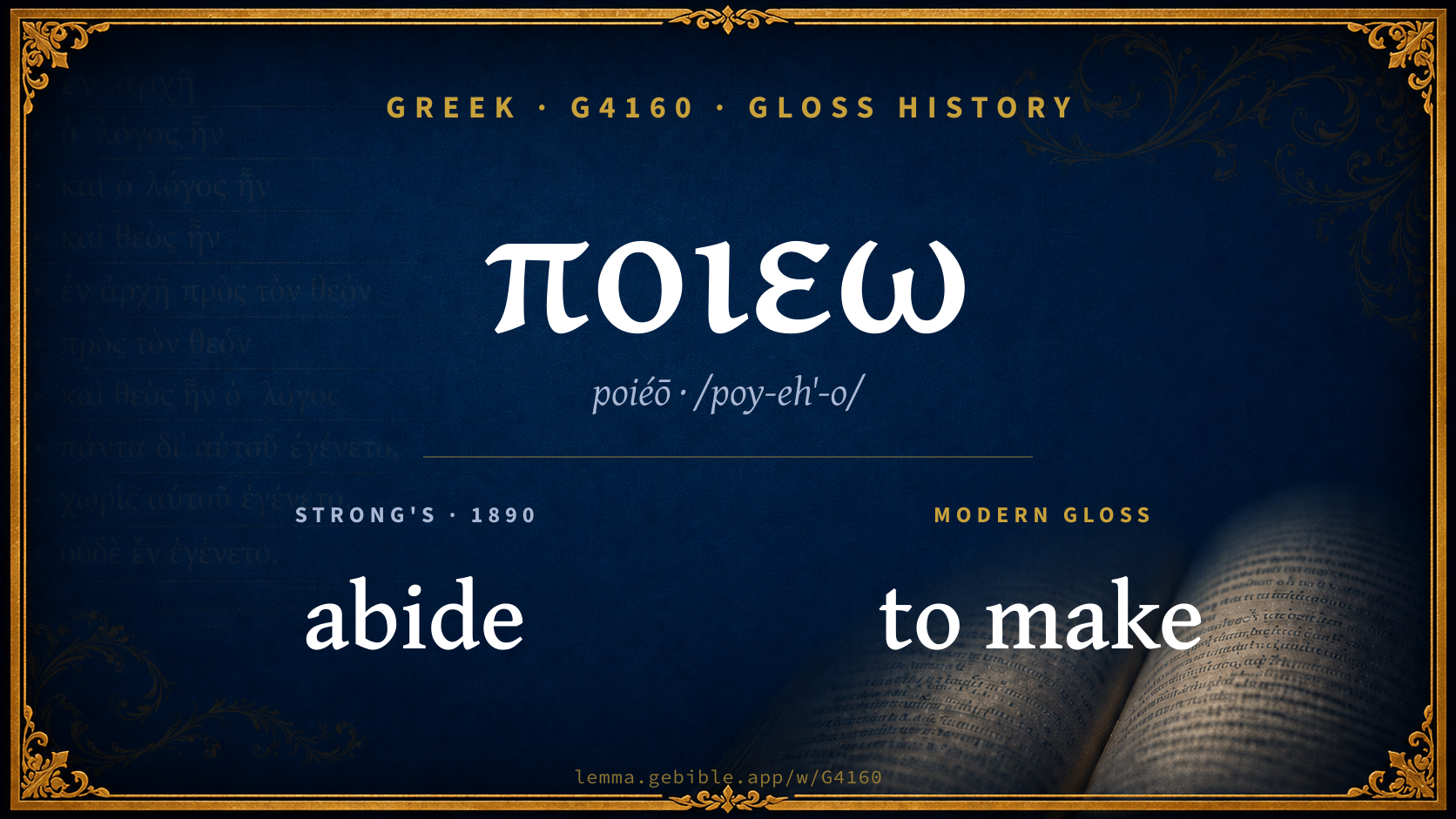
Gloss history
Strong's 1890 vs modern scholarship
About this word
Strong's G4160 catalogs a Greek word from the Greek New Testament.
These counts are not copied from any lexicon or concordance. They are computed here, from the morphology-tagged Greek New Testament. What Lemma adds →
- 514
- distinct verses
- The word appears in 514 distinct verses.
- 26 / 27
- NT books
- The word appears in 26 of 27 New Testament books.
- #34
- by frequency
- Top 50 most frequent Greek words (rank 34 of 5,347 Greek words by occurrence).
View all 514 occurrences in the concordance →
By section of the New Testament
By traditional corpus
Conventional, traditional groupings — biblical authorship is debated, so this is a traditional corpus grouping, not an authorship claim. Some books belong to more than one corpus (Luke is in both the Gospels and the Lukan corpus, and so on), so these shares overlap and need not total 100%. Each figure is a share of the word’s 514 distinct verses.
- Gospels 294 verses · 57%
- Lukan (Luke–Acts) 145 verses · 28%
- Johannine 138 verses · 27%
- Pauline corpus 78 verses · 15%
- General (Catholic) Epistles 33 verses · 6%
- Revelation 26 verses · 5%
- Hebrews 18 verses · 4%
How translations render this word
Counts come from each version’s own published word-to-Strong’s tagging or interlinear alignment — an approximate guide to how each version renders this word, not a word-level alignment the data otherwise carries. Because each total is that version’s own tagged count, the per-version totals vary from one another and need not match the appearance or distinct-verse counts above. These counts may also differ from a printed concordance because Lemma counts each distinctly tagged rendering and does not collapse phrase taggings into a single head-word total. This is a fixed set of word-tagged versions (KJV, ASV, BSB, ULT) and does not change with the reading translation you choose elsewhere. Each version’s license is shown beside its name below (and on Sources).
- King James Version: Do 100×, Make 31×, Did 30×
- American Standard Version: Do 105×, Make 33×, Did 31×
- Berean Standard Bible: Do 83×, Make 22×, Did 17×
- unfoldingWord Literal Text: Do 109×, Make 36×, Doing 32×
King James Version Public Domain
Renders G4160 across 586 tagged occurrences — most commonly:
Plus other, less common renderings. Plus 110 renderings that appear only once — usually multi-word phrases or single function words the recovered tagging swept in, not distinct renderings. Not rendered by a distinct English word in 16 further occurrences.
American Standard Version Public Domain
Renders G4160 across 583 tagged occurrences — most commonly:
Plus other, less common renderings. Plus 123 renderings that appear only once — usually multi-word phrases or single function words the recovered tagging swept in, not distinct renderings. Not rendered by a distinct English word in 1 further occurrence.
Berean Standard Bible Public Domain
Renders G4160 across 544 tagged occurrences — most commonly:
Plus other, less common renderings. Plus 163 renderings that appear only once — usually multi-word phrases or single function words the recovered tagging swept in, not distinct renderings. Not rendered by a distinct English word in 9 further occurrences.
unfoldingWord Literal Text CC BY-SA 4.0
Renders G4160 across 624 tagged occurrences — most commonly:
Plus other, less common renderings. Plus 105 renderings that appear only once — usually multi-word phrases or single function words the recovered tagging swept in, not distinct renderings.
15 senses in Thayer's, in lexicon order
The 15 senses Thayer's distinguishes for this word, in lexicon order (not ranked by frequency or importance). The full entry — with sub-senses — is in the Lexicon Entry tab.
- with the names of things made, to produce, construct, form, fashion, etc.
- to be the authors of, the cause
- to make ready, to prepare
- to produce, bear, shoot forth
- to acquire, to provide a thing for one's self
- to make a thing out of something
- to (make i.e.) render one anything
- to put one forth, to lead him out
- to make one do something
- to be the authors of a thing (to cause, bring about)
This word has an unusually long lexicon entry — 15 senses across its verb stems. The first 10 are shown above in lexicon order; the remaining 5 senses (more of the same, repeated under each stem) and the full sub-sense tree are in the Lexicon Entry tab.
Word origin
Origin: apparently a prolonged form of an obsolete primary
Apparently a prolonged form of an obsolete primary; to make or do (in a very wide application more or less direct): - abide + agree appoint X avenge + band together be bear + bewray bring (forth) cast out cause commit + content continue deal + without any delay (would) do (-ing) execute exercise fulfil gain give have hold X journeying keep + lay wait + lighten the ship make X mean + none of these things move me observe ordain perform provide + have purged purpose put + raising up X secure shew X shoot out spend take tarry + transgress the law work yield. Compare G4238 .
— Strong’s Exhaustive Concordance (1890), public domain.
Forms in the corpus
The 77 distinct written forms G4160 takes in the Greek New Testament, most frequent first — each parse links to that tense’s occurrences in the concordance.
The 60 most common forms are shown; 17 rarer forms follow in the full concordance.
Same root — word family
Other Thayer's entries built from the same root as G4160, grouped by Strong’s listed origin. These share a root / origin per the lexicon — not necessarily a shared meaning. Each links to that word’s own entry.
Derived from this word
Compare all same-root words → They share a root, not necessarily a meaning.
Septuagint usage
The same Greek word ποιεω appears 2,711 times in the Greek Old Testament (Septuagint), across 2,345 verses in 38 books.
- 2,711
- LXX occurrences
- Tagged occurrences of this Greek word in the Septuagint.
- 2,345
- verses
- Distinct Septuagint verses containing this word.
- 38 / 39
- OT books
- The word appears in 38 of the 39 Old Testament books.
Sample Septuagint occurrences
- Genesis 1:1 ποιέω
- Exodus 1:17 ποιέω
- Leviticus 2:7 ποιέω
- Numbers 1:54 ποιέω
- Deuteronomy 1:14 ποιέω
- Joshua 1:7 ποιέω
- Judges 1:7 ποιέω
- Ruth 1:8 ποιέω
- 1 Samuel 1:7 ποιέω
- 2 Samuel 2:5 ποιέω
- 1 Kings 1:5 ποιέω
- 2 Kings 1:18 ποιέω
Septuagint occurrences (same lexeme)
Every verse where the same Strong’s number (G4160) appears in the Greek Septuagint — showing the first 50 of 2,345. Verse text shown in the World English Bible for context; the Greek form is the matched word — the English is not keyword-highlighted.
- Genesis 1:1 ποιέω In the beginning God created the heavens and the earth.
- Genesis 1:7 ποιέω God made the expanse, and divided the waters which were under the expanse from the waters which were above the expanse, and it was so.
- Genesis 1:11 ποιέω God said, "Let the earth put forth grass, herbs yielding seed, and fruit trees bearing fruit after their kind, with its seed in it, on the earth," and it was so.
- Genesis 1:12 ποιέω The earth brought forth grass, herbs yielding seed after their kind, and trees bearing fruit, with its seed in it, after their kind: and God saw that it was good.
- Genesis 1:16 ποιέω God made the two great lights: the greater light to rule the day, and the lesser light to rule the night. He also made the stars.
- Genesis 1:21 ποιέω God created the large sea creatures, and every living creature that moves, with which the waters swarmed, after their kind, and every winged bird after its kind. God saw that it was good.
- Genesis 1:25 ποιέω God made the animals of the earth after their kind, and the cattle after their kind, and everything that creeps on the ground after its kind. God saw that it was good.
- Genesis 1:26 ποιέω God said, "Let us make man in our image, after our likeness: and let them have dominion over the fish of the sea, and over the birds of the sky, and over the cattle, and over all the earth, and over every creeping thing that creeps on the earth."
- Genesis 1:27 ποιέω God created man in his own image. In God's image he created him; male and female he created them.
- Genesis 1:31 ποιέω God saw everything that he had made, and, behold, it was very good. There was evening and there was morning, the sixth day.
- Genesis 2:2 ποιέω On the seventh day God finished his work which he had made; and he rested on the seventh day from all his work which he had made.
- Genesis 2:3 ποιέω God blessed the seventh day, and made it holy, because he rested in it from all his work which he had created and made.
- Genesis 2:4 ποιέω This is the history of the generations of the heavens and of the earth when they were created, in the day that Yahweh God made earth and the heavens.
- Genesis 2:18 ποιέω Yahweh God said, "It is not good that the man should be alone; I will make him a helper suitable for him."
- Genesis 3:1 ποιέω Now the serpent was more subtle than any animal of the field which Yahweh God had made. He said to the woman, "Yes, has God said, 'You shall not eat of any tree of the garden?'"
- Genesis 3:7 ποιέω Both of their eyes were opened, and they knew that they were naked. They sewed fig leaves together, and made themselves aprons.
- Genesis 3:13 ποιέω Yahweh God said to the woman, "What is this you have done?" The woman said, "The serpent deceived me, and I ate."
- Genesis 3:14 ποιέω Yahweh God said to the serpent, "Because you have done this, cursed are you above all cattle, and above every animal of the field. On your belly shall you go, and you shall eat dust all the days of your life.
- Genesis 3:21 ποιέω Yahweh God made coats of skins for Adam and for his wife, and clothed them.
- Genesis 4:10 ποιέω Yahweh said, "What have you done? The voice of your brother's blood cries to me from the ground.
- Genesis 5:1 ποιέω This is the book of the generations of Adam. In the day that God created man, he made him in God's likeness.
- Genesis 5:2 ποιέω He created them male and female, and blessed them, and called their name Adam, in the day when they were created.
- Genesis 6:6 ποιέω Yahweh was sorry that he had made man on the earth, and it grieved him in his heart.
- Genesis 6:7 ποιέω Yahweh said, "I will destroy man whom I have created from the surface of the ground; man, along with animals, creeping things, and birds of the sky; for I am sorry that I have made them."
- Genesis 6:14 ποιέω Make an ark of gopher wood. You shall make rooms in the ark, and shall seal it inside and outside with pitch.
- Genesis 6:15 ποιέω This is how you shall make it. The length of the ark will be three hundred cubits, the breadth of it fifty cubits, and the height of it thirty cubits.
- Genesis 6:16 ποιέω You shall make a roof in the ark, and to a cubit shall you finish it upward. You shall set the door of the ark in the side of it. You shall make it with lower, second, and third levels.
- Genesis 6:22 ποιέω Thus Noah did. According to all that God commanded him, so he did.
- Genesis 7:4 ποιέω In seven days, I will cause it to rain on the earth for forty days and forty nights. Every living thing that I have made, I will destroy from the surface of the ground."
- Genesis 7:5 ποιέω Noah did everything that Yahweh commanded him.
- Genesis 8:6 ποιέω It happened at the end of forty days, that Noah opened the window of the ark which he had made,
- Genesis 8:13 ποιέω It happened in the six hundred first year, in the first month, the first day of the month, the waters were dried up from off the earth. Noah removed the covering of the ark, and looked. He saw that the surface of the ground was dried.
- Genesis 8:21 ποιέω Yahweh smelled the sweet savor. Yahweh said in his heart, "I will not again curse the ground any more for man's sake, because the imagination of man's heart is evil from his youth; neither will I ever again strike everything living, as I have done.
- Genesis 9:6 ποιέω Whoever sheds man's blood, by man will his blood be shed, for in the image of God made he man.
- Genesis 9:24 ποιέω Noah awoke from his wine, and knew what his youngest son had done to him.
- Genesis 11:4 ποιέω They said, "Come, let's build us a city, and a tower, whose top reaches to the sky, and let's make us a name; lest we be scattered abroad on the surface of the whole earth."
- Genesis 11:6 ποιέω Yahweh said, "Behold, they are one people, and they have all one language; and this is what they begin to do. Now nothing will be withheld from them, which they intend to do.
- Genesis 12:2 ποιέω I will make of you a great nation. I will bless you, and make your name great. You will be a blessing.
- Genesis 12:18 ποιέω Pharaoh called Abram, and said, "What is this that you have done to me? Why didn't you tell me that she was your wife?
- Genesis 13:4 ποιέω to the place of the altar, which he had made there at the first. There Abram called on the name of Yahweh.
- Genesis 13:16 ποιέω I will make your offspring as the dust of the earth, so that if a man can number the dust of the earth, then your seed may also be numbered.
- Genesis 14:2 ποιέω that they made war with Bera, king of Sodom, and with Birsha, king of Gomorrah, Shinab, king of Admah, and Shemeber, king of Zeboiim, and the king of Bela (the same is Zoar).
- Genesis 18:5 ποιέω I will get a morsel of bread so you can refresh your heart. After that you may go your way, now that you have come to your servant." They said, "Very well, do as you have said."
- Genesis 18:6 ποιέω Abraham hurried into the tent to Sarah, and said, "Quickly make ready three measures of fine meal, knead it, and make cakes."
- Genesis 18:7 ποιέω Abraham ran to the herd, and fetched a tender and good calf, and gave it to the servant. He hurried to dress it.
- Genesis 18:8 ποιέω He took butter, milk, and the calf which he had dressed, and set it before them. He stood by them under the tree, and they ate.
- Genesis 18:17 ποιέω Yahweh said, "Will I hide from Abraham what I do,
- Genesis 18:19 ποιέω For I have known him, to the end that he may command his children and his household after him, that they may keep the way of Yahweh, to do righteousness and justice; to the end that Yahweh may bring on Abraham that which he has spoken of him."
- Genesis 18:25 ποιέω Be it far from you to do things like that, to kill the righteous with the wicked, that so the righteous should be as the wicked. May that be far from you. Shouldn't the Judge of all the earth do right?"
- Genesis 19:3 ποιέω He urged them greatly, and they came in with him, and entered into his house. He made them a feast, and baked unleavened bread, and they ate.
These are occurrences of the same Greek lexeme (G4160) in the Septuagint — not a translation of any one Hebrew word. The store carries no word-level Hebrew↔Greek alignment, so no Hebrew original is asserted here. Counts come from the recovered LXX Strong's tagging — high-frequency vocabulary is well covered, while rare or late forms may be untagged — so they reflect tagged occurrences and may slightly undercount.