Mark 1:3

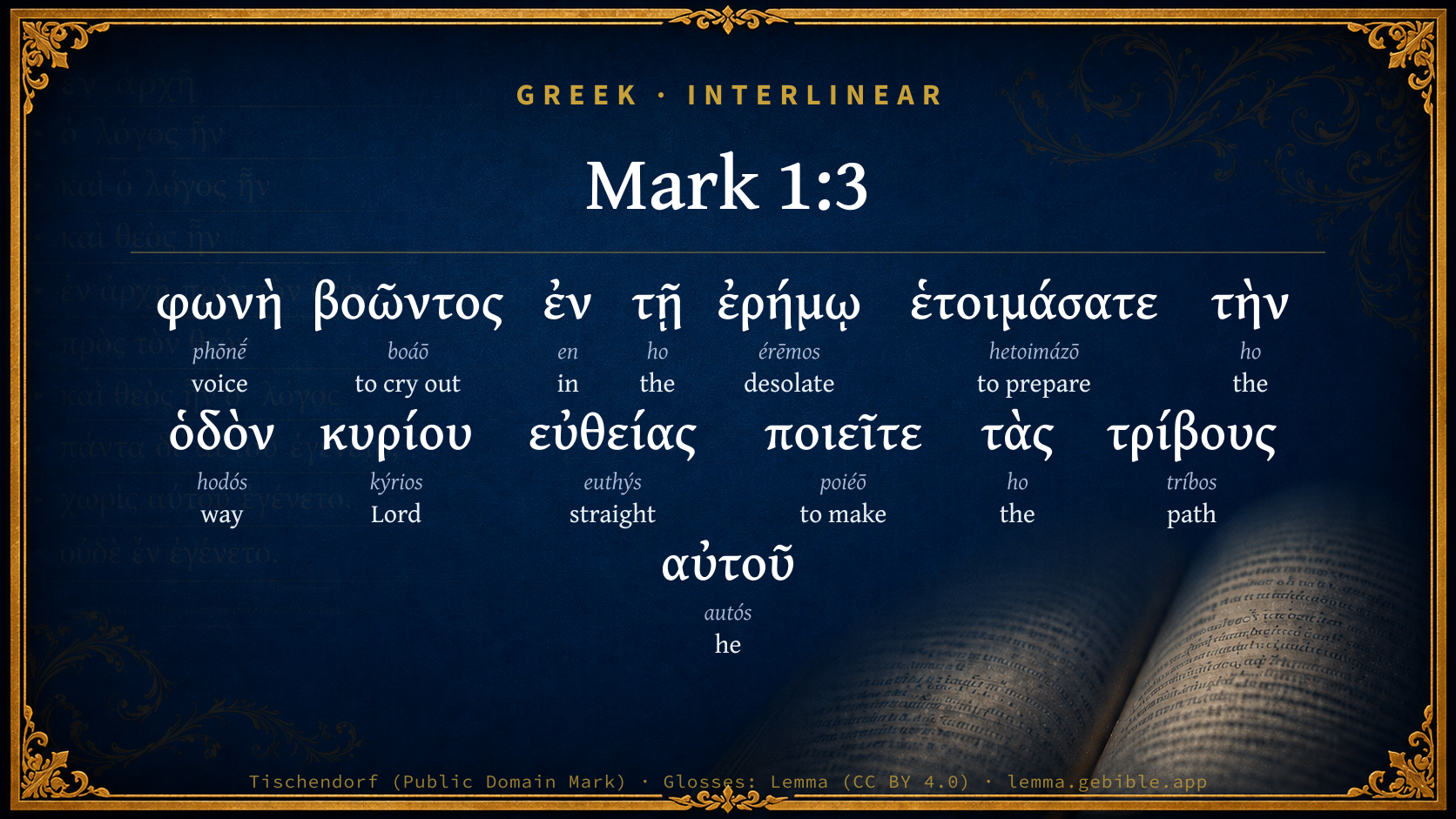
Greek (Tischendorf 8th ed.) Mark 1:3 appears in the Greek New Testament. The text above is from the Tischendorf 8th edition. Each word links to its Strong’s number and a concise gloss. Click any word for its full Thayer’s Greek Lexicon entry.
Download image
Cite this verse

Mark 1:3 (World English Bible). Public Domain. Lemma interlinear Bible study tool, https://lemma.gebible.app/v/mark/1/3.

Show BibTeX & RIS
BibTeX
RIS
English Translation
The voice of one crying in the wilderness, 'Make ready the way of the Lord! Make his paths straight!'"
World English Bible · Public Domain
Download a study sheet

One document with this verse’s original text, its word-by-word gloss line, the meaning frame, cross-references with their text, attributed commentary, and full source and license credits — printable, and it pastes into notes with its structure intact.

This verse Autodidact and up

Study sheet (.html) Plain text (.txt)

A passage Seminary Student

Up to 50 verses in one chapter. A passage sheet keeps up to 6 commentary sources and 12 cross-references per verse, in the order this page ranks them, and says so on the sheet whenever that leaves anything out. Ask for a single verse and you get the Autodidact verse sheet above.

Everything on this page stays free to read, with no account — the sheet is a download of what is already on screen, not access to it.

Want to remove ads? Support Godless Engineer
Compare translations 3

The same verse in 3 English versions, stacked beneath the original-language interlinear above. Click any original word for its lexicon entry.

Each is an independent rendering of the whole verse — the interlinear is not word-aligned to these translations.

Highlighted words mark where these versions differ — a whole-verse word diff, not a word-by-word alignment.

  • World English Bible Public Domain
    The voice of one crying in the wilderness, 'Make ready the way of the Lord! Make his paths straight!'"
  • King James Version Public Domain
    The voice of one crying in the wilderness, Prepare ye the way of the Lord, make his paths straight.
  • unfoldingWord Literal Text CC BY-SA 4.0
    a voice of one calling out in the wilderness, ‘Make ready the way of the Lord; make his paths straight.’”

unfoldingWord Literal Text — © unfoldingWord, licensed CC BY-SA 4.0. Word-aligned USFM3 via Door43 (git.door43.org/unfoldingWord/en_ult).

Versions to compare (up to 4)

3 of 4 selected

Show all 19 translations

Every available English version of this verse, each an independent rendering of the whole verse.

  • World English Bible Public Domain
    The voice of one crying in the wilderness, 'Make ready the way of the Lord! Make his paths straight!'"
  • Berean Standard Bible Public Domain
    “A voice of one calling in the wilderness, ‘Prepare the way for the Lord, make straight paths for Him.’”
  • Majority Standard Bible Public Domain
    “A voice of one calling in the wilderness, ‘Prepare the way for the Lord, make straight paths for Him.’”
  • King James Version Public Domain
    The voice of one crying in the wilderness, Prepare ye the way of the Lord, make his paths straight.
  • American Standard Version (1901) Public Domain
    The voice of one crying in the wilderness, Make ye ready the way of the Lord, Make his paths straight;
  • Revised Version (1885) Public Domain
    The voice of one crying in the wilderness, Make ye ready the way of the Lord, Make his paths straight;
  • Geneva Bible (1599) Public Domain
    The voyce of him that cryeth in the wildernesse is, Prepare the way of the Lord: make his paths straight.
  • Douay-Rheims (1899) Public Domain
    A voice of one crying in the desert: Prepare ye the way of the Lord, make straight his paths.
  • Young's Literal Translation Public Domain
    `A voice of one calling in the wilderness, Prepare ye the way of the Lord, straight make ye his paths,' --
  • Literal Standard Version CC BY-SA 4.0
    A voice of one calling in the wilderness: Prepare the way of the LORD, || Make His paths straight.”
  • Unlocked Literal Bible CC BY-SA 4.0
    The voice of one calling out in the wilderness, 'Make ready the way of the Lord; make his paths straight.'”
  • unfoldingWord Literal Text CC BY-SA 4.0
    a voice of one calling out in the wilderness, ‘Make ready the way of the Lord; make his paths straight.’”
  • Darby Bible Public Domain
    Voice of one crying in the wilderness, Prepare the way of [the] Lord, make his paths straight.
  • World Messianic Bible Public Domain
    the voice of one crying in the wilderness, ‘Make ready the way of the Lord! Make his paths straight!’”
  • Webster's Bible Public Domain
    The voice of one crying in the wilderness, Prepare ye the way of the Lord, make his paths straight.
  • Free Bible Version CC BY-SA 4.0
    A voice is calling in the desert, ‘Prepare the Lord's way! Make his paths straight.’”
  • Bible in Basic English Public Domain
    The voice of one crying in the waste land, Make ready the way of the Lord, make his roads straight;
  • Text-Critical English NT CC BY 4.0
    the voice of one crying out in the wilderness, ‘Prepare the way for the Lord; make his paths straight,’ ”
  • Tyndale New Testament (1534) Public Domain
    The voyce of a cryer in the wildernes: prepare ye the waye of the Lorde make his paches streyght.

Literal Standard Version (2020), Covenant Press — licensed CC BY-SA 4.0. Text via the HelloAO Bible API (eBible.org). Unlocked Literal Bible (unfoldingWord) — licensed CC BY-SA 4.0. Text via the HelloAO Bible API (eBible.org). unfoldingWord Literal Text — © unfoldingWord, licensed CC BY-SA 4.0. Word-aligned USFM3 via Door43 (git.door43.org/unfoldingWord/en_ult). Free Bible Version, Dr. Jonathan Gallagher — licensed CC BY-SA 4.0. Text via the HelloAO Bible API (eBible.org).

Word by word

More ways to search: Search by grammar → Find every occurrence → Compare this word →

Practice this passage: Drill this verse → Learn its vocabulary →

τρίβους
tríbos
G5147
“path”
Noun, Accusative, Plural, Feminine
Part of Speech
Noun
Case
Accusative
Number
Plural
Gender
Feminine
Full Thayer's Definition

Origin: "from tribo (to "rub", akin to teiro, truo, and the base of G5131 , G5134 )"

TDNT: None

1. a worn way, a path
  1. φωνὴ phōnḗ G5456 “voice” Noun, Nominative, Singular, Feminine
  2. βοῶντος boáō G994 “to cry out” Verb, Present, Active, Participle, Genitive, Singular, Masculine
  3. ἐν en G1722 “in” Preposition
  4. τῇ ho G3588 “the” Article, Dative, Singular, Feminine
  5. ἐρήμῳ érēmos G2048 “desolate” Adjective, Dative, Singular, Feminine
  6. ἑτοιμάσατε hetoimázō G2090 “to prepare” Verb, Aorist, Active, Imperative, 2nd person, Plural
  7. τὴν ho G3588 “the” Article, Accusative, Singular, Feminine
  8. ὁδὸν hodós G3598 “way” Noun, Accusative, Singular, Feminine
  9. κυρίου kýrios G2962 “Lord” Noun, Genitive, Singular, Masculine
  10. εὐθείας euthýs G2117 “straight” Adjective, Accusative, Plural, Feminine
  11. ποιεῖτε poiéō G4160 “to make” Verb, Present, Active, Imperative, 2nd person, Plural
  12. τὰς ho G3588 “the” Article, Accusative, Plural, Feminine
  13. αὐτοῦ autós G846 “he” Personal pronoun, Genitive, Singular, Masculine

About this verse

These counts appear in no published source. They are computed here, from the morphology-tagged text and Lemma’s own curated glosses. What Lemma adds →

14
words
12
distinct lemmas
Gospels
section

Notable vocabulary

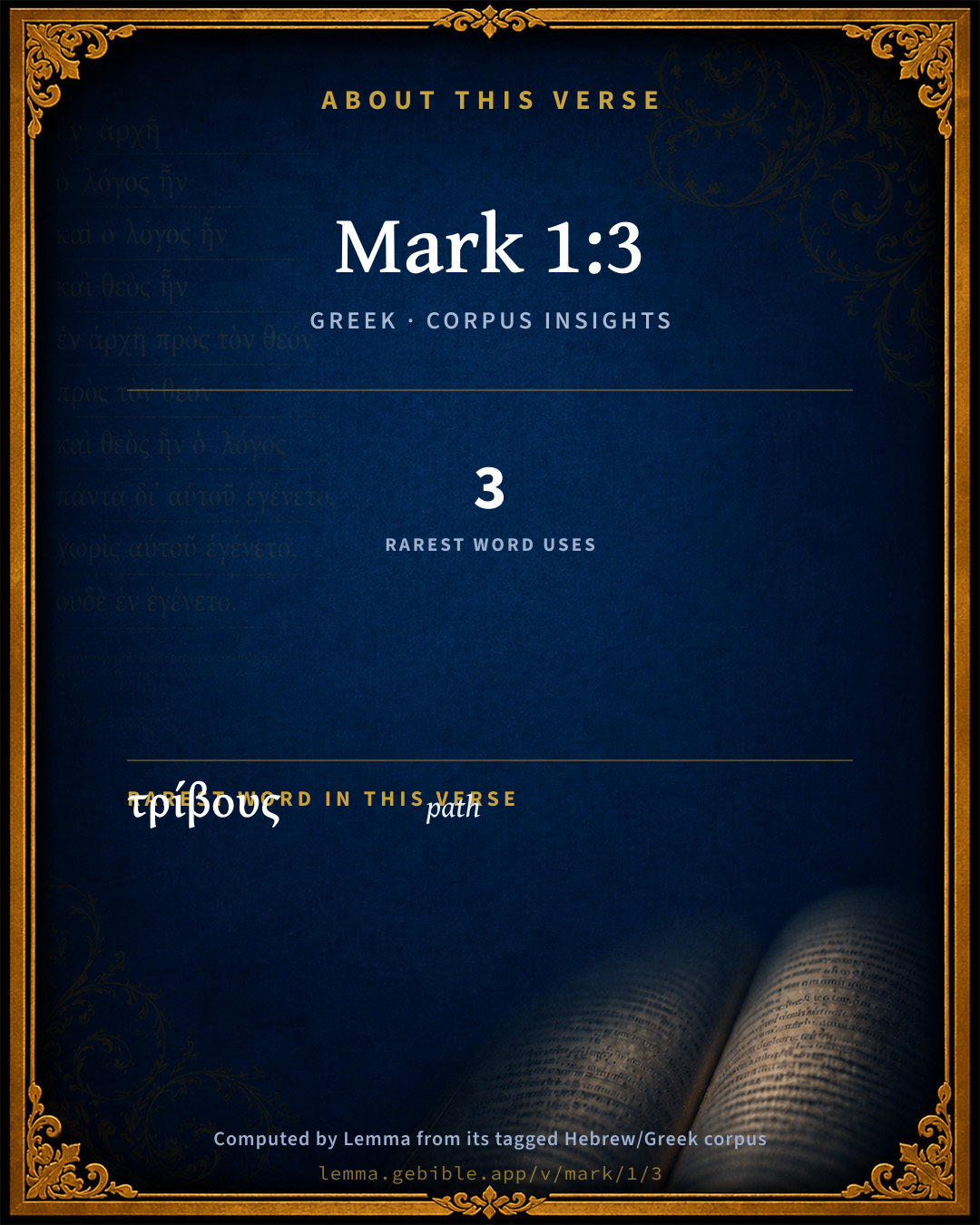
The rarest word here is τρίβους path G5147 — appearing just 3 times in the whole Greek New Testament.

Shared distinctive vocabulary

τρίβους path G5147 occurs in 3 verses of the Greek New Testament. Also found in:

Repetition

A word recurs within this verse:

Cross-references

6

Topical passages linked to Mark 1:3 in the Treasury of Scripture Knowledge — connected by theme and wording, ordered by reader-vote popularity; previews shown in the World English Bible.

  • Isaiah 40:3–5 The voice of one who cries, Prepare you in the wilderness the way of Yahweh; make level in the desert a highway for our God.
  • Matthew 3:3 For this is he who was spoken of by Isaiah the prophet, saying, "The voice of one crying in the wilderness, Make ready the way of the Lord, Make his paths straight."
  • Luke 3:4–6 As it is written in the book of the words of Isaiah the prophet, "The voice of one crying in the wilderness, 'Make ready the way of the Lord. Make his paths straight.
  • John 3:28–36 You yourselves testify that I said, 'I am not the Christ,' but, 'I have been sent before him.'
  • John 1:15 John testified about him. He cried out, saying, "This was he of whom I said, 'He who comes after me has surpassed me, for he was before me.'"
  • John 1:19–34 This is John's testimony, when the Jews sent priests and Levites from Jerusalem to ask him, "Who are you?"

Cross-references courtesy of OpenBible.info (CC BY 4.0).

Commentary

Notes on Mark 1:3 from classic Christian and Jewish commentators (each source and its license shown beneath its notes). The classic Christian expositions comment on the surrounding passage and are grouped to its opening verse, so a note may address several verses; the Jewish commentaries on the Tanakh (Rashi and others) are per-verse, so they appear only where the commentator wrote on this verse.

Lemma curates 59 commentaries, every one of them public domain or Creative Commons licensed, each selected and text-cleaned for this edition rather than reprinted as found. About our sources →

The Biblical Illustrator

Joseph S. Exell

Mar_1:3

The voice of one crying in the wilderness.

I. Ministers ought to show zeal and earnestness in their office (Isa_58:1; Hos_8:1; 2Ti_4:2). A minister of the Word must not do the work of the Lord negligently or coldly, but with zeal and fervency of spirit. This zeal and earnestness consists chiefly in

(1) being affected and moved in his own heart with that which he delivers, feeling the power of it in himself;

(2) labouring so to speak as to affect and move his hearers to the embracing of that which is taught. This is done by the particular applying, and earnest urging and pressing of the doctrine taught, to the consciences of the hearers; when it is not only delivered in general manner, and so left, but particularly applied, for the reproving and convincing of sin in people, and for the stirring of them up to good duties (Ecc_12:11). The doctrine of the Word (preached by the ministers of it) is compared to nails fastened, to show that it must be driven home, and up to the head (as it were), by the hammer of application.

II. Ministers should also, with courage and boldness of spirit, deliver the word and message of the Lord (Eph_6:20; Jer_1:17; Eze_3:9). We deliver not our own message, but that of God; we speak not in our own name, but in the Name of the Almighty. Let us then, with all boldness, deliver Gods message, not forbearing to reprove sin, nor concealing any part of the truth, for fear of mens displeasure (G. Petter.)

Gods use of mans voice

The highest praise of a prophet is that he should be simply a voice employed by God. God borrows voices still. While the weapons of our warfare are heavenly, the weapons of His warfare are earthly. For the human lips a Divine message must be sought; for the Divine message human lips are requisite. Consecrate thy lips to Him, and He will pour grace into them. (R. Glover.)

The preacher a voice

A preacher should, if possible, be nothing but a voice, which should be always heard and never seen to cry is to preach with such force as is worthy of the truth, without lowering the voice through complaisance. To this end he must not be a man of the world, but one who comes, as it were, out of the wilderness, without relations, without friends, without secular engagements, which may thwart and obstruct his ministry. The first man who appears in the gospel is one entirely dedicated to repentance: the first example and the first precept are an example and a precept of repentance-so necessary is this to salvation l (Quesnel.)

Novelty and mystery

I. A wonderful preacher.

1. The subject of prophecy.

2. The last of the prophets.

3. Choosing a strange place to preach in.

4. Adopting an antiquated garb and manner.

II. A wonderful sermon.

1. Not the exposition of a creed.

2. Not concerning traditions and ceremonies.

3. Personal-as repentance is a personal duty.

4. Practical-as leading to visible results.

III. A wonderful congregation.

1. Strangely composed-of city and country people.

2. All travelling a great distance to hear the preacher.

3. All yielding to the truth-confessing their sins.

4. All submitting to the rite imposed by the desert preacher. (J. C. Grey.)

Christs public entrance upon His ministry

I. The need of the human herald of Christ. Though our Lord came in the fulness of the time, the time was not ready for Him, so far as His own people were concerned. The popular heart was intensely cold and unrepentant. A certain measure of national disaster will bring repentance and reformation. People read chastisement in their sorrows. But without spiritual guides there comes on religious indifference. The popular heart was softened. It was prepared for the truth, and to be an honest witness of Christs miracles. Here lies the whole philosophy of the Christian ministry. Christ could operate directly on the heart without the human instrument. But He requires of man that he go before Him, and do all that the human voice can do, and then He comes to complete the order of salvation. He gives man as much as he can do and bear in the great work of saving men.

II. The human preparation of Christ for His work.

III. The subjection of the servant to the master. (J. F. Hurst, D. D.)

A rough man for rough work

He had rough work to do; therefore a man of refined taste and delicate organization could not perform it. John is fitted for his work-a coarse man levelling mountains and filling up valleys, sternness in his looks, vehemence in his voice. The truth is-Reformers must despise the conventionalities of society. They have rude work to do, and they must not be too dainty respecting the means they adopt to effect it. Adorn your frontispieces, embellish your cornerstones, but let the foundations be as rugged as you please. Decorations are for the superstructure, strength and solidity for the base. Luther has often been charged with rudeness, coarseness, and even scurrility. The indictment contains, perhaps, too much truth for us successfully to gainsay. But we should not forget that he had a coarse age to deal with, coarse enemies to contend with, coarse sins to battle with. Coarse or not coarse, the question is-Did he do his work? If he did that, who are we to cavil at the means he used? Would our smooth phrases and rounded periods accomplish the task of regenerating half Europe, and of giving the other half a shaking from which it has not yet recovered, nor is likely to recover this century? Regenerate half Europe indeed! Shame upon us! We cannot regenerate half a parish, and who are we to find fault with a mall who regenerated half a continent? Who will go to fell forest trees of a thousand years standing with a superfine razor? Is not the heavy axe the fit tool wherewith to cut them down? (J. C. Jones.)

The Biblical Illustrator, edited by Joseph S. Exell (c. 1880s–1900s) — public domain. Text from a community e-Sword module.

Godbey's Commentary on the New Testament

William B. Godbey

CHAPTER 4

MINISTRY OF JOHN THE BAPTIST BY MATTHEW, MARK, AND LUKE

Luk 3:1-2. “In the fifteenth year of the dominion of Tiberius Caesar, Pontius Pilate being governor of Judea, and Herod tetrarch of Galilee, and Philip his brother tetrarch of Iturea and the Trachonitis country, and Lysanias being tetrarch of Abilene, during the high priesthood of Annas and Caiaphas, the word of God came to John, the son of Zacharias, in the wilderness.” Luke gives us important specifications, stating that Tiberius was emperor of the Roman world; Pontius Pilate, governor of Judea; Herod — i.e., Herod Antipas, the son of Herod the Great, who was on the throne of Judea when our Savior was born, and slew the infants — was tetrarch of Galilee. His jurisdiction also included Perea, east of the Jordan. As both of these countries were traversed by our Savior, it is important that they appear in this introductory. The Philip here mentioned, the brother of Herod, and governor of Iturea and Trachonitis, was not the one whose wife, Herodias, Herod Antipas took; but she was the wife of another Philip, who was a half brother to Herod. Abilene, the tetrarchy of Lysanias, was a region of country in Anti-Lebanon, between Damascus and Heliopolis. We have Annas and Caiaphas here, both spoken of as high priests; and we see, in our Lord’s arraignment, He was brought before each one of them. The solution of the matter seems to be that the Roman authorities favored the high-priesthood of Annas, and the Jewish that of Caiaphas. After Zacharias and Elizabeth fled away from Jutta, near Bethlehem, into the wilderness of Judea, to protect their child from the cruelties of Herod, they returned no more during the minority of John. Consequently, upon reaching the age of thirty, he entered at once upon his ministry there in the desert (Mat 3:1-2), “preaching in the desert of Judea, and saying, Repent, for the kingdom of heaven is at hand.”

Mar 1:4, “John came baptizing in the desert, and preaching the baptism of repentance unto the remission of sins.” I here use the word “desert,” in lieu of “wilderness,” because the latter is utterly illusory to the American reader. By wilderness, in this country, we understand a wild region of Country, overgrown with briers, brambles, and brush, as well as forest trees. That is not the Bible meaning of the word eremos, which means a region of country either destitute of water, because the rains do not fall on it, or at least partially destitute, because of insufficiency of rains. Four times have I traveled through the wilderness of Judea, where John the Baptist was brought up and did his first preaching. It is a desert, dry and unproductive, seldom seeing a green leaf, because of insufficient rains. Mosses, ferns, and nettles grow there, fed on by the goats, donkeys, and camels. In the deserts there are oases, like islands in the ocean, where springs of water so irrigate as to produce some sustenance for man and beast, and these are the places of habitation. John was brought up in that poor, wild, sterile desert of Judea, lying between Jerusalem and Bethlehem on the west, and the Dead Sea on the east.

Here we see that the burden of John’s Gospel is repentance unto the remission of sins. When man truly repents, God always forgives. John cried, with stentorian voice, “Repent, because the kingdom of heaven is at hand;” i.e., Christ the King is at hand, who, of course, brings the kingdom with Him. Matthew 3; Mar 1:3; Luk 3:4. “The voice of one roaring in the desert, Prepare ye the way of the Lord: make His paths straight.” “Crying,” E.V. is “boontos,” from “boo,” the noise an ox makes when he lows. Hence it means roaring like an ox. We see from these facts that John had a stalwart, robust constitution, having been brought up in the rough and tumble life of the desert, and now, thirty years old — i.e., a grown young man — in his vigor, filled and flooded with the Holy Ghost, he throws his great mouth wide open, and roars, like an ox bawling. His message was simple and brief. He had but one theme, and that was repentance unto the remission of their sins, confirming their covenant by water baptism. His stentorian voice, and the burning truth, which leaped like forked lightnings from his lips, stir the people terrifically, as he assures them that the King of heaven is already on the earth, and the most important enterprise of life is to prepare to meet Him, which they can only do by repenting of all their sins, unto a conscious experimental remission, which he proposed to confirm by water baptism. A true repentance is accompanied by restitution, which undoes all the bad work of the former life, making all wrongs right so far as possible, God taking the will for the deed in case of impossibility. If you would get saved, the Lord must come into your heart. He will not travel over a crooked road. Hence you must make his paths straight — i.e., make straight ways for the Lord to come into thy heart; i.e., you must straighten out all of your own crooked ways — otherwise the Lord will never come into your heart, and you would better never have been born. John gave the trumpet no uncertain sound. He had both the thunder and the lightning — the former, to call attention and terrify; and the latter, to kill. O how the Lord needs such preachers now, to arouse a slumbering world and a dead Church from the lethargy of swift damnation!

Luke 5, 6. “Every valley shall be filled up, and every mountain and hill shall be brought low.” True repentance brings the king, the queen, the nobleman, the great man, the hon tons of society, down low in the dust at the feet of Jesus, where they can get religion, and be humble enough to black their own shoes, cook, and wash dishes, delighted to wait on themselves and their friends, and live the life of the meek and lowly; while the wonderful redeeming grace of God lifts up beggars, drunkards, and harlots, and transforms the very “filth and offscourmg of the world” into mighty men and saintly women, whose seraphic voices hold multitudes spellbound, and whose mighty works will glorify God in the day of eternity. “Crooked things shall be straight, and rough places shall become the smooth Ways, and all flesh shall see the salvation of God.” These wonderful transformations of redeeming grace and sanctifying power, transforming the roughest reprobates into the most amiable saints, and the most stupid simpletons into fire-baptized witnesses for Jesus, the blackest debauchees into bloodwashed pilgrims for glory bound, tells the wonderful secret of the world’s evangelization. There is no other way to bring about this summum desideratum, for which every true heart sighs night and day. Hence it devolves on the holiness people of all lands to verify the Commission, and “preach the gospel to every Creature.” O what a glorious privilege, to be numbered with the Sacramental Army, going forth to conquer the world for Christ!

JOHN’S LIVING

The great reason why we can’t evangelize the world is, the puzzling problem of ministerial support. The Bible answers all questions and sweeps away all difficulties. Here we have John the Baptist, the greatest’ preacher the world saw in four thousand years, and a paragon for all others to imitate. See this wonderful prophet of the desert, with a huge stone for a pulpit, and an audience of ten thousand, standing on the burning sand, listening hour after hour, so utterly spellbound that the sun goes down before they are aware. The preacher has nothing on his body by way of apparel but the coarse, shaggy, camel’s-hair mantle, worn by the poorest people, and tied around his loins with a strap of rawhide; i.e., actually clothed like a beggar. Now what about boarding the greatest preacher the world had ever seen? It is an unequivocal truth that he lived on the locusts, sweetened with the wild honey gathered from the rocks in the mountains, as the “wilderness [desert] of Judea” is one continuous bed of rugged, precipitous, cavernous, barren mountains, where very little rain falls in the winter, and none in the summer, producing very scanty vegetation but a short period in the year. I am aware that great efforts have been made to explain away the idea that John really ate the locusts. There is a tree in the Holy Land called the carob or horn tree, bearing fruit eaten by poor people, much resembling the American honey-locust. Many have claimed that this was the food of John the Baptist. Even my Arab guide pointed it out to me as the food which John ate. I must state here, once for all, that the theory is utterly untenable. The fruit of that tree is called keration. (Luk 15:16.) The prodigal son actually ate it, along with the hogs, which are very fond of it; while the word translated locusts, and specifying the food of John the Baptist, is akris, and has no meaning except the animal locust. Hence there is no dodging the issue without flatly contradicting the Word of God. So set it down as a matter of fact that John lived on locusts. This clear revelation of God’s Word is abundantly corroborated by all the collateral facts and circumstances appertaining to the case.

(a) This day the locusts abound in the very country where John lived thirty years and entered upon his wonderful ministry.

I have seen them, in quantities so great that I could have filled a bushel basket in a diameter of a single rod.

(b) It is a well-known fact that the Bedouins, living in the desert now, eat the locusts, not simply in case of emergency, but they are very fond of them, regarding them as a luxury, and devouring them voraciously, preferring them cooked, with salt, but eating them unhesitatingly raw, with salt if they have it, and without it if they have it not. They traverse the desert, hunting them; fill great sacks with them; carry them on camels and donkeys to their tents, and feast like kings so long as the locusts last.

(c) The poor people in the desert, with whom John was brought up, habitually eat the locusts.

Of course they invited their preacher to eat with them, giving him such as they had; i.e., locusts sweetened with wild honey. My Arab guide, accompanying me when I saw the locusts in the “wilderness of Judea,” and dismounted so as to enjoy a good look at them, as they manifested no disposition to get out of my way, told me that they taste much like fish, and are quite palatable. I took his word, and was satisfied without testing the matter. The locusts which I saw were very fine looking, and several times so large as the grasshoppers in the American deserts, of which the Indians are so fond.

(d) Good Lord, deliver us from criticizing Thy Word, and give us grace unhesitatingly to take the Bible as it says, and save us from all efforts to explain it away! John the Baptist had no money, and needed none.

We do not conclude from this that we should not give the preachers money, or anything else we have and they need. But we do conclude that the person who waits for money is out of God’s order. John had none, and was not in a place to get any. Myriads are now called by the Holy Ghost under similar circumstances. O how they grieve the Spirit when they wait, year after year, for money to defray traveling expenses, pay board, and purchase clothing and books, while millions are dropping into hell! I find men and women everywhere who confess that they are called by the Spirit, and are not in the work. An awful responsibility awaits them at the judgment bar. They should go, like John the Baptist, waiting for nothing. “The Lord will provide.”

It may not be my way, It may not be thy way; Yet, in His own way, The Lord will provide.”

If I could be a thousand men, I have open doors enough for them all to enter. What about the support? That is already settled with a draft on heaven’s bank.

Can we not have the faith of Sister Amelia Andrew, the wife of the sainted bishop? The Confederate War has swept over the country, a deluge of blood and fire, disorganizing Churches and revolutionizing society. General Lee has surrendered, and the war is over. Bishop Andrew, though now an octogenarian, is much concerned for the work in Texas, which has received no attention during the dark quadrennium.

He says to his sanctified Amelia, “O, how I‘d like to go to Texas, and look after the interest of God’s kingdom in the great ‘Lone Star State!’”

“My dear, why do you not go?” “No money.”

“I can send you to the boat-landing on Tombighee River, in my carriage, without any money.”

“But what can I do when I get there, with no money to defray my traveling expenses?”

“The Lord will provide,” responded the sanctified wife.

The venerable bishop acquiesces, and goes away by faith alone, without a cent of money. On arrival at the boat-landing, he meets a steamboat captain, a dear old friend, who kindly invites him to accept a free ride to New Orleans. On arrival at New Orleans, he meets a sea captain, a precious old friend, so glad to see him, who invites him to enjoy a free ride on his ship to Galveston, Texas. O how the Texans are delighted to receive him! God blesses his ministry. He stays long, sees the glory of God, and returns to his Alabama home with money in his pocket.

But this was a good run of luck. O no! It was the good providence of God.

I have seen it all my life. The difficulty of ministerial support is the devil’s trump-card, in the game he is playing with the Church for the damnation of the world. The argument in the case of John the Baptist is unanswerable, covering all the ground, and applicable under all circumstances.

William B. Godbey, Commentary on the New Testament (1896–1900) — public domain. Text from a community e-Sword module.

Tyndale Open Study Notes

Tyndale Open Resources

1:3 John the Baptist was the voice shouting in the wilderness for people to prepare the way for the Lord’s coming. In Isaiah, this prophecy refers to the coming of the Lord, the God of Israel. Here it refers to the Lord Jesus (see 12:35-37). The early church called itself “the Way,” probably in reference to this promise (see Acts 9:2; 19:9, 23; 22:4; 24:14, 22; cp. Acts 2:28; 18:25-26; Rom 2:20; 2 Pet 2:2, 21).

Tyndale Open Study Notes — © Tyndale Open Resources, licensed CC BY-SA 4.0. Text via the HelloAO Bible API.

Bengel's Gnomon

Johann Albrecht Bengel

Mar 1:3. Φωνὴ, the voice) see Luk 3:4, notes.—ἐν τῇ ἐρήμῳ, in the wilderness) This is repeated in the following verse, where presently after also that expression, preaching (κηρύσσων), answers to, the voice of one crying, in this ver.

Bengel's Gnomon of the New Testament — English translation (T&T Clark, Edinburgh, 1860) — public domain. Text from a community e-Sword module.

Expositor's Greek Testament

ed. W. Robertson Nicoll

Mar 1:3 . Quotation from Isa 40:3 as in Mat 3:3 .

The Expositor's Greek Testament, edited by W. Robertson Nicoll (1897–1910) — public domain. Text from a community e-Sword module.

Cambridge Greek Testament for Schools and Colleges

3. Here the only variation from LXX. is αὐτοῦ instead of τοῦ θεοῦ ἡμῶν, a change which allows Κυρίου to be understood of the Messiah. We may take ἐν τῇ ἐρήμῳ with ἑτοιμάσατε, but the usual connexion with βοῶντος is probably correct. The imagery is taken from the practice of eastern conquerors, who sent heralds to tell the nations through which they were about to pass to prepare a “king’s highway” by levelling ground and straightening roads. John prepared the way by inviting all men to prepare it. Mt. and Lk. again agree against Mk in placing the quotation from Isa 40:3 after the appearance of the Baptist, not before, as here. See Hawkins, Horae Synopticae2, pp. 210 f.; Burkitt, The Gospel History, pp. 40–58. The application of the prophecy to the Baptist was made by himself (Joh 1:23). Place only a comma at the end of Mar 1:3 (W.H.).

Cambridge Greek Testament for Schools and Colleges (Cambridge University Press, 1896; 21 vols, various authors incl. Carr, Maclear, Plummer, Farrar, Lumby, Moule, M. R. James, Simcox) — public domain. Text from a community e-Sword module.

Jamieson, Fausset & Brown

Robert Jamieson, A. R. Fausset & David Brown

The voice of one crying in the wilderness, Prepare ye the way of the Lord, make his paths straight--The second of these quotations is given by Matthew and Luke in the same connection, but they reserve the former quotation till they have occasion to return to the Baptist, after his imprisonment (Mat 11:10; Luk 7:27). (Instead of the words, "as it is written in the Prophets," there is weighty evidence in favor of the following reading: "As it is written in Isaiah the prophet." This reading is adopted by all the latest critical editors. If it be the true one, it is to be explained thus--that of the two quotations, the one from Malachi is but a later development of the great primary one in Isaiah, from which the whole prophetical matter here quoted takes its name. But the received text is quoted by IRENÆUS, before the end of the second century, and the evidence in its favor is greater in amount, if not in weight. The chief objection to it is, that if this was the true reading, it is difficult to see how the other one could have got in at all; whereas, if it be not the true reading, it is very easy to see how it found its way into the text, as it removes the startling difficulty of a prophecy beginning with the words of Malachi being ascribed to Isaiah). For the exposition, see on Mat 3:1-6, Mat 3:11.

Jamieson, Fausset & Brown — Commentary Critical and Explanatory on the Whole Bible (1871) — public domain (CC PDM 1.0). Text via the HelloAO Bible API.

Adam Clarke's Commentary

Verse 3. The voice of one crying] See Clarke on Mt 3:1-3.

Adam Clarke's Commentary on the Bible (1810–1826) — public domain. Text from a community e-Sword/MySword module.

Ellicott's Commentary for English Readers

(3) The voice of one crying in the wilderness.—See Note on Mat_3:3.

A Bible Commentary for English Readers, edited by Charles John Ellicott (1878–1897) — public domain. Text from a community e-Sword module.

John Gill's Exposition

The voice of one crying in the wilderness,.... This is the other testimony in proof of the same, and may be read in Isa 40:3. See Gill on Mat 3:3.

.

Mark 1:4

mar 1:4

mar 1:4

mar 1:4John did baptize in the wilderness,.... Of Judea, Mat 3:1, where he first appeared as a preacher; and is the same wilderness Isaiah has respect to in the above prophecy, Isa 40:3. The words are best rendered in the Vulgate Latin and Syriac versions; "John was in the wilderness, baptizing and preaching the baptism of repentance, for the remission of sins": according to which, the account of the Baptist begins with his name, John; describes the place where he was where he made his first appearance, and continued in, the wilderness; which was not a wild uninhabited place and without people, but had many cities, towns, and villages in it; and also declares his work and ministry there, which was preaching and baptizing: for though baptizing is here put before preaching, yet certain it is, that he first came preaching in these parts; and there baptized such, to whom his preaching was made useful. Baptism is here called, the

baptism of repentance: because John required repentance antecedent to it, and administered it upon profession of repentance, and as an open testification of it; and this

for, or

unto the remission of sins: not for the obtaining the remission of sins, as if either repentance, or baptism, were the causes of pardon of sin; but the sense is, that John preached that men should repent of their sins, and believe in Christ, who was to come; and upon their repentance and faith, be baptized; in which ordinance, they might be led to a fresh view of the free and full forgiveness of their sins, through Christ; whose blood was to be shed for many, to obtain it: see Act 2:38.

John Gill's Exposition of the Whole Bible (1746–1763) — public domain (CC PDM 1.0). Text via the HelloAO Bible API.

Trapp's Complete Commentary

John Trapp

3 The voice of one crying in the wilderness, Prepare ye the way of the Lord, make his paths straight.

Ver. 3. The voice of one crying] Here Mark begins the Gospel, at the preaching of the Baptist, which the author to the Hebrews begins at the preaching of Christ, Heb 2:3. But that is only to prove that so great was our Saviour’s glory in his miracles, that it matcheth, yea, surpasseth that of the angels, those ministers of the law. The ridiculous parallel of Apollonius Tyaneus with our Saviour by Hierocles, and the malicious exceptions of R. Nizachon against his doings and miracles, are fully answered by Eusebius and Munster. Annot. in Mat. Hebraice. As for John Baptist, he professeth himself to be no more than a voice. And so indeed he was totus vox, all voice. His apparel, his diet, his conversation did preach holiness as well as his doctrine, Mar 6:20; Joh 3:25-36.

John Trapp, A Commentary or Exposition upon All the Books of the Old and New Testament (1647–1656) — public domain. Text from a community e-Sword module.

Haydock's Catholic Bible Commentary

See Matthew iii. 3.

George Leo Haydock (1774–1849), Haydock's Catholic Family Bible and Commentary, 1859 edition — public domain. Excludes Psalms (Douay-Rheims chapter numbering differs from Protestant) and Deuterocanonical books (Catholic canon only).

John Wesley's Explanatory Notes

Isaiah xl, 3.

John Wesley, Explanatory Notes Upon the Whole Bible (1754–1765) — public domain. Text via the GEBible commentary corpus.

Scofield Reference Notes

C. I. Scofield

Lord

Jehovah. Isa 40:3.

The Scofield Reference Bible (1917 edition), notes by C. I. Scofield — public domain. Text from a community e-Sword module.

Burkitt's Expository Notes on the New Testament

William Burkitt

Here note, 1. The title given to John the Baptist: he is called a Voice, in respect of his ministerial office, which was to speak forth, to promulge and publish, the doctrine of salvation.

2. The quantity or kind of this voice, a crying voice, the voice of one crying.

This implies, 1. His earnestness and vehemency his zeal His and fervency, in preaching. When we lift up our voice, and cry aloud, we speak with earnestness and fervour. When our own hearts are warmly affected with what we preach, we may hope to affect the hearts of our hearers. Why has God commissioned men rather than angels, to be the preachers and dispensers of his word, but because we can speak to and treat with sinners more feelingly and more affectionately than the angels can?

2. This crying of the holy Baptist in his preaching, implies his liberty and boldness, as well as vehemency and earnestness, in delivering of his message. The lifting up of the voice in speaking, argues boldness and courage in the speaker; as, on the contrary, the depressing of the voice showeth timorousness.

Learn hence, That the ministers of the word are to use both zeal and earnestness, and also courage and boldness of spirit, in delivering the word and message of God, not forbearing to reprove sin, not concealing any part of God’s truth, for fear of men’s displeasure.

Observe, 3. The sum and substance of what he cried, Prepare ye the way of the Lord, make his paths straight; that is, "Make ready yourselves, prepare your own hearts, to entertain the doctrine and glad tidings of the gospel." It is a metaphorical speech, taken from the custom of loyal and dutiful subjects, who, when their prince is coming to lodge in their city, prepare and make ready the way for his coming, by removing every thing that may obstruct or hinder his progress.

Learn hence, That man’s heart by nature is very unfit to embrace and entertain the Lord Jesus Christ. We have naturally no fitness, no disposition, no inclination, to believe in him, or to submit unto him.

2. If ever we desire to entertain Christ in our hearts, we must first prepare and make fit our hearts for the receiving and embracing of him. For though the preparation of the heart be from the Lord, yet he requires the exercise of our faculties, and the use of our endeavours.

He prepares our hearts, by enabling us to the preparation of our own hearts. This is done by getting a sight of the evil of sin, a sense of our misery without Christ, an hungering and thirsting desire after him, and true faith in him. Christ will lodge in no heart that is not thus made ready to receive him.

William Burkitt's Expository Notes on the New Testament (1700–1703) — public domain. Text from a community e-Sword module.

Alford’s Greek Testament

Henry Alford

3.] This again stands independently, not ἐγέν. Ἰωάν. (ὁ) βαπτ … ὡς γέγρ.

The citation here is from two Prophets, Isa. and Mal.: see reff. The fact will not fail to be observed by the careful and honest student of the Gospels. Had the citation from Isaiah stood first, it would have been of no note, as Meyer observes. Consult notes on Mat 11:10; Mat 3:3.

Henry Alford, The Greek Testament (1849–1861) — public domain. Text from a community e-Sword module.

International Critical Commentary

3. φωνὴ βοῶντος ἐν τῇ ἐρήμῳ—The voice of one crying in the wilderness. This passage is quoted directly from the LXX. of Isa 40:3.Isa 40:1 Here, as in the quotation from Mal., the coming to be prepared for is that of God to his people. The purpose of his coming is to deliver his people from their captivity in Babylon by the hand of Cyrus.2 It is the note of deliverance which is common to this with the Messianic advent and intervention, and the preparation for this by the prophetic message is shared by this with the passage from Mal.

ἐν τῇ ἐρήμῳ in the Heb. belongs with ἑτοιμάσατε. See Isa 40:3, RV. But it is evident that Mk. intends to join it with βοῶντος, as this makes the prophecy anticipate the appearance of John in the wilderness.

Κύριον—the Lord, stands for Jehovah, or Yahweh, in the original, this being the LXX. rendering of that name of God. But it is probable that Mk. understands it to refer to Jesus, this being one of his familiar titles. In this way, the passage becomes more directly adapted to his purpose, making the advent, and the mission of the forerunner both figure in prophecy.

International Critical Commentary — older volumes (1896–1929), various authors — public domain. Text from a community e-Sword module.

Vincent's Word Studies in the New Testament

Marvin R. Vincent

A voice (φωνὴ)

No article as A. V. and Rev., “the voice.” It has a sort of exclamatory force. Listening, the prophet exclaims, Lo! a voice.

Marvin R. Vincent, Word Studies in the New Testament (1887–1900) — public domain. Text from a community e-Sword/MySword module.

Lesson kit

Teaching starters — assembled from the data on this page, not authored interpretation. Every prompt links to the verse data it draws on. Edit before teaching.

Mark, in the Gospels, opens this verse with 14 words (12 distinct Greek lemmas). Its most distinctive word is tríbos (“path”). A historical commentator’s framing appears above. Read the whole chapter for the surrounding context.

Discussion questions

  1. The word tríbos carries the sense “path.” How does it shape the verse?
  2. How does Matthew 3:3, which shares the word «path», read alongside this verse?
  3. What does the repetition of “the” (3× in this one verse) do in this verse?
  4. These translations render this verse differently. What is at stake in choosing one wording over another?
  5. Compare how The Biblical Illustrator and Godbey's Commentary on the New Testament read this verse. Where do they agree or differ?

Things to notice

Reading settings

Reading text

Shown beneath each verse's original-language words.

Old Testament
Old Testament edition

Read the OT as the Masoretic Hebrew (MT) or the Greek Septuagint (LXX).

English shown for the Greek Septuagint (in the Hebrew ↔ Greek comparison).

Comparing translations? Open the Compare panel on any verse page to stack up to four side by side.