Matthew 21:43

Greek (Tischendorf 8th ed.) Matthew 21:43 appears in the Greek New Testament. The text above is from the Tischendorf 8th edition. Each word links to its Strong’s number and a concise gloss. Click any word for its full Thayer’s Greek Lexicon entry.
Download image
Cite this verse

Matthew 21:43 (World English Bible). Public Domain. Lemma interlinear Bible study tool, https://lemma.gebible.app/v/matthew/21/43.

Show BibTeX & RIS
BibTeX
RIS
English Translation
"Therefore I tell you, the Kingdom of God will be taken away from you, and will be given to a nation bringing forth its fruits.
World English Bible · Public Domain
Download a study sheet

One document with this verse’s original text, its word-by-word gloss line, the meaning frame, cross-references with their text, attributed commentary, and full source and license credits — printable, and it pastes into notes with its structure intact.

This verse Autodidact and up

Study sheet (.html) Plain text (.txt)

A passage Seminary Student

Up to 50 verses in one chapter. A passage sheet keeps up to 6 commentary sources and 12 cross-references per verse, in the order this page ranks them, and says so on the sheet whenever that leaves anything out. Ask for a single verse and you get the Autodidact verse sheet above.

Everything on this page stays free to read, with no account — the sheet is a download of what is already on screen, not access to it.

Want to remove ads? Support Godless Engineer
Compare translations 3

The same verse in 3 English versions, stacked beneath the original-language interlinear above. Click any original word for its lexicon entry.

Each is an independent rendering of the whole verse — the interlinear is not word-aligned to these translations.

Highlighted words mark where these versions differ — a whole-verse word diff, not a word-by-word alignment.

  • World English Bible Public Domain
    "Therefore I tell you, the Kingdom of God will be taken away from you, and will be given to a nation bringing forth its fruits.
  • King James Version Public Domain
    Therefore say I unto you, The kingdom of God shall be taken from you, and given to a nation bringing forth the fruits thereof.
  • unfoldingWord Literal Text CC BY-SA 4.0
    For this reason I say to you that the kingdom of God will be taken away from you and will be given to a nation producing its fruits.

unfoldingWord Literal Text — © unfoldingWord, licensed CC BY-SA 4.0. Word-aligned USFM3 via Door43 (git.door43.org/unfoldingWord/en_ult).

Versions to compare (up to 4)

3 of 4 selected

Show all 19 translations

Every available English version of this verse, each an independent rendering of the whole verse.

  • World English Bible Public Domain
    "Therefore I tell you, the Kingdom of God will be taken away from you, and will be given to a nation bringing forth its fruits.
  • Berean Standard Bible Public Domain
    Therefore I tell you that the kingdom of God will be taken away from you and given to a people who will produce its fruit.
  • Majority Standard Bible Public Domain
    Therefore I tell you that the kingdom of God will be taken away from you and given to a people who will produce its fruit.
  • King James Version Public Domain
    Therefore say I unto you, The kingdom of God shall be taken from you, and given to a nation bringing forth the fruits thereof.
  • American Standard Version (1901) Public Domain
    Therefore say I unto you, The kingdom of God shall be taken away from you, and shall be given to a nation bringing forth the fruits thereof.
  • Revised Version (1885) Public Domain
    Therefore say I unto you, The kingdom of God shall be taken away from you, and shall be given to a nation bringing forth the fruits thereof.
  • Geneva Bible (1599) Public Domain
    Therefore say I vnto you, The kingdome of God shalbe taken from you, and shalbe giuen to a nation, which shall bring foorth the fruites thereof.
  • Douay-Rheims (1899) Public Domain
    Therefore I say to you, that the kingdom of God shall be taken from you, and shall be given to a nation yielding the fruits thereof.
  • Young's Literal Translation Public Domain
    `Because of this I say to you, that the reign of God shall be taken from you, and given to a nation bringing forth its fruit;
  • Literal Standard Version CC BY-SA 4.0
    Because of this I say to you that the Kingdom of God will be taken from you, and given to a nation bringing forth its fruit;
  • Unlocked Literal Bible CC BY-SA 4.0
    Therefore I say to you, the kingdom of God will be taken away from you and will be given to a nation that produces its fruits.
  • unfoldingWord Literal Text CC BY-SA 4.0
    For this reason I say to you that the kingdom of God will be taken away from you and will be given to a nation producing its fruits.
  • Darby Bible Public Domain
    Therefore I say to you, that the kingdom of God shall be taken from you and shall be given to a nation producing the fruits of it.
  • World Messianic Bible Public Domain
    “Therefore I tell you, God’s Kingdom will be taken away from you and will be given to a nation producing its fruit.
  • Webster's Bible Public Domain
    Therefore I say to you, The kingdom of God shall be taken from you, and given to a nation bringing forth the fruits of it.
  • Free Bible Version CC BY-SA 4.0
    That's why I'm telling you that the kingdom of God will be taken away from you. It will be given to a people who produce the right kind of fruit.
  • Bible in Basic English Public Domain
    For this reason I say to you, The kingdom of God will be taken away from you, and will be given to a nation producing the fruits of it.
  • Text-Critical English NT CC BY 4.0
    Therefore I tell you that the kingdom of God will be taken away from you and given to a people who will produce its fruit.
  • Tyndale New Testament (1534) Public Domain
    Therfore saye I vnto you the kyngdome of God shalbe take from you and shalbe geve to the getyls which shall brynge forth the frutes of it.

Literal Standard Version (2020), Covenant Press — licensed CC BY-SA 4.0. Text via the HelloAO Bible API (eBible.org). Unlocked Literal Bible (unfoldingWord) — licensed CC BY-SA 4.0. Text via the HelloAO Bible API (eBible.org). unfoldingWord Literal Text — © unfoldingWord, licensed CC BY-SA 4.0. Word-aligned USFM3 via Door43 (git.door43.org/unfoldingWord/en_ult). Free Bible Version, Dr. Jonathan Gallagher — licensed CC BY-SA 4.0. Text via the HelloAO Bible API (eBible.org).

Word by word

More ways to search: Search by grammar → Find every occurrence → Compare this word →

Practice this passage: Drill this verse → Learn its vocabulary →

καρποὺς
karpós
G2590
“fruit”
Noun, Accusative, Plural, Masculine
Part of Speech
Noun
Case
Accusative
Number
Plural
Gender
Masculine
Full Thayer's Definition

Origin: probably from the base of G726

TDNT: 13:14,4

1. fruit a. the fruit of the trees, vines, of the fields b. the fruit of one's loins, i.e. his progeny, his posterity 2. that which originates or comes from something, an effect, result a. work, act, deed b. advantage, profit, utility c. praises, which are presented to God as a thank offering d. to gather fruit (i.e. a reaped harvest) into life eternal (as into a granary), is used in fig. discourse of those who by their labours have fitted souls to obtain eternal life
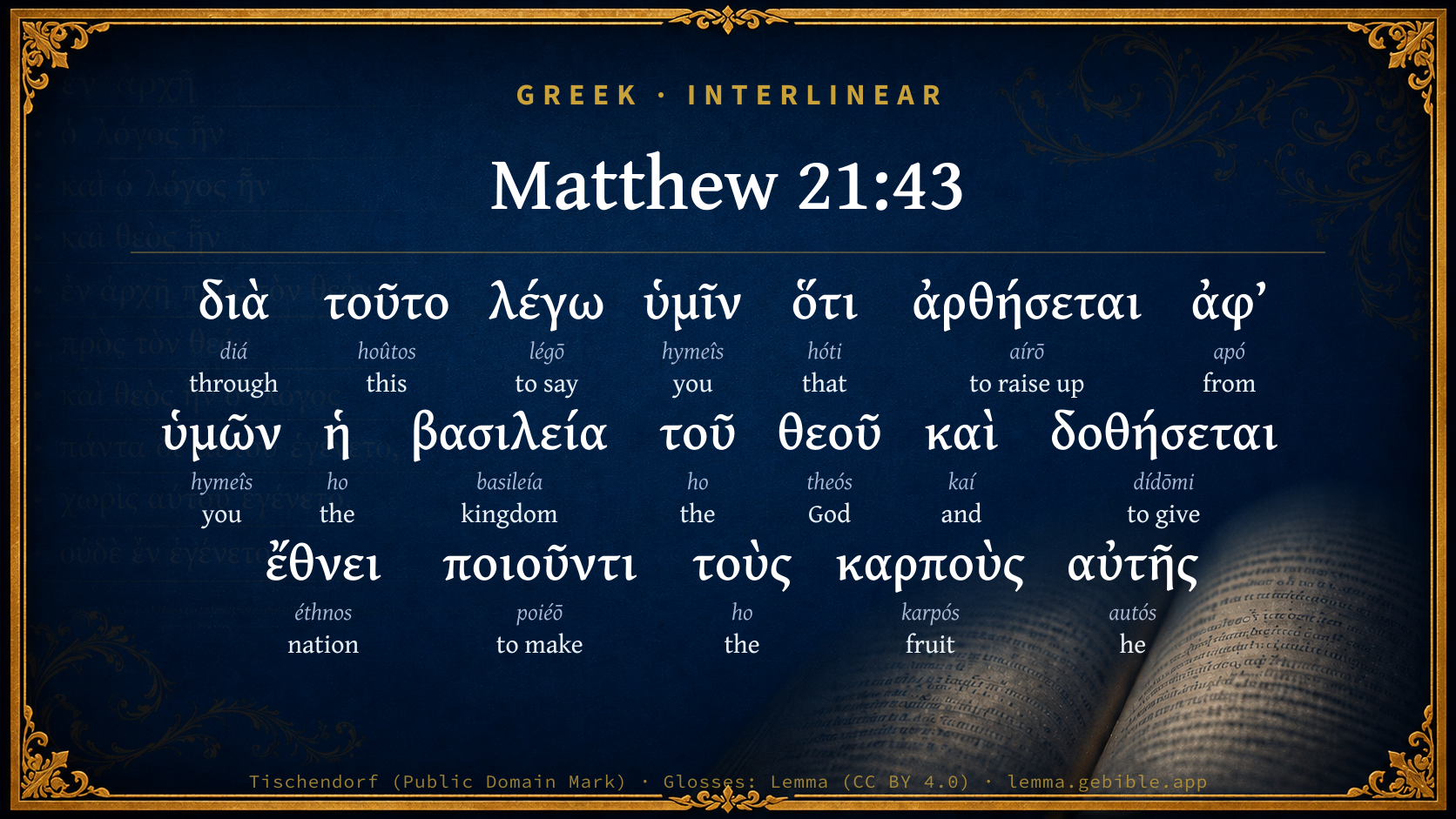
  1. διὰ diá G1223 “through” Preposition
  2. τοῦτο hoûtos G3778 “this” Demonstrative pronoun, Accusative, Singular, Neuter
  3. λέγω légō G3004 “to say” Verb, Present, Active, Indicative, 1st person, Singular
  4. ὑμῖν hymeîs G5210 “you” Personal pronoun, 2nd person, Dative, Plural
  5. ὅτι hóti G3754 “that” Conjunction
  6. ἀρθήσεται aírō G142 “to raise up” Verb, Future, Passive, Indicative, 3rd person, Singular
  7. ἀφ’ apó G575 “from” Preposition
  8. ὑμῶν hymeîs G5210 “you” Personal pronoun, 2nd person, Genitive, Plural
  9. ἡ ho G3588 “the” Article, Nominative, Singular, Feminine
  10. βασιλεία basileía G932 “kingdom” Noun, Nominative, Singular, Feminine
  11. τοῦ ho G3588 “the” Article, Genitive, Singular, Masculine
  12. θεοῦ theós G2316 “God” Noun, Genitive, Singular, Masculine
  13. καὶ kaí G2532 “and” Conjunction
  14. δοθήσεται dídōmi G1325 “to give” Verb, Future, Passive, Indicative, 3rd person, Singular
  15. ἔθνει éthnos G1484 “nation” Noun, Dative, Singular, Neuter
  16. ποιοῦντι poiéō G4160 “to make” Verb, Present, Active, Participle, Dative, Singular, Neuter
  17. τοὺς ho G3588 “the” Article, Accusative, Plural, Masculine
  18. αὐτῆς autós G846 “he” Personal pronoun, Genitive, Singular, Feminine

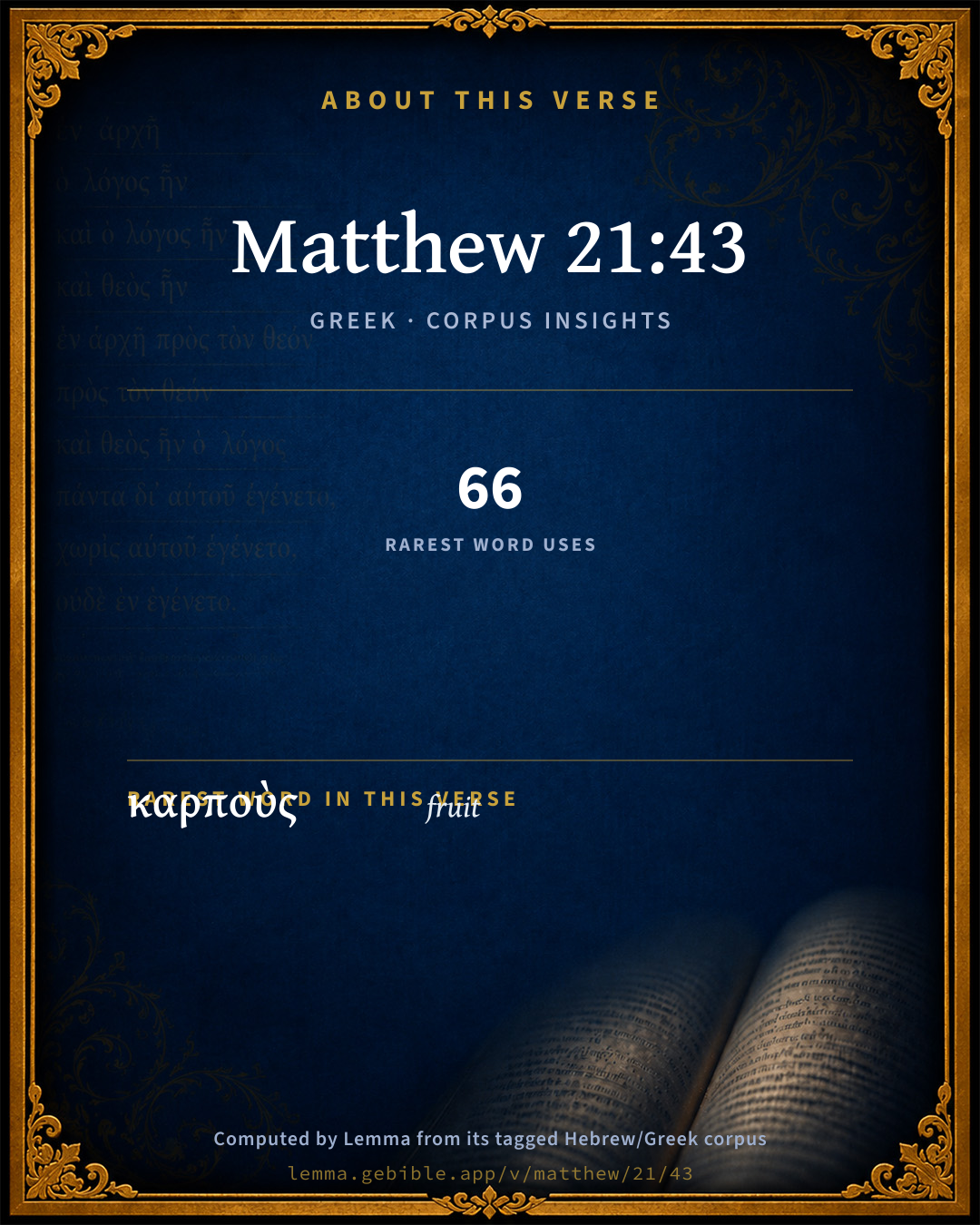
About this verse

These counts appear in no published source. They are computed here, from the morphology-tagged text and Lemma’s own curated glosses. What Lemma adds →

19
words
16
distinct lemmas
Gospels
section

Repetition

Words recur within this verse:

Cross-references

9

Topical passages linked to Matthew 21:43 in the Treasury of Scripture Knowledge — connected by theme and wording, ordered by reader-vote popularity; previews shown in the World English Bible.

  • Matthew 21:41 They told him, "He will miserably destroy those miserable men, and will lease out the vineyard to other farmers, who will give him the fruit in its season."
  • Matthew 8:11–12 I tell you that many will come from the east and the west, and will sit down with Abraham, Isaac, and Jacob in the Kingdom of Heaven,
  • 1 Peter 2:9 But you are a chosen race, a royal priesthood, a holy nation, a people for God's own possession, that you may show forth the excellencies of him who called you out of darkness into his marvelous light:
  • John 3:3 Jesus answered him, "Most assuredly, I tell you, unless one is born anew, he can't see the Kingdom of God."
  • Isaiah 26:2 Open you the gates, that the righteous nation which keeps faith may enter in.
  • Luke 17:20–21 Being asked by the Pharisees when the Kingdom of God would come, he answered them, "The Kingdom of God doesn't come with observation;
  • John 3:5 Jesus answered, "Most assuredly I tell you, unless one is born of water and spirit, he can't enter into the Kingdom of God!
  • Exodus 19:6 and you shall be to me a kingdom of priests, and a holy nation.' These are the words which you shall speak to the children of Israel."
  • Isaiah 28:2 Behold, the Lord has a mighty and strong one; as a tempest of hail, a destroying storm, as a tempest of mighty waters overflowing, will he cast down to the earth with the hand.

Cross-references courtesy of OpenBible.info (CC BY 4.0).

Commentary

Notes on Matthew 21:43 from classic Christian and Jewish commentators (each source and its license shown beneath its notes). The classic Christian expositions comment on the surrounding passage and are grouped to its opening verse, so a note may address several verses; the Jewish commentaries on the Tanakh (Rashi and others) are per-verse, so they appear only where the commentator wrote on this verse.

Lemma curates 59 commentaries, every one of them public domain or Creative Commons licensed, each selected and text-cleaned for this edition rather than reprinted as found. About our sources →

Tyndale Open Study Notes

Tyndale Open Resources

21:43 taken away from you: Either the privilege of being God’s chosen nation no longer belonged to the Jews, or the religious leaders had lost the privilege of being leaders of God’s people (see Rom 9–11). • The Christian community is a nation that will produce the proper fruit—that is, a life of trust and obedience that demonstrates the inauguration of the Kingdom (see Matt 3:8; 7:15-20; 12:33; 13:8, 26).

Tyndale Open Study Notes — © Tyndale Open Resources, licensed CC BY-SA 4.0. Text via the HelloAO Bible API.

Bengel's Gnomon

Johann Albrecht Bengel

Mat 21:43. Αὐτῆς, thereof) sc. the kingdom.[949]

[949] Even though thou mayest be a good tree, yet thy fruit is not thine own, but that of the vineyard. Rom 11:17—V. g.

Bengel's Gnomon of the New Testament — English translation (T&T Clark, Edinburgh, 1860) — public domain. Text from a community e-Sword module.

Meyer's Critical & Exegetical Commentary

Heinrich August Wilhelm Meyer

Mat_21:43. Διὰ τοῦτο] therefore, because, according to the psalm just quoted, the rejected stone is destined to become the corner-stone. What is contained in the following announcement is the necessary consequence of the inversion of the order of things just referred to. The λέγω ὑμῖν, however, like the ἀφʼ ὑμῶν below, implies the obvious intermediate thought: for it is you who reject this corner-stone.

ἀρθήσεται ἀφʼ ὑμῶν] for they, along with the whole Ἰσραὴλ κατὰ σάρκα represented by them, were by natural right the owners of the approaching Messianic kingdom, its theocratic heirs; comp. Mat_13:38.

ἔθνει ποιοῦντι, κ.τ.λ.] Jesus is not here referring to the Gentiles, as, since Eusebius time, many, and in particular Schenkel, Hilgenfeld, Keim, Volkmar, have supposed, but, as the use of the singular already plainly indicates, to the whole of the future subjects of the kingdom of the Messiah, conceived of as one people, which will therefore consist of Jews and Gentiles, that new Messianic people of God, which is to constitute the body politic in the kingdom that is about to be established, 1Pe_2:9. The fruits of the Messiahs kingdom are those fruits which must be produced as the condition of admission (Mat_5:3 ff., Mat_13:8). Hence, likewise, the use of the present ποιοῦντι; for Jesus regards the future subjects of the kingdom as already anticipating its establishment by producing its fruits. The metaphor is to be regarded as an echo of the parable of the vineyard. The fruits themselves are identical with those mentioned in Eph_5:9; Gal_5:22; Rom_6:22.

Meyer — Critical and Exegetical Commentary on the New Testament — English translation by Peter Christie, edited by Frederick Crombie (T&T Clark, 1880) — public domain. Text from a community e-Sword module.

Expositor's Greek Testament

ed. W. Robertson Nicoll

Mat 21:43 . διὰ τοῦτο , introducing the application of the oracle, and implying that the persons addressed are the builders = therefore. ἡ βασιλεία τ . θ .: the doom is forfeiture of privilege, the kingdom taken from them and given to others. ἔθνει , to a nation; previously, as Paul calls it, a no nation ( οὐκ ἔθνει , Rom 10:19 ), the reference being, plainly, to the heathen world. ποιοῦντι τ . κ . α .: cf. Mat 3:8 ; Mat 3:10 ; Mat 7:17 , bringing forth the fruits of it (the kingdom). The hope that the new nation will bring forth the fruit is the ground of the transference. God elects with a view to usefulness; a useless elect people has no prescriptive rights.

The Expositor's Greek Testament, edited by W. Robertson Nicoll (1897–1910) — public domain. Text from a community e-Sword module.

International Critical Commentary

(E) 43. Therefore I say to you, That the kingdom of God shall be taken from you, and shall be given to a nation which produceth its fruits.] The words do not occur in Mk. They are an expository comment of the editor. The parable carries forward the thought of the preceding section. The Jewish rulers had adopted towards the Baptist a policy of non-recognition, which involved them in doubts as to the authority of Christ as the Messiah, vv. 23-32. Their action was typical and prophetic. They had at all times disobeyed the messengers of God, and were on the point of putting to death the Messiah, the Son of God, and His final Messenger to them. Consequently the divine favour, the kingdom = the vineyard, would be withdrawn from them and given to others. Vv. 41-42 express the same thought under another metaphor. The stone which the builders of Israel, that is, the Jewish authorities, rejected would become the chief stone in another building. The edifice of Israel’s national life was to give place to another building; cf. 16:18 οἰκοδομήσω μου τὴν ἐκκλησίαν.—ἡ βασιλεία τοῦ θεοῦ] Since the parable as a whole is clearly taken from Mk., there is every reason to suppose that this verse, which is not in Mk., is an editorial comment on the meaning of the parable. The vineyard was to be taken from the Jewish nation; but what term could the editor substitute for the vineyard? What he wished to express was, no doubt, the privileged position of the Jews as the recipients of a divine revelation. But this was just what the Rabbinical writers express by “the sovereignty of the heavens.” When a heathen became a proselyte, and was incorporated into the privileged Jewish people, he was said to take upon himself the sovereignty of the heavens; see Dalman, Words, p. 97. We might therefore have expected the editor to use the phrase βασιλεία τῶν οὐρανῶν. But since he has throughout the Gospel employed this term for the eschatological kingdom which Christ announced, and which was to be inaugurated when the Son of Man came upon the clouds of heaven, it would have been unsuitable here. For that kingdom had never been the possession of the Jewish rulers, and could not be taken from them. The phrase βασιλεία τοῦ θεοῦ, in the sense current among the Jews of the 1st century a.d., of sovereignty of God, seemed more suitable here; and the editor, by using it, once more betrays his Jewish origin, and emphasises his sense of the difference between this phrase in his Gospel and the more frequent βασιλεία τῶν οὐρανῶν. See on 12:28 and 21:31, and Introduction, p. lxvii.—ἔθνει] the conception of the Christian society as an ἔθνος occurs only here in the Gospel. It has twice been called an ἐκκλησία, 16:17, 18:17. The word is probably here suggested by the idea of the Jewish nation, implied in the ὑμῶν.

(E?) 44. And every one who falleth upon this stone shall be dashed in pieces: but upon whomsoever it shall fall, it shall scatter him as dust.] The words do not occur in Mk. The stone of v. 42 seems to have suggested the stone of Isa 8:14, Isa 8:15 and the stone of Dan 2:34, Dan 2:44-45. The verse apparently means that the rejection of the Messiah, “the son” of v. 37 and “the stone” of v. 42, would involve the complete break up of the Jewish polity.—λικμήσει] is borrowed from Dan 2:44 (Th.), and is used in the same sense as in that passage, namely, to break into small pieces, or to scatter as dust; see Deissm. Bib. Stud. p. 225. See also Briggs, Messianic Prophecy, p. 208.

The verse is omitted by D 33 a b e ff1 2 S1. It may perhaps be an interpolation from Luk 20:18, where the saying occurs in the form πᾶς ὁ πεσὼν ἐπʼ ἐκεῖνον τὸν λίθον, κ.τ.λ. But the verse as it stands in Mt. looks very much like an early gloss, suggested by v. 43. That verse seems to be an editorial interpretation of the meaning of the parable. The vineyard was to be given to others, v. 41. That is to say, the privileges of the Jewish nation, entrusted to it by God, were to be taken from it and given to others. The editor describes these privileges as “the kingdom of God,” by which he probably means the whole of the special revelation vouchsafed to the Jewish nation. He could hardly have used the term “the kingdom of the heavens,” because he everywhere employs this term to signify the kingdom announced by Christ as coming in the near future. Here the parable necessitates the use of a term to describe some privilege, corresponding to the vineyard, already in the possession of the Jewish nation. It is not very probable that after thus interpreting the parable and closing the narrative the editor would have added v. 44, which carries the thought back again to v. 42. But a later copyist of the Gospel has been reminded by the word ἔθνει (v. 43) of a passage in Dan 2:44 where it is said that the kingdom shall not be left to another people, ἡ βασιλεία αὐτοῦ λαῷ ἑτέρῳ οὐχ ὑπολειφθήσεται, Th.; αὕτη ἡ βασιλεία ἄλλο ἔθνος οὐ μὴ ἐάσῃ, LXX. Whilst considering this contrast, his eye was caught by the next clause in Dn., λεπτυνεῖ καὶ λικμήσει πάσας τὰς βασιλείας. This afforded him the nucleus of an explanatory gloss, v. 44, which he has built up out of Dan 2:45 (Th..), Isa 8:14, Isa 8:15. How, then, are we to explain Luk 20:18? It is natural to say that, if not genuine in Mt., the history of the saying begins with Luk 20:18, whence it has been transferred to Mt. But, if I am not mistaken, the history of the clause begins rather with Mat 21:43. It was the ἔθνει of that verse which directed attention to the “other nation” of Dan 2:44, and so to the λικμήσει of that passage. It is improbable that the original editor of Mt. inserted v. 44, but it may have been interpolated at a very early date, and may have been read as part of the first Gospel by the author of the third. Or it may have passed from the first Gospel into the third at so early a date that no hint of its spuriousness there is given by the extant witnesses to the text of that Gospel. There is, of course, no reason why the same glossator should not have inserted the words in both Gospels.

International Critical Commentary — older volumes (1896–1929), various authors — public domain. Text from a community e-Sword module.

Geneva Bible (1599)

Geneva Bible translators

They bring forth the fruits of the kingdom of God, which bring forth the fruits of the Spirit, and not of the flesh, Gal. 5.

Geneva Bible (1599) marginal notes — public domain. Text via Bolls.life.

Jamieson, Fausset & Brown

Robert Jamieson, A. R. Fausset & David Brown

Therefore say I unto you, The kingdom of God--God's visible Kingdom, or Church, upon earth, which up to this time stood in the seed of Abraham.

shall be taken from you, and given to a nation bringing forth the fruits thereof--that is, the great evangelical community of the faithful, which, after the extrusion of the Jewish nation, would consist chiefly of Gentiles, until "all Israel should be saved" (Rom 11:25-26). This vastly important statement is given by Matthew only.

Jamieson, Fausset & Brown — Commentary Critical and Explanatory on the Whole Bible (1871) — public domain (CC PDM 1.0). Text via the HelloAO Bible API.

Adam Clarke's Commentary

Verse 43. Therefore say I] Thus showing them, that to them alone the parable belonged. The kingdom of God shall be taken from you-the Gospel shall be taken from you, and given to the Gentiles, who will receive it, and bring forth fruit to the glory of God.

Bringing forth the fruits] As in Mt 21:34 an allusion is made to paying the landlord in kind, so here the Gentiles are represented as paying God thus. The returns which He expects for his grace are the fruits of grace; nothing can ever be acceptable in the sight of God that does not spring from himself.

Adam Clarke's Commentary on the Bible (1810–1826) — public domain. Text from a community e-Sword/MySword module.

John Gill's Exposition

Therefore I say unto you,.... This is the application of the parable; and the words are directed to the chief priests, elders, scribes, and people of the Jews; and are delivered as what would be in consequence of the builders, rejecting the Messiah, the foundation and corner stone of the building,

The kingdom of God shall be taken from you: by which is meant, not their political estate, their civil government, which was of God, and in a short time was to depart from them, according to ancient prophecy, and which is come to pass, as the event shows; nor their legal national church state and ordinances only, or the priesthood, and the appendages of it; all which, in a little while, were shaken and removed; but the Gospel, which had been preached among them by John the Baptist, Christ, and his apostles; so called because it treats of the kingdom of God, and things pertaining to it, and shows men both their right and meetness for it; the one as in the righteousness of Christ, and the other in the regenerating and sanctifying grace of the Spirit, which Gospel may be taken away from a people, as from the Jews, because of their contempt of it, and opposition to it, or lukewarmness and indifference about it, or unfruitfulness under it; and when God has no more souls to gather in by it in such a place, and which is a very unhappy case, whenever it is the case of any people: for when the Gospel is taken away, the riches of a people are gone; the glory of a nation is departed; the light of it is put out; the spiritual bread of a people is no more; the means of conversion and spiritual knowledge cease: all which have a melancholy aspect on posterity. Moreover, the Gospel church state, which was set up in Judea, may be here meant; which, though it continued and flourished a while, in process of time was to be removed: and which may be done elsewhere, as it has been in Judea, by God's suffering persecution to arise, as he did against the church of Jerusalem, whereby the ministers of the Gospel are driven into corners, or scattered abroad; or by ordering his ministers to preach no more unto such a people, as the apostles were ordered to turn from the Jews to the Gentiles; or by taking away ministers and members of churches by death, and not raising up others in their room; or by withholding a blessing from the word; or by permitting the growth of errors and heresies, which, in course of time, must issue in the dissolution of the church state in such a place, and which necessarily follows upon the removing of the Gospel:

and given to a nation bringing forth the fruits thereof. Though God may take away the Gospel from a people, as he did from the Jews; yet he does not, nor will he, as yet, take it out of the world: he gives it to another "nation"; to the Gentiles, to all the nations of the world, whither he sent his apostles to preach and where it must be preached before the end of the world comes, in order to gather his elect out of them: for not one particular nation is meant, unless the nation of God's elect, among all nations, can be thought to be designed. It may be observed, that the Gospel, wherever it comes, it comes as a gift; it is "given": to have it only in the external ministration of it, is a favour; and more especially to understand it spiritually; this is an unmerited gift; as is also ability to preach it: and it is likewise a national mercy wherever it comes; for though it comes in power only to a few in a nation, yet it is more or less a blessing to the whole: nor is it easy to say what temporal advantages a nation enjoys through the ministration of the Gospel in it: and where it is given, and comes in power, it brings forth fruit, as it did in all the world of the Gentiles; even the fruits of grace, and righteousness, and every good work; all which come from Christ, under the influence of his Spirit, and by the word and ordinances, as means, and highly become the Gospel, and the professors of it; and for want of which it is removed sometimes from one nation to another: for this cause it was taken from the Jews, and given to the Gentiles. One of the Jewish commentators (d) on these words, in Jer 13:17 "my soul shall weep in secret places for your pride", has this note,

"because of your grandeur, which shall cease; because of the excellency of "the kingdom of heaven", , "which shall be given to the profane";

i.e. the nations of the world,

(d) Jarchi in Jer. xiii. 17.

John Gill's Exposition of the Whole Bible (1746–1763) — public domain (CC PDM 1.0). Text via the HelloAO Bible API.

Trapp's Complete Commentary

John Trapp

43 Therefore say I unto you, The kingdom of God shall be taken from you, and given to a nation bringing forth the fruits thereof.

Ver. 43. The kingdom of God shall be taken from you] A heavy sentence. We had better, saith one, be without meat, drink, light, air, earth, all the elements, yea, life itself, than that one sweet saying of our Saviour, "Come unto me, all ye that are weary and heavy laden, and I will refresh you." {a} The gospel is that inheritance we received from our godly forefathers, the martyrs; and it must be our care to transmit the same to our posterity, earnestly contending for the faith which was once delivered, Jdg 1:3, once for all; for if lost, or any way corrupted, it will hardly be ever given again. Look to it, therefore, unfruitfulness forfeits all, as the merchant’s nonpayment of the custom forfeits all his goods. It is to be feared, saith one, lest Mr Herbert be a true prophet, and the gospel be, in its solar motion, travelling for the West, for the American parts, and quitting its present place of residence, and unworthy professors and possessors; and then farewell England.

{a} Mallemus carere coelo, terra, omnibus elementis, &c. Sel. Paedag. Christ.

John Trapp, A Commentary or Exposition upon All the Books of the Old and New Testament (1647–1656) — public domain. Text from a community e-Sword module.

Haydock's Catholic Bible Commentary

The kingdom of God shall be taken from you. By this dreadful conclusion he tells them in plain terms, that they shall be forsaken, and punished for their blindness and obstinacy. (Witham)

George Leo Haydock (1774–1849), Haydock's Catholic Family Bible and Commentary, 1859 edition — public domain. Excludes Psalms (Douay-Rheims chapter numbering differs from Protestant) and Deuterocanonical books (Catholic canon only).

Whedon's Commentary on the Bible

Daniel D. Whedon

43. From you — And by this emphatic you he directly implies that they are, in solemn verity, the condemned husbandmen of the parable, and will be subjected to the terrible sentence they have themselves pronounced. Given to a nation — A race of people. Our Lord here predicts again the rejection of the Jews and the call of the Gentiles.

Daniel D. Whedon (gen. ed.), Commentary on the Old and New Testaments (1874–1909) — public domain. Text from a community e-Sword module.

The Pulpit Commentary

Therefore I say unto you. Having denounced the sin, Christ now enunciates the punishment thereof, in continuation of his parable. Because ye slay the Son, reject the Cornerstone, the vineyard, i.e. the kingdom of God, shall be taken from you. Ye shall no longer be God"s peculiar people; your special privileges shall be taken away. A nation. The Christian Church, the spiritual Israel, formed chiefly from the Gentile peoples. (Act_15:14 1Pe_2:9) The fruits thereof (authv); i.e. of the kingdom of God, such faith, life, good works, as become those thus favoured by Divine grace.

The Pulpit Commentary (1880–1919), ed. H.D.M. Spence-Jones & Joseph S. Exell — public domain. Text from a community e-Sword module.

John Wesley's Explanatory Notes

Therefore - Because ye reject this corner stone. The kingdom of God - That is, the Gospel.

John Wesley, Explanatory Notes Upon the Whole Bible (1754–1765) — public domain. Text via the GEBible commentary corpus.

Scofield Reference Notes

C. I. Scofield

kingdom of God

Note that Matthew here as in Mat 21:31 uses the larger word, kingdom of God: (Cf) (See Scofield "Mat 6:33").

The kingdom of heaven; (See Scofield "Mat 3:2"). See Scofield "1Co 15:24" will yet be set up. Meantime the kingdom of God and his righteousness is taken from Israel nationally and given to the Gentiles. Rom 9:30-33.

you

i.e. national Israel, the barren vine. Mat 21:33-41 Isa 5:1-7.

The Scofield Reference Bible (1917 edition), notes by C. I. Scofield — public domain. Text from a community e-Sword module.

The People's New Testament

B. W. Johnson

43. Given to a nation bringing forth the fruits. The kingdom was taken from the Jews and given to the “chosen nation” (1 Peter 2:9); not any particular nation, but those chosen out of the nations to be a “peculiar people.”

B. W. Johnson's The People's New Testament with Notes (1889–1891) — public domain. Electronic text from the Christian Classics Ethereal Library (CCEL) ThML edition.

unfoldingWord translationNotes

Door43 World Missions Community

I say to you

This adds emphasis to what Jesus says next.

to you

Here "you" is plural. Jesus was speaking to the religious leaders and also to the Jewish people in general. (See: Forms of You)

the kingdom of God will be taken away from you and will be given to a nation

Here "kingdom of God" refers to God's rule as king. This can be stated in active form. AT: "God will take his kingdom away from you and will give it to a nation" or "God will reject you, the Jewish people, and he will be king over people from other nations" (See: Metonymy and Active or Passive)

will be taken away from you

No one is sure if Jesus meant that God would someday give the kingdom back or that he would never give it back. Your translation should allow both possible understandings.

that produces its fruits

"Fruits" here is a metaphor for "results" or outcome." AT: "that produces good results" (See: Idiom)

Whoever falls on this stone will be broken to pieces

Here, "this stone" is the same stone as in Matthew 21:42. This is a metaphor that means the Christ will destroy anyone who rebels against him. This can be stated in active form. AT: "The stone will break into pieces anyone who falls on it" (See: Metaphor and Active or Passive)

But anyone on whom it falls will be crushed

This means basically the same thing as the previous sentence. It is a metaphor that means the Christ will have the final judgment and will destroy everyone who rebels against him. (See: Parallelism and Metaphor)

translationWords

kingdom of God

nation

unfoldingWord translationNotes — © Distant Shores Media and the Door43 World Missions Community, licensed CC BY-SA 4.0. Source: git.door43.org/Door43/en_tn.

Cambridge Greek Testament for Schools and Colleges

43, 44. For remarks on the poetical form of these verses see Bp Jebb’s Sacred Literature, pp. 127–130. The climax is perfect. The first couplet (ἄρθησεται … καρποὺς αὐτῆς) expresses loss, the second (καὶ ὁ πεσὼν … λικμήσει αὐτόν) infliction of pain: in the first the sense of loss is enhanced by the sight of the possession passing to another, in the second pain is succeeded by utter destruction.

43. διὰ τοῦτο. Because of this rejection.

Cambridge Greek Testament for Schools and Colleges (Cambridge University Press, 1896; 21 vols, various authors incl. Carr, Maclear, Plummer, Farrar, Lumby, Moule, M. R. James, Simcox) — public domain. Text from a community e-Sword module.

Alford’s Greek Testament

Henry Alford

43.] Our Lord here returns to the parable, and more plainly than ever before announces to them their rejection by God. The ἀμπελών is now ἡ βασ. τ. θ. The ἔθνος here spoken of is not the Gentiles in general, but the Church of the truly faithful,—the ἔθνος ἅγιον, λαὸς εἰς περιποίησιν of 1Pe 2:9: see Act 15:14.

Henry Alford, The Greek Testament (1849–1861) — public domain. Text from a community e-Sword module.

Lesson kit

Teaching starters — assembled from the data on this page, not authored interpretation. Every prompt links to the verse data it draws on. Edit before teaching.

Matthew, in the Gospels, opens this verse with 19 words (16 distinct Greek lemmas). Its most distinctive word is karpós (“fruit”). A historical commentator’s framing appears above. Read the whole chapter for the surrounding context.

Discussion questions

  1. How does “fruit” (karpós) shape what this verse is saying?
  2. Matthew 21:41 shares this passage’s theme. How do the two illuminate each other?
  3. “the” occurs 3× in this one verse. What is the effect of the repetition?
  4. These translations render this verse differently; the difference is in the English rendering, not the original. What questions does that raise?
  5. Reading how Tyndale Open Study Notes and Bengel's Gnomon read this verse, where do the two commentators agree and where do they part?

Things to notice

Reading settings

Reading text

Shown beneath each verse's original-language words.

Old Testament
Old Testament edition

Read the OT as the Masoretic Hebrew (MT) or the Greek Septuagint (LXX).

English shown for the Greek Septuagint (in the Hebrew ↔ Greek comparison).

Comparing translations? Open the Compare panel on any verse page to stack up to four side by side.