
Mark 6:21

Greek (Tischendorf 8th ed.) Mark 6:21 appears in the Greek New Testament. The text above is from the Tischendorf 8th edition. Each word links to its Strong’s number and a concise gloss. Click any word for its full Thayer’s Greek Lexicon entry.
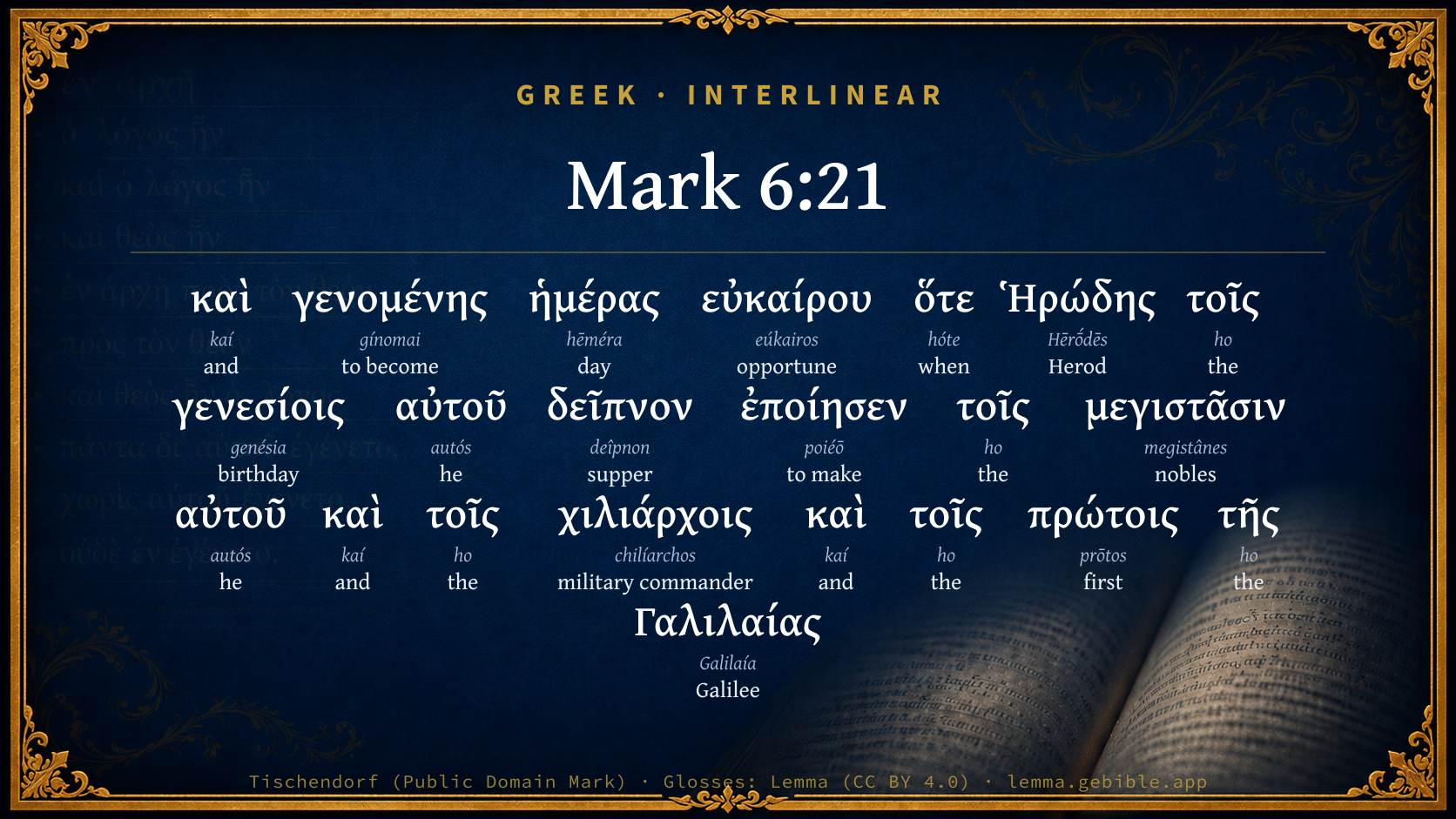
Download image
Cite this verse

Mark 6:21 (World English Bible). Public Domain. Lemma interlinear Bible study tool, https://lemma.gebible.app/v/mark/6/21.

Show BibTeX & RIS
BibTeX
RIS
English Translation
Then a convenient day came, that Herod on his birthday made a supper for his nobles, the high officers, and the chief men of Galilee.
World English Bible · Public Domain
Highlights
  • 3 first appearances in the Greek New Testament
Full analysis ↓
Download a study sheet

One document with this verse’s original text, its word-by-word gloss line, the meaning frame, cross-references with their text, attributed commentary, and full source and license credits — printable, and it pastes into notes with its structure intact.

This verse Autodidact and up

Study sheet (.html) Plain text (.txt)

A passage Seminary Student

Up to 50 verses in one chapter. A passage sheet keeps up to 6 commentary sources and 12 cross-references per verse, in the order this page ranks them, and says so on the sheet whenever that leaves anything out. Ask for a single verse and you get the Autodidact verse sheet above.

Everything on this page stays free to read, with no account — the sheet is a download of what is already on screen, not access to it.

Want to remove ads? Support Godless Engineer
Compare translations 3

The same verse in 3 English versions, stacked beneath the original-language interlinear above. Click any original word for its lexicon entry.

Each is an independent rendering of the whole verse — the interlinear is not word-aligned to these translations.

Highlighted words mark where these versions differ — a whole-verse word diff, not a word-by-word alignment.

  • World English Bible Public Domain
    Then a convenient day came, that Herod on his birthday made a supper for his nobles, the high officers, and the chief men of Galilee.
  • King James Version Public Domain
    And when a convenient day was come, that Herod on his birthday made a supper to his lords, high captains, and chief estates of Galilee;
  • unfoldingWord Literal Text CC BY-SA 4.0
    And an opportune day having come, when Herod made a dinner for his birthday for his great ones and for the chiliarchs and for the first of Galilee,

unfoldingWord Literal Text — © unfoldingWord, licensed CC BY-SA 4.0. Word-aligned USFM3 via Door43 (git.door43.org/unfoldingWord/en_ult).

Versions to compare (up to 4)

3 of 4 selected

Show all 19 translations

Every available English version of this verse, each an independent rendering of the whole verse.

  • World English Bible Public Domain
    Then a convenient day came, that Herod on his birthday made a supper for his nobles, the high officers, and the chief men of Galilee.
  • Berean Standard Bible Public Domain
    On Herod’s birthday, her opportunity arose. Herod held a banquet for his nobles and military commanders and the leading men of Galilee.
  • Majority Standard Bible Public Domain
    On Herod’s birthday, her opportunity arose. Herod held a banquet for his nobles and military commanders and the leading men of Galilee.
  • King James Version Public Domain
    And when a convenient day was come, that Herod on his birthday made a supper to his lords, high captains, and chief estates of Galilee;
  • American Standard Version (1901) Public Domain
    And when a convenient day was come, that Herod on his birthday made a supper to his lords, and the high captains, and the chief men of Galilee;
  • Revised Version (1885) Public Domain
    And when a convenient day was come, that Herod on his birthday made a supper to his lords, and the high captains, and the chief men of Galilee;
  • Geneva Bible (1599) Public Domain
    But the time being conuenient, when Herod on his birth day made a banket to his princes and captaines, and chiefe estates of Galile:
  • Douay-Rheims (1899) Public Domain
    And when a convenient day was come, Herod made a supper for his birthday, for the princes, and tribunes, and chief men of Galilee.
  • Young's Literal Translation Public Domain
    And a seasonable day having come, when Herod on his birthday was making a supper to his great men, and to the chiefs of thousands, and to the first men of Galilee,
  • Literal Standard Version CC BY-SA 4.0
    And a seasonable day having come when Herod on his birthday was making a banquet to his great men, and to the chiefs of thousands, and to the first men of Galilee,
  • Unlocked Literal Bible CC BY-SA 4.0
    Then the opportunity came when Herod had his birthday and he made a dinner for his officials, and his commanders, and leaders of Galilee.
  • unfoldingWord Literal Text CC BY-SA 4.0
    And an opportune day having come, when Herod made a dinner for his birthday for his great ones and for the chiliarchs and for the first of Galilee,
  • Darby Bible Public Domain
    And a holiday being come, when Herod, on his birthday, made a supper to his grandees, and to the chiliarchs, and the chief [men] of Galilee;
  • World Messianic Bible Public Domain
    Then a convenient day came when Herod on his birthday made a supper for his nobles, the high officers, and the chief men of Galilee.
  • Webster's Bible Public Domain
    And when a convenient day had come, that Herod on his birth-day made a supper to his lords, high captains, and chief men of Galilee;
  • Free Bible Version CC BY-SA 4.0
    Herodias had her opportunity on Herod's birthday. He gave a banquet for the nobles, military officers, and important leaders of Galilee.
  • Bible in Basic English Public Domain
    And the chance came when Herod on his birthday gave a feast to his lords, and the high captains, and the chief men of Galilee;
  • Text-Critical English NT CC BY 4.0
    But an opportune day came. On his birthday Herod prepared a banquet for his nobles, military commanders, and the prominent men of Galilee.
  • Tyndale New Testament (1534) Public Domain
    But when a conuenient daye was come: Herode on his birth daye made a supper to the lordes captayns and chefe estates of Galile.

Literal Standard Version (2020), Covenant Press — licensed CC BY-SA 4.0. Text via the HelloAO Bible API (eBible.org). Unlocked Literal Bible (unfoldingWord) — licensed CC BY-SA 4.0. Text via the HelloAO Bible API (eBible.org). unfoldingWord Literal Text — © unfoldingWord, licensed CC BY-SA 4.0. Word-aligned USFM3 via Door43 (git.door43.org/unfoldingWord/en_ult). Free Bible Version, Dr. Jonathan Gallagher — licensed CC BY-SA 4.0. Text via the HelloAO Bible API (eBible.org).

Word by word

More ways to search: Search by grammar → Find every occurrence → Compare this word →

Practice this passage: Drill this verse → Learn its vocabulary →

εὐκαίρου
eúkairos
G2121
“opportune”
Adjective, Genitive, Singular, Feminine
Part of Speech
Adjective
Case
Genitive
Number
Singular
Gender
Feminine
Full Thayer's Definition

Origin: from G2095 and G2540

TDNT: 10:42,4

1. seasonable, timely, opportune
  1. καὶ kaí G2532 “and” Conjunction
  2. γενομένης gínomai G1096 “to become” Verb, Aorist, Middle deponent, Participle, Genitive, Singular, Feminine
  3. ἡμέρας hēméra G2250 “day” Noun, Genitive, Singular, Feminine
  4. ὅτε hóte G3753 “when” Adverb
  5. Ἡρώδης Hērṓdēs G2264 “Herod” Noun, Nominative, Singular, Masculine
  6. τοῖς ho G3588 “the” Article, Dative, Plural, Neuter
  7. γενεσίοις genésia G1077 “birthday” Noun, Dative, Plural, Neuter
  8. αὐτοῦ autós G846 “he” Personal pronoun, Genitive, Singular, Masculine
  9. δεῖπνον deîpnon G1173 “supper” Noun, Accusative, Singular, Neuter
  10. ἐποίησεν poiéō G4160 “to make” Verb, Aorist, Active, Indicative, 3rd person, Singular
  11. τοῖς ho G3588 “the” Article, Dative, Plural, Masculine
  12. μεγιστᾶσιν megistânes G3175 “nobles” Noun, Dative, Plural, Masculine, Superlative
  13. αὐτοῦ autós G846 “he” Personal pronoun, Genitive, Singular, Masculine
  14. καὶ kaí G2532 “and” Conjunction
  15. τοῖς ho G3588 “the” Article, Dative, Plural, Masculine
  16. χιλιάρχοις chilíarchos G5506 “military commander” Noun, Dative, Plural, Masculine
  17. καὶ kaí G2532 “and” Conjunction
  18. τοῖς ho G3588 “the” Article, Dative, Plural, Masculine
  19. πρώτοις prōtos G4413 “first” Adjective, Dative, Plural, Masculine, Superlative
  20. τῆς ho G3588 “the” Article, Genitive, Singular, Feminine
  21. Γαλιλαίας Galilaía G1056 “Galilee” Noun, Genitive, Singular, Feminine

About this verse

These counts appear in no published source. They are computed here, from the morphology-tagged text and Lemma’s own curated glosses. What Lemma adds →

22
words
15
distinct lemmas
Gospels
section

Notable vocabulary

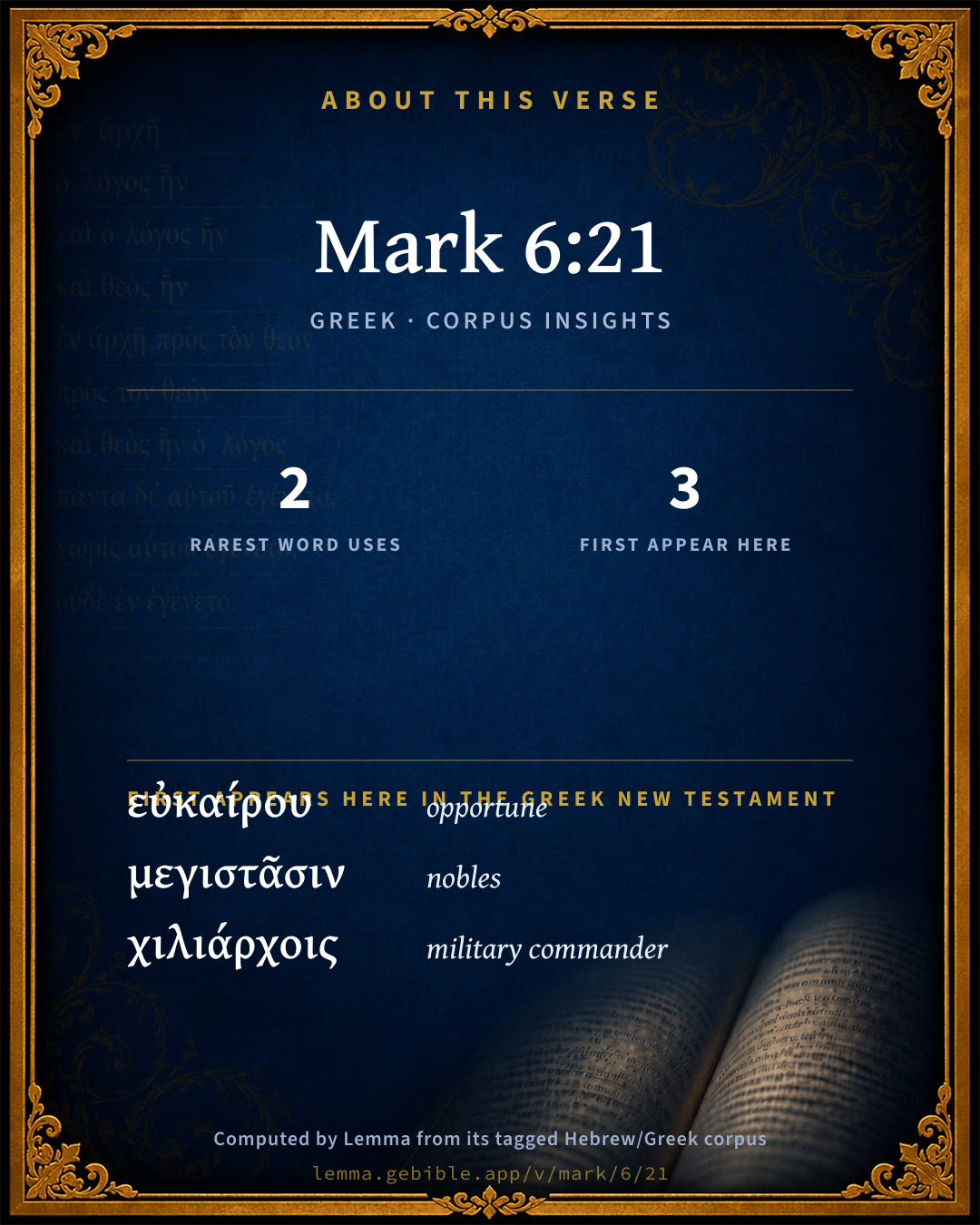
The rarest word here is εὐκαίρου opportune G2121 — appearing just 2 times in the whole Greek New Testament.

First appearance in Scripture

These words make their first canonical appearance in the Greek New Testament here:

  • εὐκαίρου opportune G2121
  • μεγιστᾶσιν nobles G3175
  • χιλιάρχοις military commander G5506

Shared distinctive vocabulary

εὐκαίρου opportune G2121 occurs in 2 verses of the Greek New Testament. Also found in:
Repetition

Words recur within this verse:

  • τοῖς the G3588 ×5
  • καὶ and G2532 ×3
  • αὐτοῦ he G846 ×2

Cross-references

14

Topical passages linked to Mark 6:21 in the Treasury of Scripture Knowledge — connected by theme and wording, ordered by reader-vote popularity; previews shown in the World English Bible.

  • Esther 2:18 Then the king made a great feast to all his princes and his servants, even Esther's feast; and he made a release to the provinces, and gave gifts, according to the bounty of the king.
  • Genesis 40:20 It happened the third day, which was Pharaoh's birthday, that he made a feast for all his servants, and he lifted up the head of the chief cupbearer and the head of the chief baker among his servants.
  • Genesis 27:41 Esau hated Jacob because of the blessing with which his father blessed him. Esau said in his heart, "The days of mourning for my father are at hand. Then I will kill my brother Jacob."
  • 2 Samuel 13:23–29 It happened after two full years, that Absalom had sheep-shearers in Baal Hazor, which is beside Ephraim: and Absalom invited all the king's sons.
  • Esther 1:3–7 in the third year of his reign, he made a feast to all his princes and his servants; the power of Persia and Media, the nobles and princes of the provinces, being before him;
  • Esther 3:7 In the first month, which is the month Nisan, in the twelfth year of king Ahasuerus, they cast Pur, that is, the lot, before Haman from day to day, and from month to month, [to] the twelfth [month], which is the month Adar.
  • Psalms 37:12–13 The wicked plots against the just, And gnashes at him with his teeth.
  • Proverbs 31:4–5 It is not for kings, Lemuel; It is not for kings to drink wine; Nor for princes to say, 'Where is strong drink?'
  • Daniel 5:1–4 Belshazzar the king made a great feast to a thousand of his lords, and drank wine before the thousand.
  • Hosea 7:5 On the day of our king, the princes made themselves sick with the heat of wine. He joined his hand with mockers.
  • Luke 3:1 Now in the fifteenth year of the reign of Tiberius Caesar, Pontius Pilate being governor of Judea, and Herod being tetrarch of Galilee, and his brother Philip tetrarch of the region of Ituraea and Trachonitis, and Lysanias tetrarch of Abilene,
  • Acts 12:2–4 He killed James, the brother of John, with the sword.
  • 1 Peter 4:3 For we have spent enough of our past time doing the desire of the Gentiles, and having walked in lewdness, lusts, drunken binges, orgies, carousings, and abominable idolatries.
  • Revelation 11:10 Those who dwell on the earth rejoice over them, and they will be glad. They will give gifts to one another, because these two prophets tormented those who dwell on the earth.

Cross-references courtesy of OpenBible.info (CC BY 4.0).

Commentary

Notes on Mark 6:21 from classic Christian and Jewish commentators (each source and its license shown beneath its notes). The classic Christian expositions comment on the surrounding passage and are grouped to its opening verse, so a note may address several verses; the Jewish commentaries on the Tanakh (Rashi and others) are per-verse, so they appear only where the commentator wrote on this verse.

Lemma curates 59 commentaries, every one of them public domain or Creative Commons licensed, each selected and text-cleaned for this edition rather than reprinted as found. About our sources →

Whedon's Commentary on the Bible

Daniel D. Whedon

§ 60. — DEATH OF JOHN THE BAPTIST, Mar_6:21-29.

(See notes on Mat_14:6-12.)

Daniel D. Whedon (gen. ed.), Commentary on the Old and New Testaments (1874–1909) — public domain. Text from a community e-Sword module.

Bengel's Gnomon

Johann Albrecht Bengel

Mar 6:21. Γενεσίοις) Γενέσια, This is the genus: γενέθλια, the species. The latter denotes properly a birth-day feast [or celebration]; the former, any anniversary feast-day whatever; for instance, the anniversary of entering on a kingdom.—μεγιστᾶσιν, the great men) of the palace and of the court.—χιλιάρχοις, chief captains) of his soldiery.—τοῖς πρώτοις, the nobles) in provincial posts.

Bengel's Gnomon of the New Testament — English translation (T&T Clark, Edinburgh, 1860) — public domain. Text from a community e-Sword module.

Expositor's Greek Testament

ed. W. Robertson Nicoll

Mar 6:21-29 . The fatal day .

Mar 6:21 . εὐκαίρου , a day convenient for the long cherished purpose of Herodias; so regarded by her as well as by the evangelist. She had a chance then, if ever, and might hope that by wine, love, and the assistance of obsequious guests, her irresolute husband would at last be brought to the point (Grotius). The word occurs again in the N. T., Heb 4:16 , εὔκαιρον βοήθειαν = seasonable succour. μεγιστᾶσιν ( μεγιστᾶνες from μέγιστος ), magnates . A word belonging to Macedonian Greek, condemned by Phryn. (p. 196: μέγα δυναμένοι the right expression), frequent in Sept [52] With these magnates, the civil authorities, are named the chief military men ( χιλιάρχοις ) and the socially important persons of Galilee ( πρώτοις ) an imposing gathering on Herod’s birthday.

[52]Septuagint.

The Expositor's Greek Testament, edited by W. Robertson Nicoll (1897–1910) — public domain. Text from a community e-Sword module.

Adam Clarke's Commentary

Verse 21. Lords] μεγιστασιν, probably governors of particular districts.

High captains] χιλιαρχοις; literally, chiefs or captains over a thousand men, military chiefs.

Chief estates] πρωτοις; probably such as might be called nobles by title only, having no office civil or military; probably magistrates. See KYPKE an the place.

Adam Clarke's Commentary on the Bible (1810–1826) — public domain. Text from a community e-Sword/MySword module.

Ellicott's Commentary for English Readers

(21-29) And when a convenient day was come.—See Notes on Mat_14:6-12.

His lords, high captains, and chief estates.—St. Mark alone gives the account of the guests. The three words mean respectively—(1) the magnates, or officials of the court; (2) the chiliarchs, or chief captains (literally, captain of a thousand—the same word as in Act_21:31; Act_26:26) in the Roman legion; (3) the chief men (“estates” to modern ears is too formal a word), probably the large landowners of the province.

A Bible Commentary for English Readers, edited by Charles John Ellicott (1878–1897) — public domain. Text from a community e-Sword module.

The Cambridge Bible for Schools and Colleges

gen. ed. J. J. S. Perowne

21. a convenient day] i. e. a suitable day for her fell designs.

on his birthday] In imitation of the Roman emperors, the Herodian princes kept their birthdays with feasting and revelry and magnificent banquets. Wieseler, however, considers the word denotes a feast celebrating Herod’s accession, but this is more than doubtful. Birthday festivals were one sample of foreign habits introduced into Palestine and spread there by the Herodians.

made a supper] probably at Machærus or some neighbouring palace.

lords, high captains] or “chiliarchs.” The words here used denote servants of the state, civil and military.

chief estates] This term denotes men of high rank, and includes the Galilæan nobles generally. Comp. Fuller Ch. Hist. V. iii. 28, “God never gave grace nor knowledge of Holy Scripture to any great estate or rich man.” State is also employed in the same way. Thus Adams says (Nichol’s Puritan Divines), “Sin deals with her guests as that bloody prince that, having invited many great states to a solemn feast.”

The Cambridge Bible for Schools and Colleges (gen. ed. J. J. S. Perowne; Cambridge University Press, 1878–1918) — public domain. Text from a community e-Sword module.

John Gill's Exposition

And when a convenient day was come,.... For Herodias; who had long sought and watched for an opportunity of avenging herself on John, and such a time Herod's birthday proved; though some think, that this phrase is the same with , "a good day"; often used by the Jews for a festival, any one of their feast days; there is a tract in their Misna which bears this name; and that such a day was this. But not one of the festivals of the Jews was this, as either their passover, or pentecost, or feast of tabernacles, which Herod had no regard to; but his own birthday, which he kept as a festival, in eating, and drinking, and dancing; and so was a very opportune and seasonable time for Herodias to take the advantage of Herod when in a good humour, amidst his company, and in his cups, to solicit that, which she had often done without success: and so it was now,

that Herod on his birthday made a supper to his lords, high captains, and chief estates of Galilee: this birthday, was either the day of his natural, or civil birth; the day when he was born into the world, or of his accession to the throne; See Gill on Mat 14:6, when he made a grand entertainment in the evening for his nobles, and the officers of the army, the captains of thousands, and the principal men, those of the first rank and quality in Galilee, of which he was Tetrarch.

John Gill's Exposition of the Whole Bible (1746–1763) — public domain (CC PDM 1.0). Text via the HelloAO Bible API.

Trapp's Complete Commentary

John Trapp

21 And when a convenient day was come, that Herod on his birthday made a supper to his lords, high captains, and chief estates of Galilee;

Ver. 21. Made a supper] The ancients took a light dinner usually, and therefore called it prandium quasi perendium: at supper they feasted more freely, and therefore called it Δειπνον παρα το δειν παυειν, because then their day’s work was done.

John Trapp, A Commentary or Exposition upon All the Books of the Old and New Testament (1647–1656) — public domain. Text from a community e-Sword module.

The Pulpit Commentary

Vers. 21-28. The murderers of John the Baptist.

The name of Herod Antipas is associated with that of our Lord on three occasions. The first is mentioned in this chapter. On the second he sends a threatening message through the Pharisees; (Luk_13:31) and on the third, with his men of war, he mocked the world"s Redeemer. (Luk_23:8-12) These together afford an example of the progressive nature of sin. Herod passed from superstitious fear to anger, and from anger to mockery and scorn. He "walked in the counsel of the ungodly," and "stood in the way of sinners," and at last "sat in the seat of the scornful" (Psalm 1). It appears to have been the extension of our Lord"s influence, doubtless through the work of his newly appointed apostles, which aroused the interest and fear of Herod. The miracles which were wrought vividly brought before his guilty conscience the terrible crime which he had recently committed, in the murder of John the Baptist, of which Mark gives us the most graphic and detailed narrative we have. The feast described could hardly have taken place in Tiberias, but probably in some other palace close by the castle of Machaerus, in which John was a prisoner. In the scene which is here portrayed we see three types of character, represented by the three chief actors in this tragedy, which are worthy of our study.

I CONSIDER HEROD AS AN EXAMPLE OF MORAL WEAKNESS, He was the son of Herod the Great, by Malthace, a Samaritan woman, and inherited his father"s vices without his vigor. Profligate and luxurious, he had no vestige of moral greatness. His language was that of a braggart, as we can see in his promise that he would give "the half of his kingdom;" as if he were a mighty Ahasuerus, whereas he was but the subordinate ruler of the small districts of Galilee and Peraea. In the scene before us we notice in him the following faults:

1. He was disloyal to his convictions. Impressed by John"s words, he did not forsake his sins. like Pilate, he acknowledged the innocence and dignity of his victim, yet he had not the moral courage to set him free. To know the right, and yet to fail in following it, is the germ of grosser sins.

2. He was easily influenced by circumstances. A convenient day" came at last for Herodias"s purpose, a time when the weak king would be inflamed by wine and lust. The tempter ever waits and watches for such occasions to effect the moral ruin of those who do not resolutely resist him. The opinion of the civil and military officials around him also prevented Herod"s refusal of Salome"s request. like all moral cowards, he had more fear of the scorn of men than of the wrath of God.

3. He was led gradually to the worst crime, There had been a time when he would have shrunk from the murder of John; but he had been gradually prepared for it. His sinful connection with Herodias blunted any sensibility to good, as sensuality always does. His unwillingness to put her away led him to silence the bold preacher who denounced his crime. And when licentiousness had led to persecution, it was not long before persecution led to murder.

4. He was moulded by the stronger will of companion in guilt. The weakness of a vacillating man is easily overcome by one who is resolutely bad. Give examples from Scripture, and illustrations from daily life, of the perils besetting those who have no moral firmness and strength.

II CONSIDER SALOME AS AN EXAMPLE OF ABUSED GIFTS. Physical beauty is as much God"s gift as wealth, or position, or mental talent. Too often it has been used for the sake of display, for the gratification of vanity, or for the excitement of evil passions. Many have hereby been led into moral ruin. Salome degraded herself unspeakably by coming forward in this shameless dance. Forgetting all decency and decorum, she danced" in the midst," that is, in a circle of half-intoxicated admirers.

1. Her regal dignity was forgotten. With amazement the historian records that it was the "daughter of Herodias herself" (not "of the said Herodias") a princess of royal blood. Even social position and family repute may be fairly regarded as defences against sin.

2. Her maiden modesty was sacrificed. In modern social life Christians should set themselves against all that seems to have the slightest tendency to this.

3. Her feminine tenderness was repudiated. The twenty-fifth verse indicates that she eagerly shared her mother"s hatred against John. But her womanly pity should have pleaded for the life of a helpless prisoner, and this God-given characteristic of her sex being trampled underfoot, made her crime the more revolting when she accepted the bleeding head of the murdered prophet.

III CONSIDER HERODIAS AS AN EXAMPLE OF UNSCRUPULOUS WICKEDNESS. She was to Herod what Jezebel was to Ahab, or what lady Macbeth was to her husband.

1. Her vices were great. Abandoned licentiousness and malignant cruelty.

2. Her influence was disastrous over both Herod and her own daughter Salome. She ruined herself and others too. For all such there will come a terrible awakening and retribution. "Who hath hardened himself against God, and prospered? A.R.

The Pulpit Commentary (1880–1919), ed. H.D.M. Spence-Jones & Joseph S. Exell — public domain. Text from a community e-Sword module.

John Wesley's Explanatory Notes

A convenient day - Convenient for her purpose. His lords, captains, and principal men of Galilee - The great men of the court, the army, and the province.

John Wesley, Explanatory Notes Upon the Whole Bible (1754–1765) — public domain. Text via the GEBible commentary corpus.

Kretzmann's Popular Commentary

Paul E. Kretzmann

The birthday festival:

v. 21. And when a convenient day was come, that Herod on his birthday made a supper to his lords, high captains, and chief estates of Galilee;

v. 22. and when the daughter of the said Herodias came in and danced, and pleased Herod and them that sat with him, the king said unto the damsel, Ask of me whatsoever thou wilt, and I will give it thee.

v. 23. And he sware unto her, Whatsoever thou shalt ask of me, I will give it thee, unto the half of my kingdom.

v. 24. And she went forth and said unto her mother, What shall I ask? And she said, The head of John the Baptist.

v. 25. And she came in straightway with haste unto the king and asked, saying, I will that thou give me by and by in a charger the head of John the Baptist. Convenient this birthday festival was, coming just at a good, at the right time to agree with the vengeful plans of Herodias, for she still cherished her grudge against John the Baptist.

On his birth. day Herod must needs celebrate in style, in a manner befitting one who expected soon to bear the title of king, by permission of the Emperor and the Roman Senate. The mighty ones and the rulers of thousands and the first families of Galilee were invited, that is, the state, civil, and military officials, and the socially important persons of Galilee: an imposing gathering for such an important event. The joy of the festival banquet was at its height, the guests having undoubtedly freely imbibed and being in the condition of semi-intoxication when reason and sense have alike fled, though articulate speech remains. There had probably also been the usual forms of dancing after the Oriental fashion for the amusement of the guests, when a number not on the program was introduced by the wily Herodias. She had trained her own daughter in the voluptuous dances of the dancing girls, and the girl came into the banquet-hall and danced with reckless abandon and shamelessness. The dance pleased Herod and those that were reclining about the tables. They had just about reached the condition when such exhibitions were inclined to appeal to them with special force. Herod immediately made an extravagant promise to the girl, encouraging her to name the reward that was to be hers for this dance. And when she, either from exhaustion after the strenuous exercise or in natural hesitation over the offer, was still standing undecided, he added an oath, swearing that she should have her desire, though it aspire to half of his kingdom: a true example of maudlin, amatory generosity, as one commentator calls it. It may be that her mother had instructed her even beforehand what she should ask for, as the account of Matthew implies, though not expressly says, and now she needed a further urging. At any rate, she hurries to her mother, who promptly impresses upon her the need to ask for, and insist upon, only one thing. Whether there was another determining factor or not, Salome, the dancer, was now ready to do her mother’s bidding. Without delay and with a quick step, as though the business in hand was the most interesting and joyous in the world, she returns to the banquet-hall. Her words properly indicate the condition of her heart: I want that thou without delay givest me on a platter the head of John the Baptist. Gruesome words from the lips of a young girl, "request proffered with a cool, pert impudence almost outdoing the mother."

Paul E. Kretzmann, Popular Commentary of the Bible (1921–1924) — public domain. Text from a community e-Sword module.

The People's New Testament

B. W. Johnson

21. When a convenient day was come. For the execution of the plans of the vengeful woman.

B. W. Johnson's The People's New Testament with Notes (1889–1891) — public domain. Electronic text from the Christian Classics Ethereal Library (CCEL) ThML edition.

unfoldingWord translationNotes

Door43 World Missions Community

Connecting Statement:

The author continues to give background information about Herod and the beheading of John the Baptist. (See: Background Information)

he made a dinner for his officials ... of Galilee

Here the word "he" refers to Herod and is a metonym for his servant whom he would have commanded to prepare a meal. AT: "he had a dinner made for his officials ... of Galilee" or "he invited his officials ... of Galilee to eat and celebrate with him"

a dinner

a formal meal or banquet

Herodias herself

The word "herself" is a reflexive pronoun used to emphasize that it was significant that it was Herodias' own daughter who danced at the dinner. (See: Reflexive Pronouns)

came in

"came into the room"

translationWords

Herod Antipas

commander

Galilee

Herodias

king

unfoldingWord translationNotes — © Distant Shores Media and the Door43 World Missions Community, licensed CC BY-SA 4.0. Source: git.door43.org/Door43/en_tn.

Cambridge Greek Testament for Schools and Colleges

21. γενομένης ἡμέρας εὐκαίρου. Mk has the deadly enmity of Herodias in mind. She was always on the watch, and at last found an opportune day. Cf. Heb 4:16.

τοῖς γενεσίοις αὐτοῦ. On his birthday. This meaning is firmly established, although in Attic Grk we should have τὰ γενέθλια or ἡ γενέθλιος ἡμέρα (2Ma 6:7). Hdt. iv. 26 shows that τὰ γενέσια meant a festival in commemoration of a dead person. But in late Grk the distinction was not strictly observed. Joseph. Ant. XII. iv. 7 we have ἑορτάζοντες τὴν γενέσιον ἡμέραν τοῦ παιδίον, at the birth of a son to Ptolemy Epiphanes. On the other hand, Plutarch uses γενέθλια of commemoration of the dead. In papyri, γενέσια seems always to mean “birth-day fête.” Christianity tended to obliterate the distinction between the two words by regarding the death of the faithful as their birthday into eternal life (Mart. Pol. 18; Tert. De Coron. 3, Scorp. 15). Seneca (Ep. cii. 24) has the same thought; Dies iste, quem tanquam extremum reformidas, aeterni natalis est. On the proposal to make τὰ γενέσια the anniversary of Herod’s accession see Schürer, Jewish People I. ii. p. 26 note. Origen and Jerome condemn the keeping of birthdays; no good man in Scripture keeps them, but only Pharaoh and Herod.

δεῖπνον ἐποίησεν. At Machaerus; there is no ground for thinking that Mk places the banquet at Tiberias; see Schürer, loc. cit.

τοῖς μεγιστᾶσιν κ.τ.λ. The three classes are civil magistrates, military officers, and leading men. The chiliarchs are his own officers, not Roman tribunes. Elsewhere we have πρῶτοι τοῦ λαοῦ (Luk 19:47), τῆς πόλεως, τῶν Ἰουδαίων, τῆς νήσου (Act 13:50; Act 25:2; Act 28:7; Act 28:17). In the later books of O.T. μεγιστᾶνες is freq., and Vulg. varies greatly in translation; principes, magnates, fortes, optimates, magnifici, etc.

Cambridge Greek Testament for Schools and Colleges (Cambridge University Press, 1896; 21 vols, various authors incl. Carr, Maclear, Plummer, Farrar, Lumby, Moule, M. R. James, Simcox) — public domain. Text from a community e-Sword module.

Alford’s Greek Testament

Henry Alford

21.] εὐκαίρ., not, a festal day, as Hammond and others interpret it, for this use of εὔκαιρος hardly seems to be justified—but, a convenient day (see ver. 31 and Act 24:25,—and cf. Soph. Œd. Col. 32) for the purposes of Herodias: which shews that the dance, &c. had been all previously contrived by her.

μεγιστᾶνες, a Macedonian word, which came into use at the Alexandrine conquest. See Lobeck on Phrynichus, p. 197. He adduces the nom. form μεγιστᾶνος from Anna Comnena, xi. 324 c.

Henry Alford, The Greek Testament (1849–1861) — public domain. Text from a community e-Sword module.

International Critical Commentary

21. ἡμέρας εὐκαίρου—an opportune day, viz. for Herodias’ purposes. τοῖς γενεσίοις—on his birthday feast. This word is used in Greek for a service in commemoration of a dead friend. γενέθλια is the word for a birthday celebration.1 μεγιστᾶσιν—grandees. A later Greek word. χιλιάρχοις—chiliarchs. If we render the word literally, it means commander of a thousand, and its equivalent in our military phraseology is colonel. τοῖς πρώτοις τ. Γαλιλαίας—the first men of Galilee. His retainers, and especially his military officers, would be foreigners. These would be the men of the province.

ἐποίησεν, instead of ἐποίει, after δεῖπνον, Tisch. Treg. WH. RV. א BCL Δ 13, 28, 69, 124, Latt.

International Critical Commentary — older volumes (1896–1929), various authors — public domain. Text from a community e-Sword module.

Vincent's Word Studies in the New Testament

Marvin R. Vincent

Convenient [ευκαιρον] . Mark only. Convenient for Herodias' purpose. "Opportune for the insidious woman, who hoped, through wine, lust, and the concurrence of sycophants, to be able easily to overcome the wavering mind of her husband" (Grotius in Meyer).

Birthday. See on Mt 14:6. The notice of the banquet and of the rank of the guests is peculiar to Mark.

Lords (megistasin). Only here, and Rev 6:15; Rev 18:3. A late word, from megav, great.

High captains [χιλιαρχοις] . Lit., commanders of a thousand men. Answering to a Roman military tribune. Both civil and military dignitaries were present, with other distinguished men of the district (chief men).

Marvin R. Vincent, Word Studies in the New Testament (1887–1900) — public domain. Text from a community e-Sword/MySword module.

Lesson kit

Teaching starters — assembled from the data on this page, not authored interpretation. Every prompt links to the verse data it draws on. Edit before teaching.

Mark, in the Gospels, opens this verse with 22 words (15 distinct Greek lemmas). Its most distinctive word is eúkairos (“opportune”). A historical commentator’s framing appears above. Read the whole chapter for the surrounding context.

Discussion questions

  1. How does “opportune” (eúkairos) shape what this verse is saying?
  2. 3 words here appear for the first time in Scripture. What is being introduced at this debut?
  3. Hebrews 4:16 shares the word «opportune» with this verse. How do the two illuminate each other?
  4. “the” occurs 5× in this one verse. What is the effect of the repetition?
  5. These translations render this verse differently. What is at stake in choosing one wording over another?
  6. Reading how Whedon's Commentary on the Bible and Bengel's Gnomon read this verse, where do the two commentators agree and where do they part?

Things to notice

  • 3 words make their first canonical appearance in Scripture here.
  • These translations choose different wording for 20 words in this verse.
  • “the” occurs 5× in this single verse.
  • 15 distinct Greek lemmas span 22 words in this verse.

Reading settings

Reading text

Shown beneath each verse's original-language words.

Old Testament
Old Testament edition

Read the OT as the Masoretic Hebrew (MT) or the Greek Septuagint (LXX).

English shown for the Greek Septuagint (in the Hebrew ↔ Greek comparison).

Comparing translations? Open the Compare panel on any verse page to stack up to four side by side.