
Genesis 9:24

Hebrew (Westminster Leningrad Codex) Genesis 9:24 appears in the Hebrew Old Testament. The text above is from the Westminster Leningrad Codex. Each word links to its Strong’s number, a concise gloss, and parsing drawn from the Open Scriptures Hebrew Bible morphology. Click any word for its full Brown-Driver-Briggs (BDB) entry.
Download image
Cite this verse

Genesis 9:24 (World English Bible). Public Domain. Lemma interlinear Bible study tool, https://lemma.gebible.app/v/genesis/9/24.

Show BibTeX & RIS
BibTeX
RIS
English Translation
Noah awoke from his wine, and knew what his youngest son had done to him.
World English Bible · Public Domain
Highlights
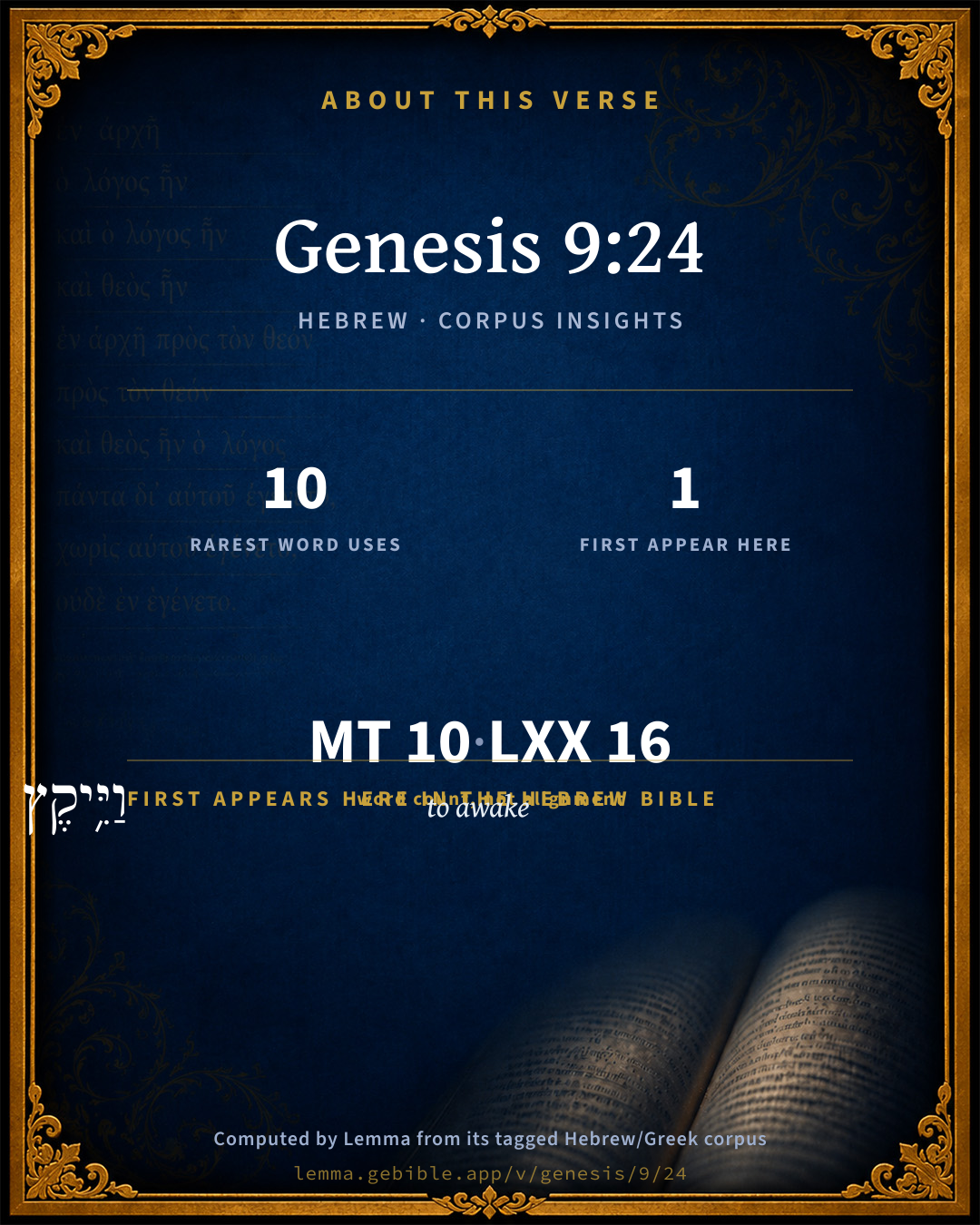
  • 1 first appearance in the Hebrew Bible
Full analysis ↓
Download a study sheet

One document with this verse’s original text, its word-by-word gloss line, the meaning frame, cross-references with their text, attributed commentary, and full source and license credits — printable, and it pastes into notes with its structure intact.

This verse Autodidact and up

Study sheet (.html) Plain text (.txt)

A passage Seminary Student

Up to 50 verses in one chapter. A passage sheet keeps up to 6 commentary sources and 12 cross-references per verse, in the order this page ranks them, and says so on the sheet whenever that leaves anything out. Ask for a single verse and you get the Autodidact verse sheet above.

Everything on this page stays free to read, with no account — the sheet is a download of what is already on screen, not access to it.

Want to remove ads? Support Godless Engineer
Compare translations 3

The same verse in 3 English versions, stacked beneath the original-language interlinear above. Click any original word for its lexicon entry.

Each is an independent rendering of the whole verse — the interlinear is not word-aligned to these translations.

Highlighted words mark where these versions differ — a whole-verse word diff, not a word-by-word alignment.

  • World English Bible Public Domain
    Noah awoke from his wine, and knew what his youngest son had done to him.
  • King James Version Public Domain
    And Noah awoke from his wine, and knew what his younger son had done unto him.
  • unfoldingWord Literal Text CC BY-SA 4.0
    Then Noah woke up from his wine, and he learned what his youngest son had done to him,

unfoldingWord Literal Text — © unfoldingWord, licensed CC BY-SA 4.0. Word-aligned USFM3 via Door43 (git.door43.org/unfoldingWord/en_ult).

Versions to compare (up to 4)

3 of 4 selected

Show all 18 translations

Every available English version of this verse, each an independent rendering of the whole verse.

  • World English Bible Public Domain
    Noah awoke from his wine, and knew what his youngest son had done to him.
  • Berean Standard Bible Public Domain
    When Noah awoke from his drunkenness and learned what his youngest son had done to him,
  • Majority Standard Bible Public Domain
    When Noah awoke from his drunkenness and learned what his youngest son had done to him,
  • King James Version Public Domain
    And Noah awoke from his wine, and knew what his younger son had done unto him.
  • American Standard Version (1901) Public Domain
    And Noah awoke from his wine, and knew what his youngest son had done unto him.
  • Revised Version (1885) Public Domain
    And Noah awoke from his wine, and knew what his youngest son had done unto him.
  • Geneva Bible (1599) Public Domain
    Then Noah awoke from his wine, and knew what his yonger sonne had done vnto him,
  • Douay-Rheims (1899) Public Domain
    And Noe awaking from the wine, when he had learned what his younger son had done to him,
  • Young's Literal Translation Public Domain
    And Noah awaketh from his wine, and knoweth that which his young son hath done to him,
  • Literal Standard Version CC BY-SA 4.0
    And Noah awakens from his wine, and knows that which his young son has done to him,
  • Unlocked Literal Bible CC BY-SA 4.0
    When Noah awoke from his wine, he learned what his youngest son had done to him.
  • unfoldingWord Literal Text CC BY-SA 4.0
    Then Noah woke up from his wine, and he learned what his youngest son had done to him,
  • Darby Bible Public Domain
    And Noah awoke from his wine, and learned what his youngest son had done to him.
  • World Messianic Bible Public Domain
    Noah awoke from his wine, and knew what his youngest son had done to him.
  • Webster's Bible Public Domain
    And Noah awoke from his wine, and knew what his younger son had done to him.
  • Free Bible Version CC BY-SA 4.0
    When Noah woke up from his drunken sleep, he discovered what his youngest son had done,
  • Bible in Basic English Public Domain
    And, awaking from his wine, Noah saw what his youngest son had done to him, and he said,
  • JPS Tanakh (1917) Public Domain
    And Noah awoke from his wine, and knew what his youngest son had done unto him.

Literal Standard Version (2020), Covenant Press — licensed CC BY-SA 4.0. Text via the HelloAO Bible API (eBible.org). Unlocked Literal Bible (unfoldingWord) — licensed CC BY-SA 4.0. Text via the HelloAO Bible API (eBible.org). unfoldingWord Literal Text — © unfoldingWord, licensed CC BY-SA 4.0. Word-aligned USFM3 via Door43 (git.door43.org/unfoldingWord/en_ult). Free Bible Version, Dr. Jonathan Gallagher — licensed CC BY-SA 4.0. Text via the HelloAO Bible API (eBible.org).

Word by word

More ways to search: Search by grammar → Find every occurrence → Compare this word →

Practice this passage: Drill this verse → Learn its vocabulary →

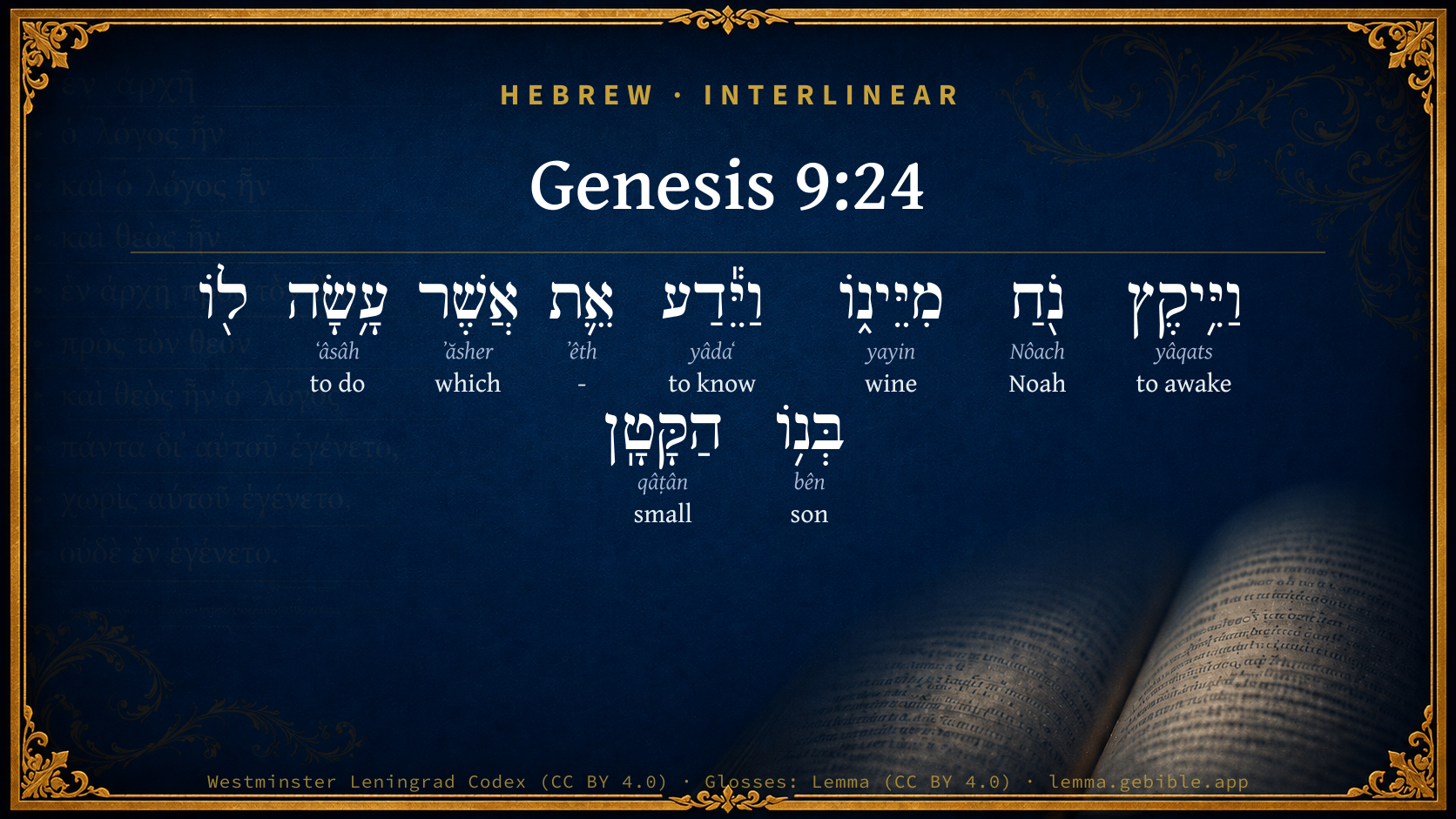
וַיִּ֥יקֶץ
yâqats
H3364
“and · to awake”
Conjunction + Verb, Qal, Sequential Imperfect, 3rd Person, Masculine, Singular
Part of Speech
Conjunction + Verb
Stem
Qal
Form
Sequential Imperfect
Person
3rd Person
Gender
Masculine
Number
Singular
Full BDB Definition

Origin: a primitive root

TWOT: 904

(Qal) to awake, awaken, become active
  1. נֹ֖חַ Nôach H5146 “Noah” Noun, Proper
  2. מִיֵּינ֑וֹ yayin H3196 “from · wine · his” Preposition + Noun, Common, Masculine, Singular, Construct + Suffix, Personal, 3rd Person, Masculine, Singular
  3. וַיֵּ֕דַע yâdaʻ H3045 “and · to know” Conjunction + Verb, Qal, Sequential Imperfect, 3rd Person, Masculine, Singular
  4. אֵ֛ת ʼêth H853 “-” Particle, Direct Object
  5. אֲשֶׁר ʼăsher H834 “which” Particle, Relative
  6. עָ֥שָׂה ʻâsâh H6213 “to do” Verb, Qal, Perfect, 3rd Person, Masculine, Singular
  7. בְּנ֥וֹ bên H1121 “son · his” Noun, Common, Masculine, Singular, Construct + Suffix, Personal, 3rd Person, Masculine, Singular
  8. הַקָּטָֽן qâṭân H6996 “the · small” Particle, Definite Article + Adjective, Adjective, Masculine, Singular, Absolute

About this verse

These counts appear in no published source. They are computed here, from the morphology-tagged text and Lemma’s own curated glosses. What Lemma adds →

10
words
9
distinct lemmas
Pentateuch
section

Notable vocabulary

The rarest word here is וַיִּ֥יקֶץ to awake H3364 — appearing just 10 times in the whole Hebrew Bible.

First appearance in Scripture

This word makes its first canonical appearance in the Hebrew Bible here:

  • וַיִּ֥יקֶץ to awake H3364

Shared distinctive vocabulary

וַיִּ֥יקֶץ to awake H3364 occurs in 10 verses of the Hebrew Bible. Also found in:

Grammatical profile

  • 3 verbs
  • 3 nouns
  • 1 adjective
  • 1 preposition
  • 2 particles

Verb forms

  • וַיִּ֥יקֶץ Qal · Sequential Imperfect
  • וַיֵּ֕דַע Qal · Sequential Imperfect
  • עָ֥שָׂה Qal · Perfect

Hebrew & Septuagint length

In English translation the verse runs 15 words from the Hebrew and 17 from the Septuagint (LXX English) — closely comparable.

A rough comparison of the two English renderings, which tokenize alike — not a word-level alignment.

Word counts can differ between the Hebrew and the Greek without any difference in meaning — e.g. the Hebrew direct-object marker אֵת has no separate Greek word, and Greek often adds the article ὁ.

In the original languages it is 10 Hebrew tokens and 16 Greek tokens — but the two are counted differently (Hebrew bundles its prefixes and suffixes into one token; the Greek is in lemma form), so that isn’t a like-for-like length.

Hebrew and Greek witnesses Masoretic Hebrew ↔ Greek Septuagint

The same verse in the two great witnesses to the Old Testament, shown verse-for-verse.

These are two independent witnesses, not word-aligned to each other, and the Septuagint is shown in lemma (dictionary) form.

Hebrew Genesis 9:24 Masoretic · Westminster Leningrad Codex

וַיִּ֥יקֶץ נֹ֖חַ מִיֵּינ֑וֹ וַיֵּ֕דַע אֵ֛ת אֲשֶׁר עָ֥שָׂה ל֖וֹ בְּנ֥וֹ הַקָּטָֽן

Noah awoke from his wine, and knew what his youngest son had done to him.

World English Bible · Public Domain

Greek LXX Genesis 9:24 Septuagint · lemma form

ἐκνήφω δέ νωε ἀπό ὁ οἶνος καί γιγνώσκω ὅσος ποιέω αὐτός ὁ υἱός αὐτός ὁ νέος

And Noe recovered from the wine, and knew all that his younger son had done to him.

LXX2012 (modern English Septuagint) · Public Domain

On this verse, The Cambridge Bible for Schools and Colleges discusses the Septuagint’s reading. Read the note in Commentary ↓

Hebrew: Westminster Leningrad Codex (CC BY 4.0). Greek: Septuagint (public domain); English from LXX2012 (modern English Septuagint) (Public Domain). How the Septuagint differs from the Hebrew →

Targum (Aramaic paraphrase)

2

The Targum is the ancient Jewish Aramaic paraphrase of the Hebrew Scriptures — an interpretive translation, not the Hebrew text itself. Onkelos (literal) and Pseudo-Jonathan (expansive) render the Torah, and Jonathan the Prophets. Coverage is partial: where no permissively-licensed English translation exists for a verse, only the Aramaic is shown. This is verse-level text, not a word-by-word alignment to the Hebrew.

  1. Targum Onkelos Torah (Genesis–Deuteronomy)
    וְאִתְּעַר נֹחַ מֵחַמְרֵהּ וִידַע יָת דִּי עֲבַד לֵהּ בְּרֵהּ זְעֵירָא

    And Noach awoke from his wine, and knew that which his youngest son had done unto him;

    Targum Onkelos — Aramaic: “Onkelos Genesis” (public domain); “Onkelos Exodus” (public domain); “Onkelos Leviticus” (public domain); “Onkelos Numbers” (public domain); “Onkelos Deuteronomy” (public domain). English: “Sefaria Community Translation” (CC0 1.0 (public-domain dedication)); “J.W. Etheridge. The Targums of Onkelos and Jonathan Ben Uzziel on the Pentateuch. London: Longmans, Green, 1862” (public domain). Text via Sefaria.

  2. Targum Pseudo-Jonathan Torah (Genesis–Deuteronomy)
    וְאִתְעַר נחַ מִן חַמְרֵיהּ וִידַע בְּאִשְׁתָּעוֹת חֶלְמָא יַת דְעָבַד לֵיהּ חָם בְּרֵיהּ דְהוּא קָלִיל בִּזְכוּתָא דְגָרַם לֵיהּ דְלָא יוֹלִיד בַּר רְבִיעָיֵי

    And Noach awoke from his wine, and knew, by the relation of a dream, what had been done to him by Cham his son, who was inferior in worth, on the account that he had not begotten a fourth son.

    Targum Pseudo-Jonathan — Aramaic: “Targum Jonathan on Genesis” (public domain); “Targum Jonathan on Exodus” (public domain); “Targum Jonathan on Leviticus” (public domain); “Targum Jonathan on Numbers” (public domain); “Targum Jonathan on Deuteronomy” (public domain). English: “The Targum of Jonathan ben Uzziel, trans. J. W. Etheridge, London, 1862” (public domain). Text via Sefaria.

Commentary

Notes on Genesis 9:24 from classic Christian and Jewish commentators (each source and its license shown beneath its notes). The classic Christian expositions comment on the surrounding passage and are grouped to its opening verse, so a note may address several verses; the Jewish commentaries on the Tanakh (Rashi and others) are per-verse, so they appear only where the commentator wrote on this verse.

Lemma curates 59 commentaries, every one of them public domain or Creative Commons licensed, each selected and text-cleaned for this edition rather than reprinted as found. About our sources →

Trapp's Complete Commentary

John Trapp

Gen 9:24 And Noah awoke from his wine, and knew what his younger son had done unto him.

Ver. 24. And Noah awoke from his wine.] And returned no more to it. Once was enough; "the time past may well suffice, to have walked in excess of wine". {1Pe 4:3} We will buy repentance so dear no more. It is expressly noted of Judah, that "he knew Tamar again no more". {Gen 38:26} And we may be well assured, that Noah was never drunk again. Solomon’s drunkard cries, "when shall I awake? I will seek it yet again". {Pro 23:35} As swine break their bellies, so do such men their heads, with filthy quaffing; yea, "whoredom and wine, and new wine, take away the heart," saith the prophet. {Hos 4:11} They beset and infatuate, yea, rob a man of himself, and lay a beast in his room. Our drunkards say, as the vine in Jotham’s parable; Non possum relinquere vinum meum ." Take away my liquor, you take away my life." {a} How often, saith a grave divine, {b} have I seen vermin sucking the drunkard’s blood, as fast as he that of the grape and malt, yet would he not leave his hold, or lose his draught! Some are soaked with drink, and then laid out to be sunned and scorned.

And knew what his younger son had done unto him.] It is probable, that finding himself covered with a cloak, he asked his wife and children how he came covered; and that then Shem and Japhet told him all the matter; which moved him to bless them. It is our wisest way, to do what good we can to others. And though they, for present, being drunk with malice, or rash anger, know it not, yet a waking time may come, when they may see the good, and bless us for it, as David did Abigail. {1Sa 25:33} When he had slept out his drunken passion, he saw cause to bless God, to bless her, and to bless her counsel. Mr Gilpin’s plain dealing with the Bishop of Durham, how well it succeeded. See his life written by Bishop Carleton, p. 58.

{a} Malle se vitam quam vinum eripi . - August. De Temp. Serm. 131.

{b} Mr Harris’s Drunkard’s Cup.

John Trapp, A Commentary or Exposition upon All the Books of the Old and New Testament (1647–1656) — public domain. Text from a community e-Sword module.

Joseph Benson's Commentary

Gen 9:24. Noah knew — Either by the information of his sons, or by divine inspiration, what his younger son, (Hebrews his son, הקשׂן, the younger, or little one,) had done unto him. Canaan is thought by many to be chiefly intended. 1st, Because the following curse is appropriated to him; and, 2d, Because the title of younger, little son, does not seem so properly added if Ham be meant, it not being probable that he was the youngest of Noah’s sons; for when they are mentioned together, he is never named last, but always second. Be this as it may, it is very likely he partook of his father’s sin, and probably first saw the situation which his grandfather was in, and told it to his father, who then told it to his brethren.

Joseph Benson's Commentary on the Old and New Testaments (1811–1818) — public domain. Text from a community e-Sword module.

Matthew Henry's Commentary

Here, I. Noah comes to himself: He awoke from his wine. Sleep cured him, and, we may suppose, so cured him that he never relapsed into that sin afterwards. Those that sleep as Noah did should awake as he did, and not as that drunkard (Pro 23:35) who says when he awakes, I will seek it yet again.

II. The spirit of prophecy comes upon him, and, like dying Jacob, he tells his sons what shall befal them, Gen 49:1.

1. He pronounces a curse on Canaan the son of Ham (Gen 9:25), in whom Ham is himself cursed, either because this son of his was now more guilty than the rest, or because the posterity of this son was afterwards to be rooted out of their land, to make room for Israel. And Moses here records it for the animating of Israel in the wars of Canaan; though the Canaanites were a formidable people, yet they were of old an accursed people, and doomed to ruin. The particular curse is, A servant of servants (that is, the meanest and most despicable servant) shall he be, even to his brethren. Those who by birth were his equals shall by conquest be his lords. This certainly points at the victories obtained by Israel over the Canaanites, by which they were all either put to the sword or put under tribute (Jos 9:23; Jdg 1:28, Jdg 1:30, Jdg 1:33, Jdg 1:35), which happened not till about 800 years after this. Note, (1.) God often visits the iniquity of the fathers upon the children, especially when the children inherit the fathers' wicked dispositions, and imitate the fathers' wicked practices, and do nothing to cut off the entail of the curse. (2.) Disgrace is justly put upon those that put disgrace upon others, especially that dishonour and grieve their own parents. An undutiful child that mocks at his parents is no more worthy to be called a son, but deserves to be made as a hired servant, nay, as a servant of servants, among his brethren. (3.) Though divine curses operate slowly, yet, first or last, they will take effect. The Canaanites were under a curse of slavery, and yet, for a great while, had the dominion; for a family, a people, a person, may lie under the curse of God, and yet may long prosper in the world, till the measure of their iniquity, like that of the Canaanites, be full. Many are marked for ruin that are not yet ripe for ruin. Therefore, Let not thy heart envy sinners.

2. He entails a blessing upon Shem and Japheth.

(1.) He blesses Shem, or rather blesses God for him, yet so that it entitles him to the greatest honour and happiness imaginable, Gen 9:26. Observe, [1.] He calls the Lord the god of Shem; and happy, thrice happy, is that people whose God is the Lord, Psa 144:15. All blessings are included in this. This was the blessing conferred on Abraham and his seed; the God of heaven was not ashamed to be called their God, Heb 11:16. Shem is sufficiently recompensed for his respect to his father by this, that the Lord himself puts this honour upon him, to be his God, which is a sufficient recompence for all our services and all our sufferings for his name. [2.] He gives to God the glory of that good work which Shem had done, and, instead of blessing and praising him that was the instrument, he blesses and praises God that was the author. Note, The glory of all that is at any time well done, by ourselves or others, must be humbly and thankfully transmitted to God, who works all our good works in us and for us. When we see men's good works we should glorify, not them, but our Father, Mat 5:16. Thus David, in effect, blessed Abigail, when he blessed God that sent her (Sa1 25:32, Sa1 25:33), for it is an honour and a favour to be employed for God and used by him in doing good. [3.] He foresees and foretels that God's gracious dealings with Shem and his family would be such as would evidence to all the world that he was the God of Shem, on which behalf thanksgivings would by many be rendered to him: Blessed be the Lord God of Shem. [4.] It is intimated that the church should be built up and continued in the posterity of Shem; for of him came the Jews, who were, for a great while, the only professing people God had in the world. [5.] Some think reference is here had to Christ, who was the Lord God that, in his human nature, should descend from the loins of Shem; for of him, as concerning the flesh, Christ came. [6.] Canaan is particularly enslaved to him: He shall be his servant. Note, Those that have the Lord for their God shall have as much of the honour and power of this world as he sees good for them.

(2.) He blesses Japheth, and, in him, the isles of the Gentiles, which were peopled by his seed: God shall enlarge Japheth, and he shall dwell in the tents of Shem, Gen 9:27. Now, [1.] Some make this to belong wholly to Japheth, and to denote either, First, His outward prosperity, that his seed should be so numerous and so victorious that they should be masters of the tents of Shem, which was fulfilled when the people of the Jews, the most eminent of Shem's race, were tributaries to the Grecians first and afterwards to the Romans, both of Japheth's seed. Note, Outward prosperity is no infallible mark of the true church: the tents of Shem are not always the tents of the conqueror. Or, Secondly, It denotes the conversion of the Gentiles, and the bringing of them into the church; and then we should read it, God shall persuade Japheth (for so the word signifies), and then, being so persuaded, he shall dwell in the tents of Shem, that is, Jews and Gentiles shall be united together in the gospel fold. After many of the Gentiles shall have been proselyted to the Jewish religion, both shall be one in Christ (Eph 2:14, Eph 2:15), and the Christian church, mostly made up of the Gentiles, shall succeed the Jews in the privileges of church-membership; the latter having first cast themselves out by their unbelief, the Gentiles shall dwell in their tents, Rom 11:11, etc. Note, It is God only that can bring those again into the church who have separated themselves from it. It is the power of God that makes the gospel of Christ effectual to salvation, Rom 1:16. And again, Souls are brought into the church, not by force, but by persuasion, Psa 110:3. They are drawn by the cords of a man, and persuaded by reason to be religious. [2.] Others divide this between Japheth and Shem, Shem having not been directly blessed, Gen 9:26. First, Japheth has the blessing of the earth beneath: God shall enlarge Japheth, enlarge his seed, enlarge his border. Japheth's prosperity peopled all Europe, a great part of Asia, and perhaps America. Note, God is to be acknowledged in all our enlargements. It is he that enlarges the coast and enlarges the heart. And again, many dwell in large tents that do not dwell in God's tents, as Japheth did. Secondly, Shem has the blessing of heaven above: He shall (that is, God shall) dwell in the tents of Shem, that is "From his loins Christ shall come, and in his seed the church shall be continued." The birth-right was now to be divided between Shem and Japheth, Ham being utterly discarded. In the principality which they equally share Canaan shall be servant to both. The double portion is given to Japheth, whom God shall enlarge; but the priesthood is given to Shem, for God shall dwell in the tents of Shem: and certainly we are more happy if we have God dwelling in our tents than if we had there all the silver and gold in the world. It is better to dwell in tents with God than in palaces without him. In Salem, where is God's tabernacle, there is more satisfaction than in all the isles of the Gentiles. Thirdly, They both have dominion over Canaan: Canaan shall be servant to them; so some read it. When Japheth joins with Shem, Canaan falls before them both. When strangers become friends, enemies become servants.

Matthew Henry's Commentary on the Whole Bible (1708–1710) — public domain (CC PDM 1.0). Text via the HelloAO Bible API.

Jamieson, Fausset & Brown

Robert Jamieson, A. R. Fausset & David Brown

This incident could scarcely have happened till twenty years after the flood; for Canaan, whose conduct was more offensive than that even of his father, was not born till after that event. It is probable that there is a long interval included between these verses and that this prophecy, like that of Jacob on his sons, was not uttered till near the close of Noah's life when the prophetic spirit came upon him; this presumption is strengthened by the mention of his death immediately after.

Jamieson, Fausset & Brown — Commentary Critical and Explanatory on the Whole Bible (1871) — public domain (CC PDM 1.0). Text via the HelloAO Bible API.

Adam Clarke's Commentary

Verse 24. See Clarke on Ge 9:22

Adam Clarke's Commentary on the Bible (1810–1826) — public domain. Text from a community e-Sword/MySword module.

John Calvin's Commentaries

24. And Noah awoke. It might seem to some that Noah, although he had just cause of anger, still conducted himself with too little modesty and gravity; and that he ought, at least, silently to have mourned over his sin before God; and also, with shame, to have given proof of his repentance to men: but that now as if he had committed no offense, he fulminates with excessive severity against his son. Moses, however, does not here relate reproaches uttered by Noah, under the excitement of rage and anger, but rather introduces him speaking in the spirit of prophecy. Wherefore we ought not to doubt, that the holy man was truly humbled (as he ought to be) under a sense of his fault, and honestly reflected on his own deserts; but now, having received the grant of pardon, and his condemnation being removed, he proceeds as the herald of Divine judgment. It is not indeed to be doubted that the holy man, endued with a disposition otherwise gentle, and being one of the best of parents, would pronounce this sentence upon his son with the most bitter grief of mind. For he saw him miraculously preserved amongst a few and having a place among the very flower of the human race. Now, therefore, when, with his own mouth, he is compelled to separate him from the Church of God, he doubtless would grievously bewail the malediction of his son. But by this example, God would admonish us that the constancy of our faith must be retained, if at any time we see those fail who are most closely united to us, and that our spirits ought not to be broken; nay, that we must so exercise the severity which God enjoins, as not to spare even our own bowels. And whereas, Noah does not pronounce a sentence so harsh, except by Divine inspiration, it behaves us to infer from the severity of the punishment how abominable in the sight of God is the impious contempt of parents, since it perverts the sacred order of nature, and violates the majesty and authority of God, in the person of those whom he has commanded to preside in his place.

John Calvin's Commentaries (1540-1563) — public domain. Text from the Calvin Translation Society English edition (1840s-50s) via the Christian Classics Ethereal Library (ccel.org). Calvin's coverage is partial (roughly two-thirds of the Bible); uncommented books and verses are honest gaps, never fabricated. The 19th-century editor's footnotes and remarks are omitted so the notes are faithfully Calvin's own voice.

Ellicott's Commentary for English Readers

(24) Noah . . . knew what his younger son had done unto him.—Heb., his son, the little one. This can only mean his youngest son. So it is applied to Benjamin in Gen_42:34; Gen_43:29, and to David in 1Sa_16:11, where the words literally are, there re- maineth yet the little one. Now Ham was not the youngest son, but Japheth; and it is not Ham who is cursed, but Canaan. So far from Ham being accursed, his descendants were building mighty cities, such as Egyptian Thebes, Nineveh, and Babylon, were rearing palaces, digging canals, organising governments, and founding empires at a time when the descendants of Japheth were wandering over Europe with no better weapons than implements of flint and bone. The application of the curse to Ham seems to have been suggested to commentators by the degradation of the African race in modern times, and especially by the prevalence of negro slavery: but anciently the converse was the case, and for centuries the Egyptians, a Hamite race, made the Israelites serve them.

We must not extend, therefore, to Ham the curse pronounced upon Canaan. But what had Canaan done to deserve it? As the son, the little one, was not Ham, so certainly it was not Japheth, but probably it was Canaan. He was the youngest son of Ham, and in Hebrew “son” is occasionally used for grandson (Gen_29:5; Gen_31:55), and so he might be described as Noah’s youngest son, being the youngest member of his family. Origen quotes a tradition that Canaan was the first who saw Noah’s exposure, and that he told it to his father. Aben Ezra says that Canaan had done worse than mock, though the Scripture does not in words reveal his crime. With some such surmise we must be content; and the meaning seems to be, “Noah awoke from his wine, and knew what (Canaan) his youngest son (or grandson) had done unto him; and it was a deed so shameless that he said, ‘Cursed be Canaan.’”

A Bible Commentary for English Readers, edited by Charles John Ellicott (1878–1897) — public domain. Text from a community e-Sword module.

The Cambridge Bible for Schools and Colleges

gen. ed. J. J. S. Perowne

24. his youngest son] The rendering of the R.V. marg. and of the A.V., younger (so LXX ὁ νεώτερος, Lat. minor), is not permissible. The Hebrew word, where there is a comparison between more than two persons, means “the youngest,” as in the story of David (1Sa_16:11; 1Sa_17:14). The difficulty, which has led to the rendering of the R.V. marg. and the A.V., arises from the fact that in the order of Noah’s sons given by J in Gen_9:18, and by P in Gen_5:32, Gen_6:10, Gen_7:13, and Gen_10:1, Japheth is mentioned third, and was therefore considered to be the youngest. If, however, as seems probable, we are here dealing with a distinct tradition, in which the third and youngest son was Canaan, the difficulty caused by the words, “his youngest son,” taken in conjunction with the curse pronounced upon Canaan (Ham not being mentioned), will disappear.

Origen, in order to escape the difficulty, suggested that Canaan, the youngest son of Ham (Gen_10:6), saw his grandfather, Noah, lying exposed, and reported it to his father, Ham; and this theory has found favour with many. But, at the best, it is an ingenious gloss; it is not in the text, but an addition to it.

had done] Nothing is told of the youngest son’s misconduct. So far as our text goes, he had merely reported to his brothers their father’s shameful condition. These words, however, suggest that the narrative in Gen_9:22 has for good reasons been abbreviated or modified.

The Cambridge Bible for Schools and Colleges (gen. ed. J. J. S. Perowne; Cambridge University Press, 1878–1918) — public domain. Text from a community e-Sword module.

John Gill's Exposition

And Noah awoke from his wine,.... From his sleep, which his wine brought on him; when the force and strength of that was gone, and when not only he awaked, but came to himself, and was sober:

and knew what his younger son had done to him; either by revelation, as some, or prophecy, as Ben Gersom, or by the relation of his two sons, whom, when finding himself covered with another's garment, he might question how it came about, and they told him the whole affair: some, as Aben Ezra, Ben Gersom, and Abendana, think that this was not Ham, the younger son of Noah, and whom some also will have not to be the youngest, being always placed middlemost, but Canaan, the fourth and youngest son of Ham; and whom Noah indeed might call his younger, or "his son, the little one" (p); as it was usual for grandchildren to be called the sons of their grandfather; see Gen 29:5 and Noah might be informed how his little son, or rather grandson Canaan, had been in his tent, and seeing him in the posture he was, went very merrily, and told his father Ham of it, who made a jest of it also; and this seems the more reasonable, since Canaan was immediately cursed by Noah, as in the following verse; See Gill on Gen 9:22 this affair must happen many years after Noah's coming out of the ark, since then his sons had no children; whereas Ham had at this time four sons, and Canaan was the youngest of them; and he was grown up to an age sufficient to be concerned in this matter, of treating his grandfather in an ill way, so as to bring his curse upon him: Jarchi interprets "little" by abominable and contemptible, supposing it refers not to age, but character, and which was bad both in Ham and Canaan: See Gill on Gen 9:22.

(p) "filius suus parvus", Montanus; "filius ejus parvus", Cartwright.

John Gill's Exposition of the Whole Bible (1746–1763) — public domain (CC PDM 1.0). Text via the HelloAO Bible API.

Matthew Poole's English Annotations

Noah awoke from his wine, from his drunkenness, or from his sleep, the effect of it,

and knew, either by the information of his sons, or by Divine inspiration,

what his younger son had done unto him; or, his little son, either Ham, mentioned Gen 9:22, or Canaan, mentioned in Gen 9:25; by comparing of which places it may be gathered that Canaan first saw it, and told his father Ham of it, and he told it to his brethren. The latter seems here principally intended,

1. Because the curse following is appropriated to him.

2. Because of the title of younger or little son, which seems not to be so properly added if Ham was meant; both because it doth not appear that he was the youngest, for wheresoever these three brethren are mentioned he is always put in the middle place, and because that addition seems to be unnecessary and impertinent to the present business, which if Canaan be intended, is proper and pertinent, by way of distinction, to show that he spake of his grandson, or his son’s son.

Object. He calleth him his son.

Answ. Grandchildren are frequently called their grandfather’s sons in Scripture, as Gen 29:5; 2Sa 19:24; 1Ch 1:17.

Matthew Poole's English Annotations on the Holy Bible (1683–1685) — public domain. Text from a community e-Sword/MySword module.

Whedon's Commentary on the Bible

Daniel D. Whedon

24. Awoke… and knew — His stupor was not so deep as to prevent his being conscious of Ham’s shameful conduct.

Daniel D. Whedon (gen. ed.), Commentary on the Old and New Testaments (1874–1909) — public domain. Text from a community e-Sword module.

The Pulpit Commentary

And Noah awoke from his wine. Ie. the effects of his wine; (1Sa_1:14 1Sa_25:37) ejxenhye (LXX); "became fully conscious of his condition" (T. Lewis). And knew. By inspiration (Alford); more probably by making inquiries as to the reason of the simlah covering him. What his younger son. Literally, his son, the little one, i.e. the youngest son (Willet, Murphy, Wordsworth, T. Lewis, Alford, Candlish), or the younger son (Keil, Bush, Karisch); cf. Gen_5:32. Generally believed to have been Ham, though by many Canaan is understood (Aben Ezra, Theodoret, Procopius, Scaliger, Poole, Jamieson, Inglis, Lewis) Origen mentions a tradition that Canaan first saw the shame of Noah, and told it to his father. Wordsworth, following Chrysostom, believes Canaan may have been an accomplice. "The Speaker"s Commentary" thinks it would solve the difficulty which attaches to the cursing of Canaan.

The Pulpit Commentary (1880–1919), ed. H.D.M. Spence-Jones & Joseph S. Exell — public domain. Text from a community e-Sword module.

Kretzmann's Popular Commentary

Paul E. Kretzmann

The curse upon Canaan

v. 24. And Noah awoke from his wine, and knew what his younger son had done unto him. As the intoxication wore off, Noah awoke to soberness and found out what Ham had done, probably by reason of the dress which covered him. It was doubtless with deep humiliation that he became fully aware of the role which he had played. But to this was added just anger at the disrespect of Ham.

v. 25. And he said, Cursed be Canaan; a servant of servants shall he be unto his brethren. The curse strikes Canaan, because he followed his father in his sinful, wicked disposition. Therefore his offspring, his whole generation, should be cursed by being servants of servants to the brothers of Ham and their descendants. The sons of Canaan in Palestine were either annihilated or became servants of the children of Israel; and his later descendants in Africa were, for many centuries, the slaves of the Japhetic peoples. It has been only through the power of the Gospel that their lot has been changed, and that they have become partakers of the glories of salvation and of the blessings which attend Christianity.

v. 26. And he said, Blessed be the Lord God of Shem; and Canaan shall be his servant. The Lord Jehovah, the true, living God, was to be the God of Shem. From the descendants of Shem the Lord chose the people to whom He entrusted His oracles, the Messianic prophecies. From the descendants of Shem, from the children of Israel, the promised Seed of the woman, Jesus Christ the Savior, was born.

v. 27. God shall enlarge Japheth, and he shall dwell in the tents of Shem; and Canaan shall be his servant. The blessing of God came upon Japheth and his descendants, chiefly the European nations. They have been spread out far and wide; they have had the destinies of the world in their hands, under God. But the highest distinction of these peoples was that they partook of the blessings of Shem, that they became partakers of the one salvation, in Christ. Like a refrain the fact of Canaan’s servitude is predicted three times, showing that his curse indeed would be heavy and long enduring.

v. 28. And Noah lived after the Flood three hundred and fifty years.

v. 29. And all the days of Noah were nine hundred and fifty years; and he died. Holy man though he was, and distinguished above all men of his time, he yet, as a sinner, was subject to death: he went the way of all flesh.

Paul E. Kretzmann, Popular Commentary of the Bible (1921–1924) — public domain. Text from a community e-Sword module.

unfoldingWord translationNotes

Door43 World Missions Community

General Information:

In verses 25-27 Noah pronounced a curse on Ham's son and blessings on Ham's brothers. What Noah said about them also applied to their descendants, as shown in the UDB.

General Information:

Some translations set each line of poetry farther to the right than the rest of the text to make it easier to read. The ULB does this with the poetry in Noah's curse and blessings in verses 25-27.

awoke from his wine

He awoke after drinking wine and becoming drunk. He "became sober."

his youngest son

This refers to Ham. AT: "his youngest son, Ham"

Cursed be Canaan

"I curse Canaan" or "May bad things happen to Canaan"

Canaan

This was one of Ham's sons. AT: "Ham's son Canaan"

a servant to his brothers' servants

"the lowest servant of his brothers" or "the least important servant of his brothers"

his brothers

This could refer either to Canaan's brothers or to his relatives in general.

translationWords

Noah

curse

Canaan

servant

brother

unfoldingWord translationNotes — © Distant Shores Media and the Door43 World Missions Community, licensed CC BY-SA 4.0. Source: git.door43.org/Door43/en_tn.

Rashi

Rabbi Shlomo Yitzchaki (Rashi)

בנו הקטן HIS YOUNGER SON — The unworthy and despicable one, as (Jeremiah 49:15) “For, behold, I make thee small (קטן) among the nations, and despised among men" (Genesis Rabbah 36:7).

Rashi on the Tanakh — English translations: “The Judaica Press complete Tanach with Rashi, translated by A. J. Rosenberg” (CC BY 4.0); “Pentateuch with Rashi's commentary by M. Rosenbaum and A.M. Silbermann, 1929-1934” (public domain); “The Metsudah Tanach series, Lakewood, N.J” (CC BY 4.0); and “The Book of Joshua, Metsudah Publications, 1997” (CC BY 4.0). Text via Sefaria.

Radak

Rabbi David Kimhi (Radak)

ויקץ נח, drunkenness makes a person as insensitive to what goes on around him as does sleep. Therefore, the Torah describes his becoming sober as “waking up.”

ויקץ, the reason why this is spelled with a single letter י so that the letter י which is part of the root is missing, is because this was not a true “awakening:” from sleep. [The fact is that in all the Torah scrolls nowadays the word is spelled with two letters י, so that there is no need to justify a “missing” letter, seeing it is not missing. Ed.]

אשר עשה לו בנו הקטן, if we were to understand these words as referring to what Cham had done, we would have to understand the word הקטן as “the inferior one.” We have explained already on 5,32 as well as on 6,10 that Cham was not the youngest of Noach’s sons as he was never mentioned last in the list of Noach’s sons. If what he did was to only tell his brothers about his father’s nakedness instead of first covering up his private parts, why did Noach cause Canaan, Cham’s son, instead of Cham himself? He foresaw in prophetic vision that both Cham and his offspring would forever be evil people. Actually, he could not effectively curse Cham, as G’d had already blessed him. (compare verse 1 in our chapter) Our sages (Bereshit Rabbah 36,7) therefore say that “Cham saw and Canaan was cursed,” the reason being that once G’d has blessed someone, man cannot annul G’d’s blessing. Other sages are of the opinion that Canaan castrated Noach, and that the words בנו הקטן refer to Canaan, seeing that he was the youngest of Cham’s sons. There is nothing unusual in a grandson being referred to as a “son.”

Radak on the Tanakh — English translations: “Sefaria Community Translation” (CC0 1.0 (public-domain dedication)); “Eliyahu Munk, HaChut Hameshulash” (CC BY 4.0); “Rabbi Mike Feuer, Jerusalem Anthology” (CC BY 4.0); and “R. David Kimhi on the first book of Psalms, Translated by R.G. Finch, London, 1919” (public domain). Text via Sefaria.

Lesson kit

Teaching starters — assembled from the data on this page, not authored interpretation. Every prompt links to the verse data it draws on. Edit before teaching.

Genesis, in the Pentateuch, opens this verse with 10 words (9 distinct Hebrew lemmas). Its most distinctive word is yâqats (“to awake”). A historical commentator’s framing appears above. Read the whole chapter for the surrounding context.

Discussion questions

  1. The word yâqats carries the sense “to awake.” How does it shape the verse?
  2. This is the first place “to awake” appears in Scripture (first appears here). What does its debut here establish?
  3. How does Genesis 28:16, which shares the word «to awake», read alongside this verse?
  4. The translations on this page render this verse differently — a whole-verse word diff, not a word-by-word alignment. What might account for the different wordings?
  5. «וַיִּ֥יקֶץ» is a Qal Sequential Imperfect verb. How does that grammatical form shape the action described?
  6. Compare how Trapp's Complete Commentary and Joseph Benson's Commentary read this verse. Where do they agree or differ?

Things to notice

Reading settings

Reading text

Shown beneath each verse's original-language words.

Old Testament
Old Testament edition

Read the OT as the Masoretic Hebrew (MT) or the Greek Septuagint (LXX).

English shown for the Greek Septuagint (in the Hebrew ↔ Greek comparison).

Comparing translations? Open the Compare panel on any verse page to stack up to four side by side.