

Luke 15:19
Greek (Tischendorf 8th ed.) Luke 15:19 appears in the Greek New Testament. The text above is from the Tischendorf 8th edition. Each word links to its Strong’s number and a concise gloss. Click any word for its full Thayer’s Greek Lexicon entry.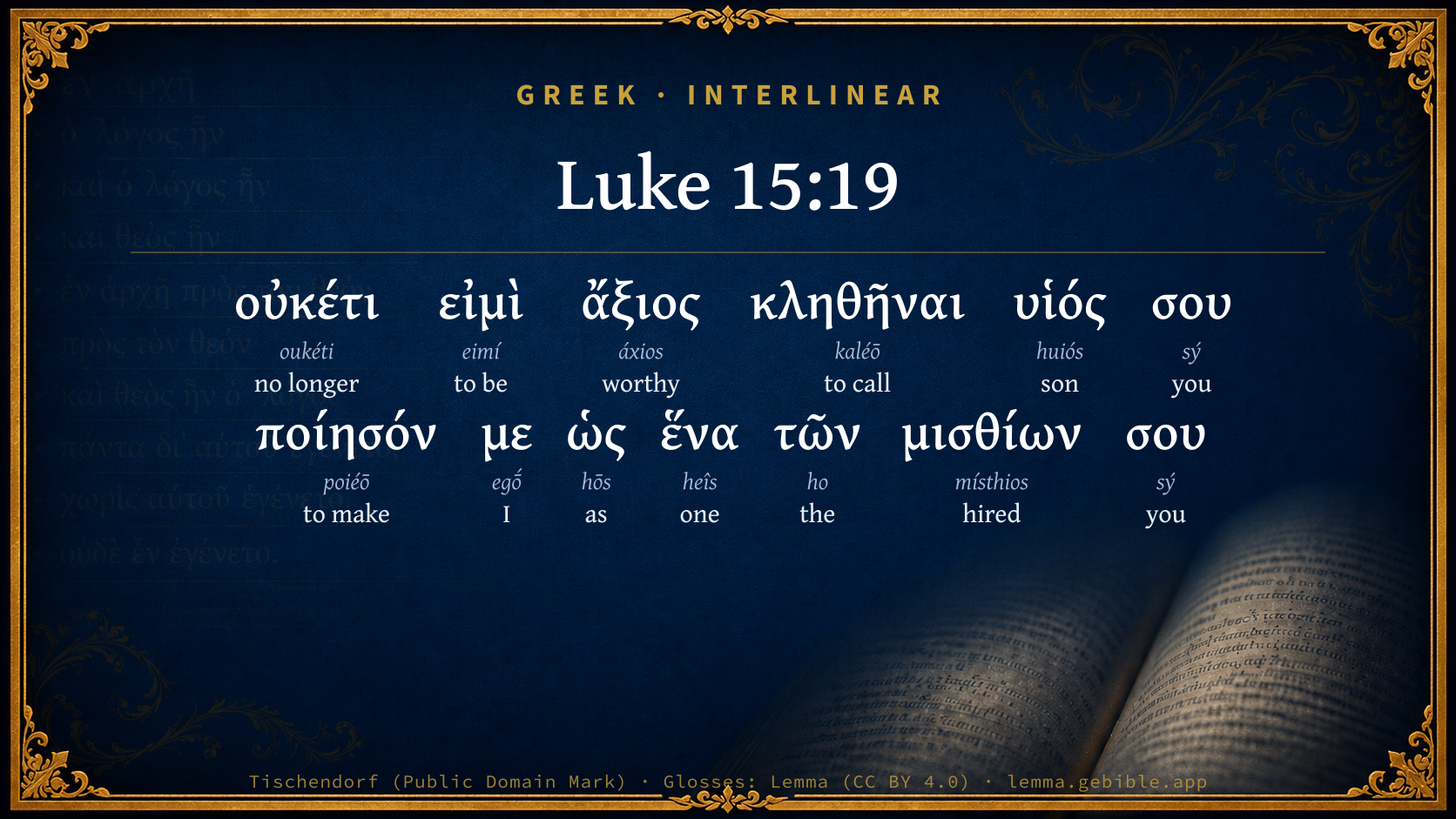
I am no more worthy to be called your son. Make me as one of your hired servants."'
Download a study sheet
One document with this verse’s original text, its word-by-word gloss line, the meaning frame, cross-references with their text, attributed commentary, and full source and license credits — printable, and it pastes into notes with its structure intact.
This verse Autodidact and up
A passage Seminary Student
Up to 50 verses in one chapter. A passage sheet keeps up to 6 commentary sources and 12 cross-references per verse, in the order this page ranks them, and says so on the sheet whenever that leaves anything out. Ask for a single verse and you get the Autodidact verse sheet above.
Everything on this page stays free to read, with no account — the sheet is a download of what is already on screen, not access to it.
Compare translations 3
The same verse in 3 English versions, stacked beneath the original-language interlinear above. Click any original word for its lexicon entry.
Each is an independent rendering of the whole verse — the interlinear is not word-aligned to these translations.
Highlighted words mark where these versions differ — a whole-verse word diff, not a word-by-word alignment.
-
World English Bible Public Domain
I am no more worthy to be called your son. Make me as one of your hired servants."'
-
King James Version Public Domain
And am no more worthy to be called thy son: make me as one of thy hired servants.
-
unfoldingWord Literal Text CC BY-SA 4.0
I am no longer worthy to be called your son; make me as one of your hired servants.”’
unfoldingWord Literal Text — © unfoldingWord, licensed CC BY-SA 4.0. Word-aligned USFM3 via Door43 (git.door43.org/unfoldingWord/en_ult).
Show all 19 translations
Every available English version of this verse, each an independent rendering of the whole verse.
-
World English Bible Public Domain
I am no more worthy to be called your son. Make me as one of your hired servants."'
-
Berean Standard Bible Public Domain
I am no longer worthy to be called your son. Make me like one of your hired servants.”’
-
Majority Standard Bible Public Domain
I am no longer worthy to be called your son. Make me like one of your hired servants.”’
-
King James Version Public Domain
And am no more worthy to be called thy son: make me as one of thy hired servants.
-
American Standard Version (1901) Public Domain
I am no more worthy to be called your son: make me as one of thy hired servants.
-
Revised Version (1885) Public Domain
I am no more worthy to be called thy son: make me as one of thy hired servants.
-
Geneva Bible (1599) Public Domain
And am no more worthy to be called thy sonne: make me as one of thy hired seruants.
-
Douay-Rheims (1899) Public Domain
I am not worthy to be called thy son: make me as one of thy hired servants.
-
Young's Literal Translation Public Domain
and no more am I worthy to be called thy son; make me as one of thy hirelings.
-
Literal Standard Version CC BY-SA 4.0
and I am no longer worthy to be called your son; make me as one of your hired workers.
-
Unlocked Literal Bible CC BY-SA 4.0
I am no longer worthy to be called your son; make me as one of your hired servants.”'
-
unfoldingWord Literal Text CC BY-SA 4.0
I am no longer worthy to be called your son; make me as one of your hired servants.”’
-
Darby Bible Public Domain
I am no longer worthy to be called thy son: make me as one of thy hired servants.
-
World Messianic Bible Public Domain
I am no more worthy to be called your son. Make me as one of your hired servants.”’
-
Webster's Bible Public Domain
And am no more worthy to be called thy son: make me as one of thy hired servants.
-
Free Bible Version CC BY-SA 4.0
I'm no longer worthy to be called your son. Please treat me as one of your hired workers.’
-
Bible in Basic English Public Domain
I am no longer good enough to be named your son: make me like one of your servants.
-
Text-Critical English NT CC BY 4.0
I am no longer worthy to be called yoʋr son; make me like one of yoʋr hired workers.” ’
-
Tyndale New Testament (1534) Public Domain
and am no moare worthy to be called thy sonne make me as one of thy hyred servauntes.
Literal Standard Version (2020), Covenant Press — licensed CC BY-SA 4.0. Text via the HelloAO Bible API (eBible.org). Unlocked Literal Bible (unfoldingWord) — licensed CC BY-SA 4.0. Text via the HelloAO Bible API (eBible.org). unfoldingWord Literal Text — © unfoldingWord, licensed CC BY-SA 4.0. Word-aligned USFM3 via Door43 (git.door43.org/unfoldingWord/en_ult). Free Bible Version, Dr. Jonathan Gallagher — licensed CC BY-SA 4.0. Text via the HelloAO Bible API (eBible.org).
Word by word
More ways to search: Search by grammar → Find every occurrence → Compare this word →
Practice this passage: Drill this verse → Learn its vocabulary →
- Appears 2× in the Greek New Testament
- First appears at Luke 15:17
- Part of Speech
- Adjective
- Case
- Genitive
- Number
- Plural
- Gender
- Masculine
Full Thayer's Definition
- οὐκέτι oukéti G3765 “no longer” Adverb, Negative
- εἰμὶ eimí G1510 “to be” Verb, Present, Active, Indicative, 1st person, Singular
- ἄξιος áxios G514 “worthy” Adjective, Nominative, Singular, Masculine
- κληθῆναι kaléō G2564 “to call” Verb, Aorist, Passive, Infinitive
- υἱός huiós G5207 “son” Noun, Nominative, Singular, Masculine
- σου sý G4771 “you” Personal pronoun, 2nd person, Genitive, Singular
- ποίησόν poiéō G4160 “to make” Verb, Aorist, Active, Imperative, 2nd person, Singular
- με egṓ G1473 “I” Personal pronoun, 1st person, Accusative, Singular
- ὡς hōs G5613 “as” Adverb
- ἕνα heîs G1520 “one” Adjective, Accusative, Singular, Masculine
- τῶν ho G3588 “the” Article, Genitive, Plural, Masculine
- μισθίων místhios G3407 “hired” Adjective, Genitive, Plural, Masculine
- σου sý G4771 “you” Personal pronoun, 2nd person, Genitive, Singular
About this verse
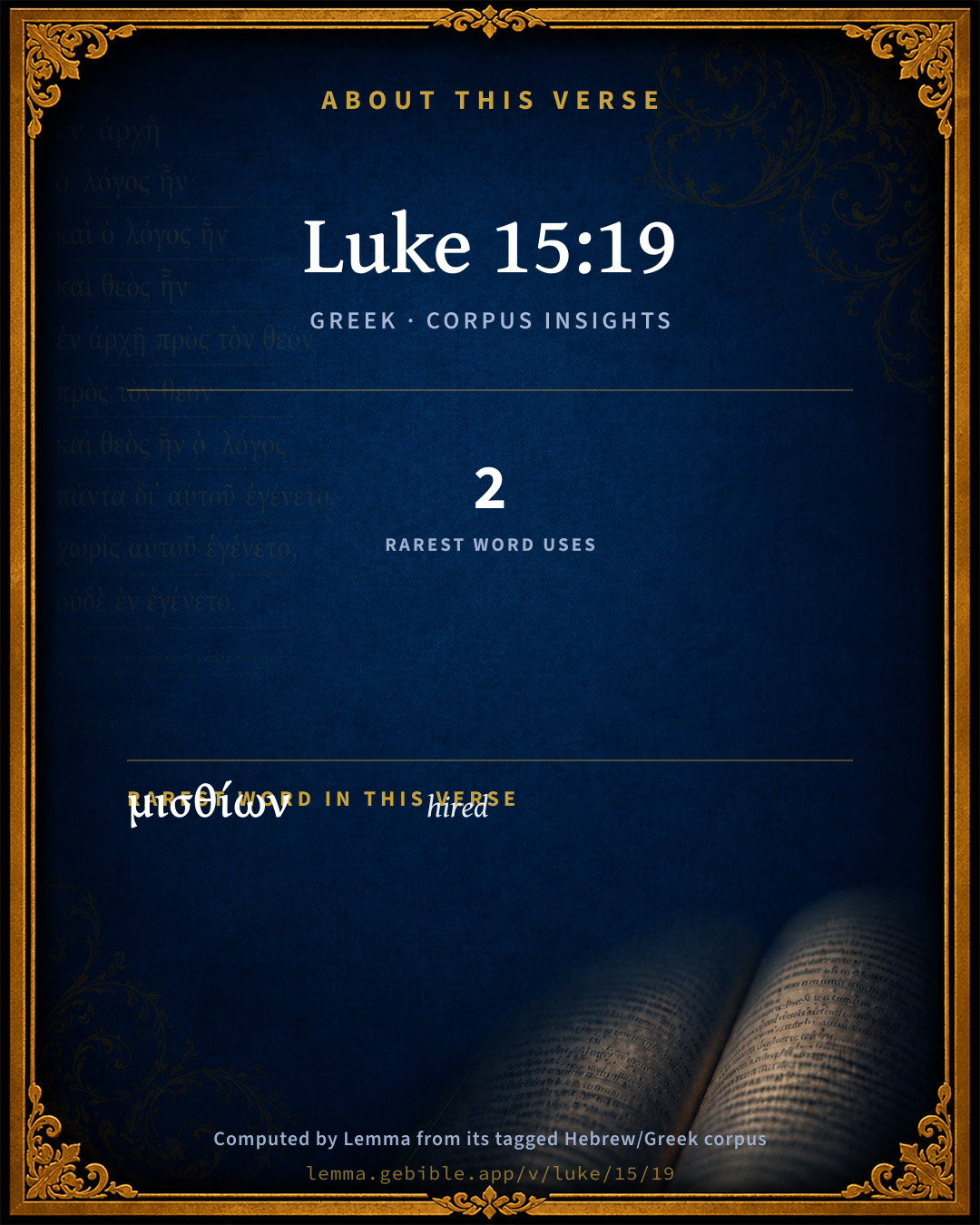
These counts appear in no published source. They are computed here, from the morphology-tagged text and Lemma’s own curated glosses. What Lemma adds →
- 13
- words
- 12
- distinct lemmas
- Gospels
- section
Cross-references
11Topical passages linked to Luke 15:19 in the Treasury of Scripture Knowledge — connected by theme and wording, ordered by reader-vote popularity; previews shown in the World English Bible.
- Job 42:6 Therefore I abhor myself, And repent in dust and ashes."
- Psalms 84:10 For a day in your courts is better than a thousand. I would rather be a doorkeeper in the house of my God, Than to dwell in the tents of wickedness.
- James 4:8–10 Draw near to God, and he will draw near to you. Cleanse your hands, you sinners; and purify your hearts, you double-minded.
- 1 Peter 5:6 Humble yourselves therefore under the mighty hand of God, that he may exalt you in due time;
- Genesis 32:10 I am not worthy of the least of all the loving kindnesses, and of all the truth, which you have shown to your servant; for with just my staff I passed over this Jordan; and now I have become two companies.
- Joshua 9:24–25 They answered Joshua, and said, Because it was certainly told your servants, how that Yahweh your God commanded his servant Moses to give you all the land, and to destroy all the inhabitants of the land from before you; therefore we were sore afraid for our lives because of you, and have done this thing.
- Luke 5:8 But Simon Peter, when he saw it, fell down at Jesus' knees, saying, "Depart from me, for I am a sinful man, Lord."
- Luke 7:6–7 Jesus went with them. When he was now not far from the house, the centurion sent friends to him, saying to him, "Lord, don't trouble yourself, for I am not worthy for you to come under my roof.
- 1 Corinthians 15:9 For I am the least of the apostles, who is not worthy to be called an apostle, because I persecuted the assembly of God.
- Matthew 15:26–27 But he answered, "It is not appropriate to take the children's bread and throw it to the dogs."
- 1 Timothy 1:13–16 although I was before a blasphemer, a persecutor, and insolent. However, I obtained mercy, because I did it ignorantly in unbelief.
Cross-references courtesy of OpenBible.info (CC BY 4.0).
Lesson kit
Teaching starters — assembled from the data on this page, not authored interpretation. Every prompt links to the verse data it draws on. Edit before teaching.
Luke, in the Gospels, opens this verse with 13 words (12 distinct Greek lemmas). Its most distinctive word is místhios (“hired”). A historical commentator’s framing appears above. Read the whole chapter for the surrounding context.
Discussion questions
- The word místhios carries the sense “hired.” How does it shape the verse?
- How does Luke 15:17, which shares the word «hired», read alongside this verse?
- What does the repetition of “you” (2× in this one verse) do in this verse?
- These translations render this verse differently; the difference is in the English rendering, not the original. What questions does that raise?
- Compare how Bengel's Gnomon and John Gill's Exposition read this verse. Where do they agree or differ?
Things to notice
- These translations choose different wording for 3 words in this verse.
- “you” occurs 2× in this single verse.
- 12 distinct Greek lemmas span 13 words in this verse.
Commentary
Notes on Luke 15:19 from classic Christian and Jewish commentators (each source and its license shown beneath its notes). The classic Christian expositions comment on the surrounding passage and are grouped to its opening verse, so a note may address several verses; the Jewish commentaries on the Tanakh (Rashi and others) are per-verse, so they appear only where the commentator wrote on this verse.
Lemma curates 59 commentaries, every one of them public domain or Creative Commons licensed, each selected and text-cleaned for this edition rather than reprinted as found. About our sources →
Bengel's Gnomon
Johann Albrecht Bengel
Bengel's Gnomon of the New Testament — English translation (T&T Clark, Edinburgh, 1860) — public domain. Text from a community e-Sword module.
John Gill's Exposition
John Gill's Exposition of the Whole Bible (1746–1763) — public domain (CC PDM 1.0). Text via the HelloAO Bible API.
Trapp's Complete Commentary
John Trapp
John Trapp, A Commentary or Exposition upon All the Books of the Old and New Testament (1647–1656) — public domain. Text from a community e-Sword module.
Albert Barnes' Notes on the Bible
Albert Barnes' Notes on the Bible (1834–1885) — public domain. Text from a community e-Sword/MySword module.
International Critical Commentary
International Critical Commentary — older volumes (1896–1929), various authors — public domain. Text from a community e-Sword module.