
Mark 3:35

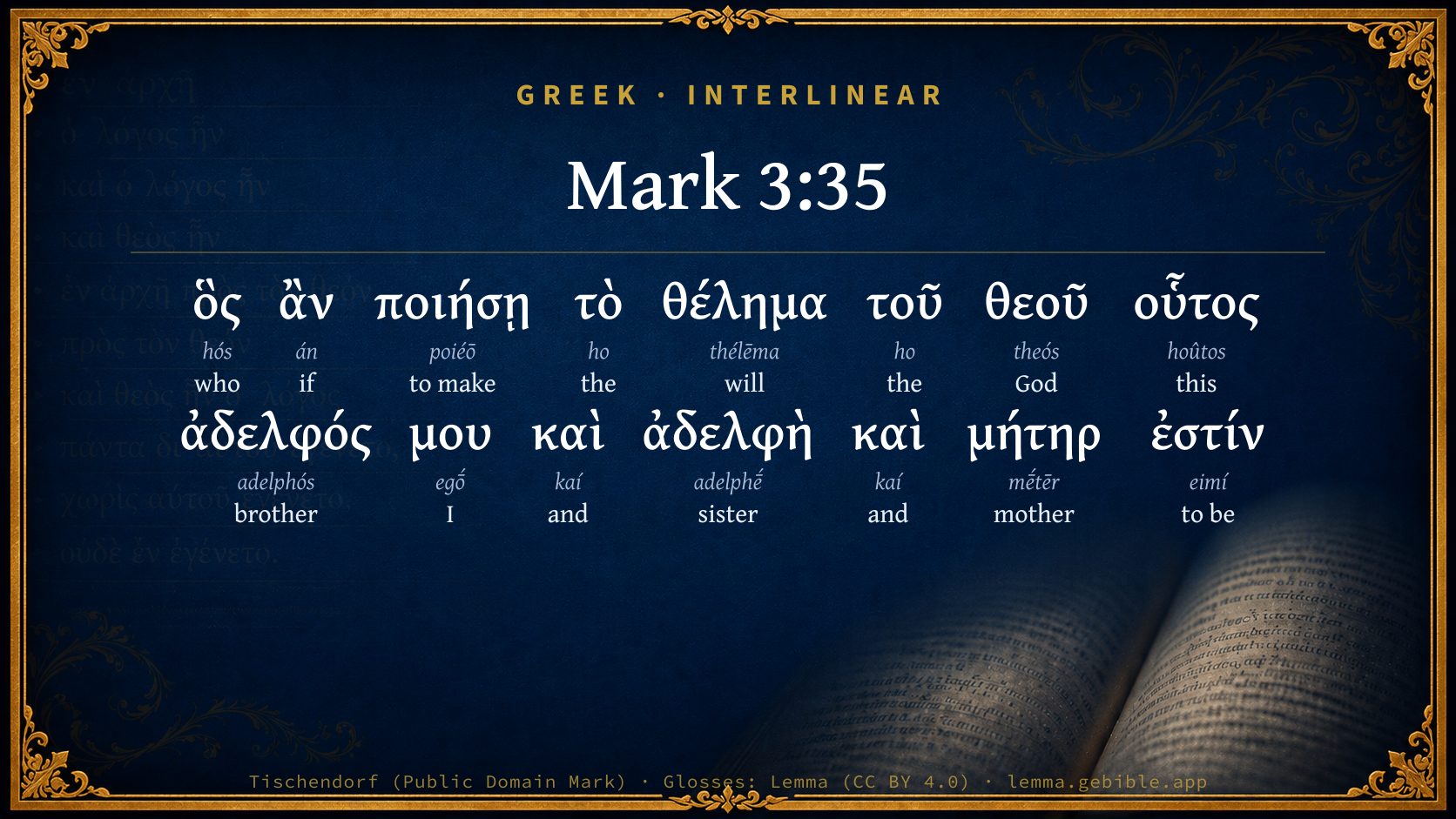
Greek (Tischendorf 8th ed.) Mark 3:35 appears in the Greek New Testament. The text above is from the Tischendorf 8th edition. Each word links to its Strong’s number and a concise gloss. Click any word for its full Thayer’s Greek Lexicon entry.
Download image
Cite this verse

Mark 3:35 (World English Bible). Public Domain. Lemma interlinear Bible study tool, https://lemma.gebible.app/v/mark/3/35.

Show BibTeX & RIS
BibTeX
RIS
English Translation
For whoever does the will of God, the same is my brother, and my sister, and mother."
World English Bible · Public Domain
Download a study sheet

One document with this verse’s original text, its word-by-word gloss line, the meaning frame, cross-references with their text, attributed commentary, and full source and license credits — printable, and it pastes into notes with its structure intact.

This verse Autodidact and up

Study sheet (.html) Plain text (.txt)

A passage Seminary Student

Up to 50 verses in one chapter. A passage sheet keeps up to 6 commentary sources and 12 cross-references per verse, in the order this page ranks them, and says so on the sheet whenever that leaves anything out. Ask for a single verse and you get the Autodidact verse sheet above.

Everything on this page stays free to read, with no account — the sheet is a download of what is already on screen, not access to it.

Want to remove ads? Support Godless Engineer
Compare translations 3

The same verse in 3 English versions, stacked beneath the original-language interlinear above. Click any original word for its lexicon entry.

Each is an independent rendering of the whole verse — the interlinear is not word-aligned to these translations.

Highlighted words mark where these versions differ — a whole-verse word diff, not a word-by-word alignment.

  • World English Bible Public Domain
    For whoever does the will of God, the same is my brother, and my sister, and mother."
  • King James Version Public Domain
    For whosoever shall do the will of God, the same is my brother, and my sister, and mother.
  • unfoldingWord Literal Text CC BY-SA 4.0
    For whoever does the will of God, this is my brother and sister and mother.”

unfoldingWord Literal Text — © unfoldingWord, licensed CC BY-SA 4.0. Word-aligned USFM3 via Door43 (git.door43.org/unfoldingWord/en_ult).

Versions to compare (up to 4)

3 of 4 selected

Show all 19 translations

Every available English version of this verse, each an independent rendering of the whole verse.

  • World English Bible Public Domain
    For whoever does the will of God, the same is my brother, and my sister, and mother."
  • Berean Standard Bible Public Domain
    For whoever does the will of God is My brother and sister and mother.”
  • Majority Standard Bible Public Domain
    For whoever does the will of God is My brother and sister and mother.”
  • King James Version Public Domain
    For whosoever shall do the will of God, the same is my brother, and my sister, and mother.
  • American Standard Version (1901) Public Domain
    For whosoever shall do the will of God, the same is my brother, and sister, and mother.
  • Revised Version (1885) Public Domain
    For whosoever shall do the will of God, the same is my brother, and sister, and mother.
  • Geneva Bible (1599) Public Domain
    For whosoeuer doeth the will of God, he is my brother, and my sister, and mother.
  • Douay-Rheims (1899) Public Domain
    For whosoever shall do the will of God, he is my brother, and my sister, and mother.
  • Young's Literal Translation Public Domain
    for whoever may do the will of God, he is my brother, and my sister, and mother.'
  • Literal Standard Version CC BY-SA 4.0
    For whoever may do the will of God, he is My brother, and My sister, and mother.”
  • Unlocked Literal Bible CC BY-SA 4.0
    For whoever does the will of God, that person is my brother, and sister, and mother.”
  • unfoldingWord Literal Text CC BY-SA 4.0
    For whoever does the will of God, this is my brother and sister and mother.”
  • Darby Bible Public Domain
    for whosoever shall do the will of God, *he* is my brother, and sister, and mother.
  • World Messianic Bible Public Domain
    For whoever does the will of God is my brother, my sister, and mother.”
  • Webster's Bible Public Domain
    For whoever shall do the will of God, the same is my brother, and my sister, and mother.
  • Free Bible Version CC BY-SA 4.0
    Whoever does what God wants, they are my brother, and sister, and mother.”
  • Bible in Basic English Public Domain
    Whoever does God's pleasure, the same is my brother, and sister, and mother.
  • Text-Critical English NT CC BY 4.0
    For whoever does the will of God is my brother and my sister and mother.”
  • Tyndale New Testament (1534) Public Domain
    For who soever doeth the will of God he is my brother my syster and mother.

Literal Standard Version (2020), Covenant Press — licensed CC BY-SA 4.0. Text via the HelloAO Bible API (eBible.org). Unlocked Literal Bible (unfoldingWord) — licensed CC BY-SA 4.0. Text via the HelloAO Bible API (eBible.org). unfoldingWord Literal Text — © unfoldingWord, licensed CC BY-SA 4.0. Word-aligned USFM3 via Door43 (git.door43.org/unfoldingWord/en_ult). Free Bible Version, Dr. Jonathan Gallagher — licensed CC BY-SA 4.0. Text via the HelloAO Bible API (eBible.org).

Word by word

More ways to search: Search by grammar → Find every occurrence → Compare this word →

Practice this passage: Drill this verse → Learn its vocabulary →

ἀδελφὴ
adelphḗ
G79
“sister”
Noun, Nominative, Singular, Feminine
Part of Speech
Noun
Case
Nominative
Number
Singular
Gender
Feminine
Full Thayer's Definition

Origin: from G80

TDNT: 03:24,2

1. a full, own sister 2. one connected by the tie of the Christian religion
  1. ὃς hós G3739 “who” Relative pronoun, Nominative, Singular, Masculine
  2. ἂν án G302 “if” Particle
  3. ποιήσῃ poiéō G4160 “to make” Verb, Aorist, Active, Subjunctive, 3rd person, Singular
  4. τὸ ho G3588 “the” Article, Accusative, Singular, Neuter
  5. θέλημα thélēma G2307 “will” Noun, Accusative, Singular, Neuter
  6. τοῦ ho G3588 “the” Article, Genitive, Singular, Masculine
  7. θεοῦ theós G2316 “God” Noun, Genitive, Singular, Masculine
  8. οὗτος hoûtos G3778 “this” Demonstrative pronoun, Nominative, Singular, Masculine
  9. ἀδελφός adelphós G80 “brother” Noun, Nominative, Singular, Masculine
  10. μου egṓ G1473 “I” Personal pronoun, 1st person, Genitive, Singular
  11. καὶ kaí G2532 “and” Conjunction
  12. καὶ kaí G2532 “and” Conjunction
  13. μήτηρ mḗtēr G3384 “mother” Noun, Nominative, Singular, Feminine
  14. ἐστίν eimí G1510 “to be” Verb, Present, Active, Indicative, 3rd person, Singular

About this verse

These counts appear in no published source. They are computed here, from the morphology-tagged text and Lemma’s own curated glosses. What Lemma adds →

15
words
13
distinct lemmas
Gospels
section

Shared distinctive vocabulary

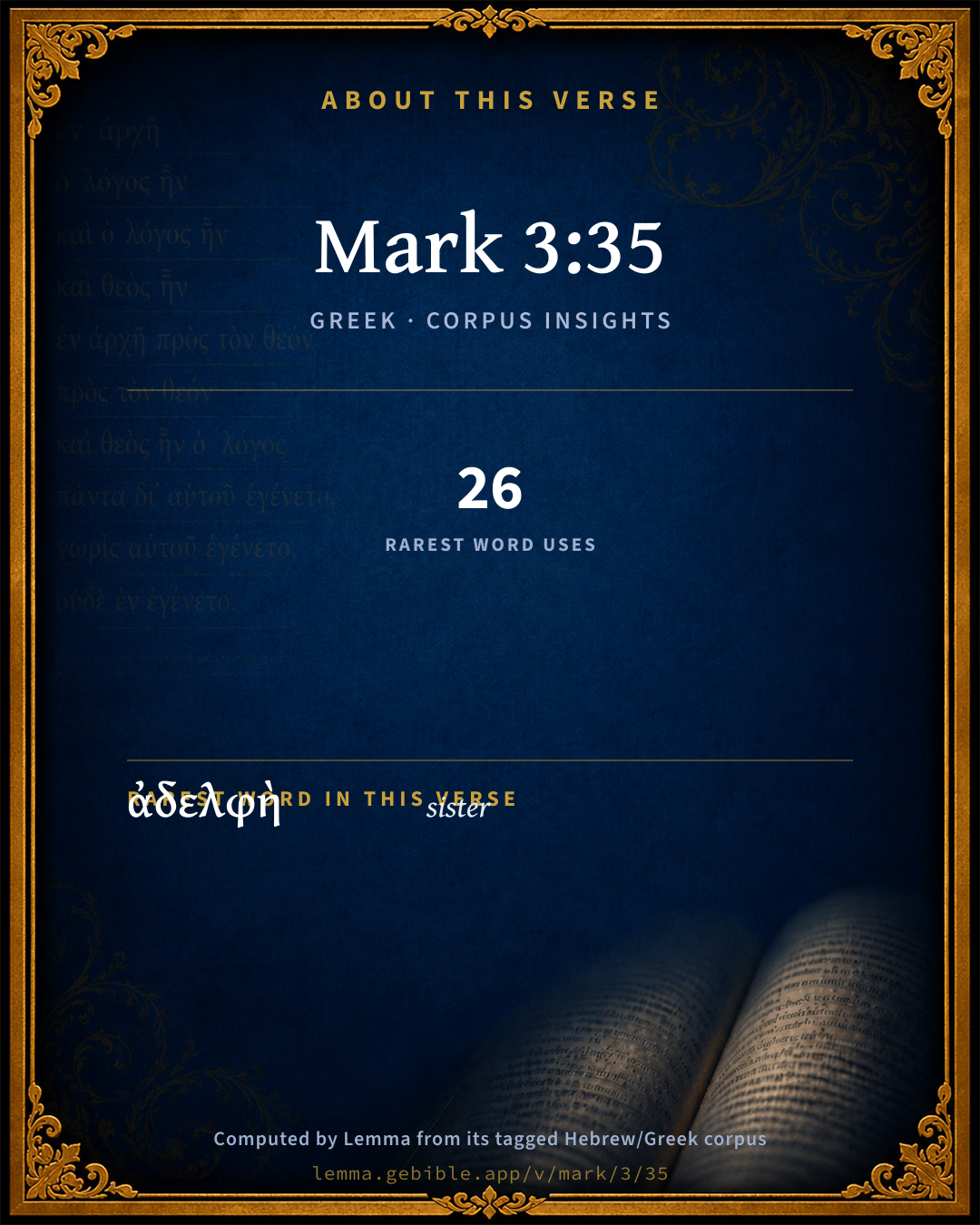
ἀδελφὴ sister G79 occurs in 26 verses of the Greek New Testament. Also found in:
Repetition

Words recur within this verse:

Cross-references

5

Topical passages linked to Mark 3:35 in the Treasury of Scripture Knowledge — connected by theme and wording, ordered by reader-vote popularity; previews shown in the World English Bible.

  • 1 John 2:17 The world is passing away with its lusts, but he who does God's will remains forever.
  • Matthew 7:21 Not everyone who says to me, 'Lord, Lord,' will enter into the Kingdom of Heaven; but he who does the will of my Father who is in heaven.
  • 1 John 3:22–23 and whatever we ask, we receive from him, because we keep his commandments and do the things that are pleasing in his sight.
  • John 7:17 If anyone desires to do his will, he will know about the teaching, whether it is from God, or if I am speaking from myself.
  • James 1:25 But he who looks into the perfect law, the law of freedom, and continues, not being a hearer who forgets but a doer of the work, this man will be blessed in what he does.

Cross-references courtesy of OpenBible.info (CC BY 4.0).

Commentary

Notes on Mark 3:35 from classic Christian and Jewish commentators (each source and its license shown beneath its notes). The classic Christian expositions comment on the surrounding passage and are grouped to its opening verse, so a note may address several verses; the Jewish commentaries on the Tanakh (Rashi and others) are per-verse, so they appear only where the commentator wrote on this verse.

Lemma curates 59 commentaries, every one of them public domain or Creative Commons licensed, each selected and text-cleaned for this edition rather than reprinted as found. About our sources →

MacLaren's Expositions of Holy Scripture

Alexander MacLaren

Mark

THE MISTAKES OF CHRIST’S FOES AND FRIENDS

CHRIST’S KINDRED

CHRIST’S RELATIONS

Mar 3:35.

There was a conspiracy to seize Jesus because He is ‘mad,’ and Mary was in the plot!

I. The example for us.

{1} Of how all natural and human ties and affections are to be subordinated to doing God’s will.

Obedience to Him is the first and main thing to which everything else bows, and which determines everything.

If others compete or interfere, reject them.

Out of that common obedience new ties are formed among men.

{2} Of how all these ties may be doubled in power and preciousness by being based on that obedience.

II. The promise for us.

Of Christ’s loving relationship in which He finds delight; in which He sustains and transcends all these in His own proper person and to each.

Alexander MacLaren, Expositions of Holy Scripture (1904–1910) — public domain. Text from a community e-Sword module.

Tyndale Open Study Notes

Tyndale Open Resources

3:35 Doing God’s will includes repentance from sin, faith in God, and following Jesus (1:15, 18, 20).

Tyndale Open Study Notes — © Tyndale Open Resources, licensed CC BY-SA 4.0. Text via the HelloAO Bible API.

Expositor's Greek Testament

ed. W. Robertson Nicoll

Mar 3:35 . ὃς ἂν , etc.: whosoever shall do the will of God (“of my Father in heaven,” Mt.), definition of true discipleship. ἀδελφός , ἀδελφή , μήτηρ : without the article, because the nouns are used figuratively (Fritzsche). This saying and the mood it expressed would confirm the friends in the belief that Jesus was in a morbid state of mind.

The Expositor's Greek Testament, edited by W. Robertson Nicoll (1897–1910) — public domain. Text from a community e-Sword module.

The Pulpit Commentary

Divine relationships.

I HOW FAR RESEMBLING HUMAN RELATIONSHIPS.

1. In laying down the condition of Divine relationship, Christ does not absolutely displace human relationships. It would have been hard for him so to do, since men were being addressed, and the relationships sustained by them would depend upon the religious sanction they might possess for the measure of honor and faithful observance they would receive. That the terms of human relationship were still employed showed that an analogy at least existed.

2. The terms denoting the distinctions of natural relationships are used in speaking of the heavenly. The "brother "and "sister" and "mother," therefore, express a real distinction in the heavenly family. And there are differences of mutual service and affection which must exist within the common "bond of charity," even as on earth. In the case of those who believe in Christ, then, the beautiful variation which God has created in the affection of the domestic circle will have a use and fitness in fulfilling the duties and realizing the ideal of the Divine life. The latter has its sphere for the sisterliness, the brotherliness, etc., even as the human life; and these are modes through which the Divine love will express itself. Indeed, it may be said that the human affections of father, mother, etc., do not fully manifest or realize themselves in the merely human life; it is the Divine life in which the ideal of each is rendered possible.

II IN WHAT RESPECTS DIFFERING FROM THESE.

1. The affections characteristic of human family will spring from a spiritual principle and express Divine love. "The will of God," or "the will of the Father," will take the place of blind instinct or selfish gratification. Thus springing from a new source they will be transformed, purified, and freed from limitation and defect. "The will of God" will be the law according to which they will express themselves; but as that will has been interpreted as salvation and universal benevolence, so the distinctions of human affection will be brought into play in furthering the redemptive scheme of the Father amongst his sinful children; and through them phases of the Divine love will be realized that would otherwise find no expression. They will thus, also, be universalized and directed into channels of service and helpfulness.

2. The Divine relationship is therefore based upon a new nature. It is only those who are born of the Spirit who can do the will of God. It is the life of the Spirit in them that changes and adapts them for the unselfish affections of the family of God.

3. the Divine relationship is a moral possibility of every one. Every woman may become a sister, a mother, of Christ; event man his brother. M.

The Pulpit Commentary (1880–1919), ed. H.D.M. Spence-Jones & Joseph S. Exell — public domain. Text from a community e-Sword module.

Cambridge Greek Testament for Schools and Colleges

35. γάρ, though strongly attested ([571][572][573][574][575] etc., Latt. Syrr. Arm. Goth.) is the kind of connexion which scribes often insert; [576] b c Memph. omit. [577] has τὰ θελήματα, which is freq. in LXX.

[571] Codex Sinaiticus. 4th cent. Discovered by Tischendorf in 1859 at the Monastery of St Katharine on Mount Sinai. Now at St Petersburg. The whole Gospel, ending at Mar 16:8. Photographic facsimile, 1911.

[572] Codex Alexandrinus. 5th cent. Brought by Cyril Lucar, Patriarch of Constantinople, from Alexandria, and afterwards presented by him to King Charles I. in 1628. In the British Museum. The whole Gospel. Photographic facsimile, 1879.

[573] Codex Ephraemi. 5th cent. A palimpsest: the original writing has been partially rubbed out, and the works of Ephraem the Syrian have been written over it; but a great deal of the original writing has been recovered; of Mark we have Mar 1:17 to Mar 6:31, Mar 8:5 to Mar 12:29, Mar 13:19 to Mar 16:20. In the National Library at Paris.

[574] Codex Bezae. 6th cent. Has a Latin translation (d) side by side with the Greek text, and the two do not quite always agree. Presented by Beza to the University Library of Cambridge in 1581. Remarkable for its frequent divergences from other texts. Contains Mark, except Mar 16:15-20, which has been added by a later hand. Photographic facsimile, 1899.

[575] Codex Regius. 8th cent. An important witness. At Paris. Contains Mar 1:1 to Mar 10:15; Mar 10:30 to Mar 15:1; Mar 15:20 to Mar 16:20, but the shorter ending is inserted between Mar 16:8 and Mar 16:9, showing that the scribe preferred it to the longer one.

[576] Codex Vaticanus. 4th cent., but perhaps a little later than א. In the Vatican Library almost since its foundation by Pope Nicolas V., and one of its greatest treasures. The whole Gospel, ending at Mar 16:8. Photographic facsimile, 1889.

[577] Codex Vaticanus. 4th cent., but perhaps a little later than א. In the Vatican Library almost since its foundation by Pope Nicolas V., and one of its greatest treasures. The whole Gospel, ending at Mar 16:8. Photographic facsimile, 1889.

35. ὃς ἂν ποιήσῃ. See crit. note; the “For” (A.V., R.V.) is probably an interpolation.

τὸ θέλημα τοῦ θεοῦ. Here only in Mk. When used of the Divine Will, τὸ θέλημα in N.T. almost always has a distinguishing gen. See esp. Mat 7:21. Rom 2:18 is hardly an exception, for θεῷ has preceded; and in 1Co 16:12 the context shows that the Divine Will is not the meaning. He Himself was doing the Divine Will in ministering to those whom “He is not ashamed to call brethren” (Heb 2:11; Mat 25:40; Mat 28:10; Joh 20:17).

καὶ ἀδελφή. This is added, because women were present, not because His sisters were outside. He does not say καὶ πατήρ: in spiritual relationship that position could not be approached by human beings; cf. Mat 12:50. Almost certainly Joseph was dead before the Ministry began.

On the insoluble question of “the Brethren of the Lord” two theories are worthy of consideration; (1) that they were the sons of Joseph and Mary, born after the virgin-birth of Christ; (2) that they were the children of Joseph by a former wife, of whom there is no mention in Scripture or in tradition. Any theory which makes Apostles to be brethren of the Lord is excluded by Joh 7:5. Nothing in Scripture forbids us to adopt (1), which is confirmed by Mat 1:25 and by the fact that the brethren here accompany Mary. See J. B. Mayor, Ep. of S. James, pp. v–xxxvi, and his thorough reinvestigation of the subject, Expositor, July and August, 1908; Lightfoot, Galatians, pp. 253–291; D.C.G. artt. “Brethren of the Lord” and “Mary the Virgin.”

Cambridge Greek Testament for Schools and Colleges (Cambridge University Press, 1896; 21 vols, various authors incl. Carr, Maclear, Plummer, Farrar, Lumby, Moule, M. R. James, Simcox) — public domain. Text from a community e-Sword module.

International Critical Commentary

35. τοῦ Θεοῦ—Mat 12:50 says τοῦ πατρός μου τοῦ ἐν οὐρανῷ, which defines more closely the nature and reason of this relation. It is a common relation to the heavenly Father, and not to an earthly father, that is at the basis of the kinship acknowledged by him.Moreover, the relation to God is of the moral kind, shown by doing His will. It is due to a new nature begotten in the man by God, but it shows itself in obedience. Jesus’ own relation to God, making it his meat and drink to do his will, is the uppermost and central thing in his life, and those who share with him this relation come nearest to him. Spiritual kinship surpasses the accidents of birth.

ὃς ἀν ποιήσῃ—whoever does.

Omit γὰρ, for, Tisch. (Treg.) WH. B mss. of Lat. Vet. Memph. γὰρ is an emendation. Omit μου, my, after ἀδελφή Tisch. Treg. WH. RV. א ABDL Δ mss. of Lat. Vet.

The order of Mk. here, connecting this paragraph with the teaching in parables which follows, is also the order of Mt., and the latter marks this as a chronological order by the use of ἔτι αὐτοῦ λαλοῦντος, 12:46, and ἐν τῇ ἐκείνῃ ἡμέρᾳ, 13:1. On the other hand, Luk 11:37 connects this attack of the Pharisees with Jesus’ denunciation of them by another definite chronological mark, ἐν δὲ τῷ λαλῆσαι. And Mt. puts this denunciation among the events of the passion week, and fixes it there by his introductory Τότε. This is a specimen of the disagreement of the Evangelists in their attempts to give chronological sequence to their narratives. Dr. Gardiner, Harmony, p. 70, explains this by the supposition that such expressions as ἔτι αὐτοῦ λαλοῦντος and ἐν τῷ λαλῆσαι may be used by the Evangelist to indicate that an event took place, not necessarily in the midst of that particular discourse, but simply of some discourse or other; that is, while he was talking, instead of walking, or healing or something. This is a good example of the ingenuities and curiosities of harmonizing interpretation. Such use of language by the Evangelists would discredit them equally with the inconsistencies that it is intended to remove.

1 The omission of the art. is probably due to the fact that εἰς συναγωγήν had passed into a phrase, like εἰς οἶκον, or our to church.

Tisch. Tischendorf.

Treg. Tregelles.

WH. Westcott and Hort.

אԠCodex Sinaiticus.

B Codex Vaticanus.

2 Luk 6:6 says the right hand. Dr. Morison contends that this is the reason for the use of the art. But evidently, the art. is insufficient for this discrimination, as the other use, allowing it to apply to either hand, is so much more obvious.

RV. Revised Version.

C Codex Bezae.

L Codex Regius.

Δ̠Codex Sangallensis

33 Codex Regius.

Lat. Vet. Vetus Latina.

Memph. Memphitic.

Harcl. Harclean.

3 On the use of ἔγειρε, see on 2:11.

A Codex Alexandrinus.

D Codex Ephraemi.

4 ἀγαθοποιῆσαι is a Biblical word. εὐεργετεῖν is the Greek word, or εὗ ποιεῖν. κακοποιεῖν is a good Greek word.

1 On the double augment, see Win. 12, 7 a.

marg. Revided Version marg.

E Codex Basiliensis.

M Codex Campianus.

S Codex Vaticanus.

U Codex Nanianus.

V Codex Mosquensis.

Γ̠Codex Tischendorfianus

Vulg. Vulgate.

Syrr. Syriac Versions.

1 συμβούλιον belongs to later Greek.

13 Codex Regius.

28 Codex Regius.

69 Codex Leicestrensis.

G Codex Wolfi A.

F Codex Borelli.

K Codex Cyprius.

Pesh. Peshito.

1 .Codex Basiliensis

1 ὅταν ἐθεώρουν is a rare construction. Generally, ὅταν is used with conditions belonging to the future, or with general conditions belonging to any time, and is construed with the subjunctive. The indefiniteness in the time of past conditions expressed in our -ever is denoted by -ποτε.

2 On this use of ὅτι to introduce direct quotation, see on 1:15.

346 Codex Ambrosianus.

1 See on 1:39.

AV. Authorised Version.

Latt. Latin Versions.

1 See 1:34.

209 An unnamed, valuable manuscript.

1 Where the inf. is used with ὥστε, the N.T. invariably employs the neg. μή, even when the result is stated as a fact. See Win. 55, 2d.

2 See on 2:12.

1 The Heb. is בַּעַל זְבוּל, זְבוּל, being a rabbinical form of זֶבֶל. The whole means god of filth.

1 See on 1:13.

1 ἀνέστη and ἐμερίσθη are aorist, and it preserves the flavor of the original better to translate them as simple pasts, arose, and was divided, instead of perfects.

1 Ἀμήν is the Heb. particle of affirmation from אָמֵן, to be firm, sure. Its proper place is at the end of the sentence, and disconnected with it, like our Amen. This adverbial use of it, placed at the beginning of the sentence, belongs to the report of our Lord’s discourses in the Gospels. Elsewhere in the N.T. it is used after the Heb. fashion.

2 ὅσα is the cognate acc. after βλασφημήσωσιν, and independent of both βλασφημίαι and ἁμαρτήματα. See Col 3:14, where ὃ is used in the same way.

H Codex Wolfi B.

3 See Morison’s singular note.

4 In this use of a preposition after βλασφημήσῃ, there is a return to the earlier construction, for which the N.T. employs the simple acc.

1 Literally, hath not forgiveness forever. The Heb. form of the universal negative, joining the negative with the verb, instead of with the adverb.

2 So Meyer, Weiss, Holtzmann, etc.

1 See v. 20, and especially Luk 8:19.

2 With the acc., περί is used locally, with the gen., of subject matter—around a person or thing, and about a subject.

3 The Greeks used the middle, instead of the pass, of ἀποκρίνω, in the sense of answer. This use is peculiar to N.T. Greek.

International Critical Commentary — older volumes (1896–1929), various authors — public domain. Text from a community e-Sword module.

Lesson kit

Teaching starters — assembled from the data on this page, not authored interpretation. Every prompt links to the verse data it draws on. Edit before teaching.

Mark, in the Gospels, opens this verse with 15 words (13 distinct Greek lemmas). Its most distinctive word is adelphḗ (“sister”). A historical commentator’s framing appears above. Read the whole chapter for the surrounding context.

Discussion questions

  1. How does “sister” (adelphḗ) shape what this verse is saying?
  2. Matthew 12:50 shares the word «sister» with this verse. How do the two illuminate each other?
  3. “the” occurs 2× in this one verse. What is the effect of the repetition?
  4. The translations on this page render this verse differently — a whole-verse word diff, not a word-by-word alignment. What might account for the different wordings?
  5. Reading how MacLaren's Expositions of Holy Scripture and Tyndale Open Study Notes read this verse, where do the two commentators agree and where do they part?

Things to notice

Reading settings

Reading text

Shown beneath each verse's original-language words.

Old Testament
Old Testament edition

Read the OT as the Masoretic Hebrew (MT) or the Greek Septuagint (LXX).

English shown for the Greek Septuagint (in the Hebrew ↔ Greek comparison).

Comparing translations? Open the Compare panel on any verse page to stack up to four side by side.