

Luke 16:9
Greek (Tischendorf 8th ed.) Luke 16:9 appears in the Greek New Testament. The text above is from the Tischendorf 8th edition. Each word links to its Strong’s number and a concise gloss. Click any word for its full Thayer’s Greek Lexicon entry.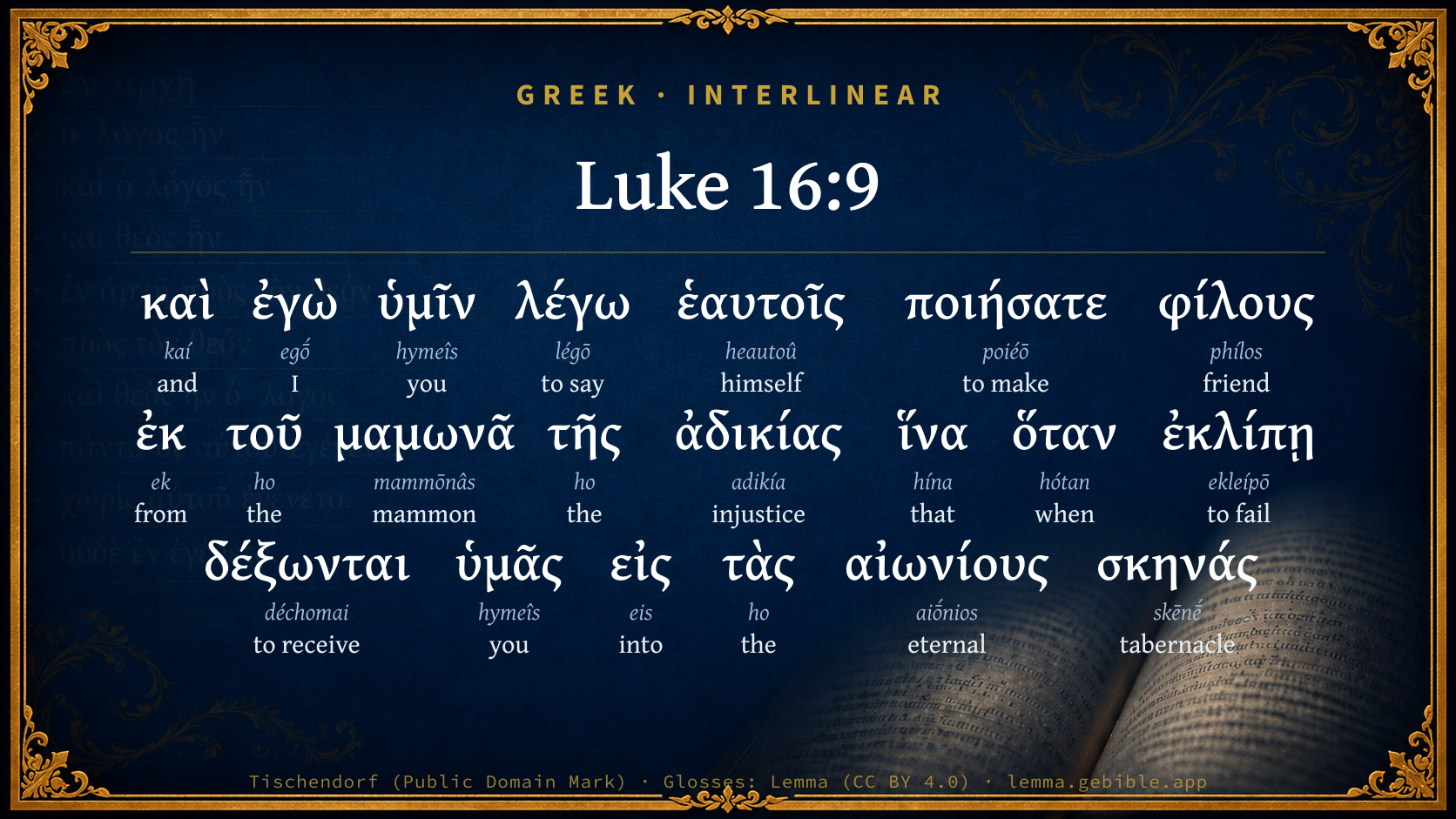
I tell you, make for yourselves friends by means of unrighteous mammon, so that when you fail, they may receive you into the eternal tents.
Download a study sheet
One document with this verse’s original text, its word-by-word gloss line, the meaning frame, cross-references with their text, attributed commentary, and full source and license credits — printable, and it pastes into notes with its structure intact.
This verse Autodidact and up
A passage Seminary Student
Up to 50 verses in one chapter. A passage sheet keeps up to 6 commentary sources and 12 cross-references per verse, in the order this page ranks them, and says so on the sheet whenever that leaves anything out. Ask for a single verse and you get the Autodidact verse sheet above.
Everything on this page stays free to read, with no account — the sheet is a download of what is already on screen, not access to it.
Compare translations 3
The same verse in 3 English versions, stacked beneath the original-language interlinear above. Click any original word for its lexicon entry.
Each is an independent rendering of the whole verse — the interlinear is not word-aligned to these translations.
Highlighted words mark where these versions differ — a whole-verse word diff, not a word-by-word alignment.
-
World English Bible Public Domain
I tell you, make for yourselves friends by means of unrighteous mammon, so that when you fail, they may receive you into the eternal tents.
-
King James Version Public Domain
And I say unto you, Make to yourselves friends of the mammon of unrighteousness; that, when ye fail, they may receive you into everlasting habitations.
-
unfoldingWord Literal Text CC BY-SA 4.0
And I say to you, make friends for yourselves by means of unrighteous wealth, so that when it fails, they may welcome you into the eternal dwellings.
unfoldingWord Literal Text — © unfoldingWord, licensed CC BY-SA 4.0. Word-aligned USFM3 via Door43 (git.door43.org/unfoldingWord/en_ult).
Show all 19 translations
Every available English version of this verse, each an independent rendering of the whole verse.
-
World English Bible Public Domain
I tell you, make for yourselves friends by means of unrighteous mammon, so that when you fail, they may receive you into the eternal tents.
-
Berean Standard Bible Public Domain
I tell you, use worldly wealth to make friends for yourselves, so that when it is gone, they will welcome you into eternal dwellings.
-
Majority Standard Bible Public Domain
I tell you, use worldly wealth to make friends for yourselves so that when you fail, they will welcome you into eternal dwellings.
-
King James Version Public Domain
And I say unto you, Make to yourselves friends of the mammon of unrighteousness; that, when ye fail, they may receive you into everlasting habitations.
-
American Standard Version (1901) Public Domain
And I say unto you, Make to yourselves friends by means of the mammon of unrighteousness; that, when it shall fail, they may receive you into the eternal tabernacles.
-
Revised Version (1885) Public Domain
And I say unto you, Make to yourselves friends by means of the mammon of unrighteousness; that, when it shall fail, they may receive you into the eternal tabernacles.
-
Geneva Bible (1599) Public Domain
And I say vnto you, Make you friends with the riches of iniquitie, that when ye shall want, they may receiue you into euerlasting habitations.
-
Douay-Rheims (1899) Public Domain
And I say to you: Make unto you friends of the mammon of iniquity; that when you shall fail, they may receive you into everlasting dwellings.
-
Young's Literal Translation Public Domain
and I say to you, Make to yourselves friends out of the mammon of unrighteousness, that when ye may fail, they may receive you to the age-during tabernacles.
-
Literal Standard Version CC BY-SA 4.0
And I say to you, make to yourselves friends out of the wealth of unrighteousness, that when you may fail, they may receive you into the continuous dwelling places.
-
Unlocked Literal Bible CC BY-SA 4.0
I say to you, make friends for yourselves by means of unrighteous wealth, so that when it is gone, they may welcome you into the eternal dwellings.
-
unfoldingWord Literal Text CC BY-SA 4.0
And I say to you, make friends for yourselves by means of unrighteous wealth, so that when it fails, they may welcome you into the eternal dwellings.
-
Darby Bible Public Domain
And *I* say to you, Make to yourselves friends with the mammon of unrighteousness, that when it fails ye may be received into the eternal tabernacles.
-
World Messianic Bible Public Domain
I tell you, make for yourselves friends by means of unrighteous mammon, so that when you fail, they may receive you into the eternal tents.
-
Webster's Bible Public Domain
And I say to you, Make to yourselves friends of the mammon of unrighteousness; that when ye fail, they may receive you into everlasting habitations.
-
Free Bible Version CC BY-SA 4.0
I tell you, use the wealth of this world to make friends for yourselves so that when it's gone, you'll be welcomed into an eternal home.
-
Bible in Basic English Public Domain
And I say to you, Make friends for yourselves through the wealth of this life, so that when it comes to an end, you may be taken into the eternal resting-places.
-
Text-Critical English NT CC BY 4.0
And I tell you, make friends for yourselves by means of unrighteous wealth so that when you die, those friends will receive you into eternal dwellings.
-
Tyndale New Testament (1534) Public Domain
And I saye also vnto you: make you frendes of the wicked mammon that when ye shall departe they may receave you into everlastinge habitacions.
Literal Standard Version (2020), Covenant Press — licensed CC BY-SA 4.0. Text via the HelloAO Bible API (eBible.org). Unlocked Literal Bible (unfoldingWord) — licensed CC BY-SA 4.0. Text via the HelloAO Bible API (eBible.org). unfoldingWord Literal Text — © unfoldingWord, licensed CC BY-SA 4.0. Word-aligned USFM3 via Door43 (git.door43.org/unfoldingWord/en_ult). Free Bible Version, Dr. Jonathan Gallagher — licensed CC BY-SA 4.0. Text via the HelloAO Bible API (eBible.org).
Word by word
More ways to search: Search by grammar → Find every occurrence → Compare this word →
Practice this passage: Drill this verse → Learn its vocabulary →
- Appears 4× in the Greek New Testament
- First appears at Matthew 6:24
- Part of Speech
- Noun
- Case
- Genitive
- Number
- Singular
- Gender
- Masculine
Full Thayer's Definition
- καὶ kaí G2532 “and” Conjunction
- ἐγὼ egṓ G1473 “I” Personal pronoun, 1st person, Nominative, Singular
- ὑμῖν hymeîs G5210 “you” Personal pronoun, 2nd person, Dative, Plural
- λέγω légō G3004 “to say” Verb, Present, Active, Indicative, 1st person, Singular
- ἑαυτοῖς heautoû G1438 “himself” Reflexive pronoun, 2nd person, Dative, Plural, Masculine
- ποιήσατε poiéō G4160 “to make” Verb, Aorist, Active, Imperative, 2nd person, Plural
- φίλους phílos G5384 “friend” Adjective, Accusative, Plural, Masculine
- ἐκ ek G1537 “from” Preposition
- τοῦ ho G3588 “the” Article, Genitive, Singular, Masculine
- μαμωνᾶ mammōnâs G3126 “mammon” Noun, Genitive, Singular, Masculine
- τῆς ho G3588 “the” Article, Genitive, Singular, Feminine
- ἀδικίας adikía G93 “injustice” Noun, Genitive, Singular, Feminine
- ἵνα hína G2443 “that” Conjunction
- ὅταν hótan G3752 “when” Conjunction
- ἐκλίπῃ ekleípō G1587 “to fail” Verb, Aorist, Active, Subjunctive, 3rd person, Singular
- δέξωνται déchomai G1209 “to receive” Verb, Aorist, Middle deponent, Subjunctive, 3rd person, Plural
- ὑμᾶς hymeîs G5210 “you” Personal pronoun, 2nd person, Accusative, Plural
- εἰς eis G1519 “into” Preposition
- τὰς ho G3588 “the” Article, Accusative, Plural, Feminine
- αἰωνίους aiṓnios G166 “eternal” Adjective, Accusative, Plural, Feminine
- σκηνάς skēnḗ G4633 “tabernacle” Noun, Accusative, Plural, Feminine
About this verse
These counts appear in no published source. They are computed here, from the morphology-tagged text and Lemma’s own curated glosses. What Lemma adds →
- 21
- words
- 18
- distinct lemmas
- Gospels
- section
Notable vocabulary
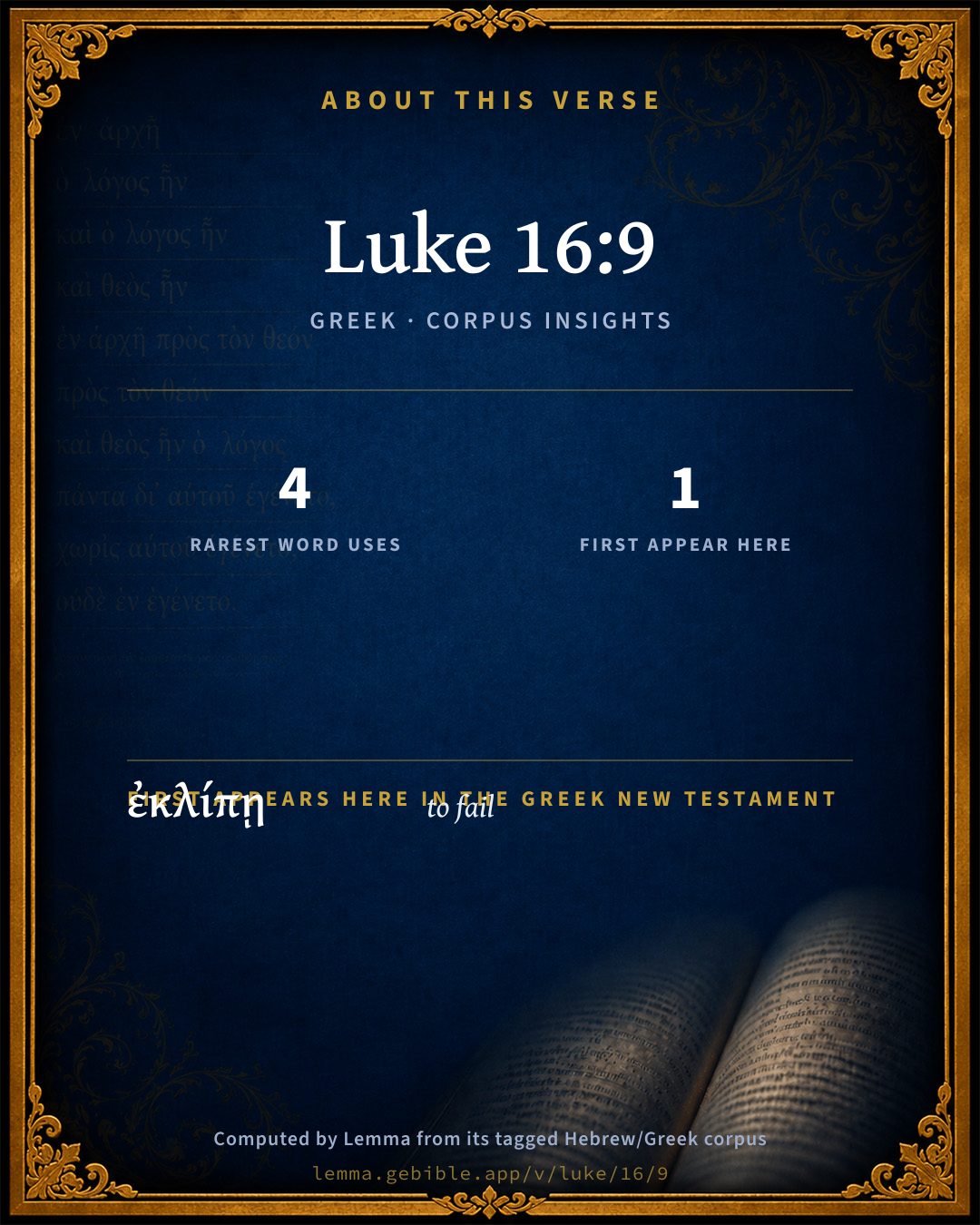
The rarest word here is μαμωνᾶ mammon G3126 — appearing just 4 times in the whole Greek New Testament.
First appearance in Scripture
This word makes its first canonical appearance in the Greek New Testament here:
- ἐκλίπῃ to fail G1587
Shared distinctive vocabulary
μαμωνᾶ mammon G3126 occurs in 4 verses of the Greek New Testament. Also found in:
Cross-references
25Topical passages linked to Luke 16:9 in the Treasury of Scripture Knowledge — connected by theme and wording, ordered by reader-vote popularity; previews shown in the World English Bible.
- Matthew 19:21 Jesus said to him, "If you want to be perfect, go, sell what you have, and give to the poor, and you will have treasure in heaven; and come, follow me."
- 1 Timothy 6:17–19 Charge those who are rich in this present world that they not be haughty, nor have their hope set on the uncertainty of riches, but on the living God, who richly provides us with everything to enjoy;
- Daniel 4:27 Therefore, O king, let my counsel be acceptable to you, and break off your sins by righteousness, and your iniquities by showing mercy to the poor; if there may be a lengthening of your tranquillity.
- Matthew 6:24 "No one can serve two masters, for either he will hate the one and love the other; or else he will be devoted to one and despise the other. You can't serve both God and Mammon.
- Proverbs 19:17 He who has pity on the poor lends to Yahweh; He will reward him.
- Luke 14:14 and you will be blessed, because they don't have the resources to repay you. For you will be repaid in the resurrection of the righteous."
- Luke 16:11 If therefore you have not been faithful in the unrighteous mammon, who will commit to your trust the true riches?
- Luke 12:33 Sell that which you have, and give gifts to the needy. Make for yourselves purses which don't grow old, a treasure in the heavens that doesn't fail, where no thief approaches, neither moth destroys.
- Isaiah 58:7–8 Isn't it to deal your bread to the hungry, and that you bring the poor who are cast out to your house? when you see the naked, that you cover him; and that you not hide yourself from your own flesh?
- 1 Timothy 6:9–10 But those who are determined to be rich fall into a temptation and a snare and many foolish and harmful lusts, such as drown men in ruin and destruction.
- Luke 11:41 But give for gifts to the needy those things which are within, and behold, all things will be clean to you.
- Luke 16:13 No servant can serve two masters, for either he will hate the one, and love the other; or else he will hold to one, and despise the other. You aren't able to serve God and mammon."
- Acts 10:31 and said, 'Cornelius, your prayer is heard, and your gifts to the needy are remembered in the sight of God.
- 2 Corinthians 4:17–5:1 For our light affliction, which is for the moment, works for us more and more exceedingly an eternal weight of glory;
- 2 Timothy 1:16–18 May the Lord grant mercy to the house of Onesiphorus, for he often refreshed me, and was not ashamed of my chain,
- Ecclesiastes 12:3–7 In the day when the keepers of the house shall tremble, And the strong men shall bow themselves, And the grinders cease because they are few, And those who look out of the windows are darkened,
- Matthew 6:19 "Don't lay up treasures for yourselves on the earth, where moth and rust consume, and where thieves break through and steal;
- 2 Corinthians 9:12–15 For this service of giving that you perform not only makes up for lack among the saints, but abounds also through many givings of thanks to God;
- Proverbs 23:5 Why do you set your eyes on that which is not? For it certainly sprouts wings like an eagle and flies in the sky.
- Ecclesiastes 11:1 Cast your bread on the waters; For you shall find it after many days.
- Matthew 25:35–40 for I was hungry, and you gave me food to eat; I was thirsty, and you gave me drink; I was a stranger, and you took me in;
- Acts 10:4 He, fastening his eyes on him, and being frightened, said, "What is it, Lord?" He said to him, "Your prayers and your gifts to the needy have gone up for a memorial before God.
- Jude 1:21 Keep yourselves in the love of God, looking for the mercy of our Lord Jesus Christ to eternal life.
- Psalms 73:26 My flesh and my heart fails, But God is the strength of my heart and my portion forever.
- Isaiah 57:16 For I will not contend forever, neither will I be always angry; for the spirit would faint before me, and the souls who I have made.
Cross-references courtesy of OpenBible.info (CC BY 4.0).
Where the printed editions differ
1 variantPlaces in this verse where the major printed Greek editions disagree on the wording in a way that affects the translation — a comparison of editions, not a manuscript-by-manuscript collation. The editions are the modern critical texts (Nestlé-Aland 28/27, SBL, Westcott-Hort, Tregelles, Tyndale House) and the traditional texts behind the KJV (the Textus Receptus and the Byzantine/Majority text). It is not a claim about which reading is original.
-
Different wording
ἐκλίπῃ
“it may fail”
In NA28NA27TynSBLWHTreg Not in TRByzἐκλίπητε (eklipēte) 'you may fail' occurs in traditional manuscripts (TR+Byz) instead of ἐκλίπῃ (eklipē) 'it may fail' in older manuscripts (NA28+NA27+Tyn+SBL+WH+Treg)
Textual data: Translators Amalgamated Greek New Testament (STEPBible TAGNT) · CC BY 4.0.
Lesson kit
Teaching starters — assembled from the data on this page, not authored interpretation. Every prompt links to the verse data it draws on. Edit before teaching.
Luke, in the Gospels, opens this verse with 21 words (18 distinct Greek lemmas). Its most distinctive word is mammōnâs (“mammon”). A historical commentator’s framing appears above. Read the whole chapter for the surrounding context.
Discussion questions
- How does “mammon” (mammōnâs) shape what this verse is saying?
- This is the first place “to fail” appears in Scripture (first appears here). What does its debut here establish?
- How does Matthew 6:24, which shares the word «mammon», read alongside this verse?
- What does the repetition of “the” (3× in this one verse) do in this verse?
- The translations on this page render this verse differently — a whole-verse word diff, not a word-by-word alignment. What might account for the different wordings?
- Compare how The Biblical Illustrator and Tyndale Open Study Notes read this verse. Where do they agree or differ?
Things to notice
- 1 word makes its first canonical appearance in Scripture here.
- These translations choose different wording for 16 words in this verse.
- “the” occurs 3× in this single verse.
- 18 distinct Greek lemmas span 21 words in this verse.
Commentary
Notes on Luke 16:9 from classic Christian and Jewish commentators (each source and its license shown beneath its notes). The classic Christian expositions comment on the surrounding passage and are grouped to its opening verse, so a note may address several verses; the Jewish commentaries on the Tanakh (Rashi and others) are per-verse, so they appear only where the commentator wrote on this verse.
Lemma curates 59 commentaries, every one of them public domain or Creative Commons licensed, each selected and text-cleaned for this edition rather than reprinted as found. About our sources →
The Biblical Illustrator
Joseph S. Exell
The Biblical Illustrator, edited by Joseph S. Exell (c. 1880s–1900s) — public domain. Text from a community e-Sword module.
Tyndale Open Study Notes
Tyndale Open Resources
Tyndale Open Study Notes — © Tyndale Open Resources, licensed CC BY-SA 4.0. Text via the HelloAO Bible API.
Bengel's Gnomon
Johann Albrecht Bengel
Bengel's Gnomon of the New Testament — English translation (T&T Clark, Edinburgh, 1860) — public domain. Text from a community e-Sword module.
Meyer's Critical & Exegetical Commentary
Heinrich August Wilhelm Meyer
Meyer — Critical and Exegetical Commentary on the New Testament — English translation by Peter Christie, edited by Frederick Crombie (T&T Clark, 1880) — public domain. Text from a community e-Sword module.
Expositor's Greek Testament
ed. W. Robertson Nicoll
The Expositor's Greek Testament, edited by W. Robertson Nicoll (1897–1910) — public domain. Text from a community e-Sword module.
Geneva Bible (1599)
Geneva Bible translators
Geneva Bible (1599) marginal notes — public domain. Text via Bolls.life.
Jamieson, Fausset & Brown
Robert Jamieson, A. R. Fausset & David Brown
Jamieson, Fausset & Brown — Commentary Critical and Explanatory on the Whole Bible (1871) — public domain (CC PDM 1.0). Text via the HelloAO Bible API.
Adam Clarke's Commentary
Adam Clarke's Commentary on the Bible (1810–1826) — public domain. Text from a community e-Sword/MySword module.
Ellicott's Commentary for English Readers
A Bible Commentary for English Readers, edited by Charles John Ellicott (1878–1897) — public domain. Text from a community e-Sword module.
The Cambridge Bible for Schools and Colleges
gen. ed. J. J. S. Perowne
The Cambridge Bible for Schools and Colleges (gen. ed. J. J. S. Perowne; Cambridge University Press, 1878–1918) — public domain. Text from a community e-Sword module.
John Gill's Exposition
John Gill's Exposition of the Whole Bible (1746–1763) — public domain (CC PDM 1.0). Text via the HelloAO Bible API.
Trapp's Complete Commentary
John Trapp
John Trapp, A Commentary or Exposition upon All the Books of the Old and New Testament (1647–1656) — public domain. Text from a community e-Sword module.
Albert Barnes' Notes on the Bible
Albert Barnes' Notes on the Bible (1834–1885) — public domain. Text from a community e-Sword/MySword module.
Haydock's Catholic Bible Commentary
George Leo Haydock (1774–1849), Haydock's Catholic Family Bible and Commentary, 1859 edition — public domain. Excludes Psalms (Douay-Rheims chapter numbering differs from Protestant) and Deuterocanonical books (Catholic canon only).
Matthew Poole's English Annotations
Matthew Poole's English Annotations on the Holy Bible (1683–1685) — public domain. Text from a community e-Sword/MySword module.
Whedon's Commentary on the Bible
Daniel D. Whedon
Daniel D. Whedon (gen. ed.), Commentary on the Old and New Testaments (1874–1909) — public domain. Text from a community e-Sword module.
The Pulpit Commentary
The Pulpit Commentary (1880–1919), ed. H.D.M. Spence-Jones & Joseph S. Exell — public domain. Text from a community e-Sword module.
John Wesley's Explanatory Notes
John Wesley, Explanatory Notes Upon the Whole Bible (1754–1765) — public domain. Text via the GEBible commentary corpus.
Kretzmann's Popular Commentary
Paul E. Kretzmann
Paul E. Kretzmann, Popular Commentary of the Bible (1921–1924) — public domain. Text from a community e-Sword module.
Burkitt's Expository Notes on the New Testament
William Burkitt
William Burkitt's Expository Notes on the New Testament (1700–1703) — public domain. Text from a community e-Sword module.
The People's New Testament
B. W. Johnson
B. W. Johnson's The People's New Testament with Notes (1889–1891) — public domain. Electronic text from the Christian Classics Ethereal Library (CCEL) ThML edition.
Cambridge Greek Testament for Schools and Colleges
Cambridge Greek Testament for Schools and Colleges (Cambridge University Press, 1896; 21 vols, various authors incl. Carr, Maclear, Plummer, Farrar, Lumby, Moule, M. R. James, Simcox) — public domain. Text from a community e-Sword module.
Alford’s Greek Testament
Henry Alford
Henry Alford, The Greek Testament (1849–1861) — public domain. Text from a community e-Sword module.
International Critical Commentary
International Critical Commentary — older volumes (1896–1929), various authors — public domain. Text from a community e-Sword module.
Vincent's Word Studies in the New Testament
Marvin R. Vincent
Marvin R. Vincent, Word Studies in the New Testament (1887–1900) — public domain. Text from a community e-Sword/MySword module.